




Abstract
This study is part of an investigation of the chemotherapeutic activity of organometallic compounds as affected by chemical combination with dithiols.
War research has brought out the fact that BAL (British Anti Lewisite, 2,3-dimercaptopropanol) protects man and experimental animals against the toxic effect of organic arsenicals, including 4-arsenoso-2-aminophenol (I), i.e., oxophenarsine U.S.P., and counteracts in vitro the trypanocidal effect of this drug. 1 , 3
The limited information published to date (February 18, 1947) suggests that the compound resulting from the condensation of I with BAL, i.e., 2-amino-4-[methylol-(ethylenedimercaptoarsino)]-phenol (II) would be significantly less toxic than its parent substance (I), but devoid of chemotherapeutic activity.
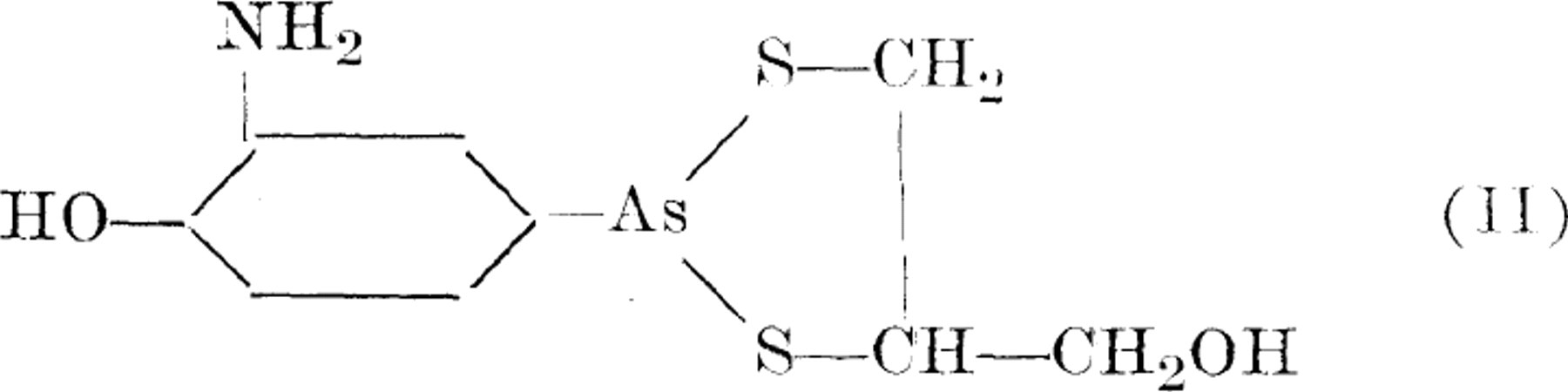
With a view to evaluating this proposition, we have synthesized (II) and tested in vivo its trypanocidal and spirochetocidal activity.
(II) crystallizes from methanol as white needles, soluble in propylene glycol and dilute hydrochloric acid, insoluble in water and anhydrous acetone. It gives a negative nitroprusside reaction at pH 8, positive at 10.
(II) forms a crystalline hydrochloride (III), soluble in water, ethanol and propylene glycol, insoluble in anhydrous acetone.
The free base (II), and more so its hydrochloride (III), are quite stable. Propylene glycol solutions of the hydrochloride may be sterilized by heating for one hour at 100°.
(III) cures the experimental T. equiperdum infection of the mouse with a single intraperitoneal dose of 0.02 g/kg, while the maximum tolerated dose, intraperitoneally, was found to be 0.12 g/kg, corresponding to a therapeutic index of 6. The immediate spirochetocidal effect of (II) was screened in rabbit syphilis: 16 animals with fully developed, dark-field positive chancres were treated with a single subcutaneous injection of (II) dissolved in propylene glycol in doses ranging from 2.5-40 mg (.0OO8-.013 g/kg). In all animals treated with doses equal to or greater than .006/kg the spirochetes were not demonstrable 5 days after the treatment. As to toxicity, a single intramuscular dose of .05 g/kg is well tolerated while .08 g/kg is lethal.
Get full access to this article
View all access options for this article.