




Abstract
The estimation of the area of the human cerebrum has become a matter of considerable interest since the mass of the cerebral cortex is closely related to the surface area of the brain.
This subject has been investigated by a quantitative study of 20 brains ranging in age from the fourth (lunar) month of prenatal life to the close of the fifth decade and in volume from about 5 cc. to over 1000 cc. The method of measuring surface area is described in other papers 1 , 2 and the volume was determined by the displacement method. Various indices of the relation of cerebral volume to surface are shown in Table I and in Fig. 1. In both the table and the figure the observations are arranged in order of cerebral volume.
Column (b) of the table and panel (A) of Fig. 1 show the index of “total” surface area divided by cerebral volume (surface in sq. cm., volume in cc.). The index drops slowly at first, until the cerebrum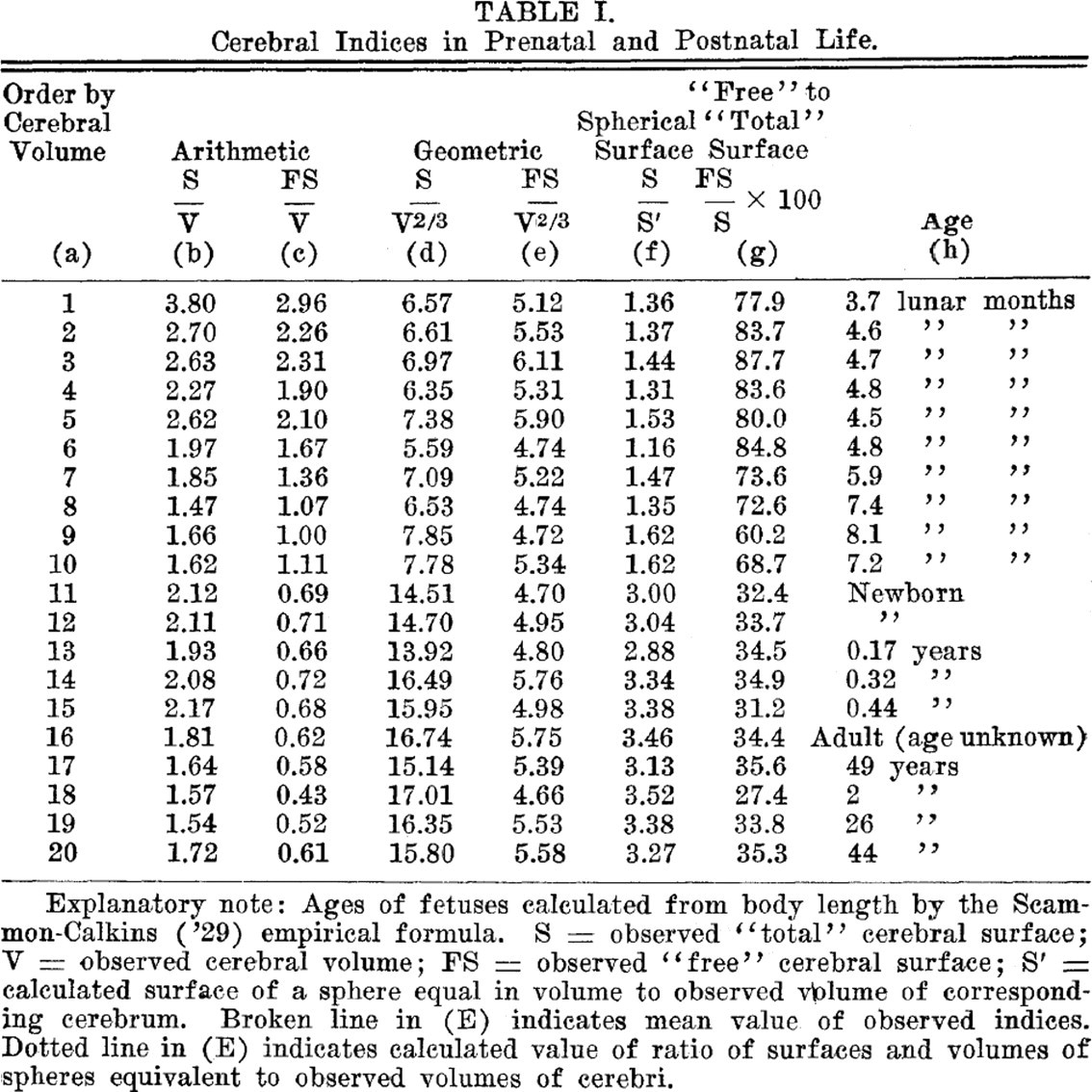 has a volume of nearly 100 cc. (in the eighth lunar month), and shows practically no regular trend of change thereafter.
A better index is the “total” surface of the cerebrum divided by the two-thirds power of the cerebral volume, for this measure considers the factor of dimensionality. The index thus determined [Table I, column (d), Fig. 1, panel (B)] shows no prominent change until the cerebrum attains a volume of nearly 100 cc. (in the eighth fetal or lunar month) and rises abruptly to a new plateau at a period (just before birth) when there is relatively little increase in volume, and thereafter shows little significant change. There could hardly be a better demonstration of the great relative increase in cerebral surface area by fissuration in later fetal life.
Get full access to this article
View all access options for this article.