




Abstract
Okada
1
called attention to the marked acidification of the bile during its concentration in the gall bladder. However, the mechanism by which this acidification takes place has never been completely elucidated. Ravdin
2
studied the question and found that dog's liver bile had a pH of 7.1 or even higher and attributed the acidification in the gall bladder to some unknown anion. This present study has consisted of parallel analyses of the gall bladder and liver bile 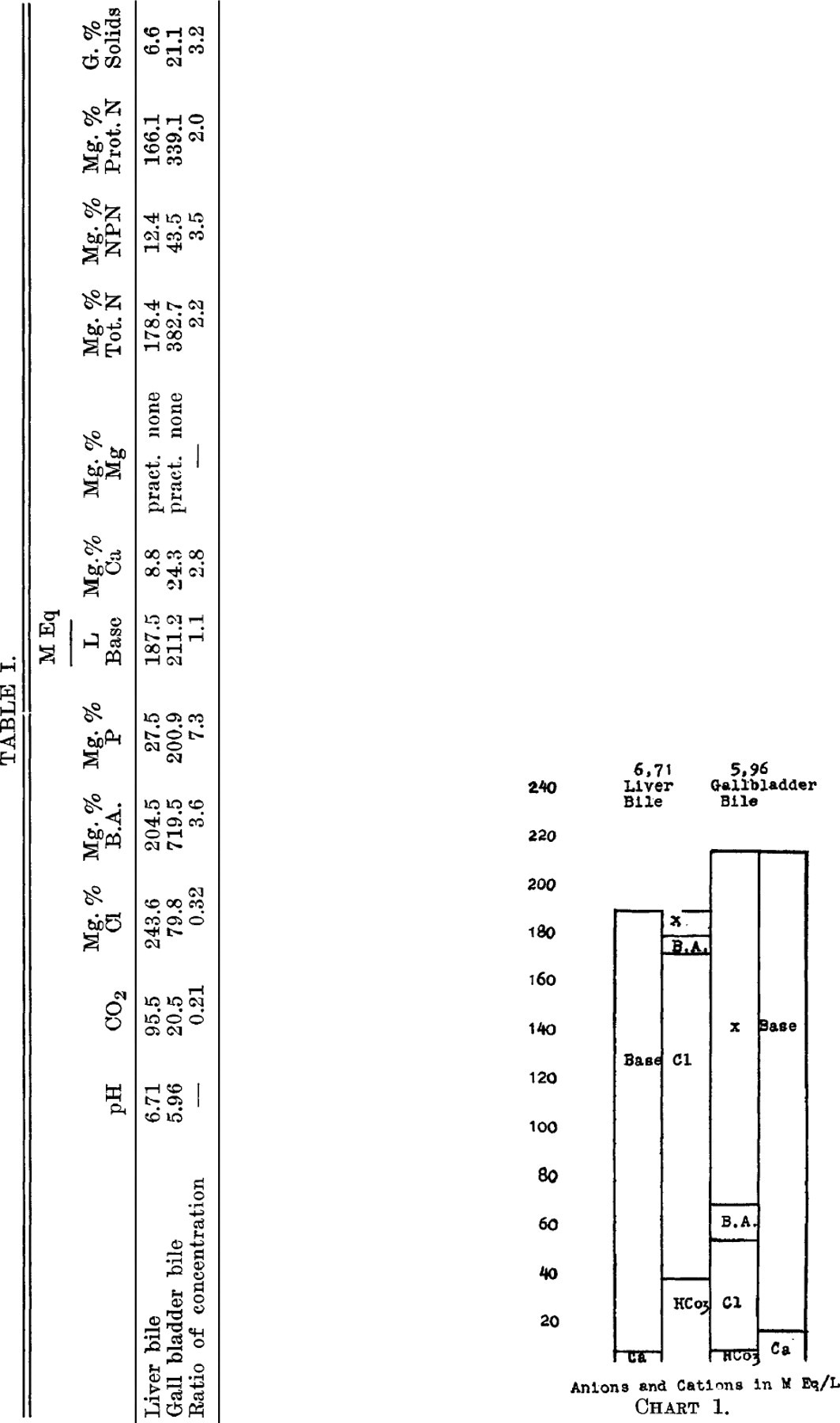 in which all of the principal factors affecting the acid-base equilibrium were estimated. (Chart I.)
Special stress is laid on the method of obtaining the bile because in many of the previously reported cases the effects of anesthesia and other extraneous phenomena could not be ruled out. In our dogs the liver bile was collected after first performing a laminectomy in the mid-dorsal region under local anesthesia and a trans-section of the spinal cord. Following this, when the dog had recovered from the shock, a laparotomy was performed, the cystic duct clamped, and the common duct cannulated, the cannula being connected with a tube leading to a glass container in which the bile was collected under oil. This elaborate technique was necessary as repeated attempts to secure bile under a number of different anesthetics showed us that the quality of the bile was markedly affected by the drug. This technique gave us a constant flow of clear Me without any admixture of air or blood, Special care was taken to determine the carbon dioxide and pH of the bile immediately. Standard methods of blood and urine analyses were used throughout except with the phosphorus, for which the specimens were ashed in a muffle furnace.
Get full access to this article
View all access options for this article.