



Abstract
The colonic spindle of the rabbit is an anatomical and functional modification of the gut connecting the ascending colon with the descending colon. 1 One of its functional activities is to squeeze out the liquid contents of the scybala formed in the ascending colon and to deliver these scybala, now hard and relatively dry, to the immediately adjacent descending colon. 2
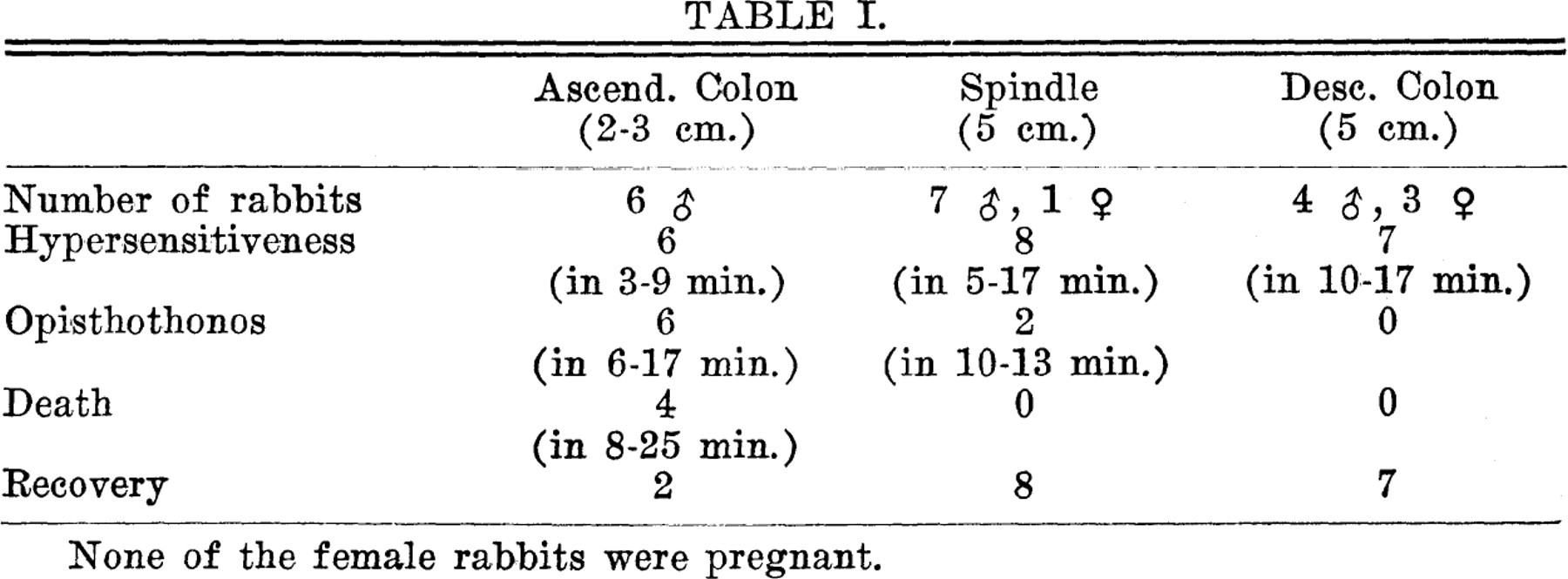
The present paper deals with the rate of absorption occurring in (1) the colonic spindle, (2) the ascending colon proximal to the spindle and (3) the descending colon distal to the spindle. A 1% solution of strychnin sulphate was used to betray absorption, the dose being 1 mg. per kilo rabbit injected into the ligated section of the gut.
The rabbits were narcotized satisfactorily by injecting 5 mg. of morphin sulphate per kilo subcutaneously. After laparotomy, a section of the ascending colon (single row of haustra) or the spindle itself, or a section of the thin walled descending colon was doubly ligated, carefully sparing the blood supply. The appropriate dose of strychnin was then injected into the lumen of the empty ligated section and the abdomen closed with 2 rows of sutures. After release, the animal was tested by tapping at 2–5 minute intervals for the development of hypersensitiveness and opisthotonos.
The ligated sections were not of equal length, in order to equalize the absorptive areas; in the ascending colon 2 to 3 cm. lengths were ligated, while 5 cm. lengths were used in the other 2 sections. The absorptive area in the ascending colon was, therefore, if anything smaller than that in the spindle or the descending colon.
Either an autopsy or a biopsy was made on every animal to determine the condition of the ligated sections of the gut, the normality of the kidneys and of the animal in general.
Get full access to this article
View all access options for this article.