




Abstract
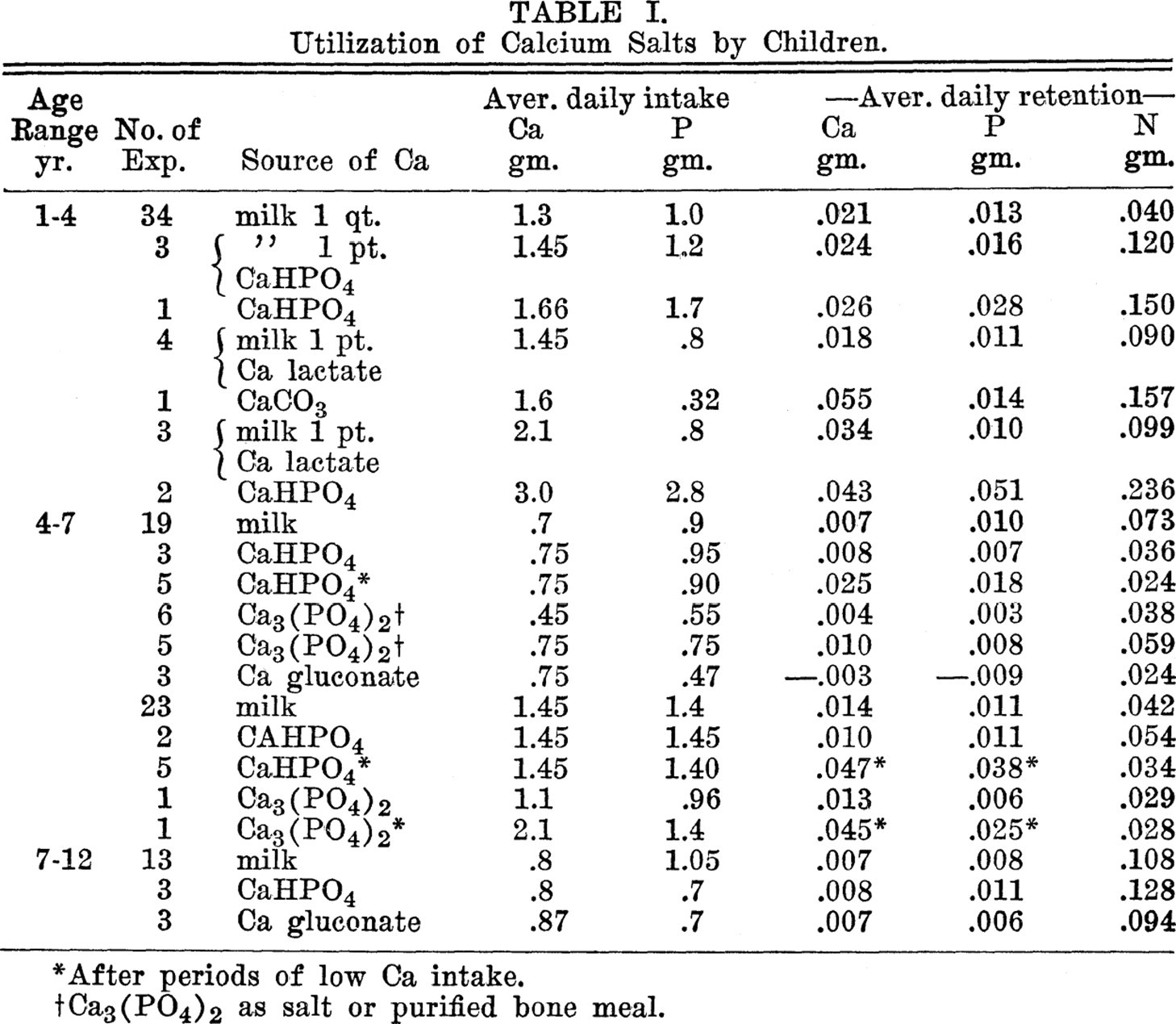
Children 4-12 years of age have been given calcium salts in amounts such that the calcium content was equivalent to that in a pint or quart of milk. The retentions of calcium and phosphorus have been determined and compared with the retentions from the equivalent quantities of milk. The calcium and phosphorus retentions of children from 1 to 4 years of age have been determined when a quart of milk was given as the chief source of calcium, and when a calcium salt was substituted for one pint of the milk. A few studies were made wherein the salt was substituted for all of the milk. The protein intake of each diet was kept approximately constant during the salt and milk periods. The salts used were calcium lactate, carbonate, gluconate, and the di- and tri-phosphates. The latter was given either as the salt or in the form of a purified bone meal. No difference was observed in the relative retentions from the two sources. The results are summarized in Table I.
In general, the calcium and phosphorus retentions when the calcium phosphates were fed, were approximately equal to those from equivalent quantities of milk. The very high retentions observed when these salts were fed after periods of low calcium intake indicate that all forms used are well absorbed by the average child of these ages. The retentions with the other calcium salts, the gluconate, lactate and the one study with calcium carbonate, are not so consistent as those obtained with the calcium phosphates. A greater individual variation was observed in the quantity of calcium and phosphorus retained by the different children. In general, it appeared that when the intake levels of calcium and phosphorus were approximately equal, the retentions of both these elements were good in relation to the intake, but that the greater the difference between the intake levels of calcium and phosphorus, the less satisfactory were the relative retentions of these elements.
Get full access to this article
View all access options for this article.