




Abstract
A study of the effect of ultraviolet irradiation on the amount of hemoglobin of the blood was made on 3 pens of White Leghorn chickens (10 chickens each pen) grown in complete absence of sunshine. The room, 20′× 30′, received moderate lighting from two 60 watt Mazda lamps. Small brooders supplied with 60 watt carbon filament lamps furnished the brooder heat for individual pens.
Pen 1, the normal controls, received 2 minutes daily irradiation from a quartz mercury arc lamp at 30 inches distance. Pen 2 had no ultraviolet irradiation. Pen 3 received no ultraviolet until after hemoglobin studies on rachitic chickens were made.
The irradiated chickens developed smooth plumage, yellow shanks and bills, and the male birds large red combs. (These organs do not develop until later in the females.) All of these chickens showed every sign of normal growth.
The non-irradiated chickens were less than 2/3 the size of the controls (Table I). Many showed extreme weakness and deformed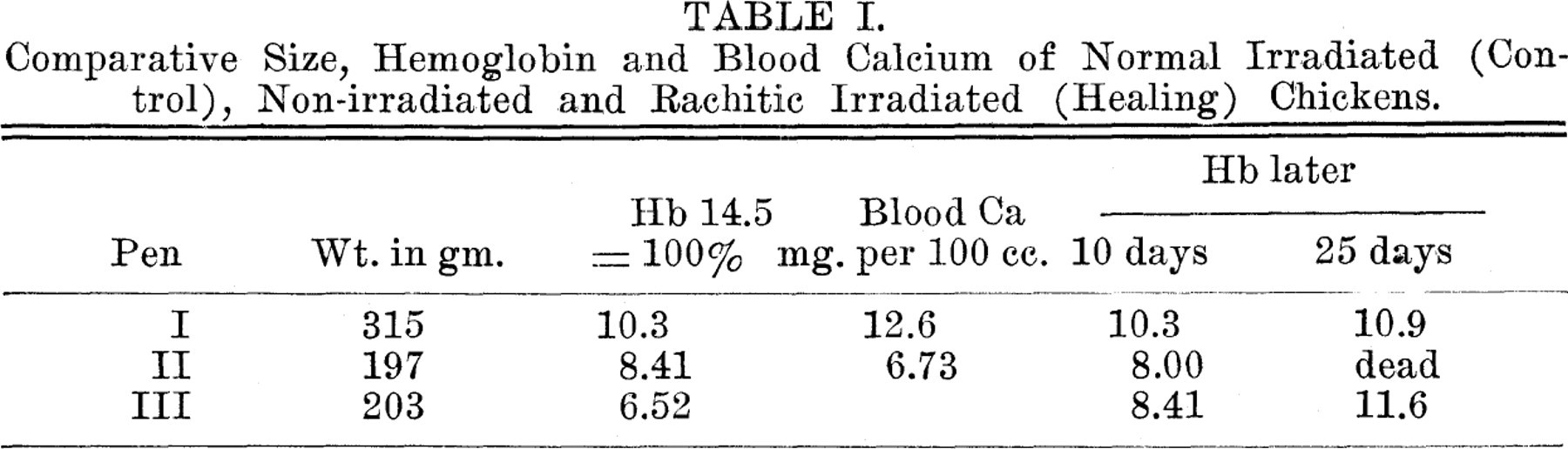 joints and bones due to rickets. The feathers were rough and the shanks and bills were light, almost white, in color.
At 7 weeks of age hemoglobin studies were made. These average readings were for the 3 pens, 10.3; 8.41; and 6.52 gm. Hb per 100 cc. blood, respectively. (Determinations were made by the Hellige Solid Plane Hemometer reduced to the standard 14.5 gm. Hb per 100cc. of blood.)
Get full access to this article
View all access options for this article.