



Abstract
Ellison and Wolfe
1
have reported that in the anterior pituitaries of castrated mature female rats there is an increase in the percentages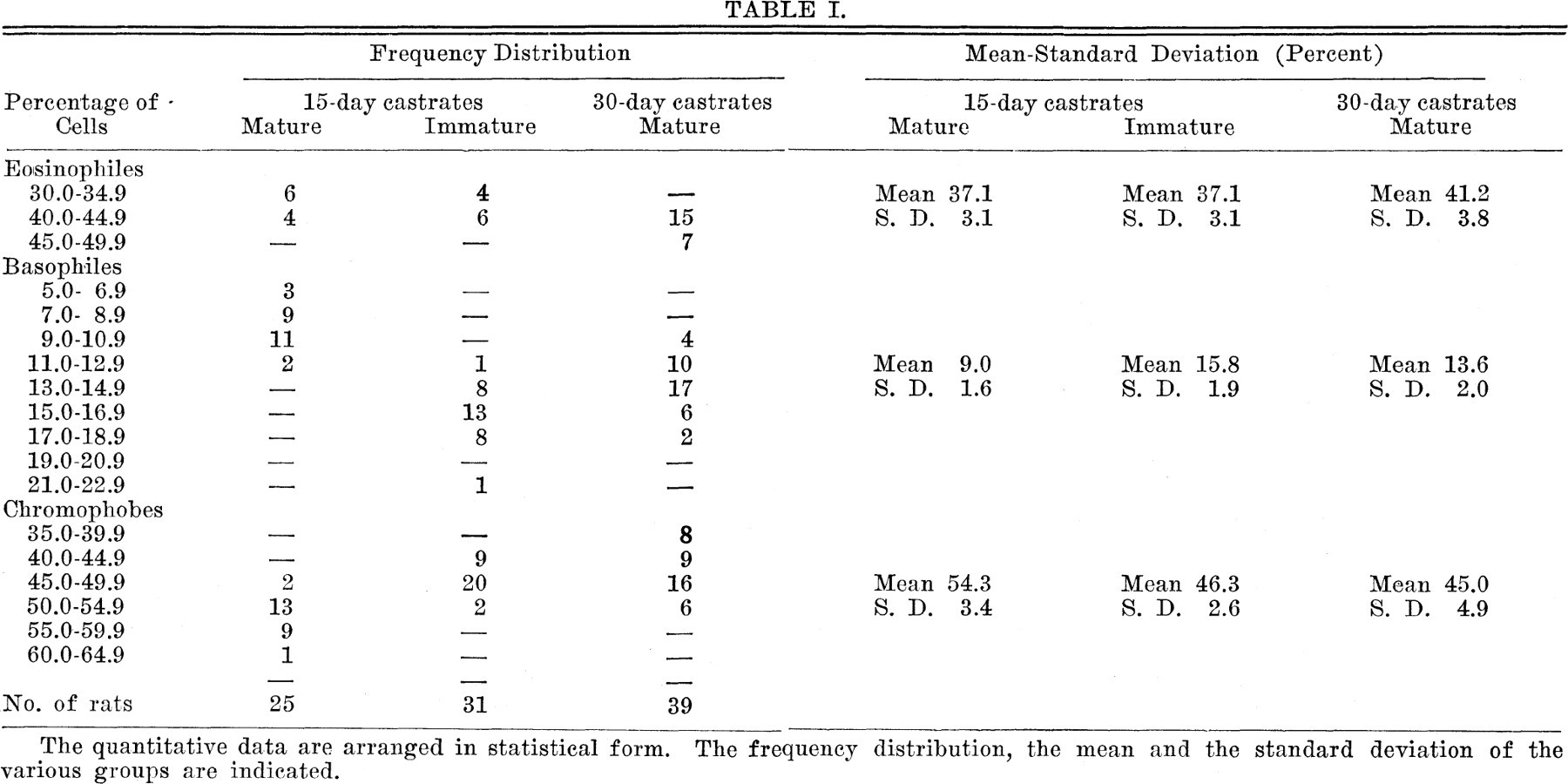 of the basophiles to a mean level of 9% in the 15-day castrates and 13.6% in the 30-day castrates. A few signet-ring castration cells were also found in the anterior pituitaries of the 30-day castrates. In further studies
2
we have pointed out that injection of pregnancy urine extracts† are without action on the pituitaries of mature female rats castrated for 15 and 30 days. By adding the 2 series of injected and uninjected animals together, we have to date studied and made cell counts on the anterior pituitaries of 25 mature females castrated for 15 days and 39 castrated for 30 days. These data are arranged in statistical form in Table I, in which the frequency distribution of the percentages of the various cell types, the mean and the standard deviation are given. In addition, 31 immature female rats were castrated when between 25 and 30 days of age and sacrificed 15 days later. Sixteen of these animals received injections of pregnancy urine extracts. Since these extracts were without action on the anterior pituitary,
3
data from these 31 rats are considered together and arranged statistically in Table I. For non-castrated controls we have to date made cell counts on the anterior pituitaries of 69 mature female rats killed at various periods of the oestral cycle, and 31 immature female rats killed between 25 and 35 days of age. The mean levels of the eosinophiles in the anterior pituitaries of the mature and immature controls were 33.6 and 36.1%, respectively. The standard deviations (S. D.) were 4.5 and 3.9, respectively.
of the basophiles to a mean level of 9% in the 15-day castrates and 13.6% in the 30-day castrates. A few signet-ring castration cells were also found in the anterior pituitaries of the 30-day castrates. In further studies
2
we have pointed out that injection of pregnancy urine extracts† are without action on the pituitaries of mature female rats castrated for 15 and 30 days. By adding the 2 series of injected and uninjected animals together, we have to date studied and made cell counts on the anterior pituitaries of 25 mature females castrated for 15 days and 39 castrated for 30 days. These data are arranged in statistical form in Table I, in which the frequency distribution of the percentages of the various cell types, the mean and the standard deviation are given. In addition, 31 immature female rats were castrated when between 25 and 30 days of age and sacrificed 15 days later. Sixteen of these animals received injections of pregnancy urine extracts. Since these extracts were without action on the anterior pituitary,
3
data from these 31 rats are considered together and arranged statistically in Table I. For non-castrated controls we have to date made cell counts on the anterior pituitaries of 69 mature female rats killed at various periods of the oestral cycle, and 31 immature female rats killed between 25 and 35 days of age. The mean levels of the eosinophiles in the anterior pituitaries of the mature and immature controls were 33.6 and 36.1%, respectively. The standard deviations (S. D.) were 4.5 and 3.9, respectively.
Get full access to this article
View all access options for this article.