




Abstract
In these experiments the urinary excretion of creatinine has been compared with that of (1) mono-iodo-methane sulphonate of sodium (Skiodan), (2) 3:5 diiodo-4-pyridon-N-acetic acid diethan-olamine (Neoskiodan, Diodrast) and (3) sodium ortho-iodohip-purate (Hippuran). These 3 organic compounds of iodine owe their practical usefulness in excretion urography to their exceptionally rapid elimination in the urine. Of the normal constituents of urine creatinine is excreted in highest concentration relative to the plasma level. The mechanism of creatinine excretion is not entirely clear (Rehberg, 1 Jolliffe, Shannon and Smith 2 ); it is therefore interesting to record that the plasma clearances of these organic compounds of iodine may equal or, under certain conditions, considerably exceed the simultaneously determined creatinine clearances. Their excretion is similar on one hand to that of creatinine, on the other to that of phenol red (Marshall 3 ).
In human subjects and unanesthetized dogs various grades of water diuresis were induced. Creatinine was administered intra-peritoneally (1.0 to 1.5 gm.) in dogs and orally (3.0 to 5.0 gm.) in man. Skiodan and Neoskiodan were injected intravenously. Hippuran was administered intravenously in dogs, orally in man. Large amounts of organic iodine were given to dogs but in man the amounts were limited to the ordinary dose used for excretion urography. Urine and samples of blood were collected at half-hourly or hourly intervals.
Urine and separated plasma were analyzed for iodine by Leipert's
4
method, and for creatinine by the method of Folin as used by Holten and Rehberg.
5
The clearances (C) of both iodine and creatinine were calculated in terms of cc. of plasma cleared per minute by the usual equation; urinary concentration (U) divided by blood concentration (B) times the volume (in cc.) of urine formed per minute (V), C = 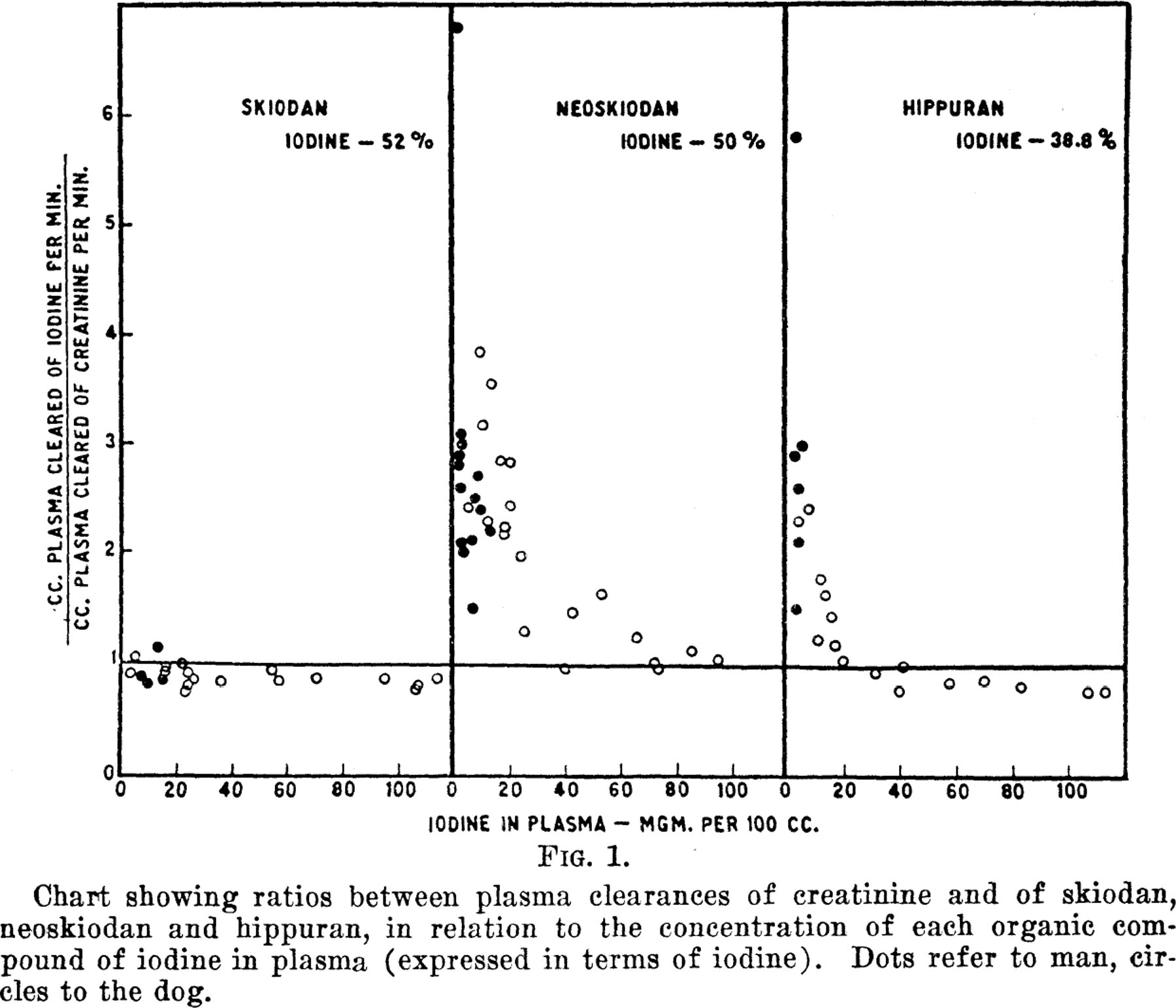 .
.
Get full access to this article
View all access options for this article.