




Abstract
In an earlier paper 1 it was shown that the simultaneous determination of permeability constants for water and for a dissolved substance is possible by a study of the volume changes of a cell placed in an originally isotonic medium to which the penetrating substance has been added in known amount. The method depends on measuring the shrinkage of the cell and the time of attainment of the minimum volume, the values of the permeability constants in question being read off from a prepared chart. The published chart was, however, restricted in its usefulness to a single concentration of the penetrating substance.
In cases, which are frequently encountered, where a knowledge merely of the ratio of the 2 permeability constants is desired, a more direct and general solution of the problem is possible, since the relation between the ratio, K, of the 2 constants, the external concentration, Cs, of the penetrating solute, the amount, S, of the solute that has penetrated the cell, and the volume, V, of the latter may be shown to be:

where
This equation is obtained by solving, subject to the condition that when V = 1, S = 0, the differential equation
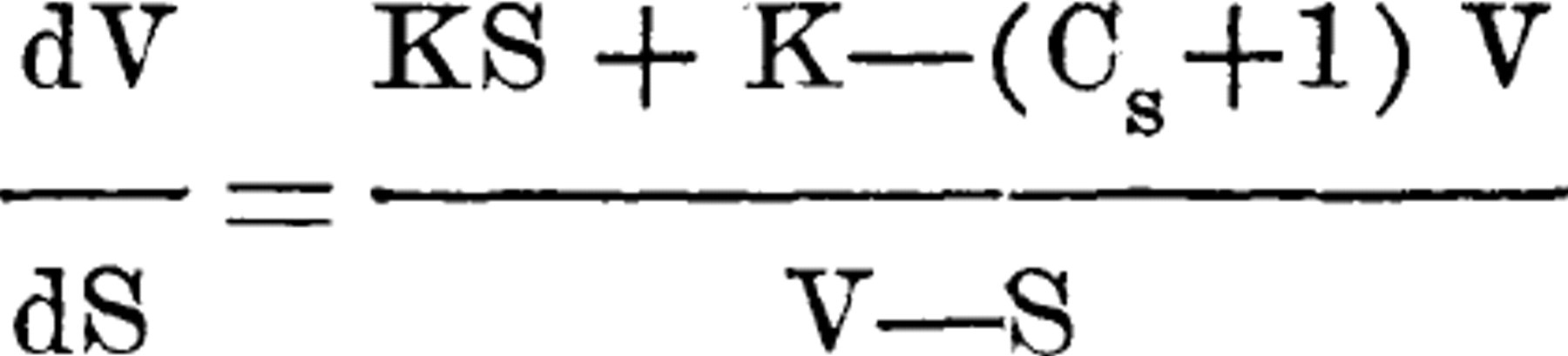
which is in turn derived from equations 2 and 3 of the earlier paper, using such units of concentration and volume that a and Cm in these equations are both equal to unity.
As shown previously, 2 the condition for minimum volume in the case in question is that S=(CS+1)V-1. Substituting this value of S in the general equation, simplifying, and changing for convenience to common logarithms, we obtain finally

From this relation the minimum volume corresponding to any values of K and Cs may readily be calculated, remembering that for the case in question only the value of Vmin which is less than unity has a real physical significance, since it is impossible for the cell volume ever to exceed its initial value. Conversely, for any given value of Cs the value of K may be calculated from the observed minimum volume. Practical applications of this principle to problems of cell permeability will be discussed in a later paper.
Get full access to this article
View all access options for this article.