




Abstract
With collective phenomena it has been often observed that the curve describing the frequency of the occurrence of an event is asymmetrical and not symmetrical as should be expected if the occurrence of the event depended merely on chance. (Gauss's probability curve.) This has been generally ascribed to the asymmetrical variation of the parameter on which the occurrence of the event depends. A different explanation is given below. It is shown that asymmetry is to be expected whenever the time which registers the event is a non-linear function of the parameter on which the occurrence of the event depends even though the variation of the same follows the probability rule.
The parameter  will be a non-linear function of the time if the event is the consequence of the upset of an equilibrium, i. e., the equilibrium between an existing noxious power (for example, the toxic action of a chemical) and resistance, which upset may result in destruction (for example, death of an organism) which is the registered event. If x and y are the parameters which determine the equilibrium, then the latter will be characterized by
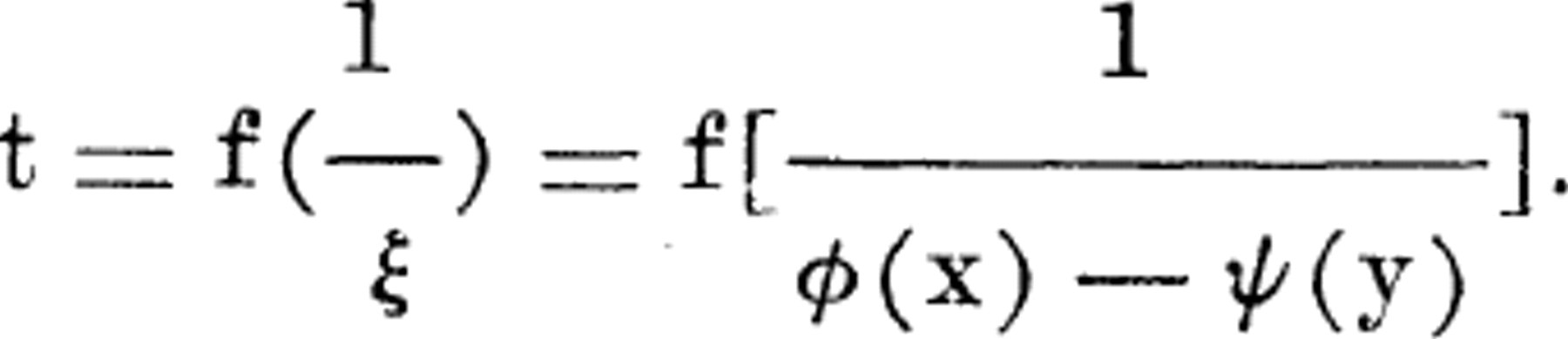
The simplest assumption about f is that any small increase of t will be proportional to the relative decrease of  . Thus

The validity of this equation was tested on the mortality curves of bacteria exposed to a disinfecting agent (disinfection rate curves). These curves very often show a remarkable asymmetry, which is so great that the curves were considered by some to be of the type characteristic of the course of a monomolecular chemical reaction (Madsen and Nyman, 1 Chick, 2 Arrhenius, 3 and others). Eijkman, 4 Hewlett, 5 Reichenbach, 6 Brooks, 7 and others have attributed the asymmetry to a peculiar distribution of resistance among bacteria.
Get full access to this article
View all access options for this article.