




Abstract
The rates of the glycolytic processes in blood vary from animal to animal and class to class, being fairly rapid in man, dog and sheep, but slow in ox and pig. 1 The important enzymes are largely present in the formed elements of the blood. 2 Lundsgaard 3 has shown that glycolysis is inhibited by monoiodoacetate in concentrations which do not interfere with many other enzymic processes. It is well known that glycolysis is more rapid in nitrogen than in oxygen (Pasteur reaction), probably because the oxidative and fermentative enzyme systems are competing for a compound such as methyl glyoxal, important in each type of catabolism. Accordingly it seemed possible that the Lundsgaard reagent would be more effective in inhibiting aerobic than anaerobic glycolysis, since in the latter case there is but one anti-glycolytic mechanism, in the former in a sense there are two.
To test this assumption tubes were made up as follows, using blood from a single animal (dog) for each series of experiments: Defibrinated blood, 10.0 ml., 1% glucose 5.0 ml., Sorensen's phosphate buffer (pH 7.2) 10.0 ml., distilled water or various concentrations of sodium monoiodoacetate to volume of 40.0 ml.
These tubes were placed in a thermostat at 37°C. for 4 to 5 hours. Oxygen-free nitrogen was passed through some of these, air through others, and the decrease in glucose then determined. With a concentration of Lundsgaard's reagent of 1.88 mg./ml. in the experimental tubes, the following data were obtained. A pair of experiments, a and b, were performed in each case.
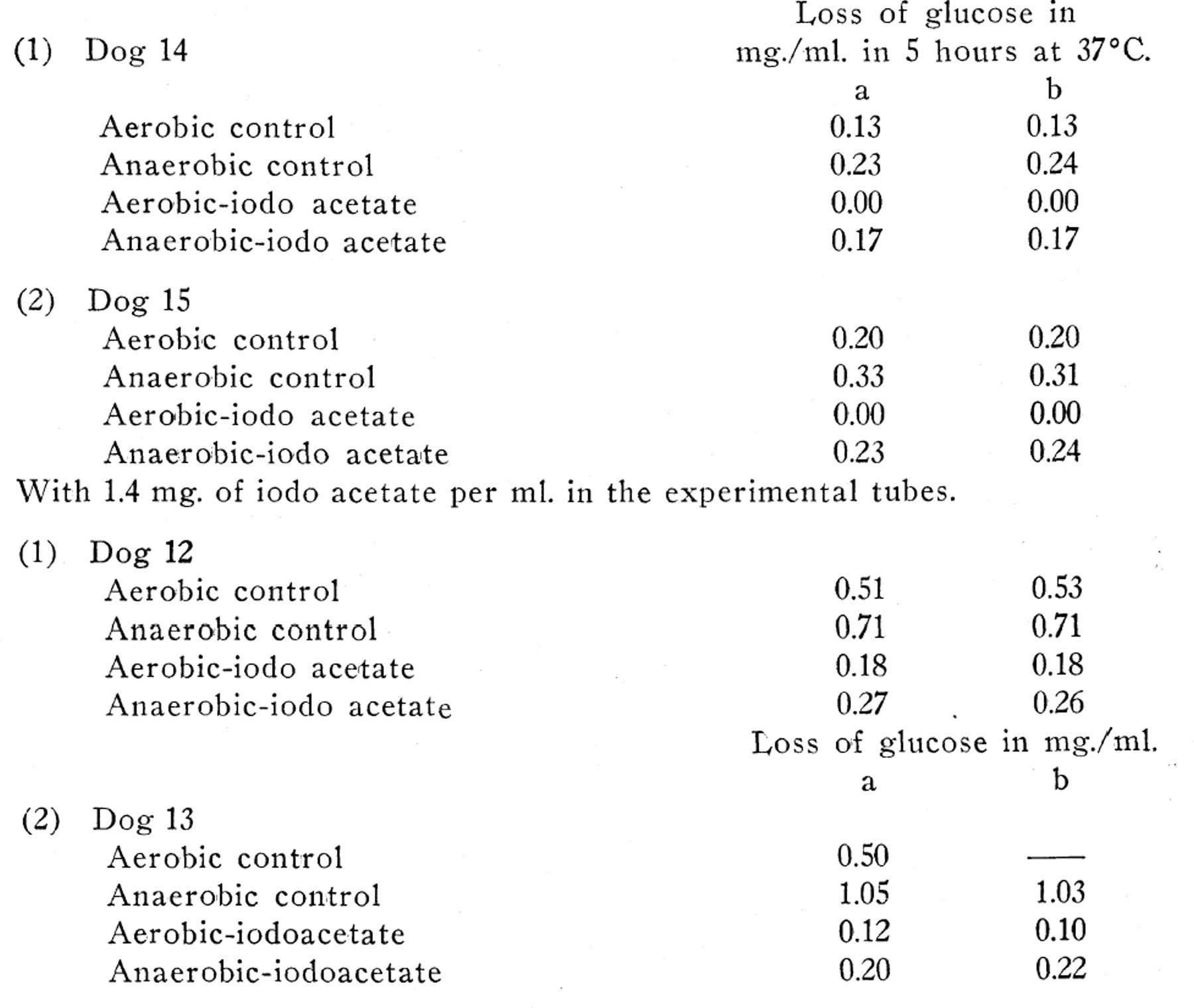
The data indicate that anaerobiosis diminishes the inhibitory action of sodiummonoiodoacetate on glycolysis in dog's blood under the conditions of these experiments. The fate of the glucose disappearing, the rates of reaction, and the effect of arsenates and other agents modifying fermentative activity will be the subject of a subsequent communication.
Get full access to this article
View all access options for this article.