




Abstract
The relation of the vitamin B complex to the rate of growth, to the consumption of food and water and to the utilization of food in rats has been studied. The Evans and Burr diet (purified casein—25, sucrose—75, salt mixture—4) was used and was supplemented daily with 9 drops of cod liver oil. The B complex was supplied by daily additions of one or more of the following: whole dried hog liver (high B2-low B1), autoclaved liver (high B2), whole dried yeast (high B1-moderately high B2), tikitiki (high B1). Male rats were placed on the experimental diet when 50 gm. in weight and were kept in individual raised cages. Some of the data are shown in Table I. Groups 1 to 4 were restricted in food consumption to approximately the same number of calories. The remaining groups were fed the basal diet ad libitum.
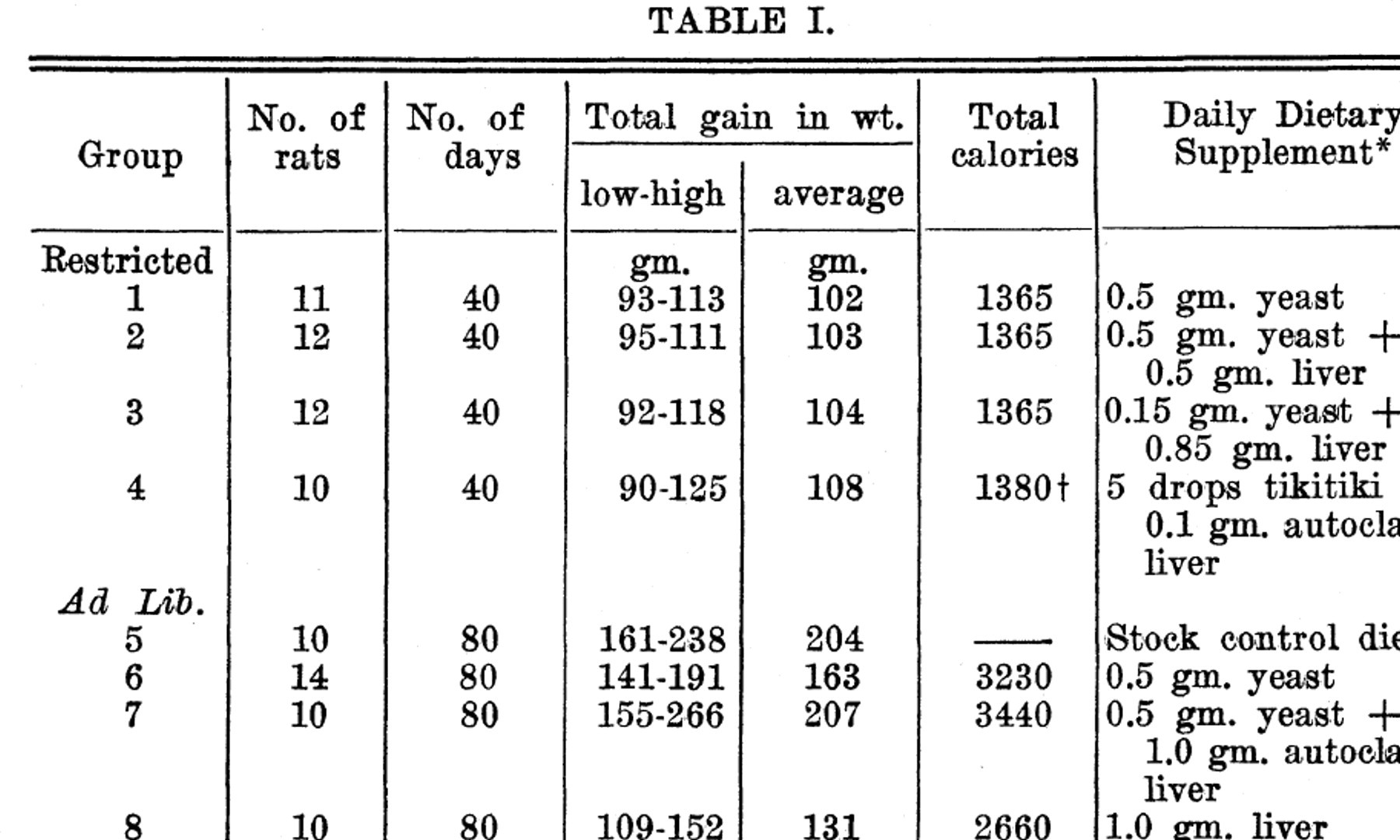
The weight increments for the first 4 groups were surprisingly uniform in spite of the fact that only one of the 4 supplements (Group 2) was adequate for optimum growth when the basal diet was fed ad libitum (Group 10). The results with Group 4 were particularly interesting because of the relatively low concentration of vitamin B2 required for satisfactory utilization. In these experiments the utilization of food was apparently unaffected by considerable variation in the amounts of B1 and B2 furnished in the supplements.
On the other hand, the appetite of the rats was markedly affected by the nature of the supplement. If either tikitiki (B1) or autoclaved liver (B2) was used as the source of the B complex appetite failed and growth did not occur. However, the combination of tikitiki and autoclaved liver resulted in optimum growth (Group 12); i. e., growth as good or better than that of the stock control rats (Group 5) . The difference between Groups 6 and 7 and between Groups I I and 12 was largely due to the appetite-stimulating effect of the autoclaved liver.
Get full access to this article
View all access options for this article.