




Abstract
In order to gain further information on the inheritance of serological characters in the hybridization of species, 1 an attempt has been made to find an instance of fertile species hybrids where a serological differentiation of the parent types would be possible. A material answering these requirements consists of the two sorts of cavies mentioned in the title, the cross of which has been studied extensively by Detlefsen. 2 As established by this author, the F1 females are fertile when mated with either of the parent species.
When the blood and serum of the two species were allowed to interact, no hemagglutination or hemolysis took place. It was not difficult, however, to obtain hemolytic sera by several intraperitoneal injections of 0.5 cc. washed blood of the wild Brazilian guinea pig into the common domestic guinea pig. An experiment with one of the most active immune sera gave the following results:
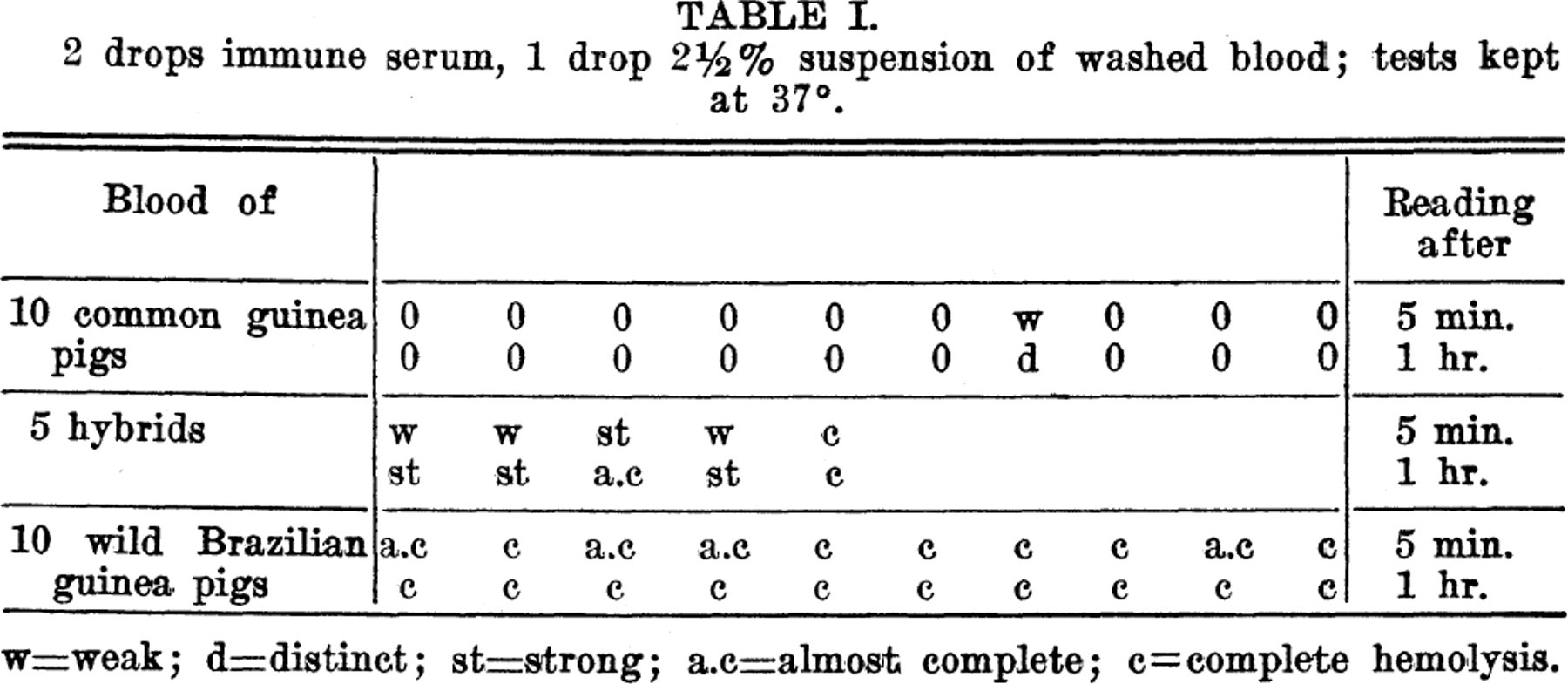
In all, 20 Brazilian and 23 common guinea pigs were examined. Whereas the cells of all the former reacted positively with varying intensities, the blood of only one common guinea pig gave a distinctly positive reaction, although to a considerably lesser degree than any individual of the other species. The bloods of 6 hybrids ( ) showed positive reactions, but with one exception these were weaker than those obtained with the wild type.
On inactivating the sera, similar differences were demonstrable by hemagglutination.
It is proposed to extend these studies to further generations and to search for other reactions differentiating not only the blood cells but, if possible, also the proteins of the two kinds of animals.
Get full access to this article
View all access options for this article.