




Abstract
Just as a material body may be considered the sum of an infinite number of material particles differing from each other only with respect to their orientation in space, so the ventricular muscle may be considered the sum of an infinite number of units differing only with respect to the direction in which the excitation process passes over them, and consequently in the direction of the potential differences which they produce during ventricular activation.
The analysis of the electrocardiogram is greatly complicated by the fact that not all of the muscle units are activated at the same time. This difficulty may be eliminated by determining the mean deflection in each of the 3 standard leads over any desired interval. The mean deflection in lead I (MeI) during the QRS interval may be expressed by the following equation:
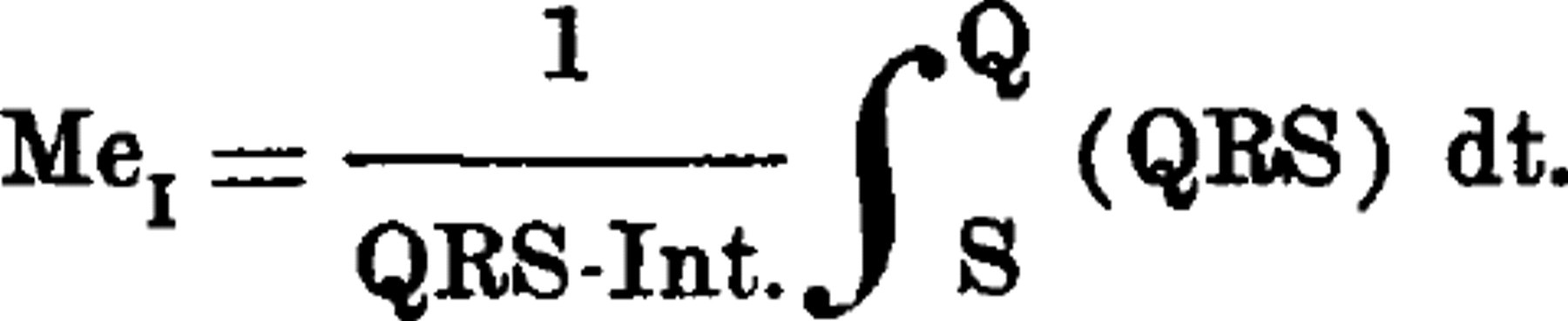
In this equation the value of the integral is the area under the curve, determined by planimeter, between the onset of Q and the end of S.
If the mean deflection for any interval be determined for each of the 3 standard leads in this manner, the mean electrical axis and the mean manifest potential difference may be obtained by means of Einthoven's triangle. In this way the electrocardiogram, so far as the interval in question is concerned, may be reduced to a single vector.
The mean electrical axis during the inscription of P will give the average direction of the excitation process in the auricles. The mean electrical axis during the QRS interval will give the average direction of the excitation process in the ventricular muscle. The mean electrical axis during the inscription of T will give the average direction of the wave of ventricular deactivation.
Get full access to this article
View all access options for this article.