



Abstract
In all recent work concerned with the fitting of formulae to curves obtained for the action of the simple haemolysins it has been assumed that the “fundamental reaction” between the cells and the lysin is one in which the latter combines with some component (probably protein) in the membrane of the former, thus forming a new compound as the result of the formation of which the integrity of the cell is destroyed. Thus, the quantity of the cell component, S, destroyed, is proportional to the quantity of lysin, x, used up in the system, and the velocity of the reaction is given by

whence
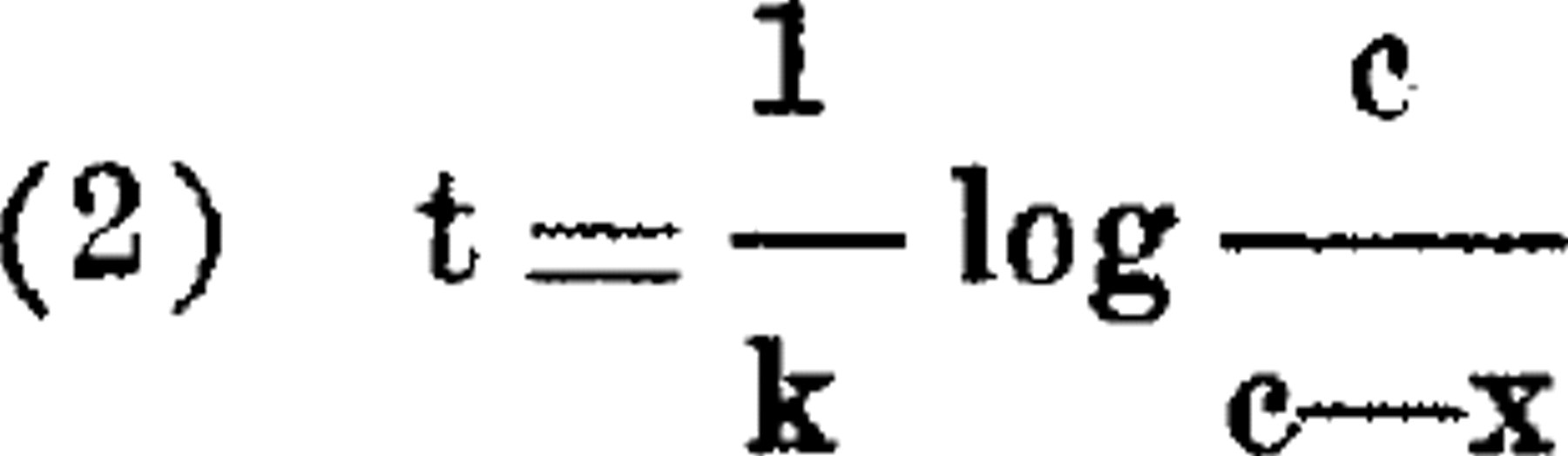
where c is the initial quantity of lysin (in milligrams), where t is the time required to produce lysis of an arbitrary number of red cells, and where S is large compared to c. Since it is assumed that the complete lysis of n cells corresponds to the utilization of a constant quantity of lysin, we obtain, by putting × = const., and varying c in (2), a relation between the time for complete lysis of n cells and c, the initial concentration of lysin; when plotted, this relation gives the “time-dilution curve” for any particular lysin. If we are concerned with the number of cells, N, haemolysed from moment to moment by a particular concentration of lysin, from the beginning of the reaction until its completion, we solve (2) simultaneously with

and obtain the S-shaped “percentage haemolysis curves”.
For certain haemolysins under certain conditions, these expressions describe the experimental results excellently. Recently, however, we have examined the action of several simple lysins over very much longer periods than previously, observing the time-dilution and percentage haemolysis curves over periods as long as 300 minutes and as short as 6 seconds.
Get full access to this article
View all access options for this article.