




Abstract
It is generally considered that the blood of all animals contains both free cholesterol and cholesterol esters, the former existing in corpuscles and plasma and the latter occurring only in the plasma or serum. Since this conception is founded upon the results of determinations carried out on the blood of higher animals it seemed of interest to determine whether lower and more primitive forms would also contain these constituents in their blood corpuscles and serum.
The horsehoe crab (Limulus polyphemus) and the woolly bear caterpillar (Isia isabella) were chosen as suitable experimental animals both as to position in the animal scale and as to the ease with which sufficient blood could be obtained. The work on the horseshoe crab was carried out on 2 adult animals, and that on the caterpillars on pooled blood samples from 40 animals. Bloor's 1 method was used in determining total cholesterol and Bloor and Knudson's 2 in determining cholesterol ester, both modified as to amount of material tested and amount of extractive used in anticipation of very low values. The results obtained are given in Tables I and II.
Summary. The blood serum of Limulus polyphemus was found to be entirely free of cholesterol or cholesterol esters and thus differs 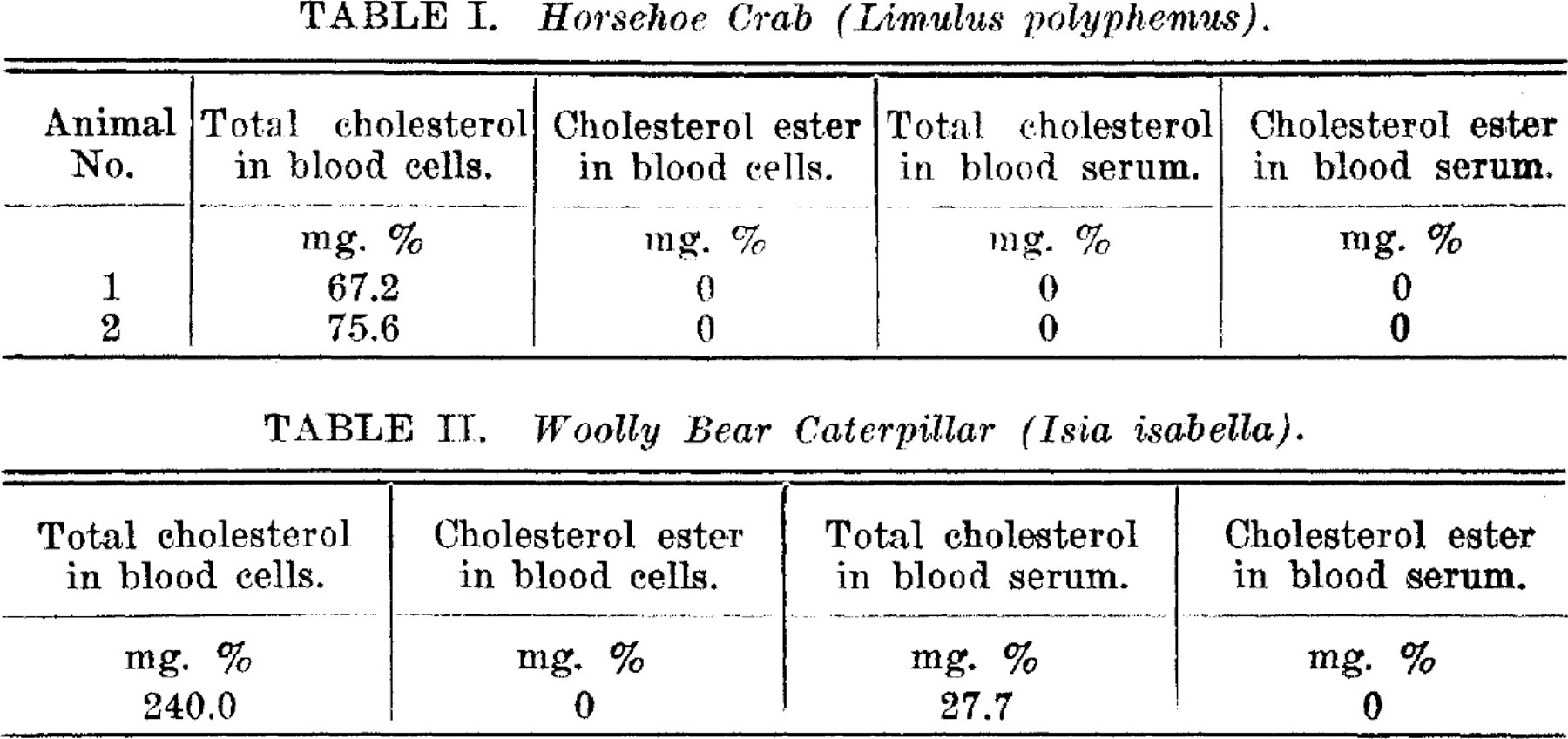
Get full access to this article
View all access options for this article.