




Abstract
It has been previously demonstrated that after sodium bromide is given by mouth for 5 days, a comparison of the bromide found in the blood and spinal fluid shows about 3 times as much bromide in the blood as in the spinal fluid. In certain pathological states of the nervous system this ratio shows a characteristic change. It was concluded that this method gives us a reliable method of estimating changes in permeability.
We used Malamud's 1 modification of Walter's 2 technique on patients whose mouth temperatures had been raised to 103°–106° F. for at least 30 minutes daily for at least 5 consecutive days. The patients were put into an ordinary bath tub or, more comfortably, into a continuous bath tub, the temperature of the bath being gradually raised to 110° F.
The following examples will illustrate the range of the permeability quotient.
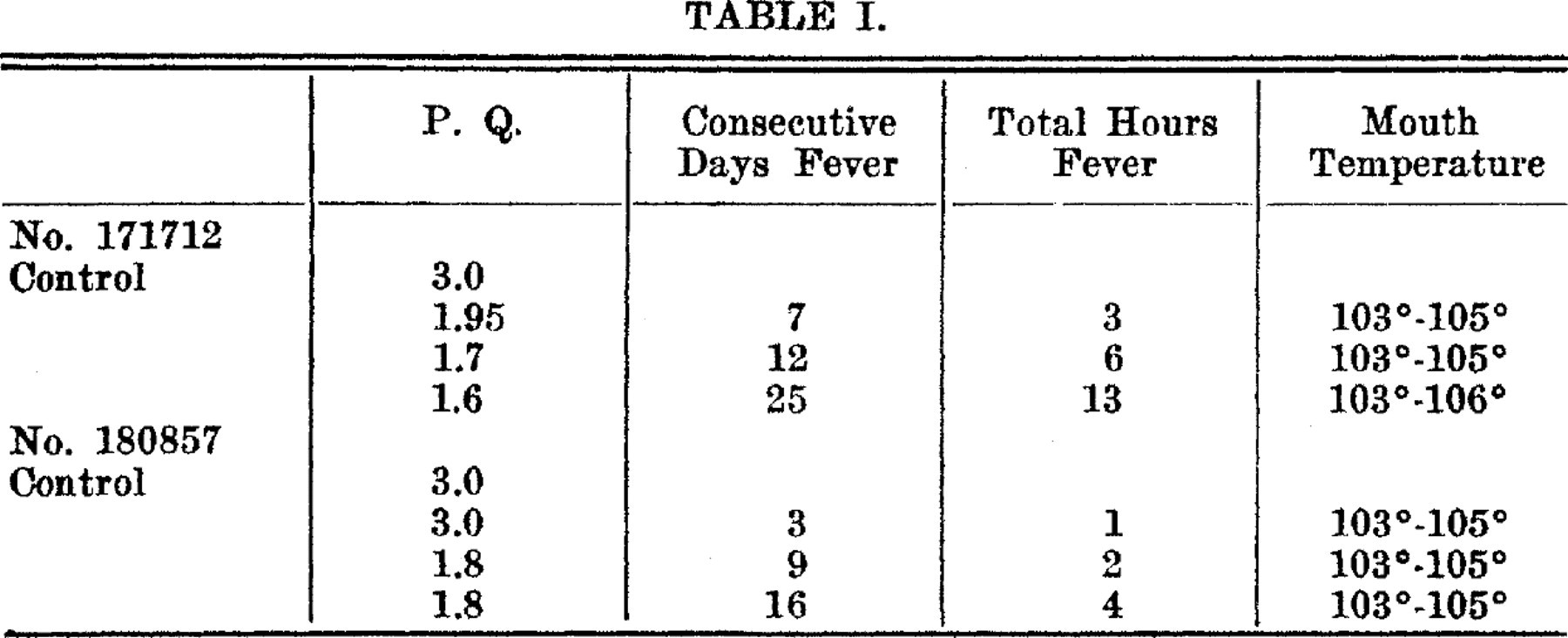
Conclusions: The ratio of bromide in blood and spinal fluid is changed after fever. This hyperpyrexia must be greater than 103° F., continued at least 30 minutes and be repeated at least 5 successive days. The permeability quotient (P. Q.) in all cases was lowered, showing increased permeability. The maximum lowering was a P. Q. of 1.6; the least result was 2.7. A lower temperature than 103° F. or one continued for less than 5 days produced uncertain results.
The above results indicate that a hyperpyrexia produced by hot baths is capable of lowering the permeability quotient in the same manner as does the malarial fever.
Get full access to this article
View all access options for this article.