




Abstract
The introduction by Minot and Murphy
1
,
2
,
3
of the liver diet in the treatment of pernicious anemia has supplied experimental medicine with a hitherto unequalled method of studying blood formation. Three general types of anemia have been produced experimentally, secondary anemia due to hemorrhage, the aplastic anemia due to destruction of the blood forming element of the bone marrow, and the hyperchromatic anemia produced by certain poisons. The fact which differentiates the condition in pernicious anemia from the types of anemia which have been experimentally produced, is that in pernicious anemia a blood is available which shows a low spontaneous regenerative activity and yet the bone marrow is not aplastic. 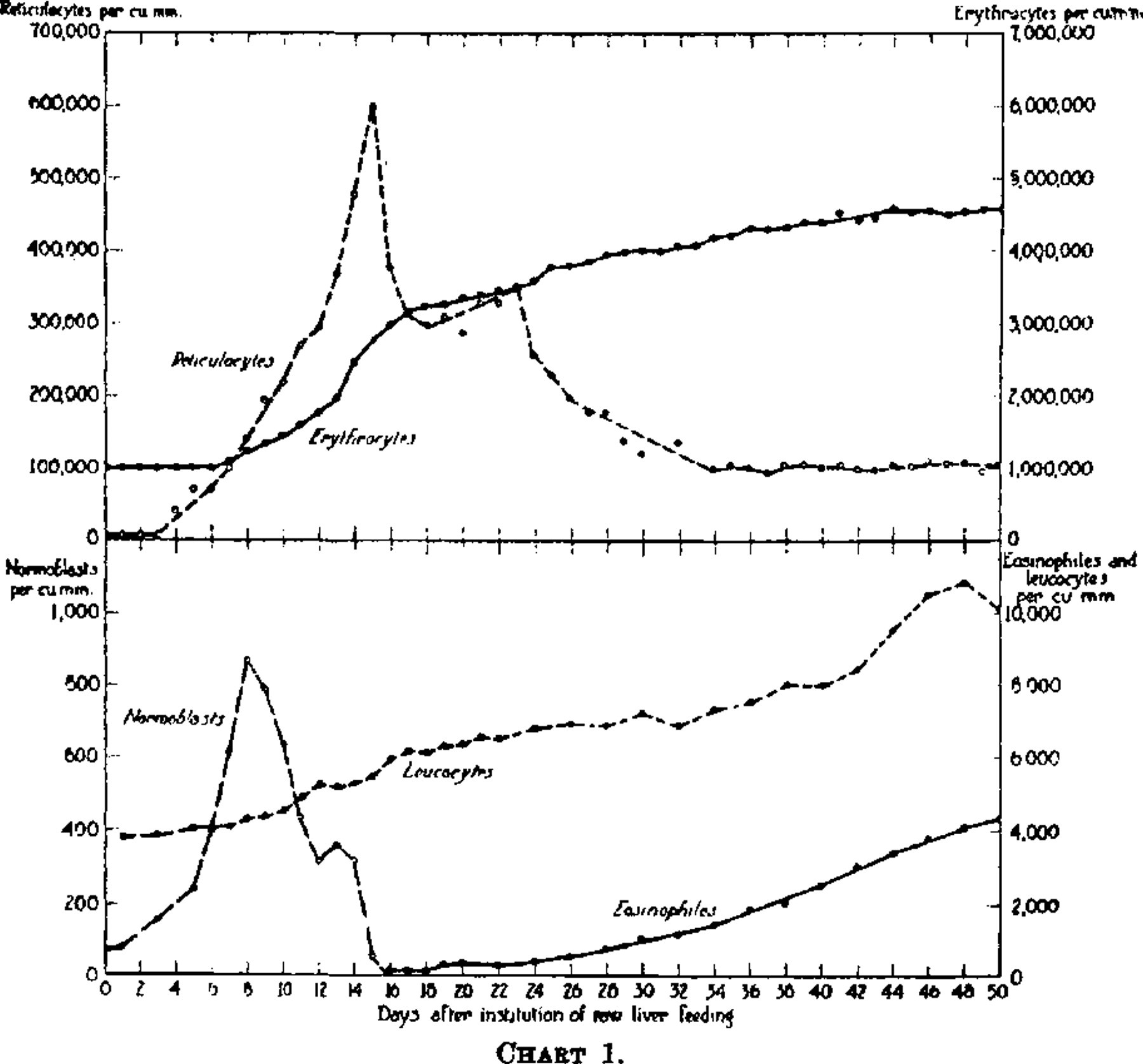 Minot and his co-workers have shown that after about two months of the liver treatment, the morphological blood picture of pernicious anemia has returned to practically normal.
A detailed study of the morphological blood features in a case of pernicious anemia is presented in figures 1 and 2. The patient is a married woman 52 years of age presenting the classical picture of the disease. Before the liver diet (all liver given raw) the morphological picture was observed for 5 days, ascertaining that no signs of blood-forming activity were present. There is in our graphs no curve for megaloblasts. Whether they occur or not is a question of more than momentary interest. The megaloblast is a cell which is normally produced in the blood islands around the yolk sac and in the connecting stalk of the embryo, and pathologically occurs only occasionally in pernicious anemia and severe toxic anemias.
Get full access to this article
View all access options for this article.