




Abstract
While studying the effect of massive doses of nicotine on the enteric nervous mechanism of dogs, Thomas and Kuntz 1 stimulated the vagi after giving large doses of nicotine. The response of the intestine was not abolished by these large doses of nicotine, but, on the contrary, were greater and more constant than before nicotine was administered. This was apparently contrary to the generally accepted conclusion of Bayliss and Starling. 2
The present report is based on 28 experiments on cats, 19 females and 9 males, weighing from 2.0 to 4.1 kilograms. They were narcotized with ether, and the brain and spinal cord destroyed by pithing, Artificial respiration was administered through a tracheotomy tube. Both vagi were exposed, but only the right was electrically stimulated after a primary testing of the effect of both, Fig. 1. A 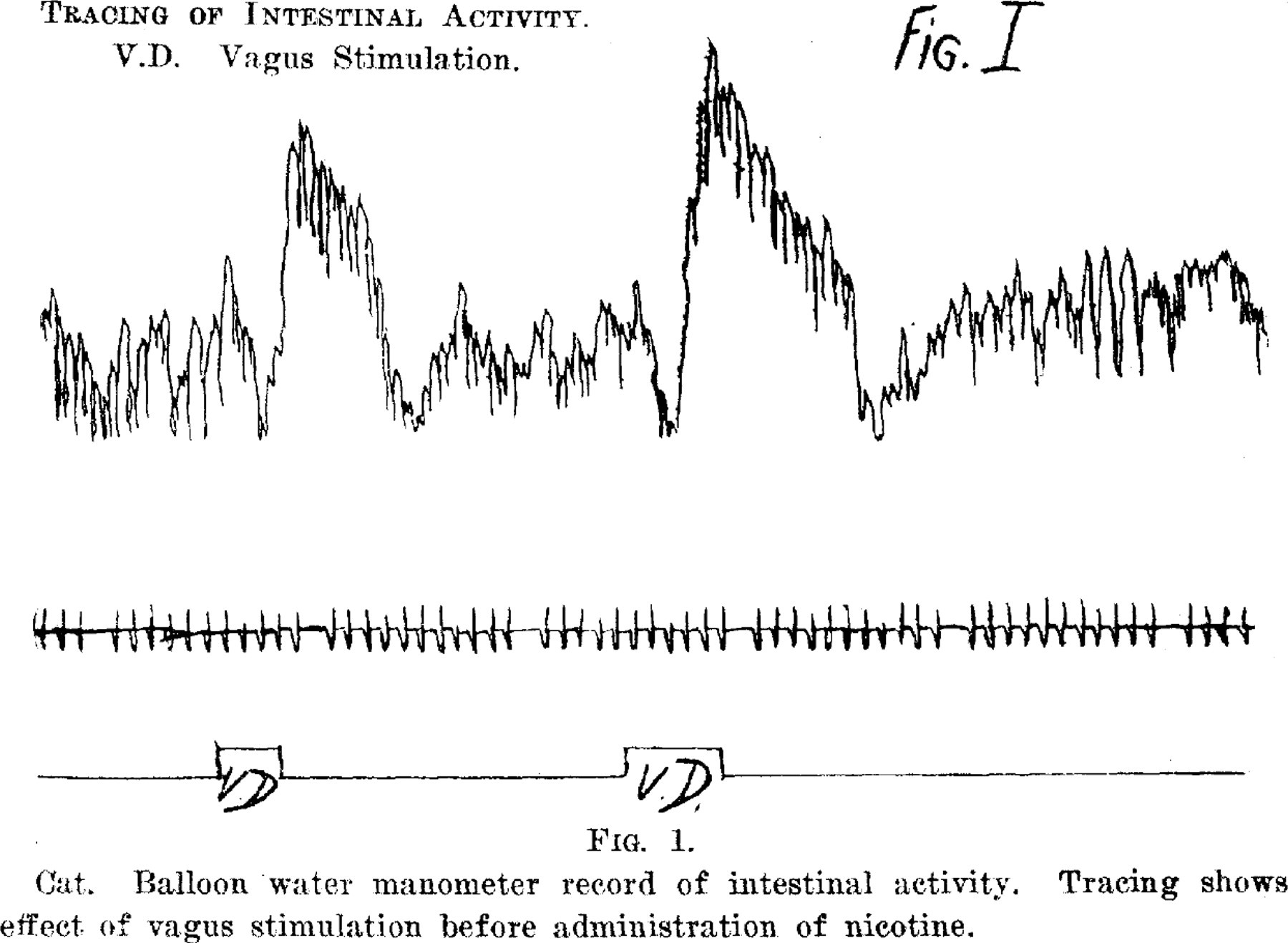
Three series of experiments were done as follows: (a) 11 experiments with same procedure as described above. (b) 9 experiments with both adrenals removed. (c) 8 experiments with both adrenals and semi-lunar ganglia extirpated.
As the results were essentially the same, whether the adrenals and semi-lunar ganglia were present or removed, they will be presented together.
Nicotine given intravenously causes a cessation of motility and a drop in tone of the cat's intestine. If the vagus response was good before the injection of the nicotine, it invariably disappeared with the first injection, which was always between 1 to 10 mg. per kilo of body weight, Fig. 2.
Get full access to this article
View all access options for this article.