




Abstract
In a recent paper Dean and Webb 1 have shown that just as in the Ramon test there is an optimum zone in mixtures of protein and its antiserum where precipitation occurs more quickly, and that the indicator or first tube in which a precipitate appears contains neither protein or antiserum in excess. They also find that after the reaction is completed the largest amount of precipitate is not found in this indicator tube. Dean's 2 previous work has shown that a mixture that gives the maximum precipitate is not the one that fixes the largest amount of complement.
Our object has been to study the quantitative relationship of antigen and antiserum in both the precipitin and complement fixation reactions in order to determine whether they are related. We have 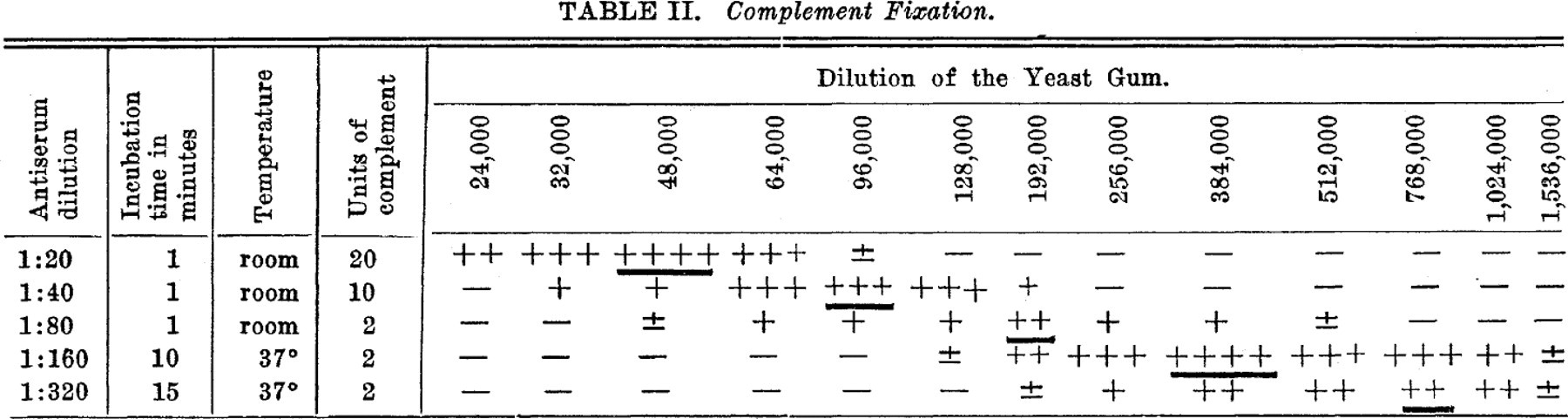 considered throughout the first tube giving precipitate or fixation so that our method differs from previous work where emphasis was placed on the maximum precipitate. Because of their great sensitivity we have used carbohydrate haptens rather than proteins as antigens. One of these haptens is a carbohydrate gum obtained from a pathogenic yeast, and the other the aerogenes specific substance described in the preceding paper. Both of these gave a precipitate with their respective immune serum when diluted 1:500,000 and complement fixation when diluted 1:64,000,000.
For the precipitation reaction the method of Dean and Webb was followed. Dilutions lower than 1 :5 and higher than 1 :40 could not be used, as in the former precipitate occurred at once in several tubes, and in the latter there was a slight opacity only.
It is difficult to restrict the fixation of complement to a few tubes, but by using varying amounts of complement and different incubation times and temperatures it is possible to determine for each dilution of serum the zone where maximum fixation takes place.
Get full access to this article
View all access options for this article.