




Abstract
A quantitative study has been made of the growth of a portion of the arterial system in 48 human fetuses ranging from 10.7 to 49.8 cm. in total or crown-heel length.
A segment of standard length was cut from each vessel with an apparatus consisting of two steel blades firmly fastened in parallel to a machined brass block exactly 5 millimeters apart. Rings were cut from each of the following arteries: thoracic aorta, abdominal aorta, innominate, left common carotid, left subclavian, right and left umbilical and the right and left common iliac.
When the weights of the rings are plotted against crown-heel length in centimeters, the resulting curves are of two general classes. The values of the rings of the vessels which supply the body only, 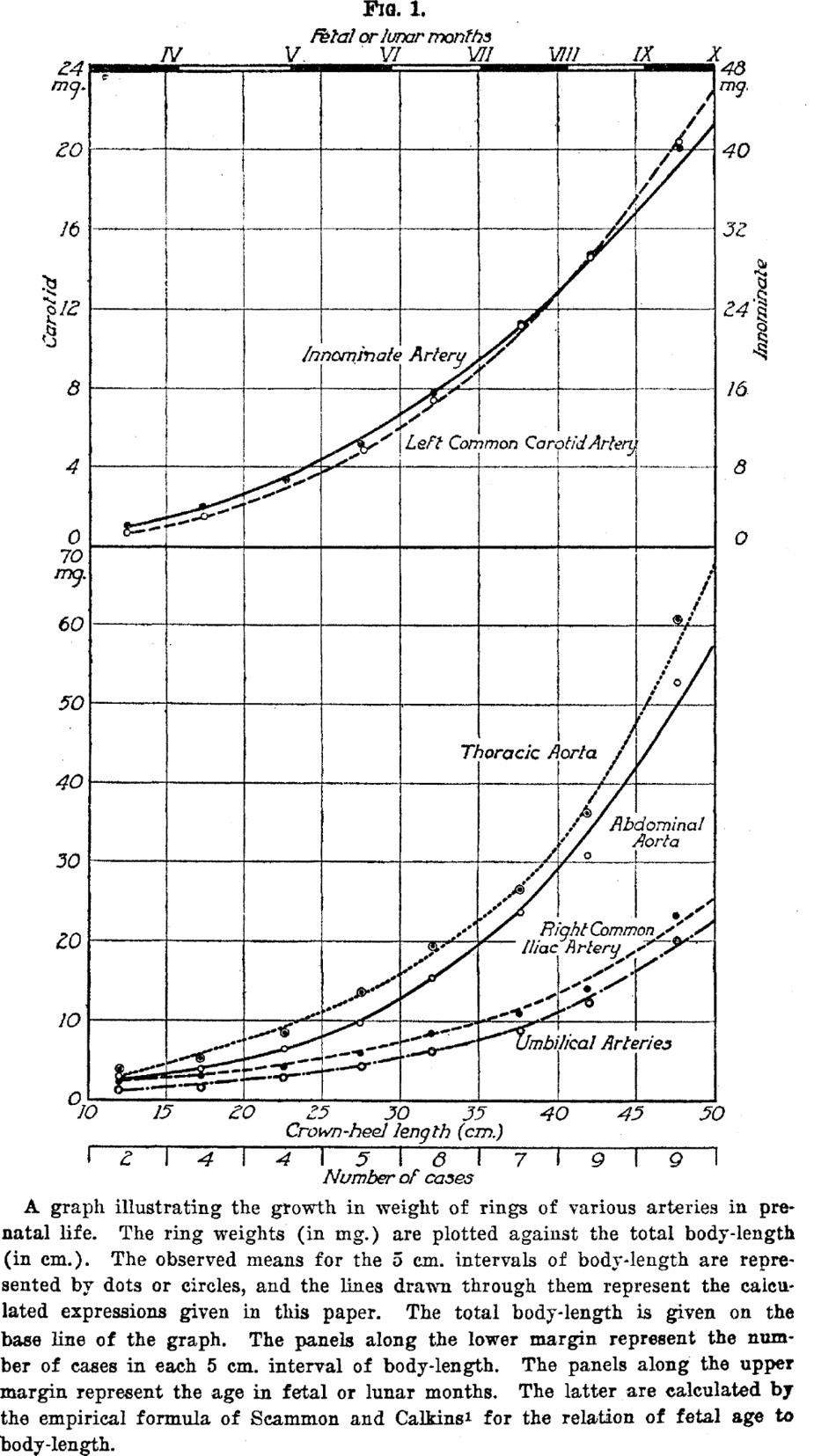
Y = aXb
where “Y” = the weight of the segment in question, “X” = the total body-length and “a” and “b” are empirically determined constants, the first in the form of a decimal fraction and the second a power between a square and a cube. The graphs of these relationships are shown in the following figure. The empirical formulae for these weights, as determined from the 5 cm. interval averages of crown-heel length by the method of means, weighting by the square root of the number of cases, are as follows:
The curve of the left subclavian artery is not included in the figure for its values are so similar to those of the left common carotid artery that they could not [be clearly represented upon the combined graph.
Get full access to this article
View all access options for this article.