




Abstract
The idea that tetany was a condition associated with alkalosis originated from the high figures for the CO2 combining power of the blood obtained in tetany occasioned by gastric lavage and was strengthened by the statement that tetany may be accompanied by a pH as high as 7.8. As a result of work carried out here two years ago, the conclusion was reached that the variation in the pH to the alkaline side of normal need not necessarily be great, and that such a variation was undoubtedly followed by a fall to the acid side of the normal for the animal under observation.
To investigate changes in the acid-base balance by determining values for the pH, [CO2], [H2CO3] and [BHCO3] of the blood, CO2 dissociation curves were drawn for the blood of normal and thyroparathyroidectomized dogs, the determinations on the latter being made on the three consecutive days following the operation. The pH was calculated from the equilibration data by use of the Hasselbach formula and thus a curve approximately linear in character was obtained in which [CO2] was related to pH. The pH for the blood under consideration was then found by interpolation upon this curve of the total [CO2] value of the blood as drawn. To determine changes in the alkali reserve the value of the [CO2] for the blood as drawn was extrapolated to the value which would obtain at the CO2 tension necessary to maintain the pH at the normal figure for the animal. From the value thus found the [BHCO3] was calculated,
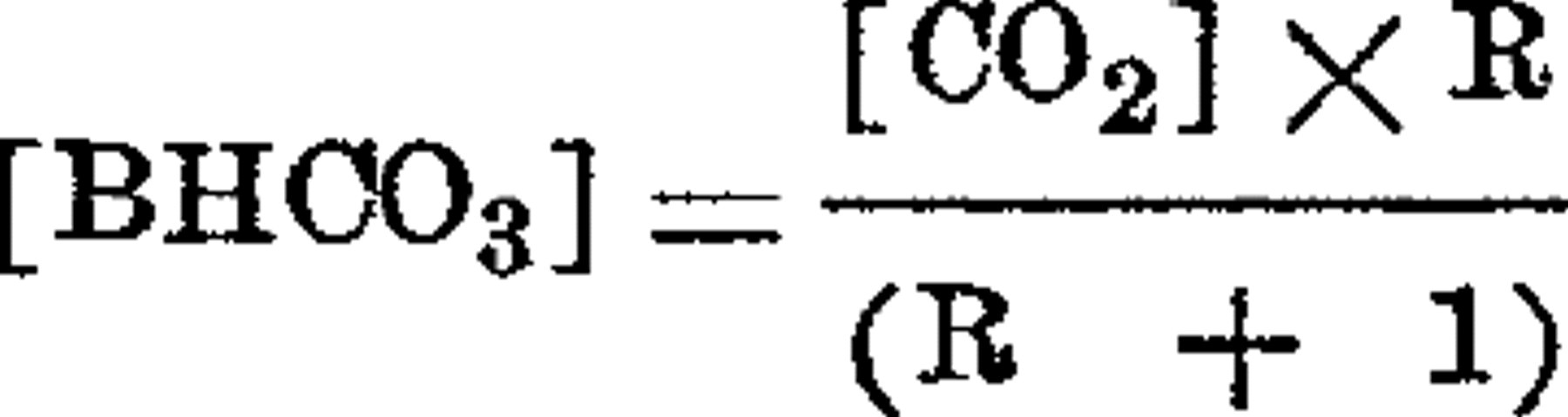
R being equal to the ratio [BHCO3] : [H2CO3]; the change in the base content of the blood then indicated the excess of base over acids other than H2CO3.
Get full access to this article
View all access options for this article.