




Abstract
It has been generally assumed that the weight of the body in prenatal life may be represented by a cube of a fraction of the total or crown-heel length. In a study of the lengths and deadweights of 2202 embryos and fetuses we have found that this relation can be more accurately expressed by the formulae:
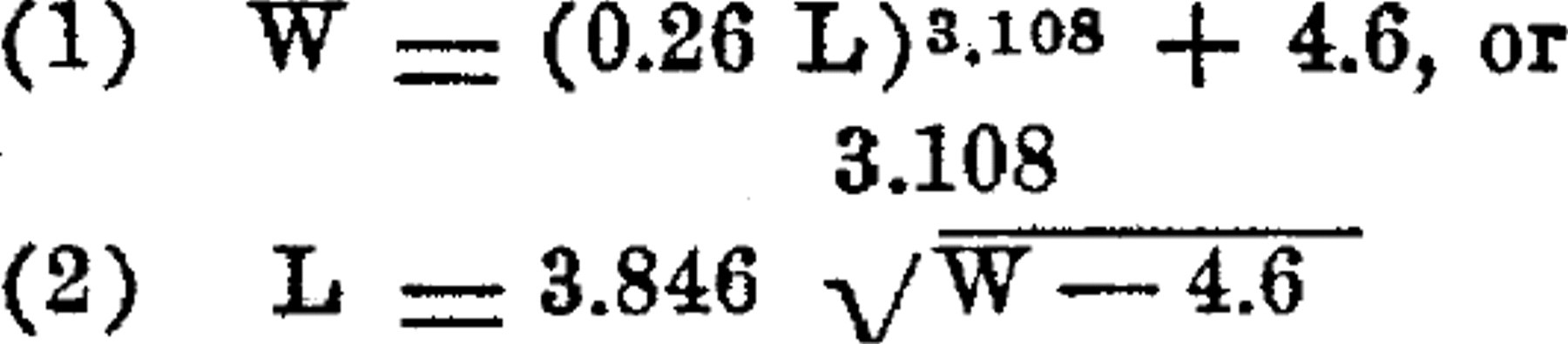
In these expressions W is the weight in grams, and L is the total or crown-heel length in centimeters. These formulae are satisfactory from 5 to 55 cm. body-length but do not hold good above the latter limit and, probably, not below the former. The following graph shows the relation between the observed values and the calculated curve of weight increase, in respect to length; and the accompanying table gives the observed and calculated mean weights for each 5 cm. range of body-length, and the absolute and percentage differences between these values.
The live and dead-weights of fetuses of the same body-length are quite different, the former being distinctly the greater. Therefore the majority of the published tables and curves of weight increment in prenatal life are not strictly correct, for they include both types of material.
In order to estimate the amount of this difference we have computed the mean body-weight of living fetuses and newborn children for each 5 cm. range of body-length from 35 to 55 cm. inclusive. These computations are based on a series of 5674 observations. A comparison of these values with the calculated values for dead material at the same mean lengths shows an average difference of 219.3 gm. in favor of the living material. The 5 cm. range differences showed no consistent increase with increasing body-length. Therefore the relation between live-weight
and body-length in the latter part of prenatal life may be approximated by the empirical formulae:
Get full access to this article
View all access options for this article.