




Abstract
Are the conditions which are believed to be necessary for autolysis realized in infarction? A true acidity is known to be necessary in some critical cases for autolysis, 1 that is, PH < 7, 0. Infarction was made by kidney vessel ligation. The CH was determined for the control blood and for that of the blood from the kidney after various periods of time elapsing after ligation.
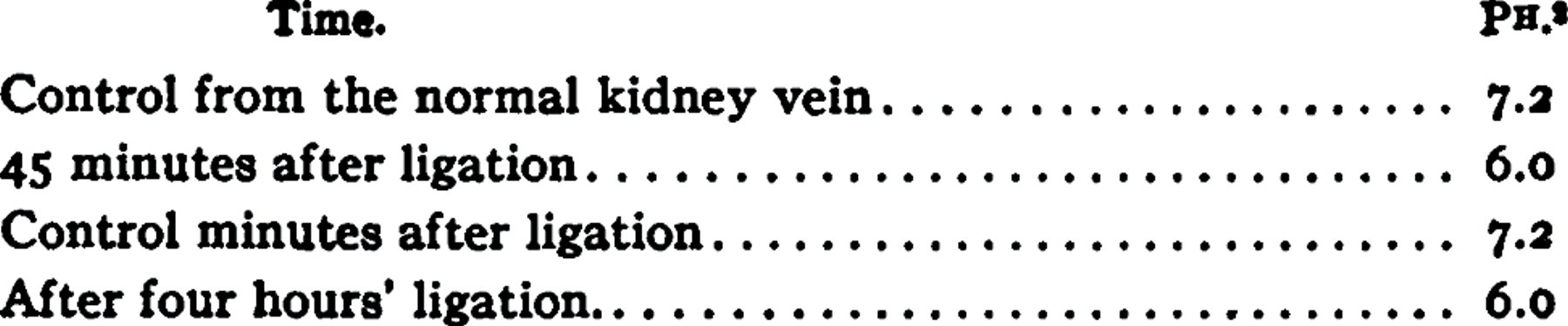
Again, in a guinea-pig liver, excised and frozen by CO2 within 50 seconds after excision, ground up and suspended in 0.9 per cent. NaCl solution and introduced into a Clark (W. M.) shaking hydrogen electrode CH gave PH 6, 5, the blood control giving 7, 2. After 35 minutes, PH = 6, 33 This rapid rise in CH is in harmony with the observations of Hopkins, Moore and Roaf, concerning the origin of lactic acid immediately after the death of the tissue. It is likewise compatible with the determinations which Taschiro4 has made on CO2 evolution after injury. The conclusion is justified that as far as reaction is concerned, the concentration of hydrogen ions is adequate for autolysis.
Can protein hydrolysis be demonstrated codrdinate with the CH? In the experiments described above, the variation of CNH 2 nitrogen was found to be as follows:
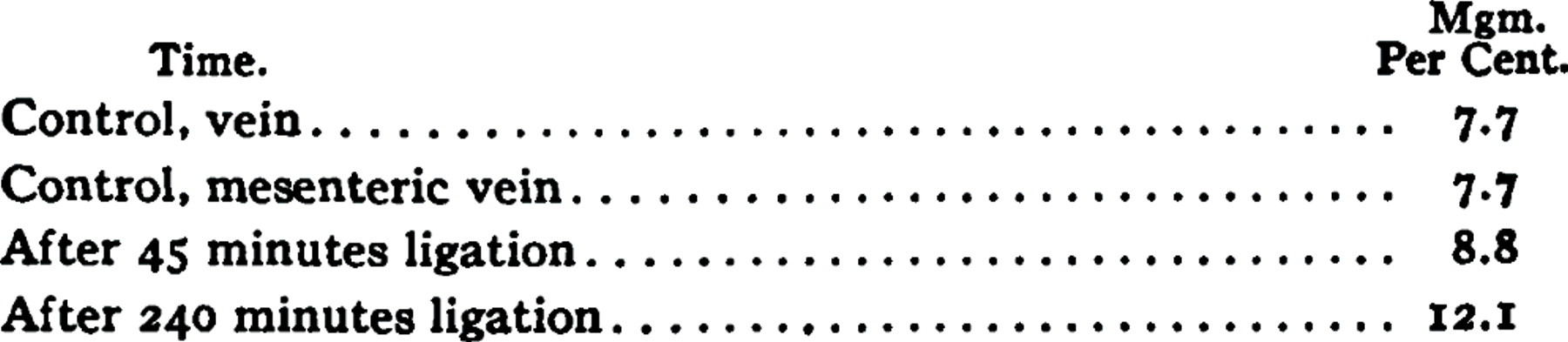
The conclusion is here justified that there is evidence of hydrolysis of the proteins correlative with the development of acidity.
In work with inorganic colloids and catalysis, it has been shown that there is a relation between colloidal dispersion and catalysis. It is known that brain tissue hydrolyzes very much more slowly in vitro than in vivo and than other tissues. The question arose as to the following point:
Get full access to this article
View all access options for this article.