




Abstract
The following determinations of basal metabolism were calculated by indirect calorimetry from the oxygen absorption and the R. Q., these factors being obtained by means of Benedict's unit apparatus (mouthpiece and spirometer). At least three ten-minute periods were run, and the average taken for that day's basal metabolism. In case I the calculation included the estimation of calories due to non-protein metabolism and to this was added that due to protein. In the other cases the protein metabolism was ignored. None of these cases had over 6-7 grams urinary nitrogen per day, so that the protein element would not affect the total calorie calculation by more than 1 to 2 per cent.
The body surface has been calculated by Meeh's formula and also by DuBois's.
The results are given in the table.
Cases studied were:
Case 1. Simple obesity of many years duration.
Case 2. Very marked obesity, also of many years duration.
Case 3. Sudden gain in weight in last year and a half. Sugar tolerance abnormally low. Thought to be hypo-pituitary. Said to have a polyuria, not noticed in ward.
Case 4. Acromegaly of long standing. Sugar tolerance now high. Thought to be going over into a hypopituitary stage.
Case 5. Typical myxedema. Never treated with thyroid.
Subject Dr. P. Normal control. Large muscular man.
In the cases studied the surface area by Meeh's formula was from 10 to 30 per cent. below that by DuBois's. In two cases of marked, obesity the metabolism per square meter (DuBois) was 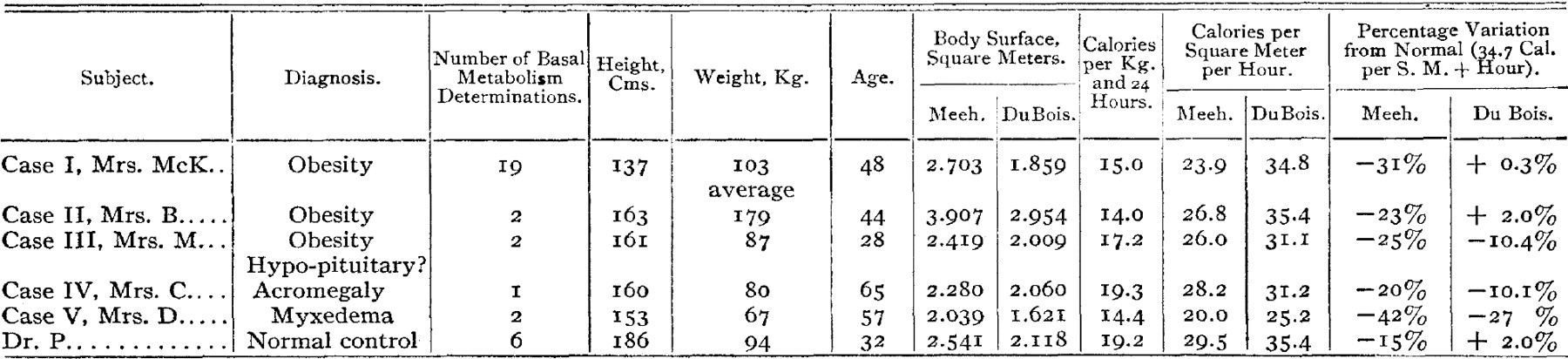 normal. One case of obesity thought to be of pituitary origin was 10 per cent. from the normal average and hence may be regarded as suspicious. The case of acromegaly was also 10 per cent. below, and the myxedema 27 per cent. below.
Get full access to this article
View all access options for this article.