




Abstract
Michaelis and several other workers following him have claimed for the phenomenon of acid agglutination a specificity comparable with that of specific serum agglutination. The reaction is specific, they say, in that optimum agglutination is produced in suspensions of bacteria of a single species by a definite concentration of hydrogen ions, irrespective of the acid used, and in that this concentration is, in general, different for different species. Their method has been to prepare solutions of definite hydrogen ion concentrations by using mixtures of a weak acid with its sodium salt, the concentrations being calculated from the formula
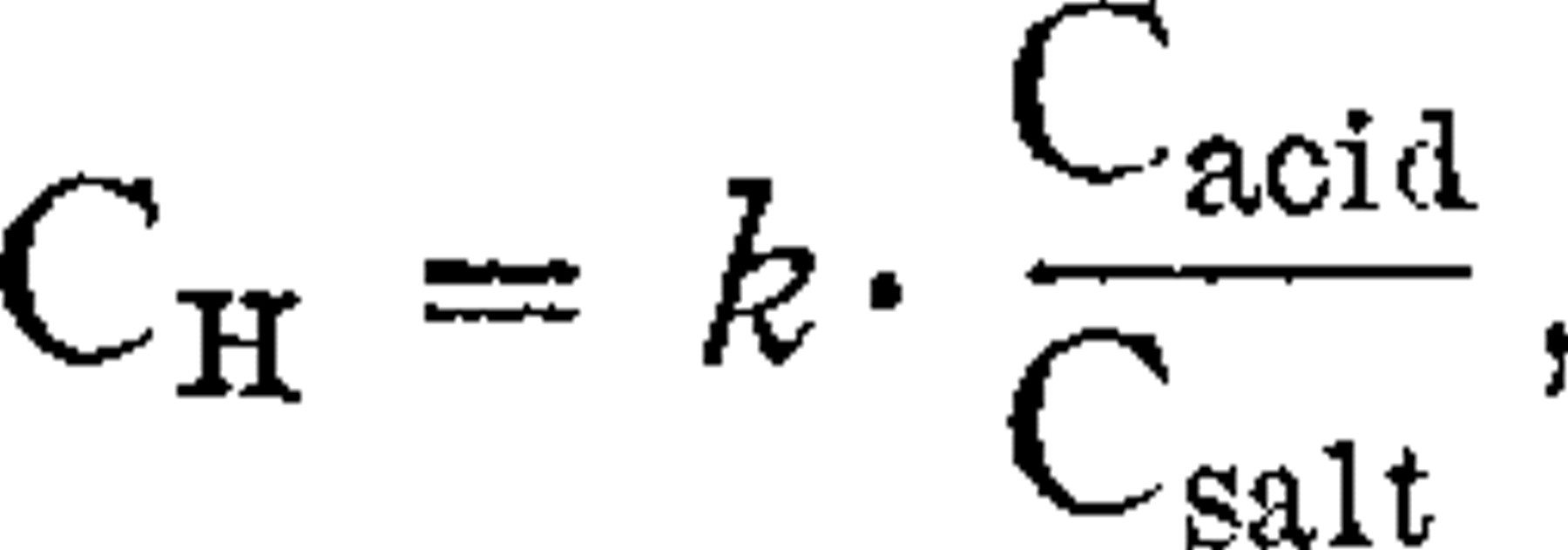
where k represents the dissociation constant of the acid used. The differences between the constants obtained in this way for the different species are especially marked in the case of the typhoid-colon group. Schidorsky and Reim claim to have had considerable success in the practical diagnosis of typhoid using this method.
Jaffé, working with a number of strains in the typhoid-colon group, obtained constants differing somewhat from those of Michaelis, and observed also several strains of each species which showed markedly different behavior toward the reagents from that of the general average.
In my investigations I made use of six strains of B. typhosus and four of B. coli. In two sets of experiments, using in one case, acetic acid and sodium acetate, and in the other, lactic acid and sodium lactate, the behavior of five strains of B. typhosus was shown to be the same toward both of these reagents. Three of the strains regularly failed to agglutinate at all even when concentrations of hydrogen ion varying between .7 and 900'× 10-5 were used. The other two strains agglutinated about equally in all the concentrations between 14 and 200 × 10-5.
Get full access to this article
View all access options for this article.