




Abstract
Drawing from frameworks of categorical inequality and leveled tracking, this study examines how English learners (EL) status serves as a label that limits students’ access to college-level course-taking in high school and subsequent postsecondary opportunities. We find that EL–never-EL gaps in postsecondary outcomes vary by the timing of reclassification but are largely explained by student and school factors. We also show that ELs reclassified in later grades take fewer college-level courses than both never-EL students and ELs reclassified earlier. Nonlinear variance decomposition analyses reveal that a substantial portion of these outcome gaps is attributable to differences in college-level course-taking. We conclude by sharing insights from district staff to help schools support EL students in completing college-level coursework and expanding their postsecondary opportunities.
Keywords
Introduction
The share of U.S. students who are first- or second-generation immigrants has nearly doubled over the past 3 decades, rising from 13.4% in 1990 to 25.7% in 2023 (Migration Policy Institute, n.d.). In 2020, approximately 5 million students in U.S. public schools were classified as English learners (EL), comprising 10.3% of the student population and reflecting a 10% increase from the previous decade (National Center for Education Statistics, 2023). This growing linguistic and cultural diversity presents both opportunities and challenges for schools, which must support English language development while ensuring equitable access to academic content. Although EL classification is designed to support language acquisition, it can also serve as a mechanism of curricular tracking—granting access to linguistic supports while simultaneously limiting access to rigorous academic content (Domina et al., 2017; Umansky, 2016). These patterns raise equity concerns, particularly for a population that is disproportionately low-income and non-White (U.S. Department of Education, n.d.). Because college-level course-taking in high school is associated with postsecondary enrollment and completion (Attewell & Domina, 2008; M. C. Long et al., 2012), ELs’ restricted access to such coursework may have lasting consequences for educational attainment.
A growing body of research has examined EL students’ course-taking and postsecondary outcomes. Several studies have focused on advanced course-taking (Callahan, 2005; Callahan & Shifrer, 2016; Callahan et al., 2009, 2010; Johnson, 2019a; Kanno & Kangas, 2014; Thompson, 2017) or college enrollment (Callahan & Humphries, 2016; Callahan et al., 2024; Carlson & Knowles, 2016; Johnson, 2019b; Kanno & Cromley, 2015), but fewer have followed EL students to college completion (Kanno & Cromley, 2013; Schudde et al., 2025). Only a couple of studies distinguish between general postsecondary outcomes and those specific to 4-year institutions (Callahan et al., 2024; Schudde et al., 2025). Furthermore, limited research has explored the connection between EL students’ access to college-level coursework in high school—such as Advanced Placement (AP), International Baccalaureate (IB), and dual credit courses—and their postsecondary outcomes (Kanno, 2018; Schudde et al., 2025). In addition, there is a need to better understand how the timing of EL reclassification influences course-taking patterns and educational attainment. While Cashiola et al. (2022) found associations between early reclassification and academic outcomes in middle and high school, Painter and Flores (2013) reported no significant differences by the timing of reclassification.
This study bridges three previously siloed areas of research—EL timing of reclassification, EL gaps in college-level course-taking in high school, and EL gaps in postsecondary outcomes—to test the assumption that inequitable course-taking opportunities contribute to educational stratification (Callahan & Gándara, 2004). Drawing on longitudinal data from a research-practice partnership (RPP) with the Houston Independent School District (HISD), we examine how college-level course-taking during the junior and senior years of high school mediates postsecondary gaps between EL groups, distinguishing students by EL status and timing of reclassification. Our analyses make several unique contributions to the growing literature on EL course-taking and postsecondary attainment.
First, we disaggregate the broad category of “ever-EL” to examine how the timing of reclassification—whether in elementary, middle, or high school—predicts access to college-level coursework and postsecondary enrollment and completion. Although recent studies examine the relationship between EL status, advanced course-taking, and college outcomes (Callahan et al., 2024; Schudde et al., 2025), they typically treat EL students as a homogenous group. If early reclassification is associated with improved outcomes, grouping all reclassified students together may obscure meaningful variation—a gap our study helps to address. Second, we focus specifically on AP, IB, and dual credit courses—collectively referred to as college-level coursework in high school—rather than broader definitions of advanced coursework that may include any class exceeding minimum graduation requirements. We emphasize these course types because they can confer college credit and are associated with concrete academic benefits, including higher first-year GPAs (An, 2013) and reduced time to degree (Evans, 2019). Third, we apply a decomposition method to quantify how sociodemographic, academic, and school-level factors 1 —particularly differences in college-level course-taking in high school—explain variation in postsecondary outcomes. This approach offers a clearer picture of the mechanisms linking EL status to college access and success. Fourth, we leverage rich administrative data from HISD, including robust measures such as course grades and a neighborhood-level proxy for socioeconomic status (SES), which are not typically available in state-level datasets. Finally, because this study emerged from an RPP, our analysis is enriched by insights from district collaborators, helping us interpret the findings in ways that are policy-relevant and actionable.
We find that EL gaps in college enrollment and completion are large but become statistically insignificant after accounting for sociodemographic, academic, and school-level factors. Prior to adjustment, gaps between never-EL students and those reclassified in later grades (e.g., high school) were larger than gaps between never-EL students and those reclassified earlier (e.g., elementary school). We also show that the timing of EL reclassification predicts the number of college-level courses taken in the 11th and 12th grades. While never-EL students and those reclassified in elementary school take about the same number of college-level courses, students reclassified in middle school take fewer, and those reclassified in high school or never reclassified take even fewer. Last, decomposition analyses reveal that disparities in college-level course-taking explain a substantial share of the EL gap in college enrollment and completion. In addition, we find that differences in high school factors contribute to the EL gap in college completion. Notably, our study is among the first to empirically link the timing of EL reclassification to college-level coursework in high school and long-term postsecondary outcomes, offering new insight into how EL status shapes educational opportunity.
Literature Review
English Learners, Postsecondary Outcomes, and Academic Preparation
Several studies have examined the postsecondary outcomes of English learners and typically find that EL college enrollment and completion rates remain low compared to non-EL students. For instance, in their analysis of the National Educational Longitudinal Study of 1988, Kanno and Cromley (2013) found that ELs had lower rates of starting and finishing postsecondary education (i.e., vocational programs, community colleges, and 4-year colleges) than English proficient or monolingual students. Close to one-third of English monolingual students completed a bachelor’s degree (31.9%), nearly tripling the rate among ELs (11.7%). Using the Educational Longitudinal Study (ELS) of 2002, Kanno and Cromley (2015) showed that ELs were less likely than English proficient and native English-speaking students to remain on a 4-year college pathway, defined by five milestones: (a) aspiring to graduate from a 4-year college, (b) completing Algebra II, (c) graduating from high school, (d) applying to a 4-year college, and (e) enrolling in one. Only 13% of ELs achieved all five milestones, compared to 25% of English proficient students and 36% of native English-speaking students.
EL gaps in higher education access and success may be tied to gaps in academic preparation (Callahan & Gándara, 2004; Kanno, 2018). Descriptively, Kanno and Cromley (2013, 2015) show that EL students were less likely to complete Algebra II or advanced math coursework during high school, though their analyses did not focus specifically on AP, IB, or dual credit courses. Callahan and Shifrer (2016) analyzed ELS data and found that ELs were less likely to complete a college preparatory curriculum than linguistic minority students not enrolled in English as a second language (ESL) coursework, as well as native English speakers, even after accounting for test scores, grades, and educational expectations. Their definition of college preparatory coursework, however, was relatively broad—focused on credit accumulation in core subjects beyond minimum graduation requirements—rather than enrollment in courses that more explicitly signal college-level rigor. Using a similarly broad definition of college preparatory coursework, Callahan et al. (2010) clarified that the relationship between EL status and college preparatory coursework may vary based on student need. They found that ESL placement had heterogeneous effects among linguistic minority students: it improved college preparatory course-taking for those with greater educational needs (e.g., recent immigrants, lower English proficiency, and lower test scores) but reduced it for students with fewer needs. Although these studies offer important insights into EL access to advanced coursework, few give specific attention to the relationship between EL status and access to college-level coursework, such as AP, IB, and dual credit courses, in high school.
College-Level Coursework in High School: AP, IB, and Dual Credit
High schools offer several opportunities for EL students to engage in college-level coursework through AP, IB, and dual credit courses. Unlike advanced or honors courses, these programs allow students to earn college credit while still in high school, potentially providing a “financially inexpensive pathway” to higher education (Evans, 2019, p. 2), particularly for marginalized students. The AP program, administered by the College Board, offers subject-specific college-level courses (College Board, n.d.), while the IB program provides a comprehensive curriculum at the college level across six subject areas (International Baccalaureate Organization, 2025). Dual credit programs allow students to take college courses at local colleges or universities, rather than college-level courses delivered in high school classrooms (An & Taylor, 2019). Students can earn credit in AP and IB programs by achieving qualifying scores on standardized exams, while dual credit students earn credit through course completion. Participation in these programs has been associated with positive postsecondary outcomes, including increased college enrollment (Saavedra, 2014), higher first-year GPAs, reduced remediation rates (An, 2013), and shorter time to degree completion (Evans, 2019). Despite this growing body of evidence, few studies have examined how participation in college-level coursework during high school contributes to disparities in postsecondary outcomes by EL status.
College-Level Coursework in High School and Postsecondary Outcomes Among EL Students
Two recent studies have explored the relationship between college-level coursework in high school and postsecondary outcomes for EL students. Using Texas administrative data, Schudde et al. (2025) compared students ever classified as EL to their never-EL peers on college enrollment, college type, and degree attainment. Descriptively, they found that ever-EL students attending 2-year colleges took fewer AP/IB and dual credit courses than never-ELs, while those attending 4-year colleges were more likely to take AP/IB courses. While the study considers how course-taking relates to enrollment, it does not examine whether college-level coursework mediates the relationship between EL status and postsecondary outcomes. Another Texas study examines whether ever-EL status moderates the relationship between advanced math course-taking—defined as math courses beyond Algebra II—and college enrollment (Callahan et al., 2024). Like Schudde et al. (2025), they found ever-ELs completed fewer advanced courses than never-ELs. In multilevel models, Callahan et al. (2024) show that ever-ELs were as likely as never-ELs to enroll in a 4-year college—but only among students who completed at least three advanced math courses beyond their school’s average. However, their measure of advanced coursework combines AP, IB, and dual credit math with other advanced math courses beyond Algebra II, making it difficult to isolate the role of college-level math.
While Schudde et al. (2025) and Callahan et al. (2024) make important contributions to our understanding of advanced coursework and college outcomes for EL students, our study builds on their work in several ways. First, Schudde et al. (2025) present valuable descriptive statistics on AP, IB, and dual credit course-taking but do not examine these patterns in depth. Second, although Callahan et al. (2024) explore whether ever-EL status moderates the relationship between advanced math coursework and college enrollment, their analysis focuses only on math and considers outcomes within 3 years of high school graduation, without examining college completion. Third, the two studies are limited by the absence of grades—an important predictor of academic success, including college GPA (Geiser & Santelices, 2007)—potentially affecting estimates of the relationship between coursework and college outcomes. Most notably, both studies group all students ever classified as EL, without accounting for when reclassification occurred—a factor that may shape access to advanced coursework and, ultimately, college trajectories. Our study extends this line of research by considering how the timing of reclassification relates to both college-level course-taking in high school and postsecondary attainment.
Timing of Reclassification and Long-Term Outcomes
Reclassification—the point at which students are deemed proficient in English and exit EL services (Umansky & Reardon, 2014)—reshapes educational opportunity, reducing language support even as it broadens academic pathways. 2 For instance, Umansky (2016) found that reclassification increased the academic and honors credits taken by middle school students, and Carlson and Knowles (2016) identified positive effects on ACT scores, high school graduation, and college enrollment. Yet there is a growing need for analyses that disaggregate EL students by the timing of reclassification and connect it to both college-level course-taking and postsecondary outcomes. Prior research supports this approach. Kieffer and Thompson (2018) show that meaningful differences exist between students currently classified as ELs and those who have been reclassified, and that focusing only on current ELs can obscure evidence of educational progress. Although their study examined test score trends, a similar issue arises for other outcomes: progress in areas such as access to advanced coursework may also be overlooked when former ELs are excluded or when all ELs are collapsed into a single ever-EL category. Given that tracking into hierarchically ordered courses begins in middle school and intensifies in high school (Dauber et al., 1996; Gamoran, 1992), when students reclassify is crucial. For example, taking pre-AP Algebra I in eighth grade may be a prerequisite for later access to AP Calculus. Thus, participation in college-level coursework in high school may reflect a longer course-taking sequence, shaped by opportunities or constraints introduced earlier in a student’s educational trajectory (Stevenson et al., 1994).
The literature, however, presents mixed evidence on whether earlier reclassification enhances course-taking and college outcomes. Painter and Flores (2013) found that while EL reclassification improved several academic outcomes, there was little variation by the grade at which reclassification occurred. In contrast, Johnson (2019a) examined course-taking patterns among never-EL and EL students in a California school district, disaggregating by reclassification status and time spent as an EL. She found that newcomer, mid-term, and long-term EL students completed fewer AP and honors courses than their never-EL peers, although these disparities either disappeared or reversed to an EL advantage after adjusting for prior achievement. In another study, Johnson (2019b) found no effect of initial EL classification on high school graduation or college attendance but identified positive effects of reclassification before key school transitions (i.e., grades 5 and 8).
Theoretical Framework
To examine the relationship between EL status, college-level course-taking in high school, and postsecondary enrollment and completion, we draw from the sociological frameworks of categorical inequality and leveled tracking. Humans are adept “at creating distinct social groups based on seemingly trivial differences and then acting on those distinctions” (Domina et al., 2023, p. 6). The social categories people create help them understand the world, form partnerships, divide resources and responsibilities, and, unfortunately, produce opportunities for exploitation (Domina et al., 2017). Broadly, categorical inequality holds that “social categories create boundaries and influence the distribution of valuable resources across those boundaries” (Domina et al., 2017, p. 315). Domina et al. (2017, 2023) apply this framework to education to explain how schools can simultaneously mitigate and exacerbate social stratification. They argue that schools serve as “social sorting machines” that create internal categories (e.g., academic tracks) and acquire imposed categories (e.g., accountability labels) in ways that entrench enduring inequalities (Domina et al., 2017, p. 315).
Domina et al. (2017) underscore that external categories, including those established through school accountability policies, create “socially meaningful categories” that send signals about who students are, shaping how teachers and staff evaluate and interact with them (p. 317). In the case of English learners, public schools adopt categories of English proficiency based on federal and state standards and sort students accordingly. Under the Every Student Succeeds Act (ESSA), states must set criteria identifying ELs for support services as well as for reclassification (Sugarman, 2020). States vary in their reclassification criteria (Rafa et al., 2020). While ESSA requires standardized entrance and exit procedures, some state policies still allow districts or schools to exercise discretion over reclassification decisions. For example, in Texas, school-level committees can make the final determination on whether a student is reclassified, and criteria include not only standardized English proficiency and reading assessments but also a teacher-rated evaluation based on the state’s rubric (Texas Education Agency, 2025).
Schools and districts may also decide how imposed categories like English learner shape educational opportunities and “direct these students toward differentiated—and often unequal—sets of instructional services” (Domina et al., 2017, p. 319). Umansky (2016) connects the differentiated instruction experienced by EL students to the curriculum tracking literature. Tracking is defined as “the practice of separating students for instruction based on measures of their achievement or perceived ability” (Tyson, 2013, p. 169). Despite an intention to provide instruction targeted to performance levels and academic needs, tracking may exacerbate educational inequalities (Gamoran, 1987, 2004). Lower-track courses emphasize rote skills like memorization of facts and formulas, with little class discussion, rather than developing students’ problem-solving and writing skills (Gamoran, 2004; Gamoran et al., 1995). In contrast, students who complete higher-level coursework typically outperform their peers on standardized tests, are more likely to attend college, choose selective institutions, and graduate with a degree (Adelman, 2006; Attewell & Domina, 2008; Evans, 2019; M. C. Long at al., 2012). Drawing from this research, Umansky (2016) identifies two forms of tracking experienced by EL students: (a) exclusionary tracking, which restricts ELs from core academic content courses (e.g., math, science), and (b) leveled tracking, which sorts ELs into differentiated coursework (e.g., remedial, honors). Although exclusionary tracking hinders ELs’ access to courses required for high school graduation, leveled tracking limits access to advanced courses that prepare students for postsecondary success.
On the one hand, EL students’ constrained access to higher-track courses is structural. EL classification triggers language acquisition courses that can crowd out advanced coursework from student schedules (Umansky, 2016). For example, Arizona’s Structured English Immersion model assigned ELs to 4 hr of English language development, leaving only one-fifth of instructional time for other subjects (Gándara & Orfield, 2012; Lillie et al., 2012). In a study of a large urban California district, Umansky (2016) found that ELs were 40 percentage points less likely than their English-only peers to enroll in a full academic course load—defined as English language arts, math, and science—during middle school (grades 6–8). On the other hand, the EL label may stigmatize students, signaling to teachers and staff that they are incapable of handling rigorous coursework. As Callahan and Shifrer (2016) argue, “EL status suggests to teachers a need to limit instructional rigor and academic expectations while students learn English” (p. 488). Studies show that ELs may be placed in remedial or low-track courses regardless of academic performance (Kanno, 2018; Kanno & Kangas, 2014; Zuniga et al., 2005). For example, two qualitative analyses found ELs were automatically assigned to remedial coursework after completing language development courses (Kanno, 2018; Kanno & Kangas, 2014). Although prior performance explained many differences between students, Umansky (2016) found that ELs completed two fewer honors credits during middle school than their English-only peers.
Research Questions
While the EL category was designed to provide targeted English language support, it may also function as a sorting mechanism that tracks students into less rigorous educational paths. This sorting and tracking can result from language support services crowding out college-level courses or from teacher perceptions and institutional rules that limit EL students’ opportunities. Such dynamics may ultimately constrain ELs’ postsecondary prospects if the barriers to college-level coursework outweigh the benefits of language support. Although most research on ELs focuses on PK-12 academic outcomes and reclassification as English proficient, far less is known about how current and former ELs fare beyond secondary education. This study bridges research on ELs’ access to advanced coursework with their postsecondary outcomes to assess whether EL status operates as a category that tracks students away from college-level opportunities in high school and beyond. Because course-taking is sequential, the timing of reclassification is crucial. We divide students into four groups—never-EL, reclassified in elementary school, reclassified in middle school, and reclassified in high school or still classified as EL—to examine how both EL status and reclassification timing shape access to college-level coursework in high school and, in turn, postsecondary attendance and graduation. Specifically, we address the following questions:
What is the role of EL status, specifically the grade level during which a student reclassifies, in predicting college enrollment and completion 6 years after high school graduation?
Is there a relationship between EL status and college-level course-taking during high school?
What share of the gap in college enrollment and completion by EL status is attributable to gaps in college-level course-taking during high school?
Data
To test how EL status predicts postsecondary attainment, we used longitudinal administrative data from HISD, the nation’s ninth-largest school district (National Center for Education Statistics, 2022). Our data, obtained from the Houston Education Research Consortium (HERC), an RPP, spanned the 1994–1995 through 2017–2018 school years, allowing us to determine students’ EL status over time and to track them to and through college. The dataset included sociodemographic, academic, and school characteristics and was matched to National Student Clearinghouse records to measure college attendance and graduation. Our sample consisted of five cohorts of high school students who graduated in the spring semesters from 2008 to 2012 and who had nonmissing data (N = 31,504). 3
HISD provides an important, policy-relevant setting for this analysis. As the largest district in Texas and one of the most diverse nationally, nearly two-fifths of 12th-grade students were classified as current or former ELs during the study period. The district encompasses a wide range environments—from selective magnet programs to schools serving predominantly low-income immigrant communities—but operates under a unified reclassification policy. These characteristics strengthen internal validity by allowing us to examine variation in college-level course-taking and postsecondary outcomes within a common policy context, rather than across districts with differing practices. HISD’s administrative data also include measures typically unavailable in state datasets, such as course grades and a neighborhood SES index based on Census data. These finer-grained indicators enable more precise analyses of academic preparation and contextual disadvantage. Finally, because the study was conducted through an RPP with HISD, practitioner insights helped shape both the interpretation of findings and the development of actionable implications.
Dependent Variables
To address research questions one and three, we examined two sets of outcomes: (a) whether a student enrolled in any college or a 4-year college within 6 years of high school graduation, and (b) whether a student completed any postsecondary credential or a bachelor’s degree within the same time frame. College completion analyses were restricted to students who enrolled in any college or a 4-year college in the fall following graduation. For research question two, the outcome of interest was college-level course-taking in high school, measured as the total number of AP, IB, and academic dual credit courses students completed during their junior and senior years.
Key Independent Variables
Rather than using a binary ever-EL indicator, we defined EL status by the timing of reclassification—that is, when schools, drawing on a mix of academic measures, staff judgments, and policy interpretation, deem students eligible to exit EL services. 4 This process is not solely a measure of English proficiency but is also shaped by local discretion and, at times, bias (Mavrogordato & White, 2020; Umansky et al., 2020). We disaggregated EL status to capture how earlier reclassification might correspond with reduced exposure to tracking mechanisms in the upper grades (Dauber et al., 1996; Gamoran, 1992). The resulting four-category variable identifies students as: (a) never-EL, (b) former EL reclassified in elementary school (grades PK–5), 5 (c) former EL reclassified in middle school (grades 6–8), and (d) former EL reclassified in high school (grades 9–11) or current EL (grade 12).6,7 We used this variable to calculate raw gaps in college outcomes by EL status and to observe how those gaps changed after accounting for sociodemographic, academic, and school factors (RQ1). We also used the variable to assess differences in college-level course-taking in high school by EL status (RQ2) and to examine how differences in sociodemographic, academic, and school factors contributed to disparities in college outcomes (RQ3). In addition, for research question three, a second key independent variable of interest was the number of college-level courses a student took during their junior and senior years of high school. 8
Sociodemographic, Academic, and School-Level Factors
Our statistical analysis considered student- and school-level factors that might influence students’ decisions to attend and graduate from college or take college-level courses during high school. 9 Rather than making causal claims, we descriptively examine how observed differences across domains of opportunity structure—sociodemographic background, academic preparation, and school context—relate to gaps in postsecondary outcomes by EL status and reclassification timing. Importantly, many of these factors may themselves reflect midstream consequences of EL classification and schooling, so we treat them as part of the pathways associated with postsecondary outcomes rather than as purely exogenous controls. Variables were categorized into three groups: sociodemographic factors (e.g., gender, race/ethnicity, economic disadvantage), academic factors (e.g., standardized reading test scores, average course grades), and school-level factors (e.g., percentage of economically disadvantaged students). Sociodemographic factors influence students’ access to resources, exposure to college-going norms, and educator expectations; academic factors capture demonstrated performance and preparation, which may reflect and shape institutional gatekeeping; and school-level factors represent differences in resources, curriculum offerings, and college-going cultures. We hypothesize that each cluster may independently and collectively influence students’ postsecondary trajectories. Supplementary Appendix Table 1 (available in the online version of this article) describes in detail the sociodemographic, academic, and school-level factors included in the models.
Summary Statistics
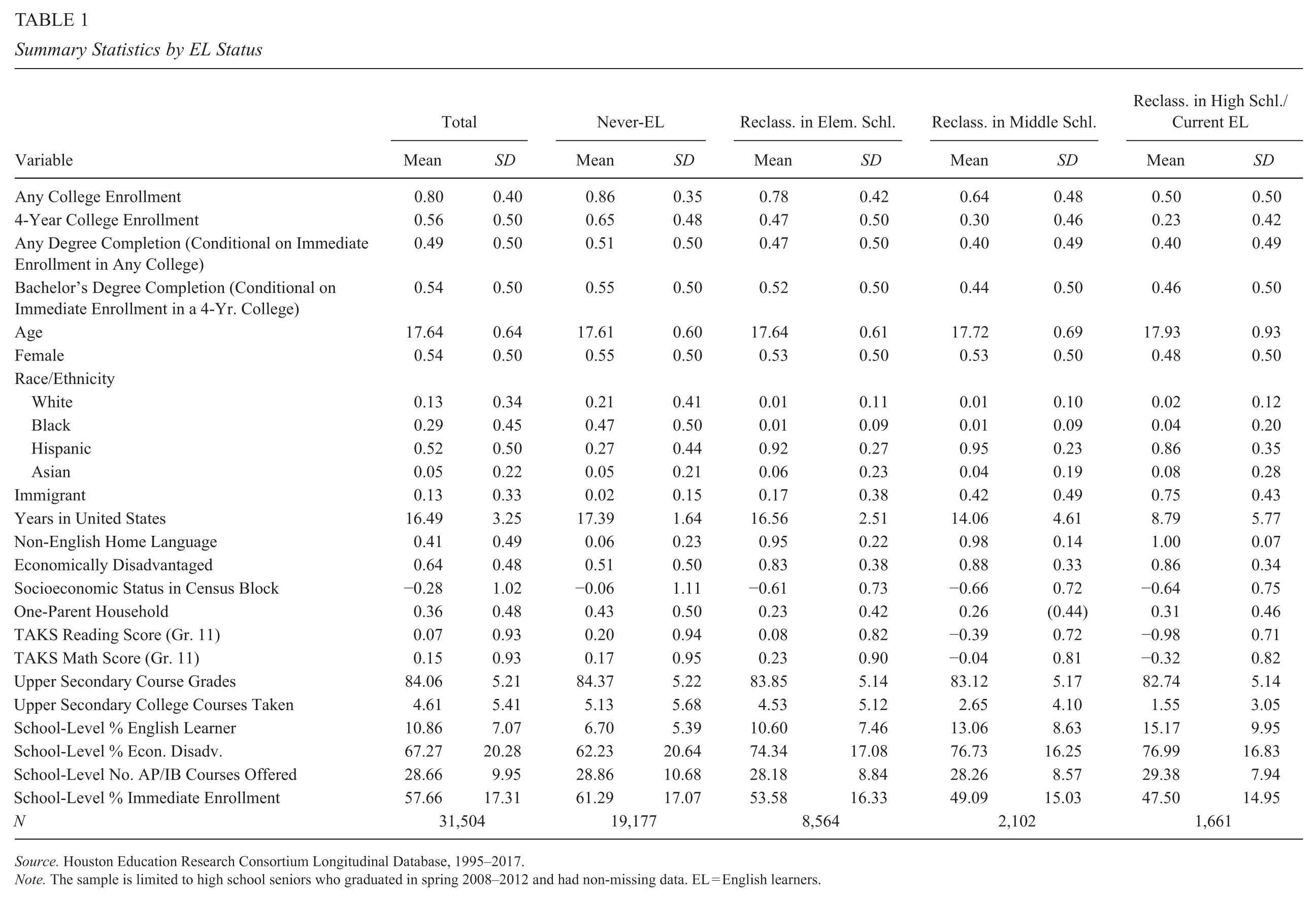
Table 1 presents summary statistics for the full analytic sample (N = 31,504) and by EL status: never-EL students and EL students reclassified in elementary, middle, and high school. Never-EL students comprised 61% of the sample. Students reclassified in elementary school made up 27%, those reclassified in middle school accounted for 7%, and the remaining 5% were either reclassified in high school or still classified as EL in 12th grade. Compared to never-EL students, higher proportions of EL students were Hispanic. Among EL students, larger shares of those reclassified in later grades were immigrants compared to those reclassified earlier. EL students were also more socioeconomically disadvantaged than never-EL students. Higher proportions of EL students qualified for free or reduced-price lunch or other poverty programs, and their average neighborhood SES index was about three-fifths of a standard deviation (SD) below the mean (compared to −0.06 SD for never-EL students). EL students also had lower academic performance (e.g., reading and math scores) and attended schools with lower college enrollment rates. Overall, EL students faced disadvantages across sociodemographic, academic, and school-level factors compared to their never-EL peers.
Summary Statistics by EL Status
Source. Houston Education Research Consortium Longitudinal Database, 1995–2017.
Note. The sample is limited to high school seniors who graduated in spring 2008–2012 and had non-missing data. EL = English learners.
Methods
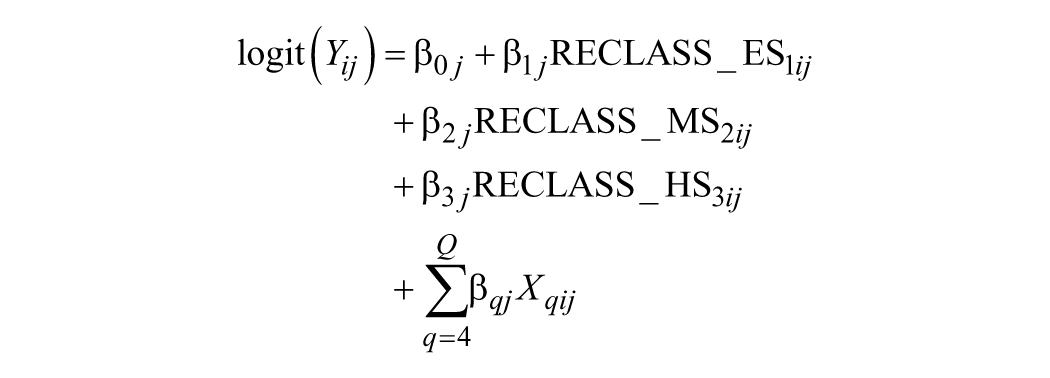
To address the first research question—how EL status predicts college enrollment and completion—we use multilevel logistic regression models with students nested in high schools:
Level-1
Level-2
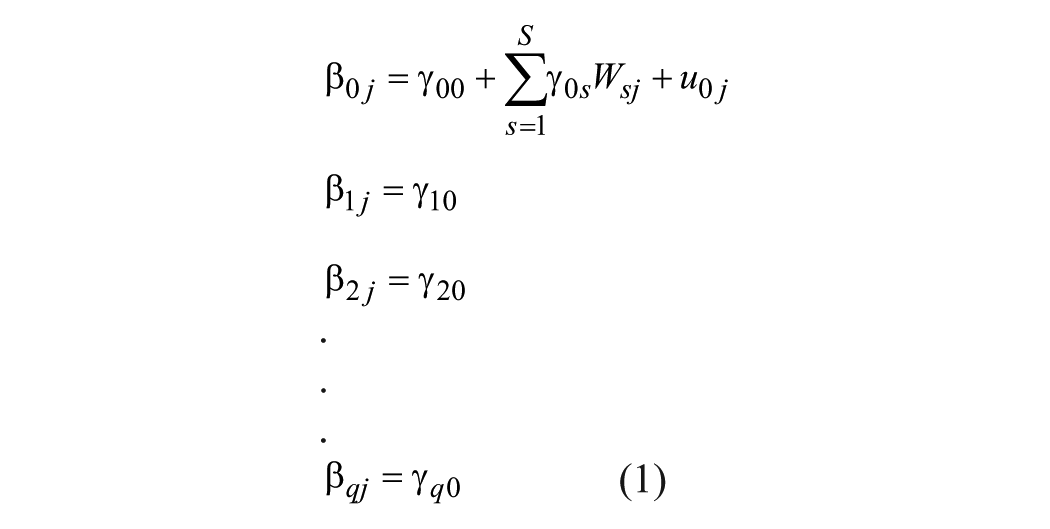
where
The other research questions explore how college-level course-taking in high school may serve as a form of leveled tracking for EL students, which, in turn, may partly explain differences in postsecondary attainment by EL status. For the second research question, we use a zero-inflated negative binomial count model to examine how EL status (ref. = Never-EL) predicts the number of college-level courses students take during the junior and senior years of high school. This model accounts for sociodemographic and school factors, and standard errors are clustered by school. 11 For the third research question, we use the Karlson–Holm–Breen (KHB) nonlinear variance decomposition method (Breen et al., 2013; Karlson & Holm, 2011; Karlson et al., 2012) to investigate how gaps in sociodemographic, academic, and school factors indirectly contribute to differences in college outcomes. Decomposition analyses, including the KHB approach, traditionally examine mediation and distinguish between direct and indirect effects of a predictor variable on an outcome (Breen et al., 2013). In our study, we focus on the indirect effect of EL status on postsecondary enrollment and completion.
We focus primarily on the academic indirect effects, particularly college-level course-taking in high school, because they are most relevant to leveled tracking and represent key mechanisms through which schools can effect change (Labaree, 2010; Phillips et al., 1998). At the same time, it is important to acknowledge that many of the sociodemographic, academic, and school factors included in our models may themselves be shaped by students’ prior educational experiences, including their EL status. For instance, test scores and grades may reflect not only prior achievement but also differential access to instructional opportunities following EL designation. Although often treated as controls, these variables can also capture important pathways through which educational experiences are linked to postsecondary outcomes. Recognizing these dynamics, our decomposition approach may be interpreted as a gaps-on-gaps analysis: we first calculate the difference in a college outcome (e.g., enrollment) between two groups (e.g., never-EL students and students reclassified in high school), then break down that disparity into its constituent parts (e.g., the portion attributable to differences in academic factors). Intuitively, the decomposition may be expressed as follows:
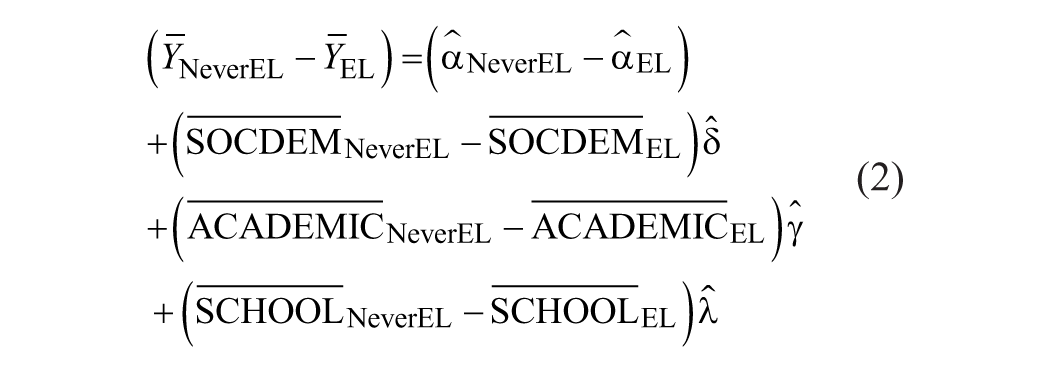
where
To explain our approach more simply, consider a hypothetical example using 4-year college enrollment rates. Suppose 70% of students in group A enroll in a 4-year college, compared to only 40% of students in group B—a 30 percentage point gap. This gap can be decomposed into its constituent parts. For example, if group A students come from higher-income families, approximately two-thirds of the gap might be attributed to differences in family income. The remaining 10 points could reflect academic differences, which can be further disaggregated: 6 points due to disparities in SAT scores, and 4 points due to differences in high school coursework.
For research questions one and three, we use the khbtab and khb commands in Stata (Kohler et al., 2011). 12 In both linear and discrete outcome regression models, adding control variables can change the magnitude of coefficients. However, in nonlinear models such as logistic regression, coefficient changes may also result from rescaling: when additional covariates are added, the total variance of the latent outcome changes, which alter the scale of the coefficients and complicates interpretation (Karlson & Holm, 2011). This shift can occur even if the added variables are not statistically significant or do not improve model fit. In contrast, the total variance remains fixed across linear regression models (Karlson et al., 2012). As a result, comparing coefficients across nested nonlinear models can be misleading since the observed changes may reflect either confounding or rescaling. The KHB method addresses this issue by correcting for rescaling, allowing for valid coefficient comparisons and decompositions of group differences (Karlson et al., 2012).
Limitations
As with any research, this study has several limitations. First, our analyses draw on data from a single school district in Texas, which limits external validity. Findings may not generalize to other U.S. districts, particularly those that are less diverse or have different infrastructures for serving English learners. We also acknowledge that Texas uses relatively subjective reclassification criteria (Texas Education Agency, 2025), which may reduce comparability with states using more standardized or automated processes. Second, the administrative data do not allow us to track a full pre-kindergarten cohort through high school graduation, nor do they capture EL classification prior to district entry. Although we include cohort and years-in-district fixed effects, and estimate a model restricted to students continuously enrolled for 13 years, these approaches may still underrepresent disparities between EL and never-EL students. Third, our analyses are limited to high school graduates due to constraints in the availability of long-term postsecondary outcome data. If ELs are more likely to graduate late or earn a General Educational Development certificate (GED) before enrolling in college, we may again underestimate group differences. 13 This sample restriction likely biases our estimates of postsecondary gaps toward zero, rendering them conservative. Finally, while our analysis is descriptive and does not support causal inference, we acknowledge that variables included in the decomposition may serve as predictors or levers for educational intervention. Notably, the consistent association between college-level coursework in high school and postsecondary attainment highlights the potential role of course-taking patterns. Although these relationships are correlational, they point to actionable areas for future research using explicitly causal designs to test the impact of early reclassification or expanded access to rigorous coursework.
Relatedly, while our use of regression and decomposition approaches allows us to quantify how sociodemographic, academic, and school-level factors are associated with postsecondary outcomes, many of these factors are themselves shaped by students’ prior school experiences, including EL status. As such, they may function as mediators rather than independent influences. More detailed pathway analyses, such as structural equation modeling, or longitudinal qualitative studies tracking students from early grades through postsecondary transitions could offer deeper insight into how EL status interacts with opportunity structures over time. These approaches are beyond the scope of the present study but point to important directions for future work. Despite these limitations, we believe this study makes a meaningful contribution. By combining unique administrative data from an RPP with a decomposition approach, we offer new insights into how reclassification timing shapes access to college-level coursework in high school and postsecondary attainment. These findings help bridge previously siloed strands of research and raise actionable questions for future causal and longitudinal studies.
Results
How EL Status Predicts College Outcomes
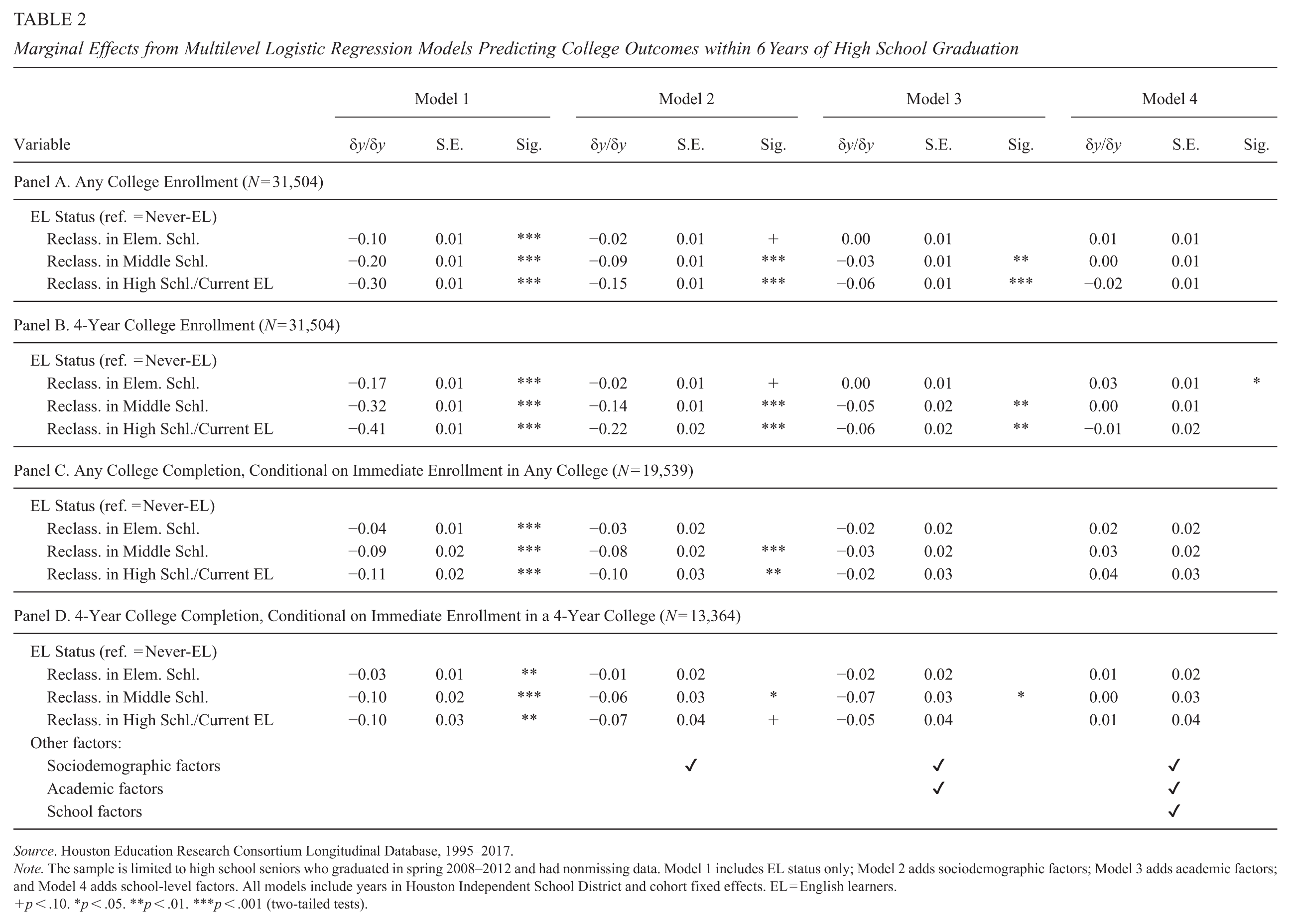
Table 2 presents results from multilevel logistic regression models predicting college outcomes within 6 years of high school graduation. All models include cohort and years-in-HISD fixed effects, cluster standard errors by school, and adjust for rescaling, which enables an accurate comparison of coefficients across nested regression models. Model 1 includes only EL status (ref. = Never-EL), while Models 2 to 4 sequentially add sociodemographic, academic, and school-level factors. To enhance interpretability, we compute marginal effects, allowing our results to be discussed as percentage point changes.
Marginal Effects from Multilevel Logistic Regression Models Predicting College Outcomes within 6 Years of High School Graduation
Source. Houston Education Research Consortium Longitudinal Database, 1995–2017.
Note. The sample is limited to high school seniors who graduated in spring 2008–2012 and had nonmissing data. Model 1 includes EL status only; Model 2 adds sociodemographic factors; Model 3 adds academic factors; and Model 4 adds school-level factors. All models include years in Houston Independent School District and cohort fixed effects. EL = English learners.
p < .10. *p < .05. **p < .01. ***p < .001 (two-tailed tests).
Panel A predicts any college enrollment. From Model 1, we see that EL students who reclassify in elementary school are 10 percentage points less likely to enroll in any postsecondary institution than students never classified as EL. We observe even larger gaps for students reclassified in later grade levels: students reclassified during middle school and high school are 20 and 30 percentage points, respectively, less likely to enroll in any college than never-EL students. Adding sociodemographic factors (e.g., gender, race/ethnicity, economic disadvantage) in Model 2 appears to attenuate these gaps greatly, and the never-EL–reclassified in elementary school gap is rendered marginally significant. In Model 3, which includes academic factors (e.g., standardized reading test scores, average course grades), the never-EL–reclassified in elementary gap disappears, and in the final model, which includes school-level factors (e.g., percentage of economically disadvantaged students), the gaps between never-EL students and students reclassified in middle and high school approach zero and lose significance.
Panel B of the table shows results from models predicting 4-year college enrollment. The initial gaps between groups are greater, with students reclassified in elementary, middle, and high school being 17 to 41 percentage points less likely to enroll in a 4-year college than never-EL students. Like the results in Panel A, the EL gaps attenuate after adding sociodemographic, academic, and school-level factors. In the final model, the coefficients on the reclassified in middle and high school variables are close to zero and no longer significant. Interestingly, we find that students reclassified in elementary school are now three percentage points more likely to enroll in a 4-year college than never-EL students.
Panels C and D present results from models predicting any and 4-year college completion. Please note that the sample sizes in these analyses are smaller, as we limit the models to students who enrolled in any college or a 4-year college immediately after high school graduation. In both panels, we initially find gaps in completion outcomes by EL status, with students reclassified in elementary, middle, and high school less likely to earn a postsecondary credential or bachelor’s degree than students who were never-EL. However, these gaps attenuate and are rendered statistically insignificant after accounting for sociodemographic, academic, and school-level factors. As with the enrollment models, the pattern of results for completion suggests that EL gaps in any and 4-year college completion are largely tied to these factors rather than EL status alone.
While the models reveal EL gaps in college outcomes—gaps associated with reclassification timing and statistically reduced after adjusting for sociodemographic, academic, and school-level factors—we again caution that many of these variables are themselves shaped by students’ EL status. Sociodemographic factors such as race and ethnicity are not neutral background traits but reflect broader systems of structural disadvantage and differential access to opportunity. Similarly, academic outcomes are shaped by students’ classification experiences and instructional environments. As such, the explained portion of the gap should not be interpreted as unimportant—it reflects systemic processes linked to EL status and broader dimensions of educational stratification.
How EL Status Predicts College-Level Course-Taking in High School
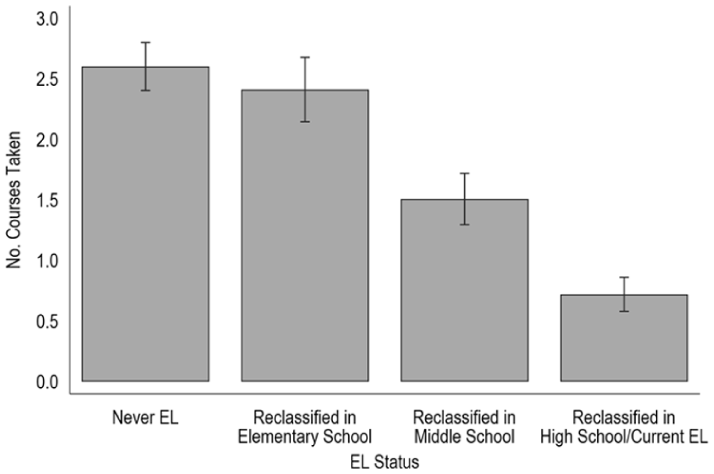
Based on the literature (Callahan & Gándara, 2004; Callahan & Shifrer, 2016; Kanno & Kangas, 2014), we focus on one factor that may mediate the relationship between EL status and postsecondary outcomes: college-level courses taken during high school. We explore college-level course-taking by, first, examining whether there are differences in course-taking by EL status and, second, how inequalities in course-taking may explain inequalities in postsecondary enrollment and completion. To examine the potential disparities in college-level course-taking by EL status, we used a zero-inflated negative binomial count model to predict the number of college-level courses taken in the 11th and 12th grades; results are presented in Supplementary Appendix Table 2 (available in the online version of this article). 14 The model includes sociodemographic and school-level factors and clusters standard errors by school. Figure 1 plots the adjusted average number of college-level courses taken by never-EL students and students reclassified in elementary, middle, and high school. The results showed that never-EL students took, on average, 2.60 college-level courses, while students reclassified in elementary school took 2.41 college-level courses; this difference was not statistically significant. However, we found that reclassification in later grade levels was negatively associated with college-level course-taking in high school. For instance, students reclassified in middle school took, on average, 1.51 courses, while students reclassified in high school took 0.72 courses; these predicted means were statistically significantly different from both the never-EL and elementary-reclassified groups. Additionally, the reclassified in high school-reclassified mean was significantly different from the middle school-reclassified mean.
Upper Secondary College Course-Taking by EL Status.
There appears to be an association between the timing of EL reclassification and college-level course-taking in high school. Notably, the gap in course-taking between never-EL students and those reclassified in elementary school is small and statistically insignificant. Middle school is often when ability grouping and tracking begin in public schools (Dauber et al., 1996; Gamoran, 1992). EL students who reclassify before that point may have greater access to advanced middle school coursework that sets them on a path toward AP, IB, and dual credit courses in high school. In contrast, students who remain classified as EL into middle or high school may face more limited options because language acquisition courses crowd out advanced coursework (Gándara & Orfield, 2012; Lillie et al., 2012), or because their EL designation functions as a label that signals—accurately or not—to school staff they are not prepared for rigorous courses (Kanno, 2018; Kanno & Kangas, 2014; Zuniga et al., 2005). Even reclassification in eighth grade, for example, may come too late. The college preparatory pipeline often begins earlier, and students might have already missed opportunities in middle school that would have positioned them for more advanced coursework in high school (Dauber et al., 1996; Gamoran, 1992; Stevenson et al., 1994).
Decomposition Analysis of EL Gaps in College Outcomes
As shown in Figure 1, the timing of reclassification predicts the number of college-level courses taken in the 11th and 12th grades. In addition, Supplementary Appendix Table 3 (available in the online version of this article) indicates that college-level course-taking is positively associated with postsecondary enrollment and completion. For example, each additional college-level course taken is associated with a 5-percentage point increase in 4-year college enrollment and a 3-percentage point increase in 4-year college completion, conditional on immediate 4-year enrollment. In this section, we consider both patterns simultaneously and examine how college-level course-taking in high school may serve as a mediator, or have an indirect effect, in explaining gaps in postsecondary outcomes between EL groups.
To address this question, we use the KHB method of nonlinear variance decomposition (Breen et al., 2013; Karlson et al., 2012; Karlson & Holm, 2011). This approach allows us to isolate how much of the EL gap in each college outcome can be explained by EL–never-EL differences in sociodemographic, academic, and school factors. We conduct the decomposition analysis using the khb command in Stata (Kohler et al., 2011) with multilevel logistic regression models. To ease interpretation, we convert the results to marginal effects, which are used to produce the figures. Results for 4-year college enrollment and bachelor’s degree completion are shown in Figures 2 and 3; results for any college enrollment and any college completion are substantively similar and presented in the Supplementary Appendix (available in the online version of this article).
Decomposition of 4-Year College Enrollment by EL Status.
Decomposition of Bachelor’s Degree Completion by EL Status, Conditional on Immediate Enrollment in a 4-Year College.
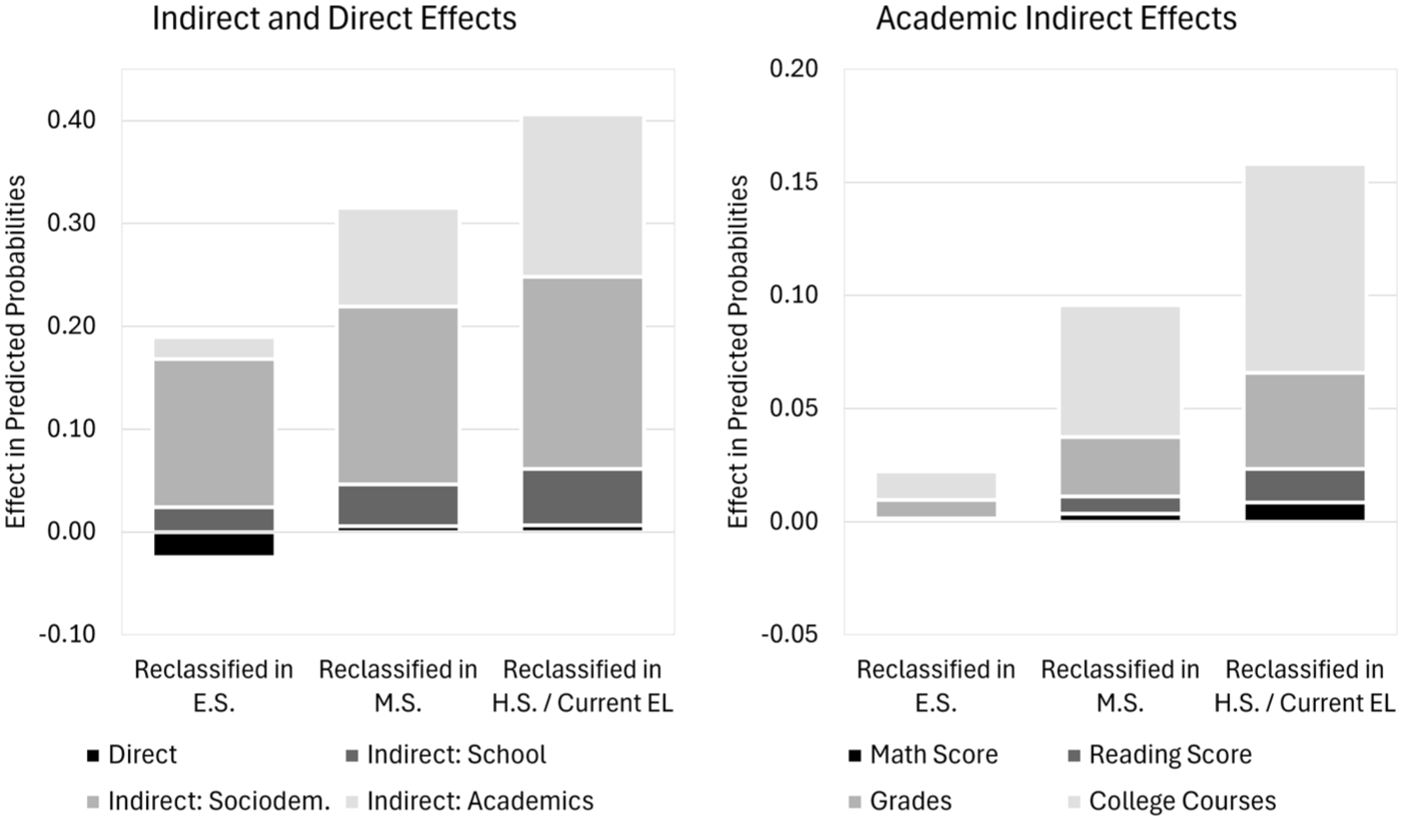
On the left side of Figure 2, labeled “Indirect and Direct Effects,” each full bar represents the total gap in 4-year college enrollment between never-EL students and students reclassified in elementary, middle, and high school (i.e., the gaps calculated in Model 1 of Panel B in Table 2). Within each bar, four sections represent groups of factors. The sections labeled sociodemographics (medium gray), academics (light gray), and school (dark gray) represent the indirect effects—that is, the portion of the EL–never-EL gap in college enrollment explained by group differences in these factors. For example, 14 percentage points of the never-EL–reclassified in elementary school gap may be attributed to differences in sociodemographic factors. The small solid black section represents the direct effect—the remaining unexplained gap after accounting for the observed factors. Most sections of each bar lie above the x-axis, indicating that never-EL students hold an advantage. For instance, the sociodemographic section of the never-EL–reclassified in elementary bar suggests that never-EL students benefit from more favorable sociodemographic profiles. Occasionally, however, sections dip below the x-axis, indicating that the EL group holds an advantage for that group of factors. When the direct effect lies below the x-axis, it can be interpreted as an EL advantage in the outcome after adjusting for observed factors. For the reclassified in elementary group, this corresponds to the positive and significant relationship observed in Model 4 of Panel B in Table 2.
Across all three bars, sociodemographic factors (medium gray) account for the largest share of the EL–never-EL gap in enrollment. This indicates that much of the disparity stems from differences in traits such as gender, race and ethnicity, and economic disadvantage. Although factors like race and ethnicity may not be directly malleable for individual educators (Labaree, 2010; Phillips et al., 1998), they often reflect broader structural forces—such as unequal access to opportunity, bias, and discrimination—that are shaped by policy and practice. As such, they remain important indicators of systemic inequality, even if classroom educators cannot alter them directly. In contrast, academic indicators such as test scores, grades, and course-taking are more immediately actionable within classrooms and schools and thus remain a central focus for practitioners. Represented in light gray, academic factors explain 13% of the elementary group’s gap (2.1 percentage points), 30% of the middle school group’s gap (9.6 percentage points), and 39% of the high school group’s gap (15.8 percentage points).
The right side of Figure 2, labeled “Academic Indirect Effects,” breaks the academic section down into its components: reading and math test scores, grades, and college-level course-taking in high school—each shown using distinct shades of gray. Across all three groups, gaps in college-level course-taking account for the largest share of the academic component (58% –61%). In concrete terms, these differences amount to 1.3 percentage points (8%) of the total gap for the reclassified in elementary group, 5.8 points (18%) for the middle school group, and 9.2 points (23%) for the high school group. We can use these decomposition estimates to construct simple counterfactuals: What would the EL–never-EL gap in 4-year college enrollment look like if EL students had taken the same number of college-level courses in high school as their never-EL peers?
The gap for the reclassified in elementary school group would decrease from 16.5 to 15.3 percentage points.
The gap for the reclassified in middle school group would decrease from 31.5 to 25.7 percentage points.
The gap for the reclassified in high school group would decrease from 40.6 to 31.4 percentage points.
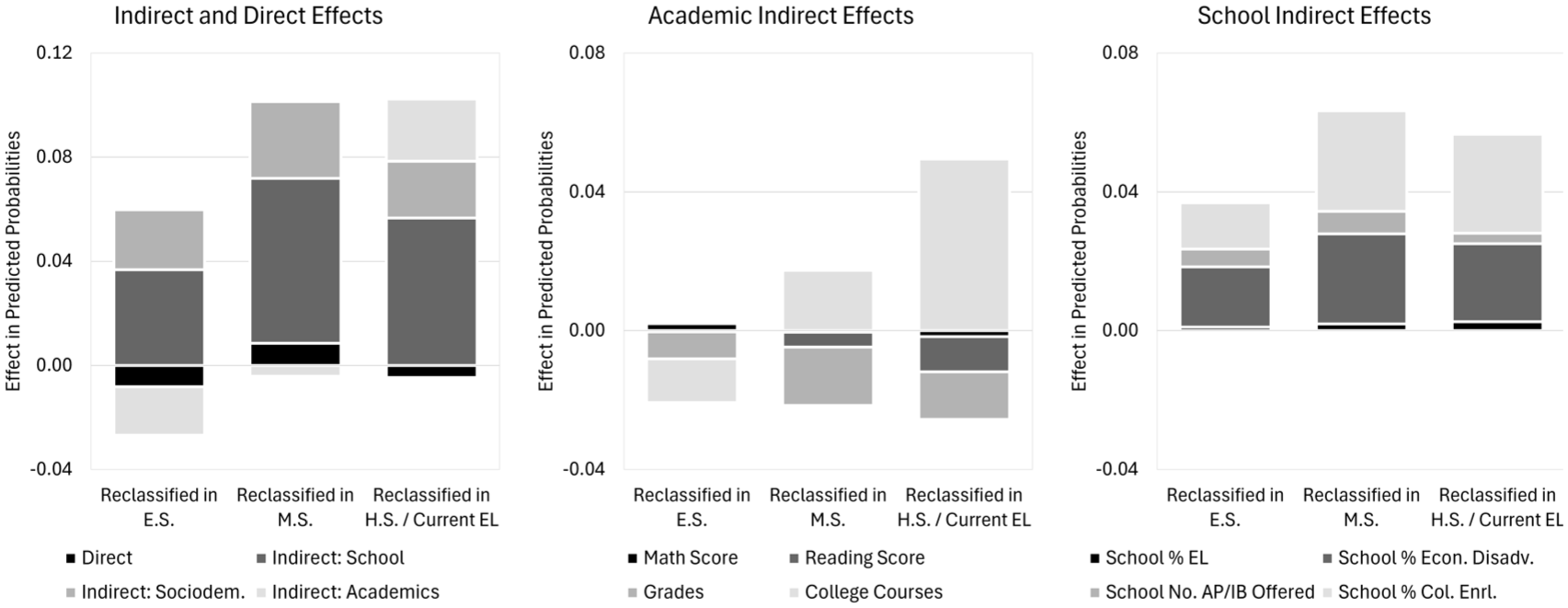
Next, Figure 3 presents decomposition results for bachelor’s degree completion, conditional on immediate enrollment in a 4-year college. Here, much of the EL–never-EL gap is explained by school-level factors, while the role of academic factors is more limited. In fact, for the reclassified in elementary school group, academic factors indicate a slight EL advantage. A key difference between these results and those discussed earlier is that the bachelor’s degree completion analysis is limited to students who enrolled in a 4-year college immediately after high school. As a result, the sample is more selective, and differences in academic factors by EL status may be less pronounced among college-going students.
We further disaggregate the academic and school components into their constituent parts. We find that disparities in high school college-level course-taking by EL status account for a substantial share of the EL–never-EL gaps in 4-year college completion among students reclassified in middle and high school. Specifically, if students in these groups took as many college-level courses as never-EL students—closing the course-taking gap—the gap in college completion would shrink from 9.7 to 8.0 percentage points for those reclassified in middle school, and from 9.8 to 4.8 percentage points for those reclassified in high school. In contrast, the course-taking component of the gap for students reclassified in elementary school dips below the x-axis, indicating that, conditional on immediate 4-year college enrollment, these students actually take more college-level courses than never-ELs. As a result, equalizing course-taking across groups would increase the completion gap between never-EL students and those reclassified in elementary school—from 3.3 to 4.6 percentage points.
Conditional on 4-year college enrollment, EL–never-EL gaps in college completion are largely explained by differences in school contexts. The decomposition results indicate that EL students are more likely to attend high schools with higher concentrations of economically disadvantaged students and lower rates of college attendance. To contextualize these findings: If ELs reclassified in elementary, middle, and high school attended high schools with similar socioeconomic compositions as those attended by never-ELs, 4-year college completion gaps would narrow by 1.7 to 2.6 percentage points. Moreover, if ELs and never-ELs attended schools with comparable college-going cultures, as proxied by the share of graduates enrolling in college immediately after high school, completion gaps would shrink by an additional 1.3 to 2.9 percentage points. 15
Robustness Checks
Many EL students come from immigrant backgrounds, have less experience in U.S. schools, and face fewer opportunities to develop English proficiency and reclassify. For instance, a student who arrives in the United States in 10th grade cannot be reclassified in elementary or middle school and may have limited access to college-level courses during their remaining time in high school. Our analyses address this limitation by controlling for the number of years a student has lived in the United States and by including fixed effects for years enrolled in HISD, which account for unobserved EL status prior to district entry. As an additional robustness check, we restrict the sample to students who were continuously enrolled in HISD for 13 years, from early grades through high school graduation. While this reduces the sample size, the results remain substantively similar and indicate that EL–never-EL differences in college outcomes largely disappear after adjusting for academic factors. In further sensitivity analyses, we exclude students who were still classified as EL in 12th grade, non-EL students who were later identified as EL, and EL students with multiple reclassifications. Finally, given that the majority of EL students are Hispanic and many are foreign-born, we replicate the analyses among Hispanic students only and immigrant students only. The patterns in these subgroup analyses closely mirror the main results.
Thompson (2017) identifies a “reclassification window during the upper elementary grades” (p. 47). If students are not identified as English proficient by that period (i.e., grades 4–5), their likelihood of reclassification begins to decline. Although Thompson’s “reclassification window” terminology highlights the importance of reclassification prior to the middle school transition, her results show lower reclassification rates in the early elementary years and higher reclassification rates in late elementary years (e.g., 6.5% in grade 2 vs. 29.2% in grade 5). While early elementary reclassification might be less common than late elementary reclassification, it may confer unique benefits. Therefore, as a robustness check, we disaggregated the elementary reclassification group into early (PK–3) and late (4–5) categories and replicated all main models. Although there is not a strong rationale for dividing the elementary group at grade 4, this division coincides with the transition from “learning to read to reading to learn,” as described in the stages of reading (Colombo, 2011, p. 190).
Results from this replication suggest that early elementary reclassifiers may follow different trajectories than their later-reclassified peers. For example, compared to never-EL students and accounting for sociodemographic, academic, and school-level factors, students reclassified early in elementary school are four percentage points more likely to enroll in a 4-year college. Late-elementary reclassifiers are two percentage points more likely to do so, but this difference is statistically insignificant (see Supplemental Appendix Table 5 in the online version of the journal for additional results). The decomposition results further indicate that while differences in college-level course-taking in high school explain part of the late elementary–never-EL gap in postsecondary outcomes, they confer a particular advantage for early elementary reclassifiers (see Supplemental Appendix Figures 4–7 in the online version of the journal). Additional tables and figures from this replication are available in the Supplementary Appendix (available in the online version of this article). Overall, these findings lend merit to distinguishing early and late elementary reclassifiers in quantitative analyses and, potentially, in schools. We encourage future research to explore these distinctions more systematically, including the question of where best to draw the dividing line between the early and late elementary years.
Additional robustness checks—such as controlling for bilingual and ESL program duration, including students receiving special education services, estimating high school graduation as a separate outcome, incorporating high school fixed effects, and controlling for college selectivity in the college completion models—are discussed in footnotes throughout the manuscript. While most yielded results consistent with the main findings, some—such as the high school graduation outcome—offered additional insights beyond those presented in the main text. Supplemental results are available from the authors upon request.
Discussion
Scholars have suggested that inequitable access to advanced coursework in high school constrains college opportunities for EL students (Callahan & Gándara, 2004). Our study builds on this assumption by examining gaps in college-level course-taking and postsecondary outcomes between EL and never-EL students, with a focus on how the timing of EL reclassification shapes these inequalities. We contribute new insights by demonstrating that reclassification timing is closely linked to both access to advanced coursework and longer-term postsecondary attainment. We find substantial gaps in college enrollment and completion by EL status, with students reclassified in elementary, middle, and high school attending and graduating from college at lower rates than their never-EL peers. However, these gaps are attenuated and rendered statistically insignificant after adjusting for sociodemographic, academic, and school-level factors—many of which likely reflect midstream consequences of EL status rather than purely exogenous characteristics.
College-level course-taking during high school emerges as a key mediator, partly explaining disparities in postsecondary outcomes by EL status and supporting Umansky’s (2016) framework of leveled tracking. In this framework, exclusionary tracking refers to barriers that limit ELs’ access to entire content areas, while leveled tracking constrains their participation in advanced courses. Our findings suggest that the latter form of tracking restricts EL’s access to college-level course-taking in high school, with implications for patterns of postsecondary attainment. To examine this pathway more directly, we turn to the decomposition results to show how course-taking shapes EL students’ educational trajectories, empirically connecting two domains often studied separately: EL disparities in advanced coursework and college outcomes. Specifically, the KHB decomposition method allows us to isolate course-taking as a mechanism, disentangling its indirect contribution from the broader influences of EL status and other factors (which, as noted earlier, may reflect both the consequences of classification and broader structural conditions). Rather than simply adjusting for variables, the decompositions shift attention from identifying which groups are behind to quantifying which aspects of schooling contribute to educational disparities and may be leveraged to promote more equitable outcomes.
We find that the timing of reclassification is associated with differences in college-level course-taking, which in turn mediate the relationship between EL status and postsecondary outcomes. As Kieffer and Thompson (2018) demonstrate with respect to test scores, focusing only on current ELs—or on broad, aggregated categories—can obscure the progress that becomes visible once students are reclassified. Extending this insight, our study disaggregates the ever-EL category to show that the timing of reclassification is closely linked to access to college-level coursework, especially for students reclassified earlier. Students who remain EL through middle and high school take fewer college-level courses than both their never-EL peers and students reclassified in elementary school. Course-taking differences explain 8–23% of the EL–never-EL gap in 4-year college enrollment, depending on the timing of reclassification, and also account for a substantial share of the gap in bachelor’s degree completion (conditional on 4-year enrollment), particularly for students reclassified in middle and high school. Notably, we observe a progressive pattern: college-level course-taking explains a larger share of postsecondary gaps among students reclassified in later grades, likely reflecting the compounded effects of curricular tracking that intensify during secondary school.
Students reclassified earlier are more likely to access college-preparatory pathways in middle school, while those reclassified later often miss key windows for placement into pre-AP or other advanced sequences. These missed opportunities may be exacerbated by structural barriers, such as EL coursework crowding out advanced classes (Gándara & Orfield, 2012; Lillie et al., 2012) or educator perceptions that EL students lack the English proficiency needed for rigorous curricula (Kanno, 2018; Kanno & Kangas, 2014; Zuniga et al., 2005). Even students reclassified in seventh grade may face constrained opportunities due to the sequenced nature of advanced coursework (Stevenson et al., 1994). Collectively, these patterns of sorting and tracking contribute to persistent disparities in postsecondary attainment by EL status.
Our findings suggest that course-taking is not merely a byproduct of prior achievement or language development but also represents a critical leverage point for intervention—especially in middle and early high school, when tracking decisions are often made. If EL students are systematically steered away from college-preparatory pathways due to late reclassification, scheduling constraints, or assumptions about academic readiness, then adjusting placement processes during these formative years could expand access to advanced coursework. By empirically linking course-taking disparities to longer-term educational attainment, the decomposition results highlight actionable opportunities for educational leaders to design pathways that do not exclude ELs—intentionally or unintentionally—from advanced learning opportunities that can lead to a college degree.
Interestingly, when limiting the analysis to students who enrolled in a 4-year college directly after high school and examining bachelor’s degree completion, the role of school context becomes more pronounced. This shift—from individual factors accounting for more of the enrollment gap to school-level factors accounting for more of the completion gap—suggests that structural dimensions like school poverty and college-going culture might play a more critical role in supporting students through degree attainment than for initial college access. Specifically, EL students attend higher-poverty high schools with lower college enrollment rates than their never-EL peers, which partly explains their lower rates of bachelor’s degree completion. (Differences in the availability of college-level coursework across high schools do not appear to meaningfully mediate gaps in college graduation). It is unclear why these factors explain a sizable share of the completion gap. One possibility is that the high schools ELs attend have fewer resources to support students in the college application process, and these factors reflect those institutional inequities. Alternatively, they may capture variation in the quality of college-level coursework. Even if EL and never-EL students attend schools with similar numbers of AP and IB courses, differences in instructional quality or course rigor may affect students’ college preparation, performance on placement exams, and ability to earn college credit—factors that can influence graduation outcomes (Evans, 2019). 16
Although our findings suggest that differences in college-level course-taking account for much of the disparity in postsecondary outcomes by EL status, our analyses are not designed to estimate the causal impact of expanding access to rigorous high school coursework for EL students. As noted previously, enrollment in college-level coursework late in high school may be the culmination of a long-term educational trajectory with roots planted earlier in high school, middle school, or even elementary school (Stevenson et al., 1994). Students without access to pre-AP, pre-IB, gifted, and honors courses in early adolescence may follow a distinct academic path, making placement in AP, IB, or dual credit courses during the junior or senior years insufficient for postsecondary readiness (Johnson & Mercado-Garcia, 2022). While late high school course-taking explains a substantial share of the EL–never-EL gap in college outcomes, addressing these inequities may require schools and districts to expand access to advanced coursework earlier and more consistently throughout middle and high school.
Overall, our study offers new insights into how EL status, reclassification, college-level course-taking in high school, and postsecondary outcomes are connected. By disaggregating the broad “ever-EL” category, we show that reclassification in earlier grades is associated not only with stronger high school achievement, as prior studies suggest, but also with long-term college outcomes, including bachelor’s degree completion. We also find that college-level course-taking mediates the relationship between EL status and postsecondary outcomes. Unequal access to college-level coursework appears to be a key driver of EL–never-EL disparities in educational attainment outcomes, as decomposition analyses attribute a sizable share of the enrollment and completion gaps to course-taking differences. The results further show that school context matters, with differences in school-level factors contributing meaningfully to EL–never-EL gaps in college completion.
Implications for Policy and Practice
A distinct contribution of this study is the inclusion of input from our school district partner on the implications of the findings. 17 Our study was informed by the insights of school district administrators and leaders through an RPP, specifically HERC’s partnership with HISD. The following potential strategies are based on conversations with district staff via email, a presentation to the Multilingual Education Department, and a cross-functional meeting designed to foster collaboration across district departments.
Exercising Caution With Early Reclassification
A potential takeaway from this study is that school practitioners might consider strategies to reclassify EL students earlier, especially before middle school, as doing so may enable them to take more rigorous coursework in middle and high school, which, in turn, is associated with improved postsecondary outcomes. While this conclusion may have merit, staff in the district’s Multilingual Education Department expressed caution, warning that haphazard, premature reclassification could do more harm than good. If reclassification standards were relaxed without care, students might struggle academically, become frustrated, and drop out of high school.
Expanding EL Access to Advanced Coursework
Nonetheless, through our conversations, we learned that there might be ways for schools and districts to broaden access to advanced courses for EL students in middle and high school. First, even if an EL student is not ready for reclassification, they may still be encouraged to take advanced courses that are less language-dependent, such as studio art or mathematics, or those that build on existing language skills, like Spanish literature for native speakers. Practitioners might also adopt more culturally responsive approaches by offering advanced courses in students’ native languages, where staff capacity allows, or by providing aides and tutors to support ELs with English-based content.
Second, schools and districts can reevaluate their processes for recommending students for advanced coursework (Garet & Delany, 1988; Spade et al., 1997). In HISD, course recommendations are based on students’ grades and completion of prerequisites. While useful, these indicators may not fully capture students’ educational aspirations, subject-matter interests, or work ethic. Teachers who interact with students daily may be better positioned to assess which EL students can succeed in advanced courses and which subjects best match their strengths. Teacher recommendations could therefore serve as a valuable complement to existing placement criteria. Of course, this must be done with care, as prior research points to potential biases in EL reclassification decisions (Mavrogordato & White, 2020; Umansky et al., 2020). Nevertheless, teacher input may provide a pathway for ELs to access advanced content that bypasses traditional cognitive metrics associated with tracking (Dauber et al., 1996; Gamoran, 1992).
It is also important that individuals or groups responsible for EL reclassification decisions, such as HISD’s Language Proficiency Assessment Committee, maintain clear communication with school counselors and registrars, who typically determine course enrollment. Reclassification decision-makers are familiar with students’ academic progress, can clarify areas of strength, and may recommend advanced courses appropriate for those still developing English proficiency. More broadly, misconceptions may persist about EL students’ capabilities and what the EL label permits or restricts. Counselors, registrars, and other placement staff may benefit from targeted training or webinars on ELs and course eligibility. Serving ELs cannot occur in isolation; school and district personnel committed to their success should actively collaborate with staff working on college and career readiness. Existing district programs and advising services aimed at improving college access may already benefit this population—and could be expanded to include initiatives explicitly tailored to their needs.
Embedding Language Development Into Core Instruction
While our district colleagues expressed caution about early reclassification, schools and districts can adopt instructional practices that both support English development and expand access to advanced coursework. Our findings indicate that EL students reclassified by the end of elementary school take about as many college-level courses in 11th and 12th grade as their never-EL peers. To support earlier reclassification and access to rigorous courses, schools can equip secondary teachers with tools to embed language instruction into core academic content. One strategy recommended by HISD was sheltered instruction, 18 defined as “an instructional approach that engages [ELs] above the beginner level in developing grade-level content-area knowledge, academic skills, and increased English proficiency” (The Education Alliance at Brown University, n.d.). A recent evaluation of an HISD middle school using this model showed gains in students’ English proficiency and reclassification rates (Lee et al., 2024). Additional evidence-based guidance is provided in the Institute of Education Sciences practice guide on teaching academic content and literacy to ELs (Baker et al., 2014) and the National Academies of Sciences, Engineering, and Medicine’s (NASEM, 2018) report on ELs in STEM, which outlines approaches for integrating language development into content instruction. Educators across the PK–12 pipeline may find these resources useful for embedding literacy practices into academic subjects—a strategy that supports English proficiency while reducing exclusionary practices, such as pulling ELs from core coursework, that may limit access to rigorous content (Umansky, 2016).
Strengthening Early Supports for ELs
Although many district recommendations focused on secondary schools, it is equally important to support EL students earlier in their educational trajectories. Schools and districts may consider using classroom-level diagnostics, such as summative and formative assessments in elementary school, to identify gaps in both content knowledge and language proficiency (NASEM, 2018). These tools can help educators provide targeted support and identify students ready for enrichment or accelerated learning, including higher-level within-classroom groupings and advanced course placements. Procedures should be reviewed to ensure ELs have equitable access to pre-AP and pre-IB coursework, which often serve as gateways to AP and IB courses in high school. Evidence-based instructional practices—particularly those designed for primary school settings—offer concrete guidance for integrating language development into rigorous content instruction (Baker et al., 2014; NASEM, 2018). Implementing these early interventions can help prevent ELs from being tracked away from advanced learning opportunities long before they reach high school.
Advancing Equity Through State Reclassification Policy
While policymakers and practitioners should be cautious about reclassifying students too early—particularly if it results in the premature removal of academic supports—emerging research highlights ways that state policy can promote greater equity in EL reclassification. In many states, reclassification criteria have been simplified following the implementation of ESSA, potentially expanding opportunities for EL students to access rigorous coursework and college pathways (Morales & Lepper, 2024). In contrast, Texas has maintained relatively stringent reclassification standards, and changes to the Texas English Language Proficiency Assessment System in the mid-2010s appear to have contributed to declining proficiency rates during this period (Texas Education Agency, 2021). In a quasi-experimental analysis, Bartlett et al. (2024) find shifting reclassification from a manual, district-level process to an automatic, state-based system based on test scores increased reclassification rates by 35 percentage points. The effects were particularly pronounced for Spanish-speaking ELs, potentially addressing concerns about bias in more subjective reclassification systems (Mavrogordato & White, 2020; Umansky et al., 2020). Further research is needed to assess whether default or automatic reclassification policies, such as those implemented in Michigan, expand access to academic opportunities, including college-level coursework in high school, and lead to improved postsecondary outcomes.
Conclusion
This study reveals large inequalities in postsecondary outcomes by EL status and shows that access to college-level coursework in high school serves as a mediator—supporting the argument that EL classification can facilitate curricular tracking (Umansky, 2016) and operate as a form of categorical inequality (Domina et al., 2017). Using nonlinear variance decomposition, we quantify how much of the observed EL–never-EL disparities in college enrollment and completion are associated with differences in college-level course-taking. These results point to how unequal course-taking opportunities—shaped by placement decisions in middle and early high school—can accumulate over time and contribute to broader educational inequalities.
Building on these insights, we offer a series of practice-oriented recommendations based on conversations with district leaders; of course, further research is needed to evaluate the efficacy of these proposed policies and practices. Given that our analyses focus on HISD, a district with a large Hispanic population, we encourage replication in other geographic contexts, particularly those with different demographics (e.g., Asian or Pacific Islander students). Future studies might also investigate specific courses or subjects where ELs face restricted access, or examine how school contexts mediate the link between EL status and college completion. Ultimately, we hope this study serves as a springboard for additional research on the long-run outcomes of ELs and the curricular (in)opportunities that shape their lives.
Supplemental Material
sj-pdf-1-epa-10.3102_01623737251392299 – Supplemental material for Sorted and Tracked: English Learners, College-Level Course-Taking in High School, and Postsecondary Opportunity
Supplemental material, sj-pdf-1-epa-10.3102_01623737251392299 for Sorted and Tracked: English Learners, College-Level Course-Taking in High School, and Postsecondary Opportunity by Brian Holzman, Esmeralda Sánchez Salazar, Irina Chukhray and Weiqi Guo in Educational Evaluation and Policy Analysis
Footnotes
Acknowledgements
We thank the leaders and staff at the Houston Independent School District for their feedback and collaboration, as well as Rice University’s Houston Education Research Consortium for providing access to data. We are also grateful for the feedback from staff and workshop participants at Rice University (Houston Education Research Consortium and Sociologists Talking About Population Health), as well as from discussants and participants at academic conferences. Opinions reflect those of the authors and do not necessarily represent those of the Houston Independent School District. The results, conclusions, and any errors are our own.
Declaration of Conflicting Interests
The authors declared no potential conflicts of interest with respect to the research, authorship, and/or publication of this article.
Funding
The authors disclosed receipt of the following financial support for the research, authorship, and/or publication of this article: Support was provided through the Population Research Institute at Pennsylvania State University, which is funded by the Eunice Kennedy Shriver National Institute of Child Health and Human Development (P2CHD041025).

Notes
Authors
BRIAN HOLZMAN, PhD, is an assistant professor in the Department of Educational Administration and Human Resource Development, with a courtesy appointment in Sociology, at Texas A&M University. His research focuses on racial/ethnic and socioeconomic inequalities in college access and success, and he employs descriptive and causal methods to evaluate policies and interventions aimed at reducing educational disparities.
ESMERALDA SÁNCHEZ SALAZAR, PhD, is an assistant professor of Sociology at William & Mary. Her research examines how educational, familial, religious, and state institutions intersect to shape racial and ethnic stratification in higher education, science, and the labor market.
IRINA CHUKHRAY, PhD, is the assistant director of Institutional Research at San Francisco Bay University. Her research interests include improving college access and success for immigrant-origin and underserved students through data-driven decision-making and policy development.
WEIQI GUO, MS, is a Ph.D. candidate in Educational Psychology at Texas A&M University. Her research interests include second and foreign language acquisition, as well as bilingual and heritage language development, with an emphasis on pragmatics instruction.
References
Supplementary Material
Please find the following supplemental material available below.
For Open Access articles published under a Creative Commons License, all supplemental material carries the same license as the article it is associated with.
For non-Open Access articles published, all supplemental material carries a non-exclusive license, and permission requests for re-use of supplemental material or any part of supplemental material shall be sent directly to the copyright owner as specified in the copyright notice associated with the article.
