




Abstract
This article develops a framework for understanding and analyzing the intermediary work of platform technologies, and their owners, as an emerging form of platform governance in educational systems. Our investigation is guided by two questions: (a) How do platform technologies shape policy by brokering relations among commercial, technical, and educational actors? And (b) how might these relations contribute to, or compromise, educational equity as they are folded into existing governance regimes? We address these questions by bringing together two critical orientations—critical policy analysis and critical platform studies—to map the power and politics of platformization in and across education systems.
Keywords
O
This platformization has significant policy implications. On one hand, platformization holds promise for helping educational systems meet policy goals. The expansive use of platforms for administration, instruction, and learning produces a vast network of data streams that can be mined for patterns and insights to improve efficiency, efficacy, and equality in schools. From this view, platformization is integral to enhancing data-driven governance in, and across, national education systems (cf. Gulson et al., 2022; Pangrazio et al., 2022). On the other hand, the reliance on platforms to achieve this potential creates new policy challenges. Not only does platformization cede tremendous influence over the everyday activities of public education systems to private technology companies, but it also tethers institutional decision-making to the governing logics of the code, algorithms, and data processes that underwrite platform technologies. Indeed, a growing interdisciplinary literature in “critical platform studies” (e.g., Burgess, 2021; Decuypere et al., 2021; Nichols & Garcia, 2022; Plantin et al., 2018) has shown that these logics often coax user behaviors to accord with the technical constraints and economic interests of platforms and their owners (Srnicek, 2017; Zuboff, 2019). Moreover, they can also reproduce structural inequalities by encoding discriminatory design features (Benjamin, 2019), exploitative data processes (Dixon-Román & Parisi, 2020; Dixon-Román et al., 2020), and racializing surveillance mechanisms (Browne, 2015) into even the most quotidian uses of technology.
Consequently, platformization complicates familiar depictions of technology in education policy studies as a beneficent resource for addressing educational inequities and inefficiencies by improving infrastructure, accessibility, and evidence-based decision-making in school systems (cf. Roumell & Salajan, 2016; Selwyn, 2018). Despite their appearances, platforms are not just neutral tools to support policy goals; they are, themselves, powerful de facto policy actors (Lingard, 2003): They inherit, from their commercial owners and technical architectures, interests and imperatives, which shape the conditions for equitable education in schools. Accordingly, with the proliferation of such technologies, there is a growing need for policy research that is attuned not only to the instrumental effects of individual platforms on student, teacher, or school performance but also to the structural transformations that follow as educational institutions and practices are being remade by platformization.
In this conceptual article, we develop a framework for analyzing such transformations by attending to the intermediary work of platforms, and their owners and users, as constitutive of an emergent expression of power in educational systems—what we call platform governance. We do so by bringing together the literatures of critical platform studies and critical policy analysis to ask (a) how are platform technologies shaping policy by brokering relations among commercial, technical, and educational actors? And (2) how might these relations contribute to, or compromise, educational equity as they are folded into existing governance regimes? Using a diffractive method (Barad, 2007; Dixon-Román, 2016a), we read these critical literatures through one another to identify key features of platform governance, and we consider how these features are being brought to bear in four extant spheres of educational governance—administrative, professional, market, and empowerment (Shipps, 2012)—as each is increasingly intermediated by platform technologies.
Technology and Education Policy
For as widely used as platforms are, they are relatively absent from the literature in U.S. educational policy studies. To the extent that platform technologies figure into policy analysis, it tends to have less to do with them being “platforms” than with them being “technologies.” This is because technology, more than “platforms,” has a rich history in policy research. Since technology is commonly associated with modernization, scholars have long studied its evolving role in schools—and more specifically, how it might be leveraged to better advance national goals for innovation and the development of human capital in a globalizing economy (Selwyn, 2018). Writing at the dawn of the personal computing era, Cohen (1987) historicized this drive to “modernize” schools through technology by tracing its past fluctuations—from mass-printed textbooks in the 1820s to radio, film, television, and paperback books in the 20th century. Cuban (1986), similarly, cautioned that the grand transformations recurrently ascribed to new educational technologies often strain to take hold in the everyday life of classrooms. Radio and television, for instance, found a modest place in instruction only because they could supplement, rather than reconfigure, already-existing practices. In many ways, the incongruity that Cohen and Cuban highlight, between the transformative potential associated with technology in the popular imagination and the reality of its uneven and fragmentary uptake in schools, has been a key focus for federal policy interventions related to technology over the last three decades.
Several comprehensive reviews of U.S. educational technology policy reports have identified the shifting recommendations on offer to reconcile the promise of reality of technology adoption in schools. Synthesizing 20 years of federal documentation, Culp and colleagues (2005) found that the most common suggestions stressed the need to increase “accessibility”—both of technology itself and of resources for using it. Observing a similar pattern in their review of National Educational Technology Plans between 1996 and 2010, Roumell and Salajan (2016) argue that calls for greater accessibility are often coupled with concerns about global competitiveness. A repeated issue they highlight, is the challenge posed by the global economy and the need “to prepare future generations to meet that challenge by reforming traditional ways of teaching with the help of digital technologies” (p. 381). And yet, they also discern that these reports position the obverse—the absence of modern technology and its associated skills to meet the challenges of global competitiveness—as a threat to educational equity. In this way, anxieties about the inaccessibility of technology simultaneously signal a national threat (to economic growth) and an individual threat (to future employment and upward mobility). Framed like this, access to technology emerges as an unalloyed good, a solution to multiple looming crises. Importantly, for our purposes, it also serves the interests of technology companies—both by boosting their sales and by positioning them as allies in the struggle for educational innovation and equity.
A more recent shift in U.S. technology policy is the growing importance of “interoperability” in federal guidance. Roumell and Salajan (2016) noted this pivot in the 2010 National Educational Technology Plan, where, in contrast with earlier reports focused on “accessibility,” there was now also an emphasis on coordinating district, school, and classroom technologies so they could work in tandem. They interpret this shift as signaling an emerging view of technology as “a vehicle for developing a more standardized model of efficiency to be adopted by states in the name of interoperability, quality measures, maximizing efficiencies, research and design, and bringing functional systems ‘to scale’” (p. 383). This focus on interoperability has carried through to the most recent National Educational Technology Plan. The 2017 report recommends that “data systems and learning platforms should include seamless interoperability with a focus on data security and issues related to privacy” (p. 58). What is significant about this focus on interoperation is that it speaks to the triumph of previous policies in making technology “accessible.” Technological integration no longer requires a justification in federal guidance based on its importance for national or human development; its value is taken for granted. The work of policy that remains, then, is to coordinate the constellation of technologies that now permeate districts, schools, and classrooms. This shift also speaks to an important difference in the structure of educational technologies themselves. Interoperability, for instance, could not arise as a policy concern in the radio- and television-mediated classrooms that Cohen and Cuban described; it is characteristic of a newer mode of networked technology that increasingly underwrites administration, instruction, and learning—platforms.
Platform Ecologies
Platform technologies are digital apps, services, and infrastructures that facilitate social, technical, and economic exchanges (Gillespie, 2010). Over the last decade, they have become integral to the ways people work, shop, travel, diet, exercise, and communicate and, we have noted, to administration and instruction in educational systems. While the scope and uses of platforms are varied enough that they often appear to us as distinct, stand-alone tools, scholars in the interdisciplinary field of critical platform studies (e.g., Burgess, 2021; Decuypere et al., 2021; Nichols & Garcia, 2022; Plantin et al., 2018) contend that they share an underlying logic that joins them together, and sets them apart, as a unique category of technology (van Dijck, 2013). Unlike other educational technologies, platforms do not just deliver a product or service to consumers; they simultaneously harvest data from such activities, which is then folded back into the platform itself to be stored, aggregated, or analyzed—or used, by platform owners, to derive insights for future product enhancements or developments.
This recursive logic makes platforms an example of what economists refer to as “multi-sided markets” (Sanchez-Cartas & León, 2021). Their everyday social uses (i.e., their consumer-facing side) actively shape, and are shaped by, both the political-economic interests of their owners (i.e., their business-facing side) and the technical features of their design (i.e., their development-facing side). The dynamic inseparability of these three dimensions—the social, technical, and political-economic—differentiates platforms from a more fixed, single-function technology, like an overhead projector or a graphing calculator. For this reason, Nichols and Garcia (2022; cf. Garcia & Nichols, 2021) argue that platforms are best understood not as stand-alone “tools” but as complex “ecologies.” Building on van Dijck (2021), they represent these relations using the image of a tree to illustrate how the social uses and impacts of platforms (the leaves) are always conditioned by both their technical substrates (the trunk) and their political-economic attachments and imperatives (the roots; Figure 1).
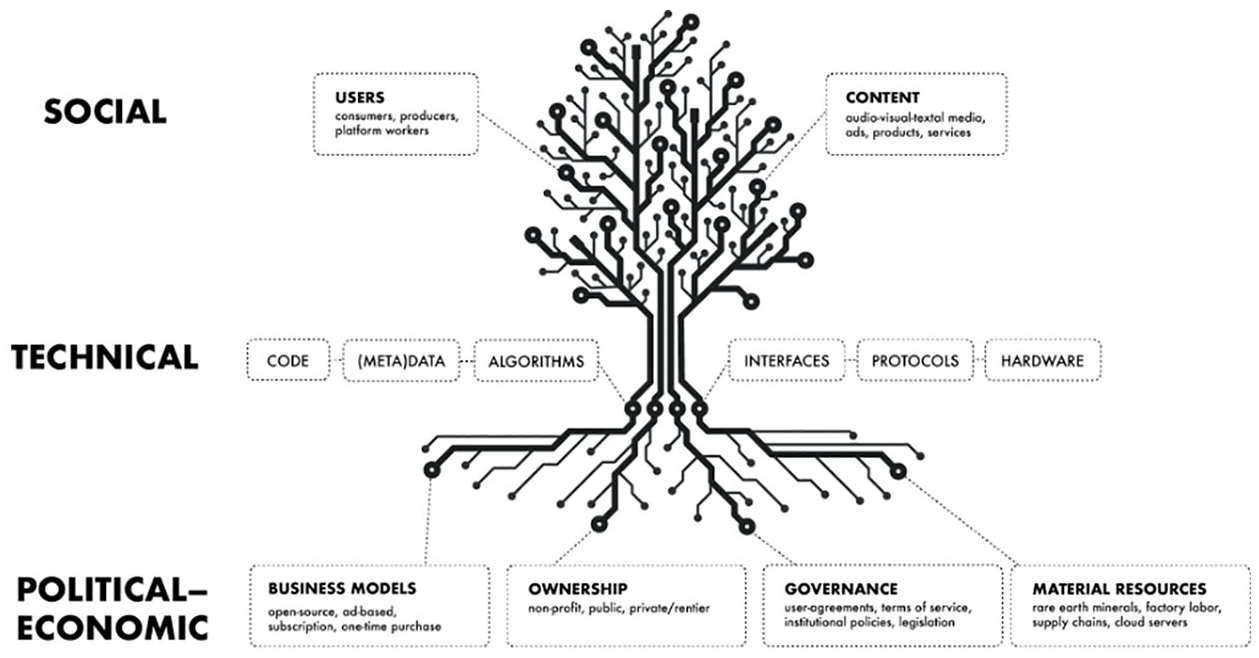
Visualization of a platform ecology.
Importantly, platforms are also ecological in a second sense: their multi-sided design not only links users and platform owners to one another but also to other platforms. A platform for assessing student learning, for instance, may generate feedback about an individual’s performance, but it may also share its data with other networked platforms for personalizing future assignments or for tracking students’ achievement over time. It may even interface with administrative platforms for deriving classroom- or school-level insights about student growth, for purposes of professional learning or acco-untability. Consequently, in a moment when educational systems are investing resources in the production and analysis of data, the creation of centralized databases, and the embed-ding of data experts and technologies across countries, districts, schools, and classrooms (Anagnostopoulos et al., 2015; Hartong, 2016), platforms have become vital infrastructures for data-driven administration and instruction in schools today (Pangrazio et al., 2022), and the use of one platform technology often reinforces the use of other compatible platforms to scale data-use across educational systems (Perrotta et al., 2020). This creates powerful imperatives for state, district, and school leaders to adopt platforms based on their interoperability with existing software and user experience—which helps to clarify why interoperability has become a key focus of the most recent National Education Technology Plans (Roumell & Salajan, 2016; U.S. Department of Education, 2017, p. 58).
An ecological view of platforms helps to crystallize the need for critical inquiry into how platform and policy environments are shaping one another in education and the implications for educational equity. The multi-sided architecture of platforms spotlights how they are shot through with contradictions: the technical features they inherit from their designers and the political-economic imperatives infused from the business world are not always aligned, and the arrangement of each can neglect the interests and values of the people who choose (or are required) to use a platform in a given social setting. Scholars have documented the stakes of such incongruities. Noble (2018), for instance, shows how “color-blind” search engine algorithms misrepresent marginalized subjects by privileging the circulation of offensive caricatures of Black women. Eubanks (2017) similarly demonstrates how automated decision-support systems exclude poor people from social welfare programs. Benjamin (2019) refers to such examples as “discriminatory design,” where the technical dimension of platforms inherits ideologies from their designers, owners, and the wider social world, allowing the products and services they provide to reproduce formations of difference behind a veil of algorithmic objectivity. Dixon-Román (2016b) argues that data are assemblages that are always already imbued with sociopolitical relations, and as a result, the logic of algorithmic systems becomes a racializing force once it is trained on data assemblages. This suggests that education policies that treat technologies as a tool for effective administration and instruction, or that promote access to technology as a driver of equity or student empowerment, may paper over the ways platform technologies actually diminish these commitments, even as they purport to serve them.
The interoperability of platforms with one another also has stakes for equitable education. The promise of a networked ecosystem of data-sharing platforms that can streamline and sharpen educational decision-making across levels of school systems is alluring enough that it can elevate “compatibility” above other concerns in making determinations about technology. McMillan Cottom (2020) warns of the “predatory inclusion” with which platforms operate, where short-term benefits (e.g., interoperability, free services, subsidized devices, “access” to skills or credentials) are used to lure in users to lock them into long-term predatory relationships (e.g., data extraction, surveillance, exploitative contract terms, rentier-like subscription costs). Examples of such practices abound in K–16 education. Platform providers regularly promise to address concerns related to accessibility, cost savings, data-driven decision-making, and college- and career-readiness as a strategy for embedding themselves and their product ecosystems into schools: for instance, massive open online courses (edX), online program managers (2U), subsidized hardware (Chromebooks), professional development programs (Google Certified Teachers), and free and low-cost software (Google Classroom). However, scholars have shown that, beneath their inclusive veneer, such practices can capitalize on the needs of schools, often in terms that serve the commercial interests of platform providers more than the long-term well-being of public education, or educators (e.g., Gulson & Witzenberger, 2022; Kerssens & van Dijck, 2022; McMillan Cottom, 2020; Smith et al., 2023; Williamson et al., 2022).
The force of these pressures—discriminatory design and predatory inclusion—point to the need for critical inquiry into platforms, not as neutral administrative or instructional resources but as powerful de facto policy actors (Lingard, 2003), whose social, technical, and political-economic dimensions condition, direct, and even govern educational activities in the sites where they are embedded. It is to theorizing and examining this mode of platform governance that we turn in what follows.
Theorizing Platform Governance
While there is not a singular consensus about the meaning of “governance,” the term generally refers to modes of control that steer social activity without necessarily relying on top-down impositions from the state (Levi-Faur, 2012). Instead of viewing power as a hierarchical force, traveling unidirectionally from governments to civil society, studies of “governance” attend to the ways power is relational and practiced within, between, and against these entities. In this way, governance is comparable to what Foucault (1977) calls “disciplinary power”: rather than enforcing com-pliance with commands or punishments (“sovereign power,” in Foucault’s terms), governance disciplines its subjects “at a distance,” preserving a semblance of their autonomy even as it enfolds them in norms, standards, protocols, and statistics that nudge them toward certain behaviors rather than others (cf. Miller & Rose, 2008, pp. 17–18).
This understanding of governance has been influential in critical educational policy analysis. In contrast with policy research that centers the measurement and evaluation of state policy interventions, critical analysts disaggregate “policy” to include not only government directives but also the wide range of non-state actors and public–private entities that are equally important in shaping what happens in schools (Diem et al., 2014). Scholars in this critical tradition approach policy not as a monolith but as the accomplishment of a relational “environment” (Dixon-Román, 2017; Weaver-Hightower, 2008), or a “network” (Ball, 2012) through which governance gets negotiated. They consider how competing state–society interests form a matrix of pressures which delimit what actions are thinkable, desirable, or available to the people and institutions enmeshed with it and the ways this arrangement preserves or challenges dominant social hierarchies.
One line of research to emerge from this tradition—and an important antecedent to our theorization of platform governance—pertains to the shifting role of “data” as a technology of governance. Lawn (2013) argues that educational governance today has been deeply shaped by statistical rationalities that originated in 19th century administrative systems—where the collection, analysis, and circulation of data serve as techniques for controlling social activities by making them legible for calculation, comparison, and improvement. Ozga (2008) suggests that the resulting “governance by numbers” has introduced new imperatives for educational systems both to gather more data and to develop new practices to maximize its utility. In the United States, for example, we can see such imperatives at work in the tethering of federal Race to the Top funds to the formation of state data systems which, in turn, have stimulated further development of centralized databases and the embedding of data experts and technologies in districts and schools (Anagnostopoulos et al., 2015; Desimone et al., 2019). Documenting the evolution of such systems, Anagnostopoulos et al. (2015) assert that data—and the assemblages of human and machine labor required to harvest, analyze, and operationalize it—increasingly function as “infrastructures,” which mold educational institutions to comport with the imperatives to accumulate and use more data. Importantly, this tendency is not unique to the United States. In recent years, a robust transnational literature has similarly mapped the escalating role of data in local and global educational governance (e.g., Hartong & Piattoeva, 2021; Pangrazio & Sefton-Green, 2022; Selwyn, 2016; Williamson, 2017).
While the research on “data governance” has been a crucial and fruitful focus of educational policy studies, there is risk, in foregrounding “data” as an object of inquiry, of eliding other important relations that constitute “data” as such. Scholars of science and technology studies (STS) have long argued that data does not exist in the world like a natural resource waiting to be discovered; rather, it is a manufactured achievement—a product of the instruments, practices, and rationalities involved in translating a given phenomenon into an abstracted, recordable datapoint (Barad, 2007; Gitelman, 2013; Haraway, 1989; Latour, 1987). Because data are always imprinted by the conditions of its production, attempts to understand data that do not account for these conditions can paper over assumptions and ideologies they inherit from them (Dixon-Román, 2017). This is where attention to “platform governance” has much to offer educational policy research. For as data-driven as today’s educational landscape is, stakeholders do not actually interface directly with data; they do so through an intermediary network of platform technologies. And as scholars of critical platform studies (building on insights from the adjacent field of STS; cf. Plantin et al., 2018) suggest, these platforms are not neutral go-betweens; they actively shape the data processes they facilitate in accordance with the social, technical, and political-economic relations that animate them. In this way, attending to platform governance does not obviate existing work on “data governance”; it extends this work to include registers of power that may not be discernible through the study of “data” alone.
Accordingly, in this article, we theorize platform governance, and its implications for education policy, by bringing critical platform studies into conversation with critical policy analysis. We do so using what scholars call a “diffractive methodology” (Barad, 2014; Dixon-Román, 2016a, 2017; Haraway, 1992). Much like diffraction, in physics, refers to the interference created when waves (e.g., of light, sound, water) encounter one another, a diffractive analysis considers the patterns of interaction and difference that emerge when texts—or, in this case, bodies of literature—are read through each other. While research in critical platform studies, for instance, has explored platforms’ governance of individuals (Bucher & Helmond, 2018) and institutions (Gorwa, 2019), and how their disciplinary power inflects specific social sectors—for example, law (Suzor, 2018), health (Siapera, 2022), economics (Teh, 2022), and public administration (Sahamies et al., 2022)—there have not been substantive efforts to extend such analyses to education policy environments. And likewise, while critical policy analysts have demonstrated that educational governance is an agonistic phenomenon, where competing “governance regimes” vie for influence in education systems (Shipps, 2012), there has been limited investigation of how these regimes are being remade by the platform technologies that increasingly intermediate them. Reading these literatures diffractively, then, helps clarify how the insights from one are reinforced or complicated by those of the other, and vice versa.
Importantly, a diffractive reading is not necessarily meant to reconcile gaps or tensions that surface between literatures but to recognize these incongruities as vectors for inquiry. As will become evident in the following sections, one such tension that emerged, in our analysis, as a key feature of platform governance pertains to the way platforms enact power in and across existing educational governance regimes. On one hand, platforms offer distributed participation in educational governance by fostering networked relations among people, data, algorithms, hardware, private companies, and public institutions. On the other hand, they also require consolidated control to maximize the benefits of these networked relations in a given site of practice. In this way, platform governance not only expands the circulation of disciplinary power in education by multiplying the visible and invisible actors that shape what happens in schools but also introduces forms of continuous instrumentation that are indicative of an altogether different configuration of power—what Deleuze (1992) calls “control.” Rather than force (sovereign power) or coercion (disciplinary power), control uses visibility—to others, via data and networked surveillance, and to ourselves, via iterative information flows—to generatively shape behavior in real time. At a certain level of saturation, the data dashboards, predictive analytics, and instant assessments that platforms make possible can begin to look less like useful, if imperfect, temperature checks and more like adaptive feedback loops informing us of who we (or others) really are, what we (or they) are really capable of, and what ought to be done in light of these disclosures (cf. Dixon-Román, 2016b; Holloway & Lewis, 2022; Sellar & Thompson, 2016). While our analysis in what follows is not a definitive account of how platforms enact discipline and control in educational systems, it is demonstrative of the slippages that occur between these modes of power as existing governance regimes are platformized.
Platform Governance Regimes
To explore how platform governance gets constituted through the interplay of platform and policy environments, we draw on Shipps’s (2012) delineation of competing “governance regimes” in educational systems. Shipps’s theorization builds on prior research on urban governance (Henig, 2010; Stone et al., 2001), which argues that policy is negotiated through the cooperative or agonistic relations of diverse stakeholders—government and non-government, public and private (Reckhow, 2013; Scott et al., 2017; Stone, 1993). Shipps extends this perspective to the governance of school systems, identifying four ideal “regimes” whose distinct interests shape decision-making and policy change in public education. These include administrative, professional, market, and empowerment regimes. While Shipps’s taxonomy is not a totalizing theory of educational governance, it provides a heuristic for distinguishing significant actors whose divergent desires for, and claims on, public schools overdetermine how policies are prioritized, contested, and compromised in practice. Importantly, for our purposes, this view not only accords with the “ecological” orientation to policy that is characteristic of critical policy analysis (Weaver-Hightower, 2008), but its guiding taxonomy offers a framework for tracing the tra-nsformations in these regimes as they are conditioned by platform ecologies.
In what follows, we examine these four regimes, the evolving influence of platform technologies in each, and the implications for educational governance. As we have suggested, one feature of platform governance that emerges from this analysis is a shift in the circulations of power in each regime—from disciplinary mechanisms that coax accountability from stakeholders to control mechanisms that circumscribe the horizons for thought and action, even as they appear to expand them. Significantly, these twin impulses—toward open networks and tight interoperability, distribution, and control—blur the lines between these educational regimes, drawing them into tenuous alliances as their differences are smoothed over by the intermediations of platform technologies. Accordingly, while we consider these regimes separately in the next sections, we also spotlight their imbrication, as well as their stakes for educational equity.
The Administrative Regime
According to Shipps (2012), the administrative regime refers to a form of educational governance characterized by hierarchical oversight and management—as popularized by the ideals of administrative progressives in the early 20th century (cf. Tyack, 1974). Such regimes are animated by principles of bureaucratic order, allowing school systems to be measured and optimized for efficacy and efficiency. Administrative regimes have historically relied on different forms of power to herd stakeholders’ activities: training, credentials, technical routines, and standardization, for example, can be reinforced both through punitive measures (i.e., sovereign power) and through more subtle forms of disciplinary power that nudge stakeholders to comport with established norms (Nichols et al., 2021). An important facet of this regime, then, is its tendency to individualize responsibility for meeting the targets and indicators necessary to streamline the systemic operation of schools (Ball, 2003). The layering of platform technologies into this regime amplifies this impulse and, in turn, shifts its attendant power relations to a more intimate register of control.
As we suggest, one way this shift occurs is through the distributed participation that platforms provide to a given regime. Where, in the past, the administrative regime relied on data from large- and small-scale assessments, or related to student behavior or teacher performance, to measure outcomes, bolster accountability, and identify opportunities for intervention, advances in mobile and networked technology have dramatically increased not only the speed and volume at which data can be collected but also the variety (Mayer-Schönberger & Cukier, 2013). In addition to streamlining already-existing forms of managerial data gathering, platformization allows administrators to derive insights from the constellation of apps, services, and infrastructures that increasingly underwrite everyday teaching and learning in schools (Selwyn, 2016). Analytics software, for instance, can harvest data from students’ online activities (e.g., clicks, swipes, pauses, searches) to extract patterns that can be used for personalized instruction or classroom management (Perrotta & Williamson, 2018). Likewise, developments in geolocation, facial recognition, and sentiment analysis technologies have birthed flourishing industries for monitoring students’ biological, social, and emotional conditions in granular, even invasive, detail—like bracelets to measure time on task or aggression detectors to predict and preempt school violence (Gulson et al., 2022; Hope, 2016; Lupton & Williamson, 2017). Such examples are part of a larger trend toward “dataveillance” (van Dijck, 2014), where data-driven platforms are embedded into even the most banal aspects of schooling: from entering the building (Schoolpass) or leaving class to use the restroom (Smartpass) to writing papers (NoRedInk) or collaborating with peers (ClassDojo) (Nichols & Monea, 2022). Where such activities might previously have evaded the oversight of the administrative regime, platformization expands its view to include them.
However, this drive for distributed participation in data systems is also counterbalanced, in the logic of platform governance, by an imperative to consolidate control of, and through, the unruly data streams that result. The range of data sources that platformization enrolls in the administrative regime, after all, has purchase only insofar as the vast stores of information it yields can be made legible for use by educators. Consequently, scholars show that the vertical integration of platforms across scales of educational systems also necessitates new forms of intermediary work to bring the data processes and practices of each into alignment (Landri, 2018; Williamson, 2016). Within states, districts, and schools, for instance, this includes the reshaping of management roles around data analysis and usage—for example, Chief Data Officers and District Data Directors—as well as coaching and professional development targeted toward the integration of digital data in administrative and instructional decision-making (Selwyn, 2021). At national and international levels, it also introduces new networks of intermediaries to broker evidence about effective technology procurement and implementation (e.g., Edtech Evidence Exchange, Edtech Impact; see Williamson, 2021b) and to coordinate alignments between local and global data systems through analytic dashboards and professional training programs (Decuypere, 2016; S. Lewis, 2020). In this way, platform governance simultaneously expands and contracts the administrative regime. It increases the flow of the data in educational systems and the actors responsible for managing it, even as these intermediaries work to consolidate these data streams for more precise integration across institutional scales.
Crucially, the double-logic of platform governance not only impacts the observable org-anization of administrative activity within institutions but also inflects this regime in more subtle, but no less significant, ways. Research in critical platform studies stresses that the visible, social uses of platforms cannot be separated from the opaque technical designs that underwrite them (Nichols & LeBlanc, 2021; Sefton-Green, 2022). The data that platformization produces, in other words, are dependent on assemblages of code, metadata, algorithms, and interfaces that allow it to be harvested, reduced, and translated for use in the administrative regime (van Dijck, 2013). This means that the distributed participation that platforms afford also extends to technical processes whose protocols consolidate control in administrative decision-making at obscure, even unintelligible, levels. Scholars have demonstrated, for instance, that algorithms responsible for sorting and simplifying data often inherit normative biases in their designs that reproduce formations of difference (Dixon-Román, 2016b); discriminate along lines of race, gender, sexuality, and ability (Benjamin, 2019; Chun, 2021; Monea, 2022; Noble, 2018); and enroll subjects into predatory modes of racializing surveillance (Browne, 2015; McMillan Cottom, 2020). In this way, even as platforms reinforce the administrative regime by expanding its capacities for data-driven management, they also remake it by introducing, under cloak of algorithmic objectivity, imperatives that delimit what these data reveal and obfuscate about students, teach-ers, classes, and schools—thereby exacerbating already-existing shortcomings in administrative data gathering, particularly related to non-dominant populations (Viano & Baker, 2020). Plat-form governance, then, is characterized not by a break from administrative governance; rather, it simultaneously affirms and steers this regime in accordance with its double-logic of distributed participation and consolidated control, placing the tentacles of the state in the shaping of the quotidian practices of schooling.
The Professional Regime
Shipps (2012) theorizes the professional regime of educational governance as the mobilization of educators’ expertise in institutional reforms and decision-making related to curriculum, instruction, and assessment. Horsford et al. (2019) historicize the professional regime as an outgrowth of movements in the 1970s and 1980s, which criticized the workplace culture of schools for atomizing teachers and excluding them from participation in decisions about school governance, or even their own professional development (p. 93). In contrast, the professional regime aims to center practice-based knowledge in institutional decision-making and to foster professional learning communities where this knowledge can be cultivated. In this way, while the professional regime is comprised of the same actors as the administrative regime—administrators and teachers—it is oriented less toward bureaucratic order or efficiency and more toward the transformation of school culture and pedagogy. Where the administrative regime disciplines accountability through technical routines and standards, the latter does so through professional norms, and inter-group mediation to reinforce them. As in the administrative regime, however, the layering of platform technologies in the professional regime further molds this disciplinary power to comport with the double-logic of platform governance.
The distributed participation that platformization affords connects the professional regime to data practices that ostensibly serve to empower educators’ localized decision-making. Where the drive for data in the administrative regime is tied to a desire for systemic order and efficiency, the professional regime privileges data that can support professional inquiry and practice without tethering them to circumscribed methods or external measures (Cochran-Smith & Lytle, 2009). Indeed, Cuban (1986) suggests that a reason why educational technologies have historically struggled to transform classroom instruction and learning is because their top-down implementation tends to overlook the aims and expertise of on-the-ground educators. Platforms sidestep this tension by appealing to both parties: As much as they assist in “datafying” education—that is, rendering teaching and learning amenable to analysis as data (cf. Pangrazio et al., 2022)—for administrative purposes, the stores of information they produce can also be folded back into professional practice, giving teachers autonomy to use these datapoints based on their expertise and judgment. Many platforms center such promises in advertising themselves to schools. Learning management systems like Canvas, Blackboard, and Google Classroom, for instance, use data about students’ online activities and performance to derive patterns and visualizations that can support educators in making professional determinations about how best to tailor their instruction to classes or individuals. Some scholars argue that such analytics open powerful possibilities for justice-oriented education by equipping teachers with the data needed to personalize their teaching to meet the needs of diverse learners (Aguilar, 2018). In this way, we can see platformization working in tandem with broader movements to foreground “data literacy” in professional learning communities and collaborators, where data practices are used to augment and extend teacher knowledge in local settings (Mandinach & Gummer, 2016).
A second form of distributed participation that platforms layer into the professional regime pertains to instructional materials. As software spaces for social and economic exchange, platforms are an interface where educators can share insights, experiences, lessons, and assessments with one another—thereby expanding opportunities for peer-to-peer professional learning. This potential was a powerful current in the early optimism surrounding Web 2.0 and social networks, and their implications for education, in the early 2000s (Tucker, 2011). Platforms like Twitter have been effective sites for fostering professional communities that share ideas and resources (Fischer et al., 2019; Greenhow et al., 2020). Other platforms, likewise, have emerged as popular hubs where teachers look to exchange resources—Pinterest, TeachersPayTeachers, ReadWriteThink (Sawyer & Myers, 2018; Schroeder et al., 2019). Im-portantly, it is not only the content that circulates on platforms that multiplies the grist for the mill of the professional regime but also the platform technologies themselves. Where, in the past, edu-cational technologies often required large investments from districts, and had to be adopted through a formal procurement process, platform technologies tend to have few, if any, upfront costs and can be integrated directly by teachers. For instance, Singer (2017) stresses that a key to Google’s rapid spread in U.S. classrooms is that it appealed to educators’ sense of professional judgment. Beginning with the launch of its office suite (Docs, Spreadsheets, Slides), and continuing through the development of Google Classroom (now Google Workspace for Education), the company piloted its products with working teachers, who were encouraged to share their feedback not only with Google but with one another, via Google Groups. These networks became the foundation for Google’s popular Certified Trainer program, which provides professional development opportunities for individual educators through partnerships with districts and states (e.g., Nevada Department of Education, 2021).
However, as we have suggested, platform governance functions not only by distributing participation—through data practices and instructional content and resources—but also by consolidating control over how these diverse elements are brought to bear in public schools. As much as platform technologies present opportunities for centering the professional regime’s commitment to educator experience and judgment, the logic of these systems also narrows how this judgment can be exercised. The data generated by platforms, for instance, may be useful in making professional determinations, but they are also conditioned by layers of technical mediation and algorithmic judgments which circumscribe what kinds of decisions educators are able to make with them (Williamson, 2019). Learning analytics platforms, for instance, arrive in classrooms embedded with particular theories of learning, which may or may not accord with educators’ own philosophy or values (Khalil et al., 2022). The veneer of algorithmic objectivity these platforms carry can prevent educators from noticing, much less confronting, these asymmetries. This also holds for instructional resources made available through platformization. Scholars have demonstrated, for instance, that popular instructional materials that circulate on platforms like Pinterest and TeachersPayTeachers are often of low quality (Shelton et al., 2022) and, in many cases, include racist or culturally insensitive tropes (Harris et al., 2021; Rodríguez et al., 2020). Moreover, the expanded opportunities for teachers to coordinate a constellation of platforms tailored to their own classroom (e.g., Google Classroom) also risk reducing professional expertise to a form of brand ambassadorship, even as it claims to empower teachers (Carpenter et al., 2022; Saldaña et al., 2021). In this way, the distributed participation that supports the professional regime simultaneously constricts the ways that professional knowledge is defined and operationalized in schools.
The Market Regime
The market regime of education governance, according to Shipps (2012), is invested in remaking schools through market incentives that aim to drive accountability through the expansion of competition and choice (see Scott & Holme, 2016). Where the administrative and professional regimes have traditionally been buffered from external influence by their commitments to bureaucratic order and professional discretion, respectively, the market regime views such boundaries as antithetical to “innovation,” preempting exogenous shocks to public systems and professional practices that might allow for more fluid circulations of private influence and capital (Nichols, 2020, 2022). Unlike the previous two regimes, then, the market regime is not comprised of administrators and teachers but industries, business leaders, venture philanthropists, and intermediary groups interested in incentive-driven public school reforms (Scott & Jabbar, 2014). Importantly, for our purposes, technology has figured prominently in the expansion of market regimes. In a 2012 report, titled The Fall of the Wall, the investment firm Global Silicon Valley Advisors (2012) compared the spread of market-based reforms, like charter schools, to the fall of the Berlin Wall, and it spotlighted the centrality of technology in driving new forms of speculation in the $6.5 trillion global education market. This helps clarify why many advocates of privatization and the charter movement have been among the most vocal supporters for integrating platform technologies in schools (Hursh, 2017) and why technology executives like Bill Gates (Microsoft), Laurene Powell Jobs (Apple), and Mark and Chan Zuckerberg (Facebook) have made education a pillar for their philanthropic spending (Williamson, 2018). However, as in other regimes, platform governance also reconfigures how the market regime asserts its influence on school systems.
In one sense, the distributed participation that platformization introduces in the market regime is an extension of existing modes of marketization focused on carving out private alternatives in public school systems. The promise of platforms, from this view, is that their connective architectures help to unlock economies of scale that are not possible with the physical and human constraints of conventional educational institutions. Early predictions about massively open online courses (MOOCs), for instance, celebrated them not only for expanding the accessibility of higher education to a wider range of students but also for upending universities’ monopoly on educational credentialling—with some suggesting that MOOC platform providers, like edX and Coursera, could one day become accredited competitors themselves (Billington & Fronmueller, 2013). Likewise, online program managers, like Academic Partnership and 2U—the latter of which acquired edX in 2021—now provide avenues for reputable non-profit universities to “unbundle” their degree programs to create revenue-generating course progressions toward certifications and micro-credentials (McCowan, 2017). Platforms also extend the market regime in K–12 settings. In some states, for example, virtual charter programs leverage platformization to provide scalable services to large numbers of students, allowing them to spend less on per-pupil costs and instructional salaries (Burch, 2021; Weber & Baker, 2018)—a gainful arrangement for their non-profit and, in many cases, for-profit operators.
In addition to distributing participation in the organizational arrangement of education, platforms also embolden the market regime by multiplying the entry points for new market relations in teaching and learning and accompanying forms of speculation. Because, as our analysis of the professional regime noted, platform providers often sidestep conventional vetting practices by marketing themselves directly to teachers, there is potential for virtually all classroom activities to be subject to market competition for edtech products to optimize or enhance. Even before a global pandemic accelerated schools’ adoption of platforms for online instruction, educators relied on such technologies to share assignments (Google Classroom, Moodle), manage classroom behavior (ClassDojo, Sch-oology), monitor school devices (GoGuardian, Securely), assess student learning (Kahoot, Soc-rative), communicate with families (SeeSaw, Tal-king Points), and supplement instruction (Khan Academy, Code Academy). According to one study, in 2019, U.S. districts accessed, on average, more than 700 digital platforms each month; and, in 2021, that number had doubled (LearnPlatform, 2019, 2021). The proliferation of platforms thro-ughout school systems, and the profitability of their providers, has not only inspired established and start-up companies to enter the education sector but also created new categories of market actors to drive venture capital investments in edtech. These include special purpose acquisition companies that buy edtech companies and scale them quickly to make them more profitable (Komljenovic, 2021), as well as education-focused exchange-traded funds to encourage speculative investment specifically in the edtech sector (Williamson, 2021a). Market intelligence agencies like HolonIQ, likewise, offer meta-analysis of wider development in the sector, making valuation claims and offering predictions about the future of the industry. The company predicts that the global edtech market will grow from $16 billion in 2020 to $404 billion by 2025 (HolonIQ, 2020).
As in the other regimes, however, the distributed participation platforms bring to the market regime also consolidates control over how these new and old market actors intermingle. For as many platforms as there are available for ed-ucators to choose among, their selections are overdetermined by logistical pressures, like their compatibility with existing IT infrastructures and their interoperability with other software programs. Big Tech companies like Google, Apple, and Microsoft, for instance, are powerful players in public education systems, in part, because their products are not stand-alone “tools” for administration or instruction but proprietary “ecosystems” of hardware, software, data analytics, and cloud computing services (Garcia & Nichols, 2021). They couple physical devices (Chromebooks, iPads, Surfaces) with cloud-based syncing (Google Cloud, Apple iCloud, Microsoft Azure), which links educational suites (Google Workspace for Education, Apple for Education, Office 365 for Education) with data storage, identity management, single sign-on security, and device monitoring. The vertical integration of these components, then, effectively locks education systems not just into using one company’s products but also into selecting other products based on their compatibility with these systems (Kerssens & van Dijck, 2022). Perrotta et al. (2020) argue that “compatibility” is technically constructed through application programming interfaces—conventions and standards that allow different platforms to integrate, or communicate, with one another. The companies that control these conventions, in other words, have an outsize influence not only on what products educators choose to use but also on how education technology is designed. Williamson and Komljenovic (2022) suggest we might say the same of the speculative markets now emerging in relation to edtech. As much as these open the market regime to investment streams, they also project a particular imagined future about what technology-mediated education ought to look like—one that forecloses alternate imaginaries for how school systems might relate to, or use, technology.
The Empowerment Regime
In Shipps’s (2012) theorization, the empowerment regime is a form of education governance that puts pressure on school systems to enhance their political responsiveness to the needs and demands of interest groups and constituents who have, historically, been left out of decision-making processes. The actors empowered through this regime can range from parents and community groups that desire greater control over public education to unions and social movements interested in improving the working and learning conditions of schools, the nature or quality of instruction, or even the content of the curriculum. As in the market regime, then, the empowerment regime tends to be comprised of external actors, rather than the administrators and educators embedded in a particular site of practice—although they may share overlapping values and commitments (e.g., union organizing, for inst-ance, may arise in tandem with, or in response to, the practice-based knowledge associated with the professional regime). Horsford et al. (2019), likewise, note that the distinctions between empowerment and market regimes can also blur. Activist groups, for instance, may present themselves as grassroots organizations yet be funded by corporations interested in expanding market-based reforms (p. 95).
Importantly, platform technologies have figured heavily into such conflations, in part, because of the double-logic they layer into the empowerment regime—simultaneously distributing participation in, and consolidating control over, how dissent and political advocacy unfold. The former is something commonly associated with platform technologies. Platforms like Twitter and Facebook, for instance, have been used by social movements to mobilize support for causes, manage networks, and create spaces for political solidarity and deliberation (Tufekci, 2017). While many familiar examples of such movements are associated with progressive causes, or responses to human and environmental injustices—#BLM, #NoDAPL, #MeToo, #MarchOfOurLives, #ClimateEmergency (Florini, 2019; Jackson et al., 2020)—the same connective technologies have also helped nurture reactionary, far-right communities (Bjork-James, 2020; R. Lewis, 2018). Indeed, there is even evidence to suggest that the correlation between social media use and participation in other forms of political protest is even stronger among right-wing causes (Boulianne & Lee, 2022; Munger & Phillips, 2022). The extension of platforms into the empowerment regime of educational systems reflects these wider patterns of distributed participation. Platforms have been powerful venues for youth organizing for social justice in and out of schools (Stornaiuolo & Thomas, 2017) and for parents and communities to make direct appeals to education policymakers (Supovitz et al., 2018). But this distributed participation has also moved fringe political positions, and misinformation, into prominent positions in public discourse. The passage of Florida’s discriminatory “Don’t Say Gay or Trans” bill, for example, was propelled, in part, by the circulation of false narratives on social media that suggested discussions about LBGTQ+ issues in schools amount to “grooming” (Center for Countering Digital Hate & The Human Rights Campaign, 2022).
The example of Florida’s recent legislation points to the other component in the logic of platform governance—consolidated control. As much as platforms distribute participation of the empowerment regime, they are not a neutral “public sphere,” where participants’ contributions are carefully deliberated, and the best ideas rise to the top. Rather, the technical design of platforms privileges the volume of engagement—clicks, views, interactions—over the quality of content (Pasquale, 2020). This adds a new layer of control, overseen by algorithmic reasoning, to the empowerment regime. While scholars have recognized, for instance, the presence of “echo chambers” in online discourse related to education policy—particularly surrounding the circulation of evidence for market-based reforms (Castillo et al., 2021; Goldie et al., 2014)—there is an important sense in which participation in such echo chambers is only partially a matter of self-selection. Platformization mediates preferential connections among users, content, and social action through a stratum of algorithmic curation that is intended to reinforce a particular mode of engagement. Just as scholars have identified patterns in YouTube’s algorithmic recommendations, steering casual viewers toward right-wing content (Munger & Phillips, 2022), scrolling through Instagram or TikTok posts about parenting might, likewise, lead users through adjacent discourse communities associated with child development and alternative schooling replete with misinformation about public education. While such mischaracterizations are not new, platformization alters the scale and speed at which they circulate and the subtle register at which they are reinforced. Platform governance coaxes the empowerment regime toward causes and modes of action that accord with the forms of engagement that platforms, themselves, are able to interpret and assetize, rather than those that might be most materially pressing for the publics involved.
Implications for Policy, Research, and Practice
Reading the literatures of critical platform studies and critical policy analysis diffractively—attending to the alignments and tensions that each makes visible in the other—we can begin to see how platform governance is imbricated with other, already-existing governance regimes in education. Not only does it enact forms of discipline and control within administrative, professional, market, and empowerment regimes, but it also blurs the lines between them—creating tenuous alliances that simultaneously reinforce and diminish the interests of each. The same technical processes used to harvest data for the administrative regime, for example, can also be used to uphold the exercise of educators’ judgment in the professional regime, and each of these uses can concurrently produce metadata that drive future product enhancements in the market regime. The distributed participation that platform governance enables, in other words, broadens the purview of each regime. Yet, as we have suggested, it also consolidates control over how these new currents of information and new modes of participation can be put to work. This helps to clarify the operation of platform governance not as a separate or supplemental regime but as a convergent one—fusing with other regimes while coaxing each to comport with the social, technical, and political-economic relations that constitute and animate its activities.
Attending to this interplay of platform and policy ecologies has several important implications for educational stakeholders. For policymakers, it suggests that a focus on accessibility or interoperability of technology in educational systems—what has been the predominant emphasis of federal technology plans for the last three decades (Roumell & Salajan, 2016)—fails to consider the assumptions and collateral impacts that technologies carry in freight when they are introduced into schools. Today’s connective technologies are not stand-alone tools but complex ecologies. They inherit sociopolitical discourses from their owners, designers, and the wider social world—and all of these relations inflect the ways they steer administrative and instructional activities when they are grafted into different governance regimes. Rather than taking the beneficence of technology for granted—for instance, by assuming that increased accessibility and interoperability of platforms will lead to greater equity and efficacy in school systems—policymakers might, instead, consider how the forms of discipline and control that platforms enact might serve the interests of certain stakeholders in certain regimes over others. Interrogating how such arrangements are aligned with, or oppositional to, the larger project of equitable public education, we suggest, can tune attention to otherwise overlooked registers of edtech policymaking: for example, the development of standards for platform data collection, storage, analysis, and use; protocols for vetting platform technologies according to such standards; regular audits of platforms’ algorithms, data processes, and default settings; regulations for holding private platform providers accountable to public systems; and professional norms for the ethical adoption, use, or rejection of platform technologies.
For policy researchers and practitioners, attention to platform governance expands the purview of inquiry for studying, or adopting, technologies. Rather than weighing the efficacy of individual platforms for achieving specific ends, this orientation looks relationally at the conflicting imperatives to which platforms tether administrators, teachers, and students. It also elucidates how platforms fuse private interests into intimate corners of public education: from personal details and predictive analytics (in the administrative regime) to teachers’ understandings of themselves as practitioners (in the professional regime) and to the publics’ means of interpreting and advocating for educational reforms (in the empowerment regime). Platform governance reinforces these compromises by cloaking them in the anodyne discourse of “innovation”—promising to modernize education, disrupt tradition, boost global competition, and cultivate human capital. Indeed, one way that platforms vacillate from disciplinary power to control is by selectively extending these promises to each regime, even as they circumscribe the courses of action available to its stakeholders. Because there is no governance regime immune to being co-opted by platform power, there is need for research that can crystallize how these appropriations unfold differently in different settings and where there might be opportunities for intervention. Here, policy scholars and practitioners—especially those with on-the-ground experience working with, within, and against platform governance—have much to contribute.
We can distill these future directions for policy, research, and practice to a fairly straightforward agenda: we need to better understand how governance by platforms works so we can improve our tactics for the governance of platforms in educational systems. Studying platforms ecologically—tracing the ways their social, technical, and political-economic dimensions intermediate activities in and across educational sectors—helps not only to map how platforms exert disciplinary power and control in school systems but also to identify locations ripe for policy interventions to contest and regulate such impositions. Taking up this agenda is, we believe, a coalitional project—one that would benefit not only from the perspectives of students, teachers, administrators, and policymakers but also from other disciplinary experts who have, similarly, wrestled with the consequences of platform governance in their respective fields (e.g., Gorwa, 2019; Teh, 2022). Only through building such coalitions will advocates of public education be positioned to confront platform power at the expansive scale at which it operates. In this way, a focus on platform governance invites us to contemplate not just the soaring potentials of new technologies but also their limits and how attending to the gulf between the two might help sustain conditions for public education, and the communities it serves, to flourish.
Footnotes
Declaration of Conflicting Interests
The author(s) declared no potential conflicts of interest with respect to the research, authorship, and/or publication of this article.
Funding
The author(s) received no financial support for the research, authorship, and/or publication of this article.

Authors
T. PHILIP NICHOLS, PhD, is an associate professor in the Department of Curriculum and Instruction at Baylor University. His research focuses on the digitalization of education and its implications for educational equity.
EZEKIEL DIXON-ROMÁN, PhD, is a professor of Critical Race, Media, and Educational Studies and Director of the Edmund W. Gordon Institute for Urban and Minority Education at Teachers College, Columbia University. His research focuses on cultural and critical theoretical interventions toward rethinking and reconceptualizing technologies and practices of quantification as mediums and agencies or systems of sociopolitical relations whereby race and other assemblages of difference are byproducts.