




Abstract
Over the past 20 years, there has been a concentrated effort on expanding K–12 pathways, experiences, and access in computer science education (CSEd). Computer science (CS) is a multifaceted discipline within education, and the current emphasis in education policy has focused on how to expand access for K–12 students in CSEd that will lead to increased innovation and bring new participants into the United States labor economy. Industry partners have advocated for policies and incentives to increase pathways to CS opportunities. This chapter interrogates the side effects of CSEd and offers a framework for considering how side effects impact CS teaching and learning. We highlight the barriers that exist within CS and CSEd and how broadening participation in computing efforts could address longstanding equity and disparity issues.
Attention around computer science (CS) in educational settings has increased due to direct investments in science, technology, engineering, and mathematics (STEM) education and fields. Although initially captured under the umbrella category of “technology,” CS has emerged as its own independent field of study (Guzdial & Morrison, 2016). In CS, “side effects” are known as any observable change in a computing system caused by a function, method, or operation beyond the return value it produces. Some examples in CS modifying are variable or data structure; input/output operations, which include reading from or writing to files; interacting with a user through a graphical user interface; or direct influences on memory allocations or resources available in a system. Known side effects in CS can have both intentional consequences (e.g., performing necessary tasks such as updating files, printing outputs to consoles) and unintentional consequences (e.g., unexpected behaviors that make codes difficult to understand, debug, and operate; Von Ahn & Dabbish, 2008). In CS, understanding and managing side effects are essential for writing maintainable and predictable code while improving the quality and reliability of CS programs and systems.
A side effect within STEM has been the vested interest in the design, development, and use of computer systems. Furthermore, the innovation in CS has led to advances in areas such as algorithms, programming languages, software engineering, artificial intelligence (AI), and computer networks (Jin & Lin, 2012). CS appeal has brought attention to the principles and techniques of mathematics and its application to solve real-world problems. As technology and innovation expanded throughout various social sectors, a parallel effort on expanding CS learning opportunities for students in K–12 educational systems has also emerged. Computer science education (CSEd), a subfield of CS since the 1970s, has had a recent resurgence in research, funding, and policy implementation. CSEd centers on the teaching and learning of CS principles, concepts, and skills (Barr & Stephenson, 2011). Furthermore, CSEd encompasses a range of educational activities that equip students with tools to understand computer systems, computational thinking, programming languages, and problem-solving techniques (Grover & Pea, 2013). Researchers have studied how CSEd cultivates students’ ability to engage with and contribute to an evolving digital world and prepares them for technology and computing careers (Kirwan & Connolly, 2022).
Despite the importance of CSEd for future career pathways, barriers still exist that contribute to and exacerbate ongoing educational inequities. For example, social factors (e.g., housing, transportation, public health) are barriers that exist outside of schools and classrooms yet directly influence how a student engages with CSEd (Childs & Lofton, 2021). Factors inside of schools, such as teacher quality, peer interactions, and overall learning culture, impact how students engage with CSEd opportunities (Ottenbreit-Leftwich, Dunton, et al., 2022). These in-school and out-of-school factors can positively or negatively influence students’ pathways to take CSEd courses and eventually pursue workforce opportunities. For example, students are more likely to respond to CS instructional activities when it is offered by a CS teacher who has the knowledge and skills in CS and computational thinking (Kwon et al., 2021). Additionally, a students’ social context, such as housing, transportation, and overall health, can influence their engagement with CS opportunities (Marshall & Grooms, 2022; Ryoo, 2019; Vakil, 2018, 2020).
Even with attempts to foster students’ increased engagement and the growing investment in CSEd across the United States, CS remains an isolated subject in the K–12 educational system (Lang et al., 2013). Effects and side effects occur in a variety of ways in CSEd because it is a multifaceted discipline within education (Ericson et al., 2016). For example, the monetary investment of industry partners in CSEd has resulted in numerous collaborations across the K–12 educational system that have focused on producing workforce pipelines in CS (Marshall & Grooms, 2022). Many communities, districts, schools, and nonprofit organizations have implemented robust programs that educate and prepare students equipped to enter CS postsecondary degree plans and professions. At the same time, many of these investments are happening in communities that already have a robust portfolio of resources and programs, leaving many historically underrepresented and underserved communities unable to benefit from educational partnerships (Zarch et al., 2020). This is reflected in national and state level data that show how despite recent overall increases in student participation in CSEd, access to and enrollment in CSEd courses remains lower for students in underrepresented racially minoritized groups (e.g., Black students), multilingual learners, students with disabilities, and students in rural or economically disadvantaged communities (Code.org et al., 2023; Gordon & Heck, 2019; A. Scott et al., 2019).
The educational side effects (i.e., observable changes) of CSEd have been understudied despite recent trends around investments, policies, and legislation targeting K–12 CS. One of the goals of this narrative review is to conceptualize how equity has (or has not) been integrated in CSEd pathways, policies, and educational practices. Understanding the effects, both main and side, of equity in CSEd is critical for understanding how educators and policymakers have attempted to address the missing 70% of students who are not engaged in CSEd learning pathways (Nager & Atkinson, 2016; National Science Foundation [NSF], 2012). The current emphasis in education policy has focused on how to expand access for K–12 students in CEDs that will lead to increased innovation and bring new participations into the U.S. labor economy. Industry and tech companies have advocated policies and provided incentives that would lure youth into CS jobs. Today, we are exposed to numerous applications and technologies that impact how we access and produce information and communicate with friends, family, and educators. Some students can take courses to learn how to use and design these technologies in schools, whereas others have been denied opportunities to engage in CS and produce new knowledge to advance computing innovations (Goode et al., 2012).
To recognize the side effects in CEDs, we begin this chapter with a brief overview of the history of CSEd in the United States. This history provides important framing for contextualizing the broadening participation in computing (BPC) movement and efforts to diversify the computing workforce through K–12 education. We also include a detailed description of our review procedures and provide a rationale for using a narrative review approach for analyzing the Association for Computing Machinery (ACM) database of publications. The second part of the chapter analyzes articles through a BPC framework, organized across several dimensions, to show how both the main effects and side effects of CSEd have contributed to the evolution of “Computer Science for All” and how research could influence the next decade of CS policy and educational practices.
Historical Background
Guzdial and du Boulay (2019) detailed how education about computing has been happening since the 1950s. During World War II, computing machines had been developed for military purposes, but soon after the war ended, many institutions of higher education (IHEs) and research institutions began to incorporate computing machines into their science disciplines. Through the IHEs’ and others’ efforts, the field of CSEd began to emerge (Parker et al., 2008). In the late 1960s and early 1970s, two areas of study began to emerge in CSEd. The first focused on understanding the psychology around the activity or program. As Guzdial & Du Boulay (2019) highlighted, this area of study focused on the “theoretical and empirical study of programming as a human skill” (p. 13). The second area “centered more specifically on the learning of programming in educational settings” (Guzdial & Du Boulay, 2019, p. 13). This included understanding how the design and evolution of programming was impacted by educational contexts, who taught and led programming modules, and who was being trained in educational settings across the K–20 system (Tedre & Malmi, 2018).
While the CSEd field was beginning to emerge, the growth of the broadening participation movement was also occurring. The BPC movement mirrored many diversity-focused efforts of the 20th century. BPC are efforts aimed at increasing the diversity of underrepresented and underserved groups in CS (C. L. Fletcher & Warner, 2021; Intemann, 2009). In the mid-1960s, ACM created the Committee on Computing and the Disadvantaged, initiated by socially minded White professionals as an initial attempt to address members’ and researchers’ growing calls to diversify CS (Aspray, 2016). This committee and similar efforts were dependent on investment from external sources, such as industry and federal agencies. Companies such as IBM and GE were also providing training and development for minoritized communities that were entering the computing workforce. By the mid-1970s, with the emergence of CSEd and more attention on teaching computer programming and language, the ACM committee disbanded, and support for diversifying had largely waned.
Fortunately, in 1980, Congress enacted the NSF Authorization and Science and Technology Equal Opportunities Act. This legislation established the Committee on Equal Opportunities in Science and Engineering, which was designed to advise NSF on policies and programs that encourage full participation by women, individuals from racially minoritized communities, and persons with disabilities in STEM. One of its major charges was to challenge NSF to diversify internally both when it came to staffing and the funding of research grants and investments. Also, BPC had been slowly creeping into the K–12 space, with several researchers beginning to study the impact of the lack of diversity in CS (Jolly et al., 2004). With the dot.com boom of the late 1990s and early 2000s, pressures for a computing workforce were exacerbated. Perceptions around computing also shifted in a way that computing careers were increasingly seen as a path to prosperity (E. C. Fletcher et al., 2018). New NSF initiatives, such as the Computer and Information Science and Engineering Directorate programs, provided support for projects designed for improving research and professional opportunities for minoritized populations in CS (Wardle, 2003). In 2005, the NSF’s Broadening Participation in Computing program was officially launched, with a focus not just on education but also the collective impact of individual organizations working toward a unified goal, building capacity, and ensuring consistent opportunities for underrepresented groups to participate in CS. Since then, programs at NSF and other funding agencies have emerged and been retained to expand opportunities in CS for women, individuals with disabilities, and racially minoritized populations.
Framework for Review
This review describes the educational side effects of CSEd at four broad dimensions relevant to (a) access (i.e., how standards shape students’ opportunities to learn), (b) targets (i.e., who is the focal population, such as girls), (c) experiences (i.e., the kind of learning experience, such as computational thinking), and (d) broadening participation (e.g., who is engaged in CS, for example, via industry partnerships).
Access focuses on ways that opportunities are structured or delivered so that all students have opportunities to participate in CSEd. Increasing the number and diversity of students who experience high-quality CSEd is central when it comes to improving access and for improving the representation of historically marginalized students in computing. “Targets” refers to the identification of specific populations, grade spans, or geographic regions that are necessary for increasing CSEd participation. Targets are critical for improving access and opportunities for minoritized populations who have often been at the periphery of participation in CSEd. Experiences consist of meaningful curricular and pedagogical offerings that allow all students (and educators) to engage in CSEd. These experiences can occur in both in-school and out-of-school settings, and there is an underlying desire to expose more students to CSEd through educational and outreach programs. Broadening participation pays particular attention to who is engaged in CS across the various levels of the K–12 education system and how policy shapes and impacts students’ (and educators’) engagement in CSEd. This recognizes that schools cannot increase CSEd alone and that collaborations with industry partners, higher education, and other social sectors are critical for broadening participation in computing. At a cursory level, BPC focuses on improving diversity in the computing disciplines. Despite numerous national, state, and local efforts, CS remains a predominantly White and male discipline (Ong, 2011; Wang et al., 2016). Heightened awareness in CS has pointed to disparities as it relates to diversity (N. Chi et al., 2021). These disparities exist not only when it comes to who participates and designs CS applications and tools but also when it comes to engaging with CS technology (Schelenz, 2023). Several reasons exist on how addressing BPC has become an important education priority. The last 20 years have seen different perspectives when it comes to conceptualizing (and theorizing) the unique problems in CS. For example, tech and industry firms have chronicled the need for a diverse workforce that is competitive in science and engineering (Marshall & Grooms, 2022). The economic argument for diversifying CS has been an often championed goal; however, little progress has been made in seeing whole-scale improvements in CS participation for diverse student populations (Zarch et al., 2020). Repenning and Ioannidou (2008) highlighted the dismal placement of U.S. programming teams at the ACM International Collegiate Programming Contests as an example of the lack of U.S. programming talent and participation in CS. This connects with overall perceptions of student motivation in CS as being underwhelming, that current approaches to improving students’ interests in CSEd often occur too late (D. C. Webb et al., 2012), and that courses such as Advanced Placement (AP) CS Principles are not consistently successful in attracting girls and racially minoritized students (A. Scott et al., 2017).
Notably, these categorizations (i.e., access, targets, experiences, and broadening participation) should not be viewed as strictly distinct levels because there can be overlap within each data source. For example, K–12 computing standards can provide guidance that can decrease disparities of access in CSEd. In the Computer Science Teachers Association (CSTA) standards, much of the standards language represents targets when it comes to focusing on a particular student group who has disproportionately been left out of CSEd (e.g., Black girls in K–8 learning settings). CSTA Standard 2 Equity and Inclusion (Seehorn et al., 2011) focuses on advocating for equity and inclusion in CS classrooms and ensuring that classrooms represent diverse perspectives. Furthermore, computational thinking is seen as an important type of experience for students because it equips them to be able to analyze and solve complex problems. Expanding computational thinking experiences, whether through curriculum or programmatic offerings, can potentially support broadening participation in CS among minoritized communities.
Literature Search
The field of CSEd has been rapidly expanding since 2000. Our narrative review is primarily based on literature since 2008, the year before the launch of the NSF BPC program and an important period for increased awareness and advocacy around the importance of diversity and inclusion in computing. Specifically, the research communities that examine CSEd started to focus on trends that highlighted the low participation of minoritized populations in computing experiences in 2008. This research has predominantly been published in ACM journals, a professional organization focused on advancing computing as a science and profession. Founded in 1947 by a group of computer scientists, mathematicians, and engineers, the goal of ACM has been to champion the development of computing as an academic discipline. To date, ACM has grown into a global network of more than 100,000 members, including educators, researchers, practitioners, and undergraduate and graduate students. An important contribution of ACM is their Digital Library, an online database with every article published by ACM, including journals, conference proceedings, magazines, and newsletters. In over 50 years of ACM publications, there have been over 2.8 million articles.
The way diversity has been discussed in ACM publications has evolved significantly. In recent years, discussions of diversity and inclusion have become increasingly prominent in ACM publications, reflecting a growing recognition of the importance of these issues in the field of computing. ACM publications now regularly feature articles and research studies on topics related to diversity and inclusion, and the organization continues to develop new initiatives and programs aimed at promoting diversity and inclusion in the field. Thus, we mostly draw on ACM refereed publications and conference proceedings. Foundational articles from other outlets were also considered based on the authors’ expertise in their respective areas.
Articles we included for consideration provided conceptual or empirical insights related to CSEd; thus, publications that were literature reviews, essays, demonstration studies, panels, session overviews, poster descriptions, briefs, or meta-analytic studies were not included in the narrative review. We did not consider articles that solely reported on methodological improvements in research on CSEd. Also, we primarily focused on research in the U.S. context but when appropriate, considered global studies that had direct implications for U.S. education. Although the ACM Digital Library is a tool well equipped to allow users to find relevant publications, a more structured approach was necessary to evaluate the contents of the library over our selected time frame with regards to diversity, equity, and inclusion in the K–12 CSEd sector. To sift through the ACM library more effectively for articles of interest, the authors established a system search criterion based on background knowledge of the CSEd research field.
Our analytic strategy included recording articles’ relevant data, such as year of publication, author(s) and number of citations. Articles were recorded and downloaded when possible. For each article, we read the abstract and decided whether it fit the inclusion criteria of the review (see Figure 1). Articles were analyzed based on if they met certain inclusion criteria (Mills et al., 2024), which included: (a) discussion of teaching and learning environments that involved student experiences and outcomes; (b) published between 2008 and 2023; (c) engaged in CSEd topical areas, such as computational thinking, computing, coding, computer programming, and AI; (d) published in English; (e) primarily published in ACM or other affiliated CSEd conference proceedings or peer-reviewed journal; (f) focused on K–12 CSEd; and (g) original research. Articles were then categorized in four themes: (a) broadening participation, (b) targeting specific populations and grade levels, (c) providing experiences to all populations, and (d) broadening participation in state policymaking. Broadening participation in computing refers to efforts to increase the number of underrepresented groups in CSEd. This acknowledges that more equitable opportunities for students to access and participate in CSEd are needed. Targeting specific populations and grade levels recognizes that educational experiences should encompass tailored educational initiatives, programs, and resources that provide equitable learning opportunities for students. Providing experiences to all populations is defined as how teachers and educational systems provide opportunities for students to learn and engage in CSEd. Furthermore, it illuminates the importance of inclusivity and diversity while also acknowledging that side effects of these experiences can lead to inequitable learning environments based on race, gender, or socioeconomic status. Finally, broadening participation in state policymaking highlights that state legislative bodies, agencies, policymakers, and stakeholders play key roles in the development, implementation, and evaluations of CSEd policies. Furthermore, it explores the role that different organizational contexts play when it comes to their influence on what is taught and learned. These themes captured the research team’s collective sensemaking around CSEd and its side effects and emerged from multiple iterations of our developed coding structure and how articles addressed access, targets, experiences, and state policymaking.
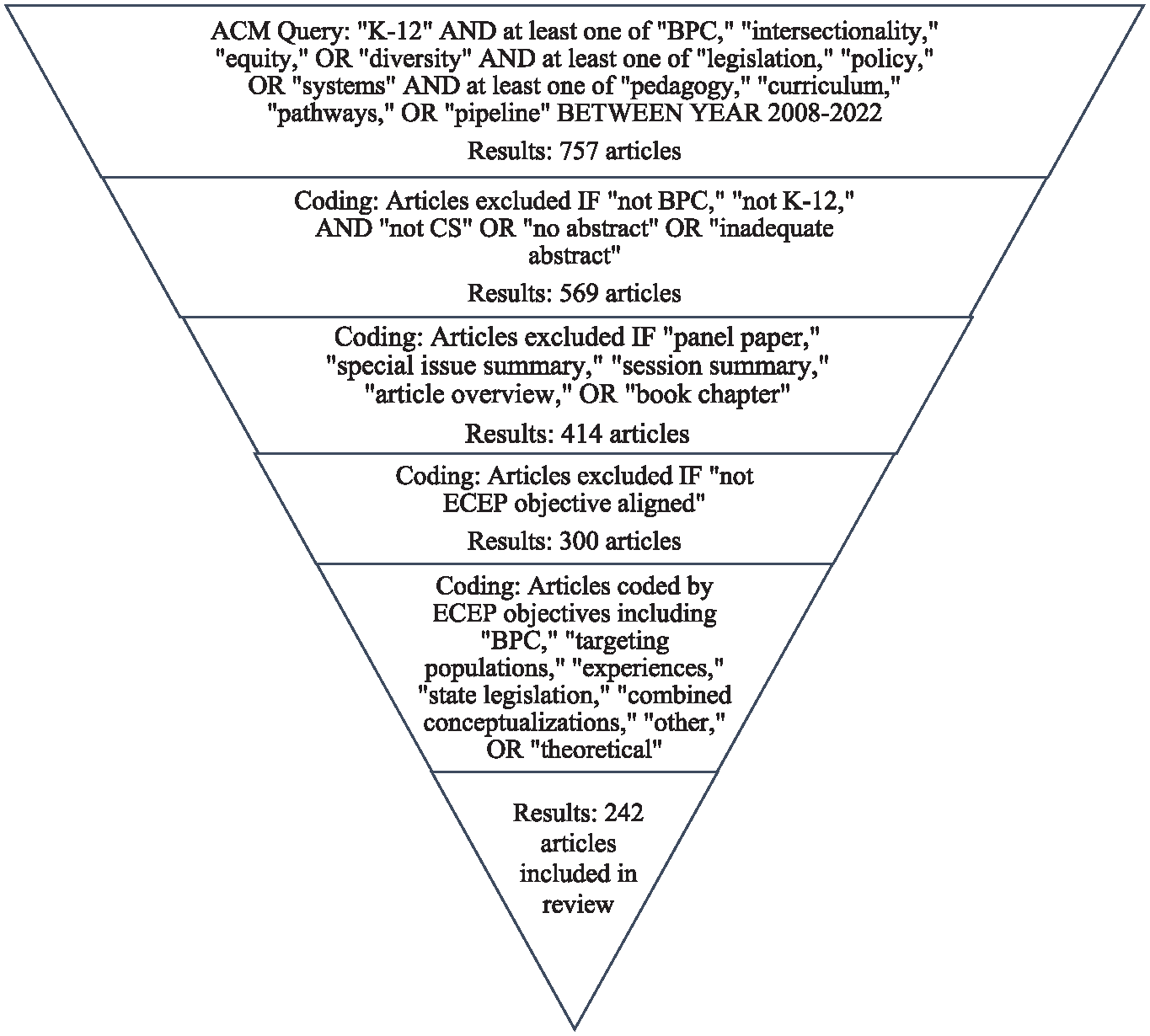
Search Query Construction and Coding Procedure for Association for Computing Machinery Articles Since 2008 (N = 757)
Research articles could be assigned more than one category. The thematic analysis yielded articles that were coded across multiple themes based on their theoretical or conceptual framework(s), literature review, or research findings. These articles went through additional rounds of coding and a collective sensemaking process. Final inclusion parameters for these articles were based on the overall assessment of how the articles contributed to our overall discussion of side effects in CSEd and how well they met the inclusion criteria of each theme. Articles included in the list of potentially eligible studies were carefully reviewed by experts on the author team in their respective area of expertise to identify and synthesize larger conceptual themes: main effects and side effects. Figure 1 illustrates our search query construction and coding procedure, which located 757 relevant articles, with the team identifying 242 articles eligible for our narrative review. Subthemes emerged from analyzing each of the articles, using a rater reliability scale of analysis, and coding articles to ensure that articles fit within the various dimensions of the overall themes. To maintain consistency and reliability in our analysis, we relied on multiple coders (or raters) to make decisions at various points in the screening and data extraction from the review of articles. Initially, raters independently analyzed a subset of selected articles. Using a grounded theory approach, raters classified a random sample of articles so that themes could emerge organically. This included applying a classification scheme, writing of memos to capture discrepancies, and an assessment process implemented among the raters to ensure consistency in coding and participation. An iterative process was also used to capture the coding themes and adjust those themes when consensus was reached. Raters were allowed to exercise discretion based on subjectivities, and the lead researchers checked all compiled codes and themes before finalizing.
Findings
This section summarizes findings from our review. First, we briefly define broadening participation to situate CS as an important discipline that requires further development when it comes to providing access, targeting populations, improving experiences, and promoting educational policies and practices. Second, we outline for readers the philosophy of expanding access as a mechanism for addressing broadening participation. Next, we describe the ways CSEd has targeted specific populations, grade spans, and geographic regions. Then, we outline the ways the CSEd field has attempted to provide meaningful and engaging experiences for all populations. Finally, we detail how broadening participation efforts have been an integral part of state policymaking. Table 1 provides a summary of the results of all the articles in the review, broken down by each of the themes that guide the findings section. Also, Table 1 presents characteristics of CSEd and captures how since 2008 CSEd has had a pivotal role in educational practice and policymaking.
Summary of Results (N Studies = 242)

Defining Broadening Participation
The growth of CSEd, through innovation in AI, increasing importance of digital literacy and computational thinking, and industry partners investing in computer science careers, has still created a side effect of disparities and inequities that limit accessible opportunities for certain groups of students. These persistent disparities in access and participation challenge efforts to expand CSEd and perpetuate historical barriers across the K–12 educational system. Broadening participation in CSEd is a multifaceted approach aimed at seeking opportunities for students from diverse backgrounds to have equitable access to computing experiences and learning. We identified 22 articles (9.1%) that focused on broadening participation based on our review criteria. Several subthemes emerged, and we organized based on a systematic process. Articles in the expanding access, course offerings, and standards subtheme categories provide insight on the possibilities of CSEd for minoritized students and ways to make broadening participation possible.
Expanding Access
Promoting access in CSEd has been pivotal when it comes to BPC. In their foundational book, Stuck in the Shallow End: Race, Education, and Computing, Margolis et al. (2008) defined access as the efforts aimed at making CS learning opportunities available to a wider range of individuals, specifically, those who have historically been underrepresented or underserved. Additionally, their book highlighted how expanding access in CSEd involves addressing the racial and gender disparities in computing. Bergin et al. (2006) further argued that expanding access to CSEd is critical for students to have the opportunity to develop the knowledge and skills that are necessary in today’s digitally connected world. As businesses have increasingly relied on technology and innovation to advance their revenue streams and market shares, CSEd has gained prominence in sectors outside of formal K–12 settings.
Course Offerings
Recently, there has been a significant increase in the number of CSEd courses in U.S. K–12 education. Yauney (2022) acknowledged that more states, districts, and schools have faced increasing pressure to enroll more students in CS and to increase the number of CS courses offered. Although CS has been one of the fastest growing professional sectors, a limited number of school districts are thoroughly providing CS courses that are accessible for all students (Tucker, 2010). The rapid advancement of technology and integration into daily societal routines has placed considerable importance on equipping K–12 students with CS skills. Industries in software development, data analytics, cyber security, and AI all require a workforce that has been adequately trained with skills in CS. In a study examining course offerings at 251 of Virginia’s 320 high schools, Rhoton (2018) found that accessibility to on-site CS courses was lacking across the state. This is despite Virginia being the first state to require CS instruction and mandating that middle school and high school CS classes be designed as standalone electives. Their study further describes a particular side effect with mandates when it comes to accessing CSEd courses and instruction: Disparities not only exist across race, class, and gender but also by geographic areas. Garvin et al. (2019) maintained that although CS initiatives have promising potential for improving opportunities for underrepresented and underserved groups, state control over CSEd policy creates challenges when it comes to providing every student access to high-quality high school computing courses. Therefore, we see disparities when it comes to implementation around course offerings, including what gets offered and who teaches CS courses. Districts and schools with limited resources may struggle to provide the necessary infrastructure to deliver high-quality CS courses, thus leading to unequal opportunities and exacerbating existing inequities. In Maryland, although there is a requirement to offer at least one high school CS course, opportunities to study CS vary due to lack of standardized CS curriculum and no state teacher certification requirement (desJardins & Martin, 2013).
Standards
Computer science standards assist in the measuring and visualizing of the effects of learning computer programming (Santo et al., 2020). Standards provide a rubric for evaluating student performance and assessing the educational effects of CSEd (Santo et al., 2020). Assessments aligned with standards can also support formative assessment, providing feedback to students and teachers (Paiva et al., 2022). Despite the importance of CSEd, there are several obstacles that students face in participating and staying engaged in CS standards and assessments, such as issues with access to technology or misaligned curriculum). Although there has been a strong push for having states create rigorous CS standards (Ottenbreit-Leftwich, Childs, & Hendrickson, 2022; Zarch et al., 2020), questions remain about how to align CS content, assessments, and support materials in individual state standards (Samarasekara et al., 2021). Furthermore, there is an acknowledgment that standards have the potential to influence students’ perceptions and affect their overall motivation and self-efficacy for learning computer science (Feldhausen et al., 2018).
In 2012, the CSTA released its K–12 Computer Science Standards. Revised in 2017, these standards have provided a foundation for CS as a core discipline (Seehorn et al., 2011). CS standards outline how students should be not only consumers of technology but also creators of systems that involve using computational thinking to address complex problems (Gal-Ezer & Stephenson, 2014). Gal-Ezer and Stephenson (2014) further explained: Problem solving lies at the heart of computer science. Learning and doing computer science requires students to state problems clearly and unambiguously, write an algorithmic solution for the problem that takes into account all boundary conditions (robustness), determine that the algorithm produces the right answer (correctness), and test that the solution is efficient (complexity considerations). At each step in this process, students are learning core skills that will serve them well in any field in which they choose to study. (p. 2)
The central role of problem solving in CS highlights how standards (and assessments) should be constructed so that students develop essential skills that can have broad applications across different fields of study. Mathematics is heavily integrated within CS, and the field’s understanding of how math and CS reinforce one another has evolved (Fisler et al., 2021). Fisler et al. (2021) described Bootstrap, a curriculum for integrating computing into middle school and high school mathematics, as one example for leveraging integrated curricula to cover standards in both math and CS. The authors recognized that several of the CS standards’ topical areas in algorithms, programming, and computational thinking align with mathematics standards that could lead to successful integration between the two subjects.
Often, students equate CS with solely focusing on coding (Armoni, 2016). CSEd can be taught at any age or grade level both with and without a computer. Access to CS courses is critical for students but does not guarantee that there will be equitable enrollment or outcomes. However, in many schools, CS curriculum is defined by computer literacy and basic computing skills, such as typing and word processing. The integration of mathematics and CS standards offers a promising path forward for providing increased access to CSEd. However, there exists a legacy of mathematics, particularly algebra, as being a gatekeeper for students to access CS courses (Torbey et al., 2020). Algebra is a fundamental subject in K–12 education (Chen et al., 2023), and many states require completion of one or several algebra courses for high school graduation (Han et al., 2023). Therefore, algebra (and other math subjects) can serve as prerequisites for CS courses and programs. Students who have strong foundational knowledge and experiences in mathematics are funneled into CS courses and are more likely to stay in CS courses through high school graduation (Gretter et al., 2019). However, students who lack confidence in their mathematical abilities or come from educational backgrounds with limited access to quality math instruction may be dissuaded from pursuing CS courses or face institutional pushback from enrolling in CS courses (Goode, 2010; Ryoo & Tsui, 2020).
Overall, broadening participation was discussed in 9.1% of the articles that were part of the review. These articles highlight the efforts to increase the involvement of minoritized and underrepresented groups in CSEd while also illuminating side effects such as barriers to access and misaligned attempts at fostering diversity and inclusion.
Targeting Specific Populations and Grade Levels
Scholarship has recognized that the diverse needs, interests, and challenges faced by different student populations can impede broadening participation efforts (C. L. Fletcher et al., 2021). Tailored approaches that rely on specific interventions and resources that meet students’ lived environments and experiences require instructional approaches that take into account the diversity in different populations and align with developmental stages and academic readiness. The 101 (41.6%) articles described in this section either investigated, analyzed, or discussed the role of CSEd curriculum and engagement strategies for minoritized and underserved students in K–12 education.
The effect of CS on innovation and the global economy has brought further scrutiny on who benefits from CSEd. Most U.S. high schools, especially those with high concentrations of low-income and minoritized student populations, have limited access to CS courses. BPC efforts have continuously concentrated on addressing equity issues in CSEd by focusing on how to target minoritized students, grade levels in the K–12 system, and addressing the rural and urban divide in CS. Public demand for CSEd has grown because most parents want their child’s school to offer CS (Google & Gallup, 2015), and there is a growing recognition that most of today’s students will be using CS in STEM and non-STEM future career professions (Change the Equation, 2015).
Minoritized Students
There exist significant disparities in CS enrollment and persistence of students in technology fields when data are disaggregated across race, ethnicity, gender, and disability. Historical and perpetual racial and gender inequities in CSEd have created barriers for minoritized 1 (Dubois et al., 2021) student populations’ participation in K–12 CS. Compared to other K–12 subject areas, CS courses typically have the fewest girls and boys of color (Wang & Hejazj Moghadam, 2017). Furthermore, minoritized students are less likely to attend a school that offers at least a foundational CS course, and students who are multilingual learners, students with disabilities, and economically disadvantaged students are underrepresented in CS (Dunton et al., 2022). The lack of diversity in computing has been a well-recognized and -researched phenomenon (C. L. Fletcher et al., 2021; A. Scott et al., 2016), highlighting the different disparities that exist between minoritized student populations and dominant groups in CS (White and Asian males; Cheong et al., 2021).
Although overall enrollment in CSEd courses has increased over the past 20 years, the underrepresentation of racially minoritized students remains a persistent challenge (McGill et al., 2022). Systemic and structural issues, such as lack of CSEd teachers, courses, and opportunities, limit racially minoritized students from accessing CS (Ibe et al., 2018). Furthermore, lack of support from school professionals, such as counselors and leaders, limits racially minoritized students’ engagement and enrollment in CSEd (W. Chi et al., 2023). Compared to other STEM disciplines, CS lags when it comes to gender diversity (Hinckle et al., 2020). Noninclusive environments, lack of support and role models, low self-efficacy, and minimal exposure to CS experiences are just some of the reasons why girls (and women) are not thoroughly represented in K–12 CSEd (Sun & Clarke-Midura, 2022). Students with physical, mental, and social disabilities are also consistently underrepresented in K–12 CSEd (Beyer, 2012; Burgstahler & Ladner, 2006; Patel et al., 2020). Many supports used to teach CS in K–12 schools are inaccessible to students with disabilities (Ladner et al., 2017), and teachers have reported not being properly equipped with effective pedagogical approaches that would guide them to include learners with disabilities (Israel et al., 2020).
Elementary, Middle, and High School
Exposing students to CS earlier has been a growing priority (Grover et al., 2016). Teaching CS in elementary classrooms has not always been a priority because there was a dearth of engaging and relevant curriculum that targeted K–5 students (Frost, 2007). At the elementary school level, targeting CSEd involves introducing young students to the basic concepts of CS through age-appropriate teaching and learning opportunities (Ottenbreit-Leftwich et al., 2021). Initiatives such as Hour of Code focus on engaging students at a younger age in CSEd (Armoni, 2016; Kumar, 2014). Elementary age students who have positive experiences and attitudes toward CS are likely to have higher self-efficacy in computer programming (Coenraad et al., 2022). Block-based programming languages and computational thinking approaches that rely on students acquiring knowledge about CS from firsthand experiences and direct observations are popular classroom practices in elementary CSEd classrooms (Resnick & Rusk, 2020; Wing, 2006). However, as Tsan et al. (2020) acknowledged, existing CS elementary teaching and learning options have been developed by experts who often situate terminology for adults but still have expectations that students will be able to understand and master it. Furthermore, elementary age students are less likely to be comfortable with terminology, understand general CS concepts, or engage learning materials in ways that CS content experts expect.
Recently, the CSEd community has engaged in two activities that have primarily focused on engaging elementary age students in CS. Unplugged CSEd activities, aimed at exposing students to CS without the use of computers, provide accessible and inclusive learning opportunities for students who may not have access to traditional computing resources or face consistent barriers to accessing CS (Cortina, 2015). Unplugged activities rely on hands-on, offline activities and exercises that do not require expensive technology or internet access and are more likely to be designed to incorporate culturally diverse examples and contexts that are relatable to students from different backgrounds (Brackmann et al., 2017; Prottsman, 2014; Reed et al., 2015; Rodriguez & Lehman, 2017; Thies & Vahrenhold, 2012, 2013). The second CS activity has centered on pair programming, or collaborative learning, that benefits students in engaging in self-explanation, question asking, and uptake (Tsan et al., 2021). A growing body of CS research literature has explored collaborative learning contexts and the degree that teachers and peers can influence students’ academic regulation (Vandenberg et al., 2021). CS elementary teachers are more likely to assign collaborative work and group projects that require collective negotiation of task goals, monitoring, and evaluation of CS strategies and processes (Vandenberg et al., 2020, 2021). Pair programming, especially among girls and minoritized student populations, has shown to be an effective approach for providing high-quality CS experiences and produces higher self-efficacy due to the structure of engagement between two programmers who learn from one another regardless of their prior knowledge in CS (Tsan et al., 2018). Supportive peer networks are valuable for students that come from cultural backgrounds that emphasize collectivism over individualism and can be critical for recruiting minoritized students in computing courses and future computing pathways (Lunn et al., 2021).
Middle school, where the impacts of social dynamics begin to influence student learning and interactions greater, are formative years for the cognitive and social development around engagement with CS (Grover et al., 2016). Curricula, interventions, programs, and support in structured middle school CS have grown recently (Dou et al., 2020). Robotics, Scratch, Alice, and textual programming languages are also frequently used as curricular interventions for CSEd (Huff et al., 2021). These learning environments help motivate middle school students through ease of use and features that support the development of CS projects (Grover et al., 2016). At the middle school level, games and pedagogical tools that focus on increasing fluency and motivation in computational problem solving have dominated curricular approaches (Taub et al., 2012). Werner et al. (2012) concluded that although computer game programming through learning environments such as Alice has been useful for engaging diverse populations in CS, without direct support from CS teachers, students do not get comprehensive exposure to specific programming concepts or strategies. Therefore, informal learning environments have proven to be critical spaces for middle school students to learn basic constructs and concepts in CS (Grover et al., 2016). Occurring outside of daily classroom instruction, informal CS learning in after-school and summer camp programs have been implemented to recruit and retain students in CSEd (Maloney et al., 2008; Schanzer et al., 2013; Werner et al., 2012). Although many of these informal settings are geared toward high school age students, when informal learning opportunities are presented to middle school students, CS academic and social interactions increase (Clarke-Midura et al., 2019; Katuka et al., 2023).
An important academic program in high school CS education has been Advanced Placement Computer Science (APCS) courses. These courses have shaped high school CS curriculum for years and have influenced how educational policies and practices are implemented in schooling environments (Ottenbreit-Leftwich, Dunton, et al., 2022). AP offers two CS courses and accompanying exams, AP Computer Science A (APCS-A) and AP CS Principles. Introduced in 1984, the APCS-A course is an object-oriented programming and data structures course that relies on Java as the primary programming language that students engage with (Sax et al., 2020). Until the 2016–2017 school year, APCS-A was the only AP computing course offered to high school students nationwide. Historically, APCS-A course enrollment has been low, and the number of students taking APCS-A exams has been fewer compared to other AP mathematics and science courses (Wang et al., 2016). AP CS Principles was launched in 2016 as an introductory course on the foundational concepts of CS and computational thinking (Greenberg et al., 2020). AP CS Principles focuses on the influence of computing and how computing influences innovation and technology (Sax et al., 2022). According to the College Board, in 2020, more than 116,000 students took the AP CS Principles exam (Wyatt et al., 2020). Although there have been increases in the number of students taking AP CS exams (Goldsmith & Stanton, 2021), participation in AP courses and exam taking among girls and Black and Latinx students still does not reflect the diversity of U.S. high schools’ student bodies (Sax et al., 2022). Despite this evidence, AP courses, such as AP CS Principles, serve as important entry points for high school students to the CS pipeline (Sax et al., 2020). Sax et al. (2022) found that girls who take any AP CS course were more likely to pursue computing majors and careers than boys and encouraged them to pursue and investigate various computing pathways.
In all, 41.6% of the articles in the review were situated in the targeting specific populations and grade levels category. Understanding the impact of teaching and learning and how educational initiatives meet (or do not meet) the needs of students are critical in CSEd. However, inadvertently reinforcing stereotypes or perpetuating inequities are potential side effects of targeting specific populations.
Providing Experiences to all Populations
Providing CS experiences to all populations regardless of their background or circumstances has been paramount for promoting equity in access to CSEd and bridging the digital divide. Students who have early exposure to CS courses and opportunities are more likely to succeed in CS courses (Goode et al., 2014). Student-centered teaching strategies, such as problem-based learning and pair programming, can be useful CS experiences (Clarke-Midura et al., 2020). Experiences in CSEd include both students and teachers, and an equity lens illuminates the underrepresentation of certain groups from diverse backgrounds (e.g., racially minoritized youth) from having equal opportunities to engage and succeed in CS. Furthermore, this includes recognizing that both students and teachers need to be supported in their CS experiences and that having access to resources, thriving in a supportive school environment, and offering professional development opportunities are critical for long-term success. One hundred and eight articles (44.7%) discussed the role of teaching and learning strategies, curricula, and resources of K–12 students. This included the impact of culturally responsive teaching and learning (CRTL) and professional development (PD), two subthemes that emerged from the thematic analysis.
Culturally Responsive Teaching and Learning
CRTL recognizes the importance of incorporating students’ cultural backgrounds, experiences, and identities into the curriculum. It acknowledges that students’ cultural contexts shape their learning styles, interests, and motivations and requires educators to draw and build on students’ cultural practices in CS classrooms (for a review of CRTL approaches in CS, see Madkins et al., 2020). CRTL aims to create more meaningful and engaging learning experiences for all students, fostering a sense of belonging and empowering them to succeed in CS (Madkins et al., 2020; Ryoo, 2019). Importantly, teaching CS in this way can support minoritized learners to see how they can use CS knowledge and skills to engage in social-justice-oriented work and transform their communities (Madkins et al., 2020; Vogel, 2021). With K–12 CSEd evolving to incorporate focused BPC efforts and initiatives, CRTL provides an opportunity for strengthening students’ connectedness and exposure to CS (Kraemer et al., 2019). Culturally relevant examples and metaphors are used to connect students to see how CS is relevant to their own lives and experiences (Madkins et al., 2020; S. S. Scott et al., 2014). Challenging stereotypes and biases about minoritized groups in CS helps students to see that they can succeed in CS regardless of their race, gender, socioeconomic, or disability status (Jayathirtha & Kafai, 2020). This creates CSEd classrooms that promote students feeling valued, respected, and comfortable to engage in problem-solving approaches and critical thinking designs and pursue justice-oriented goals (Madkins et al., 2020; Santo et al., 2019).
Teacher Professional Development
Goode et al. (2012) revealed that CSEd tends to focus narrowly on subject matter and curriculum within the discipline and rarely approaches addressing teacher PD. Since their publication, research has increased on examining how transforming teacher pedagogy through PD can lead to improved CSEd experiences for students and educators (M. Webb et al., 2017). CSEd requires teachers to possess a solid understanding of pedagogical practices that are specific to teaching the subject (Milliken et al., 2019). PD programs that focus on building teachers’ pedagogical knowledge, including instructional strategies, assessment techniques, and classroom management strategies, can help teachers align CS curriculum with engaging and effective learning experiences for students (Ni et al., 2023). PD in CSEd also should develop teachers’ technological competence by providing tools, programming languages, and software that are timely for today’s student (Hamlen Mansour et al., 2023). Because many teachers were recruited to CS teaching positions with limited preparation and pedagogical training (Nugent et al., 2022), one side effect is that many students’ experiences with CSEd come from improperly trained teachers. Therefore, PD programs should provide opportunities for teachers to enhance their technical skills through hands-on activities, workshops, and collaborative projects that enable educators to effectively teach CS concepts and keep pace with the rapidly evolving nature of the field (Martin et al., 2022; Shanley et al., 2023).
Providing experiences to all populations comprised the greatest number of review articles at 44.7%. Quality experiences that benefit all learners can help create equitable conditions for teaching and learning to thrive, whereas promoting talent and workforce diversity can make CS accessible for all. Despite the best of intentions, resources can be scarce in certain communities and locales attempting to broaden participation in CSEd, even as they attempt to enhance the CSEd experiences for students.
Broadening Participation in State Policymaking
Broadening participation in CSEd extends beyond the classroom and includes understanding the development and implementation of state - level policies that influence access and equity in computing. The state role in CSEd has expanded since 2008, with more states creating CSEd pathways, teacher and leader pipelines that focus on CSEd, CSEd curriculum and graduation requirements, and expanded CSEd course offerings. This has impacted how initiatives are not only funded but also expanded across a state and reach specific student populations. By setting priorities, enacting legislation, and allocating resources, state policymakers and agencies can influence the reach and outcome of CSEd statewide. Eleven (4.6%) articles highlighted how states engage in CSEd policymaking and their various roles of influence on CSEd curriculum, standards, and teaching.
CSEd policy has influenced K–12 students’ CS participation in K–12 education in recent years. Research has highlighted how more states have added CS, with more communities asking for CS and leaders recognizing the importance of CSEd for students in their schools (Knudson et al., 2022). Currently, 51% of U.S. public high schools offer at least one foundational CS course (Code.org et al., 2021, 2023). Despite recent efforts at the state level, millions of students are still missing out on CS learning opportunities (C. L. Fletcher & Warner, 2021). Because individual states establish their own educational policies, there are a wide range of approaches and legislation that have attempted to increase CS in K–12 education (Yadav et al., 2022). Across the United States, states have been promoting CSEd through a variety of different policies. These policies have included teacher certification, K–12 CS standards, CS funding, and expanding professional development opportunities for CS educators and professionals (Goode & Margolis, 2011; Ottenbreit-Leftwich, Childs, & Hendrickson, 2022).
State standards have played a crucial role in shaping the curriculum and educational framework in CS. In 2017, only seven states had adopted K–12 CSEd standards (Guo & Ottenbreit-Leftwich, 2020). Virginia was the first state to require CS in Grades K through 8 to be specifically addressed in content subject areas; middle school and high school CS classes could be standalone electives for students (Sawchuk, 2017). As of 2022, 43 states have standards, and 27 states require K–12 schools to teach CS (Ottenbreit-Leftwich, Childs, & Hendrickson, 2022). State standards encompass a range of topics, including programming, algorithms, data analysis, computational thinking, and the societal impact of technology (DeLyser et al., 2020). In some states, topics such as cybersecurity have been an additional component of CS standards as investments from government agencies, such as the Department of Defense, have spurred technology innovation (Guo & Ottenbreit-Leftwich, 2020). Although many state standards focus on the high school level, due to the prominence of AP courses, elementary school and middle school CS education are becoming more integrated in states’ standards (Kaya et al., 2021).
Limitations
Our review on the side effects of CSEd is not without limitations, and three challenges influenced the overall outcome of the review. First, our selection criteria focused on articles only from ACM-affiliated journals and conference proceedings. This choice excluded important articles that were in other CS conference proceedings, peer-review journals, or non-ACM-affiliated publications. The team decided to include several non-ACM affiliated articles that provided empirical data, highlighted important contributions in CSEd, and matched the search criteria in our framework. The review’s inclusion of these works and exclusion of other articles or publications should not minimize researchers’ contributions in CSEd research. Second, our selection criteria resulted in the exclusion of many articles, such as literature reviews, experience reports, position papers, and conceptual pieces, that could provide additional lenses to view the side effects of CSEd. We note the rich history and demonstration of ACM and other CSEd-related publication outlets that have used these types of works to highlight the growing body of knowledge in CSEd. Finally, during the review process, there were several challenging points when it came to sorting and organizing the data due to the search being broad and expansive. Because CSEd is often situated in the broader STEM field, the review process had to be flexible in the search to ensure that there were sufficient data for the analyses and that there was not overlap with other STEM fields, such as engineering or mathematics. However, we recognize that intersections exist between other STEM fields and CSEd, and future reviews should explore those intersections.
Broadening participation in state policymaking represented 4.6% of articles that were part of this review. This number is not indicative of the amount of research that exists about state policymaking in CSEd. State policymaking around CSEd is a relatively new endeavor because only a handful of states have passed laws regarding CS course taking, graduation requirements, and teacher certifications in recent years (Adrion et al., 2016; Judson & Glassmeyer, 2019; Margolis & Goode, 2016).
Side Effects in Csed and Future Directions
Side effects in CS are not new. Computer scientists continuously deal with the unintended consequences that occur because of executing a program or performing specific technological actions. Side effects can manifest themselves in various ways and have different implications depending on context. Similarly, side effects in CSEd potentially lead to various outcomes for students and teachers, especially as it relates to implementing and scaling BPC efforts (Margolis et al., 2015; Ottenbreit-Leftwich, Childs, & Hendrickson, 2022). For years, CSEd has been dealing with capacity issues when it comes to providing sufficient learning experiences for all students (Margolis et al., 2008). These capacity issues include not enough highly qualified CS teachers, courses, and programs for students to keep up with the demand for an educated CS future workforce (Goode et al., 2020; McGill et al., 2020). This has created persistent gaps in access, participation, and achievement in CS learning experiences (Goode et al., 2021). Despite these gaps, stakeholders have started to support equity-oriented CSEd in K–12 schools through their implementation of educational policies and practices. Although barriers exist when it comes to fully participating in CS, our literature review highlights the potential for addressing side effects in CSEd when equity is centered in approaches.
The steady increase in the number of states adopting CS standards and initiatives to increase the number of certified CS teachers highlight the potential of CS becoming an integral part of K–12 education. Data-driven CSEd models that are accessible and scalable provide opportunities for stakeholders representing diverse social sector industries, institutions, and government agencies to understand the importance of designing equitable CS pathways (Warner, Fletcher, et al., 2021). The annual state of CS report (Code.org et al., 2023), which shares data on CSEd trends, has expanded its reporting of disaggregated CSEd trends by student and community characteristics since the first iteration of the report in 2017 (e.g., disparities for multilingual learners). In CSEd, data—especially disaggregated data—are important for supporting BPC and ensuring that students have quality teaching and learning opportunities. State governments in the United States have constructed data reporting systems that allow the tracking and examination of educational outcomes, allowing stakeholders to identify areas to address and opportunities to modify state and local policy (Warner, Fletcher, et al., 2021; Zarch et al., 2023). Data systems are not always robust, and although many provide disaggregated data related to race, gender, ethnicity, and socioeconomic status, minimal data are available to understand other minoritized student populations, such as students with disabilities or LGBTQ+ students (Bruno & Lewis, 2021; Dunton et al., 2022; Warner, Childs, 2021).
CSEd scholars, practitioners, and other stakeholders should continue to be mindful of equity when updating curriculum and policies over time to address new technological developments. In particular, the recent expansion of AI as both a CSEd instructional tool and topic in CSEd curriculum has the potential to introduce new challenges for equity in student experiences in CSEd classrooms given the gender and racial bias inherent in many AI algorithms (Kuhlman et al., 2020; Solyst et al., 2023). Initial studies have suggested that teaching both teachers and students about these biases and related ethical issues of AI can provide them with awareness and prepare them to use these tools appropriately (Williams et al., 2023). However, it is also important to engage more diverse perspectives in creating AI tools and increase the diversity of the AI workforce (Lee et al., 2021; Solyst et al., 2023).
Policy efforts designed to make wide-scale change(s) are complex and may result in side effects. In CSEd, these side effects could over time become the “main effect” of policies due to the multifaceted components of applying CSEd in mainstream K–12 education. In this chapter, we provided a narrative review of CSEd research related to BPC efforts that focused on addressing equity concerns in K–12 school systems. This chapter recognizes the potential of BPC while highlighting some of the side effects of BPC and addressing the complexities around race, class, gender, and socioeconomic demographics that complicate scaffolding CS for all students.
There is a need to consider how the side effects of CSEd can either be mitigated or scaled, depending on the side effect(s) impact on students, to address equity-related teaching and learning concerns in education. CSEd should not simply be viewed as extracurricular or informal education, and we should be conscious that the formal structures to recognize and support CSEd do not adversely affect BPC work. Educational systems need to reconsider CS side effects and how these side effects are both measured and conceptualized to realize educational goals. A potential next step would be to conduct empirical support through meta-analyses of CSEd studies to identify links between changes in policy with changes in classroom practice and student outcomes. In sum, addressing the side effects of CSEd requires a collective recognition that BPC efforts must approach CS teaching and learning opportunities through an equitable approach that recognizes all students and educators in K–12 systems as capable users and consumers of knowledge.
Supplemental Material
sj-docx-1-rre-10.3102_0091732X241286475 – Supplemental material for Advancing Equity and Access: Addressing the Side Effects of Broadening Participation in Computer Science K–12 Education
Supplemental material, sj-docx-1-rre-10.3102_0091732X241286475 for Advancing Equity and Access: Addressing the Side Effects of Broadening Participation in Computer Science K–12 Education by Joshua Childs, Rebecca Zarch, Sarah Dunton, Tia c. Madkins, Katelin Trautmann, Z. W. Taylor, Miriam Jacobson, Sonnur Ozturk and Anne Ottenbreit-Leftwich in Review of Research in Education
Footnotes
Funding
The author(s) disclosed receipt of the following financial support for the research, authorship, and/or publication of this article: This work was supported by the National Science Foundation CISE Education and Workforce Program under Grant No. (2137834).
ORCID iDs

Notes
Authors
References
Supplementary Material
Please find the following supplemental material available below.
For Open Access articles published under a Creative Commons License, all supplemental material carries the same license as the article it is associated with.
For non-Open Access articles published, all supplemental material carries a non-exclusive license, and permission requests for re-use of supplemental material or any part of supplemental material shall be sent directly to the copyright owner as specified in the copyright notice associated with the article.
