




Abstract
The influence of posthumanist philosophies—broadly defined to include theories such as Baradian new materialism, Deleuzian assemblage theory, Wynterian counterhumanism, Afro-futurism studies, Indigenous studies theories of nonhuman agency, and others—on education research has been increasing at an exponential rate. This chapter provides a review of this literature organized around the theme of ethical and political responsibility. It compares four genres of posthumanist inquiry: assemblage studies, cartographic studies, diffractive studies, and place-based research. It locates these genres on a continuum from descriptive to enactive forms of inquiry. The review concludes with an examination of three different conceptions of futurity that inform posthumanist reconceptualizations of research responsibility, suggesting research is most powerful when all three are attended to in research designs.
Social science research is conducted to make a difference in our world. Scholars do not just seek to understand the world; we want to have an effect on it. This raises the question, “Which effects are worth our attention?,” which, in turn, leads to further questions, such as “Effects on whom?”; “What constitutes an effect?”; and “What kind of effects are researchers responsible to track?”
In what follows, we examine the rapidly growing body of education research influenced by posthumanist philosophies (see Figure 1), a term we define broadly. The literatures influenced by such philosophies consider responsibility of inquiry to involve not just tracking the effects of discreet policies and practices but also attending to the ontological, ethical, and political effects of the ways of knowing used to justify those practices and policies.
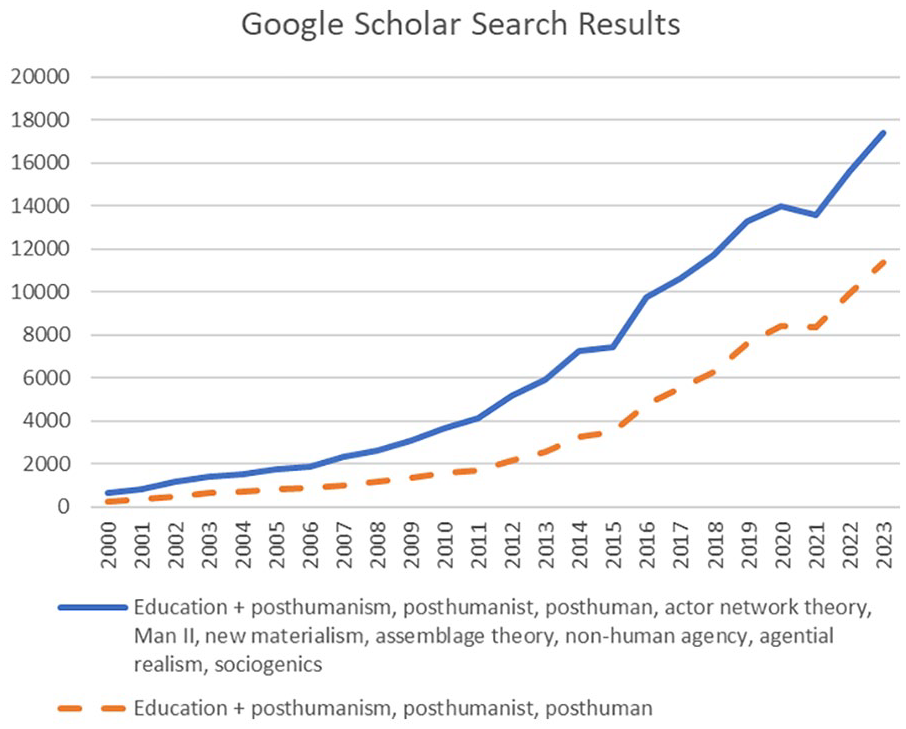
Number of Education Research Publications Citing Posthumanist Theories
Posthumanist philosophies refuse the binary of direct realism and social constructionism, both of which center a humanist spectator subject as the sole agent of inquiry. Instead, they frame research as ontologically generative, but not freely so. Social and material conditions limit what it is possible to do and desire. In some cases, objects of study are regarded as active participants in inquiries and the world’s ongoing metaphysical becoming. Understood in this way, education research is a process through which some knowing subjects, thoughts, affects, communities of human and more-than-human agents, socio-material relations, and possibilities for action come into being while others do not. In other words, empirical research is not a revealing of the world from a transcendent perspective, but it is an immanent doing in and with the world.
Circumscription of the Review
In this review, we focus on more than just the studies that are explicitly referred to as “posthumanist” and instead focus broadly on scholarship that operates with the expanded sense of responsibility just described, one that includes accountability for the ontological, ethical, and political effects of the ways of knowing employed in research projects. This substantive, rather than terminological, approach necessitates discussion of education research influenced by Indigenous philosophies that have a long history of addressing ethical reciprocity in research, the ethical significance of nonhuman agents, and relational ontologies (e.g., the work of Vine Deloria, Leanne Simpson, and Eve Tuck). This approach also requires a review of education research influenced by Black studies scholarship that critiques Western humanism and calls for a more ethically and politically visionary practice of social analysis (e.g., the work of Sylvia Wynter, Alexander Weheliye, Tina Campt, and Zakiyyah Jackson). This scholarship was read alongside education research influenced primarily by European continental philosophy (e.g., the work of Gilles Deleuze, Felix Guattari, and Bruno Latour) and Anglo-American philosophy (e.g., the work of Karen Barad, Rosi Braidotti, Donna Haraway, Alfred North Whitehead, and Brian Massumi).
The themes shared across these literatures have in part been the consequence of independent developments in different intellectual movements. However, there is considerable evidence of an ongoing history of influence and appropriation between these traditions of thought. Following scholars such as Leonard Harris (1983), Scott Pratt (2002), Juanita Sundberg (2014), Zoe Todd (2016), and others, this review considers Indigenous and Black thought and political activism to have been an influence on Eurocentric philosophies since first contact in North America and the first transatlantic human trafficking. 1 This influence was exerted even while its sources were frequently denied or dismissed as other to settler colonial ideals of rationality. In the present, even the briefest of surveys reveals that all of these literatures are in conversation and frequently imbricated in education research projects and careers even while maintaining their distinctiveness.
Additionally, an intertheoretic scope is necessary as a political praxis because it enacts a politics of citation that does not ignore and thereby contribute to the erasure of relevant literature by Indigenous scholars and scholars of color (McKitterick, 2021, pp. 25–26). Finally, it is necessary for our purposes because Indigenous studies and Black studies scholarship includes constructive critiques of the failure of Eurocentric posthumanist scholarship to live up to its stated ethical and political aspirations (Islam, 2016; King, 2017; Todd, 2016; Watts, 2013). Engagement with these critiques provides a scaffolding for more ethically and politically ambitious practices of inquiry that reach beyond the limits of Eurocentric humanism and its constitutive exclusions.
Purpose of the Review
The purpose of this review is not to provide a definitive map of the education research literature influenced by posthumanist philosophies. We consider such a definitive mapping to be impossible, even as a regulative ideal. Instead, this review is a small act within the ongoing process of this literature’s becoming; it constitutes an attempt to constructively influence the evolving relations between different communities working with these theories and by doing so, enhance the futurities they make possible.
Specifically, the review addresses two tensions in this literature. First, there is a frequently cited tension between efforts to describe the protean becoming of the world and an aspiration to produce research that performatively enacts that becoming (Lenz Taguchi, 2013, 2018; MacLure, 2013a; S. L. Pratt & Rosiek, 2023). The former is at times presented as retrograde, a slide back into humanist practices of inquiry, and the latter as more “truly” posthumanist. This review cautions against the reification of such binaries and offers this difference as a continuum on which ethically and politically engaged inquiry needs to be prepared to move if it is to be useful.
Second, and relatedly, there is a tension in this literature between two conceptions of change. One challenges the limits of humanism by drawing centrally, but not exclusively, on Black feminist and Indigenous studies scholarship (e.g., McKitterick, 2015; Truman, 2019; Tuck, 2010; Weheliye, 2014; Wynter, 2001). This scholarship prioritizes the need for axiological commitment to projects of onto-political transformation and treats the dismantling of foundationalist epistemologies as one among many means to that end. The other is research that draws heavily, but not exclusively, on continental European philosophy, contemporary philosophy of science, and feminist methodological theory (e.g., Barad, 2007; Braidotti, 2019a; Haraway, 1992; St. Pierre, 2011). It regards foundationalist metaphysics as a cornerstone of most, if not all, systems of oppression and ecological degradation. Moving beyond foundationalist epistemologies is therefore prioritized as the necessary first step to ameliorating these social scourges.
There is growing overlap between these strands of posthumanist literatures. Both involve critiques of totalizing foundationalism, both involve a rethinking of humanism and the human subject as the exclusive location of knowledge and agency, and both have at least a general commitment to advancing ameliorative social and political transformation. The difference in their priorities, however, produces tensions and some pointed critiques. The more axiologically focused literature has inspired critiques that a preoccupation with antifoundationalism is overly abstract and avoidant of substantive political solidarity in the struggle against systemic racism and settler colonialism or worse, that it reinscribes these forms of oppression through erasure and silencing of efforts to speak about real experiences of oppression. The literature focused more on antifoundationalism has critiqued the way embracing accounts of oppression that uncritically employ inherited categories of identity, emancipation, and justice risks reifying conceptual schemes that reproduce imperial knowledge projects.
This review holds space for both of these concerns. We do not find these divergent priorities to be incommensurable. To the contrary, this review offers a vision of this work in which both antifoundationalism and a readiness to make sustained onto-political commitments to specific projects of social amelioration—including but not limited to anti-racist, decolonized, feminist, queer, economically livable, ecologically sustainable futurities—are seen as complementary and mutually reinforcing. It is from within this admixture of antifoundationalism and onto-political commitments that a new understanding of research responsibility is emerging.
Review Methodology
Initial sampling occurred in three ways. First, we used widely cited anchor texts informed by posthumanist theories, including anthologies and previously published reviews of related literature (e.g., Malone et al., 2020; Snaza & Weaver, 2016; Taylor & Bayley, 2019; Toohey et al., 2020; Ulmer, 2017; Zembylas, 2018). The bibliographies of these anchor texts served as sources that led to other relevant studies. In general, we limited ourselves to scholarship published between 2000 and 2023 because according to our archival searches, the turn of the millennia is approximately the time the presence of posthumanist themes in empirical education research began growing rapidly (see Figure 1).
Second, multiple database searches were conducted—Google Scholar, EBSCO, ERIC, JSTOR, and ProQuest—using a combination of terms, such as “assemblage,” “new materialism,” “non-human agency,” “posthumanism,” “sociogenics,” and the names of key theorists, such as Karen Barad, Leanne Simpson, Sylvia Wynter, Rosi Braidotti, and Gilles Deleuze. These were combined with search terms such as “education,” “learning,” “pedagogy,” “curriculum,” and “teaching.” Based on a review of abstracts, books and articles were selected that featured analysis of educational processes significantly influenced by the relevant theories. Inclusion in the review database was determined by the conceptual design and explicit or implied purpose of the research design. A snowball sampling technique applied to the bibliographies of selected articles was used to identify additional candidate texts.
Third, having compiled this expanded list, we contacted 36 highly cited education researchers whose research is informed by these philosophical sources. We solicited citations for one to two studies that had most influenced their work to further ensure we were not missing significant texts. This was done to surface systemic oversights in our archival search process. These requests resulted in 150 additional suggestions, 48 of which were not already in our database. These suggestions surfaced gaps in our previous searches, highlighting, for example, an underrepresentation of postsecondary education research in the sample.
No preference was given to journal articles, books, or book chapters. All publications were assessed based on the conceptual content and methodological designs. In the end, over 300 articles, book chapters, and books were reviewed. We have posted the full bibliography and a searchable database at blogs.uoregon.edu/posthumanedresearch.
Subsequent selection of review themes was purposeful rather than based on frequency counts. We identified a range of ways scholars understood the purpose, ethics, and politics of ontologically generative work. We begin by identifying a continuum of approaches ranging from research that transformed its unit of analysis to permit for tracking metaphysically fluid objects of study that include the effects of ways of knowing to research that sought to performatively generate subject effects or relational effects in those addressed by the study. To illustrate this continuum, we compare four widely cited methodological genres present in the posthumanist education research literature—assemblage studies, cartographic analysis, diffractive inquiries, and place-based inquiry—acknowledging others along the way. Boundaries between these genres were not definitive. Studies were chosen to illustrate these analytic approaches not because they fit perfectly or exclusively within a category but because they possessed features that illustrated the aspect of posthumanist inquiry being discussed.
Following this, we examine the variation of research designs and comment on the importance of posthumanist research existing all along the identified continuum. We close by examining three different conceptions of futurity that inform posthumanist research designs and efforts to reconceptualize responsibility in research. Although often invoked separately, we offer that together, these three conceptions of futurity provide a metaframework for maximizing the ameliorative impact of these emerging posthumanist approaches to education research.
Assemblage Studies
One of the most common methodological innovations in this literature involves the use of the term “assemblage” to describe dynamic and complex units of analysis that include a variety of ontological elements, such as material phenomena, affect, discursive practices, subject effects, and more (Dixon-Román, 2016, 2017a; Franklin-Phipps, 2017; Mazzei & Jackson, 2017; Pennycook, 2020; Renold & Ringrose, 2017; Trafí-Prats & Fendler, 2016; Warren, 2021; Wozolek, 2021). 2 Traditional forms of education research often focus on a particular ontological aspect of the world (e.g., biology, minds, sociality, etc.) and on a single unit of analysis within that ontology (e.g., individual learning outcomes, specific behaviors, cognitive processes, economic interests, ideological contradictions, etc.). In contrast, assemblage studies posit that coherent phenomena often involve dynamic, complex, contingent relations that cross ontological types. For example, racism can be thought of as a shifting assemblage of different substances and processes, including but not limited to economic interests, the semiotics of racial difference, psychological bias, embodied affect, material violence, conceptions of knowledge, legal codes, technological algorithms, and more (de Freitas & Curinga, 2015; Dixon-Román, 2016, 2017a; Gulson et al., 2022; Rosiek & Kinslow; Weheliye, 2014). The study of racism, therefore, needs to be as multifaceted and fluid as racism itself. In assemblage studies, it is the moving whole that is the unit of analysis as opposed to any one element of the assemblage.
This transformation of the unit of analysis permits the aggregation of different, sometimes contradictory, conceptions of the object of study. The goal of research becomes not a single representation and explanation of a phenomenon but, rather, a shifting account of the many forms it takes (Coleman & Ringrose, 2013). Assemblage theory also enables the decoupling of phenomena previously presumed to be necessarily associated, such as affect from individuals (Puar, 2018), cognition from mind (Hayles, 2017), agency from humans (Barad, 2007; de Freitas & Curinga, 2015), and voice from speaker (Mayes, 2019; Mazzei & Jackson, 2017). For example, affect can be seen as moving through communities as the results of institutional policy and material events; affect is not simply something a person has but is generated and managed at a collective (human and nonhuman) level (Dixon-Román, 2016; Gulson et al., 2022; Lesko & Niccolini, 2017; McKenzie, 2017; Rousell et al., 2022; Taylor, 2017).
Assemblage studies are especially apt at documenting the intersectional nature of multiple forms of oppression. For example, Boni Wozolek’s (2021) book, Assemblages of Violence, documents the way economics, racism, colonialism, gender identity, and sexual identity are part of a complex weave of social, affective, and ultimately, material violence school-age girls experience in schools (see also Dixon-Román, 2017a; Franklin-Phipps, 2017; Ibrahim, 2014; Zapata & Kleekamp, 2022).
Sometimes, assemblages are accorded an agentic character; the assemblage is treated not just as an aggregation of disparate interacting elements but also as having a directedness, trajectory, or purpose that coheres in a manner that is not solely mechanical. These studies track the sustained coherent movement of “agentic assemblages” (Bennett, 2010; A. Y. Jackson & Mazzei, 2016; Kuby et al., 2019; Mazzei & Jackson, 2017; Warren, 2021), placing particular focus on their self-sustaining and self-replicating nature.
As we have described them here, assemblage studies enable a flexible and fluid conception of the focus of an inquiry. This goes beyond mere perspectivism and associated triangulation strategies, which presumes a single ontologically stable object of analysis and thus recommends studying the object through multiple types of data (interview, surveys, observation, etc.) or multiple points of view (students, parents, teachers, emic, etic, etc.). Assemblage studies, in contrast, allow that the phenomenon being studied is not ontologically singular or stable. It is not one object but, rather, multiple possible objects whose boundaries and nature are constantly changing. Consequently, the distinction between “effects” of an educational process and “side effects” becomes blurred. Both effects and side effects are part of the moving assemblage.
Studies that describe assemblages focus on the dynamic, protean, and complex ontological character of educational phenomena. As such, the conventions of descriptive prose often position the researcher and reader as humanist spectator subjects that can bear witness to their movement. However, the transformation of the object entails implicit and sometimes explicit transformations of the knowing subject of inquiry. Once an object of study is put in ontological motion, the nature of the inquiring subject is also put in motion and begins to become something other than a spectator. It becomes an emergent property of one among many possible relations between inquiring subjects and objects. Inquiry becomes a doing, not just a viewing. Assemblage studies begin to surface these subject effects, which brings us to our next genre of posthumanist scholarship.
Cartographic Analysis
Cartographic studies also draw on the language of assemblages. However, the subject-constituting effects of inquiry tend to receive more emphasis in the studies that describe themselves as cartographies. According to Rosi Braidotti (2019a), cartographies are immanent, not transcendent, practices of analysis that move as part of assemblages in which knowing subjects are contingent and change: I have called for a complex and heterogeneous approach that relies on the composition of active transversal assemblages . . . the task of critical thinking is to provide the cartographies and the navigational tools or figurations to understand the differences as well as the common grounds that compose these assemblages. These transversal links encompass human and non-human agents, but they do remain a function of subjectivity. (p. 153)
The cartographic scholarship we reviewed included descriptions of subject effects as they work their way through educational institutions, places, discourses, and histories (e.g., Knight, 2021; Martin & Kamberelis, 2013; Nxumalo, 2021; Renold & Ivinson, 2014; Ringrose, 2015; Warren, 2021); immanent accounts of personal experiences within the affective churn of educational settings (e.g., LeBlanc, 2023; Motala & Bozalek, 2022; Wozolek, 2021); and performative interventions, such as stories and art installations, that seek to enact particular subject effects (e.g., Rousell, 2021; Rousell & Cutter-Mackenzie-Knowles, 2020; Ulmer & Koro-Ljungberg, 2015).
Two related characteristics are most frequently shared across these studies. First, they focus on the nomadic and distributed nature of subjectivity. Sometimes, the focus is on a distributed community of knowing (Bangou & Arnott, 2018; Renold & Ivinson, 2014); sometimes, it is place-based (de Freitas, Sinclair, et al., 2022), a transspecies (Higgins & Madden, 2019; Lloro-Bidart, 2017), or even transmaterial (Flint, 2018) knowing subject. This may sound odd, but it actually refers to familiar experiences—such as finding oneself thinking about and acting on the interests of one’s family before oneself, speaking on behalf of a group, thinking as part of a disciplinary area of study, feeling injury to a place with which one is connected, being caught up in crowd enthusiasm, or being compelled by the affective machinery of an institution to worry about and do things we otherwise would not (call it a job).
Second, having left behind the individual transcendent subject of enlightenment rationalism as an imperial fantasy, the knowing subjects of cartographic studies themselves become nomadic, fluid, and multiple, operating within the relational fabric of the phenomena being studied. Knowing from within phenomena is often referred to as “folds” or “folding,” a term meant to imply that a researcher is always a part of the fabric of relations that includes the thing(s) they study. A cartographic inquirer does not presume to stand outside that relational fabric or plane of being but operates from within it, bringing different parts of the fabric constituting both the object and the inquiring subject into contact repeatedly. As P. Taylor Webb and Kalervo Gulson (2015) explained, “Our cartographical methods do not fix our understandings of policy nor bodies, but rather, produce multiple foldings that better inform how policy intensions form the topologies of education policy” (p. 79). The result of this folding is a reconfiguration of the relations being studied—again, research itself is an act, a doing, not just an observation. Cartographic studies do not just report on effects and side effects of educational practices but often use expressive forms of prose to bring audiences within the identities, affects, subjectivities, and institutional constituencies organized by particular conceptions of knowing.
Cartographic analysis makes explicit the way practices of knowing constitute us as part of distributed subjects that are infused with affective intensities (both investments and indifferences) and motivations to act or not act. Responsibility for the ethical and political consequences of the research-as-doing, therefore, lie not just with the accuracy of their descriptions but also with the futurities—possible future relations, actions, and further visions of amelioration—they enable and inspire.
Diffractive Analysis
Like cartographic analysis, diffractive analysis is immanent, “a way of understanding the world from within and as part of it” (Barad, 2007, p. 88), and as such, it is a doing in the world—“the point is not merely that knowledge practices have material consequences but that practices of knowing are specific material engagements that participate in (re)configuring the world” (Barad, 2007, p. 91). Unlike cartographies, diffractive analysis does not seek to describe the effects of knowing practices. Instead, it takes the form of presenting disparate phenomena alongside one another not to generate conclusions but to performatively generate relational effects. Diffractive analysis does not involve deductive point-by-point comparison but instead offers a curated juxtaposition of topics through which meanings become entangled. The purpose is to abductively generate new possibilities for onto-epistemic relations (e.g., Barad, 2017).
Diffractive studies take their name from Donna Haraway’s (1992) and Karen Barad’s (2007, 2014) philosophies of science that highlight the difference between inquiries based on a metaphor of light reflection and inquiries based on a metaphor of the diffraction of light. The classical Western epistemic ideal of accurate representation is premised on an image of knowledge as a reflection of the world. Diffraction also reveals things about the world, but through the way it is transformed by encounters with other things—an aperture, a corner, or other light waves. Diffraction is evidence of encounters with difference. Haraway explained: Diffraction does not produce ‘the same’ displaced, as reflection and refraction do. Diffraction is a mapping of interference, not of replication, reflection, or reproduction. A diffraction pattern does not map where differences appear, but rather maps where the effects of difference appear [italics added]. (p. 300)
Citing quantum diffraction experiments, Barad (2007) took this contrast with representationalism further by showing phenomena do not exist independent of intraaction with them. Light behaves as a wave if we set up an experimental apparatus one way; it behaves as particles if we set up our apparatus another way. The world, Barad argued, is not wholly independent of our concepts or entirely a social construction; instead, concepts and materiality co-constitute one another in inquiries. The agency of both knowing subjects and objects emerges through the material-discursive apparatus of our inquiries. Barad called this ontology “agential realism.”
In the field of teacher education, Karin Murris (2020) drew on Barad’s (2007) agential realism and Sylvia Wynter’s (2001) sociogenics to offer a diffractive analysis of six different figurations of childhood in Western thought. The juxtaposition of these similar but substantively different concepts of childhood is used to destabilize the normalization of childhood-as-deficit thinking. The child/adult binary is then read alongside human/nonhuman binaries and the various forms of racist, colonialist violence they enable. This diffractive reading both destabilizes taken-for-granted conceptions of childhood and then entangles that indeterminacy with the similarly indeterminate boundary between humans and nonhumans, which enables readers to appreciate the ways early childhood education and colonialism “are entangled phenomena” (Murris, 2020, p. 16).
In the field of educational assessment, Ezekiel Dixon-Román (2017a) provided a diffractive analysis of the way intelligence, ability, and achievement testing in U.S. schools has reproduced race and class inequality. By reading different methods of assessing educational outcomes through one another, he foregrounded the way the “iterative intra-acting process of measurement can then be understood to produce material–discursive phenomena” in different ways (p. 63). Dixon-Román made clear this is not a form of mixed methods or triangulation that uses multiple modes of measurement to corroborate a unified truth. Instead, “In the diffractive analysis of methods the focus is . . . on how one method goes beyond or contradicts another or how there may be disjunctures or tensions between varied sorts of data” (p. 71). Through highlighting these tensions, Dixon-Román sensitized readers to the differential performative effects of divergent practices of education assessment so that none can be fixed as authoritative; simultaneously, he provided the reader with an account of the ways assessment practices are entangled with the reproduction of education inequality—which raises the ethical and political stakes of assessment policy decisions. His analysis compels a transformation of the purpose of assessment practices from representation to creation—“an urgent and necessary turn toward enabling possibilities” (p. 175).
Hillevi Lenz Taguchi (2013) used diffractive analysis to denaturalize research on young women’s health and thereby examined the ways research designs can contribute to the causes of their ill health. Kuby et al. (2019) provided a diffractive analysis of different approaches to literacy curricula in an effort to loosen the hold of narrow definitions of literacy (as decoding texts) on educators’ imaginations and encourage broader conceptualizations of literacy (as the production of relations that also support ethics and justice). Diffractive analysis has similarly been applied by education scholars to different techniques of interview analysis (Lenz Taguchi, 2013), structure/agency dichotomies and the politics of citation (Murris, 2020; Rosiek & Adkins-Cartee, 2023), the use of different theoretical frameworks (Bozalek & Zembylas, 2017; Murris & Bozalek, 2019), narrative methods of inquiry in education (Coulter, 2020), disruptions of material and relational boundaries (Bellingham, 2020; Jukes et al., 2022; Lenz Taguchi & Palmer, 2013; Mayes, 2019), data analysis (Heinrichs, 2021; Warren, 2021), higher education (Bayley & Chan, 2023; Smithers & Eaton, 2017), and pedagogy (Hickey-Moody et al., 2016; Hill, 2017; Strom & Martin, 2022).
It is important to note that diffractive studies use the juxtaposition of differences to do more than problematize foundational certainty about representations of educational phenomena. There is a deconstructive element involved, but the diffractive studies we reviewed also included noncoercive affirmative and generative elements. Diffractive analysis brings readers to a precipice of multiple possible relations, where relation is inevitable but no specific relation is compelled.
Importantly, not all relations can be realized. Working from the quantum mechanical principle of complementarity, 3 Barad (2007) explained how traditional inquiries create “conditions of possibility for particular concepts to be meaningful at the exclusion of others” (p. 345). By highlighting this condition, diffractive analysis leaves a reader and researcher in a relation of both enhanced agency and increased responsibility: enhanced agency because it includes participation in generating possibility, not just representations; increased responsibility because inquirers are responsible not just for the relational possibilities eventually affirmed but also for those possibilities that are not acted on. We might call these the “null side effects,” the possibilities not realized and perhaps not even recognized. It is this relation of intensified onto-ethical responsibility that Barad called “entanglement.”
Place-Based Research
“Place-based” is an adjective used in many ways in education research literature (Gulson & Symes, 2007; Helfenbein, 2021; Tuck & McKenzie, 2015). For the purposes of this review, we focus on place-based research that emphasizes the way place shapes the ontological and ethical character of inquiry. Many of the most compelling examples of this kind of place-based research emerge from within or are influenced by Indigenous studies scholarship. Unangax scholar Eve Tuck and coauthor Marcia McKenzie (2015) succinctly summarized the salience of place to research: Consider as researchers, how we are contributing to place as event through our research. It is the specificity, the rootedness of place that makes it so important in social science, and in (post)human imagination. We urge readers and colleagues to reconsider place and its implications, not because it offers a generalizable theory or universal interpretation, but because generalizability and universality are impossibilities anyway, in no small part because place matters and place is always specific. (p. 637)
Lummi scholar Michael Marker (2018), for example, writing about the onto-ethics of conducting research in Coast Salish territory, warned about the way traditional forms of research treat location as generic space and have the effect of preventing the establishment of relations with “animate landscapes” (p. 453): An inquiry and research methodology that begins with a recognition of the Indigenous experience of place and the contrasting Enlightenment minds that divided and obscured this deeper reality could generate new conversations about relationships between natural ecologies and our ways of perceiving/experiencing them. Both Indigenous and non-Indigenous researchers must recognize the colonial legacies of thought that hinder our capacity to focus deeply on the meaning of place-ness. (p. 455)
Marker (2018), drawing on archival research on conversations with Salish elders, offered an account of the unique affects and insights made possible by some natural places as being the consequence of the merging of two sentiences—that of the human visiting and the sentience of the place itself. Education about relation to such sacred geographies, he argued, is not only important for respectful interactions with the Salish coastal people but also is a relational capacity important for the future of all human communities.
Anishnaabe and Haudenosaunee scholar Vanessa Watts (2013), in her essay, “Indigenous Place-Thought and Agency Amongst Humans and Non Humans,” similarly wrote about the co-constituting nature of place and thought. She emphasized an understanding of place and land as a specific kind of agential being with a history and gendered character.
4
She warned of the onto-political risks of treating land as something we know about rather than know with: When an Indigenous cosmology is translated through a Euro-Western process, it necessitates a distinction between place and thought. The result of this distinction is a colonised interpretation of both place and thought, where land is simply dirt and thought is only possessed by humans. (p. 32)
Thinking with Vanessa Watts’s (2013) theory of place-thought and Barad’s (2007) agential realism, Michelle Honeyford and Jennifer Watt (2020) examined how taken-for-granted conceptions of language and literacy curricula are implicated in “the hegemonic power of cultural and cognitive imperialism” (p. 32). They shared stories about how teacher inquiry enacted in a local park serves as “a powerful catalyst for writing and critical place inquiry” that creates new ethical relations with place (p. 37).
Fikile Nxumalo and Stacia Cedillo (2017) discussed “how Black feminist geographies and Indigenous knowledges might be in conversation with posthumanist theories (p.108). Writing in the field of early childhood education, they sought to “open up potentialities for (re)storying young children’s place encounters in ways that more explicitly engage with questions of racialized environmental (in)justice, human/more-than-human relationalities, as well as past–present settler colonial histories of place” (p. 108). Nxumalo (2021) applied these theories to early childhood education in her own community to refuse anti-Blackness that erases the possibility of playfulness and innocence in Black childhood from the imagination of educators. Through speculative readings of photographs of children in outdoor settings, her stories call into being both different relations to place and to the lives of very young Black children (Nxumalo, 2021; see also Nxumalo & Tuck, 2023). This work focuses on the effects not just of outdoor education curricula but also of the place and the way curriculum inquiry is performed.
Walking research, a situated practice of inquiry that seeks to performatively transform participants’ relation to place and knowledge, has been applied extensively to education processes (e.g., Franklin-Phipps & Gleason, 2019; Motala & Bozalek, 2022; Springgay & Truman, 2019, 2022; Truman & Springgay, 2019). Scholars working with walking methodologies draw on a wide range of theoretical sources, such as Indigenous studies (Tuck & McKenzie, 2015), Sylvia Wynter’s sociogenics (McKitterick, 2015), AfroFuturism (Z. I. Jackson, 2020), environmental posthumanism (Alaimo, 2016), new materialisms (Barad, 2007, 2014), and queer theory (Puar, 2018). Stephany Springgay and Sarah Truman (2022) explained how such inquiries create the possibility of transformed onto-political relations to place without naturalizing new relations as necessary or inevitable: “Queer walking tours are situated (they happen in a specific location and attend to that place) but simultaneously are ‘out of place’ (meaning that they defamiliarize how diverse publics attune to a place” (p. 173). Similar forms of place-based research can be found in the field of science education (Higgins, 2016; Higgins & Madden, 2019), early childhood literature (Downey 2022), environmental education (Malone, 2016), and creativity education (Rousell et al., 2022).
One of the features of place-based research most salient to this review is its emphasis on specificity of relation. Assemblage studies and cartographic studies provide examples of the way specific social and material contexts influence the constitution of knowing subjects, but as a means of illustrating the general relational possibilities of fluid and nomadic subjects (Braidotti, 2019a). Place-based research somewhat inverts these emphases, acknowledging the multiplicity of human and nonhuman relations possible but underscoring a need for commitment to specific place relations. As Tuck and McKenzie (2015) explained, the merit of critical place-based inquiry lies at least in part on the quality of relations that emerge from inquiry and their local impact: Thus, relational validity implies that research is not only about understanding or chronicling the relationality of life . . . but also that research necessarily influences these conditions in small or significant ways; it thus impels action and increased accountability to people and place. (p. 637)
These four genres of posthumanist inquiry—assemblage studies, cartographic analysis, diffractive analysis, and place-based research—although prevalent and widely cited, do not constitute an exhaustive list of innovations that can be found in posthumanist education research literature. Many other distinctive terminologies and modes of analysis were present in our sample, including but not limited to hauntologies (Dixon-Román, 2017b; Motala & Bozalek, 2022), listening to images (Campt, 2017; Nxumalo, 2021), analysis of nonhuman agency (Bang & Marin, 2015; Brøgger, 2018; Garroutte & Westcott, 2013; Kuby et al., 2017; Marker, 2006; Snaza, 2019), counterhumanisms (Truman, 2019), pathology analysis (Wozolek, 2021), blues methodology (Speight Vaughn, 2020), felt studies (Springgay, 2022), rhizoanalysis (Ibrahim, 2014; Sherman et al., 2020), posthumanist institutional ethnography (Taylor & Fairchild, 2020), and many more. These four, however, illustrate some of the significant variations we found in the literature.
Descriptive to Enactive Studies
The posthumanist approaches to research just reviewed, although used in distinct ways, did not always have clear definitional boundaries and were often mentioned in the same study. For example, Roussell (2021) referred to his study of the art installations as an “immersive cartography” but referred to some of the installations as creating “a diffraction effect” (p. 585). Nxumalo’s (2021) study of early childhood education used cartographic methods to study place-based knowledge construction that enacted a refusal of anti-Black racism. Examples of such theoretic syncretism are so common as to almost be the norm (see also Franklin-Phipps, 2017; Higgins, 2016; Mazzei & Jackson, 2017; Motala & Bozalek, 2022; Murris, 2020; Murris & Bozalek, 2019; A. B. Pratt, 2021; Rosiek, 2019; Snaza & Mishra Tarc, 2019).
Rather than try to artificially project rigid boundaries between these terms and categories, we took a step back from our data set to look at patterns of analytic practice independent of the specific terminologies used. There are many observational cuts we could make here, but in the space available, we focus on a continuum from what we call “descriptive” to “enactive” modes of posthumanist research. This distinction, once conceived, proved useful for clarifying elements of nearly all the studies reviewed. More importantly, focusing on this distinction as a continuum rather than a mutually exclusive binary serves the purpose outlined in the introduction of the chapter, to refuse a rigid binary between representation and performativity that can distract from the constructive contributions posthumanist inquiry can provide.
Descriptive posthumanist analyses describe the ontologically protean nature of objects of analysis and the ontologically generative effects of others’ knowledge practices. Insofar as knowledge practices are multiple and changing, this focus renders a study’s unit of analysis fluid and puts it into metaphysical motion. For example, studies may track the ontologically shifting character of what constitutes learning and educational achievement (Bang & Marin, 2015; Dixon-Román, 2017a), childhood (Malone, 2016; Murris, 2020; Nxumalo, 2021; Osgood & Robinson, 2019), student racial identity (Ibrahim, 2014), curriculum (de Freitas, Sinclair, et al., 2022; A. B. Pratt, 2021; Rosiek & Kinslow, 2016), violence (Wozolek, 2018, 2021), and more. Most of what we call “assemblage studies” fall at this end of the continuum. The implied audience in these moments of descriptive posthuman analysis is a familiar spectator subject that can view the fluid movement of other subject-object relations or the agency of things from a critical distance and work out its implications for policy, practice, and future inquiry.
These descriptions of protean educational phenomena, however, shade into participating in the emergence of a different kind of subject-object relation. By focusing on the impossibility of achieving a uniquely accurate representation of an object of analysis, authoritative practices of representation and the transcendent knowing subject they presume are destabilized. Because authoritative representations and their implied transcendent knowing subjects are entangled with processes of colonialism, whiteness, patriarchy, commodification, and so on, their destabilization and the generation of alternative relations carry ethical and political implications. A scholar providing such analysis, whether intentionally or not, becomes part of a greater assemblage that generates new and more fluid knowledge/power relations.
Enactive 5 analysis refers to inquiry that intentionally seeks to participate in this ontologically generative activity by means other than description. 6 Such studies enact novel subject/agency effects, affective relations, connections to place, or other transformations of the relation between the reader/viewer/consumer and the focus of a study. The goal is integration into an ongoing stream of relations and contributing to the generation of possibility from within them. Examples include diffractive scholarship (Lenz Taguchi & Palmer, 2013; Murris & Bozalek, 2019; Warren, 2021), performative accounts (A. Y. Jackson & Mazzei, 2022), felt studies (Springgay, 2022), and many explicitly arts-based forms of scholarship (e.g., Bayley & Chan, 2023; de Freitas, Trafí-Prats, et al., 2022; Renold & Ivinson, 2014; Roussell, 2021; Springgay, 2022; Sweet et al., 2020; Truman & Springgay, 2019).
Often, scholars move back and forth between different descriptive and enactive modes of analysis in their scholarship or even individual studies. The most explicitly theorized endorsement of this onto-epistemic shape shifting we found in the education research literature was A. Y. Jackson and Mazzei’s (2022) Thinking With Theory in Qualitative Research. In that text, they deployed Deleuze and Guatarri’s conception of “plugging-in” (pp. 1–6) to describe lateral movement between theoretical frameworks and corresponding modes of subjectivization. They explained that “in plugging in, we enact something new that is a continuous, constant doing” (p. 2) and that “plugging in is not for the purpose of making meaning, but to work with repetition to create possibles, becomings, reconfigurations” (p. 11). Within each enactive plugging in process, however, scholars provide what they called “performative accounts” (p. 2), descriptions delivered within a particular onto-epistemic theoretical frame. Understanding the descriptions as one among many forms of plugging in resists naturalizing the frame that enables it. The overall merit of an inquiry, therefore, resides not solely or even primarily in the accuracy of a representation or the thoroughness of critique but, rather, in the quality and character of the possibilities plugging in to certain modes of inquiry brings into being.
This distinction between descriptive and enactive posthumanist scholarship can be useful, we think, to conversations about the form posthuman analysis should take. Often, this has been discussed in terms of what posthumanist research should not be—it should not repeat familiar practices of representation or critique, thereby reinscribing the familiar humanist subject of Western enlightenment thought, associated foundationalist metaphysics, and the imperial anti-Black, settler colonial, patriarchal politics that follow (Barad, 2007; Braidotti, 2019a; Wynter, 1994). Viewed through the lens of this concern, any form of descriptive analysis risks falling back into the reproduction of the humanist spectator subject (see Lenz Taguchi, 2013, 2018; Mazzei, 2016; Mazzei & Jackson, 2017). Maggie MacLure (2013a), citing Elizabeth St. Pierre, summarized this concern. It is difficult, of course, not to sink into the old habits of humanism and hubris that promise some kind of depleted mastery over the world through the dogmatic exercise of methodological good sense and common sense. St. Pierre (2011, p. 620), in her map of the possible contours of post-qualitative research, writes of how difficult it is to ‘escape the “I”’, even for those who have committed to the poststructural dismantling of that humanist subject. Part of the reason why qualitative research tends to collapse back into such positions is, I suspect, associated with our failure to engage fully with the materiality of language. (p. 666)
Raising such concerns has been useful because it helps surface and denaturalize deeply inscribed habits of anthropocentric humanism and provoke methodological thought to take novel directions. However, none of the over 300 studies we reviewed entirely avoided familiar practices of representation, and most did not aspire to do so.
We see three reasons to consider this vacillating use of descriptive and enactive forms of analysis within posthumanist scholarship to be a strength rather than a flaw. First, it is consistent with a resistance to either/or logics in posthumanist philosophies (Massumi, 2002; S. L. Pratt & Rosiek, 2023). As Rosi Braidotti (2019b) explained, “The heteroglossia of contemporary data defies the logic of the excluded middle and demands complex topologies of knowledge, for subjects structured by multi-directional relationality” (p. 47).
Second, there are practical advantages to the use of a range of modes of writing. More descriptive posthuman scholarship maintains a degree of legibility to contemporary conversations about policies and practice (Fox & Alldred, 2023). This enables engagement with wider audiences in discussions about the relation between knowledge, state authority, and responsibility (e.g., Dixon-Román, 2017a; McKenzie, 2017).
Third, there are widely cited concerns that exclusively privileging the ideal of nonrepresentational or subjectless social analysis serves a depoliticizing function by suppressing testimony about experiences of identity-based subjection and reinscribing an ahistorical white innocence in the guise of moving beyond individual subjecthood (Z. I. Jackson, 2020; Mikulan & Rudder, 2019; Nxumalo & Tuck, 2023; Rosiek et al., 2020; Todd, 2016; Tuck, 2010; Watts, 2013; Wolgemuth et al., 2022; Zembylas, 2018). Alexander Weheliye (2014), for example, warned that “within the context of the Anglo-American academy more often than not an insistence on transcending limited notions of the subject or identity leads to the neglect of race as a critical category” (p. 48).
Tiffany Lethabo King (2017) found not only neglect but also active hostility in the way students and scholars of color are sometimes pressured to “disavow all claims to identity, subjecthood, and the desire for humanity” (p. 163) by those working with continental critical theories. Based on these concerns, King found value in performative refusals to engage Eurocentric posthumanist philosophies as “modes of engagement that . . . force an impasse in a discursive exchange” (p. 164). 7 The alternative is affirmation of immanent representations of Black and Indigenous identities, subjectivities, and experiences, which, because they function as the constitutive other to Western humanism, is a more politically substantive route to the disfigurement and decentering of humanist knowledge projects.
For all these reasons, it seems unlikely that posthumanist inquiry will be defined by any particular form of representation or avoidance of any particular form of representation. Instead, it seems more likely that the design of posthumanist inquiry will continue to involve a mixture of familiar and innovative research designs and prose styles determined by the situation, audience, and becomings of which they are a part. This brings us to the final feature of posthumanist scholarship we review: an emphasis on responsibility to/for the futurities social inquiry enables.
Responsibility and Futurity in Posthumanist Education Research
Posthumanist scholars move beyond the ideal of singularly authoritative representations of passive objects made by individual transcendent human subjects. Instead, inquiry is approached as immanent participation in an ongoing process of collective ontological becoming. Within this immersive and emergent understanding of inquiry, responsibility for educational effects becomes literally response-ability, the ability to respond while moving within and between ways of knowing that shape us as knowing subjects; have specific affective, material, and institutional consequences; and enable and constrain possibilities for future being and relation. Adopting terminology already present in the field, we call these emergent consequences “futurities.”
Explicitly attending to the futurities that inquiries enable/disable occurs not just at the level of predicting measurable concrete effects but also at the level of subject formation, the shaping of affect and identity, the emergence of (human and nonhuman) agency, speculative imagining of altered social possibilities, and the performative recruitment of others into shared projects of social amelioration. Futurity is not simply “the future” because within many of the theories discussed here, taken-for-granted notions of temporality are transformed; past, present, and future are entangled relations that are constantly constituting us and being reconstituted through the activity of inquiry.
Herein lies the unique contribution of posthumanist philosophies to our conception of research responsibility; it concerns not just what people do with knowledge but also what knowledge does with us. According to the literature we have reviewed, responsible research involves moving beyond an exclusive reliance on the parallel practices of discovery and critique (S. L. Pratt & Rosiek, 2023)—beyond revelation and refutation. It also requires understanding the way our practices of knowing are a part of assemblages that affirm some possibilities of being over others (Braidotti, 2013, 2022; Massumi, 2002; Mazzei & Jackson, 2018). These affirmations are not just cognitive but also affective (Campt, 2017; Seigworth & Pedwell, 2023; Springgay, 2022).
Perhaps most importantly, the relations affirmed by our inquiries cannot remain generic, as in a general endorsement of the feeling of joy or love or solidarity. Rather, they are inevitably specific. Our inquiries usher into being particular joys, particular loves, particular solidarities; they are processes of becoming that have no endpoint, but they do have character. We are always conducting inquiry where we are and not someplace else. Everywhere we turn is a site of struggle for justice and equitable well-being, and consequently, futurity constituting inquiry is emplaced political work. This is why inquiry is inherently speculative and imaginative but not irresponsibly so. It is answerable to the material and political exigencies in which we live (Patel, 2015). We can see this, for example, in the work of Afro-futurist scholar Stephanie Renee Toliver (2021), who describes her anti-racist speculative fiction research as follows: “Black authors create speculative texts that center Black characters in an effort to reclaim and recover the past, counter negative and elevate positive realities that exist in the present and create new possibilities for the future” (p. 4).
In the posthumanist education research literature reviewed, we identified three primary ways the relation between research and futurity is being conceptualized. The most frequently mentioned involved a celebration of liberation from past or existing onto-epistemic constraints that offered the promise of a relational openness, newness, and possibility for innovation or growth. St. Pierre et al. (2016) succinctly expressed this aspiration: We have ample evidence that the existence we’ve created is not ethical, and the piling up of that evidence forces us to imagine a different existence. It is curiosity about what might be possible that enables us to imagine and create a different, more ethical existence. We made the existence we have—it is not “natural.” We can think and make another, and that is the task of ethical experimentation. (p. 102)
A second account of futurities focused on sensitizing us to specific affects that provide leads to new relational possibilities. MacLure (2013b), for example, wrote about moments of data that “glow”: A fragment of a field note, an anecdote, an object, or a strange facial expression—seems to reach out from the inert corpus (corpse) of the data, to grasp us . . . they exert a kind of fascination, and have a capacity to animate further thought. (p. 228)
According to Greg Seigworth and Melissa Gregg (2010), this kind of attention to affective qualities can provide “illumination upon the ‘not yet’ of a body’s doing, casting a line along the hopeful (though also fearful) cusp of an emergent futurity, casting its lot with the infinitely connectable, impersonal, and contagious belongings to this world” (p. 4). Similar vocabulary included attending to “lures” (A. Y. Jackson & Mazzei, 2022) or “attuning” to affect (Dernikos, 2020). Research that uses literary- and arts-based modes of expression often finds its justification in the effort to generate such affective leads (Coulter, 2020; Toliver, 2023). Research of this sort identifies or performatively draws readers/audiences into particular relational paths without specifying their ultimate end.
A third relation to futurities we found involved a commitment to visions of specific reconstructions of ethical/political possibilities. Nxumalo (2021) illustrated this in her speculative research designed to cut against the grain of cultural discourses that dehumanize Black children as children.
8
She wrote: Pedagogical and research practices that carefully attend to the relationality of Black life therefore hold potential for making visible and materializing Black futurity. Holding close the interconnectedness of Black refusal and Black futurity, I am interested in possibilities for imagining and noticing Black relational subjectivities in affirmative ways. (p. 1196)
Note that Nxumalo’s inquiry is not prescriptive but is focused on imagining and generating particular kinds of anti-racist relational possibilities made compelling by the ethical and political context of contemporary society.
In the end, each of these relations to futurity seems necessary but not sufficient on their own for bringing ameliorative new possibilities into being. The first underscores a need to avoid naturalizing the outcomes of our inquiry by finding value in the open-ended possibility of transformation. The emphasis on lack of closure holds space for indeterminacy, creative growth, and a proliferation of as yet unimagined possibilities.
Open-ended possibility alone, however, does not constitute amelioration. Not all possibilities are good. Creativity and experimentation are not inherently ethical. Some guidance for how to move across the threshold from possibility to actual relation is needed. The second relation to futurity finds such guidance in specific affective impressions not interpreted as definitive truths but as leads to other possible worlds. All affective attractions, however, do not necessarily lead to long-term or collective amelioration. Affect moves us, but some explicit account of where affective leads might take us is needed to enable collective discernment of their merit.
The third relation to futurity involves speculation about how specific, as yet unrealized, relational possibilities could unfold not just through time but also through the ongoing becoming of subjects, affect, and emplaced material relations. Affirming these relational possibilities entails a degree of commitment to narratives of wider reaching social, material, and political projects—be they familiar projects of feminist, anti-racist, decolonial, ecological transformation, and other less familiar or yet to be imagined relational entanglements. These commitments provide the basis for an axiology that can guide but not prescribe 9 the protean movement of education, inquiry, and world making.
As we conclude, we offer that posthumanist inquiry, broadly defined, is most powerful when all three of these forms of research responsibility are enacted together. This conclusion does not possess the force of logical necessity. Instead, it possesses the force of desirability.
When these three expanded understandings of research responsibility come together—postfoundationalism, performative attention to the affect, and commitment to speculative visions of particular forms of ethical-political amelioration—posthumanist education scholarship promises a practice of inquiry that does not just describe the world or even merely critique the world but, rather, offers a means of metaphysically remaking the world. At its best, it is an approach to inquiry that avoids the hubris of imperial foundationalist knowledge projects while performatively contributing to the amelioration of the most pressing ethical and political matters of our time.
Footnotes
A more comprehensive bibliography of the over 300 texts reviewed for this article (not all were cited) has been posted as a citable database at https://zenodo.org/records/10298533. A Zotero database of these citations is also available at https://www.zotero.org/groups/5304354/posthumanedresearch.
