




Abstract
Role model interventions are often designed to foster students’ pursuit of careers in science, technology, engineering, and mathematics (STEM). We hypothesize that role model interventions might also unintentionally shape students’ beliefs concerning the broader social system—their ideologies—leading them to view the (inequitable) status quo in STEM as natural and acceptable. A systematic narrative review (35 articles, 42 studies) indicated that the ideological effects of role model interventions were rarely considered in the literature. Although limited, the few relevant findings revealed both desirable and undesirable side effects of role model interventions on students’ ideologies. This review demonstrates that role models can be a double-edged sword and serves as a call to evaluate role model interventions on criteria beyond motivation.
Women’s underrepresentation in science, technology, engineering, and mathematics (STEM) is of global concern (UNESCO, 2021). 1 Although girls outperform boys in school in many countries (e.g., Voyer & Voyer, 2014)—an advantage that persists at higher levels of education as well (Encinas-Martín & Cherian, 2023)—the proportion of women in STEM remains low (World Economic Forum, 2022). In 2017, the 195 member states of UNESCO—the United Nations agency that focuses on education, science, and culture—agreed to actively support the participation of women in STEM. There was consensus among member states that the most efficient way to achieve this goal is to motivate girls and young women to pursue science and that role model interventions are a suitable tool to meet this challenge.
The present review evaluates the effectiveness of this tool. However, rather than evaluating role model interventions based on their effects on individual students’ STEM self-concepts and aspirations, which is how role model interventions are typically evaluated (e.g., De Gioannis et al., 2023; Gladstone & Cimpian, 2021; Lawner et al., 2019; Olsson & Martiny, 2018), here we investigate their effects on students’ ideologies—that is, students’ beliefs and preferences concerning the broader social system they are embedded in. Our investigation is rooted in the social psychology of intergroup relations, which highlights the possibility that above and beyond any effects on students’ motivation to pursue STEM, role model interventions can substantially shape how students think about the societal status quo. Specifically, despite the positive intentions behind role model interventions, exposure to role models may inadvertently strengthen students’ acceptance of existing inequities in STEM and beyond.
After providing relevant theoretical background, we report the results of a systematic narrative review of the literature, which was guided by two research questions:
Research Question 1: To what extent has the research on role models so far considered their potential unintended effects on students’ ideologies?
Research Question 2: What do the current findings tell us about the unintended impacts of role models on these ideologies?
Role Models as a Tool to Tackle the Gender Gap in Stem
In line with previous work, a role model is defined here as someone who has succeeded in a domain where their social group is negatively stereotyped, as women are in STEM (Dasgupta, 2011). The role model’s accomplishments are intended to demonstrate that it is possible for members of their marginalized group to succeed in that domain. For instance, female scientists can be introduced as role models to girls and young women to encourage them to consider such careers. Importantly, role models differ from mentors and sponsors in that they do not provide direct encouragement to the students or practical help; in fact, commonly discussed role models such as Marie Curie, Sally Ride, or Maryam Mirzakhani have no relationship with the students whose science motivation they are supposed to boost (Downing et al., 2005). Following previous work (e.g., Gladstone & Cimpian, 2021), the present review focused on role models defined as such, exclusive of mentors and sponsors.
To date, practice guides (Halpern et al., 2007) and systematic reviews (e.g., Gladstone & Cimpian, 2021; Lawner et al., 2019) have focused on the impact of role models on students’ STEM self-concepts (i.e., their self-perceptions of ability in this domain) and aspirations to pursue STEM careers. Role model interventions are explicitly designed to have a positive impact on these outcomes. In theory, exposure to a woman who succeeded in STEM may allow female students to identify with this model, and this identification may, in turn, enhance these students’ expectations of success in this domain, perhaps also ultimately leading them to aspire to a STEM career (Morgenroth et al., 2015, see also Bagès et al., 2016). In other words, observing an in-group role model is often expected to function as a “social vaccine” that inoculates group members against the obstacles they might encounter pursuing a counterstereotypical career (Dasgupta, 2011).
Although it seems intuitive that exposure to role models would be motivating, cumulative evidence shows that the effectiveness of role model interventions on students’ self-concepts and aspirations is somewhat limited. For example, Lawner et al. (2019) conducted a meta-analysis of 45 studies to assess the effect of using role models to improve students’ performance and interest in STEM. Results indicated a positive impact—albeit a small one—of field interventions and a nonsignificant overall effect among lab studies. More recently, Gladstone and Cimpian (2021) conducted a narrative systematic review of the evidence on the relation between students’ exposure to role models and their STEM self-concepts and aspirations. Similar to Lawner et al., Gladstone and Cimpian concluded that these relations, although generally positive, are subtle and context-sensitive: A role model is more likely to have a positive effect on a student’s self-concept and aspirations to the extent that the role model is portrayed as competent (but not too competent, such that their success feels unattainable) and as meaningfully similar to the student. Gladstone and Cimpian also suggested that role models from groups that are traditionally underrepresented in STEM may have the broadest positive effects on students’ self-concepts and aspirations regardless of the identities of the students themselves. These results indicate that role models can be a useful tool for making STEM more diverse and inclusive, but only under certain circumstances. We now turn to a second type of outcome of role model interventions (i.e., their effects on students’ ideologies), which is the focus of the present argument.
Unintended Effects of Role Models on Students’ Ideologies?
In addition to their intended effects on students’ self-concepts and aspirations, role model interventions may also influence students’ ideological beliefs and preferences regarding the structure of their society, leading students to view the status quo in STEM and beyond as natural and acceptable. Following common usage in social psychology, we term these status-quo-defending beliefs and preferences “legitimizing myths” (Sidanius & Pratto, 1999). To elaborate, legitimizing myths are widely held values (e.g., egalitarianism), attitudes (e.g., sexism, racism), beliefs (e.g., stereotypes), and cultural ideologies (e.g., meritocracy). These myths are used either to imbue the (inequitable) status quo with legitimacy (e.g., Jost & Hunyady, 2005), reinforcing existing status and power hierarchies between groups in society, or alternatively, to foster a more equitable society. Legitimizing myths shape individuals’ behaviors and the functioning of social institutions, including schools (Sidanius et al., 2004).
Based on research in social psychology, we suggest five interrelated ways in which role models might affect students’ endorsement of legitimizing myths. Four of these would be, from our perspective, undesirable side effects of exposure to role models, insofar as they would collectively cement students’ endorsement of the existing gender hierarchy in STEM and beyond: (a) strengthening endorsement of meritocratic beliefs, (b) reinforcing (some) gender stereotypes, (c) encouraging victim blaming, and (d) triggering backlash effects. In contrast to these hierarchy-enhancing side effects, role model interventions may also (e) draw attention to social injustice (i.e., gender bias), which could foster a call to action and work toward a more equitable society. This side effect of role model interventions would be, from our perspective, more desirable.
Role Models May Strengthen Endorsement of Meritocratic Beliefs
Exposure to role models may reinforce the belief that STEM is a meritocracy (Manke & Cohen, 2011). To many students, the success of a competent and hardworking individual from a marginalized group (i.e., the role model) likely signals that the system is fair and rewards the most deserving—in other words, that the system is meritocratic. Seeing a member of a marginalized group who is successful in STEM makes it easy for students to conclude that the system must not be “rigged” and must instead reward individuals’ skills and efforts regardless of which group they belong to. In other words, students might reason that the role model could not have succeeded in the first place if the system was not meritocratic, so therefore, it must be meritocratic.
In particular, exposure to role models may strengthen a core component of meritocratic ideology termed “protestant work ethic” (Madeira et al., 2019; Weber, 1958). According to the protestant work ethic ideology, people have a moral responsibility to work hard—hard work is a virtue. This ideology is prevalent in many cultures and has been linked to prejudice toward disadvantaged groups and disapproval of social policies intended to help these groups (for a review, see Rosenthal, Levy, & Moyer, 2011). Protestant work ethic has two components, both of which are likely to be strengthened by exposure to role models. The first is a so-called equalizer component: Anyone who works hard can succeed, so hard work is a social equalizer. The typical narrative of a role model “pulling themselves up by their own bootstraps” despite the hardships they endured is consistent with this equalizer component and is likely to reinforce it. Protestant work ethic also encompasses a justifier component, according to which the work ethic of the disadvantaged explains their low status in society, making (lack of) hard work a justification for existing social hierarchies (Levy et al., 2010). Exposure to a female role model’s success could reinforce this component as well, particularly as it pertains to gender inequity in STEM: Students might reason that despite the occasional exception, perhaps the reason why women do not succeed in STEM is that they do not work enough (Rosenthal, London, et al., 2011).
By strengthening meritocratic beliefs, exposure to role models may give rise to a host of other attitudes and beliefs that reinforce the status quo. We discuss key instances of these attitudes and beliefs in the following (e.g., stereotypes, victim blaming) and briefly mention an additional one here: Endorsement of meritocracy makes it more likely for people—even members of disadvantaged groups—to deny the existence of discrimination. For instance, McCoy and Major (2007) demonstrated that female students experimentally primed with meritocracy (vs. neutral content) endorse gender stereotypes to a greater extent and minimize discrimination against women (see also Girerd & Bonnot, 2020). Thus, by strengthening students’ belief in meritocracy, role model interventions may simultaneously strengthen a range of other legitimizing myths, which would constitute another undesirable side effect of these interventions.
Role Models May Reinforce Gender Stereotypes
If a student believes that success in STEM is primarily determined by merit, they may also reasonably conclude that those who succeed in these prestigious fields must be more competent, hardworking, or motivated than those who do not. The fact that there are many more men than women in STEM would then suggest that it must be mostly men who possess these attributes and that women are scarce in STEM because they simply do not have “what it takes.” Role model interventions might inadvertently reinforce this belief system: Because these interventions understandably focus on highlighting and praising the achievements of the role models, they might suggest that the specific women serving as role models possess personal qualities that are unusual among members of their gender. The unintended implication of this message is that women in general lack ability in science or the ambition to succeed in this field (Krauth-Gruber et al., 2023; see also Herbaut & Barone, 2021). That is, the role model might suggest to students that there would have been more women in STEM already if more women had the qualities that the role model (and presumably, many men) possess. It is also noteworthy that this unintended effect, if present, would be particularly disheartening because the explicit goal of many role model interventions is to foster girls’ self-concepts and aspirations in STEM by combating stereotypes about women in STEM. If our argument is correct, these interventions instead reinforce (at least some) gender stereotypes relevant to STEM pursuit.
An experiment conducted by Ho et al. (2002) provided indirect support for this proposal. In this study, European American undergraduates watched videotaped profiles of people who overcame obstacles to attain economic success, all European American themselves. In the control group, the participants watched videotapes unrelated to this issue. Compared to the participants in this group, students who learned about individual attainments were more likely to endorse negative stereotypes of African Americans. According to the authors, information about the success of particular individuals contributed to the stereotyping of many other individuals by reinforcing the perception that opportunities in society were ample, which heightened the willingness to attribute the low status of a group to internal shortcomings. This example suggests that instances of individual social mobility may reinforce students’ negative views of disadvantaged groups.
Importantly, there is also evidence that gender stereotypes are in fact legitimizing myths—that is, ideologies that justify the existing hierarchy between genders (e.g., Hoffman & Hurst, 1990; Jost & Banaji, 1994). For instance, the complementary gender stereotypes of men’s competence and women’s warmth have been linked to the rationalization of the status quo in several studies (e.g., Jost & Kay, 2005; Laurin et al., 2011). Similarly, greater endorsement of the complementary gender stereotypes of men’s math and women’s verbal abilities predicts greater likelihood of endorsing the current gender hierarchy (Bonnot & Jost, 2014; Verniers et al., 2016).
Role Models May Encourage Victim Blaming
In addition to reinforcing gender stereotypes, instances of individual social mobility—such as successful female scientists—may lead to the perception that women as a group are somehow to blame for the existence and persistence of their disadvantage in STEM. The rationale for this claim is based on research on the so-called just-world hypothesis, according to which many people are motivated to believe that the world is essentially fair and that most individuals get what they deserve in life (e.g., Lerner, 1980). Because evidence contradicting the belief that the world is fair is threatening to many individuals’ deeply ingrained worldviews, it often elicits strategies aimed at restoring faith in a just world. Blaming the victims for their fate is an effective strategy to achieve this goal (for reviews, see Hafer & Bègue, 2005; van der Bruggen & Grubb, 2014). The fact that women are underrepresented in many prestigious and lucrative careers (Block et al., 2018) may challenge the belief in a just world, leading people to blame women for their disadvantages. We propose that the presence of a role model provides a convenient opportunity to shift blame onto the rest of the group. Students exposed to a role model might reason that if one woman (the role model) can overcome obstacles, then other women should do the same and that if they cannot, they deserve their disadvantage.
In support of this claim, Kim et al. (2018) found that messages emphasizing women’s ability to tackle workplace gender inequality by overcoming their own internal barriers (e.g., lack of confidence and ambition) led to perceptions that women are responsible for both creating and solving the problem of inequality (see also Georgeac & Rattan, 2019). In addition, women’s empowerment messages led to a preference for interventions aimed at changing women rather than fixing the system. It is possible that female role models in STEM—and particularly those who rely on internal explanations for their success or mention internal barriers to their success (e.g., a lack of confidence)—elicit victim blaming of women generally and subsequent opposition to public policies to address gender inequalities.
It is worth noting that victim blaming overlaps with the other proposed ideological side effects of role model interventions. For instance, one way of blaming the victims in this context would be to adopt negative stereotypes about women (e.g., “Women lack the ambition to succeed in STEM careers”), similar to the process described in the preceding section. In addition, victim blaming might be more likely if a student believes STEM to be meritocratic and if they are unaware of discrimination against women in this domain (as previously discussed). However, the fact that some of these processes converge in particular circumstances does not mean they are indistinguishable. For example, prior research suggests that endorsement of meritocratic beliefs can arise solely from cognitive factors without a specific motivation to believe in a just world (e.g., Hussak & Cimpian, 2015). In contrast, the processes underlying victim blaming (the present section) are primarily motivated—they are the by-product of a desire to see the world as fair. Thus, although the ideological effects of role model interventions are interrelated and reinforce each other in many instances, they are nevertheless conceptually distinct.
Role Models May Trigger Backlash Effects
The previous sections highlighted some of the ways in which female role models’ success in STEM may be “held against” other women, who are viewed more negatively as a result. Here, the argument is that the role models themselves may also be viewed negatively because their success in a male-dominated field makes them atypical for their group. Their atypicality may, in turn, trigger a so-called backlash effect, which serves to legitimize and reinforce existing gender hierarchies (Rudman, Moss-Racusin, Glick, & Phelan, 2012). The backlash effect refers to the social (e.g., negative attitudes) and economic (e.g., negative performance reviews) penalties that women may encounter when they display traits and behaviors that are perceived as “masculine” and thus counterstereotypical for women. The underlying mechanism that prompts people to penalize counterstereotypical women resides in the motivation individuals have to defend existing gender hierarchy (Rudman, Moss-Racusin, Phelan, & Nauts, 2012). Stereotypically masculine traits and behavior are assigned high status in society (e.g., Prentice & Carranza, 2002), so women who violate gender stereotypes by displaying these characteristics can be perceived as striving to attain power, potentially to the detriment of men, and thus possibly upsetting the traditional gender social order.
Consistent with this possibility, research in social psychology has shown that a woman candidate presenting herself in a counterstereotypical manner (i.e., self-promoting and ambitious) for a job in a male-dominated career was perceived as more dominant, less likeable, and less likely to be hired compared to a male counterpart (Rudman, Moss-Racusin, Phelan, & Nauts, 2012). Following this line of argument, we suggest that female role models may be subject to backlash, particularly when portrayed in counterstereotypical ways. It is also possible that the backlash is not limited to just the specific role model(s) featured in an intervention but may extend more generally to women and potentially other minorities in STEM fields as well.
Role Models May Increase Awareness of Gender Bias
So far, we have proposed that role model interventions might backfire by increasing endorsement of a set of interrelated legitimizing myths, including the belief that STEM is a meritocracy or that girls and women are to blame for their disadvantage in this domain. These are arguably undesirable side effects of role model interventions. The present section lays out the possibility that under specific circumstances, role model interventions might raise awareness of social injustice. In contrast to the side effects described previously, this side effect might prompt a desire to increase gender equity in STEM (e.g., via collective action; Uluğ et al., 2023; van Zomeren et al., 2008, 2018) and thereby attenuate gender hierarchies. From our perspective, this would be a desirable side effect of role model interventions.
Given that role model interventions are in part designed to present STEM fields in a favorable light, it is rather uncommon for role models to share negative personal experiences with gender bias (e.g., being the target of sexist comments, being denied a promotion on the basis of their gender). However, when female students hear about these experiences—which likely resemble some of their own—they might, as a result, identify more strongly with the role models and with other women who have encountered gender bias. The more similar individuals view themselves to be with a victim, the less blame they attribute to that person (Grubb & Harrower, 2008; Shaver, 1970; van der Bruggen & Grubb, 2014). Reduction of victim blaming might, in turn, enhance concern with justice (Correia et al., 2007) and motivation to actually restore justice (Lerner, 1980), including support for governmental policies and organizational practices intended to prevent gender- or ethnicity-based discrimination (Crosby et al., 2006). Thus, an intervention highlighting that the role model encountered gender bias could enhance perceived similarity with the role model and with women as a disadvantaged group. In turn, such an intervention could reduce perception that women are responsible for the gender gap in STEM and accordingly, enhance students’ belief that the system is responsible for addressing gender inequality. 2
Objectives of the Systematic Narrative Review
The present review aimed to answer two main research questions. First, to what extent has the research on role models so far considered the potential side effects of role model interventions on students’ endorsement of legitimizing myths? Second, what conclusions, if any, can be drawn regarding these side effects? To answer these questions, we conducted a systematic narrative review of the literature and identified studies that included outcome variables related to legitimizing myths. The results for each outcome were then summarized to uncover which desirable and undesirable side effects can be expected from role model interventions. In particular, the review focused on the five possible side effects discussed previously. Due to the limited exchange of ideas between previous research on role models and social-psychological theories of intergroup relations, it was unclear a priori whether and how often these possible side effects were investigated; notably, a systematic review that documents a lack of attention to these possible side effects is valuable in and of itself.
Method
The present review was conducted following Siddaway et al.’s (2019) recommendations and the PRISMA statement (Moher et al., 2009) for systematic reviews. The method was preregistered prior to conducting the review. The systematic review registration form (Van den Akker et al., 2020) is available on the Open Science Framework: https://doi.org/10.17605/OSF.IO/A82K4.
Search Strategy
The following databases were searched to obtain relevant research studies: PsycINFO, EBSCOhost (Psychology and Behavioral Sciences Collection), ERIC, and HAL SHS. We carried out a series of exploratory searches to identify a comprehensive and effective query string. The query string used for the research was: (“role model*” OR “peer group mentor*” OR “ingroup peer*” OR “ingroup expert*”) AND (“Scien*” OR “mathemat*” OR “math” OR “maths” OR “Physic*” NOT “physical” OR “Chemi*” OR “Biolog*” OR “Techno*” OR “Engineer*” OR “Computer Science*” OR “STEM”). The terms were searched in titles, abstracts, and full texts. The database search procedure was validated by checking whether it turned up five articles that were identified by recent reviews (Gladstone & Cimpian, 2021; Lawner et al., 2019) and that should be included in the search. As expected, all five articles were found using the search procedure; therefore, no further adjustments were made. The electronic databases were searched through February 1, 2023. In total, 786 records were generated from the electronic database search. As preregistered, we added 248 articles identified from recent systematic reviews (Carbuccia, 2020; Gladstone & Cimpian, 2021), meta-analyses (Lawner et al., 2019), and scoping reviews (De Gioannis et al., 2023) on role models. All records (N = 1,034) were exported into Rayyan, an AI-powered tool for systematic literature reviews (Ouzzani et al., 2016). From the 248 articles added from other systematic reviews, only six met the inclusion criteria and had not already been identified through our own search.
Screening Process
To be included, an article had to meet the following criteria: (a) The reported research was empirical, (b) the study included a treatment group exposed to a role model in a STEM domain and (c) a comparison group not exposed to the role model, (d) the role model was a STEM expert with whom students had no prior relationship, (e) the role model was part of a group that is underrepresented in STEM, and (f) the full text was available in English. After eliminating duplicates (n = 144), one trained research assistant screened the titles and abstracts of the remaining 890 records. At this stage, records were excluded only if there was clear evidence that a criterion was not met. Although we first considered (and preregistered) including only experimental designs in this review, random assignment was not ultimately retained as an inclusion criterion to avoid excluding a large number of studies (e.g., observational studies, program evaluations). After this preliminary screening, 75 articles potentially fulfilled the inclusion criteria. Next, the research assistant responsible for the first screening and the first author independently screened the full text of each article to determine whether it was eligible for inclusion. Disagreements regarding the decision to include or exclude an article were resolved through discussion. This process identified for inclusion 35 articles reporting 42 separate studies (see Figure 1 for flowchart).
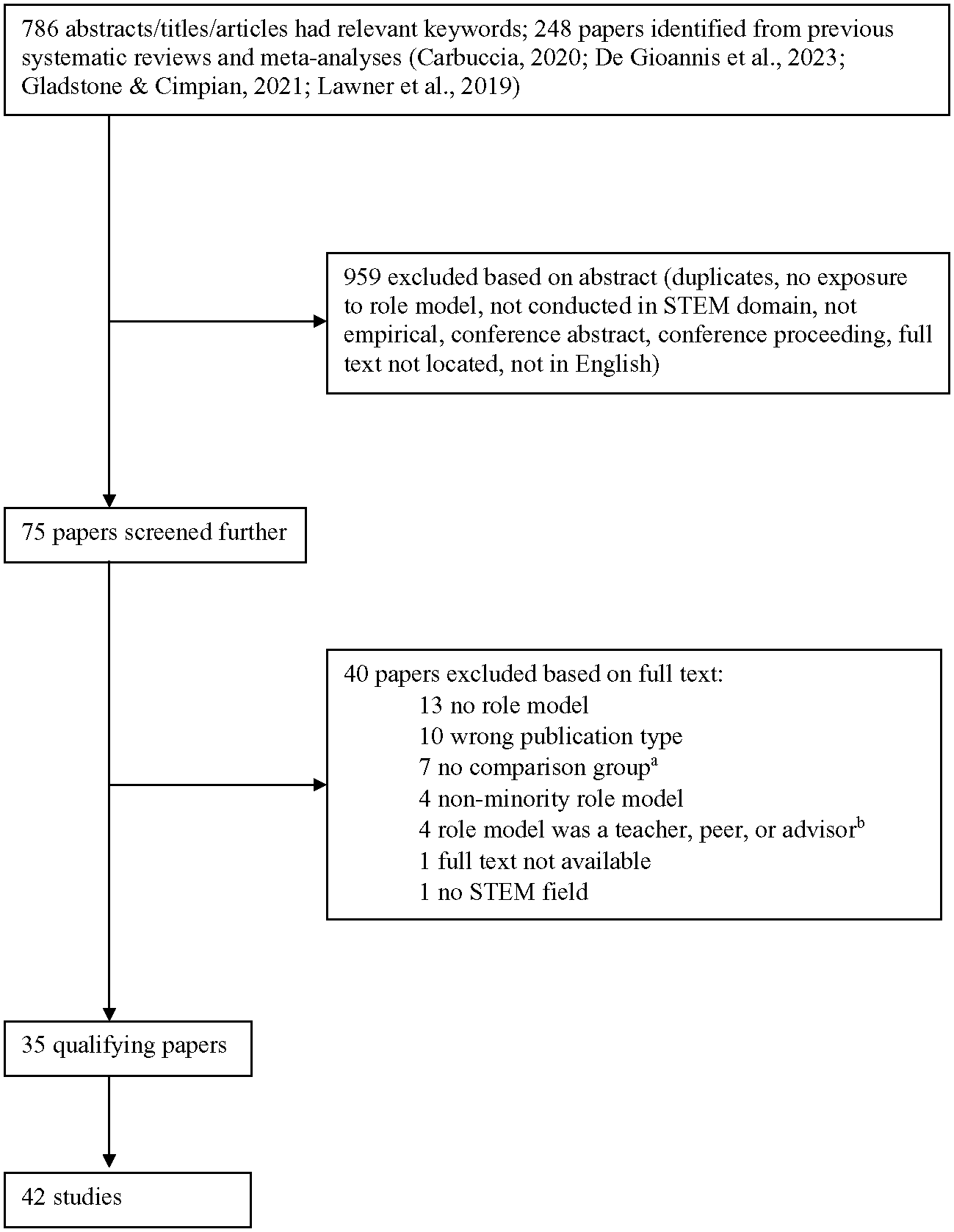
Flowchart of the Steps in the Screening Process
Data Extraction and Synthesis
For practical reasons, only one coder was trained to perform the initial extraction. The following information was extracted: (a) the article’s metadata (e.g., title, authors, doi), (b) outcome variables, (c) role model characteristics (e.g., gender, race/ethnicity, explanations for success), (d) framing of the intervention (e.g., whether the intervention explicitly discussed the gender gap in STEM), (e) sample characteristics, and (f) summary of the results (for additional details, see the systematic review registration form on OSF). The first author then checked the accuracy of the extracted data against the articles and revised the entries accordingly. The same author then analyzed the output of the data extraction and synthesized the relevant findings for each research question into a narrative summary, with input from the other authors.
Results
Research Question 1: To What Extent Has the Research on Role Models Considered the Potential Effects of Role Model Interventions on Endorsement of Legitimizing Myths?
To answer the first research question, we examined which psychological constructs related to legitimizing myths were measured in the studies in our final sample. Because measuring outcomes related to group-based hierarchies does not necessarily imply that the researchers held a priori hypotheses regarding side effects of role model interventions, we also synthesized the motivations and/or hypotheses underlying the inclusion of these variables in the studies. The presentation of the results is organized in terms of the potential side effects introduced previously. 3 Table 1 provides information about the 13 articles that included measures relevant to ideological side effects. The supplementary materials contain the complete list of the 35 articles included in the systematic review.
Studies That Included Outcome Variables Pertaining to the Hypothesized Ideological Side Effects of Role Model Interventions
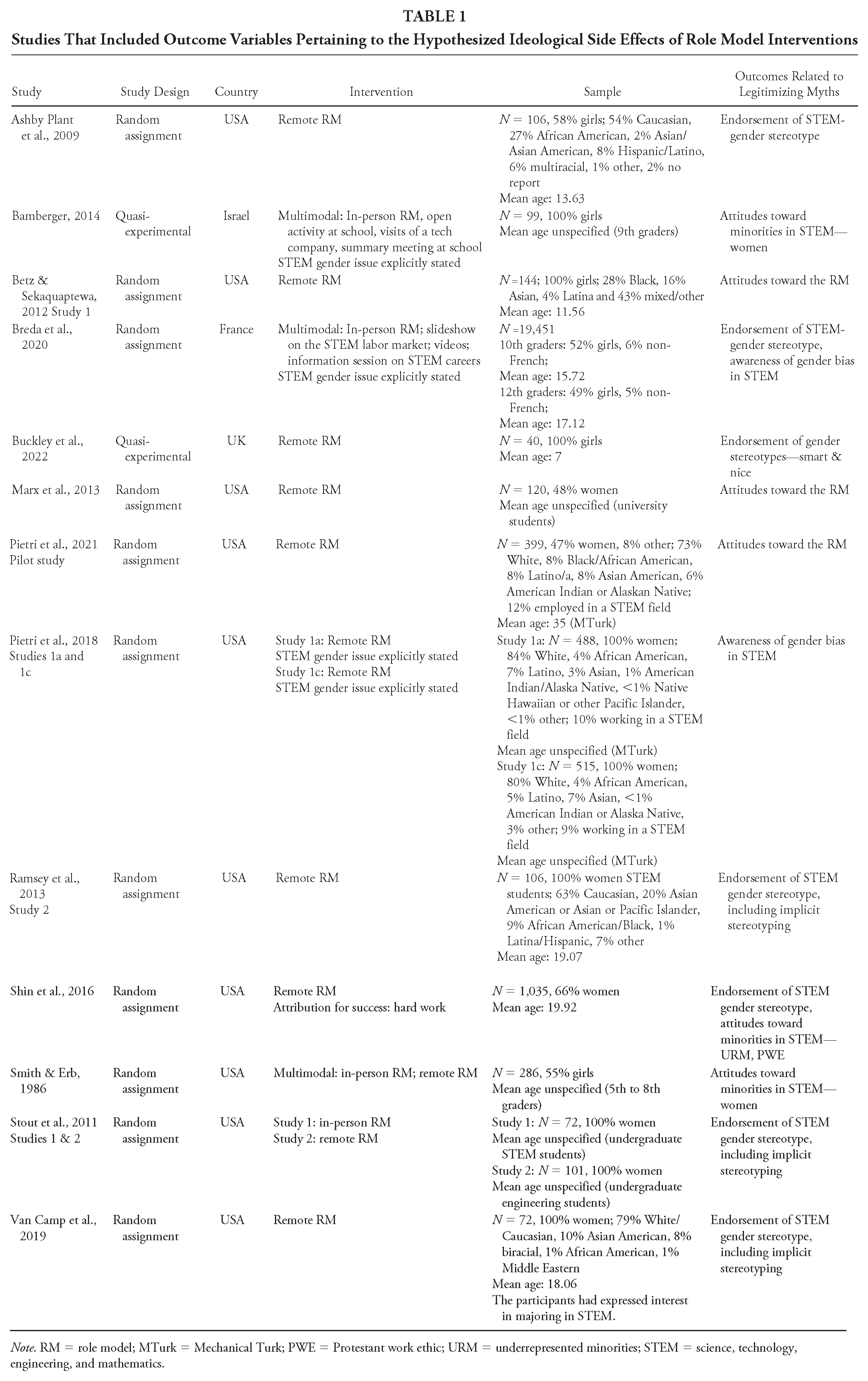
Note. RM = role model; MTurk = Mechanical Turk; PWE = Protestant work ethic; URM = underrepresented minorities; STEM = science, technology, engineering, and mathematics.
Do Role Models Strengthen Endorsement of Meritocratic Beliefs?
Motivation for including ideology-relevant outcomes
Only one study (Shin et al., 2016; see Table 1) included a measure of students’ endorsement of meritocratic beliefs—specifically, protestant work ethic, which is a core component of meritocracy (Madeira et al., 2019). This measure was included as part of a manipulation check, but its status as a legitimizing myth was not an explicit part of the motivation for its inclusion.
Results
Findings indicated that participants exposed to the role models showed greater endorsement of the belief that hard work is a social equalizer (i.e., “Anyone can succeed through hard work”) relative to participants who did not see a role model. This effect might reflect the content of the intervention, which emphasized the role model’s efforts, or it might result from students’ efforts to explain the unexpected success of a woman in a counterstereotypical domain. However, exposure to the role model did not affect endorsement of the “justifier” component of protestant work ethic—that is, the role-model-exposed participants were not more likely to believe that unsuccessful individuals simply do not work hard enough. This result was in line with authors’ expectations and the content of the role models’ biographies, which emphasized their efforts but did not address failure.
Do Role Models Reinforce Gender Stereotypes?
Motivation for including ideology-relevant outcomes
Only eight of the 42 studies included measures of students’ endorsement of gender stereotypes, and notably, only one study explicitly considered this variable from the perspective of group-based hierarchies (Buckley et al., 2022; see Table 1). This study relied on the backlash framework (Rudman, Moss-Racusin, Glick, & Phelan, 2012) and acknowledged that stereotypes are often social prescriptions and that stereotype violators face interpersonal penalties. Accordingly, Buckley et al. (2022) measured participants’ endorsement of the stereotype that women are “nice” (which is an instantiation of the stereotypes about women’s warmth and communion) following exposure to a brilliant female scientist to examine whether this exposure produced a backlash effect whereby women are seen as less nice.
The seven other studies that also included measures of gender stereotypes failed to address the relevance of this construct to group hierarchies. For instance, in Pietri et al.’s (2021) study, the role model’s perceived warmth was hypothesized to predict the participants’ feeling of friendship toward the role model and interest in computer science. Breda et al. (2020) explored students’ beliefs about gender differences in math aptitude and interest as potential mediators of their role model intervention’s effects on students’ choice of undergraduate major. In Ramsey et al. (2013), explicit and implicit gender stereotypes about STEM were examined as predictors of students’ STEM motivation and performance (see also Van Camp et al., 2019), whereas Stout et al. (2011) included measures of explicit and implicit gender stereotypes about math and English to demonstrate that mere exposure to a STEM role model did not influence stereotype endorsement but nevertheless inoculated women from applying these stereotypes to their own self-concept. In sum, with one exception, all these studies conceived of gender stereotypes in relation to students’ self-concepts and aspirations for careers in STEM without considering the implications of role model interventions for students’ broader ideologies about the gender hierarchy in STEM.
Results
Among the eight studies that included measures of stereotypes, five found that exposure to role model (vs. no exposure) did not affect endorsement of gender stereotypes about STEM. This result is surprising because—as mentioned in the introduction—role model interventions often attempt to reduce these stereotypes in order to boost girls’ self-concepts and aspirations. Null effects were observed even when the role model was intentionally framed to challenge gender stereotypes (Shin et al., 2016) and—notably—even when the intervention targeted women who were already pursuing STEM fields (Ramsey et al., 2013; Stout et al., 2011). Specifically, in four studies, female students in STEM stereotyped math as masculine at both implicit and explicit levels, and exposure to a female scientist did not reduce these beliefs (Ramsey et al., 2013, Study 2; Stout et al., 2011, Studies 1 and 2; Van Camp et al., 2019). This result is consistent with the stereotype inoculation model, according to which occasional encounters with a female scientist may not be sufficient to change STEM stereotypes, although it may inoculate women from applying these stereotypes to their own self-concept (Stout et al., 2011). Moreover, Van Camp et al. (2019) reported the results of a role model intervention that had no effect in reducing gender stereotypes about STEM unless the participants also engaged in a process of reflective identification with the STEM role model (e.g., write about the ways in which they identified with the role model).
Three studies, described next, did find evidence of the intended reductions in gender stereotypes about STEM as a result of role model interventions, although even these results were somewhat mixed. First, Ashby Plant et al. (2009) found that interacting through a computer interface with a female role model reduced boys’ (but not girls’) endorsement of gender stereotypic beliefs about engineering. Second, Buckley et al. (2022) found that girls exposed to stories about intellectually brilliant female scientists (vs. no exposure) were significantly more likely to choose their own gender as being “really, really smart,” indicating a reduction of the negative stereotype concerning female intellectual ability (Bian et al., 2017). At the same time, however, the role model intervention had no effect on another widely shared gender stereotype: that women are nice. Third, Breda et al. (2020) found that following a role model intervention, students were less likely to endorse gender stereotypes about mathematics abilities but more likely to endorse the belief that women do not like science. As acknowledged by the authors, this unintended negative effect might result from an effort to rationalize the gender gap in STEM.
The three studies—Ashby Plant et al. (2009), Buckley et al. (2022), and Breda et al. (2020)—that found the intended reduction in stereotypes about women in STEM differed in methodology (computer interface vs. short stories about women scientists vs. multimodal field intervention including video, information sessions, and in-person role models, respectively) and sample characteristics (middle school U.S. students vs. 7-year-old British girls vs. French students in 10th and 12th grades, respectively). Thus, no firm conclusions can be drawn regarding the conditions under which role model interventions achieve their intended goal of reducing stereotypes about women in STEM. The fact that the largest of these studies (Breda et al., 2020; N ≈ 12,200) also found one of the hypothesized side effects, whereby the students exposed to the role models were more likely to believe that women do not like science, should be of concern.
Do Role Models Encourage Victim Blaming?
No studies included outcomes related to victim blaming. Thus, we were unable to assess this hypothesized side effect of role model interventions. At the same time, the fact that little consideration has been given to the possibility that role models induce students to think that women are to blame for their underrepresentation in STEM is evidence for our claim that the potential ideological side effects of role model interventions have been overlooked.
Do Role Models Trigger Backlash Effects?
Motivation for including ideology-relevant outcomes
Six studies included outcome variables capturing students’ attitudes toward the role model and, more generally, toward women and racial/ethnic minorities in STEM. Negative attitudes toward women and racial/ethnic-minority scientists may reflect a hierarchy-enhancing backlash reaction—that is, a social penalty for behaving counterstereotypically (Rudman, 1998). However, only one study considered this possibility and assessed participants’ attitudes toward the female role model for the express purpose of determining whether she would be disliked for being counterstereotypical (Betz & Sekaquaptewa, 2012).
Several studies included measures of attitudes toward women in science (e.g., Bamberger, 2014; Smith & Erb, 1986), but these measures were included simply as indicators of whether exposure to the role models made it more likely for girls to aspire to a career in STEM. That is, attitudes toward women in science were not discussed from the perspective of group-based hierarchies even when the items used were face-valid indicators of attitudes about these hierarchies (i.e., “Women should not have the same chances for advancement in science careers as men do”; Smith & Erb, 1986). Attitudes toward the role model were also sometimes included merely as a manipulation check. For instance, Marx et al. (2013) measured attitudes toward the role model to rule out a possible confound in their experimental manipulation (see also Shin et al., 2016).
Two studies included measures of attitudes toward racial/ethnic minorities in STEM. In Shin et al. (2016), these attitudes were measured as a manipulation check in a study examining changes in students’ STEM engagement after exposure to successful STEM role models who were women or men of color and who achieved their success through hard work. In Pietri et al. (2021), the participants rated the role model on warmth and competence as part of a pilot study designed to check the effectiveness of a remote Black female computer scientist as a role model.
Results
The effects of role model interventions on attitudes toward female role models and toward women in science more generally were inconsistent. One study reported that both boys and girls held more positive attitudes toward women scientists after exposure to a role model than in the control group (Smith & Erb, 1986). In the same vein, the high-achieving female role model in Betz and Sekaquaptewa (2012) was rated positively regardless of whether she succeeded in STEM or in a neutral domain, and Marx et al. (2013) reported that a female role model who succeeded in math was rated as equally competent and likeable as a man who succeeded in math. In contrast, another study documented an unintended negative effect of a role model intervention on attitudes toward women in science: Following the intervention, students held a less positive view of female scientists, a trend that was not found for the control group (Bamberger, 2014). According to Bamberger (2014), following the visits and the meetings with the women scientists, some of the girls were “frightened,” and the negative change in the perceptions of women scientists reflected this fear. It is not clear whether the participants were frightened because the role models’ success seemed unattainable or because they violated gender prescriptions. Notably, this effect occurred in the context of Jewish orthodoxy, in which values such as family and children’s education are central. As acknowledged by the author, these values might “collide” with the intensive careers of the women scientists introduced as role models (Bamberger, 2014, p. 550).
Findings on attitudes toward ethnic minorities in STEM revealed little to no evidence of backlash. In Shin et al. (2016), exposure to the role models reduced racial in-group bias among the majority group (i.e., White participants) compared to a control condition (i.e., no intervention). In Pietri et al. (2021), pilot results indicated that there was no backlash toward the Black female scientist compared to a Black female journalist: The perceived competence of the role model in a counterstereotypical domain did not harm her perceived warmth. It should be noted, however, that the role model’s description emphasized communal goals (i.e., overseeing a summer camp for high school students), a limitation that was acknowledged by the authors, who suggested that without this information, participants may have pictured a “cold” computer scientist.
Do Role Models Increase Awareness of Gender Bias?
Motivation for including ideology-relevant outcomes
Only two studies assessed students’ awareness of gender bias in STEM. Awareness of bias and discrimination is a key precursor to engaging in actions to eliminate these obstacles (Radke et al., 2016; van Zomeren et al., 2008). The two studies measured this outcome for different reasons but—notably—not for the purpose of documenting whether role models reinforced group-based hierarchies. In the first study (Breda et al., 2020), awareness of gender bias was assessed with a measure of students’ perceptions of (what the authors termed) “gender roles in science” (e.g., “Women face discrimination in science-related jobs”). In the second study (Pietri et al., 2018), this outcome was included to examine whether awareness of gender bias would increase female participants’ identification with the role model and thus boost their STEM aspirations.
Results
Breda et al. (2020) found that students who received the role model intervention were more likely to report that women are discriminated against in STEM. This was an unexpected result for the authors, who suggested that perhaps the students subscribed to the idea that women face discrimination in science in an effort to explain gender gaps in this domain. Alternatively, they acknowledged that the role model might have shared personal experiences on this topic, increasing students’ awareness of gender issues.
Increased awareness of gender bias in STEM was also found by Pietri et al. (2018). However, this outcome was expected and induced by the design of their study, which contrasts with Breda et al.’s (2020) study. Female participants inferred from experimental materials describing pervasive sexism in STEM that the role model had encountered similar bias, and bias awareness, in turn, predicted their identification with the role model. Note, however, that Pietri et al. focused on how this process promotes students’ aspirations to pursue STEM; the implications of the results from the perspective of group-based hierarchies went unmentioned: Both awareness of sexism and identification as a member of a disadvantaged group have the potential to mobilize people to challenge the gender hierarchy (e.g., Radke et al., 2016).
Research Question 2: What Are the Unintended Effects of Role Models on Students’ Endorsement of Legitimizing Myths?
Drawing on social-psychological theories of intergroup relations, we proposed that role model interventions might backfire by reinforcing myths (i.e., incorrect or misguided views) that legitimize the status quo in STEM and society more generally. The results suggested that as expected, the potential side effects of role model interventions on students’ endorsement of legitimizing myths have seldom been considered in the literature. Furthermore, because the focus of most studies included in this review was to document the effects of role model interventions on students’ STEM self-concepts and aspirations, even the few findings that were relevant for the purposes of the present review were not interpreted and discussed as such. Notwithstanding that no strong conclusions can be drawn based on this limited evidential base, the next section tentatively summarizes and discusses the major findings from the perspective of group-based hierarchies. The potential undesirable side effects of role model interventions (i.e., side effects that imbue the unequal status quo with legitimacy) are discussed first, followed by the potential desirable side effects (i.e., side effects that make it more likely that students would challenge the inequitable status quo).
Undesirable Side Effects of Role Model Interventions
First, the evidence reviewed suggested that role models may strengthen meritocratic beliefs—specifically, the idea that hard work is an equalizing force in society (Shin et al., 2016). From a group-based hierarchy perspective, the possibility that role model interventions foster the idea that women’s success in STEM is just a function of their efforts raises concern because it imbues the (inequitable) status quo in this domain with legitimacy. In addition, this “equalizer” myth is related to—and may promote—a constellation of other legitimizing myths, including the belief in a just world and in individual mobility (O’Brien & Major, 2005). This myth is also associated with the tendency to make internal attributions for social ills (Christopher & Schlenker, 2005) and to exhibit intolerant attitudes toward disadvantaged groups and policies aimed at helping those groups, such as affirmative action (Rosenthal, Levy, & Moyer, 2011).
Second, with few exceptions (discussed in the next section), the research reviewed here was rather consistent in demonstrating that gender stereotypes about STEM are deep-seated and pervasive—they are not removed by an occasional role model intervention (Ramsey et al., 2013; Shin et al., 2016; Stout et al., 2011; Van Camp et al., 2019). This may be surprising to some: Several large-scale initiatives have been developed based on the idea that role models undermine gender stereotypes. For instance, the French National Center for Scientific Research developed a role model intervention intended to foster secondary school students’ motivation for tech jobs. The intervention was explicitly designed to “highlight the diversity of research in digital sciences and help break down the stereotypes that discourage women from taking this path” (Institute for Information Sciences and Technologies, n.d.). Therefore, the fact that role model interventions fail to debunk gender stereotypes and even occasionally reinforce the belief that women like science less than men (Breda et al., 2020) represents in our view an undesirable side effect.
Even more alarming is the finding that role model interventions were ineffective in changing the stereotypes held by female students in STEM (Ramsey et al., 2013; Stout et al., 2011; Van Camp et al., 2019). Social identity theory (Tajfel, 1979; Tajfel & Turner, 1986) suggests a possible explanation for this result. According to this theory, self-categorization as a member of a high-status group (e.g., “I am a STEM student”) gives rise to a motivation to maintain the superiority of the in-group over the out-group. One way group members fulfill this motivation is by emphasizing their superiority on valued characteristics (Oldmeadow & Fiske, 2010). When a student is strongly identified with STEM, they are likely motivated to maintain the positive image of STEM by, for instance, defending the idea that brilliance is required to succeed in STEM (Leslie et al., 2015; for a review, see Muradoglu et al., 2023), a characteristic associated with men more than women (Bian et al., 2017). Further empirical research is needed to examine this potential process. Regardless of what explains this finding, it seems that role model interventions fail to reduce stereotype endorsement among the very people who will likely become role models in the future, which may ultimately contribute to the perpetuation of stereotypes that are harmful to women (Carli et al., 2016).
Third, although we suggested that students might penalize female role models for their success in a counterstereotypical domain, there was little to no evidence for such backlash effects. For instance, female role models who were perceived as competent were not denied warmth and likeability (Betz & Sekaquaptewa, 2012; Marx et al., 2013; Pietri et al., 2021). Similarly, exposure to role models from racial minorities did not enhance intergroup bias among majority members (Shin et al., 2016). Although the role models as individuals seemed to avoid backlash for behaving counterstereotypically, the picture was less clear with respect to backlash directed at women in STEM as a group. The two studies included in this review that assessed attitudes toward women in STEM following role model interventions showed mixed results (Bamberger, 2014; Smith & Erb, 1986), with a backlash effect present only in a cultural context that strongly encourages women to adopt traditional gender roles (Bamberger, 2014).
Desirable Side Effects of Role Model Interventions
Most of the desirable effects of role model interventions were expected. These effects concerned students’ STEM self-concepts and aspirations. In contrast, the present review focused on desirable (but likely unintended) side effects of these interventions on students’ ideologies. Two findings are worth noting here.
First, although role models are generally ineffective in changing gender stereotypes, there is some evidence to suggest that they can counter the gender stereotypes regarding intellectual ability (Breda et al., 2020; Buckley et al., 2022). Second, role model interventions seem to offer an opportunity to raise consciousness about gender bias in STEM (Breda et al., 2020). Female students who are aware of this bias are more likely to acknowledge that the role model may have faced discrimination, which, in turn, enhances their identification with the role model (Pietri et al., 2018). Provided that further research confirms this finding, it would have important implications. Indeed, it would indicate that role models have the potential to remove two main barriers to collective action: recognition of intergroup injustice and identification as a member of the disadvantaged group (Radke et al., 2016; van Zomeren et al., 2008). Thus, role model interventions could represent an asset for encouraging collective activism for gender equality.
Reconciling the Ideological Side Effects of Role Model Interventions With Their Intended Effects on Students’ STEM Self-Concepts and Aspirations
The key takeaway of the present review is that role model interventions, although well intended, may backfire by enhancing students’ endorsement of beliefs that legitimize the gender hierarchy in STEM. However, it is important to acknowledge that role models do have a positive impact on students’ self-concepts and aspirations to pursue STEM careers in some contexts (e.g., field interventions; Lawner et al., 2019) and for specific individuals (e.g., students interested in STEM prior to the intervention; Morgenroth et al., 2015). How can these seemingly contradictory effects be reconciled? We offer a few considerations in the following.
It is noteworthy that believing STEM is a meritocracy may in fact encourage students to pursue a career in this domain. In Western workplace and educational settings, the belief that outcomes such as pay or grades are allocated based on merit is an important justice principle and a motivating factor (Son Hing et al., 2011). As previously mentioned, role models signal that STEM is fair and rewards the most deserving. Therefore, role models may make STEM fields seem appealing to students. In this case, an undesirable ideological side effect might actually enhance the intended positive effects of role model interventions. However, perceiving STEM as meritocratic is likely beneficial only for high achievers: Female and racial/ethnic minority students who excel in this domain may be reassured that their personal merit will be considered. This differential effect of meritocratic beliefs as a function of students’ achievement could explain, at least in part, why the positive effect of role model interventions on STEM enrollment is concentrated among high-achieving girls (Breda et al., 2020; see also Carrell et al., 2010).
Not all ideological side effects are beneficial for students’ STEM self-concepts and aspirations. For instance, to the extent that role model interventions reinforce some negative stereotypes about women (e.g., that women do not like science; Breda et al., 2020), they might actually undermine girls’ STEM pursuit. Even the side effects that seem more desirable from an ideological standpoint, such as raising awareness about the obstacles that women face in STEM, might not have desirable effects vis-à-vis girls’ likelihood of pursuing STEM careers (Bamberger, 2014).
It is also important to point out that in most circumstances, the relations between the ideological side effects of role model interventions and their intended effects are likely complex and hard to predict. This is so in part because members of stigmatized groups sometimes distance themselves from their groups in circumstances where such distancing could benefit their own upward mobility as individuals (e.g., Ellemers & Barreto, 2008; van Veelen et al., 2020). For instance, rather than being discouraged by the fact that a role model’s success seems to suggest that women in general are uninterested in science, a girl might distance herself from her group (e.g., “I’m not a typical girl”) to be able to benefit from the dose of inspiration that the role model provides. Much more research is needed to understand the ways in which the ideological side effects of role model interventions (when present) also affect students’ motivation to pursue STEM careers.
Limitations
The conclusions of the present systematic review should be viewed with caution due to the heterogeneity in the designs and sample characteristics of the studies in our final sample. For instance, not all studies randomly assigned participants to intervention versus control conditions. In addition, most lab experiments consisted of brief exposures to role models via teleconferencing or printed materials, whereas field interventions included in-person role models and more extensive activities (e.g., visiting a company or lab with a female scientist). As a result, it becomes challenging to disentangle the specific contribution of the role models from the effects of other activities.
Heterogeneity in sample characteristics also limits the generalizability of the findings. Indeed, among the studies in our sample, 15% focused on elementary school students, 23% focused on secondary school students, 38% focused on university students, and 15% used participants on Amazon’s Mechanical Turk platform. Although previous reviews found little evidence that age is a moderator of role models’ effects (Gladstone & Cimpian, 2021), the focus was on students’ STEM self-concepts and aspirations rather than on ideology-related outcomes. In addition, some authors have recently expressed doubts about the use of crowdsourcing platforms, questioning the quality of the data (Webb & Tangney, 2022).
Finally, many studies used rather small samples, which could imply low statistical power to detect the desired effects, raising questions about the reliability of the findings. Statistically underpowered studies could lead to false-positive findings in the published literature that are likely to fail later replication attempts (for a discussion, see Świątkowski & Dompnier, 2017).
Future Directions
Even though the studies included in this review did not provide a simple or definitive answer to the question of whether role model interventions have ideological side effects, they nonetheless open interesting perspectives. First, and in line with our theoretical argument, role model interventions might reinforce the myth that anyone can succeed if they work hard enough (Shin et al., 2016), a belief that is associated with the tendency to make internal attributions for social ills (Christopher & Schlenker, 2005). It would thus be worthwhile for future studies to examine further the impact of role models on students’ endorsement of the belief in personal responsibility for success and failure. This question is critical because prior research on role models recommends emphasizing internal, controllable explanations for role models’ success, typically their efforts (e.g., Bagès et al., 2016; Gladstone & Cimpian, 2021). The possibility that role model interventions, by promoting legitimizing myths, may paradoxically enhance negative attitudes toward policies aimed at tackling the gender gap (e.g., affirmative recruitment of women in STEM, gender quotas) needs to be investigated.
Future research and interventions should also consider the cultural specificities of the contexts where role model interventions take place, particularly with regard to gender roles. The present review highlighted an unintended negative change in students’ perceptions of women scientists following a role model intervention in a context marked by strong expectations about women’s investment in motherhood (Bamberger, 2014). In such a context, successful female scientists might encounter backlash because they threaten the status quo. According to the status incongruity hypothesis, backlash is provoked by perceived violations of status expectations, defined as violations of the gender rules that uphold the gender status hierarchy (e.g., women’s place is in the home; Rudman, Moss-Racusin, Phelan, & Nauts, 2012). Accordingly, one can speculate that in societies strongly marked by traditional gender roles, female role models might pose a threat to the system and trigger backlash in defense of the status quo.
Finally, one implication of the present research may be that role models should aim to inspire in students a desire for social justice rather than simply commenting on their own career paths. Highlighting the challenges faced by women and racial/ethnic minorities in STEM fields might be an effective means to achieve this goal. Pointing out the absence of the necessary support systems to recruit and retain members of these groups could also help. In fact, some findings indicate that failing to provide such structural explanations for the present gender and racial/ethnic gaps in STEM likely triggers rationalization on the part of the students, a process that may actually reinforce gender STEM stereotypes (Breda et al., 2020). To counter this negative side effect, we recommend that role model interventions include elements that raise awareness about structural barriers to inclusivity. This strategy may prevent students from invoking women’s and minorities’ internal attributes as explanations for their underrepresentation in STEM. In addition, raising awareness about structural barriers could encourage identification with women and underrepresented racial and ethnic minorities and help form a politicized identity, which is an important lever for the pursuit of social justice goals (van Zomeren et al., 2008, 2018).
Conclusion
In conclusion, the present work draws on social-psychological theories of intergroup relations to examine the potential side effects of role model interventions in reinforcing myths that legitimize the unequal status quo in STEM and society. To date, the literature has primarily focused on the effects of role models on students’ STEM self-concepts and aspirations, overlooking potential ideological outcomes. The findings of our systematic review, although based on limited evidence, highlight both undesirable and desirable side effects of role model interventions on students’ ideologies.
On the undesirable side, it is evident that these interventions often fail to challenge deep-seated gender stereotypes about STEM, even reinforcing the belief that women are less inclined toward science. Additionally, role model interventions may unintentionally reinforce the myth that success in STEM is solely determined by hard work. On the desirable side, some studies indicate that role model interventions can increase awareness of culturally ingrained gender bias, a key step toward potentially mobilizing students to challenge existing hierarchies. However, the limited number of studies and mixed findings suggest the need for further research to fully understand the extent and mechanisms of these ideological effects, both undesirable and desirable. Overall, this review underscores the importance of considering the potential side effects of role model interventions and encourages future research to explore these effects in more depth, contributing to the development of more effective strategies for promoting diversity and equity in STEM.
Supplemental Material
sj-docx-1-rre-10.3102_0091732X241261310 – Supplemental material for The Double-Edged Sword of Role Models: A Systematic Narrative Review of the Unintended Effects of Role Model Interventions on Support for the Status Quo
Supplemental material, sj-docx-1-rre-10.3102_0091732X241261310 for The Double-Edged Sword of Role Models: A Systematic Narrative Review of the Unintended Effects of Role Model Interventions on Support for the Status Quo by Catherine Verniers, Cristina Aelenei, Thomas Breda, Joseph R. Cimpian, Lola Girerd, Emma Molina, Laurent Sovet and Andrei Cimpian in Review of Research in Education
Footnotes
Acknowledgements
We thank Mark Bowker, Buju Dasgupta, Andy Elliot, Bethany Lassetter, Adam Stanaland, and Siqi Zhao for insightful comments on this work and the members of the Cognitive Development Lab at New York University for helpful discussion.
Declaration of Conflicting Interests
The author(s) declared no potential conflicts of interest with respect to the research, authorship, and/or publication of this article.
Funding
The author(s) disclosed receipt of the following financial support for the research, authorship, and/or publication of this article: This research was supported by a grant from the French National Research Agency (ANR) as part of the “Investissements d’Avenir” program LIEPP (ANR-11-LABX-0091, ANR-11-IDEX-0005-02) and the Université de Paris IdEx (ANR-18-IDEX-0001).

Notes
Authors
References
Supplementary Material
Please find the following supplemental material available below.
For Open Access articles published under a Creative Commons License, all supplemental material carries the same license as the article it is associated with.
For non-Open Access articles published, all supplemental material carries a non-exclusive license, and permission requests for re-use of supplemental material or any part of supplemental material shall be sent directly to the copyright owner as specified in the copyright notice associated with the article.
