




Abstract
In this systematic review, we examine research from 2009 to 2022 to identify and classify the unintended effects of turnaround in the United States. We develop a conceptual framework classifying three types of side effects—spillover effects, systemic side effects, and internal side effects—and differentiate these side effects from unintended negative intervention effects. We identify four broad categories of side effects within this framework based on the population they impact: communities, school systems, educators, and students. We find that the most prevalent side effects are related to educator experiences, staffing, community reaction, education governance, and the proliferation of external actors. We conclude by calling for future research to explicitly examine common side effects alongside the intended effects of turnaround.
A growing literature shows that school turnaround can improve student outcomes in the nation’s lowest performing schools (for systematic reviews, see Husain et al., 2022; Redding & Nguyen, 2020; Schueler et al., 2022). Under certain conditions, turnaround interventions have improved teacher practice and increased student achievement (J. Burns et al., 2023; Carlson & Lavertu, 2018; Dee, 2012; Pham et al., 2020; Strunk et al., 2016; Zimmer et al., 2017)—upending a prior narrative that low-performing schools are impervious to reform (Stuit, 2010). Although recent research provides promising evidence for turnaround, these interventions are highly disruptive and can cause unintended side effects that are poorly understood.
School turnaround is a whole-school intervention aimed at improving the systems underlying a school’s low performance (Calkins et al., 2007; Herman et al., 2008). Although turnaround may differ across contexts, federal policy broadly stipulates that states identify their lowest performing schools and then ensure certain steps are taken in those schools by the state, district, or another approved organization. Specifically, low-performing schools must undergo a needs assessment to identify issues underlying low performance, carry out a comprehensive planning process that targets the most pressing needs, and engage in continuous improvement.
Although whole-school reform and improvement have long been part of the education policy parlance, the language of “school turnaround” was introduced nationally when the American Reinvestment and Recovery Act (ARRA) infused additional funding into the federal School Improvement Grants (SIG) program in 2009. Under SIG, along with Race to the Top (RTTT) 3 years later, the federal government defined turnaround as an umbrella term comprising four models: transformation, which involves replacing the principal; turnaround, which involves replacing the principal and at least 50% of staff; restart, or placing the school under new management, such as an educational management organization (EMO); and closure. 1 Currently, the Every Student Succeeds Act (ESSA, 2015) does not prescribe interventions such as those under SIG and RTTT, but states can choose to continue using the four turnaround models. In sum, “school turnaround” comprises a family of interventions, all aimed at identifying and improving schools’ most pressing needs.
A distinct feature of the turnaround theory of action is its emphasis on rapid and dramatic change (Aladjem et al., 2010; Herman et al., 2008). There is evidence that turnaround models requiring the most dramatic interventions (e.g., replacing all or most teachers in a school) have shown the largest effects (Carlson & Lavertu, 2018; Dee, 2012; Strunk et al., 2016). These sweeping changes mean that turnaround policies are sometimes intentionally disruptive, and there is reason to believe they may have a common set of side effects. For example, several studies have examined the effects of turnaround on factors beyond student achievement, including most prevalently, staffing, the experiences of educators in turnaround schools, the communities served by the turnaround schools, and student mobility (see e.g., Atchison, 2020; Carlson & Lavertu, 2018; Lincove et al., 2018; Pham, 2023; Sun et al., 2017; Weixler et al., 2018). However, these studies are often framed either as intentional or negative effects of turnaround. The former is, by definition, not a side effect, whereas the latter is only one type of unintended effect and exclusively negative, although unintended effects can be positive or negative. Because turnaround is a whole-school intervention aimed at improving student outcomes, any positive impact on students is almost always considered an intended effect (even if not necessarily intended by the intervention), and any negative effect on students is usually considered an unintended effect (but is not the only type of unintended effect). In this chapter, we expand academic discourse by highlighting and integrating other forms of unintended effects into a unified conceptual framework. Although two meta-analyses (Redding & Nguyen, 2020; Schueler et al., 2022) have provided a thoughtful and nuanced summary of the intended effects of school turnaround, we add to this dialogue by focusing our analysis on the effects that were not intended by turnaround interventions.
Because federal policy requires that all states identify and turn around their lowest performing schools, working toward a shared understanding of not just the capacity for positive effects on intended outcomes but also the potential scope of side effects—including what is a side effect and what is an intended effect—will inform future research and turnaround policy. This systematic review makes three primary contributions. First, drawing on seminal work from Zhao (2017, 2018), we develop a unified conceptual framework that defines and differentiates unintended side effects from unintended negative effects and intended positive effects. This framework also categorizes different forms of side effects, contributing to a sharper academic and policy parlance around side effects. Importantly, our framework is broadly applicable to side effects outside of school turnaround. Second, we synthesize the current knowledge around turnaround side effects to clarify directions for future research. Third, in line with recommendations to maximize positive effects while minimizing negative impacts (Zhao, 2017), we review policy-relevant findings that will highlight how future reform models can avoid undesired side effects. Overall, this chapter will help policymakers, educators, and scholars to more comprehensively understand and assess targeted outcomes, unintended consequences, and side effects of school turnaround.
Conceptual Framework
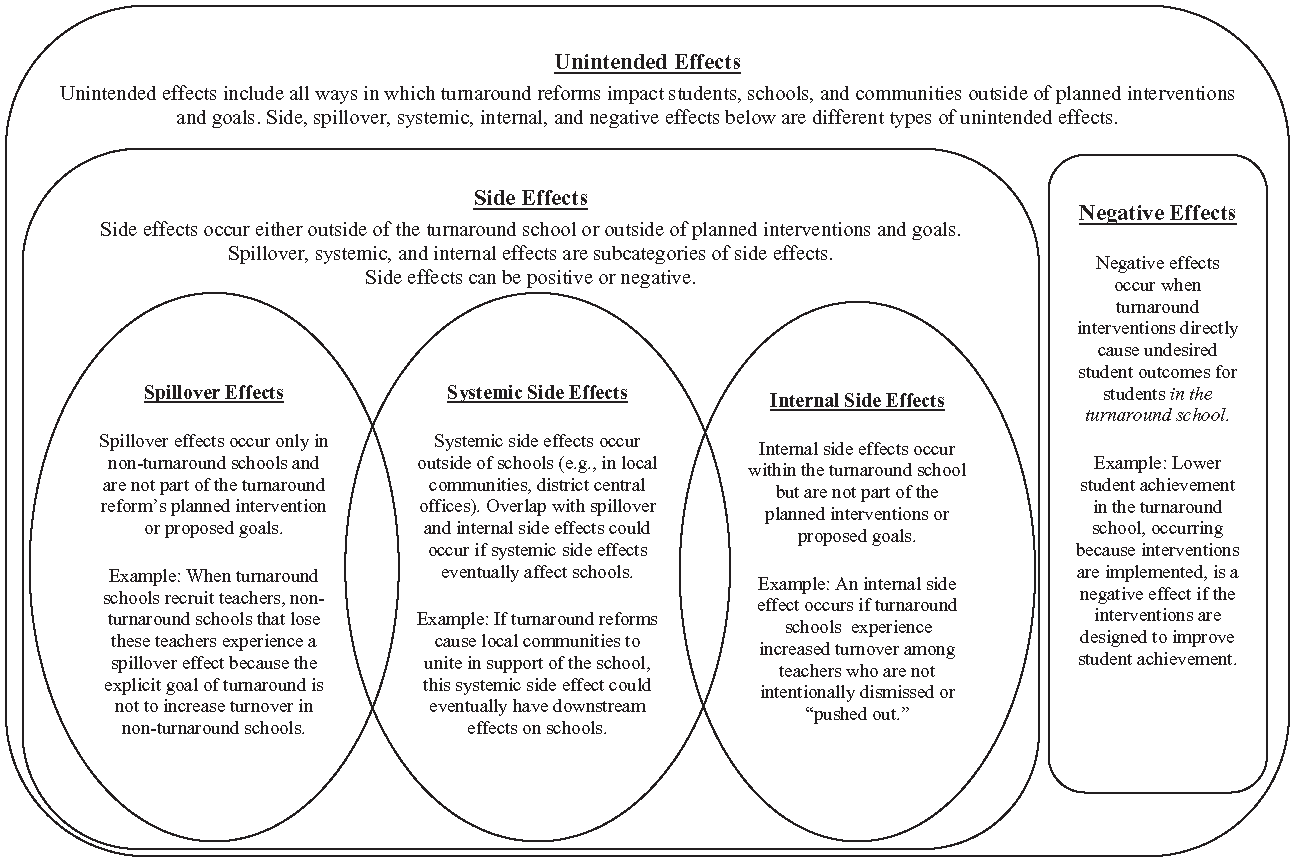
Figure 1 depicts the conceptual framework we developed to guide our discussion of unintended effects. Our framework focuses on unintended effects, comprising all ways in which turnaround reforms affect schools, students, and local communities outside of the turnaround model’s proposed goals and planned interventions. Unintended effects can be categorized as either negative effects or side effects. Unintended negative effects occur only in turnaround schools when the reforms produce undesired outcomes that are the direct opposite of their goals. For example, turnaround can be so disruptive that it decreases student achievement in the targeted school, which is the opposite of what the reforms were designed to do. Distinct from negative effects, side effects occur either outside the turnaround school or when the implementation of planned interventions triggers unforeseen effects external to the model’s goals. For example, increased teacher turnover would be a negative effect if the turnaround model was designed to increase teacher retention, whereas it would be a side effect if the turnaround model did not include any interventions or goals directly aimed at teacher retention.
Conceptual Framework
Side effects can be positive or negative (Zhao, 2017), and we further separate them into three subcategories: spillover effects, systemic side effects, and internal side effects. Spillover effects occur only in nonturnaround schools. For example, some turnaround initiatives intentionally aim to recruit effective teachers without planning for where these teachers would be recruited from. Thus, teacher recruitment interventions in turnaround schools can have spillover effects in nonturnaround schools whose teachers are recruited away. In contrast to spillover effects, internal side effects occur within the turnaround school itself but are not part of the planned interventions or goals. For example, reforms that involve longer school days could result in increased teacher turnover. Because the goal of longer school days is to increase instructional time and not to increase teacher turnover, turnover, in this case, would be an internal side effect. Finally, systemic side effects occur outside of (turnaround and nonturnaround) school buildings, such as in local communities around the school, district central offices, or state education agencies (SEAs). For example, the bold nature of turnaround can unintentionally catalyze the local community to unite in support of their neighborhood school, creating a systemic side effect. Although systemic side effects begin outside of schools, Figure 1 depicts these systemic side effects as potentially overlapping with spillover and internal side effects because they could have eventual, downstream impacts on either turnaround or nonturnaround schools. Returning to the example of community organizing, the community’s efforts can eventually result in increased resources for students in the turnaround school, a case where a systemic side effect later produces positive internal side effects.
Although we developed this conceptual framework to guide our review of the school turnaround literature, its typology is broadly applicable to educational interventions outside of turnaround. Moreover, our typology contributes better defined nomenclature to help clarify future discussion of unintended effects in three ways. First, by distinguishing negative effects from side effects, we affirm Zhao’s (2017) argument that side effects can be positive or negative and clarify that not all undesirable outcomes are side effects. Second, our framework shows that some side effects can lead to other side effects, such as systemic effects creating downstream internal side effects in turnaround schools. Finally, our framework provides a concrete distinction between internal side effects that occur within the reform school and spillover effects that occur in nontargeted schools. We emphasize that based on our conceptual framework, different types of unintended effects can occur within the same topical area (e.g., unintended effects on teacher turnover vs. unintended effects on local communities). For example, within the area of teacher turnover, unintended effects can include both spillover effects (unintended turnover in nonturnaround schools) and internal side effects (unintended turnover in turnaround schools). In the findings section, we discuss results in different topical areas and specify the relevant type(s) of unintended effects within each area. Overall, this conceptual framework contributes a broadly applicable approach to defining unintended effects, ultimately providing more concrete terminology that sharpens both our current review and future between-study discussions of unintended effects.
Method
Identification
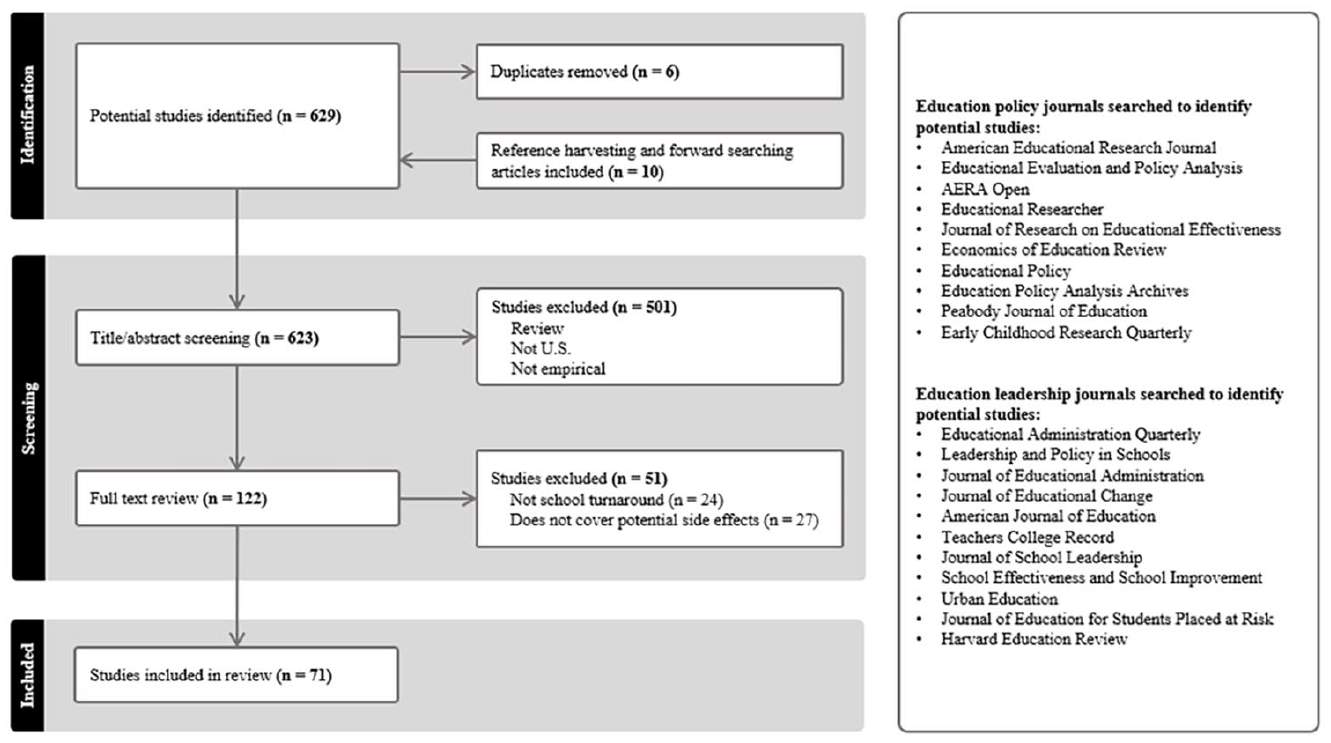
To conduct this study, we followed PRISMA guidelines for systematic reviews (Page et al., 2021). Figure 2 illustrates our search process. For tractability, we limited our search to 21 refereed journals in educational policy and leadership, which we selected based on our experience with the turnaround literature (Figure 2). Most journal articles in previous reviews and meta-analyses of turnaround were published in this subset of journals, although we recognize the limited generalizability of this approach because we did not comprehensively search the gray literature or manuscripts outside of these specific refereed journals. To search for studies, we iteratively developed the search string “school turnaround” OR “turnaround school” OR “turnaround reform” OR “school transformation” OR “school reconstitution” OR “school restart” OR “state takeover” OR “school improvement grant*”. 2 We conducted this search within our selected journals using Google Scholar. The search returned 623 unique articles.
Identification and Screening Process
Screening
Our screening process included three phases designed to identify studies meeting six inclusion criteria: (a) published after 2009, when ARRA was passed; (b) based on empirical evidence (quantitative and/or qualitative); (c) conducted in the United States; (d) written in English; (e) focused on a school turnaround; and (f) addressed potential side effects of turnaround. In Phase 1, we read the title and abstract of each study to determine whether it met Criteria a through e. Two authors then screened each study, with a third resolving disagreements. In this first phase, we leaned toward inclusion for full-text screening if it was unclear from the title and abstract whether the article discussed side effects. We noted outstanding questions and met after coding a subset of studies to resolve any conflicts and clarify inclusion criteria. We also fine-tuned the definition of “turnaround” to include all four SIG turnaround models described previously.
Our first phase of screening yielded 122 articles for full-text screening. In the second phase, two authors fully read each article to confirm they met all eligibility criteria, especially the final two criteria. Phase 2 removed 51 articles—24 for not being about a school turnaround intervention and 27 because they did not discuss potential side effects.
The screening resulted in 65 studies meeting all inclusion criteria. Then, in Phase 3, we conducted reference harvesting and forward-searching using these 65 articles. In this phase, we did not make any restrictions based on publication date or journal if the study met all other inclusion criteria to incorporate both pivotal early work on school turnaround and very recent work from more contemporary perspectives. 3 This phase added six articles to our sample, resulting in a final analytic sample of 71 articles.
Coding and Analysis
After screening, we conducted a content analysis of included studies (Hoffman et al., 2011; Kennedy, 2007) in which we deductively developed preliminary codes and then inductively refined them. First, we developed a coding framework based on themes that emerged in the full-text screening, our knowledge of the literature, and our conceptual framework. We next purposively selected an article that included rich discussion of side effects, tripled-coded it, and met to refine the coding framework, resolve questions, and ensure a common understanding of each code. Then, we assigned each article for coding across three authors. Following Bowen’s (2009) approach to document analysis, we assigned the predetermined codes to each article based on our framework described in Table 1. We used these codes to integrate and categorize the findings to identify commonalities and differences. In addition to coding for side effects, we also coded for methodological paradigm of each study (i.e., quantitative-causal, quantitative-descriptive, and qualitative) to more deeply understand how prior research has approached each code category. Throughout this process, we met to discuss coding decisions to ensure consistency and discuss discrepancies. Finally, we conducted a thematic analysis (Bowen, 2009) using our conceptual framework to aggregate each individual coding category into the four broader themes. Table 1 provides the final coding tree, definitions of each code, and shares of articles coded in each category.
Coding Tree

Note. Overall proportions are calculated based on the share of articles that are included in that coding category; total N sizes will not sum to 71 and proportions will not sum to 1 because a single article may be counted in more than one coding category.
These are unintended negative effects and not side effects.
Table 1 shows that the side effects we reviewed can be divided into four broad categories—the broader community, school systems, educators, and students—containing 13 total subcodes. Subcodes related to educators and the broader community were most prevalent. Within the educators category, the most frequently coded side effects were the educator experience (about 37% of studies) and teacher staffing (28%). The most frequently coded side effect in the broader community category was related to community reaction (34%). Within the school systems category, we coded about 21% of studies as having side effects related to governance and external actors, respectively. Side effects in the students category were least commonly discussed. This is not because turnaround does not have effects on students but because effects on students tend to be intended intervention effects. The final three rows show that our sample comprises both qualitative and quantitative studies, with more than half including a qualitative component (either as part of a mixed-methods design or fully qualitative), 28% a causal quantitative analysis, and 18% a descriptive quantitative study design. A more in-depth discussion of the codes is provided in the Appendix.
We summarize our findings as a narrative review. This approach allowed us to link together many studies for the purposes of reinterpretation and interconnection (Baumeister & Leary, 1997). When providing this holistic description of the side effects present in turnaround schools, we make connections to our conceptual framework to identify the types of side effects that were present (i.e., spillover, systemic, or internal effects) and whether they were positive or negative.
Findings
We discuss findings on each category of side effects in the following. It is important to note that each subcategory can be considered a different type of unintended effect depending on the specific turnaround model’s design and goals and how study authors have conceptualized the side effect. For example, changes in teacher staffing can be conceptualized and studied as either an internal side effect in turnaround schools that lose teachers or as a spillover side effect on nonturnaround schools that receive teachers coming from turnaround schools. Thus, we discuss throughout how researchers have tended to classify each subcategory of side effect and how they fit into our conceptual framework.
Effects on the Broader Community
Within our conceptual framework, side effects of turnaround on the broader community are primarily systemic side effects because they occur outside of school buildings, although these systemic side effects could lead to downstream spillover and internal side effects. Studies examining turnaround side effects on the broader community can be separated into two broad categories: effects in neighborhoods surrounding the school and effects on EMOs. Studies examining side effects on local neighborhoods predominantly examined how community members in mostly non-White neighborhoods reacted to turnaround models involving charter or state takeover of low-performing schools (Glazer & Egan, 2018; Kitzmiller, 2020; Lipman, 2017; Mawhinney, 2013; Nelson et al., 2022; Pazey, 2020; Schueler & West, 2022; Welsh & Williams, 2018). Community members’ reactions were often based on historical and racial tensions where racially minoritized communities experienced school takeover by external, primarily White-led organizations, such as state agencies and EMOs, that were unfamiliar and not trusted (Fried, 2020; Mawhinney, 2013; Schultz & McGinn, 2013; Suárez, 2021). For example, P. Burns (2010) and Schueler and West (2022) found that resistance to state takeover was highest in areas with larger proportions of Black voters.
Studies across different school districts, including Memphis (Glazer & Egan, 2018), Baltimore (Mawhinney, 2013), and Detroit (Suárez, 2021), reported strikingly consistent reasons why local community members united in opposition to externally driven school reforms. First, part of the resistance stemmed from the shared memory of community leaders (often people of color) who lost power over their own communities and lost local resources to external organizations when White and nonlocal actors initiated reforms and then failed to live up to their promises (Glazer, Massell, & Malone, 2019; Mawhinney, 2013). Community resistance was especially pronounced when parents and community leaders had no or little input on the design or implementation of school reforms or when their input was not taken seriously (Kitzmiller, 2020; Pazey, 2020; Pazey & DeMatthews, 2019; Schultz & McGinn, 2013). Also, community resistance grew in response to the sense that school takeover was further marginalizing already marginalized communities. For example, Friday and Smith (2023) found that school improvement led to increased home values, greater in-migration of White students, increased evictions in the turnaround school’s catchment area, and declines in non-White enrollment within the turnaround school. Pearman and Marie Greene (2022) found that school closures led to increased gentrification in primarily Black neighborhoods. This turnaround-induced gentrification aligns with other studies that found that already marginalized students were displaced from turnaround schools and forced to attend school outside their home community (Jacobson & Szczesek, 2013; Lipman, 2017).
Researchers tended to describe the antagonistic relationship with community members as a missed opportunity for state agencies and EMOs hoping to improve low-performing schools (Glazer & Egan, 2018). That is, turnaround models that ignored the broader community context (e.g., inequities exacerbating poverty and segregation) tended to frame reform as a punitive consequence of local communities failing to educate their children. This intrinsically antagonistic framing naturally engendered local resentment, which meant that organizations hoping to implement reform lost important social and political capital (Mawhinney, 2013). Organized community resistance also calcified mistrust between communities of color, SEAs, and EMOs. The persistent conflict could then have downstream spillover and internal side effects by diverting attention and resources away from educating students and creating a barrier against potentially productive collaborations between the local community and school operators (Glazer, Massell, & Malone, 2019).
On the other hand, researchers have also highlighted positive aspects of community organizing. Some found that community leaders became more aware of student needs and involved in local schools when they organized in resistance to external reforms (Ishimaru, 2018). This sometimes meant that adult leaders became more sensitive to specific obstacles faced by students and could propose better aligned solutions (Mitra & Frick, 2011). In some cases, partnerships between educators and local businesses resulted in additional economic support for local schools (Mitra & Frick, 2011). Communities that united to resist reform also gained participatory capacity through new engagement in the PTA, reform planning committees, and reform planning meetings (Ishimaru, 2018; Marsh et al., 2015; Pazey & DeMatthews, 2019).
Effects on School Systems
Side effects on school systems impact the system-level educational infrastructure, which comprises the formal structures and resources underlying improvement and is critical to school turnaround (Cohen et al., 2018; Hopkins & Woulfin, 2015; Meyers & Smylie, 2017; Spillane et al., 2019). Along this dimension, the literature included turnaround effects related to governance, the role of external actors, and funding. As with side effects on the broader community, by their nature, these are largely systemic side effects because they occur outside of school buildings—in district offices, school boards, and EMOs. These systemic side effects can also produce internal side effects in turnaround schools (e.g., adding or diversifying funding streams) and spillover into nonturnaround schools (e.g., transforming how EMOs operate).
An Evolving Federal, State, and Local Role
As the federal role in education policy has grown, some of the power that was previously centered at the district or school board has diminished (Henig, 2009, 2013)—even as schools themselves gained autonomy in some turnaround models. Meanwhile, the state executive branch has gained power in carrying out federal mandates, which, under ESSA, are flexible and relegate significant power to states (Hornbeck & Malin, 2019) and the role of private actors in education (Ladd et al., 2017). These broader changes in the educational sector have come in the form of changes in governance of low-performing schools and growth in the role of external actors in turnaround schools. These changes are typically intentional; a core component of many turnaround models is to remove the low-performing school from district control. But the resulting changing role of private actors in education is a systemic side effect of turnaround, with implications for both turnaround and nonturnaround schools outside the turnaround theory of action.
Several studies described the growth of the state as an actor in turnaround schools (Hornbeck & Malin, 2019; Mawhinney, 2013; Peurach & Neumerski, 2015; Schueler & Bleiberg, 2022; Schueler & West, 2022; VanGronigen et al., 2022). In particular, federal requirements for states to identify and improve their lowest performing schools give states power to fortify their influence in these schools, although SEAs leverage this power to different degrees. Although some see their role as identifying turnaround partners and supporting development of improvement plans—thereby outsourcing much of the turnaround itself to partners—others take on a central role in creating formalized systems and improvement processes (Peurach & Neumerski, 2015; VanGronigen et al., 2022). A related side effect may be the creation of those formalized systems and improvement processes (a systemic side effect) that states may create in response to federal turnaround mandates but then apply across nonturnaround schools (a spillover effect).
As states mostly gained power in turnaround schools, the local role in these schools largely diminished (Fried, 2020; Glazer & Egan, 2018; Glazer, Massell, & Malone, 2019; Peurach & Neumerski, 2015), another systemic side effect. Although removing schools from local control in favor of an EMO or the state is a deliberate decision to reduce local power within the school, changes in the district role are not all intentional effects of turnaround—sometimes, the district is simply supplanted by new powers granted as part of turnaround. For example, turnaround models centered on giving more autonomy to schools necessarily remove control from districts that previously held that autonomy (Glazer, Massell, & Malone, 2019). The evidence from our review provided one counterpoint to the loss of district control in which a superintendent leveraged turnaround status to push through a district-preferred turnaround model, framing the model as the only way to avoid state takeover—thus using turnaround as a mechanism to expand district power to unilaterally select reforms (Malen et al., 2002).
There is reason to believe that under ESSA, the district role may evolve differently than it did under No Child Left Behind (NCLB). Specifically, ESSA centers the district as the driver of change, and turnaround under ESSA may therefore improve district operations in service of improving the schools the district serves. In some turnaround models, this district capacity building is intentional and therefore an intended effect of the turnaround (see e.g., J. Burns et al., 2023; Marsh et al., 2017). However, as part of the process of engaging the district in turnaround, there may also be unintended effects that result in changes to district capacity. For example, turnaround could lead to new information sharing across districts (Marsh et al., 2017) and increased capacity within districts (Fried, 2020). Turnaround processes can also catalyze district-level change, a systemic side effect that could lead to spillover effects in nonturnaround schools. For example, reforms requiring districts to create new structures to facilitate school improvement can bring together distinct departments that did not previously collaborate (Meyers, 2020).
Taken together, this changing role of federal, state, and local actors in school operations comprises a systemic side effect on its own and may also lead to additional side effects. For example, when school boards lose power to the state, teachers’ unions may also lose power because they have more influence over local boards than they do at the state level, where there are more diffuse interest groups competing for influence (Schueler & West, 2022). Meanwhile, conflict related to shifting power dynamics could reduce the productivity and coherence of district and school operations both during turnaround and after interventions end (Marsh, 2016; Welsh, 2019).
A Growth in External Actors
Some school turnaround models, such as market-based reforms, explicitly center external actors as the primary catalyst for change. Others consider external partners to be one element of the turnaround process, if not a central one. Regardless of turnaround strategy, by the end of NCLB, eight states were contracting out all turnaround efforts to external partners, 38 more were using external partners in some capacity, and only five were administering turnaround exclusively via the SEA (VanGronigen & Meyers, 2019). It may therefore be unsurprising that turnaround has led to a surge in the role of external actors in public education. The most visible side effect around external actors is arguably the proliferation of EMOs—and ultimately, changes in the ways that they operate (Glazer, Groth, & Beuchse, 2019; Glazer, Massell, & Malone, 2019; Hornbeck & Malin, 2019; Lincove et al., 2018; Lipman, 2017; Marsh, 2016; Papay et al., 2022; Peurach & Neumerski, 2015). Other external organizations that have expanded their influence as a result of turnaround are turnaround partners (e.g., professional development providers, coaches, consultants, tutoring organizations) to support schools in their improvement efforts (Bulkley & Burch, 2011; Massell et al., 2015; Peurach & Neumerski, 2015) and foundations that help fund improvement strategies (Mason & Reckhow, 2017; Schueler et al., 2017).
The growing demand for EMOs has spurred growth in the number of EMOs and increased the role of private actors in public schools (Lincove et al., 2018; Lipman, 2017). Some of the increased EMO role is by design—market-based reforms call for improvement through competition. However, the growth of the EMO sector in general is a systemic side effect. So are the changes in the state role that come with having to execute a competitive process to select EMOs because the competition necessarily redirects state resources away from other responsibilities. There are also additional costs of rebidding when EMOs abdicate (Glazer, Massell, & Malone, 2019). Finally, reforms that rely on EMO takeover can have downstream side effects by removing support positions held by local community members or replacing their role with EMO staff (Lipman, 2017).
In addition to expanding the charter sector, turnaround also may have systemic side effects on the charter organizations themselves that lead to spillover effects in nonturnaround charter schools. EMOs newly taking on turnaround schools may need to adapt their structures and approaches to successfully serve low-performing schools. These changes may be positive if EMOs apply lessons from turnaround schools or adopt a more technically robust curriculum in their schools (Glazer, Groth, & Beuche, 2019; Glazer, Massell, & Malone, 2019; Papay et al., 2022). Alternatively, they may be negative if the EMO lacks the capacity to serve the turnaround school, stretching its resources too thinly as it grapples with a new type of work (Glazer, Massell, & Malone, 2019). Ultimately, if an EMO is not successful at turnaround, public perceptions could deteriorate, reducing its social legitimacy (Glazer, Massell, & Malone, 2019)—which could have downstream systemic side effects.
Other external actors are partner organizations that support the improvement efforts of turnaround schools. This necessarily brings more stakeholders into the public education sphere (Bulkley & Burch, 2011; Marsh et al., 2013; Mason & Reckhow, 2017; Mitra & Frick, 2011), creating reciprocal dependence across multiple actors (e.g., the state, district, and turnaround partners), and could lead to either more collaborative and communal school operations or without strong lines of communication, a fractured and ineffective educational infrastructure (Patterson et al., 2021; Peurach & Neumerski, 2015). Positive systemic effects could include a proliferation of high-quality providers that cultivate collaboration and improvement through a national network of turnaround schools (Peurach & Neumerski, 2015) or increased engagement by local stakeholders that outlasts the reform itself (Mitra & Frick, 2011). Another systemic side effect is simply the growing influence of private actors in public education. A turnaround strategy that targeted staffing challenges through Teach for America and New Leaders for New Schools, for example, indirectly engaged the foundations supporting those organizations (Mason & Reckhow, 2017; Reckhow, 2012; Reckhow & Snyder, 2014). This is a systemic side effect that is not necessarily positive or negative. However, it introduces new ambiguities. For example, external partners bring with them their own missions and priorities along with those of their funders, which may not be immediately clear (Bulkley & Burch, 2011).
Funding School Turnaround
In addition to indirectly supporting turnaround schools through turnaround partners, foundations and other funding sources are needed to directly support improvement efforts with both direct implications for turnaround schools and downstream implications for the school system. A positive internal side effect of turnaround could be more funding beyond the dollars earmarked for turnaround. For example, schools that adapt their reform approaches to be more competitive for turnaround funding may be able to raise more from philanthropies (Mason & Reckhow, 2017). They may also be able to leverage external funding to pay for specific reform strategies; for example, an intervention in Massachusetts used private funding to support the acceleration academies that turned out to be a major catalyst for improvement (Schueler et al., 2017). Additionally, dollars that are required to supplement rather than supplant state funding could lead states to increase their investments in turnaround schools (Dragoset et al., 2019). On the other hand, funding marked for turnaround could in fact supplant state and local dollars (Goldstein, 2014). Turnaround funding that supplants other funds could be especially problematic for schools if the new funding comes with strict rules about how to spend it that are not aligned with school needs (Malen & Rice, 2004; Rice & Croninger, 2005; Strunk et al., 2022). Finally, one study examined whether having a turnaround school led to greater within-district spending inequities due to districts targeting limited resources toward turnaround schools at the expense of nonturnaround district schools but did not find evidence that this occurred (Knight et al., 2022). Still, there is evidence from other contexts that nonturnaround schools in turnaround districts may have fared worse during turnaround, pointing to the possibility that decreased resources for nonturnaround schools may be a spillover effect of turnaround (Cullum & Harbatkin, 2023).
Effects on Educators
Because school turnaround is so disruptive for educators, it is perhaps no surprise that the reviewed studies identified multiple unintended effects on educators. We focus first on internal side effects related to educators’ work environments, including additional time demands, pressures to change curriculum and instruction, job satisfaction and stress, and the social dynamics within a school. We then describe teacher staffing side effects, including those related to teacher and principal turnover and compositional changes in the educator workforce that resulted from turnaround.
Side Effects Related to Educator Work Environments
The studies reviewed clearly show that as intended, turnaround had quick and dramatic effects on teachers’ work environments. The resulting human costs of turnaround—to borrow the phrase introduced by Rice and Malen (2003)—were not consistently positive or negative side effects. Despite the scope of changes as part of the turnaround process, studies give the overwhelming sense that teachers’ sense of agency was preserved throughout the reform process, resulting in a range of side effects. To describe these side effects, we apply Rice and Malen’s framework that delineates three human costs of turnaround: task, psychological, and social.
Task
Task costs are those involved in rebuilding the organizational infrastructure in turnaround schools. On their own, these tasks are the intended effects of turnaround. An internal side effect was that the increased managerial demands related to the day-to-day planning and operation of a turnaround school prevented more ambitious school redesign from taking place (Malen et al., 2002). Educators described the intense “volume, scope, and complexity of the new initiatives” (Malen & Rice, 2004, p. 652), which were often fragmented and in competition with one another. Other accounts indicated instructional incoherence resulting from turnaround and curricular reforms taking place contemporaneously (Collet, 2017; Cucchiara et al., 2015; Malen & Rice, 2004; Nolan, 2018; Strunk et al., 2016; Welsh & Williams, 2018).
Teachers responded to pressures to change curriculum and instruction in a variety of ways. Statements from some teachers suggest a preference for greater clarity in the reform vision to ease the demands placed on teachers (Collet, 2017; Cucchiara et al., 2015). Other teachers indicated the opposite—that turnaround limited their professional autonomy. This included expectations to use prescribed curricula or follow the school improvement plan even when some reform activities were perceived as not helping improvement efforts (Cucchiara et al., 2015; Strunk et al., 2016). Other teachers simply ignored reform practices, superficially incorporated prescribed changes, or fostered shared responsibility to meet students’ learning needs despite external pressures (Collet, 2017; Welsh & Williams, 2018). In a study of schools subjected to differentiated accountability through NCLB waivers, Dee and Dizon-Ross (2019) speculated that accountability reform fatigue may have contributed to null study findings, although they lacked the data to formally test their hypothesis.
Carrying out ambitious school reform involved additional time demands on educators. Teachers working in turnaround schools described expectations to work long hours to do the difficult work of turning around a school (Cucchiara et al., 2015), a perception supported by survey data (Heissel & Ladd, 2018; Weixler et al., 2018). Time demands appear to be particularly acute for principals in turnaround schools, given their responsibilities for restaffing, training, and supporting the influx of newly hired teachers and working with external actors (Hamilton et al., 2014; Malen et al., 2002). In a counterexample, one study found that the diversity of supports within a turnaround intervention organically increased distributed leadership in the school, contributing to the sustainability of improvements (Patterson et al., 2021).
Psychological
Turnaround had a range of psychological costs for educators, most of which, but not all, can be viewed as negative side effects. Multiple studies found that teachers felt early on that turnaround processes challenged their self-worth and professional efficacy (Fried, 2020; Harbatkin et al., 2023; Kitzmiller, 2020; Malen et al., 2002; Quartz et al., 2020; Rice & Malen, 2003). After the school year began, however, Strunk and colleagues (2016) noted a shift away from this initial demoralization, with improved teacher morale following reconstitution in the Los Angeles Unified School District. Returning teachers felt affirmed by being asked to stay in the school. However, from this point onward, teacher morale declined, and there was a general return to the preturnaround status quo, a pattern also observed for teacher job satisfaction in response to the post-Katrina reforms in New Orleans (Weixler et al., 2018).
Contextual factors pertaining specifically to the turnaround model help explain the source of these generally negative job attitudes. Studies noted an absence or loss of teacher trust in the turnaround process, which stemmed from persistent principal replacement, delayed or unhelpful technical assistance, and unrealistic school improvement goals without the supports needed to meet those goals (Henry & Harbatkin, 2020; Lenhoff & Ulmer, 2016; Malen et al., 2002; Welsh & Williams, 2018). Principals reported new work demands, new psychological burdens, and lower levels of self-efficacy (Bukoski et al., 2015; Daly et al., 2011; Hashim et al., 2022; Yoon & Barton, 2019).
Alongside the strong, consistent evidence of increased teacher stress and demoralization following school turnaround, a couple of studies spoke of positive side effects. Pham (2023) showed that many of the least satisfied teachers were pushed out of turnaround schools and that their overall job satisfaction improved drastically in their new school. In New Orleans, teachers reported working in more supportive school environments with improved behavior management and a clearer vision from the school leader (Weixler et al., 2018).
Social
The final unintended human cost of turnaround relates to the social dynamics within a school. A stated goal of turnaround is to dismantle what is often a socially demoralized professional culture (Payne, 2008) in efforts to foster a more productive school culture. Although we found less overall evidence of social costs of turnaround than task and psychological costs, reviewed studies pointed to changes in teacher collegiality and collaboration. A long-standing concern has been that turnaround breaks down collaborative teacher networks necessary to drive ambitious reform (Malen et al., 2002; Rice & Malen, 2003).
Others give a more sanguine perspective. In one example, when faced with mounting pressures from school administrators and turnaround providers, teachers ended up working together and relying more on one another (Cucchiara et al., 2015). Heissel and Ladd (2018) and Pham (2022) also observed increased teacher collaboration in turnaround schools. Similarly, principals noted improved relationship building with other principals in ways that would not have happened without having multiple schools simultaneously engaged in district-led turnaround (Andreoli et al., 2020; Meyers, 2020). As a whole, the literature suggests that turnaround is initially disruptive to existing social dynamics within a school, although some schools have been able to repair the social fabric in productive ways—whether by design or as a side effect of teachers responding to other reforms taking place in the school.
Educator Staffing Side Effects
To isolate the unintended effects of turnaround on educator staffing, we focus our attention not simply on the immediate intentional changes in staffing following turnaround but how turnaround induced additional turnover or altered the composition of the educator workforce.
Teacher turnover as a side effect of turnaround
Some turnaround models, such as reconstitution, explicitly call for teacher replacement. In these cases, teacher turnover that occurs in the first year of turnaround is an intended effect of the intervention. However, turnaround may induce unintended teacher turnover as well, for example due to demoralization and greater workload, as described previously. For example, studies in Tennessee and North Carolina found evidence of increased teacher turnover 2 and 3 years into turnaround reforms (Heissel & Ladd, 2018; Henry et al., 2020; Henry & Harbatkin, 2020). To the extent that this turnover occurred outside the theory of change, it represents an internal side effect of turnaround. On the other hand, some studies found evidence of reduced teacher turnover (Carlson & Lavertu, 2018; Sun et al., 2017), although these were often part of the intervention’s theory of action and therefore intended effects.
Teacher turnover from turnaround schools can also be a systemic side effect if teachers leave the district or teaching altogether. Evidence is mixed on this point. Strunk and colleagues (2016) found evidence that negative side effects of reconstitution extended beyond the district itself because teachers in reconstituted schools were not only more likely to leave their school but the district as well. Pham (2023), on the other hand, found that a similar share of teachers working in turnaround schools—approximately one-fourth—left teaching in the years before and after reform, suggesting this systemic side effect may be more muted.
Compounding staffing challenges associated with the rates of planned and unplanned turnover were hiring difficulties following school reconstitution. Because principals and teachers were hired around the same time in reconstituted schools, incoming principals did not have opportunities to do their own hiring, leading to delayed hiring and a frenzied start to the school year without adequate planning time for school staff (Hamilton et al., 2014; Malen et al., 2002). The volume of turnover and restrictions to hire from a district applicant pool often limited administrators’ success in finding high-quality applicants—although there were exceptions to this pattern (Henry et al., 2020; Strunk et al., 2016). In the case of a charter takeover, some teachers opted not to apply for positions in the charter school because as nonunionized employees, they would be expected to work longer days with lower pay than in traditional public schools (Kitzmiller, 2020). We also identified two studies that examined evidence of strategic staffing in turnaround schools, with schools reassigning less effective teachers to untested grades and subjects and among rural schools undergoing comprehensive school improvement, more effective teachers to tested grades and subjects (Harbatkin, 2023; Henry et al., 2022).
Taken as a whole, this set of studies pointed to ways in which teacher turnover was a side effect of turnaround in many settings, both in and of itself and in relation to the hiring difficulties it introduced.
Compositional changes to the teacher workforce
Turnaround also contributed to changes in the composition of teachers in turnaround schools in terms of qualifications, effectiveness, and racial/ethnic identity. Several studies suggested that an internal side effect of rapid changes to teacher staffing was that newly hired teachers did not bring the same experience and subject knowledge as departing teachers (Malen et al., 2002; Malen & Rice, 2004; Rice & Croninger, 2005; Rice & Malen, 2003; Welsh & Williams, 2018). Seniority transfer provisions appeared, in part, to have shaped the extent to which turnaround schools were staffed with less experienced teachers (Kitzmiller, 2020; Malen et al., 2002; Welsh & Williams, 2018). More recent quantitative studies have generally confirmed these findings, with evidence that more experienced teachers transferred in the reform year (Henry et al., 2020; Lincove et al., 2018; Strunk et al., 2016). Henry and coauthors (2020) connected the influx of novice teachers into turnaround schools with the suppression of potentially positive intervention effects on student achievement.
Recent scholarship has documented how, as intended, some turnaround schools were able to hire more effective teachers—particularly in the earlier years of reform (Henry et al., 2020; Pham et al., 2020)—while others lost effective teachers (Strunk et al., 2016). Importantly, teacher effectiveness is not necessarily stable for teachers who have transferred into or out of turnaround schools (Pham, 2023). In Tennessee, teacher effectiveness increased among teachers who moved into the more effective Innovation Zone (iZone) schools and decreased among those who transferred into the less effective Achievement School District (ASD) schools. These improvements for teachers who transferred out of turnaround schools appear to be an important spillover effect. An additional spillover effect pertains to the sending schools that lost teachers to turnaround schools. In response to financial incentives recruiting teachers to work iZone schools, nonturnaround schools lost a nonnegligible share of teachers, which resulted in decreased student achievement in sending schools (Kho et al., 2023).
Given that turnaround often occurs in schools employing disproportionately large shares of teachers of color, a possible side effect of reconstitution is the displacement of teachers of color in particular. This perception that school turnaround or charter takeover would lead to a loss of Black teachers has emerged across several settings (e.g., Chicago, New Orleans; Buras, 2011; Lipman, 2017). Because the majority of teachers in New Orleans were Black, mass teacher dismissals as part of the Recovery School District disproportionately affected Black teachers. That said, Black teachers were more likely to be rehired than teachers of another race, and a decade after Hurricane Katrina, they were more likely to remain employed in the state (Lincove et al., 2018).
Studies in Tennessee have not found the same side effects related to the racial composition of the teacher workforce. Black teachers were actually more likely to remain in turnaround schools than White teachers, and comparison nonturnaround schools became less racially diverse as more Black teachers moved to turnaround schools (Kho et al., 2023; Pham, 2023). In summary, although changes in the racial composition of teachers is an internal side effect of school turnaround, the displacement of teachers of color has not been the case in all settings and has even improved teacher diversity in some instances—a finding anticipated by Rice and Croninger (2005), who described a reconstitution process resulting in more racially diverse teaching staff than prior to reform.
Side effects on school leadership
Although principal replacement is an explicit component of the theory of action in some turnaround models, there is evidence of internal side effects that arise from those replacements. Qualitative research has pointed to inexperience and lack of preparation of new principals as a “major liability” (Malen et al., 2002; Malen & Rice, 2004, p. 646). Two studies also spoke to the racialized dynamics of principal replacement but came to different conclusions based on changes in the principals’ race (Pazey, 2020; Rice & Croninger, 2005). Whereas Pazey (2020) described the replacement of a community-engaged Black principal with a White principal without community ties, Rice and Croninger (2005) found in their setting that newly hired principals were more likely to match the racial composition of students in the school.
Quantitative evidence has confirmed that turnaround-induced principal replacement can result in changes in turnover, experience, and race/ethnicity of principals. Following the initial principal replacement that occurs as part of turnaround, principal churn continued in subsequent intervention years in some turnaround contexts in Tennessee (Pham et al., 2020). In both North Carolina and Tennessee, principals in turnaround schools were found to be less experienced (Dixon et al., 2022; Heissel & Ladd, 2018; Henry et al., 2020), although the difference in Tennessee was only for ASD schools and the last cohort of iZone schools (Pham et al., 2020). ASD schools also showed a sharp decrease in the fraction of principals of color, whereas iZone schools saw an increase (Henry et al., 2020), echoing the varied perspectives from qualitative research on the topic.
Together, these examples comprise internal side effects of turnaround on school leadership. Whether the side effects were positive or negative, however, varied by turnaround model and over time—underscoring the degree of unintended effects on educator staffing that result from quick and dramatic change school reform.
Effects on Students
The end goal of turnaround is to improve student outcomes. Therefore, its effects on students are largely intentional. However, the literature points to two elements of turnaround effects on students that are unintentional—effects on student mobility and negative effects on student achievement. As described in our conceptual framework, we conceive of negative effects on student achievement as unintended effects of the intervention but not side effects. A handful of studies found negative effects of turnaround on student achievement either on average or for particular subsets of students (Atchison, 2020; Dougherty & Weiner, 2019; Hemelt & Jacob, 2017; Henry & Harbatkin, 2020; Zimmer et al., 2017). One study (Henry et al., 2022) found negative effects on students in untested grades, a negative internal side effect if the intervention is aimed at improving student outcomes in targeted grades or an unintended effect if it is aimed at improving all grades.
But most side effects on students in the literature are related to student mobility. Specifically, school turnaround could induce families to transfer their children out of low-performing schools and into higher performing schools. Alternatively, a successful turnaround could prompt more families to send their students to a turnaround school, especially in a model with robust school choice. Increased student mobility could constitute either an internal side effect for turnaround schools and/or a spillover effect in receiving or sending schools. Here, the evidence is mixed. The most compelling evidence of increased student mobility out of turnaround schools comes from North Carolina and New York; authors found that more affluent students from turnaround schools in North Carolina were more likely to attend a different school 2 years into implementation, whereas the New York study found a pattern of decreasing enrollment in turnaround schools, although estimates in both cases were imprecise (Atchison, 2020; Heissel & Ladd, 2018). Other studies have found suggestive or anecdotal evidence of greater mobility out of turnaround schools or decreased enrollment, but none found that turnaround itself caused these changes (Dougherty & Weiner, 2019; Henry et al., 2020; Pazey, 2020). Still others found no association between turnaround and student mobility out of turnaround schools at all (Henry et al., 2020; Kho et al., 2023; Pham et al., 2020).
On the other hand, some studies found increased mobility into and interest in turnaround schools after the reform had shown promise (Carlson & Lavertu, 2018; Hamilton et al., 2014; Sun et al., 2017). To the extent that White, more affluent students disproportionately transfer out of turnaround schools when they are unsuccessful and into turnaround schools when they are successful (Friday & Smith, 2023; Heissel & Ladd, 2018; Sun et al., 2017), there would be internal side effects on school demographics. This dynamic also creates a somewhat existential question for turnaround; if a turnaround intervention is successful toward meeting its intended goals of improving student outcomes, is it still an intended effect if those improved outcomes are for students the intervention was not initially targeting? This final question underscores the unique challenges of delineating intended and unintended effects in an intervention aimed at transforming educational systems for low-performing schools.
Discussion And Conclusion
Although school turnaround can improve teacher practice and increase student achievement in low-performing schools (Husain et al., 2022; Redding & Nguyen, 2020; Schueler et al., 2022), its purposefully disruptive nature raises the question of whether the costs warrant dramatic whole-school intervention. The current review brings the field closer to answering this question by conceptualizing systemic side effects, internal side effects, spillover effects, and negative effects of school turnaround.
There are, however, limitations to our analyses and findings. First, in some cases, school accountability and turnaround are conflated because accountability designations often lead to turnaround interventions. Although we worked in our coding and analysis to isolate the findings on turnaround from those on accountability designations, the source literature does not always differentiate the two when they occur simultaneously. Thus, although we made every effort to focus on turnaround in particular, it is possible that some of our findings stem from a combination of turnaround and the accountability designation leading to turnaround. Second, as described previously, we limited our initial search to 21 journals. Although we endeavored to compile a list of journals that would provide a comprehensive view of the literature (e.g., covering both leadership and policy, publishing both qualitative and quantitative approaches), this list necessarily restricted our initial search to a subset of the literature and thus excluded unpublished papers and those published in other journals. We did expand our sources in the reference harvesting and forward searching process, although these efforts would not capture every relevant manuscript, especially outside of our initial journal source list—because manuscripts often cite other papers published in similar journals. Third, the members of our research team approached the question through our own understandings of school turnaround. The perspectives we have developed over our years of studying school turnaround necessarily framed the deductive codes and our interpretations of the literature. We aimed to achieve as broad a perspective as possible by double-coding all studies at the inclusion phase and regularly meeting to discuss articles and codes. However, the breadth of our review remains a reflection of the research team. In sum, our systematic review is necessarily limited by the initial journals we searched and the research team members. That said, we believe that the large number of studies we included combined with the broad array of themes identified as part of the review underscore the expansive nature of the identified findings.
To this end, we conclude with high-level reflections on the ways in which focusing on unintended consequences—of both school turnaround and other educational reforms—broadens the perspective on their full impact. First, there is a clear research interest in the unintended consequences of school turnaround—evidenced by the wide array of studies captured in our review. Yet outside the general expectation that school turnaround would exacerbate organizational instability, further marginalize already marginalized communities, and remove local control over schools (e.g., Malen et al., 2002; Trujillo & Renée, 2015), the field has lacked a unified framework to evaluate these and other unintended effects. A first-order contribution of this study is to categorize the unintended effects of school turnaround on the broader community, school systems, educators, and students. Evaluation of future school reform efforts could examine these unintended effects to better assess the full impact of reform.
Second, we demarcate negative effects from three interrelated categories of side effects to more clearly attend to positive and negative side effects. Although many of the identified side effects were negative, positive side effects have important implications for the school turnaround theory of action. As an example, Pham (2023) showed that teachers displaced from turnaround schools were often the least satisfied and that their overall job satisfaction improved drastically in their new school. School turnaround also drew attention to some of the most underserved schools, which in some cases, increased community involvement and awareness of students’ obstacles to learning and resulted in additional financial resources from local businesses (Mitra & Frick, 2011). We also identify ambiguities when categorizing side effects. As a case in point, the growing involvement of external actors introduced the missions and priorities of these organizations alongside those of their funders.
Third, our review yields new insights from which to understand the broader effect of school turnaround. The complexity and sheer scope of turnaround—with reforms involving not only changing school operations and staffing but also upending long-standing governance structures—has affected school systems in a variety of ways that belie easy characterization. Moreover, how school turnaround came to affect school systems is often highly contingent on prereform conditions within schools and districts. One example is a displacement of Black educators (e.g., Lincove et al., 2018; Pham, 2023). Another is how the response of community members to school turnaround was often connected to historical racial tensions (Fried, 2020; Mawhinney, 2013; Schueler & West, 2022). Thus, our framework focuses attention not only on generalized side effects but also those that were locally determined. This focus will help educational leaders, policymakers, and researchers to more comprehensively understand and assess targeted outcomes and side effects when determining the impact of new policies, programs, and practices.
Footnotes
Appendix
Appendix Table A1 provides the share of studies in each subcode that employed each of three methods—quantitative-causal, quantitative-descriptive, and qualitative. Studies are coded as quantitative-causal if they have at least one causal analysis, most commonly difference in differences and regression discontinuity, respectively. Studies are coded as quantitative-descriptive if they use associational or descriptive quantitative methods but are not trying to isolate a causal effect. Studies are coded as qualitative if they draw on qualitative methods.
Mixed-methods studies are coded as both quantitative (one of the two methods) and qualitative.
More than half of our sample (56%) contains a qualitative element, and just under half (33 of 71 studies, or 46%) contains a causal or descriptive quantitative element. Five studies are mixed methods and therefore count in both categories.
There are also patterns by code and subcode. Findings that relate to the broader community and school systems are largely qualitative, findings that relate to educators are more mixed between quantitative and qualitative methods, and findings that relate to students are more quantitative. First, certain subcodes skew qualitative—these are community reaction (75%), governance (93%), external actors (73%), funding (75%), and educator experience (77%). Others emerge more in quantitative research, especially teacher staffing (45% causal and 20% descriptive for a total of 65% quantitative) and student mobility (75% causal, 8% descriptive, 83% quantitative). The studies we coded as negative effects on student achievement are all quantitative, although we note the small N here. Finally, leader staffing and reform fatigue were more evenly split between quantitative and qualitative methods.
Authors’ Note
The first two authors are equal contributors to this work.
