




Abstract
This chapter suggests that individual and cultural/contextual contributions to learning and development can be understood as mutually constituting aspects of a holistic fractal process flowing across generations. To examine specific aspects of the dynamic mutually constituting process, the chapter suggests foregrounding or focusing on one aspect of the process and keeping others in the background for particular analyses. The chapter treats learning/development as a dynamic process in which individuals and generations transform their participation in ongoing endeavors and in so doing, create and innovate context and culture. The mutually constituting approach changes research questions and reorients methods for understanding human learning and development.
When we try to pick out anything by itself, we find it hitched to everything else in the Universe.
Along-standing dilemma in the social sciences swirls around the question of how to understand the complexity of human life. Understanding the role of context—especially cultural context—has been a challenge to mainstream approaches to the study of human learning and development since the earliest days of psychology as a field. In the 1960s and 1970s, the importance of context in human learning and development became widely known through the work of Cole, Scribner, McDermott, Lave, Vygotsky, Bronfenbrenner, Kvale, Neisser, Wertsch, Fischer, Trevarthen, Ochs, Cazden, B. Whiting, John-Steiner, Price-Williams, and many others.
One way that social sciences have approached this complexity is to avoid the question. Many branches of research have simply continued to assume that human psychological functioning is based on general traits or individual characteristics that operate without consideration for context. This approach has been the mainstream approach in psychology for generations, although its shortcomings are widely known—especially the scientific inadequacy of generalizing from people’s performance without regard for context (Gutiérrez & Rogoff, 2003). As Bronfenbrenner (1979) put it, mainstream developmental psychology is “the science of the strange behavior of children in strange situations for the briefest possible periods of time” (p. 19; see also Rogoff et al., 2018). Another serious shortcoming is that this approach has tended to reify the cultural assumptions and practices of the research community’s own cultural traditions, misrepresenting the lives and practices of people from “other” cultural backgrounds—and human learning and development itself (Rogoff et al., 2017).
An alternative approach, prompted in large part by clear evidence of cultural/contextual variation, involves a pendulum swing to the idea that everything is specific to particular contexts/cultures. For example, Bornstein’s (2017) “specificity principle” is defined in terms of a taxonomy of “specific setting conditions, specific peoples, specific times, specific processes, and specific domains” (p.4). Treating everything as specific avoids the age-old problem of overgeneralizing. But treating everything as specific precludes noticing patterns that have some generality in certain circumstances. To address the question of how it all fits together, the specificity principle relies on “moderators” to examine “factors” that “influence” the phenomenon under study. This approach separates conditions, peoples, times, processes, and domains into freestanding factors and attempts to connect them through statistical manipulation of data.
Such an approach, as pointed out long ago by Cronbach (1975), leads to a hall of mirrors extending to infinity, compounding variables upon variables, interaction effects upon interaction effects. It amounts to considering “everything, everywhere, all at once” (to borrow the title of a recent film).
In this chapter, I hope to contribute to understanding the complexity of learning and development by describing an approach that I believe deeply shifts the paradigm from the mainstream view and simplifies understanding the relation of individual and contextual/cultural aspects of life. Central to the conceptual shift is moving beyond the mainstream practice of imagining a separation between individuals, groups, and cultural communities related together with causal “mechanisms.” Instead, we can consider individual and cultural/contextual aspects of learning and development as mutually constituting aspects of a singular holistic process. Since the early 1980s, I (and others) have argued that human learning/development 1 is a process in which people transform their participation in sociocultural activities with both individual and cultural contributions mutually constituting one holistic process flowing across generations.
My goal for the present chapter is to contribute to a paradigm shift by explaining this theoretical perspective, providing ways of thinking about it, and suggesting how it refocuses empirical questions and methods. First, I describe what is involved in a mutually constituting process and contrast it with separating individual and contextual aspects into separate elements/entities. Then, I discuss several ways of thinking about the contributions of the mutually constituting relations of individuals and generations in cultural communities—such as by foregrounding or focusing on one aspect and keeping others in the background and by examining the contributions of aspects or features (not parts or components) of one holistic, fractal process. Then, I briefly consider ways of thinking about the dynamic nature of the process. Next, I turn specifically to learning and development from a mutually constituting perspective because individuals and generations transform their participation in ongoing endeavors and in so doing, bring into being and transform context and culture. I conclude with some ideas of how the mutually constituting approach changes research questions and reorients methods for understanding human learning and development.
Doug Medin commented, in his review of a draft of this chapter, “It seems like you’ve been searching for different ways of expressing the same idea(s) for more than a few decades. . . . A good case can be made that expressing the same idea in multiple ways reduces misunderstandings” (personal communication, October 10, 2023). I agree. I am still trying to find ways of helping people understand this way of conceptualizing learning and development. Given that a paradigm shift seems to be involved for many people in psychology and education, it is worth recognizing that paradigm shifts require time, effort, and new insights to begin to see things from a new perspective.
Doug asked how my thinking has changed over the decades and what motivated the changes. Some such reflections are included in the present chapter. In addition, I reflect more fully on the evolution of my thinking and its context(!) in an article written in response to a request to describe my contributions across my career so far (Rogoff, in press). In the process of preparing that piece, I looked back at my work over the decades and was expecting to be embarrassed by my early writings. I was surprised to see that even my first-year article as a grad student concluded with a statement on the importance of taking context into account (Rogoff et al., 1974). In rereading the 1982 article that I wrote pretenure to try to convince my department that my disparate research interests formed a program of research, I was surprised to find a good explanation of a mutually constituting approach to understanding context and cognition. So, building on those early efforts, in this chapter, I am trying to find ways to clarify the idea that individuals and context/culture are mutually constituting aspects of a process, a flow, that extends through generations.
A Theoretical Claim About Mutually Constituting Process
My 1982 article, “Integrating Context and Cognitive Development,” argued for the inseparability of cognition from context, contrasting a mutually constituting contextual event approach with an interactional approach (which I also refer to as an “influence” approach):
The interactional approach treats context and thought separately, examining how the one interacts with the other when each is independently defined and observed. The contextual event approach suggests that neither cognition nor context can be understood in isolation from the other; they must be studied as an integrated system. (Rogoff, 1982, p. 126)
I argued for a focus on the active and dynamic mutually defining roles of individuals, other people, and cultural practices in ongoing human activities. I explained mutually constituting using a metaphor of clapping:
For example, the activity of clapping involves the actions of two hands. But a description of the properties or action of each hand without reference to that of the other is meaningless. To understand clapping, it would be perhaps futile but at least unparsimonious to view the activity as a conglomerate that sums the action of the left hand, the action of the right hand, and their interaction or link. Clapping involves the mutual constitution of the activity by both hands, and indeed many other hands (and minds), as the meaning of clapping fits cultural traditions of communication. (Rogoff, 1982, p. 318)
It is telling that the clapping metaphor involves explaining an event, an activity, rather than explaining a static “outcome.” With the mutually constituting approach to understanding learning and development, I am trying to turn our attention to the simultaneous contributions of individuals and cultural communities engaging inseparably in cultural practices across generations—in an ongoing process flowing from past into future, across the events/activities of life. This approach contrasts with the idea of learning and development being the outcome of acquisition (or transmission) of information and skills, as individuals and contexts bump up against each other, as static objects responding to some outside force, rather than ongoing, flowing activities/events.
My 1982 contrast between the interactional and the mutually constituting contextual event approaches was built on writings making similar points, from Gibson, Vygotsky, Leont’ev, Werner, McDermott, Dewey and Bentley, Pepper, and others. 2 For example, Vygotsky (1987) was interested in finding a basic unit of analysis that “possesses all the basic characteristics of the whole. The unit is a vital and irreducible part of the whole” (p. 46). Dewey and Bentley (1949) contrasted approaches that are dynamic and emergent, with aspects of whole phenomena functioning together in a mutual way, to an interaction perspective based on static, separate components, each with their own characteristics, which may change state based on the mechanical interaction of the separate elements.
Related to these ideas, Pepper (1942, 1967) identified the “mechanism” world hypothesis as being based on the root metaphor of a machine with separate, static parts that respond to stimulation from discrete influences. Pepper contrasted this with “contextualism,” with the root metaphor of the inherently changing historical event in which processes of time and context are considered to be inherent aspects of dynamic unified phenomena. Pepper’s contextualist world hypothesis 3 defines “every aspect of psychological wholes in terms of one another, not as separate elements. . . . The different aspects of wholes coexist as intrinsic and inseparable qualities of the whole” (Altman & Rogoff, 1987, p. 25).
Pepper (1942, 1967) also described another world hypothesis—“organicism”—that considers whole systems but treats them as being made up of separate components plus relations between components. This world hypothesis is widely used in developmental psychology (and, I believe, in many dynamical systems approaches), postulating independent elements that are connected via relations between them.
For example, Jaan Valsiner (1991), in his commentary on my 1990 book Apprenticeship in Thinking, argued for the idea of “inclusive separation” in which “person and culture are separate as real-life phenomena.” He argued against their unity, claiming that they are interdependent through a “systemic link between the parts of the person-culture system” (p. 314).
From the perspective of a mutually constituting, contextual event approach, such links—necessitated by assuming the existence of separate elements—create an unwieldy way to handle the relation of individuals and context. Assuming that person and culture are separate and connected by links requires explaining these imaginary links and how they connect person and culture, introducing unnecessary complexity. In my commentary responding to Valsiner (Rogoff, 1992), I argued that individual and context/culture are mutually constituting aspects of a singular process and that each is involved even as we foreground one or another to simplify analysis:
According to my ‘mutually constituting’ view, the aspects comprising a whole – such as children developing in sociocultural activities – can be considered separately as foreground without losing sight of their inherent involvement in the whole. Their functioning can be described without assuming that the functioning of each aspect is independent of the others. (Rogoff, 1992, p. 317)
Ways of Visualizing Aspects of Mutually Constituting Process
The mutually constituting approach that I have been describing here (and across my career) involves a paradigm shift for many people, especially those steeped in the traditions of psychology. The idea of individuals being inherently separate from each other and from context runs deep in psychology and in the cultural assumptions of the societies that have spawned psychology. On the other hand, for other groups of people and intellectual traditions, such as those involving Indigenous Knowledge Systems and Buddhism, the mutually constituting approach is common sense, and the idea of separation into elements can be strange and jarring.
Across my career, I have sought ways to make more available the ideas involved in the mutually constituting approach—to help them make sense—to people studying human learning and development. In the next section, I consider the idea of foregrounding one aspect of the ongoing mutually constituted process while keeping other aspects in the background, keeping other aspects in view although with less focus than the primary aspect of interest. In the following section, I bring in the related idea of viewing the singular mutually constituting process as a fractal. In the third section, I take up the issue of thinking about the whole process dynamically, in a flow of life.
Foregrounding Aspects of Mutually Constituting Process
Although interactional and mutually constituting approaches cannot be combined in some sort of “compromise” theoretical position, both can be used in the research process. However, this requires recognition that research separating context and cognition into independent variables does so simply as a convenience for analysis. From a mutually constituting theoretical perspective, separation into elements for the sake of analysis is not “reality”—the map is not the landscape.
The mutually constituting perspective recasts the idea of separate variables and instead makes research tractable by foregrounding aspects of the holistic process for convenience of analysis without assuming separation into elements. In my 1982 article, I tried explaining foregrounding in a mutually constituting approach in this way:
By analogy, the organs in an organism work together with an inherent interdependence. If we are interested in foregrounding one organ to examine its functioning more closely, we can describe the structure and the functioning of the heart, or the skin, remembering that by itself the organ would not have that structure or function. . . . Focusing a lens on one aspect does not erase the accompanying aspects; rather it allows greater attention to be given temporarily to the contributions of one or another aspect. . . . Thus we may consider individual thinking or cultural functioning as foreground without assuming that they are actually separate phenomena. In order to examine one process, we may focus on or highlight aspects most relevant to it, but the highlighted process would lose all meaning if it were actually separated from the whole. (Rogoff, 1982, p. 317)
Over the years, one way that I have tried to convey the idea of foregrounding aspects of holistic process is by using analytic lenses. For example, Figure 1, from my 1995 article, contrasts two ways of conceptualizing learning—a “social influence” approach and a mutually constituting approach of “participatory appropriation.” The first image of Figure 1 portrays learning as internalization of social “influence,” with a boundary between individual and the world/social agent.
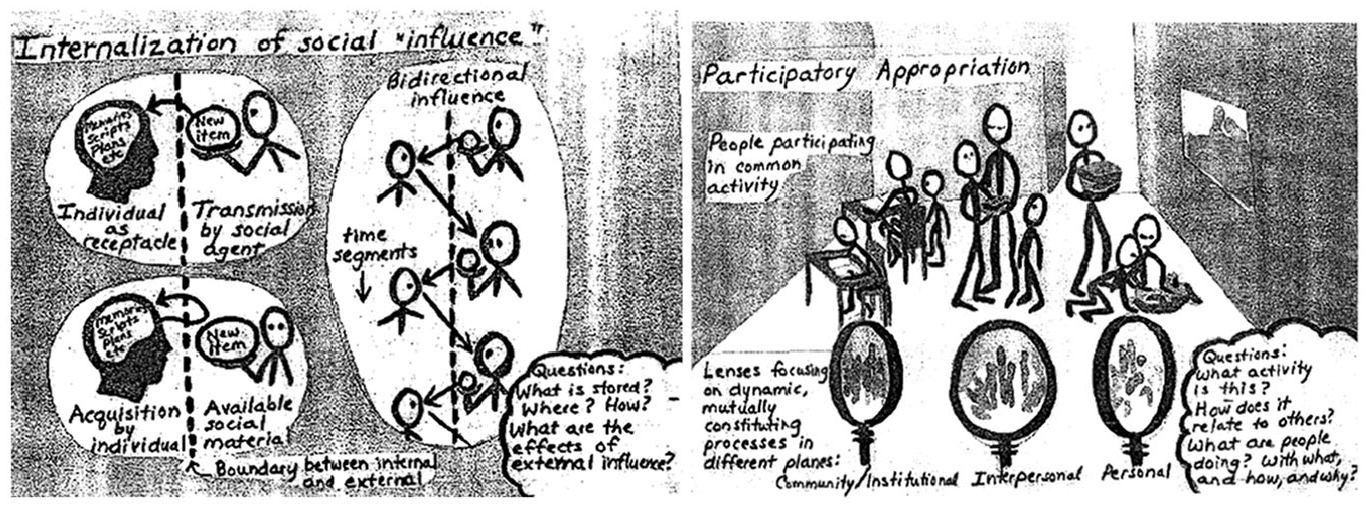
Diagram Comparing a “Social Influence” Approach and a Mutually Constituting Approach of “Participatory Appropriation”
The boundary is key to understanding the problems with the influence approach; it separates the individual and the world as if they could exist independently, as separate entities. But this separation—the boundary—creates the problem of accounting for how packets of information or skill get through the boundary to the individual (via either transmission or acquisition). The perennial unanswered question “What is the mechanism?” is a problem created by the assumption of a boundary, the assumption of an inherent separation between an individual and other people and the world (see also Rogoff, 1997, 1998, 2003).
In a mutually constituting approach, the actors are not static entities sitting still until some force acts on them. Instead, the whole process of life involves activity, movement, involvement, and energy, with individual, interpersonal, and cultural aspects visible according to how we look at the process. The second image of Figure 1 shows learning as participatory appropriation, with lenses representing views of one singular process available if we focus on the activity using any of three planes of focus (personal, interpersonal, and community/institutional). The dynamic, living process involves each individual participating together with others, mutually, in an activity in which they enact and shape the flow of cultural practices of their community available to them at the moment they begin this activity. The learning of the individuals is a process of transformation, of growth, as individuals hone their participation in the ongoing activity (see also Rogoff, 1997, 1998, 2003).
My introduction of “planes of focus” in that 1995 article was an attempt to foreground aspects of a singular mutually constituting process by suggesting camera images with differing depth of field of whole scenes. However, many readers equated “planes of focus” to “levels” of analysis. “Levels” separate individual, social, and cultural aspects of the event, in line with mainstream interactional influence approaches. So, to help my audience avoid the separation into levels, I now refer to these distinct views simply as “foci of analysis.”
It is relevant to point out that distinct foci do not assume that any particular focus is subsumed under another. This contrasts with the hierarchy that often appears in social science circular diagrams of individuals nested within groups that are nested in cultural contexts or box-and-arrow diagrams with “the individual” shown as the product of the group, which is in turn shown as the product of culture/context. Instead, each aspect forms the context of the others. This mutually constituting idea is also held in Indigenous knowledge systems and epistemological frameworks (Cajete, 1994; Ross et al., 2007; see also Meixi & Nzinga, 2023). For example, let this fractal idea sink in:
The Navajo world view includes a holistic and ordered universe where everything is interrelated and all the pieces of the universe are enfolded within the whole. At the same time every piece contains the entire universe, creating a network of relationships and processes in constant flux. (Maryboy, 2008)
The lenses in my 2003 diagram (from Figure 2 in The Cultural Nature of Human Development) improve on the 1995 diagram by more clearly illustrating the idea that different analyses (and different viewers) can foreground specific aspects of an ongoing event—with other aspects of the process visible but not the central focus. Other lenses could also be used if an observer (or a discipline) were trying to understand other aspects of the ongoing process of life—such as the contributions of neurons or hormones or genes (Rogoff, 1997, 2003; see also Immordino-Yang et al., 2019; Scribner, 1985; Zinchenko, 1985). 4
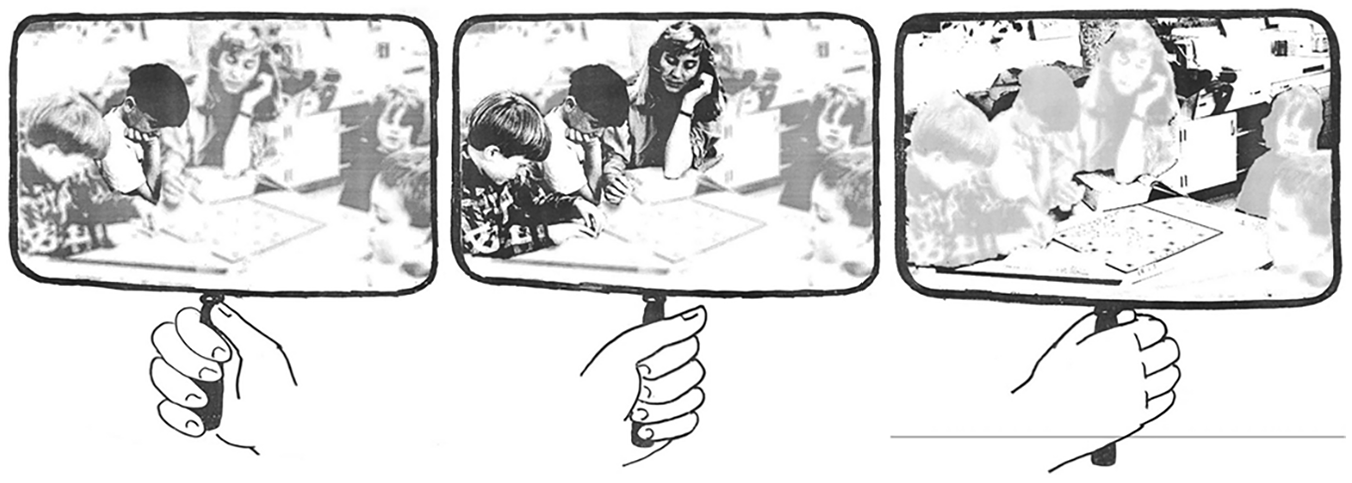
Rogoff (2003) Used These Three Lenses, Held by Different Viewers, to Represent the Idea that Different Analyses Could Focus on Different Aspects of a Single Process
Fractal Aspects of a Mutually Constituting Process
In addition to the idea of lenses helping viewers see distinct aspects of the ongoing process, I have for years also used the idea of fractals (see Figure 3). Usually, I have referred to fractals to explain the mutually constituting way of understanding complexity and to reassure students and colleagues that it is not necessary to study “everything, everywhere, all at once.” We can think of the overall process of life/learning/development fractally by looking at a phenomenon of interest close in, with microanalysis of tiny moments and small spaces, and by looking at the phenomenon with a “wide angle lens” to consider large expanses of history and space.
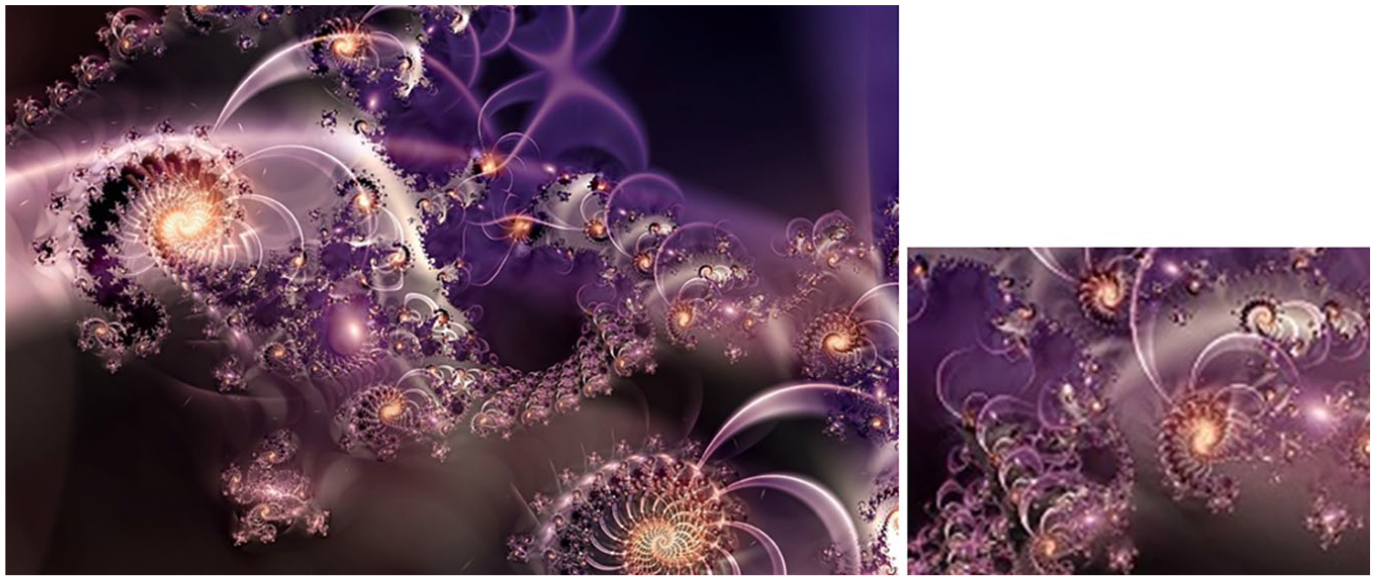
Visualizing Mutually Constituting Aspects of a Process as a Fractal
In Figure 3, note that the same recursive pattern of swirly coils composes this image at a large scale (even bigger than this image) and at the tiniest scale (“turtles all the way down”). Imagine that this image is a tiny snapshot of a flowing process that is occurring at an enormous scale, over both space and time. We can think of the fractal, and life, as a dynamic, recursive process occurring at multiple scales simultaneously over generations.
The pattern is recursive but not identical across locations and generations, modifying in conjunction with local circumstances, events, and—because this is a living process—innovation. 5 For example, patterns of family interactions occur simultaneously at a microscale of embodied action and at a millennial scale across centuries in the organization and practices of cultural communities. The patterns at these different scales are recognizable in some ways and shift in others. For example, in a conversation, we can see both change and continuity as individuals contribute something original using a language they have inherited, at a scale of microseconds, at the same time as whole communities enact and innovate the flow of cultural practices and values that have developed over centuries and more.
An example of such a fractal analysis in distinct Cherokee community settings shows a singular process of harmonious, collaborative interaction occurring fractally, simultaneously, in microsecond and millennial analyses (Dayton & Rogoff, 2023; see also Dayton et al., 2022; Dayton & Rogoff, 2016). For example, a community Elder—a schoolteacher—guided a pair of Cherokee children in learning to maneuver a stylus in a game, teaching nonintrusively by subtly shifting his position across a few seconds of interaction. In the process, he and the children simultaneously enacted a millennial Cherokee value system of respect and harmony, creating this millennial practice in the moment. Thus, the same pattern of harmonious mutuality was visible fractally, simultaneously, in a singular event examined in microseconds of engagement and in millennial principles of community values for engagement.
At a broader scale geographically, we can see this collaborative approach fractally in a common approach to supporting learning in many Indigenous communities of the Americas—Learning by Observing and Pitching In to family and community endeavors (LOPI; Rogoff, 2014; Rogoff & Mejía-Arauz, 2022). The LOPI model reflects the mutually constituting process of collaboration especially in three key features (facets) of the LOPI model. LOPI Facet 1 is a view across generations—the community organization in LOPI includes everyone, all ages, as collaborating contributors in the endeavors of the family and community. LOPI Facet 3 is a micro view across milliseconds or days—individuals engage fluidly and collaboratively, integrating their ideas and actions in synch with the direction of the group. LOPI Facet 4 spans micro and generational—it defines learning and its goals in terms of individual transformation of participation, with innovation and continuation of the ways of prior generations, in order to contribute to the life of the individual and community, across time (Rogoff, 2014; Rogoff & Mejía-Arauz, 2022; Rosado-May et al., 2020).
A mutually constituting, fractal approach can also be applied to other ways of organizing learning. For example, a mutually constituting, fractal approach provides a way to understand the complex patterns embodied in the contributions to learning of individuals and communities in the Assembly-Line Instruction (ALI) common in schooling (Rogoff & Mejía-Arauz, 2022). Small children learn to enact competition and control and inequality in ALI—to raise their hands, be called on to speak, line up as directed, “behave” or be called out, write and talk in the ways the teachers and textbooks require, take tests without helping each other, and try to best each other (see McDermott, 1993; McDermott et al., 1978). At the same time, teachers learn to enact competition and control and inequality in managing the classroom in ways that are approved and supported by supervisors, textbooks and tests, local and national policies, and their own and the community’s history in ALI. At the same time, generations of textbook companies and policymakers and lawmakers contribute to competition and control and inequality as they create and enforce rulings and materials based in economic, political, and spiritual traditions that the children and teachers are also part of. The mutually constituting, fractal approach can help us see how small classroom moments and long-standing cultural values of competition, control, and inequality involve all of these contributions in a process that embodies economic, political, material, and spiritual traditions across generations (see also Meixi & Nzinga, 2023).
The idea that different patterns can be seen while using a mutually constituting, fractal approach is illustrated with Figure 4. Figure 4 shows a very different pattern than Figure 3. But a fractal analysis shows that Figure 4, like Figure 3, has similarity of its pattern across scales. The smaller image on the right shows a similar overall pattern as the figure on the left, examined more closely. We can imagine that the figure on the left itself is a smaller snapshot of an image that extends larger than the page or the room.
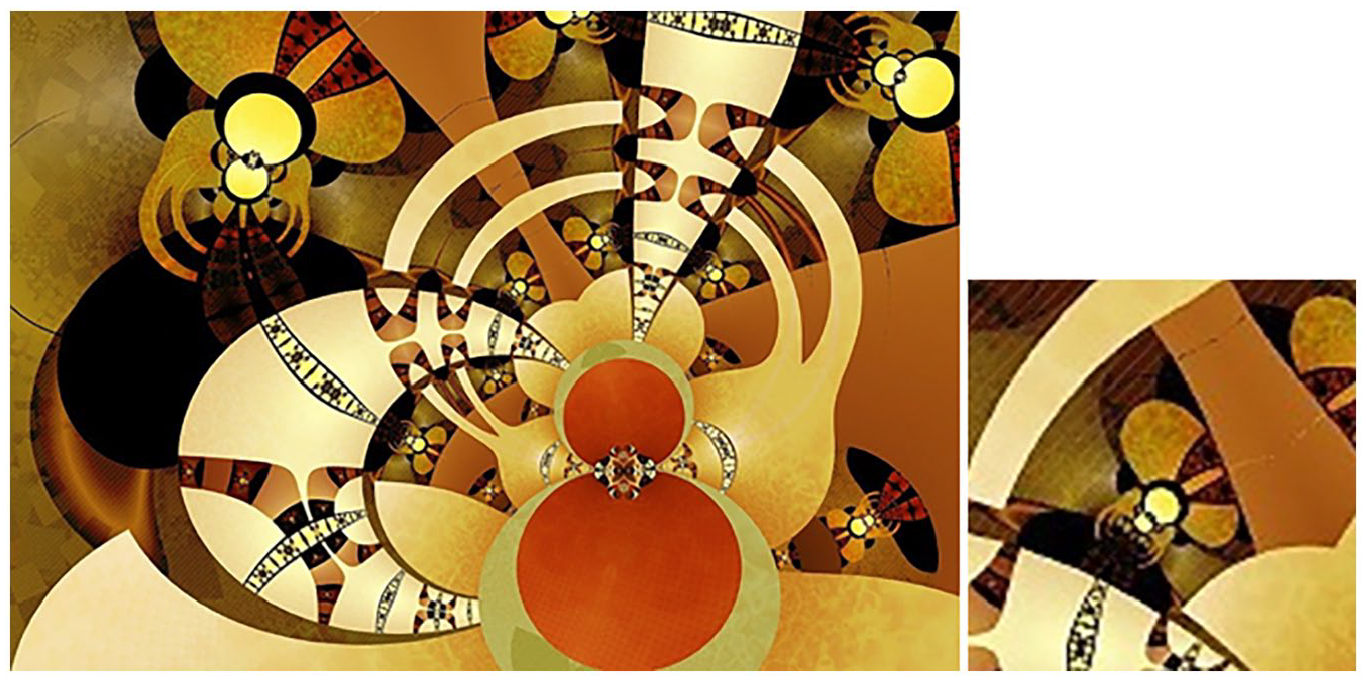
Visualizing Mutually Constituting Aspects of a Process as a Fractal
Several other of my teams research projects can also be used to illustrate fractal analyses as individuals and communities enact and innovate cultural practices over stretches of time from small moments to centuries. These investigations, using the mutually constituting approach, bring into focus the simultaneous individual, interpersonal, and cultural processes involved in learning and development over the flow of generations.
One example is a research project illustrating the mutual involvement of individual, interpersonal, and community actions involved in Girl Scout cookie sales and delivery in Salt Lake City (Rogoff et al., 1995, 2002). The initial motivation for the study was to study individual children’s planning in an everyday activity. I had been doing lab-based studies in which children and their parents or peers planned imaginary errands when I was recruited to carry the boxes of cookies that my daughters had sold—back and forth, door-to-door in inefficient routes around the neighborhood. The next year, my colleagues and I volunteered to become the chairs of the annual cookie sales for a troop of scouts, to study children’s planning, and we began to see planning and other cognitive processes as they were distributed/spread/shared across much larger expanses of time and space. We could still focus on the planning, calculating, and remembering involved in the scouts’ sales and delivery of cookies—but it had to include the contributions of other players. The customers often helped the scouts calculate the price of their order, and the order sheet walked the scouts and the customers through the calculations. The order sheet itself had developed over decades, in ways that handled calculations and memory, addressing generational changes in U.S. neighborhoods, from the 1930s when a simple order stub was placed in a window to indicate that the household had already bought cookies to the color-coordinated form arranged in a way that walked the scouts through the calculations of amount due and a column labeled “check when paid.” The planning, calculating, and remembering in cookie sales and delivery was a shared endeavor spread over generations and the contributions of the individual scouts, their mothers, customers, troop leaders, the cookie companies that designed the order forms, and the changing circumstances of family and neighborhood life.
Relatedly, a recent project in a Guatemalan Mayan town examined change and continuities across 30 years in mother–child collaboration, at a scale of microseconds, alongside globalizing changes in family life occurring across many decades (Rogoff & Aceves-Azuara, 2023). My book, Developing Destinies: A Mayan Midwife and Town (Rogoff, 2011), examined the role of individual contributions to ongoing changes and continuities in childbirth and childrearing practices occurring in small moments, generations, and centuries in a Guatemalan Mayan town where I have had the opportunity to watch changes and continuities across decades.
An important feature of the mutually constituting, fractal perspective is that individuals enact and innovate valued practices inherited from prior generations of their community. As they engage in cultural practices, they bring into being, maintain, and shift the practices of their time and future generations (Rogoff, 2003; Rosado-May et al., 2020; see also Meixi & Nzinga, 2023). This is illustrated by Marta Navichoc Cotuc’s reflection that as Mayan families in her town choose to give birth using the services of a skilled, sacred Maya midwife or a Western doctor, they are, in their individual decisions and actions, forming the present and future of childbirth practices (and an important historical tradition) of their cultural community (Rogoff, 2011). Individuals enact and create culture/context while engaging and transforming cultural practices of prior generations of their own communities and other communities.
Thinking in Terms of Dynamic Process
The mutually constituting, fractal perspective is dynamic, with past, present, and future aspects creating one process of both change and continuity. This approach’s focus on process assumes continual unfolding of life, whether maintaining a pattern or changing. To understand the dynamic, flowing process of the mutually constituting, fractal perspective often involves a paradigm shift, to move beyond the mainstream idea of individuals and contexts being separate, freestanding static objects (Rogoff, 2003). Basically, the shift involves moving to understand life in terms of verbs rather than nouns.
Although Figures 1 through 3 are static images, they attempt to convey dynamic process. Across the years, I have been experimenting with ways of communicating the idea of mutually constituting process in a more dynamic way. One day, I will learn how to foreground aspects of video images and convert Figure 2 to a video showing a focus on one aspect or another in an ongoing event over time.
In the meantime, in teaching, I have been trying to explain the mutually constituting aspects of a singular process by reference to several processes in nature. I will try one here. What if we imagine life to be like a river. A river is constantly moving, whether we look at the rapids or at the changing course of the river. At the same time, the rapids stay in the same place for a while, and a river is reliable enough, static enough to have a position on a map. We can think of the river as a process—water flowing downhill across land—a process expressed as a verb rather than an object or collection of objects.
Here, I especially appreciate what I have read about some Indigenous languages prioritizing verbs in describing phenomena that English describes with nouns. For example, botanist Robin Wall Kimmerer (2013) wrote that English, in using so many nouns, treats life as objects. In contrast, she described how a bay is spoken of in Potawatomi—wiikwegamaa (“to be a bay”):
For this moment, the living water has decided to shelter itself between these shores, conversing with cedar roots and a flock of baby mergansers. Because it could do otherwise - become a stream or an ocean or a waterfall, and there are verbs for that, too. (p. 55)
We could consider the river from the perspective of the travel of one molecule of water or from the perspective of years of geological and climate change that contribute to shifts in its winding path and its depth and speed and drinkability. These are not separate—the travel of the individual molecules of water contributes to the shape of the riverbed, and simultaneously, the riverbed contributes to the fate of the water molecules. No single aspect of the river is its most important feature or “controls” it—not the water molecules, nor the geology, nor the climate, nor the humans who try to manage it. All contribute in a mutually constituting way to the ongoing dynamic process that is the river flowing.
To understand the river, we can foreground various aspects of its functioning. Where does its water come from—snowpack, small tributaries, overflow from a dam, sudden thunderstorm in a desert? What is the terrain channeling the water—steep or flat, rocky or sandy, cut deep or spread wide? What other organisms contribute to the river—roots and branches from trees, dams from humans and beavers, agricultural runoff and factory dumping from humans? What about the climate and the role of storms and earthquakes? What about the ‘water’ itself—just H2O or silt, fertilizer, microorganisms, plastic bits? Any of these aspects, and more, could be considered in the foreground in trying to understand this river, or rivers, from a process perspective. Simultaneously, these aspects together contribute to/create the functioning of the river.
Thus, while focusing on a particular aspect, the contributions of other aspects need to be kept in mind, in the background. The same approach is involved in understanding the varied mutually constituting aspects contributing to the dynamic process of human growth of understanding and skill, maintaining and revising patterns over milliseconds and millennia.
A Self-Reflective Example of Efforts to Understand Dynamic Process, Across Generations
Here is one more way of looking at learning and development as a mutually constituting dynamic process flowing over expanses of time. It involves turning the lens on ourselves—looking at individuals and generations learning about mutually constituting approaches, as a flow of ideas across generations like a river.
I recently came across reference to “4E” approaches that focus on the “embodied, embedded, extended, and enactive” nature of cognition (Newen et al., 2018). I had not heard about 4E, and my instant reaction was “Oh, they probably think they have discovered the same things that we wrote about in 1984 in the edited volume, Everyday Cognition” (Rogoff & Lave, 1984). This volume was one of the first publications bringing together then-new work on embodied cognition, distributed cognition, and situated cognition. Indeed, the Oxford Handbook of 4E Cognition (Newen et al., 2018) described 4E cognition as “a relatively young and thriving field of interdisciplinary research” and a “recent paradigm,” introducing “new theoretical paradigms.” Humph.
I, like many other scholars of my generation, notice the uptake or repeat of ideas that we innovated, often without recognition by newer scholars. For example, I notice that the term “everyday cognition” itself is now treated as just a phrase, without reference to the original invention of this phrase or the innovations in our 1984 volume with that name. (Eric Wanner, Jean Lave, and I developed this title for the 1984 book that opened new vistas in the study of cognition; Rogoff & Lave, 1984.) Sometimes, the older generation gets offended at the lack of recognition, and often, we see the younger generation’s exclusive focus on the most recent work as unscholarly.
Ha! But I also have caught myself thinking that I have innovated an idea that I then run across in the writings of authors whose work I had read previously. For example, I recently ran across an idea that I thought I had “invented” in an article by Beatrice Whiting, one of my advisors and teachers in grad school. And of course, Bea’s generation learned from each other and from those who preceded them and likely from those who followed them. This generational process sometimes included recognition but probably often did not, as Ochs et al. (2010) found when they observed a generational flow of ideas in a physics lab that occurred without recognition from junior researchers that “their” ideas had been suggested to them by their more senior colleagues. (On the idea of individual authorship itself, see Wertsch, 1993. And Bakhtin before him!)
The continual, generational flowing process of learning and innovating is well described by Kenneth Burke (1941/1973), in his thoughts about a parlor conversation of generations of individuals engaged in an inquiry across centuries. The parlor conversation provides a glimpse of the dynamic, continuing, mutually constituting process that each scholar and the academic community engages in, flowing across generations:
Imagine that you enter a parlor. You come late. When you arrive, others have long preceded you, and they are engaged in a heated discussion, a discussion too heated for them to pause and tell you exactly what it is about. In fact, the discussion had already begun long before any of them got there, so that no one present is qualified to retrace for you all the steps that had gone before. You listen for a while, until you decide that you have caught the tenor of the argument; then you put in your oar. Someone answers; you answer him; another comes to your defense; another aligns himself against you, to either the embarrassment or gratification of your opponent, depending upon the quality of your ally’s assistance. However, the discussion is interminable. The hour grows late, you must depart. And you do depart, with the discussion still vigorously in progress. (Burke, 1941/1973, p. 110)
Of course, there is more than one parlor, and the conversations that emerge have different tenors—across disciplines, of course, but also nations, tribes, affinity groups, kin of different sorts. The different parlors often do not even know about each other or what the others are talking about. But some individuals (e.g., interdisciplinary scholars and immigrants) try to keep up with and contribute to several parlors’ conversations at once, and they import/export ideas across parlors. Their participation connects the parlors and contributes to innovations, as do current events outside the parlors, in a nonlinear flow of the ideas and conversation across time and space.
Thus, individual thinking and the whole conversation’s ideas are mutually constituting. The intergenerational flow contributes to the changes and dynamic continuities across centuries in the conversation as well as in the learning of generations of individuals (McDermott, 1993; Rogoff, 2003).
My focus here on an ongoing, generative conversation is similar to the metaphor of a symphonic performance. The idea of using performance as a helpful metaphor was offered by Rye DiRenzo, an undergraduate in my class on culture and human development, in response to an essay assignment to explain the idea of the mutually constituting relation between individuals and culture:
No one property of a performance can be isolated outside of its surrounding context. You cannot get an adequate understanding of why a symphony sounds the way it does by solely studying the conductor at the moment of performance, or studying each of the musicians individually, or collecting and analyzing each instrument. A mutually constitutive approach to understanding this acknowledges the vast array of [aspects] across time, the history of this genre of performance, and the relationships between the musicians themselves that they’ve built their whole lives leading up to the moment of this performance. . . . The mutually constitutive approach sees these [aspects] as not just interconnected but inextricable. (DiRenzo, October 26, 2022)
I am trying in this chapter (and across the past 4 decades) to find ways to think and talk about the relation of individual and culture as mutually constituting aspects of a process, an unfolding, a flow of events of life across time. The idea of a moment in the flow of life as a performance provides a way to focus on contributions of specific aspects, such as a cellist’s solo or the type of venue available in the composer’s locale and era, while of necessity keeping them situated together with the other aspects of the moment of the performance in question. Both the idea of performance and conversation inherently maintain the aspects contributing to the event/activity, mutually involved in the event’s process—even if the contribution of one aspect—such as an individual—is momentarily the focus of our attention or research.
Considering Learning/Development as Transformation of Participation
I have tried various ways of addressing individual learning from a mutually constituting perspective. In the 1980s into the 1990s, I tried out the idea of “appropriation” to get around the idea of learning as a process of “internalization,” which to me seemed to maintain a separation between individual and the world (e.g., Rogoff, 1990). However, appropriation still bothered me because its root may imply making some “thing” one’s own—which still separates internal and external.
In trying to get beyond the then- (and still?)-prevalent pendulum swing between learning being either run by the learners (“acquisition”) or run by the outside world (“transmission” from parents/teachers), I offered the concept of “guided participation” to bring together learners and the rest of the world as mutually active contributors to the learning process (Rogoff, 1986, 1990, 1994, 2003; Rogoff et al., 1984; Rogoff & Gardner, 1984). 6 I argued for analyzing adult-child interaction holistically, contrasting analysis of mutual interaction in shared events with mainstream psychology’s approach of separating mothers’ and children’s involvement in a shared event and then putting them back together statistically, losing “the meaning available in the flow of the interaction” (Rogoff, 1986, p. 31; see also Angelillo et al., 2007; Rogoff et al., 1993; Rogoff & Gauvain, 1986).
Eventually, I resolved my concern over finding a way to talk about the process of learning that would get beyond the idea of internalization and my substitution of the term “appropriation.” For a while, I tried the term “participatory appropriation,” which
refers to how individuals change through their involvement in one or another activity, in the process of becoming prepared for subsequent involvement in related activities. . . . Through engagement in an activity, individuals change and handle a later situation in ways prepared by their own participation in the previous situation. This is a process of becoming, rather than acquisition. (Rogoff, 1995, p. 142)
Soon, I realized that this idea could be referred to simply as a process of “transformation of participation” (Rogoff, 1997, 1998). While participating in an ongoing activity, people transform the ways that they engage in the activity—they learn, transforming their participation. They grow in the process of contributing to the endeavor at hand. Clearly, to say that someone learns by transforming their participation requires attention to what they are participating in. This mutually constituting idea depends on the contributions of individuals and context/culture, together, which changes the research questions and methods.
A Mutually Constituting, Fractal Approach Changes Research Questions and Reorients Methods
A mutually constituting, fractal view helps make the study of individuals-in-context tractable. Such analysis allows a viewer to focus on a particular aspect of a phenomenon with confidence that that aspect will aid in understanding the overall pattern without having to study everything all at once. This approach allows movement between micro- and macro-analysis, with a focus on any aspect of it already involved with the whole process.
It may seem tricky to choose which aspect to start on. But because the different aspects together compose one process, the point is to focus on an aspect that seems important in the context of the everyday functioning of the phenomenon of interest.
This means that researchers need to engage with the everyday lives of the people they want to understand, in the events and circumstances of their lives (Rogoff et al., 2018). Ethnographic understanding of everyday life is rare in the mainstream study of human development, due in part to the efforts to separate children from their contexts and to “control” away the complexity (Rogoff & Angelillo, 2002).
As in other sciences, developmental and learning sciences need to investigate the “natural science” of the phenomena that interest us, to understand the ecology of individuals in their niches. We need careful qualitative observations and research that helps us detect phenomena that we have yet to become aware of and that help others “see” the phenomena.
Mainstream approaches often use measures that have unknown relation with lived experience, and this lack of knowledge jeopardizes whatever interpretation the researchers make of it. Instead, it is essential to understand how measures used are likely to fit with—make sense in—the familiar contexts of the participants. In my research, this means that interview questions and observational coding systems that my colleagues and I develop in one context and with one group of people usually need adaptation to be applied in a new context and with a new population—especially when everyday experience across the contexts is likely to be quite dissimilar.
Understanding the mutually constituting involvement of individuals and context/culture requires a broad portfolio of both qualitative and quantitative methods (Rogoff & Angelillo, 2002), with a strong base in the observation of everyday life. Ethnographic understanding is important in its own right as a research method. It also is essential for informing the design of researcher-managed situations, which often requires extensive piloting. Furthermore, ethnographic understanding is necessary for researchers to move beyond their own lived experience and related assumption systems.
In addition, ethnographic understanding is needed for analysis of data in ways that maintain fidelity to individuals, communities, and their circumstances, such as the casegraphs that my team and I have used in many of our studies to bridge between individual cases and quantitative patterns (Angelillo et al., 2007; Rogoff et al., 1993). Casegraphs maintain the information from individual cases at the same time as portraying the patterns across the individual cases (for recent examples, see Alcalá et al., 2018; Coppens et al., 2016; Dayton et al., 2022; Rogoff & Aceves-Azuara, 2023; Ruvalcaba & Rogoff, 2022; Silva & Rogoff, 2020).
Ethnographic methods are especially important for studying understudied phenomena—such as the strengths for learning of children and communities that have routinely been left out or treated from a deficit perspective based on the assumptions and practices of mainstream researchers and communities (Rogoff et al., 2017). Microethnographic methods, such as those described by McDermott et al. (1978) and Erickson (1995), are extremely valuable for analyzing people’s engagements as they create contexts together in everyday life (which includes schools and lab settings).
Studying learning/development from a mutually constituting approach shifts the central questions from mainstream approaches that attempt to measure individuals’ possession of general or modular mental faculties separate from context/culture. Instead of asking how much information or skills an individual has “acquired,” a mutually constituting approach to studying learning/development asks how people’s participation in particular activities transforms, in both short- and long-term scales (Rogoff, 1997).
The focus becomes describing how people engage in an activity, not what skills or knowledge (as objects) they possess in some supposedly context-free internal repository. Rather than asking what people CAN do (or what knowledge they “possess”), the aim is finding out what people DO do in the circumstances they encounter and create. (My students refer to this as “Barbara’s do-do theory.”) From the mutually constituting, fractal perspective (and the do-do theory), the central questions in the study of learning and development become:
what the participants regard the purpose of the activity to be;
what their own purposes are for being involved and their commitment to the endeavor;
what roles people play in an activity, with what fidelity and responsibility;
how flexible and fluent their involvement is, how smoothly they coordinate with complementary roles;
how they extend their approach in one situation to others and how they distinguish when to apply an approach to a new situation;
how they contribute to innovation (extended from Rogoff, 1997).
I have argued in this chapter (and across 4 decades) that a mutually constituting approach makes the complex, contextual study of human learning and development tractable. Some years back, I felt that these cultural/historical theoretical ideas needed to be put to use in research to reveal their utility for understanding human learning and development. The findings of my research program on Learning by Observing and Pitching In to family and community endeavors — as well as the associated empirical questions and methods — exemplify this aim (see especially, Angelillo et al., 2007; Rogoff et al., 1993, 2014).
In addition to improving our science, the mutually constituting, fractal approach also makes the research useful, because it is already contextualized in situations of importance for everyday life, with attention to the extent to which people’s ways of handling the situation extend to new circumstances. Hence, research that is situated in the mutually constituting perspective can often be readily used in real circumstances related to the contexts studied, whether schooling, family life, clinical settings, or policy deliberations. This contrasts with mainstream research that needs to be “translated” from situations that are supposedly context-free (but that are based in contexts that researchers may take for granted although they may be strange to the research participants).
Kris Gutiérrez and Carol Lee have provided the metaphor of navigation to address how individuals may or may not use what they have learned in one context when they approach another context (see especially Gutiérrez, this volume). The idea of navigating across contexts through expanding and adapting one’s repertoire of practices (Gutiérrez & Rogoff, 2003) is, I believe, a more fruitful approach to understanding generalization than the mainstream approach, cast as “transfer” of information or skills (as if they are objects) across contexts. Indeed, an important feature of children’s development is determining when and how to employ what they learned in one situation when engaging in another (Rogoff, 2003).
I argue for the necessity of studying the ongoing process of individuals’ and others’ participation in activities along with how their momentary involvement is constituted by and constitutes participation in long-standing cultural practices in the present and into the future. Looking at life as process makes it possible to see how individuals transform their participation in the endeavors of their cultural community at the same time as they and their generation contribute to the flow of generations, learning and enacting and transforming the ways and practices of their cultural communities.
The complexity of life is a reality. A mutually constituting approach may require a paradigm shift for readers used to the mainstream approach of separating individuals and context. However, I believe that the mutually constituting approach provides a more parsimonious, simple way of looking at individuals’ learning and development as they participate in and create the endeavors of their context and community.
Footnotes
Acknowledgements
I am grateful for the thoughtful comments of my colleagues Andrew Dayton, Mary-Helen Immordino-Yang, Geoffrey Saxe, Samantha Basch, and Doug Medin. I appreciate the writings and mentoring over the years by the authors I mention in this article and the challenging and thought-provoking comments and questions from my graduate and undergraduate students.
Funding
The author disclosed receipt of the following financial support for the research, authorship, and/or publication of this article: The chapter was facilitated by support from the UCSC Foundation endowed chair from University of California of Santa Cruz.
Notes
Author
BARBARA ROGOFF is UCSC Foundation Distinguished Professor of Psychology at the University of California-Santa Cruz. She has received the Distinguished Lifetime Contributions Award (SRCD), the Award for Distinguished Contributions to Developmental Science (Piaget Society), and the Chemers Award for Outstanding Research (UCSC). She is an elected member of the American Academy of Arts and Sciences and the National Academy of Education and a Fellow of the AAA, APS, APA, and AERA. She has held the UC Presidential Chair and Fellowships of the Center for Advanced Study in the Behavioral Sciences, Kellogg Foundation, Spencer Foundation, and the Exploratorium and served as editor of Human Development. She is author of Apprenticeship in Thinking, Learning Together, The Cultural Nature of Human Development, and Developing Destinies: A Mayan Midwife and Town. Recent volumes include Children Learn by Observing and Contributing to Family and Community Endeavors and Learning as a Community Process of Observing and Pitching in.