




Abstract
This review focuses on a subset of literature on the arts and arts education that explores how learning is conceptualized and enacted in the context of out-of-school time (OST) arts education environments that primarily engage Black, Indigenous, and young People of Color in the United States. The review is grounded in principles of critical qualitative inquiry and sets forth four propositions, which represent key practices from OST arts education with a focus on equity and diversity in education: creating representations, exploring identity and narrative, practicing creativity, and collaborating as an outcome. The discussion offers an alternative from deficit perspectives on youth and toward asset-focused, culturally sustaining perspectives that value the artistic strengths young people bring to a learning environment.
Research and practice focused on arts learning, instruction, and education have grown into an increasingly diverse and critical area of inquiry, inviting more expansive conceptualizations of artmaking, deeper understanding of practice and programs that offer alternative contexts for learning, and cutting-edge questions about the tensions and possibilities for human learning and development in and out of school. When learners engage in artmaking practices, they are fundamentally enacting social, cultural, and historical ways of knowing and learning (Halverson, 2021; Tzou et al., 2019; Vossoughi et al., 2016). Through the arts, learners represent and express themselves and their sociocultural assets by constructing and sharing personally meaningful artifacts, and they engage in a process of learning and development that authentically centers the human experience. A growing body of work in the field seeks to understand learning processes and the pedagogical features that undergird them and make them empowering sociocognitive sites for young people (Halverson, 2021; Halverson, Saplan, & Martin, 2023; Mejias et al., 2021). Drawing from a score of research and programmatic efforts, this review centers on artmaking as an act of human flourishing and thriving with the potential to transform contemporary learning theory and research across educational disciplines (Tay & Pawelski, 2022; Wright & Pascoe, 2015). It focuses on how artmaking is being examined within a single, although multifaceted, context: out of-school time (OST) settings. 1
The review builds on four understandings and framings of the issues. First, as the RRE call for chapters suggested, education research has been limited by intellectual silos. Research in arts learning has experienced the same intellectual silos, treating cognitive and social emotional outcomes of arts practices as separate from an understanding of the arts as a powerful mechanism for political and social change (Wong & Peña, 2017). This review contributes to efforts to close the gap by examining the potential impact that including the arts can have on an integrated understanding of learning.
Second, educational and developmental science is increasingly focused on addressing educational disparities and examining the multiple contexts in which arts learning takes place, in particular, OST arts education environments that primarily engage young Black, Indigenous, and People of Color (BIPOC) who have been underserved as a result of structural inequities. To address this burgeoning area of inquiry, the review focuses on two broad research questions:
Research Question 1: What common practices and foundational ideas highlighted in the OST arts education literature center the learning experiences and potential of BIPOC youth?
Research Question 2: What can we learn about learning from OST youth arts work?
Third, as a way to learn from and advance scholarship that supports BIPOC youth, this review is grounded in principles of critical qualitative inquiry (CQI; Canella, 2017; Denzin, 2017) and follows a model for engaging with qualitative data as “pedagogical encounters” (Vossoughi & Zavala, 2020). The review is based on iterative and emergent approaches to coding and theming of literature to identify shared ideas of practice related to supporting such youth (Miles et al., 2020).
Lastly, this review advances four propositions that represent major practices from OST arts education and provides commentary on the learning opportunities they afford with a focus on equity and diversity in education. The four propositions are:
Creating representations, the core mechanism of disciplinary learning in the arts, supports a definition of learning that expands social cognition to include personal, cultural, and historical understanding through the creation of artifacts.
The mechanism for enacting an expansive definition of learning is through the exploration of identity and narrative in OST arts practice. Centering the role of learners’ personal and emotional lives in the learning process invites youth to experiment with their identities and write themselves into larger discourses.
Practicing creativity happens purposefully and with depth so that learners can safely explore difficult topics, imagine new worlds, and share their unique stories and perspectives.
Collaboration is an outcome of collective learning and not a mechanism to individualistic outcomes that frames learning as a sociocultural process requiring intentional design and reorganizes traditional knowledge and power structures.
These four propositions contribute to our understanding of what learning can be and offer a potential alternative from deficit perspectives on youth and toward asset-focused, culturally sustaining perspectives that value the artistic strengths young people bring to a learning environment as the foundation for learning together (Mejias et al., 2021; Ryoo & Calabrese Barton, 2018).
Arts education and learning initiatives can be found in a range of in-school and out-of-school contexts, from formal and informal, culturally responsive youth development organizations and venues (e.g., the political murals in many cities dating back to the 1960s, 1970s, and 1980s or recent mural projects such as Philadelphia’s Mural Arts Program, www.muralarts.org) to vibrant programs that support musical expression, poetry, and theater. This review highlights this wider band of work on the arts. It provides examples of the varied forms and roles of arts learning while directing attention to a narrower and nuanced focus on artmaking and its potential for formulating new conceptualizations and epistemological analyses for human learning and development.
The Arts in Education
Arts educators and scholars have long been required to justify their presence and value in the broader education landscape. At various points in history, the arts 2 were not considered essential or “basic” enough to be featured in students’ daily education (Efland, 1990; Eisner, 1987). The pervasiveness of cognitivism and abstract thinking over “hands-on,” artifact-centered learning has challenged the value of arts education (Efland, 2002). Furthermore, arts research and practice have had to fight the “accountability machine” that requires immediate and concrete evidence of academic improvement for schools and classrooms to be identified as successful (Au, 2011; Halverson, 2021; Sabol, 2013).
Within arts education scholarship, there is disagreement about what role the arts play in education, and why it should be a respected component of the educational ecology. The main arguments can be summarized as (a) intrinsic, the notion that experiencing or making art is valuable and meaningful in itself (Hardiman & JohnBull, 2019; Hetland & Winner, 2004), and (b) instrumental, which emphasizes a utilitarian view of the arts as a means toward achieving nonarts ends (Catterall, 2005; Labor, 2018). What neither argument addresses sufficiently is how learning in and through the arts supports and expands perspectives on human cognition to include social, cultural, historical, and developmental perspectives and how the arts can act as a bridge to connect educational disciplines, learning modalities, and learning processes (Barajas-López & Bang, 2018; Bevan et al., 2019; Halverson, 2021; Peppler et al., 2022; Tzou et al., 2019).
Some scholarship has also explored how arts practices are epistemically unique—such as Sheridan’s (2011) work on the observing and envisioning practices that studio arts experiences specifically afford learners. More recent work has illustrated how learners’ creative educational experiences can be meaningfully connected to their interests, opportunities, and relationships (Peppler et al., 2022), reframing the value of arts learning not as intrinsic or instrumental but holistic. This work has begun to bypass the value dualism that has been so entrenched in arts education literature and instead focuses on learning opportunities the arts can provide and how those opportunities impact people’s learning lives. This review considers artmaking as the foundation for understanding how cognitive, social, cultural, historical, and developmental perspectives on learning can come together, particularly through the potential to support the development of epistemic practices used across disciplines (Bevan et al., 2019; Mejias et al., 2021).
The Arts and Learning
The sociocultural turn in the learning sciences has expanded our understanding of how people know and learn beyond defining cognition as the mental processes of individual learners (Esmonde & Booker, 2017; Nasir et al., 2021). Scholars increasingly recognize that learning is embodied (Solomon et al., 2022; Vossoughi et al., 2015; Wagner & Shahjahan, 2015), affective (Craig et al., 2004; Linnenbrink, 2006; Zembylas, 2022), social (Lave, 1991; Lave & Packer, 2011), cultural (Nasir et al., 2021), and political (McKinney de Royston & Sengupta-Irving, 2019). Acknowledging that these factors are integral to learning has been the centerpiece of arguments driving pedagogy that is socially just and instructional design that encourages epistemic diversity (Ladson-Billings, 2009; Paris & Alim, 2017).
The arts act as a bridge to connect educational disciplines, learning modalities, and learning processes (e.g., Halverson, 2021; Mejias et al., 2021) precisely because the arts involve discipline-specific epistemic practices, such as creating, noticing, and critiquing, that overlap with nonarts subjects (Bevan et al., 2019) and that reframe learning as acts of knowing, doing, being, and becoming (e.g., Barajas-López & Bang, 2018). Moreover, recent shifts in perspectives on the relationship between human development and learning have created an opportunity to center the arts in social practices and learning discourse (Gadsden, 2008; Nasir et al., 2021). These recent turns in learning sciences and arts education discourse have provided an ideal opportunity to review current literature within the context of youths’ out-of-school experiences and investigate how OST youth arts practices can inform our broader understanding of learning and development.
Exploring Arts Education Outside of Schools
The term “out-of-school time” education was defined by Bevan (2017) as “a term used in educational circles to describe the hours, weeks, and months available for learning when young people are not in school” (p. 561) and includes both everyday self-directed and structured/supervised learning. “After-school time” and “OST” are often used interchangeably, with many after-school programs serving as extensions of the school day and linked primarily to improving students’ academic achievement and behavioral outcomes (see Vandell et al., 2022). OST, for the purposes of this review, reflects the language used by practitioners to refer to their organizations, represents informal and formal spaces (Schugerensky, 2000) in which youth not only engage with different forms and genres of the arts but are also co-constructors of artmaking in these spaces, and serves as a framework to uncover approaches and processes that facilitate co-construction as pathways for learning and development. This expansive conceptualization of OST also includes opportunities when external arts programs are situated in schools, sometimes during school time.
Much of the recent work in arts education scholarship, particularly work that focuses on arts practices, learning, and development, has occurred in OST spaces, including nonprofit and community arts organizations, youth-serving organizations with arts programming (Heath, 2001; Lopez, 2015), museums (Erickson & Hales, 2014), school-based programming either outside of school hours or during school hours with informal educators (S. Davis, 2013), and government agencies, such as libraries, parks, and juvenile detention centers (Barniskis, 2012; Lazzari et al., 2005). In some artmaking spaces, mentorship happens naturally (Peters, 2010) and in self-organized informal arts communities (Kárpáti et al., 2017). Sometimes OST arts work happens in schools as young people increasingly access arts education through artist-in-residence programs provided by community organizations that frequently take place during school time or on school grounds (Hager, 2010; Rabkin, 2012). Learning in these spaces can take many forms, from starring in the spring musical of a youth theatre company to walking the exhibits of an art museum with family or from participating in a virtual knitting club to taking piano lessons with a neighbor. OST has been used to represent learning that takes place in organizations like YWCA courses and Scouts as well as “unincorporated” arts, like personal hobbies and home-based crafting practices (Wali et al., 2002).
Green and Kindseth (2011) referred to the relationship between in-school and OST arts programs as “symbiotic rather than oppositional. Schools remain a vital partner to OST learning, just as afterschool programs can play a helpful role in advancing schools towards institutional goals” (p. 340). Although it is beyond the scope of this review to summarize the literature base on formal arts education in schools—a crucial piece of a creative arts ecosystem—the overlap between arts learning that is taught by classroom teachers and teaching artists is enough that this work has implications for both. Among multiple reasons for focusing on OST education environments are that they afford greater opportunities for staff to support youth agency and creativity and for youth to take arts practice further than is often acceptable in schools (Gadsden, 2008; Pittman et al., 2021). Learners can engage in arts work that is more deeply aligned in social justice without the risk of being accused of advancing a political agenda, prioritize identity exploration over completeness of a product for a grade, and develop artistic skills in ways that do not require mastery of the skill or reinforce certain performances of productivity that are common in schools (e.g., emphasis on time spent “on task”). With these different pedagogical affordances, OST arts education may enable different learning opportunities.
J. H. Davis (2010) described the opportunities OST youth arts environments afford for learning and development, including “personal and interpersonal development, arts skill building and pre-professional training, cultural and intercultural awareness, and commitment to community service and development” (p. 83). Specifically, OST education spaces have been shown to empower arts educators to ground their learning practices more explicitly in sociocultural theory and social justice (e.g., Hanley, 2011). Arts-forward pedagogy based in community arts and OST environments has enabled young people to bring their cultural assets to the fore in learning environments such as the use of Indigenous claywork in STEAM learning (Barajas-López & Bang, 2018) or hip-hop dance as a mechanism to create representations of physics concepts (Solomon et al., 2022). These learning processes represent a culturally sustaining pedagogical approach grounded in radical inclusion and the experiences of historically marginalized students (Halverson, 2021; Paris & Alim, 2017). As Gadsden (2008) articulated, “In this way, the arts act as a venue for social justice and a platform for those often invisible in traditional classroom settings” (p. 32).
Methodology and Findings
This literature review aimed to identify promising practices and leading challenges that OST youth arts organizations in the United States face when engaging young people who have been identified as “historically marginalized” from mainstream institutions (Halverson, Martin, et al., 2023, Halverson, Saplan, & Martin, 2023). It was guided by CQI, which takes the stance that research is a socially and culturally constructed process based in an ethical commitment to advancing rights and social justice (Cannella et al., 2015; Denzin, 2017). Rather than perpetuate a damage-centered perspective by describing BIPOC youth in terms of deficits and framing arts education as their saving grace, CQI provides a process that allows literature reviews to capture the inherent dignity and strengths of the focal populations, which is important to counter deficit perspectives. The review employed three primary approaches: (a) convening a diverse research team and advisory board to conduct and direct the project; (b) engaging in an iterative and collaborative process of searching for, refining, and selecting literature; and (c) analyzing the literature sample through an epistemological lens reflective of distributed expertise and an ethical lens of desire-based research, which seeks to de-pathologize “the experiences of dispossessed and disenfranchised communities so that people are seen as more than broken and conquered” (Tuck, 2009, p. 416).
Search Process and Selection Criteria
The search process sought to understand the landscape of literature about OST arts learning environments—including the opportunities they afforded and the pressing problems they faced—in an effort to aid the development of supportive, arts-centered spaces for young people who do not feel fully embraced within the dominant culture. Existing summaries of youth arts education described the valuable potential of the arts for youth learning and development (cf. Burnaford et al., 2007; Gadsden, 2008). These reviews highlighted some growth in discourse around arts learning in relation to issues of equity in education, but they also reported a general scarcity of scholarship (compared with other areas of inquiry in education research) that ultimately lacks nuance in terms of how equity is conceptualized and the role the arts can play in addressing issues of equity (Gadsden, 2008; Kraehe et al., 2016).
Selection criteria were intentionally broad (for an overview of our initial selection criteria, see Table 1) and included (a) publications focused on youth arts learning environments in the United States that work in, with, and for communities that have been historically marginalized; (b) literature from the United States and Native Nations within U.S. territory to address specific sociopolitical dynamics; (c) literature published since 2000, 2 years before the No Child Left Behind (NCLB) Act, which drastically reduced arts funding and opportunities for K–12 public school students, thereby changing the demographics of who has access to learning in and through the arts (Chappell & Cahnmann-Taylor, 2013); and (d) literature that involved young people in grades K–12 or that was in reference to youth programs, even if youth were not the exclusive focus. For instance, we included an empirical study focused on teaching artists who work with youth (Winkler & Denmead, 2016) and an article focused on arts programs directed at youth and adult learners (Peters, 2010).
Initial Literature Review Process and Criteria
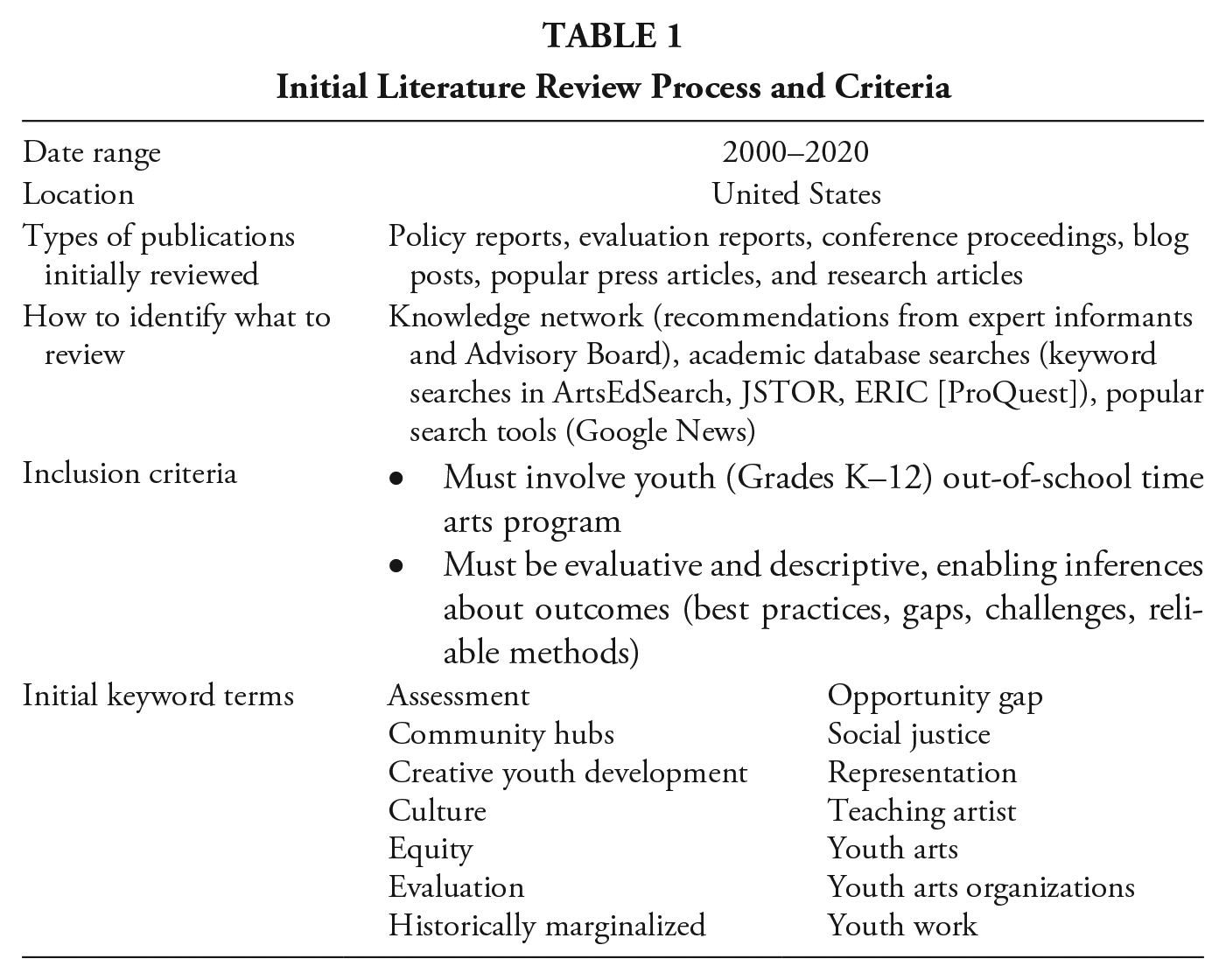
Data were drawn from four databases (three academic and one popular press, as noted in Table 1), suggestions solicited from selected experts (e.g., researchers, practitioners, and youth in programs), and crowdsourcing media such as organization blogs and practice-oriented resources because perspectives from practice are often absent from commonly used databases. For example, searching for literature about “OST arts education” in recognized databases did not identify Indigenous young people’s experiences and perspectives in what is described as “claywork” (Barajas-López & Bang, 2018) or “storywork” (Tzou et al., 2019). The search was intentional in scanning both research and gray literature pertaining to arts programs serving school-age young people who have been systematically marginalized as a result of their race, culture, or economic status, and including perspectives and publication types that are underrepresented in traditional literature reviews and academic databases is consistent with the goals of CQI (Cannella et al., 2015).
Ultimately, the initial search yielded 150 articles, chapters, and blog posts, which were reduced and refined to 57 through an iterative selection refinement process. Refinement required a multidisciplinary definition of art in order to be inclusive of cultural and social practices not always associated with arts education (e.g., spoken word, puppetry, the Maker Movement, circus arts) and more traditional categorizations (e.g., visual and performing arts). Broad ideas (e.g., arts learning and youth arts) and strings of particular practices (e.g., creative writing AND storytelling AND hip hop AND spoken word) were added, and several key search terms were combined and applied (e.g., marginalized communities and equity, minoritized, and marginalized). Some publications often mentioned a generalized community through coded language (e.g., “urban youth”) in the description of arts program participants but lacked deeper inquiry about the connections between the community and arts learning, whereas some studies brought an implicit deficit perspective, framing learning in the arts as the “treatment” to “fix” or “improve” young people’s poor behavioral or academic outcomes (see e.g., descriptions of “at risk” framing of young people in Goldstein & Lerner, 2018; Hager, 2010). As a result, literature that fundamentally leveraged arts education as a “cure” for marginalization was excluded from the review.
Basing the review on literature about “historically marginalized youth” not only came with the risk of reinforcing deficit and damage-centered perspectives on youth (Baldridge, 2014; Cannella et al., 2015; Ladson-Billings, 2006) but also had the effect of collapsing diverse racial and cultural groups into one opaque category. Search terms specific to different communities were refined, including races and ethnicities (Black, Latinx, Indigenous peoples), citizenship and first language (immigrants, language learners), and lower income and rural designations. The final selection included literature that primarily focused on serving BIPOC youth as a central feature of arts education (for a description of the resulting 57 publications, see Figure 1).
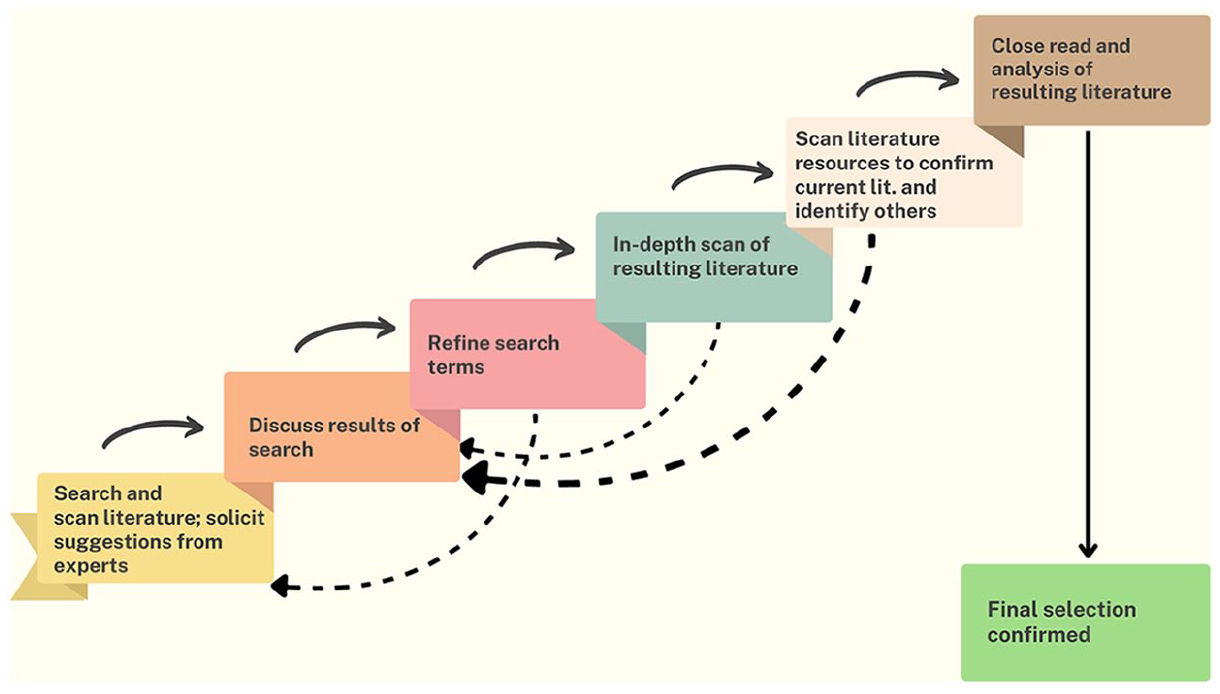
Iterative Literature Selection Process
Literature Analysis
The analysis of the final literature sample included two phases: (a) organization of the sample into a series of analytic matrices to develop a sense of what the pieces were about, track descriptive information about them (Miles et al., 2020), and “see” patterns across publications so we could create descriptive categorizations and (b) an iterative process of coding (using both emic and etic strategies; Saldaña, 2016), memo writing, and weekly analysis meetings (Merriam & Tisdell, 2016). Both phases of analysis attempted to describe promising practices found in each article and the nuance surrounding them, and these practices were construed not as ways of saving BIPOC youth but as ways of enhancing their epistemological, cultural, and linguistic assets. Key practices surfacing from the literature that centered the experiences of BIPOC youth seemed to align with broad themes of arts learning that were reported on by Halverson and Sheridan in 2014 and have been expanded on since the completion of the initial review (Halverson, 2021): creating representations, engagement in identity processes, language development, creativity and critical thinking, and collaboration. Four of the five overarching categories, most relevant to this review, were then adapted into etic codes and added to the abstracts to deepen the analysis of the literature. The particular context of educational equity and justice for BIPOC youth led to more nuanced iterations of these categories, described in the findings section.
The four propositions represent the adapted four categories of practice and link categories of arts practices in OST organizations to contemporary, desire-based perspectives on learning and development—such as framing learning as a complex sociocognitive process that is strengthened by learners integrating their diverse personal and cultural assets. Unlike practices or outcomes, propositions suggest a theoretically linked conjecture that has not yet been substantiated by empirical research. The propositions have been leveraged to argue that studying OST arts environments can help the field reframe what learning looks like for students who have been undersupported in mainstream education institutions. Learning theory can be expanded as well by analysis of arts practices. In short, these propositions should be considered open conjectures and avenues for future empirical research; they may be launching points for future design-based research or theory-driven work.
Focusing on the practices of OST arts programs resulted in a literature sample that skewed heavily toward practice-oriented publications rather than theory-generating scholarship or experimental research related to arts learning. Additionally, because the majority of literature focused on serving or supporting BIPOC youth, this review does not address other sociopolitical identities that have been historically framed as marginalized (e.g., gender identities, neurodiversity).
In taking a desire-based perspective to literature selection and analysis, this review shares key practices and assertions about arts education practices that were advanced within the literature. Some articles offer substantial empirical evidence of the claims they make related to supporting BIPOC youth (e.g., Cox, 2014), and other reports are more simplified in terms of the trends they report and their process for identifying those trends (Lim et al., 2013). The literature selection and analysis approach also purposefully overrepresents the experiences of OST arts organizations, organizational leaders, participants, and researchers that have been excluded from mainstream scholarly arts education discourse. The review centers voices (scholars and OST youth stakeholders), types of publications, and arts media (STEAM) that are often overlooked. In other words, this review does not aim for representative samples in the traditional sense and, as a result, does not offer universal principles, ideas, and experiences. The CQI stance to reviews creates a methodology for identifying and analyzing literature that is flexible and iterative, honors distributed expertise and collaborative analysis, and frames the subjects of the literature through a desire-based perspective as core principles.
Descriptive Analytic Categories of OST Youth Arts Literature
After refining the process, keywords, and descriptions, 57 articles and reports were identified, representing five descriptive categorizations: (a) types of publications, (b) regional focus, (c) populations served and age of participants, (d) art forms represented, and (e) meta-methodological analysis.
Types of publications
The search was bounded between 2000 and 2020 because of the shift in political discourse to learning as measured through NCLB-related metrics. Sixty-three percent of the works on arts learning and community were published in the past 11 years. The publications for the review were divided into four groups: (a) empirical studies (40%) that provided well-defined research methods; (b) theoretical articles (16%) that did not include research methods but explored ideas about learning at the intersection of youth artmaking and marginalized communities; (c) practice-oriented articles (39%) that described best practices, priorities, or strategies with descriptive rather than empirical evidence; and (d) documents categorized as other (4%) that did not meet any of listed categorizations, including encyclopedia entries and an academic white paper; for the types of publications included in this review, see Table 2.
Descriptive Details About Literature
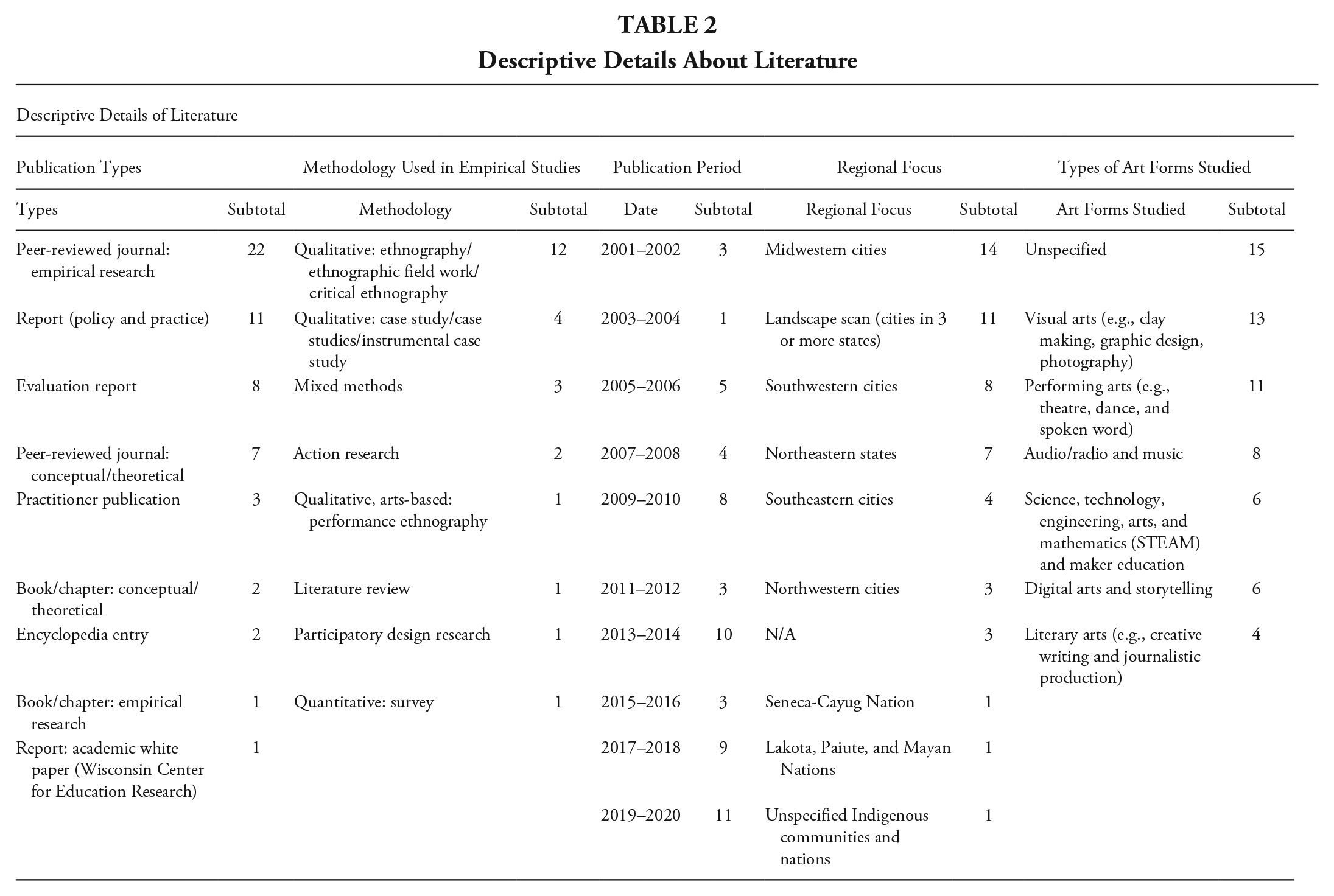
Regional focus
The sample represents purposeful diversity in regional representation with a focus on “cultural-regional scenes” labeled as the Urban Midwest, the Bay Area, Texas-Mexico Border Towns, and the Indigenous Southwest (Halverson, Martin, et al., 2023). The principles of honoring expertise and nurturing relationships by following threads of OST youth arts work to publications were highlighted rather than taking the initial search as evidence of where the study of learning was happening. Across all 57 publications in this review, 11 provided overviews of the field of arts youth organizations or youth work more broadly, 38 offered windows into specific programs or regions, and four did not specify the regional focus of their work (see Table 2). This regional diversity is directly connected to the emergent, guiding framework for a larger study, which offers the concept of “cultural-regional scenes” to bound critical qualitative case studies of OST youth arts practice (Halverson, Martin, et al., 2023).
Populations served and ages of participants
All literature included in this review intersected to some degree with an emphasis on supporting historically marginalized youth, either by articulating the implications of practices for marginalized youth (e.g., Yahner et al., 2015) or by advancing findings from programs designed for specific communities (e.g., Indigenous communities in Tzou et al., 2019). It is important to understand that communities have been making art as sites for knowing, doing, being, and becoming since time immemorial (see Table 3).
Content Details in Literature
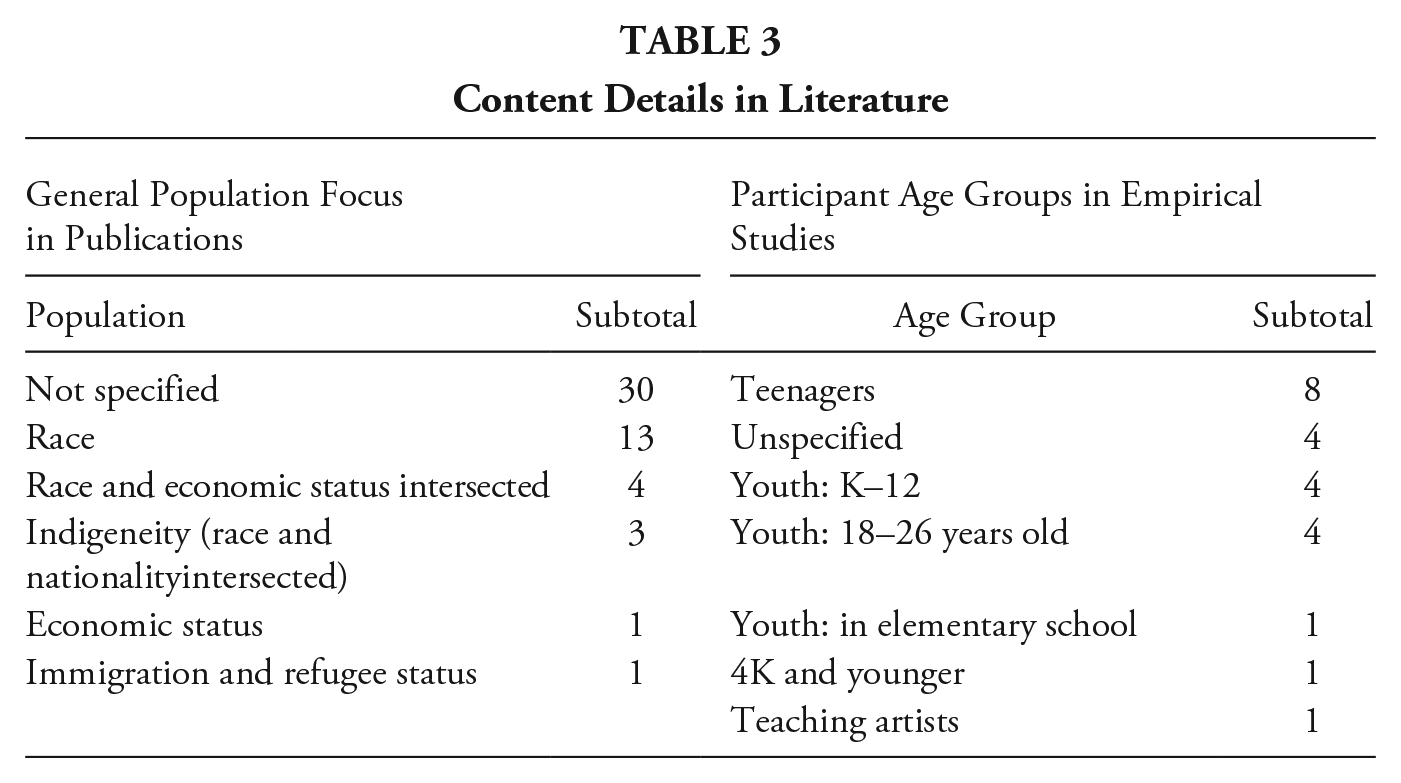
Across the literature, teenagers were most often highlighted in these studies, represented in 30% of the publications, with a few studies including K–12 youth generally, older youth between the ages of 18 and 26, and multiage groups. Two studies focused on younger children (4K and younger and elementary school youth), and one study explored the perspectives of teaching artists on youth arts. Four publications did not specify the age group in their study. The overrepresentation of teenagers may be a result of our cultural focus on ages 12 to 18 as a time when identity exploration takes center stage and is therefore the focus of many institutional and community-focused projects.
Art forms represented
The range of art forms 3 considered in the literature (see Table 2) is extensive but primarily focuses on visual arts and performing arts (16%). Notably, a significant number of publications did not specify any art form central to their work. The lack of focus on disciplinary art forms contrasts with formal education and artmaking, which requires educators and learning spaces to specify their disciplinary learning goals. Native American artists and arts organizations, for example, may not distinguish between “visual art,” “dance,” and “music” in their programming but instead see cultural-historical arts practices as inseparable.
Methodological analysis
The literature reviewed is almost exclusively qualitative (ethnographic, case studies, interview, field observation) in its approach (see Table 2). Practice-focused publications are often framed in terms of what arts programs and practices value rather than a detailed investigation of particular practices that may be associated with positive outcomes for participants. Quantitative studies were overwhelmingly school-focused because available quantitative data include course-taking patterns and standardized test scores as primary mechanisms for assessing participation and learning (e.g., Bowen & Kisida, 2019; Peppler et al., 2014). Of the 23 empirical publications included in this review, 20 relied on qualitative research methods, four used mixed methods, one included a literature review, and one drew on data from a quantitative survey. 4 Most of the qualitative, empirical studies utilized general qualitative research methods (Merriam & Tisdell, 2016) or ethnography and ethnographic methods. The literature represents both the institutional opportunities for learning through OST arts (e.g., the study of nonprofit organizations and university-community partnerships) and community-centric artmaking work (e.g., ethnographies of practice).
Overall, the literature includes a diverse set of publications featuring a broad range of art forms representing a variety of regions. The literature focuses primarily on supporting BIPOC youth through OST programs and school-age youth (K–12). In responding to the question, “What common practices and foundational ideas highlighted in the OST arts education literature center the learning experiences and potential of BIPOC youth?,” publications describe how OST arts can more authentically help youth to meet stated goals in formal education discourse (e.g., Peppler, 2010), support youth development (e.g., Agans et al., 2019; Montgomery, 2020), empower youth in identity and justice work through creative self-expression (e.g., Cox, 2014), or engage youth in personally meaningful ways (Hartmann & McClanahan, 2020; Hauseman, 2016).
Reimagining Learning and Development Through OST Arts Practices
Across the literature emerged four common practices in OST arts education. Arts organizations serving BIPOC youth engage participants in the following ways: create representations as the core mechanism of disciplinary learning, explore identity and narrative as the tools for creating representations, practice creativity in purposeful and deep ways, and collaborate as an outcome of learning, not as a mechanism for individualistic outcomes. Each practice that emerged from the analysis of the literature was reviewed, and a proposition for how this practice contributes to an integrated understanding of learning across physical, social, emotional, and cognitive processes was developed. These propositions suggest how learning theory can be expanded by analysis of arts practices.
Creating Representations
Across art forms and environments, the creation of representations is the primary process for learning (Halverson, 2013; Russell et al., 2013; Sawyer, 2018, 2019; Sheridan, 2019; Sheridan et al., 2013; Vossoughi & Bevan, 2014). In writing about OST youth arts organizations, researchers identify the key learning mechanism as (a) understanding a core idea, (b) practicing the arts skill, and (c) employing the medium (tools and materials) to create a representation of the core idea. Thus, representation refers not just to the final piece of work, but the entire process, from conception to selection and use of tools and materials to a summative artifact. Mastering representational tools of the medium—whether it is the body in dance, the paintbrush or cardboard in fine arts, or Adobe Photoshop in digital arts—is an important component of learning to develop representations as youth explore tools, techniques, and genres that can best achieve their artistic vision (Halverson, 2013; Sheridan et al., 2014; Tzou et al., 2019). Specifically, researchers identify the importance of developing a culminating artifact or other form of representation in the arts program they were studying or documenting (Cox, 2014; Erickson & Hales, 2014; Lazzari et al., 2005).
There is some disagreement around what counts as an artistic representation because representations shift regularly with changes in arts practices, tools, and media (Dewhurst, 2010). Some publications describe the creation of emergent genres and tools with which youth can construct novel forms of representation, broadening interpretation of what artistic representations (and materials) can be, such as spoken word poetry, which combines written, physical, and vocal texts (Weinstein, 2010), and digital and computational media, with which young people can construct totally new tools and genres of art and expression (e.g., Sefton-Green & Soep, 2007). A concern expressed is that a focus on the creation of a product can lead to the commodification of youth work, as happens in makerspaces where an emphasis is sometimes placed on entrepreneurial production (Vossoughi, et al., 2016).
Much of the literature describes how OST arts programs support youth to conceptualize and develop artistic products and projects ranging from large-scale, collaborative public art (Ezell & Levy, 2003) to individual clay pots that incorporate an emerging understanding of the historic and environmental conditions of a clay beach (Barajas-López & Bang, 2018). The programs that support representation include drop-in and shorter-term multisession workshops (e.g., Tzou et al., 2019) as well as long-term commitments to artmaking (e.g., Barron et al., 2014; Cox, 2014). The spaces where OST artmaking happens are intentionally designed to display the materials, tools, and processes to make visible how representation works (Peppler et al., 2016; Sebring et al., 2013; Seidel et al., 2009; Yahner et al., 2015). Real-world venues and spaces (performing arts centers, museums, circus spaces) enable learners to see professional representations and see artists working in their own settings, contributing to further understanding about what representations are and how and why they are developed (Erickson & Hales, 2014; Heath, 2001). When professionals and emerging artists work in shared spaces, parallel work processes benefit artist-mentors and teaching artists as well as young people (Barron et al., 2014; Sebring et al., 2013; Sheridan et al., 2014).
OST arts organizations provide scaffolds for artistic production and the creation of representations. These scaffolds are often integrated into a design process that foregrounds the practice of critique. Critique is the primary feedback mechanism in artmaking that affords engagement in a design process and affords risk-taking on the part of youth artists (Halverson et al., 2020). Several studies demonstrate that critique is an effective method of assessment and practice that improves the artistic representation through authentic art practice (J. H. Davis, 2010; Heath, 2001; Soep, 2005; Vossoughi, 2017) and results in a richer understanding of artistic process and creative representation (Barron et al., 2014; Dewhurst, 2010; Green & Kindseth, 2011).
For organizations working with BIPOC youth, the creation of representations is often seen as a way to center young people’s historical, social, environmental, and cultural assets in artmaking (Calabrese Barton & Tan, 2018; Wong & Peña, 2017). Focusing on the creation of representations frames the creation of artistic representations as cultural artifacts that merge institutionally sanctioned making with young people’s assets. For example, the ISTEAM project demonstrated how claywork provided Indigenous youth participants with an opportunity to learn about environmental science through the creation of clay-based art across multiple generations of community members (Barajas-López & Bang, 2018). This work emphasized the properties of natural resources (e.g., clay) as constructions of trauma and elder storytelling and a way to restructure the world by putting good intentions and spirit into what is being made (Barajas-López & Bang, 2018). In this study, the pottery practice that emerged in their STEAM summer program occurred as a result of walking as a pedagogical practice connected to Indigenous making: Clay noticed in nature precipitated its centrality in the program.
OST arts organizations emphasize the creation of representations as the core mechanism for engagement in cognitive, social, cultural, and historical work. Education researchers across disciplines have described the capacity to construct an external representation of a complex idea as a marker of mastery (diSessa, 2004; Enyedy, 2005). From a socio-cognitive perspective, creating representations is at the core of what it means to engage productively with new ideas. Specific to artmaking, Elliot Eisner (2002) wrote that “getting smart means coming to know the potential of materials in relation to the aims of a project or problem; and since each material possesses unique qualities, each material requires the development of distinctive sensibilities and technical skills” (p. 7). The relationship between the literature we reviewed and the importance of creating representations in the constructionist tradition of the learning sciences (Holbert et al., 2020) leads us to the first of four propositions:
Creating representations, the core mechanism of disciplinary learning in the arts, supports a definition of learning that expands social cognition to include personal, cultural, and historical understanding through the creation of artifacts.
Exploring Identity Through Narrative
Artmaking centers identity—doing, being, and becoming oneself—in a way that other schooling disciplines aspire to but often struggle to incorporate (Halverson, 2021). Through the process of creative self-expression in artmaking, youth are able to reflect on, imagine, make meaning of, and even create their identities (Heath, 2001; Kárpáti et al., 2017; Pinkard et al., 2017). Identity is dynamic, and explorations through the arts are especially productive for populations who feel marginalized, who are often forced to contend with stereotypes and biases imposed on them by educators, by affording multiple pathways for positive development and representation of possible selves (Halverson, 2005, 2010; Martineau & Ritskes, 2014; Van Steenis, 2020; Wiley & Feiner, 2001).
OST youth arts organizations focused on identity in artmaking for several reasons. Fleetwood (2005) and Lazzari et al. (2005) documented how young people are given the opportunity to challenge stereotyped identity constructions; Erikson and Hales (2014) and Weinstein (2010) described identity through artmaking as the exploration of possible selves. Artmaking serves as opportunities for young people to express new ways of knowing, doing, and being (Barajas-López & Bang, 2018; Cox, 2014; Martineau & Ritskes, 2014; Nelson, 2011). A challenge for OST arts programs is to accommodate a range of young people who may understand identity in different ways and who have varying comfort levels with exploring self in a collaborative, artmaking environment (Akiva et al., 2019; Barron et al., 2014; Hartmann & McClanahan, 2020). Some young people may struggle with navigating arts-related identities alongside other potentially competing future selves, such as career pathways (Montgomery, 2020; Vossoughi et al., 2016) or STEM identities (Blikstein & Worsley, 2016). Tensions arise when programs invite youth contributions but do not consider their input when making key programmatic decisions (Soep, 2005).
By centering learner identity in the creation of representations, the arts foreground learners’ pursuit of personally and socially relevant projects or products (Bevan et al., 2019; Dewhurst, 2010; Tzou et al., 2019). These projects engage youth in reflection on their own identities, the identities of their mentors and leaders (Barron et al., 2014), and how these individual and collective identities intersect with the social, civic, and community issues (Barniskis, 2012; Hutzel, 2017; Nelson, 2011; Van Steenis, 2020).
Encouraging exploration and artmaking based on identity means learners are able to develop their own voice and perspectives and write themselves into the broader discourse of the arts and learning. OST arts programs engage young people in a range of tasks that use oral and written language, including group composition, journal writing, and editing. Youth artists learn to be flexible in their use of language, drawing on a range of linguistic resources to work with others and to communicate meaning to external audiences (Heath, 2000). Media arts practices seem especially well situated for developing voice (Peppler, 2010). Through media arts, youth can actively engage with and sometimes subvert the intentions and meanings of media, producing new cultural patterns (Sefton-Green & Soep, 2007), and engage in dialogue about the deconstruction of stereotypes and reflection of experience, sometimes within the very media they are using (Barron, et. al., 2014; Fleetwood, 2005; Sandoval & Latorre, 2008). Likewise, spoken word poetry allows youth to explore intersections of individual experience and societal ideologies of race, class, and gender (Dando & Halverson, 2017; Weinstein, 2010).
While the narrative arts lend themselves well to the development of voice, the visual arts can be compelling storytelling media that communicate messages over time and across history (Barajas-Lόpez & Bang, 2018), and youth hip-hop praxis can support young people to understand themselves and the ecology of their surroundings (Van Steenis, 2020; Wong & Alim, 2017). Artmaking can also be an opportunity for the development of youth voice, particularly when issues of equity and social justice are at the forefront of program and activity design (Wilkerson & Gravel, 2020).
Through artmaking, youth write themselves and their communities into the stories they tell through art, including connections to cultural and historical identity (Lin & Bruce, 2013; Los Angeles County Arts & Culture, 2018; Sandoval & Latorre, 2008). Across art forms, artmaking affords the creation of counternarratives, stories about personal and community identity that oppose stereotypical and deficit expectations (Halverson, 2010; Reyes, 2017). Centering learner identities is becoming more important throughout learning sciences literature, which is evidenced by a focus on learners developing self-efficacy and identity in specific disciplinary contexts (e.g., thinking like a scientist). Exploring identity is more naturally embedded in arts practice than in other disciplines because the artistic representations come directly from learners’ experiences, intentions, reflections, and emotions. This orientation to learning is deeply rooted in asset-based pedagogy that views learners as already having expertise to draw from, build on, and hone with the support of peers and educators in learning environments. As a result, we offer our second proposition:
The mechanism for enacting an expansive definition of learning is through the exploration of identity and narrative in OST arts practice. Centering the role of learners’ personal and emotional lives in the learning process invites youth to experiment with their identities and write themselves into larger discourses.
Practicing Creativity
Creativity is an important academic outcome that describes successful students in the 21st century (Sawyer, 2019, 2020), and the arts provide opportunities to “practice creativity” through artmaking activities such as creative drama warm-ups (Phonethibsavads et al., 2019). Creativity involves the production of novel outcomes and the modes of thinking that are associated with those outcomes, including innovations on a known artistic form that Keinänen et al. (2006) called “vertical creativity.” An example of vertical creativity is the practice of remixing existing work into new formats, such as music sampling or graphic design (Barron et al, 2014), which can serve as creative inspiration and provide a lower barrier to entry than a blank slate.
Sheridan (2020) offered the concept of “envisioning” as a subconcept of creativity, defined as “imagining what is not there and picturing what is possible” (p. 325), which she described as an outcome of participation in OST arts programs. MacDonald (2016) sees creativity as a common occurrence, defining it as the work done when innovating with a set of resources, with a possible historic break from what already exists. Shute and Wang (2016) noted that creativity is notoriously difficult to measure, and the OST youth arts literature calls for a better definition of creative learning and how to assess it (Akiva et al., 2019; Katz-Buonincontro et al., 2017).
Breitbart and Krepes (2007) described how OST arts programs offer time and space for young people to imagine. Providing space for the imagination, through an activity like brainstorming, allows young people to move beyond ideas that are based on what exists to what is possible (Hutzel, 2017). Practices like brainstorming among youth and adults in an OST arts space offer authentic opportunities for youth to be part of the creative environment: to see creative people at work, see their resulting art forms, and discuss and critique their practice—this is an approach that invites and engages youth in creative practice (Hartmann & McClanahan, 2020; Heath, 2001; Lin & Bruce, 2013; Yahner et al., 2015).
Practicing creativity is not unique to the arts, but because creativity is central to the arts, it is more acceptable for students to take time to “mess around” or explore creative threads that may or may not lead anywhere. The context of the OST environment allows even more time and space for creativity because these environments are opt-in and generally more oriented toward learner-motivated practices. We offer a third proposition around creativity as an important feature of OST arts work:
Practicing creativity happens purposefully and with depth so that learners can safely explore difficult topics, imagine new worlds, and share their unique stories and perspectives.
Collaboration as an Outcome
OST arts organizations identify “collaborative effort among the artist, social service provider, teacher, agency staff, youth, and family” as a best practice in program delivery (Youth Arts: Best Practices, 2003, Finding No. 1 section). People can learn collaboration through participating in arts practices (Halverson, 2021; Kárpáti et al., 2017; Sawyer, 2017), often through “collaborative emergence,” described as the result of groups of people improvising together in both music and in theatre (Sawyer & deZutter, 2009). Successful collaborative emergence requires that people take on different roles or identities within a creative process and can create new possibilities, resulting in new knowledge being generated (Kafai & Harel, 1991). Instead of the individual contribution being the final measure of learning outcome, the individual work is a precondition for arts practice (Halverson, 2021).
Studies of collaboration in informal arts programs focused on the lives of BIPOC youth present a different picture of successful collaboration compared to academic models, where all youth are working equally on a project of shared value and expectations. Sometimes, being in a space where people are engaging in arts practice can be a form of collaboration, one in which neighboring practices influence one another and can lead to new constellations of arts practice and ways of working together (Halverson et al., 2018). The YOUMedia digital media production programs in Chicago Public Libraries generate opportunities for both synchronous and asynchronous collaborative practice among peers and more experienced mentors (Sebring et al., 2013).
Identifying collaboration as an outcome requires finding a way to document and measure collaborative practice. The Apprenticeship Training Program at the Manchester Craftsmen’s Guild recognized that school-based approaches to arts learning focused exclusively on traditional skills-based outcomes did not capture the scope of young people’s experiences. They designed assessments to capture what they call “intangibles – like representation of identity, interpersonal collaboration, and personal resiliency – present in the artwork and the artmaking processes of our students” (Green & Kindseth, 2011, p. 338). YOUMedia staff created explicit mechanisms for identifying collaborative practice as an essential aspect of youth work (Martin et al., 2020).
Collaborative practice also reorganizes traditional power structures in OST arts practice. In some programs, mentors and educators collaborate with youth on artmaking, emphasizing learning together and alongside one another in a collective creative process (Barron et al, 2014; Sebring et al., 2013; Van Steenis, 2020). In others, youth engage in arts practice with community members (Calabrese Barton & Tan, 2018; Hutzel, 2017) and family members (Barajas-López & Bang, 2018; Tzou et al., 2019), opening opportunities for youth and their collaborators to connect culture, community, and sense of place to their artmaking and to generate new tools and community knowledge (Rubenstein-Avila, 2006). In self-organized youth arts communities, young artists engage in both individual and collective goals and are often willing to compromise on individual goals to maintain collaborative structures (Kárpáti et al., 2017).
One challenge in engaging youth in collaboration is the pervasiveness of traditional power structures and participation arrangements. At 186 Carpenter, a gallery in Providence, Rhode Island, leaders resisted dominant discourses of “creative placemaking” to make space for young people to be collaborative partners. These young people had often been positioned as bad actors by the broader community, and 186 Carpenter kept their doors closed to ensure young people had a safe, collaborative space to make art (French, 2018). Bang and colleagues (2016) describe how Western age-segregated and individualistic methods are misaligned with the community and family orientation in Indigenous (and other) communities. Collaboration also can blur ownership over the processes and products of artmaking, troubling the individualized framing of learning as measured by what an individual person can do and who gets credit (Litts, 2014).
Whereas collaboration is a valued pedagogical tool in any teaching and learning setting, in the arts, collaboration is an outcome in arts practice. Emphasizing collaboration as a desired outcome reinforces the idea that learning and development occur between and among people and dialogic relationships and highlights the importance of creating a learning community and culture in which learners feel safe to share their ideas and work together. By centering collaboration as an outcome, OST arts organizations resist traditional power dynamics in learning, which further emphasizes the social nature of learning. We see this research as developing a fourth proposition around OST youth arts work and learning:
Collaboration is an outcome of collective learning and not a mechanism to individualistic outcomes that frames learning as a sociocultural process that requires intentional design and reorganizes traditional knowledge and power structures.
Discussion: OST Arts Work in Learning, Development, and Research
Learning in arts work is a dynamic, personally meaningful, and socioculturally situated process between and among people that is mediated by artistic tools and media and learner-constructed artifacts. Learning that occurs by engaging in these arts practices reinforces emerging perspectives on the science of learning as described in the call for chapters for this issue, which frames learning as involving “dynamically coactive processes between and among people and dialogic relationships that unfold through people’s participation in routine cultural practices, within and across spaces, and within and across stretches of time” (Gadsden et al., 2023, para. 2). This review suggests that artmaking as routine cultural practices has the potential to transform what learning looks like for young people, especially for those whose assets and resources have been excluded or marginalized in mainstream educational settings.
The four propositions suggest how learning theory can be expanded by analysis of arts practices and encapsulate an exhaustive list of arts learning affordances. Over decades of scholarship, the arts have been shown to elicit a wide variety of outcomes both intrinsic and instrumental to arts practice (e.g., Catterall, 2005; Gadsden, 2008). In this section, at least these four propositions (and perhaps others that may be identified in future work) make up the epistemic foundation of artmaking (Halverson & Sawyer, 2022; Kafai & Peppler, 2011); by attending to these four propositions, the experiences of BIPOC youth in conversations around what counts as good learning can be centered (Bevan et al., 2019; Halverson, Martin, et al., 2023; Mejias et al., 2021). Furthermore, whereas each arts practice is not necessarily unique to artmaking (e.g., creating representations of learning is important across STEM disciplines as well), artmaking uniquely and intrinsically connects the four propositions.
This dialogue began 15 years ago, when Gadsden (2008) described how a then-new movement in arts education research was,
challeng[ing] simplistic notions of product and process, and promot[ing] a view in which the varied substance and enactments of the arts are studied and understood in relationship to where and how they are situated in the human experience and in individuals’ experiences as members of cultural and social collectives. (p. 31)
And while Gadsden’s review was contained primarily to school-based arts education, she also identified OST organizations as fruitful sites for studying what and how people learn in and through the arts. The four big ideas identified in our literature review—representations, identity and narrative, creativity, and collaboration—move beyond specific disciplinary, academic outcomes and toward a vision for productive learning processes and outcomes through the arts that can stretch across young peoples’ learning lives.
First, creating, sharing, and critiquing representations is the process by which learning happens in and through the arts. Acknowledging that arts practice is a culturally sustaining and intellectually transformational way for young people to learn how to create, share, and critique representations could facilitate a connection between learning theory that also relies on representational processes and skills as markers of expertise, including work in science (diSessa, 2004), mathematics (Enyedy, 2005), language arts (Halverson, 2021; Hull & Moje, 2012), and social studies (Corredor et al., 2021).
Second, identity and narrative are the tools young people use when engaged in a representational process as learning in the arts. Using identity and narrative as tools is a fundamentally culturally sustaining pedagogical practice, defined as:
reposition[ing] the linguistic, literate, and cultural practices of working-class communities—specifically, poor communities of color—as resources and assets to honor, explore, and extend in accessing White middle-class dominant cultural norms of acting and being that are demanded in schools. (Alim & Paris, 2017, p. 4)
When artmaking begins with young people’s experiences, interests, and stories—rather than focusing an inquiry or lesson on what students do not know and cannot do—we authentically shift the learning experience from deficit to asset-based pedagogical commitments. OST arts practices begin by leveraging participants’ interests and experiences, such as hip-hop (Wong & Alim, 2017) and Indigenous storywork (Barajas-Lόpez & Bang, 2016; Tzou et al., 2019) that weave identities and narratives together seamlessly.
The reciprocal relationship between identity and narrative development as tools for representation is a model for remaking schooling that aligns with Nasir and colleagues’ (2021) research agenda for the future of learning where they call for “an asset-based orientation to the dynamism, complexity, and expansiveness of human lives, activities, and societies” (p. 561). In fact, as this research agenda calls for new models of collaboration among institutions and partners in teaching and learning, arts practice acts as a bridge, uniting aspects of young people’s lives. As just one example, the Digital Divas program engages African American girls in cultural making and computing activities that both center girls’ experiences through OST and encourage transfer to STEM learning processes and outcomes in schools (Pinkard et al., 2017).
Third, the fostering of creativity and collaboration can be outcomes of participating in a representational process using identity and narrative as tools. This is perhaps the boldest aspect of our propositions given that education research has long resisted expanding outcomes for learning beyond standardized, individual measures of content and skills. Because OST organizations are not beholden to fixed, standardized measures, what counts as learning has evolved to reflect the goals that communities of art makers have for their work. The iterative and emergent nature of the arts encourages the production of original, novel outcomes and modes of thinking that are associated with those outcomes. For instance, improvisation as an arts practice across music, theatre, and dance have been documented to develop creativity (Sawyer & DeZutter, 2009). Sheridan’s (2011) work with the visual arts (both analog and digital) explores how “envisioning” as a characteristic of making art is also directly connected to the development of creativity. The shift from seeing creativity as an inherent psychological characteristic to a learned outcome that results from arts-based pedagogy is encouraging. Likewise, arts practice in OST programs shifts conversations about the role of collaboration from a technique for encouraging individual achievement to an outcome of participation. In this way, individuals learn to be part of a community as a goal for their participation in a learning practice.
Because the organizations and programs represented in the review focused on the experiences of historically marginalized young people, we also see these propositions as centering the experiences of students who often do not see their strengths and contributions valued in the classroom. In this way, arts learning shifts from playing an instrumental role in improving struggling students’ academic performance to learning processes that promote human flourishing through creative expression and collaboration.
Conclusion: The Importance of an Asset-Focused Approach to Learning and Research Through the Lens of the Arts
This review offers two primary contributions to the study of human learning and development with a focus on young people who have historically been marginalized from mainstream learning institutions. First, four propositions are offered for how the work of OST youth arts organizations contributes to our reimagining of learning as a sociocultural process that includes personal, cultural, and historical understanding through the creation of artifacts, identity exploration, meaningful practices of creativity, and collaboration. Understanding external representations as the primary mechanisms for learning and assessment, a focus on identity and narrative in the making of art, an emphasis on the practice of creativity, and a reframing of collaboration as an outcome may help to reshape what counts as learning, for whom, and in what contexts. The future of the work will rely on scholars who study arts education and those with an interest in integrating arts practices into other disciplines to continue to test, refine, and challenge these propositions.
Second, the review took a CQI methodological stance—an unconventional choice for a literature review—in which knowledge was co-constructed among researchers, project advisors, the search process, and the articles themselves. CQI drove the larger project within which the literature review is situated (Halverson, Martin, et al., 2023; Halverson, Saplan, & Martin, 2023; Mejias et al., 2021) and helped to avoid the damage-centered approach to meaning making that has shaped much of the qualitative research focused on fixing the problems of historically marginalized communities (Tuck, 2009). The asset-focused approach to learning, development, and research was particularly crucial to promote equity and justice in, with, and for communities whose cultural and historical knowledge has been systematically devalued. Simply bringing the arts to all youth is itself an act of social justice, by subverting a dominant narrative that the only young people who deserve the arts are those who have earned them or who can afford them. And without the arts, “children and youth experience an educational injustice whereby their future abilities to participate equally in the economic, cultural, and civic life of society are undermined” (Kraehe et al., 2016, p. 222). When the arts are brought into our teaching and learning practices, we are actively encouraging young people to fight for what they care about, to make a change in the world, and to celebrate their own excellence and beauty (Cohen, 2020; Halverson, 2021; Shimshon-Santo, 2018).
Footnotes
Appendix
Four Key Outcomes by Publication
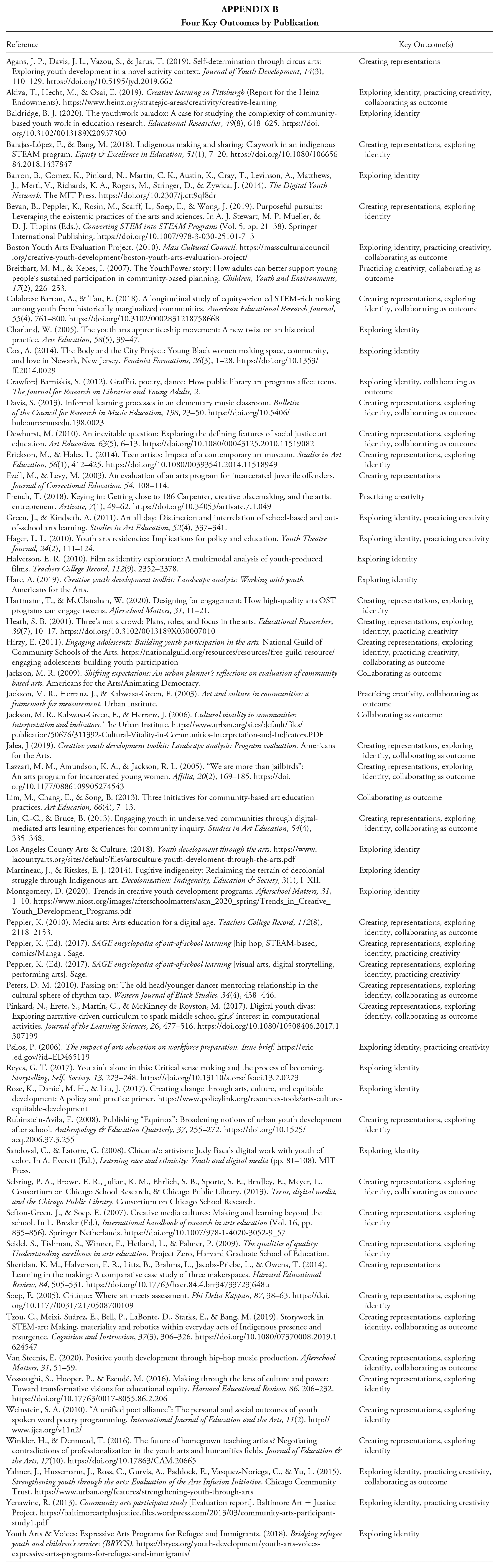
| Reference | Key Outcome(s) |
|---|---|
| Agans, J. P., Davis, J. L., Vazou, S., & Jarus, T. (2019). Self-determination through circus arts: Exploring youth development in a novel activity context. Journal of Youth Development, 14(3), 110–129. https://doi.org/10.5195/jyd.2019.662 | Creating representations |
| Akiva, T., Hecht, M., & Osai, E. (2019). Creative learning in Pittsburgh (Report for the Heinz Endowments). https://www.heinz.org/strategic-areas/creativity/creative-learning | Exploring identity, practicing creativity, collaborating as outcome |
| Baldridge, B. J. (2020). The youthwork paradox: A case for studying the complexity of community-based youth work in education research. Educational Researcher, 49(8), 618–625. https://doi.org/10.3102/0013189X20937300 | Exploring identity |
| Barajas-López, F., & Bang, M. (2018). Indigenous making and sharing: Claywork in an indigenous STEAM program. Equity & Excellence in Education, 51(1), 7–20. https://doi.org/10.1080/10665684.2018.1437847 | Creating representations, exploring identity |
| Barron, B., Gomez, K., Pinkard, N., Martin, C. K., Austin, K., Gray, T., Levinson, A., Matthews, J., Mertl, V., Richards, K. A., Rogers, M., Stringer, D., & Zywica, J. (2014). The Digital Youth Network. The MIT Press. https://doi.org/10.2307/j.ctt9qf8dr | Exploring identity |
| Bevan, B., Peppler, K., Rosin, M., Scarff, L., Soep, E., & Wong, J. (2019). Purposeful pursuits: Leveraging the epistemic practices of the arts and sciences. In A. J. Stewart, M. P. Mueller, & D. J. Tippins (Eds.), Converting STEM into STEAM Programs (Vol. 5, pp. 21–38). Springer International Publishing. https://doi.org/10.1007/978-3-030-25101-7_3 | Creating representations, exploring identity |
| Boston Youth Arts Evaluation Project. (2010). Mass Cultural Council. https://massculturalcouncil.org/creative-youth-development/boston-youth-arts-evaluation-project/ | Exploring identity, practicing creativity, collaborating as outcome |
| Breitbart, M. M., & Kepes, I. (2007). The YouthPower story: How adults can better support young people’s sustained participation in community-based planning. Children, Youth and Environments, 17(2), 226–253. | Practicing creativity, collaborating as outcome |
| Calabrese Barton, A., & Tan, E. (2018). A longitudinal study of equity-oriented STEM-rich making among youth from historically marginalized communities. American Educational Research Journal, 55(4), 761–800. https://doi.org/10.3102/0002831218758668 | Creating representations, exploring identity, collaborating as outcome |
| Charland, W. (2005). The youth arts apprenticeship movement: A new twist on an historical practice. Arts Education, 58(5), 39–47. | Exploring identity |
| Cox, A. (2014). The Body and the City Project: Young Black women making space, community, and love in Newark, New Jersey. Feminist Formations, 26(3), 1–28. https://doi.org/10.1353/ff.2014.0029 | Exploring identity |
| Crawford Barniskis, S. (2012). Graffiti, poetry, dance: How public library art programs affect teens. The Journal for Research on Libraries and Young Adults, 2. | Exploring identity, collaborating as outcome |
| Davis, S. (2013). Informal learning processes in an elementary music classroom. Bulletin of the Council for Research in Music Education, 198, 23–50. https://doi.org/10.5406/bulcouresmusedu.198.0023 | Creating representations, exploring identity, collaborating as outcome |
| Dewhurst, M. (2010). An inevitable question: Exploring the defining features of social justice art education. Art Education, 63(5), 6–13. https://doi.org/10.1080/00043125.2010.11519082 | Creating representations, exploring identity, collaborating as outcome |
| Erickson, M., & Hales, L. (2014). Teen artists: Impact of a contemporary art museum. Studies in Art Education, 56(1), 412–425. https://doi.org/10.1080/00393541.2014.11518949 | Creating representations, exploring identity |
| Ezell, M., & Levy, M. (2003). An evaluation of an arts program for incarcerated juvenile offenders. Journal of Correctional Education, 54, 108–114. | Creating representations |
| French, T. (2018). Keying in: Getting close to 186 Carpenter, creative placemaking, and the artist entrepreneur. Artivate, 7(1), 49–62. https://doi.org/10.34053/artivate.7.1.049 | Practicing creativity |
| Green, J., & Kindseth, A. (2011). Art all day: Distinction and interrelation of school-based and out-of-school arts learning. Studies in Art Education, 52(4), 337–341. | Exploring identity, practicing creativity |
| Hager, L. L. (2010). Youth arts residencies: Implications for policy and education. Youth Theatre Journal, 24(2), 111–124. | Exploring identity, practicing creativity |
| Halverson, E. R. (2010). Film as identity exploration: A multimodal analysis of youth-produced films. Teachers College Record, 112(9), 2352–2378. | Exploring identity |
| Hare, A. (2019). Creative youth development toolkit: Landscape analysis: Working with youth. Americans for the Arts. | Exploring identity |
| Hartmann, T., & McClanahan, W. (2020). Designing for engagement: How high-quality arts OST programs can engage tweens. Afterschool Matters, 31, 11–21. | Creating representations, exploring identity |
| Heath, S. B. (2001). Three’s not a crowd: Plans, roles, and focus in the arts. Educational Researcher, 30(7), 10–17. https://doi.org/10.3102/0013189X030007010 | Creating representations, exploring identity, practicing creativity |
| Hirzy, E. (2011). Engaging adolescents: Building youth participation in the arts. National Guild of Community Schools of the Arts. https://nationalguild.org/resources/resources/free-guild-resource/engaging-adolescents-building-youth-participation | Creating representations, exploring identity, practicing creativity, collaborating as outcome |
| Jackson, M. R. (2009). Shifting expectations: An urban planner’s reflections on evaluation of community-based arts. Americans for the Arts/Animating Democracy. | Collaborating as outcome |
| Jackson, M. R., Herranz, J., & Kabwasa-Green, F. (2003). Art and culture in communities: a framework for measurement. Urban Institute. | Practicing creativity, collaborating as outcome |
| Jackson, M. R., Kabwasa-Green, F., & Herranz, J. (2006). Cultural vitatlity in communities: Interpretation and indicators. The Urban Institute. https://www.urban.org/sites/default/files/publication/50676/311392-Cultural-Vitality-in-Communities-Interpretation-and-Indicators.PDF | Collaborating as outcome |
| Jalea, J (2019). Creative youth development toolkit: Landscape analysis: Program evaluation. Americans for the Arts. | Creating representations, exploring identity, collaborating as outcome |
| Lazzari, M. M., Amundson, K. A., & Jackson, R. L. (2005). “We are more than jailbirds”: An arts program for incarcerated young women. Affilia, 20(2), 169–185. https://doi.org/10.1177/0886109905274543 | Creating representations, exploring identity, collaborating as outcome |
| Lim, M., Chang, E., & Song, B. (2013). Three initiatives for community-based art education practices. Art Education, 66(4), 7–13. | Collaborating as outcome |
| Lin, C.-C., & Bruce, B. (2013). Engaging youth in underserved communities through digital-mediated arts learning experiences for community inquiry. Studies in Art Education, 54(4), 335–348. | Creating representations, exploring identity, collaborating as outcome |
| Los Angeles County Arts & Culture. (2018). Youth development through the arts. https://www.lacountyarts.org/sites/default/files/artsculture-youth-develoment-through-the-arts.pdf | Exploring identity |
| Martineau, J., & Ritskes, E. J. (2014). Fugitive indigeneity: Reclaiming the terrain of decolonial struggle through Indigenous art. Decolonization: Indigeneity, Education & Society, 3(1), I–XII. | Exploring identity |
| Montgomery, D. (2020). Trends in creative youth development programs. Afterschool Matters, 31, 1–10. https://www.niost.org/images/afterschoolmatters/asm_2020_spring/Trends_in_Creative_Youth_Development_Programs.pdf | Exploring identity |
| Peppler, K. (2010). Media arts: Arts education for a digital age. Teachers College Record, 112(8), 2118–2153. | Creating representations, exploring identity, collaborating as outcome |
| Peppler, K. (Ed). (2017). SAGE encyclopedia of out-of-school learning [hip hop, STEAM-based, comics/Manga]. Sage. | Creating representations, exploring identity, practicing creativity |
| Peppler, K. (Ed). (2017). SAGE encyclopedia of out-of-school learning [visual arts, digital storytelling, performing arts]. Sage. | Creating representations, exploring identity, practicing creativity |
| Peters, D.-M. (2010). Passing on: The old head/younger dancer mentoring relationship in the cultural sphere of rhythm tap. Western Journal of Black Studies, 34(4), 438–446. | Creating representations, exploring identity, collaborating as outcome |
| Pinkard, N., Erete, S., Martin, C., & McKinney de Royston, M. (2017). Digital youth divas: Exploring narrative-driven curriculum to spark middle school girls’ interest in computational activities. Journal of the Learning Sciences, 26, 477–516. https://doi.org/10.1080/10508406.2017.1307199 | Creating representations, exploring identity, collaborating as outcome |
| Psilos, P. (2006). The impact of arts education on workforce preparation. Issue brief. https://eric.ed.gov/?id=ED465119 | Exploring identity, practicing creativity |
| Reyes, G. T. (2017). You ain’t alone in this: Critical sense making and the process of becoming. Storytelling, Self, Society, 13, 223–248. https://doi.org/10.13110/storselfsoci.13.2.0223 | Exploring identity |
| Rose, K., Daniel, M. H., & Liu, J. (2017). Creating change through arts, culture, and equitable development: A policy and practice primer. https://www.policylink.org/resources-tools/arts-culture-equitable-development | Exploring identity |
| Rubinstein-Avila, E. (2008). Publishing “Equinox”: Broadening notions of urban youth development after school. Anthropology & Education Quarterly, 37, 255–272. https://doi.org/10.1525/aeq.2006.37.3.255 | Creating representations, exploring identity |
| Sandoval, C., & Latorre, G. (2008). Chicana/o artivism: Judy Baca’s digital work with youth of color. In A. Everett (Ed.), Learning race and ethnicity: Youth and digital media (pp. 81–108). MIT Press. | Exploring identity |
| Sebring, P. A., Brown, E. R., Julian, K. M., Ehrlich, S. B., Sporte, S. E., Bradley, E., Meyer, L., Consortium on Chicago School Research, & Chicago Public Library. (2013). Teens, digital media, and the Chicago Public Library. Consortium on Chicago School Research. | Creating representations, exploring identity, collaborating as outcome |
| Sefton-Green, J., & Soep, E. (2007). Creative media cultures: Making and learning beyond the school. In L. Bresler (Ed.), International handbook of research in arts education (Vol. 16, pp. 835–856). Springer Netherlands. https://doi.org/10.1007/978-1-4020-3052-9_57 | Creating representations, exploring identity |
| Seidel, S., Tishman, S., Winner, E., Hetland, L., & Palmer, P. (2009). The qualities of quality: Understanding excellence in arts education. Project Zero, Harvard Graduate School of Education. | Creating representations, exploring identity |
| Sheridan, K. M., Halverson, E. R., Litts, B., Brahms, L., Jacobs-Priebe, L., & Owens, T. (2014). Learning in the making: A comparative case study of three makerspaces. Harvard Educational Review, 84, 505–531. https://doi.org/10.17763/haer.84.4.brr34733723j648u | Creating representations |
| Soep, E. (2005). Critique: Where art meets assessment. Phi Delta Kappan, 87, 38–63. https://doi.org/10.1177/003172170508700109 | Creating representations, exploring identity |
| Tzou, C., Meixi, Suárez, E., Bell, P., LaBonte, D., Starks, E., & Bang, M. (2019). Storywork in STEM-art: Making, materiality and robotics within everyday acts of Indigenous presence and resurgence. Cognition and Instruction, 37(3), 306–326. https://doi.org/10.1080/07370008.2019.1624547 | Creating representations, exploring identity, collaborating as outcome |
| Van Steenis, E. (2020). Positive youth development through hip-hop music production. Afterschool Matters, 31, 51–59. | Creating representations, exploring identity, collaborating as outcome |
| Vossoughi, S., Hooper, P., & Escudé, M. (2016). Making through the lens of culture and power: Toward transformative visions for educational equity. Harvard Educational Review, 86, 206–232. https://doi.org/10.17763/0017-8055.86.2.206 | Creating representations, exploring identity |
| Weinstein, S. A. (2010). “A unified poet alliance”: The personal and social outcomes of youth spoken word poetry programming. International Journal of Education and the Arts, 11(2). http://www.ijea.org/v11n2/ | Creating representations, exploring identity |
| Winkler, H., & Denmead, T. (2016). The future of homegrown teaching artists? Negotiating contradictions of professionalization in the youth arts and humanities fields. Journal of Education & the Arts, 17(10). https://doi.org/10.17863/CAM.20665 | Creating representations, exploring identity |
| Yahner, J., Hussemann, J., Ross, C., Gurvis, A., Paddock, E., Vasquez-Noriega, C., & Yu, L. (2015). Strengthening youth through the arts: Evaluation of the Arts Infusion Initiative. Chicago Community Trust. https://www.urban.org/features/strengthening-youth-through-arts | Exploring identity, practicing creativity, collaborating as outcome |
| Yenawine, R. (2013). Community arts participant study [Evaluation report]. Baltimore Art + Justice Project. https://baltimoreartplusjustice.files.wordpress.com/2013/03/community-arts-participant-study1.pdf | Exploring identity, practicing creativity |
| Youth Arts & Voices: Expressive Arts Programs for Refugee and Immigrants. (2018). Bridging refugee youth and children’s services (BRYCS). https://brycs.org/youth-development/youth-arts-voices-expressive-arts-programs-for-refugee-and-immigrants/ | Exploring identity |
Acknowledgements
This research was made possible through support from the Wallace Foundation. The authors would like to recognize the members of the research team, all of whom contributed to the creation of this work: Jalessa Bryant, Katherine Norman, Caleb Probst, Stephanie Richards, Andy Stoiber, and Jonathan Tunstall. The advisory board for this project also contributed substantively to the authors’ thinking: Bianca Baldridge, Megan Bang, Nichole Pinkard, Shirin Vossoughi, and Peter Wardrip. The authors are grateful to the 72 artists, activists, scholars, and organizational leaders who were part of the research process.

Notes
Authors
ERICA ROSENFELD HALVERSON is the Gibb Faculty Fellow and Professor of Curriculum & Instruction at the University of Wisconsin-Madison. Her research focuses on how people learn in and through the arts and how arts practices transform teaching, learning, and design across disciplines. She is host of the podcast, Arts Educators Save the World, where artists and mentors discuss how arts education has changed their lives.
KAILEA SAPLAN is a senior PhD student at the University of Wisconsin-Madison. Their research focuses on the development of assessments for arts-centric and equitable learning. They are a teaching artist, an actor, and a roller derby athlete.
SAM MEJIAS is associate professor of social justice and community engagement at Parsons School of Design, The New School. His research focuses on young people, the arts, and learning, and his projects investigate how creativity, design, discourse, and communication influence learning, equity, and engagement in the lives of young people in formal and informal spaces.
CAITLIN MARTIN is an independent researcher working in the learning sciences, design of learning environments, and project evaluation. Specific interests in these areas include design to address issues of socioeconomic and gender equity, project-based learning, and ways to bridge the research-practice gap. She partners with teams at Northwestern University, Stanford University, and the University of Wisconsin-Madison.