




Abstract
Relationships between individual development and historical change are understudied, and yet an understanding of these relationships is foundational to understanding human development. The chapter provides a case study model for investigating individual-historical relations that coordinates archival, ethnographic, interview, and experimental methods. The methodological approach is illustrated in studies on numerical cognition conducted in Papua New Guinea. Two generalizable methodological assumptions are articulated: that the emergence of novel representations and ideas is rooted in individuals’ activities in collective practices and that the dynamic sociogenetic processes in collective practices provide the context for individual development. The chapter concludes by pointing to extensions of the framework to additional studies conducted in a wide range of communities.
Relationships between individual development and historical change are under- studied in the behavioral and educational sciences, and yet an understanding of these relationships and methods to study them is foundational to understanding human development in context. In this short chapter, I point to ways of investigating dynamic relations between individual and historical. I do so by drawing on a longitudinal case study of a remote community conducted during four periods of fieldwork between 1978 and 2014 (Saxe, 2012; Saxe & de Kirby, 2018). My methodological focus is on sociogenesis, the emergence and spread of collective representations and ideas.
For analyses of sociogenesis, I argue that case studies are an important approach while acknowledging a common critique of case study research: Findings have limited generalizability. To address this critique, I refer to Yin’s (2009) distinction between analytical and statistical generalization. For Yin, “statistical generalization” refers to a quantitative method of generalizing findings to a larger population based on statistical analysis of representative samples, as is standard in experimental designs. In contrast, the purpose of case study research is often “analytical generalization.” Typically qualitative and in-depth in nature, case studies, whether the focus is individuals or communities, generate rich and context-specific insights that can inform theory building—in my case, theory building about how sociogenetic processes become manifest in a community. Yin argued that analytical generalizations from case study research should not be directed to populations but, rather, to theory, which is inherently general. Furthermore, to establish the adequacy of an analytical generalization, the researcher applies the theory to new case studies, often introducing methodological refinements and addressing threats to validity (cf. Campbell & Stanley, 1963; Cook & Campbell, 1979). Yin argued that this replicative process should be iterative, with findings from each case study cycle informing theory revisions and/or validations. Importantly, community case studies, in particular, may include quantitative methods not unlike those Yin referenced in his discussion of statistical generalization. But as I illustrate with my own research, the findings from such quantitative methods should be subordinated to and become part of the larger case study.
Two core assumptions guide my discussion of methods related to theory building about sociogenetic processes. 1 The first assumption is that processes of sociogenesis—the historical development of representations and ideas—have their roots in the activities of individuals. As individuals make efforts to communicate and solve problems in everyday collective practices, they reproduce the forms of prior sociogenetic developments—forms such as words, number systems, communicative gestures—and use them for prior functions. But contexts shift over time, and people may inadvertently or purposefully alter forms and/or their functions to make their communicative intents clear. Some of these alterations may be taken up by others, reproducing and spreading within a community. Thus, individuals contribute to the reproduction and alteration of form-function relations through their participation in collective practices.
The second assumption is that processes of sociogenesis are the context for individual development. As individuals make sense of prior sociogenetic developments—for example, particular words, number systems, gestures— using them in interactions with others, their sense-making efforts can lead them to construct new understandings that are linked to historical developments in the cultural life. Thus, in the activities of individuals in collective life, processes of sociogenesis of representations and individual cognitive development are interwoven with one another.
Over the course of my investigations in the Oksapmin world, I used a range of methodological techniques guided by theory-oriented reflective analysis. These methods included analyses of archival records, ethnographic observations, and interviews with individuals; furthermore, the coordination of these techniques supported my generation of quasi-experimental research designs in order to evaluate the validity of claims. Throughout, I made the intentional decision to sacrifice breadth for depth: My focus was Oksapmin people’s use of their indigenous cultural form for numerical representation, a 27 body part counting system, and their uses of the counting system in everyday collective practices of economic exchange.
Figure 1 contains a representation of the Oksapmin counting system. As shown in Figure 1a, to count as Oksapmin do with the traditional system, one begins with the thumb on one hand, naming body parts around the upper periphery ending with the little finger of the opposite hand. As shown in Figure 1b, upon completion of all 27 body parts, an individual exclaims fu! while raising one or both fists to refer to completion of all 27 body parts. People also used fu to refer to a complete collection of something or plenty of something, like all the members of a clan or a full string bag of sweet potatoes.
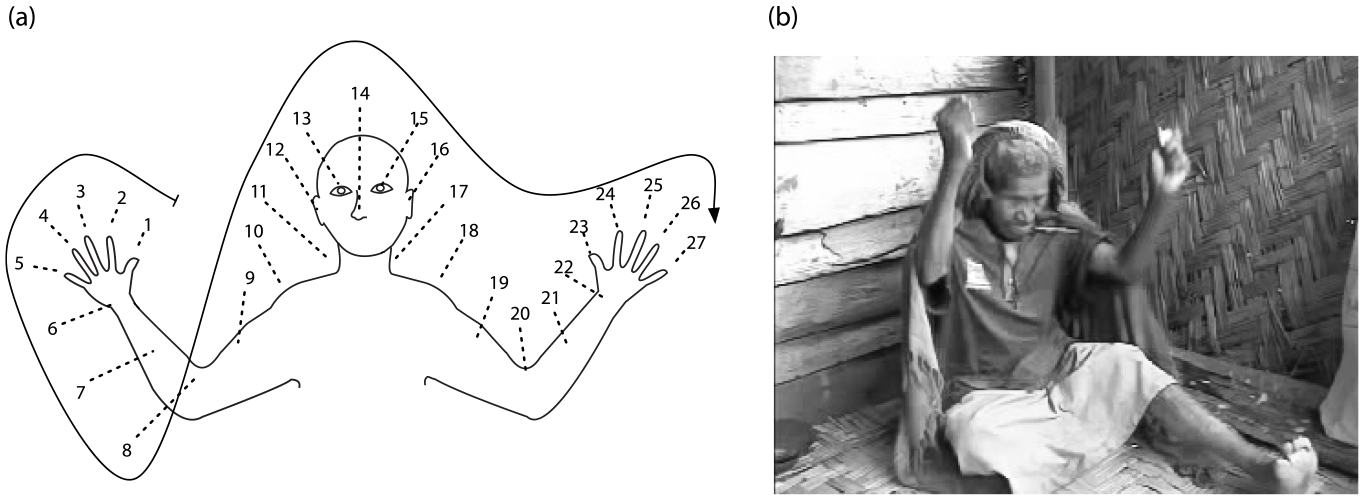
(a) The 27 body part counting system, marked at the 27th position with the word form, fu!. (b) A woman displaying the fists-raised completion of the count of all 27 body parts as she exclaims fu!—video available at https://culturecognition.com/new-page-3
Research Questions that Emerged from Ethnographic Observation: Use of fu to Serve a Multiplicative Function
Ethnographic observations played a key role at every phase of my research, and historical research on patrol officers’ reports, missionaries’ and anthropologists’ observations, and others helped to situate my observations in context. To illustrate, I highlight observations in 2001 that generated new research questions that, in turn, led to new extensions of the theoretical framework.
En route to Oksapmin for my third visit in 2001, I stopped in a mining town about 100 km from Oksapmin valleys, where, by chance, I met Oksapmin people seeking employment. I overheard people use the Oksapmin word form fu after a body part name in a way that I had never heard before, and after some queries and observations, I learned that some people were using fu to communicate that the body part should be taken as twice its numerical value; thus, the word for shoulder (10) followed by the word fu signified a value of 20 in everyday communications. Doubling is a multiplicative relation, and the use of fu to represent “double” was striking because in my prior research in 1978 and 1980 on the use of the counting system in traditional life, people did not use the counting system for arithmetical computations (Saxe, 1982, 2012). Furthermore, in those years, people used fu to refer to the completion of all 27 body parts in the counting system (recall the display in Figures 1a and 1b). What could account for the historical change in the function of fu? Was multiplicative fu simply a homonym for fist-raised fu with no continuous link? Investigating these questions required an inquiry into sociogenetic dynamics—how a multiplicative function for fu emerged in the community.
Investigating the Origins of Multiplicative Fu: Preliminary Efforts and Emergent Insights
Once I arrived in Oksapmin, I began the inquiry with the simplest of ethnographic methods—I asked people what they knew about how fu had come to mean to double the value of a body part; not a single person had any insight. To help me refine my interview techniques, I reflected on findings from my earlier research.
Earlier Research in Oksapmin
In 1978 and 1980, during my first and second visits to the Oksapmin world, I observed that although most people relied on subsistence gardening and did not engage in economic transactions, a cash economy was emerging. From the mid-1960s through the mid-1970s, men were flown out of the valleys to work on plantations, and they often returned with bags of rice and cans of fish; some established small trade stores in their hamlets. Trade store owners became engaged with new kinds of problems involving the use of the 27 body part counting system to accomplish currency counts and the sale of commodities, as did their customers.
The currency system in use during my early visits was a base-10 denominational system (100 toea = 1 kina) issued with Papua New Guinea’s independence from Australia in 1975. But surprisingly, Oksapmin trade store owners were interpreting toea and kina as if they were Australian pounds and shillings with a 20:1 denominational structure, a currency introduced by patrol officers and missionaries when Papua New Guinea was a territory of Australia (20 shillings = 1 pound). Thus, in 1978 and 1980, when pounds and shillings were obsolete, I documented that the Oksapmin people who engaged with currency transactions (e.g., trade store owners) often called 10-toea coins “shillings” and 2-kina notes “pounds”; thus, the completion of a count of twenty 10-toea coins (which many referred to as “shillings”) was referred to as a “pound” or “two kina.”
Subsequent Studies in 2001
In 2001, the reflections on ethnographic observations, historical records, and my earlier research in Oksapmin communities led me to a tentative conjecture. I knew that in traditional life, fu was used to refer to a complete group of something (like all the members of a clan, all the seeds in a pandanas nut, or all the counting body parts). By extension, fu could have been used to refer to a complete count of all the shillings in a pound, or all of the 10 toea coins in a two-kina note, in either case, an attenuation of all the body parts in a count, with a stop at the 20th rather than the 27th. Thus, fu might at once be used to refer to a pound but also two kina, the 1:2 relation, with 1 pound meaning 2 kina (see Figure 2). If I could dig deeper, revealing that fu in fact was shifting in location to the 20th body part, that would corroborate the merit of the hypothesis.
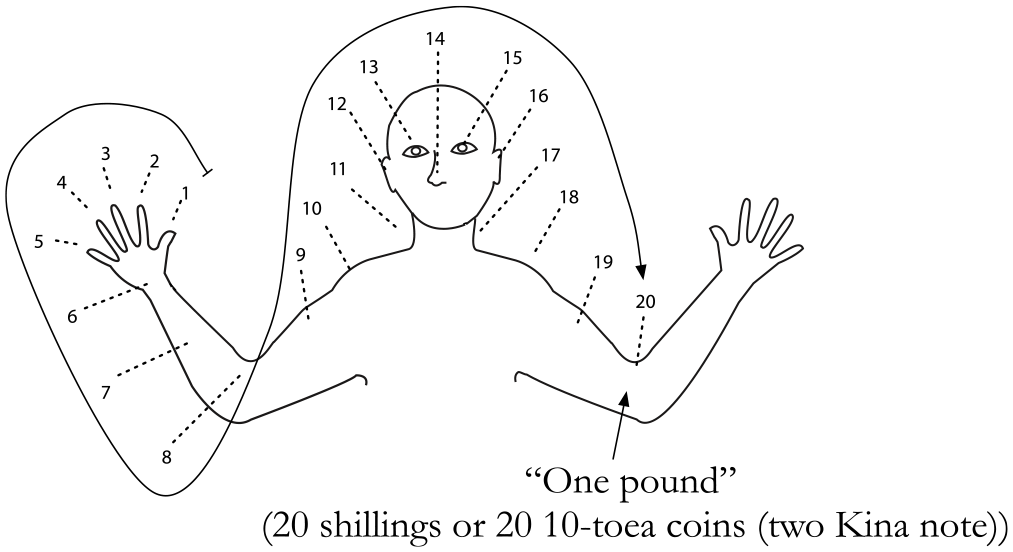
Attenuation of the body system at the elbow (20th position), using the elbow to refer to a pound (a count of 20 shillings) or a 2-kina note (a count of 20 10-toea coins)
To explore the idea, I continued with an ethnographic method, meeting with three individuals who had varying levels of participation with the money economy: an elder (little participation), an older adult (some participation), and a middle-aged adult (good deal of participation). I asked each about the location of fu on their bodies, finding support for the conjecture. The elder responded as expected: Fu was located in the 27th position of the traditional system; the older adult claimed that fu could be located at either the 20th or the 27th body part position; and the middle-aged adult said that fu was on the 20th position, not the 27th (see Figure 3). Thus, these three cases provided preliminary corroboration that the body part position of fu was historically shifting from the 27th (little finger) body part to the 20th body part (elbow), and that the shift was linked to increasing engagement with economic exchanges with currency in the community.
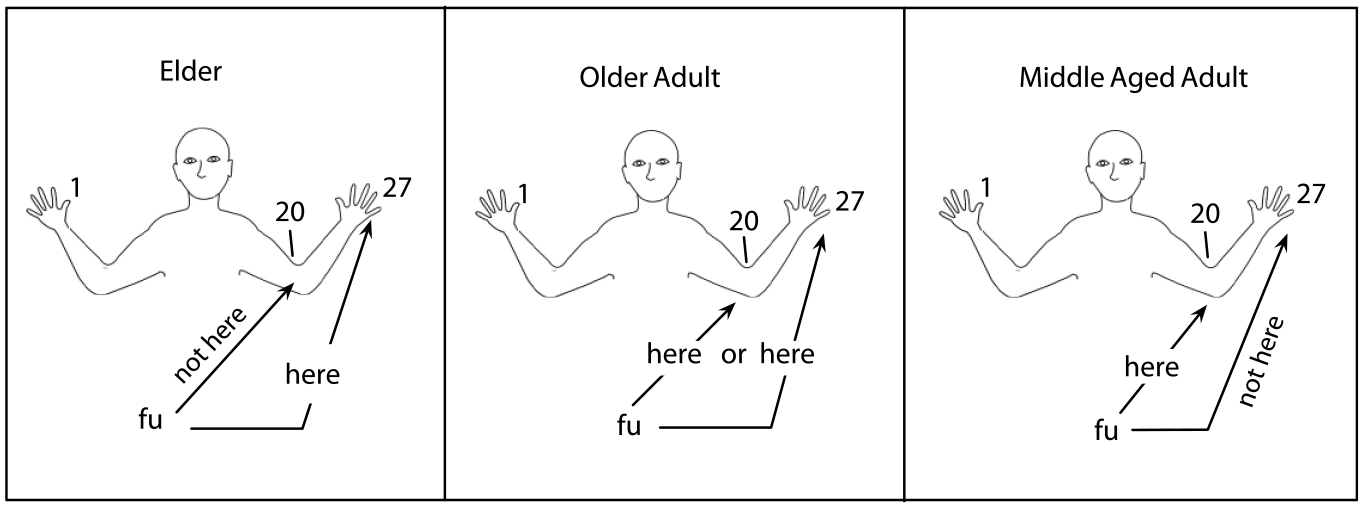
Positions of fu on the body in three different accounts
Systematic Study of Origins: Interview Methods and Quasi-Experimental Research Designs
Through my ethnographic investigative work on the Oksapmin body part counting system in relation to the history of economic exchange with currency, I had constructed a conjecture on the sociogenesis from a fists-raised fu! to a multiplicative fu. The conjecture was an effort to capture the complex interplay between form (fu) and function in a sociogenetic process that spread through networks in the Oksapmin world. But the conjecture was based on very limited data. Were the findings from the few interviews and local observations about fu idiosyncratic to the people I happened to observe and talk with? Or did those observations capture the conjectured sociogenesis of the multiplicative fu? To evaluate the adequacy of the analysis, I needed to devise new empirical methods informed by the historical research, interviews, and ethnographic observations, methods that would allow for statistical generalization to the Oksapmin population.
In developing the new studies, I created an independent variable to capture the historically changing numerical problems with which people were engaged—extent of participation in the cash economy. To this end, I sampled four cohorts each with 15 to 20 people, from traditional elders to trade store owners; furthermore, in some of the studies, I also included adolescents attending community school and children in the early grades to investigate whether knowledge of fu might continue to be reproduced or not in a subsequent generation. For dependent variables, I created interview techniques to gather information about (a) the meaning of fu in everyday talk, (b) the location of fu on the body, (c) whether fu was used to identify a 2-kina note, and (d) the use of fu in people’s representations of sums of currency. The findings revealed substantial variation in responses across cohorts, variation that provided strong support for the conjecture about the dynamics of a form-function shift in fu linked to extent of participation in exchange practices.
Meaning of Fu in Everyday Talk
Most traditional elders responded that fu referred to plenty of something or a complete group of something. With increasing participation in the money economy, people indicated either that fu referred to a body part or that they did not know the everyday meaning of fu. Schooled adolescents and children typically did not know a meaning for fu.
Location of Fu on the Body
Most elders referred to the 27th body part as the location of fu on the body; with increasing participation with the money economy, people indicated the 20th body part. Most schooled adolescents and children did not know about a position for fu.
Denomination of Currency Associated With Fu
Most elders and unschooled adults identified the 2-kina note as the referent for fu, but this identification declined with increasing participation in the money economy, indicating that a link between fu and the 2-kina note (and pound) was becoming lost to contemporary knowledge.
The Use of Fu in People’s Representations of Sums of Currency
To investigate the use of fu in representations of sums of currency, I designed an additional study. I presented people with 15 sets of objects to quantify in counterbalanced order. Figure 4 shows the 15 different conditions that included noncurrency conditions (4, 6, 11, 21, and 29 stones) and currency conditions of two types: five currency conditions that summed to lesser values (K.40, K.60, K1.10, K2.10, and K2.90) and five currency conditions that summed to higher values (K4, K6, K11, K21, and K29). I expected the fu use might be linked to the currency of higher value because it was those currency values that might be most easily expressed using a doubling function linked to vestiges of the pound. The participants included three cohorts who varied in their participation with the cash economy: elders, unschooled adults, and schooled adults.
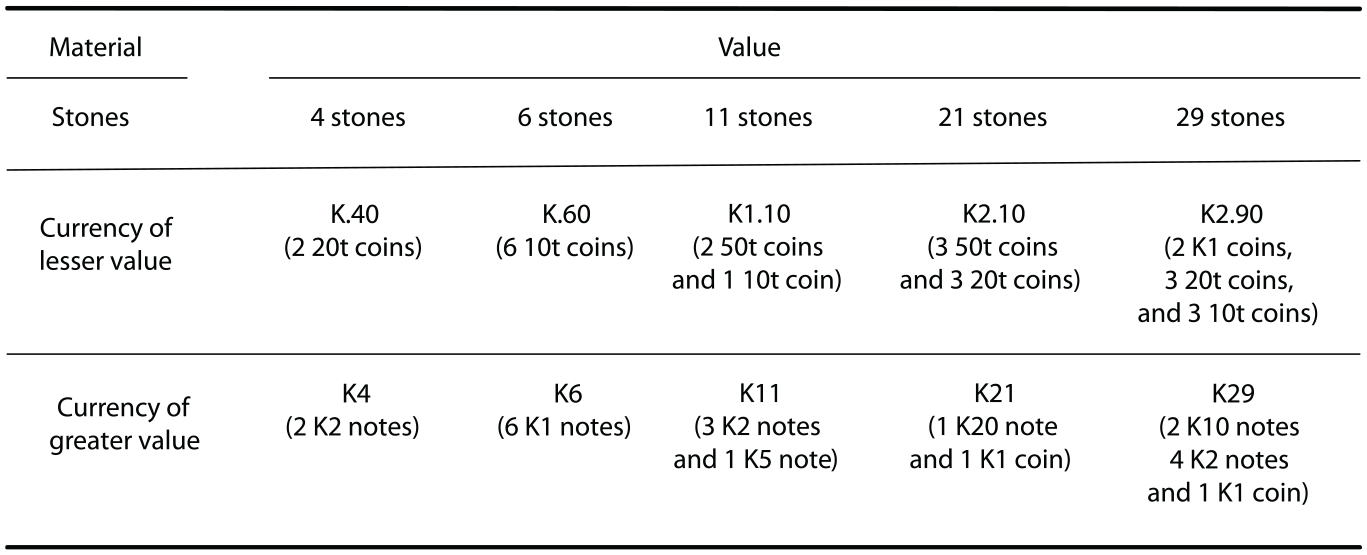
Stones, currency of lesser value, and currency of greater value conditions used in the representation of summation of values tasks
The findings are presented in Figure 5. Each of the three plots reveals the proportion of times fu was used for each value of the stones and the parallel currency low value conditions (K.40, K.60, K1.10, K2.10, K2.90) and currency high value conditions (K4, K6, K11, K21, K29). The plots reveal that all cohorts used fu frequently for currency high conditions, especially when those values were at least K21. Indeed, for values of K11, K21, and K29, at least two-thirds of all middle-aged interviewees, both schooled and unschooled, used fu in their expressions. Among the elders, at least two-thirds used fu in their expressions for 21 kina and 29 kina. Fu was infrequently used to express currency low or stones, and fu was especially rare among schooled adults. Importantly, Figure 5 reveals the spread of fu through multiple strata of Oksapmin communities when applied to higher values of currency. 2
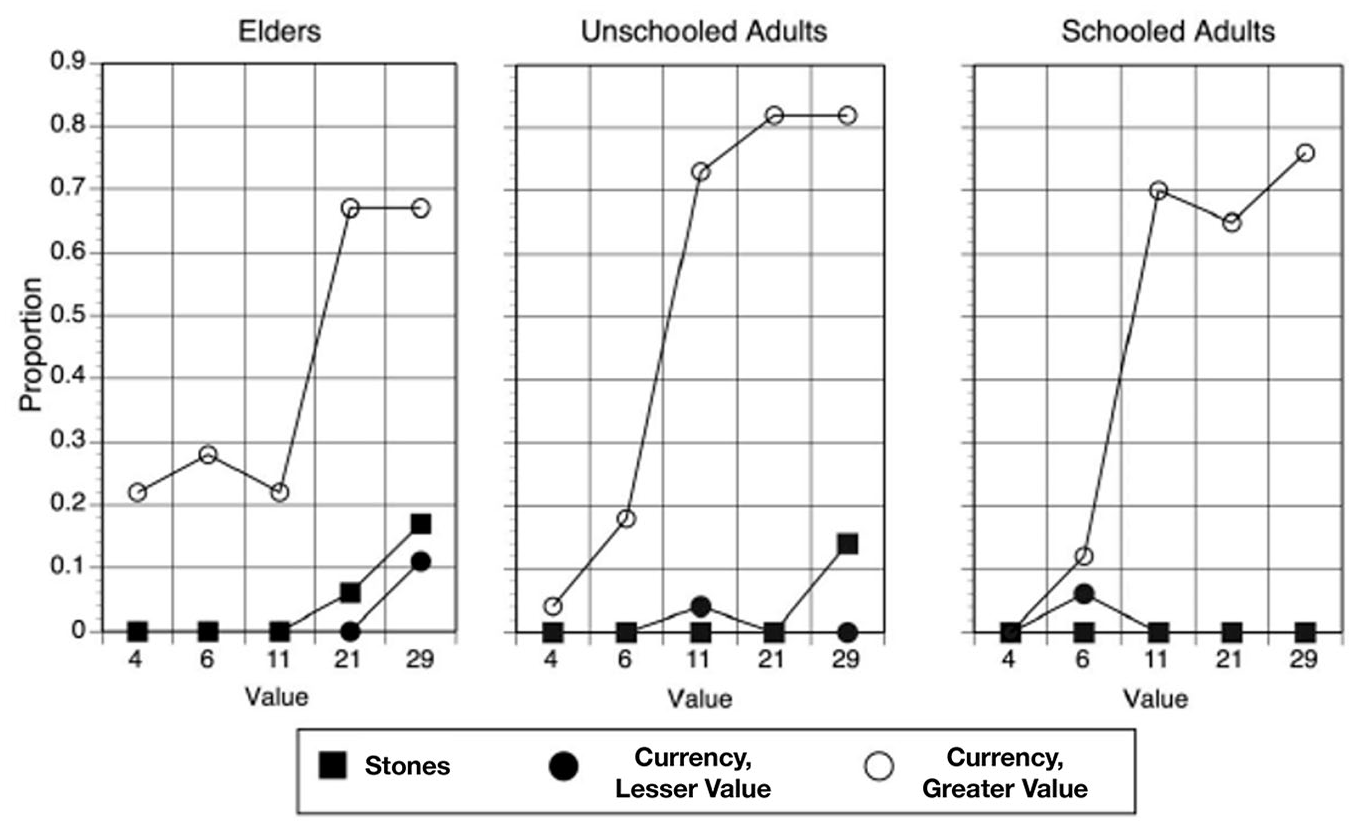
Representations using fu across three cohorts in conditions involving counts of stones and computations with cognate values of lesser and greater sums of currency (kina and toea)
Concluding Remarks
In this short chapter, I described methods designed to reveal sociogenetic processes linked to everyday interactions in collective practices. My focus has been on the Oksapmin case of fu and is thus, as I noted in my introductory remarks, subject to the critique of limited generalizability.
Consistent with my interest in theory building, I have used the sociogenetic framework iteratively and adjusted it as I pursued case studies linked to number in communities other than Oksapmin. For example, in northeastern Brazil, I investigated emerging mathematics among unschooled and schooled Brazilian child candy sellers in a rapidly inflating economy (Saxe, 1991), an urban world very different from that of the Oksapmin, with differing histories, norms, social interactions, and values. Principal foci were form-function shifts that included the reproduction and alteration through time of ways that sellers represented very large currency values and how they calculated appropriate retail pricing for candy to speed sales and at the same time make net profits. In the United States, I have used similar framework-guided coordinations of ethnographic, interview, and quasi-experimental methods to study form-function shifts in toddlers and young children’s use of number words and related ideas as they participate in collective practices in middle- and working-class home settings (Saxe et al., 1987); in this case, my focus was on the shifting function of number words over development and their use in everyday collective practices of family life. Additional studies focused on classrooms in the United States, including elementary school students’ and teachers’ interactions about mathematical topics in collective practices of classroom life with a focus on mathematical representations and their shifting form-function relations over a semester (Saxe, de Kirby, Kang, et al., 2015; Saxe, de Kirby, Le, et al., 2015; Saxe & Sussman, 2019), the travel of mathematical ideas in a middle school classroom (Saxe et al., 2009), and at the tertiary level, ways in which form-function shifts in the usage of mathematical terms emerged in interactive talk over the course of a seminar on lessons related to fractals (Saxe & Farid, 2021). Across these and other case studies, the coordination of archival, ethnographic, interview, and quasi-experimental methods has supported understanding interplay between developmental and collective processes in the sociogenesis of mathematical representations and ideas. The series of cases have led to refinements and elaborations of a theory of sociogenesis summarized earlier and elaborated in Cultural Development of Mathematical Ideas (Saxe, 2012).
I end with a reflection on statistical and analytical generalization. Research in education often privileges statistical generalizations, with “the gold standard” being random assignment of individuals to groups in true experiments (Whitehurst, 2009, 2012). The samples are all too often drawn from a narrow set of possible communities, and the research all too often neglects to consider participants’ worlds. As Henrich et al. (2010) implied in their discussion of WEIRD research (as research conducted with Western, Educated, Industrialized, Rich, and Democratic populations), any given community lives in a world situated in their respective histories. Although statistical generalizations are an important part of education research, such generalizations should be subordinated to analytical generalizations, a theory-building activity in which an iterative use of cases is used to better understand core processes of human development. Indeed, I would argue that a key aim of education research should be to understand developmental processes as they are situated in the remarkedly varied cultural worlds in which we all live.
Footnotes

Notes
Author
GEOFFREY B. SAXE is a distinguished professor of the Graduate School at the University of California, Berkeley. His research focuses on cognitive development with a concern for culture-cognition relations in the domain of mathematics. His most recent book, Cultural Development of Mathematical Ideas, received book awards from the American Anthropological Association, the Cognitive Development Society, and the American Psychological Association. More generally, his work on culture-cognition relations received two Presidential citations from the American Educational Research Association.