




Abstract
This chapter focuses on the utopian methodological approach taken up by social design-based experiments, their conceptual underpinnings, and commitments. The methods are drawn from Gutiérrez’s empirical work and detail ways of seeing and capturing human learning activity crucial to envisioning and enacting new social futures with radical possibilities for those from historically nondominant communities. It elaborates methodological commitments to seeking complexity in human learning activity as it centers equity understood as worldmaking. A review of a range of methodological tools employed across Gutierrez’s studies is presented—from an analytical focus on ensembles and the multiplicity of social spaces in learning ecologies to attending to how people’s repertoires of practices are constituted through participation in everyday activity, as they move in and across the ecologies of everyday life.
In this chapter, I discuss a “utopian” methodological approach that involves conceptualizing the past and future within the present. It presents the social design-based experiment (SDBE) as one illustration of a utopian methodological approach in which “human flourishing in [the context] of possible futures” (Levitas, 2013, p. xi) serves as a central object of learning. 1 I argue that the approach is crucial for understanding and supporting individuals, their communities, and schools in processes of transformation and change. I suggest that by focusing on what is acquired and generated through people’s activities as they move across contexts, researchers will challenge rigid and limited notions of learning and approaches to design research, which often perpetuate hierarchies and negative perceptions of learners and their possibilities. This design-based method employs a way of seeing that is crucial to envisioning and enacting a utopian methodology in which co-imagining new social futures with radical possibilities, especially for those from historically minoritized communities, is the outcome. Importantly, within this view, outcomes are not fixed but instead are better understood as “moving horizons of possibility” (Gutiérrez et al., 2020, p. 331).
SDBEs’ proleptic orientation seeks to advance methods of inquiry and design organized around imagining what is “not yet,” that is, the proleptic property of learning that brings “the end into the beginning”—what Cole (1996) defined as the “cultural mechanism that brings the past into the present” (p. 183). This future orientation is linked to a commitment to a historicized view of the present to engage in newly imagined projections of learning and becoming in the future, both for the ecologies and their inhabitants, which my colleagues and I study and design (Gutiérrez, 2008, 2016, 2022; Gutiérrez & Jurow, 2016). As I have previously argued, understanding the past can serve as a resource in the present—an understanding that can help us design our futures as individuals in collectives, to design collectives in which individuals flourish. This attention to history helps open the process of prolepsis for the development of people’s future selves and a future-oriented agenda (Gutiérrez, 2008, 2016, 2018).
As one of an SDBE’s design commitments, there also is a persistent emphasis on equity across the design process, in the theorization, design, implementation, and ongoing iterations; a design process I have termed, “equity by design” (Gutiérrez, 2015). However, equity within this design method is better understood as future- or world-making in which pragmatic realizations of equity, that is, their concrete manifestations in people’s everyday lives, including the institutions they traverse, replace equity as simply an aspirational goal. These insights serve as drivers of both consequential and expansive forms of learning and systemic change and movement toward utopian ideals.
With this context in mind, I focus on an additional dimension of a utopian methodology, drawing on models that recognize that learning takes hold as people move in and across the socially, culturally, and historically organized practices of everyday life. This focus on movement across a range of practices and space helps make visible the complex nature of learning, how people’s repertoires of practice (Gutiérrez & Rogoff, 2003) are constituted, and how knowledge production occurs in quotidian activity across time and space. This attention to the learning in people’s movement within and across practices invites researchers to employ more expansive methods of inquiry to push on claims about people’s learning, about a phenomenon, based on observations that do not account for the fuller range of people’s practices and their participation and social interactions therein.
SDBEs, grounded in cultural-historical approaches to learning and human development and design commitments around ecological resilience, sustainability, and diversity, bring together interpretive and multisited ethnographic approaches, developmental dialogues, and sociocritical approaches to design with tools that focus on how youth learn within and across multiple contexts. Both the complexity of learning processes and their study are underscored here.
Without doubt, learning is complex, and as Jean Lave (1996, 2009) reminded us more than several decades ago, “that learning occurs is not problematic, as learning is an integral aspect of activity in and with the world at all times” (Lave, 2009, p. 2003). However, as she noted, what is learned is always complexly problematic. Lave’s four tenets of learning in practice remain relevant and useful in pursuing a utopian approach to learning and inquiry and its concomitant methods, as they highlight the ongoing and dynamic, constructionist, and transformative character of knowledge production in activity; at the same time, Lave calls for the reconceptualization of taken-for-granted “natural categories” such as “bodies of knowledge, learners, and understandings of cultural transmission” (Lave, 2009, p. 203). 2
That learning is an important aspect of participation in socially situated practices (Lave, 1996, p. 150) remains uncontested in sociocultural views of learning and resonate with the RISE principles of learning, recently advanced by Nasir et al. (2020) in their Handbook of the Cultural Foundations of Learning. These learning scientists argued for a holistic theoretical perspective on learning that brings together diverse disciplinary perspectives to attend to cognitive, emotional, linguistic, physical, social, and cultural dimensions of learning. These principles, like those articulated by Lave (2009), maintain the profoundly cultural nature of learning that involves all aspects of what it means to be human—processes also organized and shaped by sociopolitical forces. Leveraging an expanded theoretical matrix, the RISE principles of learning call attention to the biological and neurological mechanisms involved in learning process. Pea (2022) further emphasized that the scientific study of learning must also be attuned to the full complexity of human life in situ. Taken together, these principles help us understand how learning and development are multidimensional and that these dimensions are part of complex, dynamic processes and integrated systems (Lee, 2010).
Ethnography of Ecologies
My long-term work has had sustained interest in accounting for the complexity in human learning and activity across ecologies and the practices that matter to me and the people with whom I collaborate. It is in understanding this complexity that, as researchers, we have worked to capture the variance and the regularity in the human experience, the ingenuity, the resistance, and the possible. Early studies (Gutiérrez, 2008; Gutiérrez et al., 1995, 1999) sought to open up the lens of classroom life, in contrast to studies that privileged the official instructional activity, its standard configuration, participation structures, and narrower or partial accounts of learning. In identifying the complexity of the classroom as a multivoiced activity system with its multiple social/learning spaces, the range of diverse student sense-making practices and competing and overlapping learning activity become evident.
Figure 1 depicts the complexity of the activity system of classrooms. It reveals the multiplicity of social spaces of the classroom, not just the official space in which the teacher is centered and on-task student interactions privileged; it also reveals the multidirectionality of talk, multimodal communication, the range of possible interactions, and competing activities. Micro-analysis of the broader ecology of participation of individuals and collectives helped us identify the contours of a robust learning space, the third space (Gutiérrez et al., 1995, 1999).
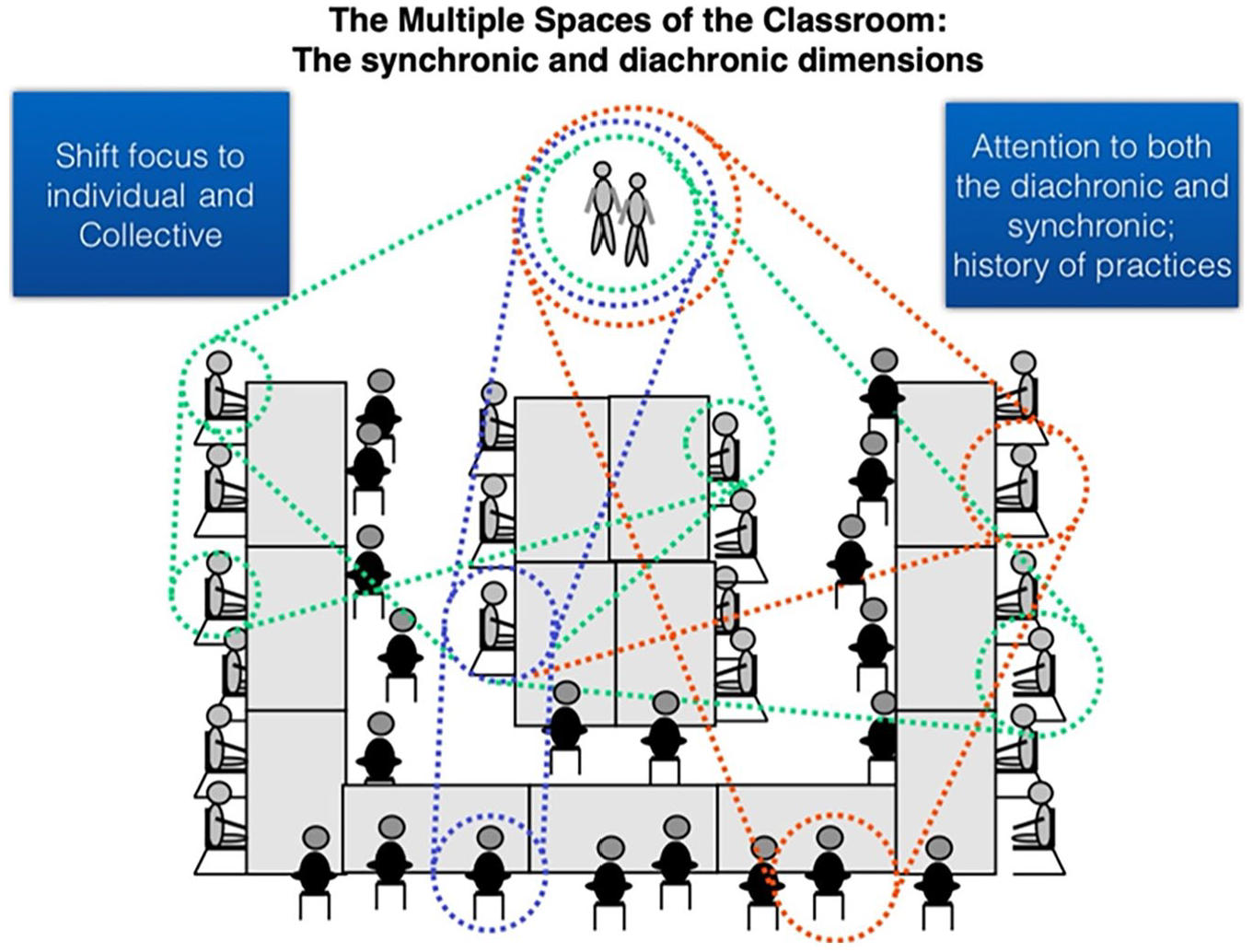
The multiple spaces of the classroom: the synchronic and diachronic dimensions
This collective third space, a particular kind of zone of proximal development, is an interactionally constituted, artifact-rich environment in which a particular set of processes that produce a relationship between social and individual functioning is co-constructed. In this particular social environment of development, students begin to reconceive their identities and social futures, including “what they might be able to accomplish academically and beyond” (Gutiérrez, 2008, p. 148). Here, the third space provides a window to understanding “why certain contexts of development become particularly” consequential to participants and their learning both in the moment and across time and space (Gutiérrez, 2008, p. 151).
Unpacking Third Spaces
My collaborative studies of emergent third spaces in these ecologies involved methods that documented the complexity and multidimensionality, the regularity and improvisation, the joy and the resistance in learning activity, including the range of tools that mediated learning. By integrating micro- and macro-analyses of learning environments, we were able to investigate the social, spatial, and temporal organizational dimensions of learning practices, notably the diachronic and synchronic dimensions of activity; that is, moment-to-moment human activity over time (diachronic) and simultaneous activity at any given moment (synchronic) and their relation (Gutiérrez, 1993; Gutiérrez & Stone, 2000, 2002).
Figure 2 is a landscape 3 of multidimensional participation that can capture a range of micro-interactional activity (e.g., talk, gestures, movement, tool use, spatial arrangement, hand movement, and eye gaze) both diachronically and synchronically. It can represent an extremely focused slice of time across a number of dimensions. Overall, it unpacks the moment-to-moment activity of focal participants as it also captures the layered and simultaneity of activity, including various modes of participation, communication, and tool use of people participating in the larger practice. These multiple layers of analysis reveal the complex and situated nature of learning, which can be analyzed not only for its cognitive and social implications. Like others, here we stress the importance of dealing with units of analysis that include but extend beyond the individual.
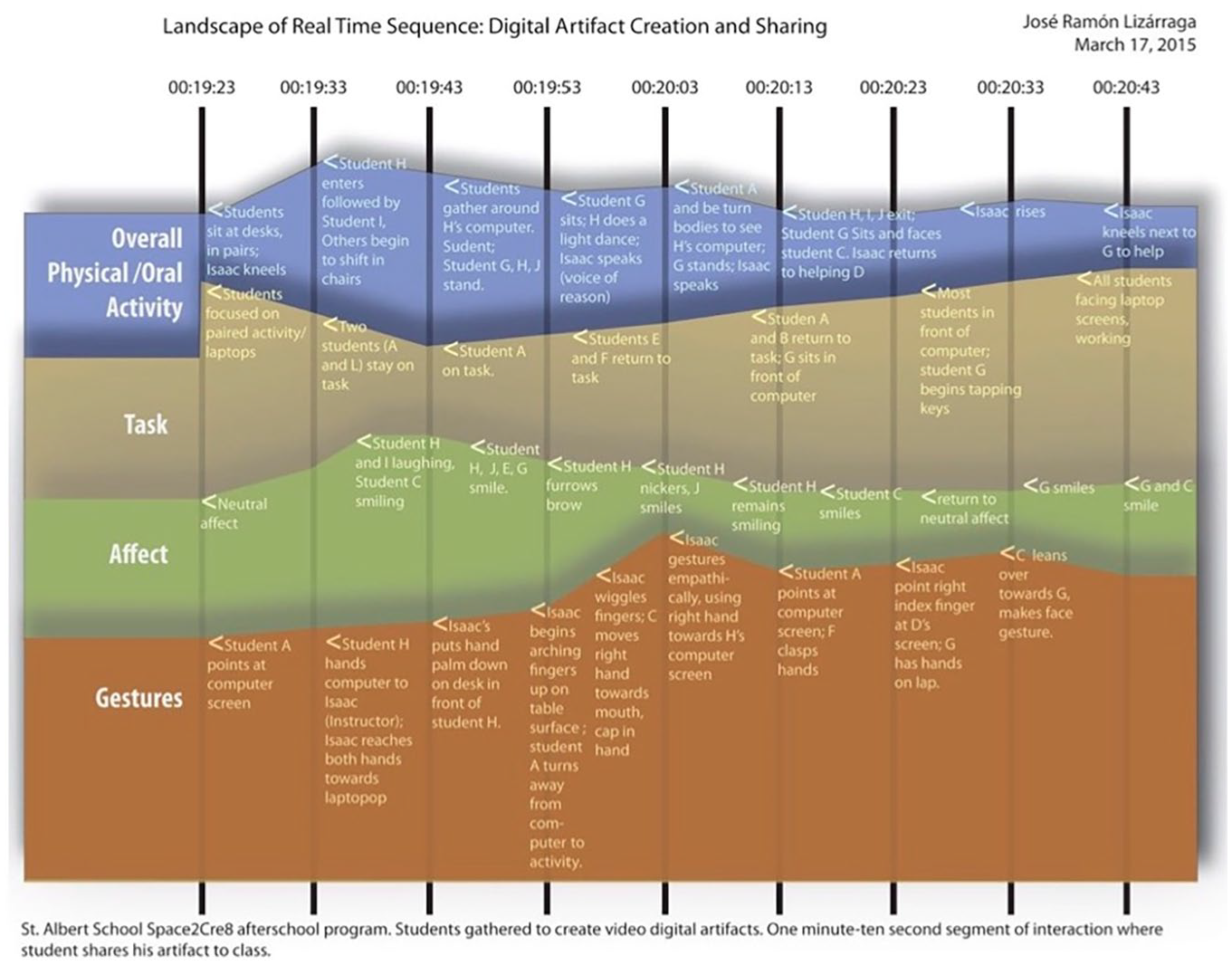
Landscape of real-time sequence
As I have written in earlier work (Stone & Gutiérrez, 2007), we also employed an expanded understanding of the theoretical construct of ensemble as a robust unit of analysis to examine participants’ interpretation and collaborative negotiations of problems, in this case, intergenerational participants in an after-school technology-mediated club (Granott,1998; Rogoff et al., 2016).
An ensemble includes the smallest group that co-constructs knowledge and the mediational tools and resources they use (Granott et al., 2002). Ensembles, we argued, are microcontexts of development that are embedded within and in a bidirectional relationship with the larger cultural context (Stone & Gutiérrez, 2007). “In other words, ensembles offer an ecological site to study” learning and development, including how participants organize themselves, their tools, and other resources to support learning as they make sense of the current and future activity (Stone & Gutiérrez, 2007, p. 45). Ma and Hall (2018) similarly employed ensemble as a unit of analysis and noted the importance of understanding that “contributions from members of the ensemble are necessary for producing the activity in question [suggesting] that pulling the ensemble apart for purposes of analysis could dissolve the activity entirely” (p. 509). This understanding echoes long-standing arguments advanced by Barbara Rogoff (1995, 2003) regarding mutually constituting, fractal modes of analysis that avoid dissecting, isolating, or separating individuals from each other and the activity in which they participate and help to co-construct.
Barbara Rogoff and I previously argued the importance of grounding “observations across multiple settings and communities and [assuming] various vantage points to understand the complexity of human activity” (Gutiérrez & Rogoff, 2003, p. 23). This theoretical orientation to learning and human development organizes both my design work and its study around the principle that people are always part of multiple activity settings in coordination with others and their learning should be studied accordingly.
This shift in focus and units of analysis from either the individual or the larger social context to an activity system allows an examination of the interrelationship between the individual and the cultural setting. In this view, social settings are not discretely circumscribed phenomena but instead occur as a part of laminated, overlapped, and interwoven social phenomena that occur in the moment and across time and space, the choreography of simultaneous activity (Gutiérrez et al., 1995; Gutiérrez & Stone, 2000). Importantly, studying learning phenomena as an ensemble of coordinated actions/interactions also involves attention to how tool use, multimodal forms of participation, language use, and resistance practices help to constitute or destabilize shared practices.
Designing Resilient Ecologies: Ethnographies of Movement
Understanding the dynamic, layered, and relational nature of human learning was foundational to the study and design of robust and sustainable learning ecologies that evolved across several decades into social design-based experiments (Gutiérrez, 2005). As discussed previously, what became an explicit and intentional method over time was motivated by long-term, careful observation in joint activity with learners across settings that made visible their history of experiences with a range of learning activity not often captured in accounts of learning. A resulting methodological imperative for this work required a multisited approach across a minimum of several activity systems to better account for youths’ learning and sense-making in their everyday movement—to deconstruct the narrow notions of learning and instead organize ecologies toward an expansive utopia in which youth are free to move beyond the constraints that often bear on their lives as learners.
Its cultural, historical, theoretical underpinning and equity focus orient those of us engaged in social design-based work to seek deeper understandings of the following: (a) the resources and constraints of the ecologies that constitute people’s everyday lives; (b) the full range of people’s practices understood across at least several activity systems; (c) people’s repertoires of practice, including the genesis of those practices; and (d) people’s participation in and movement within and across activity systems and what takes hold and travels in that movement (Gutiérrez, 2005, 2008, 2016). Although this approach employs mixed methods, it privileges multisited ethnography to develop an historicized understanding of the ecology, its resources, and constraints—an understanding that is essential to addressing the complexity and diversity as well as the contradictions and tensions in activity systems of which people are a part. Drawing from Vossoughi and Gutiérrez (2014), SDBEs argue for a “multi-sited ethnographic sensibility” to understand that and how learning is made consequential in people’s movement within and across activity systems—a view that also attends to the role of tools in facilitating and constraining that movement (Gutiérrez, Higgs, et al., 2019).
In our work, Shirin Vossoughi and I (Vossoughi & Gutiérrez, 2014) understood multisited ethnography to be an “ethnography of movement, borderlands, hybridity, and change” (p. 606). In examining the generative intersections among cultural historical approaches to learning and learning sciences, interpretive educational ethnography, and multisited research, we found synergies across all these traditions in their understanding that human beings and their cultural tools, practices, and communities are fundamental in developmental processes, and that the very processes and shifts that constitute development should also be treated as important objects of analysis. This ethnography of movement, we found, resonated with our notions of learning and development, of human activity, and aligned with our commitments to ecologically valid and equity-oriented research.
Learning as Movement
The conceptual metaphor of learning as movement (LAM) serves as an important dimension of SDBE’s utopian orientation. LAM’s framework is essential to work that seeks to design systems that support youth in joint activity with others to shape their own learning toward alternate futures (Becker & Gutiérrez, 2022; Gutiérrez, 2008, 2016, 2020; Gutiérrez et al., 2020). LAM’s ecological perspective compels to understand more fully the niche that constitutes people’s everyday lives and the cognitive and social activity that are imbued in these practices; it attends to ecological niche’s proximal and historical constraints and resources to better account for the full range of people’s practices locally and historically and their participation and social interactions therein. It is LAM’s attention to youths’ movement within and across systems, particularly the learning that takes hold in that movement, that helps us understand how repertoires of practice are constructed and leveraged across socio-spatial and sociocultural dimensions (Gutiérrez & Rogoff, 2003). The lens of LAM also directs our attention to how tools and practices travel, are taken up, and are reorganized and reinvented in people’s movement within and across practices in their everyday lives (Vossoughi & Gutiérrez, 2014).
As ethnographers of movement, Vossoughi and Gutiérrez (2014) found a strong resonance between our work and Erickson’s (2004) description of the importance of movement and multisitedness in ethnography and Hage’s (2005) notion of “an ethnographer of movement rather than stillness” (p. 467). Like Erickson and Hage, we problematized the analytic “snapshot” as the endpoint of inquiry, seeking instead to craft a moving picture of social practice and human development as it unfolds, genetically, in real time. From a methodological perspective, we argued for the relationship between treating the dynamic and developmental quality of social life as a central analytic concern and making visible the practicings (Erickson, 2004) and forms of human ingenuity (McDermott & Raley, 2011) that constitute the “field-as-experienced” as well as the “wiggle room” available for improvisation and change (Erickson, 2001, 2004; Hage, 2005; McDermott & Raley, 2011).
Learning as Movement as Design Principle and Method: Empirical Vignettes
Capturing Proleptic Practices
With colleagues, I both designed and studied people’s learning and participation in a range of practices and contexts of development. One prominent, long-standing SDBE was the UCLA Migrant Student Leadership Institute (MSLI), a 15-year collaboration between UCLA, the California State Department of Education, California migrant regional offices, and migrant parents. We designed with intentionality: Every space, place, and practice of the ecology became a potential site of learning where high school youth from migrant farmer worker backgrounds could reimagine themselves and their academic and social futures. The larger ecology of UCLA became the context for the development of new practices, knowledge, and futures, individually and collectively.
MSLI’s ecological approach to learning created opportunities to learn in natural activity across the day in residential life, at mealtimes, during the long walk up the path from the dorms to the classroom, in tutorials, in recreational time, during teatro del oprimido, in gender circles, and in numerous spontaneous events. Students, instructors, and staff would collectively participate and move across a range of practices, increasing the opportunities for learning to be connected, resituated, deepened, and made consequential.
Designed around a proleptic, future orientation of the possible, the program regularly engaged students to enact a vision of tomorrow, of what might be possible on the other side of their experiences in the program and their learning. Through metaphor, the playful imagination, sociocritical literacies, and the use of Spanish to connect home, community, and the past with present and future action, the collective nature of “social dreaming” was collaboratively enacted by students and instructional staff (Espinoza, 2008). 4 Documenting student learning thus involved coparticipating with them across a range of practices in and outside the official classroom, historicizing concepts and ideas through readings, testimonios, social theory, and enacting teatro (Vossoughi, 2014). As observant participants, we were concerned with the “field-as-experienced,” with an eye toward ingenuity, historical acting, and proleptic imaginings. Such practices expand the lens to the larger ecology of people’s everyday practices and a fuller picture of the repertoires they develop, leverage, and imagine (Gutiérrez, Becker, et al., 2019).
The Generative Lens of Multisitedness
Studying the ingenuity in the gaming and new media practices of Latinx families was the focus of our Connected Learning project (Ito et al., 2012) and provided an unprecedented opportunity for us to follow 13 focal children participating in El Pueblo Mágico (EPM), a technology-mediated after-school program, into their homes and community activities. 5 In this SDBE, modeled after our long-term work in the Las Redes 5th Dimension in an unincorporated area of Los Angeles, intergenerational configurations of youth, peers, university students, and a mythical, mischievous cyber Wizard collaborated in gaming activity that opened up new worlds in which the children and adults could assume flexible roles in play worlds that stretched their imaginations beyond the confines, rules, and norms of everyday physical and psychological constraints of normative activity. A theoretical point in our work (Gutiérrez, Higgs, et al., 2019; Rivero & Gutiérrez, 2022) is relevant here. We view video and related gaming activity as having the potential to become tertiary artifacts that “constitute relatively autonomous worlds of imaginative praxis” (Wartofsky, 1979, p. 209). In this context, youth-driven interests organized participation in a range of gaming and tinkering play activity across physical and virtual space, supporting youths’ travel through virtual realities that opened up a new imagination and access to new resources, relationships, knowledge, and activities.
Importantly, LAM is not just about documenting practices across geographical space; rather, a multisited ethnography would also want to know more about and examine youths’ movement within and across the assemblage of media and spaces in which they participated; in coordinated activity across venues, virtual and place-based; and notably, beyond the formal classroom setting. In this study, we were interested in how youth developed repertoires of practice around new media and how those practices, new dispositions, and knowledge served as resources for gaming and related activity across practices at school and in their homes. Thus, understanding of the new media practices of families became central to this work, as we also remained focused on the children across a range of practices and social configurations.
I present an example of one focal child, Simon, about whom we have previously written, to briefly illustrate the affordances of capturing youths’ practices and their learning across gaming worlds and families’ everyday media activity (Gutiérrez, Higgs, et al., 2019). Simon’s fluid movement across a number of synergistic activities (e.g., the online video game community, YouTube videos, and EPM), the tools he employed, and the distributed expertise available through the online video community served to create a rich network that supported his expanded learning (see Figure 3). Moreover, because EPM was designed as a learning ecology that facilitated Simon’s connected learning activity, he was able to leverage an everyday, interest-driven, peer-supported practice toward academic ends (Ito et al., 2012).
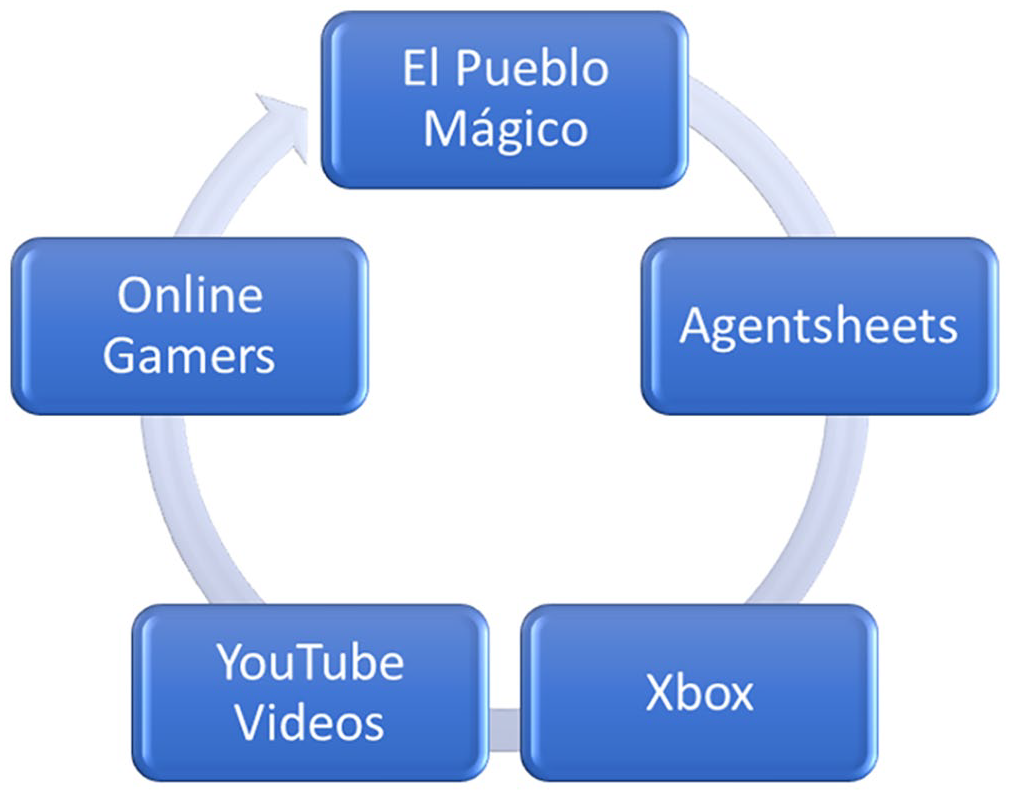
Spaces, tools, and communities that constitute Simon’s connected learning ecology
Simon also actively engaged with video games at home and learned how to design his own video games through his participation in EPM. In the after-school club, Simon’s engagement with a video game simulation authoring tool, AgentSheets (Her Many Horses, 2016; Repenning, 2017), allowed him to create a microworld where he could play with the rules and roles associated with various aspects of the game. 6 Through their jointly created drawings, undergraduates and children at EPM collaborated in imaginary video game play in which they envisioned new relationships, worlds, and possible actions in their gaming worlds; this imaginary play scaffolded subsequent activity in which the material aspects of the video games were recreated through a coding process using the software.
EPM centered the playful imagination such that youth like Simon could experiment routinely. Simon became interested in glitches in the video games, a practice he appropriated from his participation in EPM with more expert others. Glitching in video game play reveals system errors in games, or glitches (Consalvo, 2009; Gee, 2007), which are then transformed by players, thus expanding the field of participation and roles available to players. 7 Figure 4 shows Simon conducting multimodal searches in which he leverages the expertise of other online gamers through YouTube videos to develop more expertise about glitches.
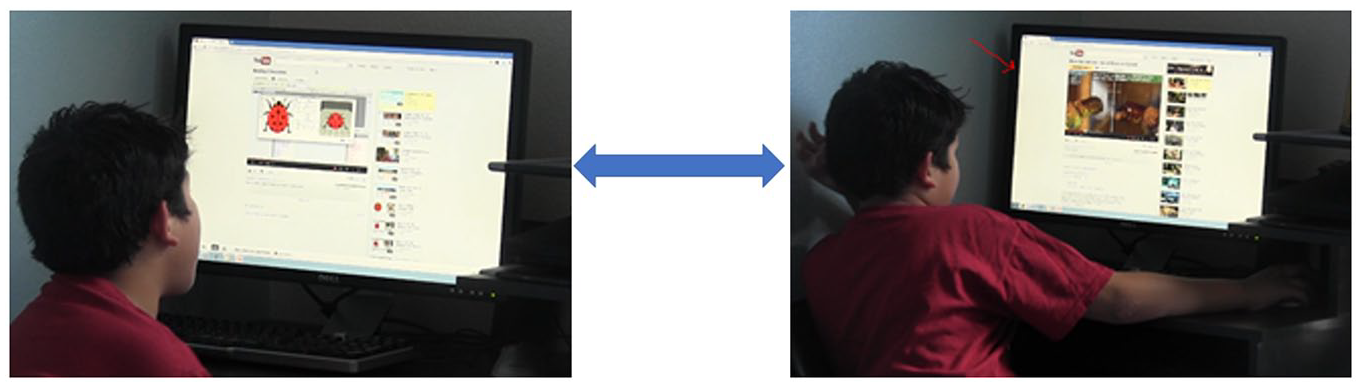
Simon looks up glitches on YouTube shortly after looking at a tutorial for AgentSheets
We were interested in the interconnectedness of the learning ecologies, tools, and activities that Simon engaged as he learned the intricacies of video game design through his movement within and across multiple spaces. Our analysis of Simon’s new media practices at home revealed that his experience of codesigning video games at EPM influenced his gaming activity at home, as he shared his expertise in family gaming activity. Simon’s recursive movement across varied physical and social media activities blended everyday and academic learning, allowing him to develop deeper understandings of the video games he played and to engage in creative reauthoring in his new role as designer. Simon’s case helps illustrate the importance of multisited accounts of youths’ participation and movement across everyday activities to understand how the ecology’s resources and constraints, the social configurations of activity, and opportunities to innovate and reinvent both individually and in coordinated activity help shape youths’ repertoires of practice (Rivero & Gutiérrez, 2019).
Conclusion
A focus on LAM has conceptual, methodological, and equity implications. It is also important analytic for a utopian methodology such as SDBEs and a key design feature essential to imagining and co-developing systems that support youth in prefiguring possible lives (Gutiérrez et al., 2020; Gutiérrez, 2022; Rose, 1999). As an analytical framework, it centers approaches that foster learning activity that recognizes people’s lives across broader ecologies; this epistemic shift involves accounting for people’s fuller repertoires and social futures, toward building collective third spaces and ultimately, collective utopia.
Ethnographers of movement commit to collaborative and future-oriented design work with a sustained focus on the unfolding and developmental nature of the social life of people developed across the activities of everyday life. The central analytic here is on what takes hold and what is made consequential in people’s movement, on how people’s lives get organized, with attention to the myriad facets of infrastructure that make visible what Soja (1989, 2010) termed “geographies of consequentiality.”
As researchers of human activity, my colleagues and I hold a methodological commitment to a multisited approach across a minimum of several activity systems to better account for youths’ learning and sense-making—to deconstruct the narrow notions of learning that reinstantiate inequities in everyday schooling and instead focus on codesigning consequential learning ecologies in which youth are free to move beyond the constraints on their lives as learners, to become historical actors toward an expansive utopia.
Footnotes
Acknowledgements
I am grateful for the thoughtful comments of my colleagues Barbara Rogoff, Shirin Vossoughi, Tesha Sengupta-Irving, and Arturo Cortéz. I am indebted to the many collaborators and co-thinkers with whom I have learned over the years, as coauthors and/or codesigners, and the many participants and youth in the long-term utopian projects: Las Redes, Migrant Student Leadership Institute, and El Pueblo Mágico. This chapter was facilitated by support from the Carol Liu Chair endowment.

Notes
Author
KRIS D. GUTIÉRREZ is the Carol Liu Distinguished Professor at the University of California, Berkeley. Her research employs a social design-based utopian approach to examine learning in designed environments, with attention to culture, historicity, and ecological resilience. She is Past President of AERA and is a member of the National Academy of Education and Fellow of the American Academy of Arts and Sciences and the British Academy. Her research is published in Education Researcher, Journal of the Learning Sciences, Cognition & Instruction, Review of Research in Education, and Reading Research Quarterly, for example. She received the 2024 Distinguished Contributions to Research in Education Award from the American Educational Research Association.