




Abstract
This chapter surfaces examples of the ways educators, programs, and families are making connections to and from out-of-school time (OST) experiences and into other contexts in learners’ lives, including additional programs, homes, communities, and schools. Through a review, the authors test, refine, and expand a design framework for connections across settings described in connected learning scholarship and identify shared goals and outcome indicators for collectively fostering equity through connective OST practices. The review has implications for practice in terms of offering design principles, examples, and outcome indicators for making connections that policymakers, program leaders, and educators can take up and for research by investigating and theorizing the role connective practices in OST programs can play in learning ecosystems.
Education researchers and practitioners seeking to foster equity, justice, and inclusion have increasingly recognized the importance of culturally sustaining, community-connected, and youth-centered approaches to foster learning (Mirra & Garcia, 2020; Paris, 2012; Paris & Alim, 2014; Popielarz, 2022). In particular, out-of-school time (OST) programs grounded in the culture and communities of minoritized youth are at the forefront of advancing asset-based approaches that honor their knowledge, expertise, and agency (Afterschool Alliance, 2022a, 2022b; Philp & Gill, 2020). Quality OST spaces are where youth deepen interest-driven learning, build supportive relationships with others who share their background and interests, build their identities in relation to their interests, and expand possibilities for future careers. However, even when an interest is developed in a culturally sustaining OST program, youth can struggle to extend their learning in other programs or settings because of lack of coordination and brokering between programs that might build on one another (Afterschool Alliance, 2021). This suggests that growth in culturally sustaining OST programming needs to be accompanied by a focus on building connections across OST programs and to homes, communities, and schools to ensure sustainability and deepen impact.
Despite the growing recognition that making connections across settings is important for culturally sustaining approaches, the processes of cross-setting connection and coordination are often invisible, implicit, and understudied, particularly in relation to OST. The goal of this review is to conceptualize and increase visibility about the significance and impact of connective practices in OST by (a) surfacing a wide range of examples of the ways educators, programs, and families are making connections to and from OST experiences and into other contexts in learners’ lives, including additional OST programs, homes, communities, and schools; (b) testing, refining, and expanding a design framework for connections across settings described in connected learning scholarship (Ito et al., 2013, 2020); and (c) identifying shared goals and outcome indicators for collectively fostering equity through connective OST practices.
To achieve these goals, we used the design principles for connections across settings from connected learning (Ito et al., 2013, 2020) as a starting point to find, organize, and synthesize research that expands on the literature reviewed by prior connected learning scholarship (see Figure 1). We tapped this larger body of research to refine and expand on the connected learning framework’s design principles and develop a taxonomy tailored to OST settings. Our findings are organized by a revised version of the connections across settings framework, highlighting practical examples of connections from OST contexts at the levels of people, programs, and infrastructure. The review has implications for (a) practice, in terms of offering design principles, examples, and outcome indicators for making connections that policymakers, program leaders, and educators can take up, and (b) research, by investigating the following questions to understand and theorize the role connective practices in OST programs can play in learning ecosystems:
How are organizations and individuals engaged in connective and coordinating practices to, from, and between OST settings?
What approaches to connecting OST programs improve and broaden equitable outcomes?
How can these approaches be differentiated and coordinated to foster collective goals, policies, and practices?
This emphasis will contribute to a growing body of socially and culturally situated theory and research that moves beyond granting youth access to opportunities (Vossoughi, 2017) toward creating more equitable opportunities that build youths’ networks and social capital to support their learning, development, and thriving (Ito et al., 2020). This review of making connections to and from OST programs is rooted in this shared commitment to fostering more equitable and connected ecosystems that support youth and community thriving. As youth learn, grow, and develop across contexts, they begin to see themselves and their identities as connected to being the “kind of person” (Gee, 2001, p. 99) that could be successful and belong in domain-specific pursuits; that is, their identities are practice-linked, or part of the connection between the self and activity bound to their social and cultural practices (Nasir & Hand, 2008). We define “thriving” in this sense as the development of identity in both personally and socially meaningful ways with a significant impact on both an individual’s life and community.
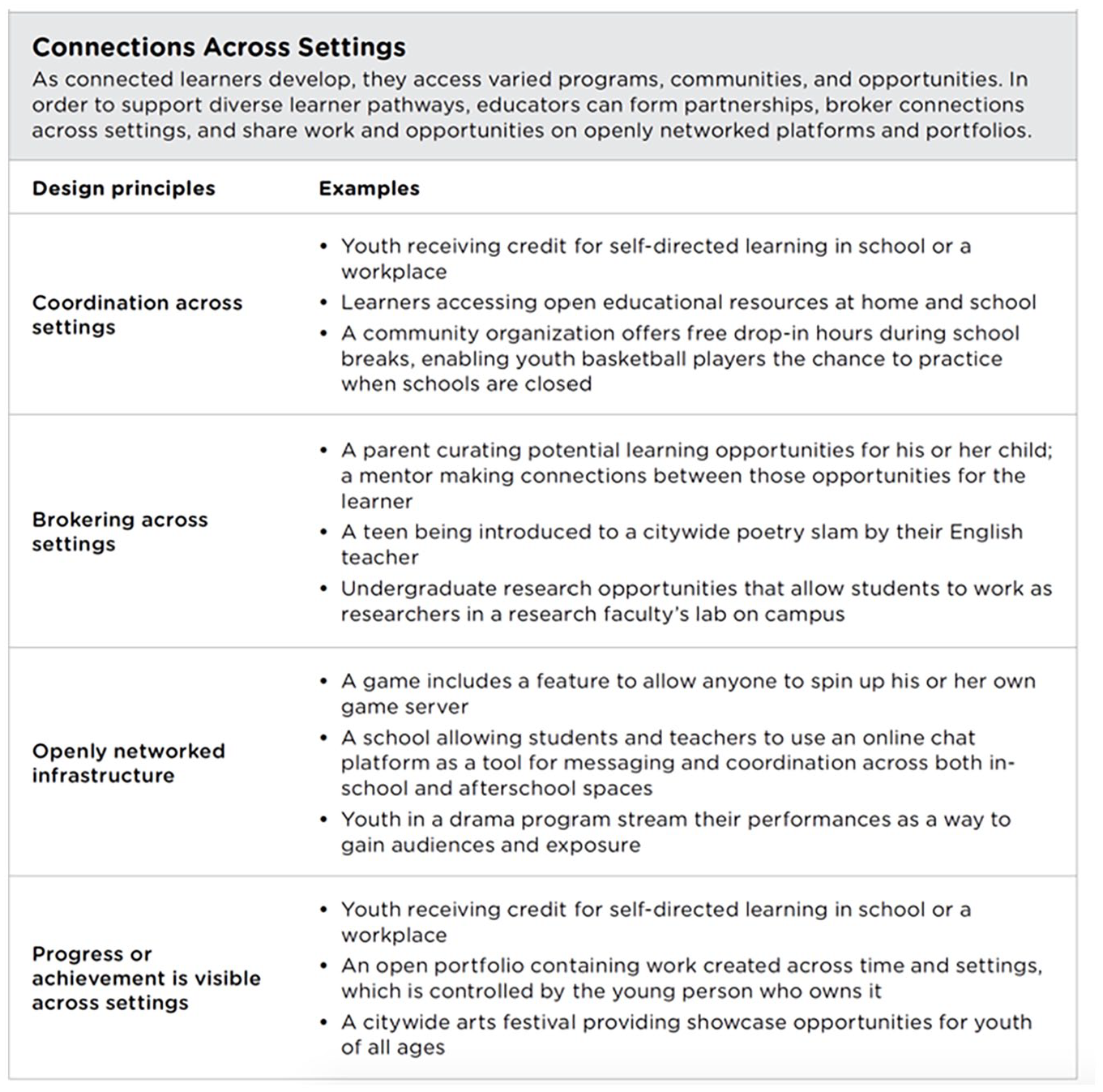
Design Principles for Making Connections Across Settings From Ito et al. (2020)
In this chapter, we start by describing the theoretical and conceptual frameworks behind this literature review. For our theoretical background, we draw from ecological approaches in the science of learning and development, locating OST settings within this broader tradition. For our conceptual framework, we draw from the connected learning framework’s design principles for connecting across settings, drawing out equity-oriented design principles for application to the OST space. We then describe the methods for literature selection before synthesizing the pieces we included in the body of the review, organized by how people make connections (i.e., brokering across settings), how OST programs make connections (i.e., coordination across settings), and how infrastructure supports connections in OST (i.e., connectivity across settings). We end with discussion of implications that surface the connective practices and policies that support the development of more connected ecosystems.
Theoretical Framework: An Ecological and Connected Lens for OST
Within the science of learning and development literature, developmental processes are viewed holistically (Lerner et al., 2021). As learners are engaged in learning and development over time, cognitive, affective, social, and emotional processes are necessarily interconnected (Cantor et al., 2021). When understood within an ecological learning landscape rooted in culture (Lee, 2017), the development of the whole child is supported through caring relationships and learning across a range of contexts (Darling-Hammond et al., 2020; Osher et al., 2020). For example, in their article reviewing science-based school and classroom practices, Darling-Hammond et al. (2020) recommended that in school contexts, structures should be designed around cultivating and sustaining strong positive relationships with an emphasis on developing psychologically and emotionally safe spaces where students feel comfortable expressing and developing their identities. Nasir (2020) built on these recommendations to suggest centering equity by grounding practices in the science of learning and development and supporting social-emotional learning in ways that recognize connectedness of the learner to broader community and cultural contexts.
This holistic approach emphasizes the importance of ecologies of learning that center outcomes on the individual learner embedded in culture and community across contexts. Learning has long been viewed as an ecological, cross-setting phenomenon (Banks et al., 2007; Barron, 2004, 2006; Hecht & Crowley, 2020; National Academies of Sciences, Engineering, and Medicine, 2021). An ecological perspective situates learning as occurring not only in formal contexts like schools but also in OST settings, recognizing everyday kinds of learning that happen in social and cultural contexts (Bevan, 2016). This perspective also recognizes that people do not learn in siloed ways and that learning occurs between or across different settings or activity systems (Engeström, 1987). This research tradition sees individual development integrated with the development of cultural and community assets; making connections between community, home, and other learning settings can foster positive development and thriving at both individual and community levels. It recognizes the informal, ongoing, and often invisible labor of families, mentors, educators, and young people in brokering connections, shuttling to and from learning settings, making recommendations, and maintaining relationships over time and space. This ecological lens also recognizes how sociocultural, programmatic, and infrastructural disconnection presents significant and often underappreciated barriers and inequities. This includes biases and exclusions that minoritized youth face when educators and peers do not share linguistic and cultural backgrounds and a related lack of connection and communication between home and school contexts (Lareau, 2006; Stanton-Salazar, 2011; Takeuchi et al., 2019). It can also include infrastructural barriers that structure program participation and often reinforce existing inequities (e.g., Pinkard, 2019).
Within this broad set of ecological dynamics and concerns, OST programs offer both unique opportunities and challenges. The interest-driven and community-connected nature of many programs and program participation offer unique opportunities for cultural and social connection. McCombs et al. (2017) suggested it might be that “a combination of [OST] experiences over a course of years contributes more to youth development, academic attainment, and life success than does one individual program” (p. 16), emphasizing the value of a connected approach within the OST landscape and highlighting a need to support nodes of connection rather than just evaluation of the programs themselves or following a learner’s pathway. Making connections to and from OST experiences and across settings in learners’ lives can advance both equity and sustainability by maximizing access to existing programmatic capacity and honoring assets and community cultural wealth (Yosso, 2005) of nondominant and community-driven groups and institutions. Knitting together learning experiences across OST settings and with more formal educational opportunities can be challenging, privileging families with the time and resources to actively seek out, pay for, and arrange for transportation to varied locations and programs. Researching and theorizing the unique conditions of OST settings is an essential component of fully understanding the ecologies of learning that can support more equitable learning ecologies.
Conceptual Framework: Equity-Oriented Design Elements in Connecting Across Settings
Connected learning (Ito et al., 2013, 2020) offers a conceptual and design framework for understanding, researching, and supporting learning across settings in ways that are culturally sustaining, equity-oriented, and learner-centered. Connected learning is defined as learning at the intersections of youth interests, supportive relationships, and academic, civic, and career opportunities. It is guided by the following design values for fostering equity and justice: (a) relational, (b) asset-based, (c) sustainable, and (d) accessible.
Connected learning recognizes that relationships are essential for connecting youth to academic, civic, and career-related future opportunities (Ching et al., 2016). Connected learning is also anchored in learner-centered and asset-based approaches that tap community cultural wealth and the unique strengths of minoritized youth (Lee, 2010; Nasir et al., 2006). A connected approach sees equity and sustainability going hand in hand by harnessing the power of affinity groups, social networks, infrastructures, and community-based OST programs. A final central equity-oriented design value is accessibility and consideration of the underlying infrastructure for visibility and inclusion. For example, Pinkard (2019) called attention to the ways in which learning ecosystems can build on existing infrastructures to increase capacity, arguing for a vision of education as a networked ecosystem. Infrastructural elements include those that are more or less controllable by educators and designers (e.g., curriculum, programs) and those that are less so (e.g., transportation issues, associated costs; Pinkard, 2019). Aligned with work that has similarly theorized learning as mobility across spaces (Marin et al., 2020), Pinkard considered ways of crossing boundaries across ecosystems as “freedom of movement,” what she specified as “supporting crossing physical boundaries of location, domain-specific boundaries of different topical areas, and conceptual boundaries of value and goodness of fit” (p. 40). Drawing from Gutiérrez’s (2008) discussion of “learning as movement,” Pinkard emphasized the “connective tissue,” or elements of infrastructure that support fluid movement across spaces (i.e., with emphasis on the connections between nodes of a learning ecosystem), required to support youths’ freedom of movement across physical sites for learning and domain-specific or conceptual boundaries (e.g., Chew et al., 2023).
To foster coordination and collaboration across sectors and settings, connected learning scholars and practitioners have sought to continuously integrate research and practice (e.g., Gutiérrez & Penuel, 2014). Through iterative cycles of co-design and development and approaches such as design-based research, connected learning scholars, designers, and practitioners have identified key elements that are present in connected learning environments (Ito et al., 2013, 2020). These include sponsorship of youth interests (i.e., meeting youth where they are at to develop their interests), shared practices (i.e., shared activities and participation structures that support youth engagement), shared purpose (i.e., cultivating a sense of belonging), and finally, making connections across settings, the focus of this review.
Each element has been broken down into design principles. For connections across settings, these are described with examples in Figure 1: coordination across settings, brokering across settings, openly networked infrastructure, and making progress or achievement visible across settings. With this framework as a starting point, we reviewed the research literature for efforts in the OST space that embody these design principles and evidence to their efficacy and impacts. As a result, this review validates key dimensions of this framework while also refining it and expanding the number of principles and examples that apply to OST settings.
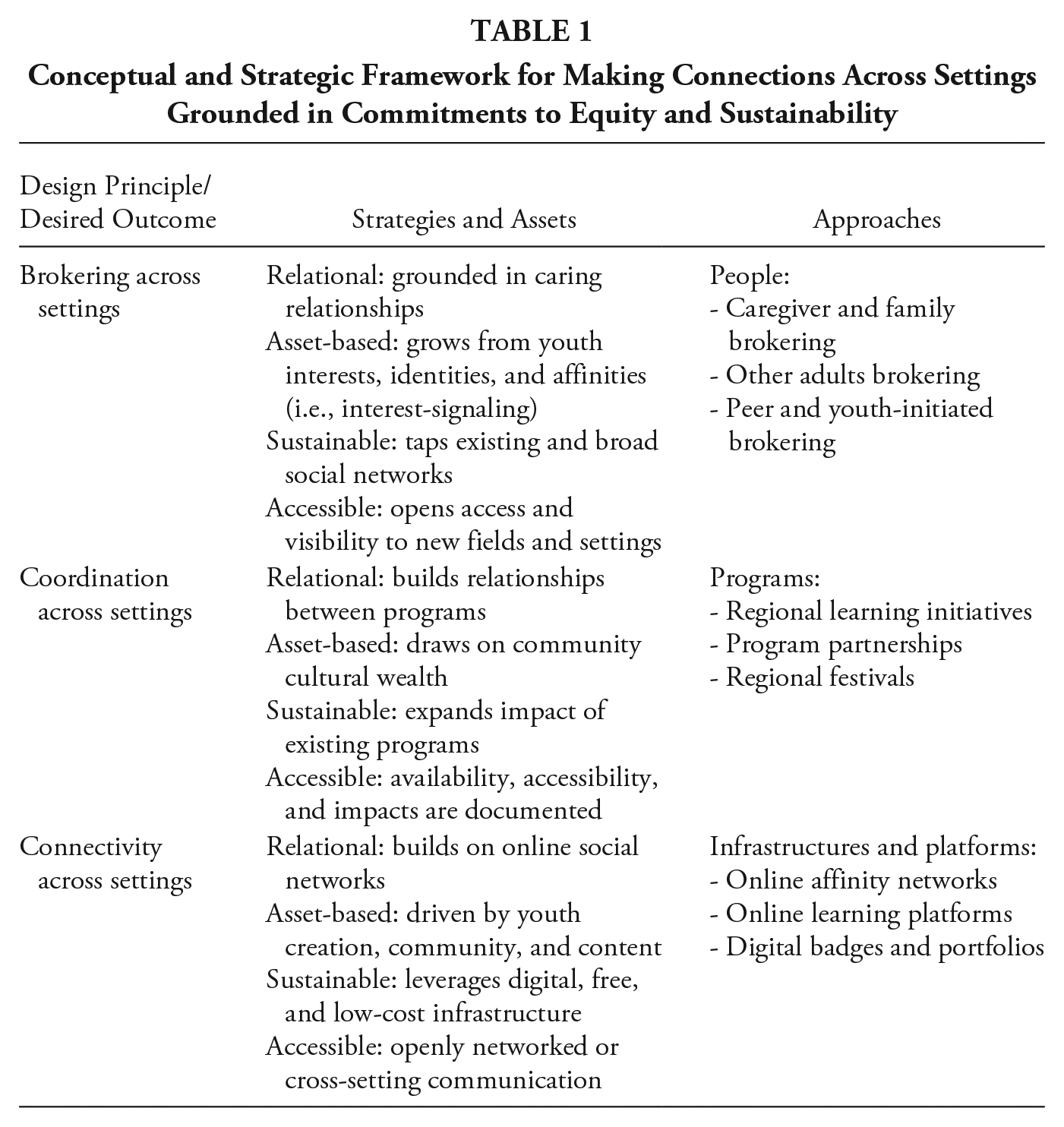
Our review surfaced a growing emphasis across education research traditions on intentionally supporting connections across settings and a wide range of efforts that embodied the approaches described in the original framework. Additionally, although the review validated the overall emphasis and high-level principles, it also suggested refinements to the framework in the form of a multilevel taxonomy and a richer set of examples. Our findings are organized based on a taxonomy of design principles that emerged in a grounded way through our review. We introduce this revised framework for connections across settings in Table 1 in the findings section, after first describing our process and methodology for the review.
Conceptual and Strategic Framework for Making Connections Across Settings Grounded in Commitments to Equity and Sustainability
Literature Selection and Methods
Connections are complex and multifaceted, and our review is inclusive of many different types of connections, with an emphasis on strategies for how OST experiences are connected across settings and in learners’ lives. In addition to the substantial research on connecting the formal educational pipeline, an important body of work has investigated how connections between schools, classrooms, and other settings are key to supporting positive youth development (e.g., Darling-Hammond et al., 2020). This chapter has a complementary focus on the unique affordances of OST settings in offering opportunities for community-connected youth thriving (Bevan & Michalchik, 2013; Morrison & Fisher, 2018; National Academies of Sciences, Engineering, and Medicine, 2021; Penuel et al., 2016; Traphagen & Traill, 2014). OST settings are often more tailored to specific youth interests, culture, and community contexts, but they also tend to be more fluid, requiring intentionality in the design of connective infrastructures, practices, and program features.
This focus on making connections to and from OST programs demanded an expansive and creative orientation to review. This meant looking beyond program-specific outcomes to consider more holistic ones, such as identity development, social connection, well-being, and community uplift. We also looked beyond transitions between formal educational settings to consider the diverse range of transitions associated with OST learning. We define OST in a broad sense, with the range of OST experiences we reviewed including ways of connecting youth to career fairs or limited-duration programs that focus on a particular topic so youth can explore an interest, connecting youth to more involved learning experiences that allow them to participate at different levels of intensity, connecting youth to real-world experiences through internships or employment, and connecting youth back to their communities through service learning or peer mentorship opportunities.
The landscape of how to support connections across OST contexts for youth is not well defined, but the connected learning framework offered an initial starting point for our review parameters. Because of the complex nature of the problem we aimed to address, we knew that a diversity of methods for finding literature to include would help us better define connections. We therefore took a grounded and iterative approach to gathering literature, which included traditional methods, such as mining databases and peer-reviewed journals, and those socially driven, drawing on our professional networks to include academic articles, technical reports, and other resources from the field.
We had three main sources for review: (a) academic databases, including Google Scholar and ERIC; (b) Elicit (https://elicit.org/), an AI research tool that uses language models to support literature reviews; and (c) a community-driven approach of information gathering and sense making over the course of an ongoing, 18-month project on making connections across settings in STEM funded by a well-known foundation in collaboration with a national STEM network.
Our review included contexts that engaged diverse populations of youth, including programs serving mixed, dominant, and minoritized groups. This choice was framed by a recognition that OST programs are often exclusionary to minoritized culture and identity and can require substantial financial resources to participate. Our intent is to understand how OST programs can reinforce structural inequality as well as mitigate it. One limitation of our review is that it focused on the OST landscape in the United States given our research expertise and background.
We used the initial connected learning design principles for connections across settings (i.e., coordination across settings, brokering across settings, openly networked infrastructure, making progress or achievement visible across settings) to search for key pieces in academic databases (i.e., Google Scholar, ERIC). Because we are focused on strategies for making connections, we reasoned that a diversity of sources, including technical and program reports, might be useful because they tend to be more practitioner-facing and perhaps would include the type of strategy language for which we were looking. With specific attention to OST experiences, we used combinations of search terms such as “making connections across settings,” “brokering,” “coordination across settings,” “openly networked infrastructure,” “visible progress and achievement,” “connected learning,” and “transitions.” We searched for and categorized relevant pieces (e.g., Jesson et al., 2011; Peppler et al., 2022; Philip & Gupta, 2020) under each of the four design principles. After a first pass on the abstracts and main findings of the gathered literature, we included six pieces under the “coordination across settings” bucket, 19 under “brokering across settings,” four under “openly networked infrastructure,” and one under “making progress or achievement visible across settings” because they all offered practical strategies for making connections. During this search, we found an additional 27 articles that did not name specific strategies for making connections but were important for our theoretical and conceptual framework (i.e., learning ecologies, connected learning).
We went back to mine for work that cited the pieces central to the in-progress review to gather additional pieces. We also explored working with the AI research tool, Elicit, to help triangulate findings. Elicit uses language models to find relevant sources related to specific research questions. Although in an early stage of development, we experimented with Elicit because our focus on connections is not as easy to search for as some other well-researched topics. Within Elicit, we asked variations of the question, “How do programs and people make connections for youth across contexts?,” which yielded much of the work we had already gathered and added 16 important pieces to our list.
Databases and AI tools can only go so far in helping outline what is happening in the broader field, and the most up-to-date, relevant, on-the-ground ways communities are producing tools and resources might not show up through traditional review methods. Therefore, the review included a community-based approach of information gathering over the course of an 18-month research project considering connections across settings. This included OST reports people in our professional network shared with us and articles we came across when implementing this research project. We added 10 to 15 new pieces through this process.
After collecting a rich group of articles guided by dual aims of focus and flexibility, we began to make sense of each design principle/strategy for making connections, further breaking these down into types of each strategy (e.g., types of peer or family brokering). This led us to additional refined searches (e.g., peer brokering) for which we went back to Google Scholar and ERIC. The findings presented here discuss the literature that surfaced across the three streamlined design principles, first centering relational support that supports connections, followed by the ways in which programs can be coordinated across settings, and ending with the ways in which digital infrastructures can foster connectivity across settings.
Findings: People, Programs, and Infrastructure to Support OST Connections
We present findings based on three high-level categories of brokering, coordination, and connectivity across settings. Table 1 offers an overview of how these three strategies manifest as design principles and types of approaches. Cutting across these three categories is a common set of values that is grounded in commitments to equity and sustainability—relational, culturally connected, sustainable, and visible. Table 1 describes how we found these values manifesting as strategies in the work that we reviewed, again, organized by the three revised design principles. This structure encompasses the connections across setting principles from the prior connected learning synthesis but integrates them into a multilayered framework that elevates higher order principles and surfaces cross-cutting design approaches.
Brokering Across Settings: The Power of People to Foster Connections
Brokering is a youth development practice that is distinct from mentoring in that its explicit aim is to connect young people to future opportunities through relational support (Santo et al., 2019). In connecting research to practice, there is evidence that effective brokering can be carefully studied and modeled as an intentional practice with strategies that can be taken up and adapted to particular contexts (Strategies for Brokering, 2019). Although pinpointing exactly what makes a brokering relationship “work” may be challenging, research has shown that strengths-based professional development may support adult after-school program staff members in having more positive interactions with young people (Akiva et al., 2022, 2023). For example, the authors found that a particular professional development experience that used videos of staff members engaging in dialogue with young people could promote staff beliefs about the importance of relational practice to their work. The act of brokering includes people who broker (e.g., family, nonfamily adults, and peers), things that get brokered (e.g., learning opportunities, social connections, institutions, and information sources), and specific practices (e.g., conversations with youth about their interests, helping youth apply to a particular program). Brokering supports the development of youth social capital, which Scales et al. (2020) defined as “the resources that arise from a web of relationships which people can access and mobilize to help them improve their lives and achieve their goals, which inevitably shift over time.”
Anyone in a young person’s social network can broker opportunities, including family members, adult educators, and peers. Teachers can be brokers for youth by connecting them to OST opportunities and experiences based on their experiences and interests they demonstrate in the classroom. Philp and Gill (2020) argued that to create more equitable after-school spaces, OST ought to be designed to support youths’ interest and identity development and link youth to critical resources for their future thriving. The authors suggested one way of adjusting this focus is to reframe the role of the after-school staff member as that of a learning broker at the institutional level and create policies that direct OST providers to focus on how brokering can support more equitable life outcomes for youth. OST providers can support youth through adult-youth partnerships that support youth voice, positive development, and social change in communities (Brion-Meisels et al., 2020).
Opportunities that can be brokered include educational experiences, social connection and network building, institutional connections, and access to information (Ching et al., 2016). The question of what opportunities are being brokered, such as a particular job, university, or other opportunity, is an especially important consideration for equity. For example, Santo et al. (2020) reported on their study that investigated the extent to which preprofessional brokering practices considered the appropriateness of a work placement site for minoritized youth of color and argued that the question of whether a workplace would be culturally welcoming was dependent on diversity of staffing, the equity orientation of the organization, and the ways that youth navigate their role within a workplace through a sociopolitical lens. Importantly, brokering can happen at different points in time throughout the duration of youth participation of an activity or program (Santo et al., 2019) and may be especially valuable when youth are first developing in their interests so they can be brokered into OST programs that relate to their interests (Van Horne et al., 2016).
Effective brokers should be responsive to the needs of the young people with whom they work. Also in the context of a collaboration with the Hive NYC network, Ching et al. (2018) researched youth interest-signaling, which they defined as “actions youth undertake to communicate their needs in ways that motivate adults and peers to mobilize resources to support them” (p. 4). The authors identified two different types of interest-signaling, what they named as “open-ended displays of interest” or “direct bids for help,” and made recommendations for educators looking to connect youth to opportunities. These recommendations include providing direct support to promote a culture of youth interest-signaling, finding ways to maintain connection between youth and program providers even after programs end, considering cultural barriers that may hold youth back from interest-signaling, and incorporating youth interest-signaling into a program’s professional development program. Sánchez et al. (2022) found that specific bridging and bonding behaviors supported minoritized youth in their social capital development. Bridging behaviors included particular practices such as connecting youth to new resources, people, and opportunities and helping to expand their social networks. Opportunities that were part of these bridging behaviors included inviting youth to copresent at conferences and coauthor publications and connecting youth to jobs. Bonding behaviors referred to the ways in which relationships were strengthened, including spending time together sharing, offering encouragement, and providing emotional support.
Caregivers and Family Members as Brokers
Caregivers and other family members find and connect youth to new opportunities, often those that occur outside of the school day. In their study of parent brokering, Louw et al. (2017) explained that parents most often chose OST programs based on scheduling and transportation needs and trying to select activities that align with their children’s interests. Parents in their study also considered how activities might introduce new interests or expand and deepen developing interests. This attunement to youth interests requires caregiver brokers who are aware of and understand how their children’s interests develop and change.
Drawing from a survey of 1,550 U.S. parents and 600 preK through eighth-grade teachers, Takeuchi et al. (2019) highlighted what they called an “enrichment gap” (see also Duncan & Murnane, 2011) that showed the top 25% of income earners spend nearly 7 times more on OST experiences for their children than the bottom 25%. One finding from their report is that high-income parents tended to solicit advice about OST opportunities from their “weaker ties” (e.g., other parent acquaintances) more than middle- or low-income parents and consult weak ties over strong ones, whereas low-income parents were more likely to consult their “strong ties” (e.g., family and close friends). By tapping weaker ties, high-income families bridge to opportunities outside of the immediate family’s professional sectors. By contrast, strong ties tend to stay within already familiar fields and professions, which is less likely to lead to exposure to new interests or expanded economic opportunity, particularly for lower income youth.
In a study of parental roles on youths’ media skills development and technological fluency, Barron et al. (2009) identified seven different roles parents took on to support learning—one of which was a “learning broker.” Youth in this study came from affluent backgrounds and had at least one parent who worked in the tech industry as a designer or engineer. Within this context, the authors defined a learning broker as the following: “Parent seeks learning opportunities for child by networking, searching the Internet, talking to other parents, and using other sources of information. Signs child up and provides necessary support for endeavor” (Barron et al., 2009, p. 64). Subcategories of brokering identified through this research included parents connecting youth to people and places, formal instruction, and taking care of transportation. These parents found or bought resources for youth to connect them to the technology they needed to pursue an interest (e.g., a parent buying and walking a child through using Photoshop software) or connected them to people in their networks who could help with solving problems (e.g., a parent introducing a child to a computer programmer friend who then collaborated with the child to debug code together). Many of these forms of brokering echo the broader efforts of concerted cultivation (Lareau, 2006) and the substantial labor and resources that middle- and upper-class families are able to invest in seeking and supporting informal and OST learning.
In contrast to brokering that centers on networking and expanding enrichment opportunities outside of the family, families also broker by engaging in joint activity and building connections to culture, identity, and community. For example, in the context of examining making and engineering practices in minoritized homes, Peppler et al. (2020) found that family members brokered resources for youth outside of school by involving youth in the making activities they practiced (e.g., asking them to help with woodworking or a sewing project), connecting youth to resources for making, explicitly teaching youth, and making alongside youth.
Cooper (2014) emphasized the value of cultural brokering for unlocking opportunities for youth. Educators, family members, and youth can all act as cultural brokers for others. By cultural brokering, Cooper and others (e.g., Civil & Bernier, 2006; Su, 2008) discussed ways of building on community cultural wealth, connecting with languages youth use at home, or explicitly connecting family expertise in weaving or sewing to math contexts. Cooper argued that the value in this cultural brokering is that it takes an asset-based approach in supporting new cultural, college, and career identities. Some of the brokering literature positions children as cultural brokers for their recent immigrant parents or other family members, often because the children are the primary English speakers in the household (Dorner et al., 2008; Katz, 2016). This work highlights the powerful role immigrant youth play in brokering cultural connections and navigating boundaries between home, school, health care, and social services.
Other Caring Adults as Brokers
Caring adult brokers that are not family members can be thought of as what Stanton-Salazar (2011) called “institutional agents,” or those with status and authority who can support youth in accessing important resources and opportunities while also contributing to the development of their social capital. Stanton-Salazar referred to a number of different types of help-giving actions and roles that institutional agents take on to support youth in this kind of development. An example of an institutional agent’s role includes that of a networking coach who supports youth in negotiating with gatekeepers and furthering their network development. He also described how institutional agents in positions of authority may be less likely to broker opportunities for minoritized youth. Nonfamily member adults can, however, act as “empowerment agents” for minoritized youth, supporting their development through brokering and instilling critical consciousness about structural inequity and the need to transform society.
Allen, Kastelein, et al. (2020) described research on professional brokers hired to connect youth to STEM learning opportunities and resources (named “STEM Guides”). These professionally hired guides had the primary purpose of making connections for youth across five rural communities. The authors found that brokers did work in three main ways, which included “pointing” (e.g., informing youth and their families about resources in their community), “supporting” (e.g., helping youth fill out applications for programs, helping to find transportation for youth, writing letters of recommendation, finding scholarships, pairing youth with mentors), and “leading” (e.g., leading a high-quality experience and connecting youth to a domain directly). Despite the laser focus on brokering opportunities for youth, the professional brokers noted several challenges to making connections across settings for youth, including limited access to transportation (especially in rural communities), cultural barriers (e.g., beliefs surrounding what STEM is for and what kind of person does it), and finally, time considerations and conflicts with other activities or sports. A major limitation of this work was that the brokers were not fully embedded in the community, and thus, the researchers suggested that the work of brokering be embedded in local educators’ identities, training, and professional practice.
Ching et al. (2015, 2016) highlighted what they named three “critical levers” (Ching et al., 2016, p. 296) for brokering to work well in OST learning settings, which include centering trust and youth interests, offering assistance to young people even after a program’s conclusion, and finding efficient ways to curate a menu of potential learning opportunities for youth. In their work with the Mozilla Hive Learning Network (Hive NYC), a connected group of OST providers, the authors aimed to explore the question of how to ensure youth can continue developing their skills, interests, and identities once their participation in a particular after-school program comes to an end. They noted key challenges reported by program providers, namely, maintaining relationships with youth after programs end when there was no consistent institutional affiliation (i.e., programs that had direct connections or affiliations with schools had a better chance of maintaining connections with youth).
Much of the literature about brokering that we uncovered looked at various approaches to mentorship (e.g., Carroll, 2014), including models that connect youth to opportunities. In their systematic literature review of precollege STEM mentoring programs, for example, Leeker et al. (2019) found that there was no consensus or a guide for running successful STEM mentoring programs with industry partnerships but did identify benefits of industry mentoring that included connections, including acting as a “gateway for internships or cooperatives” and building youth networks. They found that effective mentoring could offer young people direct experience in industry or research settings with professionals to prepare them for future careers in the field. Important for supporting equitable approaches across many of the mentoring and brokering examples, researchers also recommended recruiting those who share ethnic, cultural, and gender identity backgrounds with the young people in the program (Kekelis et al., 2017; Koch et al., 2012; Kricorian et al., 2020).
Peers as Brokers
In addition to family members and caring adults, peers and near-peers can be influential brokers for youth. Peer brokering also serves dual purposes in terms of what is gained for both the youth and the near-peer brokers themselves. Rivera et al. (2019) described how near-peer brokering can be especially effective for creating more equitable entry points to STEM learning. From their design, implementation, and study of a near-peer mentoring program between rural high school students and college students pursuing STEM majors, the authors recommended that programs regularly review the program and remain flexible to meet youth needs in different ways, provide infrastructure that supports open lines of communication between mentors and mentees, and finally, consider what the goals and main foci of the program will be (e.g., to support a connection to college, to build community capital, to network) and consistently review if the program is aligned with the intended purpose. Near-peer mentorship or brokering models can be part of an OST program’s internal making connections strategy as they build on programs’ existing capacity and benefit multiple youth (both the mentors and mentees).
The type of brokering required may look different for different disciplines depending on the features of that discipline or career path. For example, Kirshner et al. (2019) found that how youth talked about breaking into STEM included narratives about intentionally brokered pathways with institutional support. This differed from how youth described unlocking future opportunities in the context of new media arts, which included a more open and difficult to describe route. The authors suggested that when navigating a more open but precarious pathway, such as in new media arts, organizations can help to broker connections for youth by building pathways within programs and supporting entrepreneurship to help make connections toward “sustainable livelihoods” (p. 153) while building youth networks and opportunities for thriving.
The reviewed literature emphasizes the value of relational support as the center of supporting a learning ecosystem that is connected across settings for young people. In the remainder of this findings section, we review literature that includes the infrastructural elements and tools that make up the connective tissue that supports youth in navigating opportunities to further their interests in and between OST settings.
Coordination Across Settings: Programmatic Supports to Encourage Connections
Making connections requires coordinated support at an ecosystemic level, which can create more sustainable models embedded within the fabric of organizations and programs. This coordination work refers to the systems level of the work, enacted by programs, organizations, institutions, and communities to support learners and connect learning opportunities across settings through mutually beneficial and strategic partnerships. In terms of elevating practice, this coordination work can be achieved through “shared agreements and protocols [that] sustain and support youth learning through shared infrastructure, communications, credentialing, and community building” (Ito et al., 2020, p. 60). Effective coordination across settings is critical to sustaining youth interest over time because when OST organizations and programs work together in coordinated networks, youth are more likely to encounter ways to further their interest development across spaces.
Communitywide Learning Initiatives
Coordination across OST programs through citywide learning initiatives has most commonly included within-program transitions such as supporting youth in taking more advanced programming or moving to a new program at the same organization. Active efforts to connect youth to other programs and organizations is less frequent (Akiva et al., 2017). Akiva and colleagues found that leaders rarely described making connections to other OST programs outside of their organizations. They did, however, specifically describe making connections between in-school and out-of-school settings, noting that some OST programs partnered with schools to support recruitment.
Cities and counties create more equitable structures for learning when they emphasize a community-wide, comprehensive approach (Augustine et al., 2021). In the context of creating summer learning opportunities, Augustine et al. (2021) identified a number of challenges (e.g., hiring qualified staff and managing transportation to programming), enablers for success (e.g., a shared vision, strong leadership, and funding for sustainability), and early outcomes (including social emotional learning and enrollment outcomes) for the creation of coordinated networks that support such a community-wide approach. In looking across four cities, including Boston, Dallas, Pittsburgh, and Washington, D.C., the authors made a number of key recommendations for creating and sustaining coordinated networks. These recommendations included (a) setting a broad vision that allows for strategic evolution, (b) garnering mayoral support, (c) leveraging experiences of past efforts and established relationships, (d) aligning goals and strategies with organizational structure of the coordinated efforts, and (e) aligning strategies to summer programming goals. Although each item on the list is a general recommendation, cities enacted each in different ways that provide more nuance to how they played out. For example, in setting a broad vision, each city was consistent in maintaining a vision, but networks were most successful when they adopted a flexible approach to advocating for specific activities and strategies connected to their visions. Support from mayors was also used across all cities in the study, which drew attention to summer programming efforts and brought in additional funding. Building on relationships with other intermediaries, philanthropic or research organizations, and nonprofits is a strong strategy because they often have roots and existing infrastructures in cities and communities. Furthermore, building on existing organizational structures of cities was effective, such as in Washington, D.C., which built from its existing intergovernmental department organization to coordinate with school leaders across departments such as human services, police, and parks and recreation. Augustine et al. also noted the underlying conditions necessary for strategies to support coordination efforts to work. For example, developing and using an online tool to identify high-quality programs would require “(1) technological expertise, (2) the ability to populate the database with program information each year, (3) sufficient community awareness to make it a valued resource, and (4) sufficient resources to invest in development, incentives for providers, and marketing” (p. 44). Additionally, even if strategies were implemented and supported toward a community-wide approach, ongoing efforts to secure continued buy-in from stakeholders and sustainability were named as continuously important factors.
Augustine et al. (2021) referred to other studies that discussed characteristics of successfully coordinated systems (Bodilly et al. 2010; Kania & Kramer, 2011; National Summer Learning Association, 2016), with striking similarities across the sampled literature. For example, Bodilly et al. (2010) emphasized the importance of a common vision, early assessment of needs, a system to manage and track data, mayoral support, stakeholder buy-in, and funding for high-quality OST coordinated systems. Importantly, the authors found that the particular city context and mayoral support had a significant impact on outcomes and decision-making. Kania and Kramer (2011) noted particular ways networks coordinate well through managing and tracking data, including a common agenda for change, data collection and consistent measurement, an action plan that supports all stakeholders, open and consistent communication among all stakeholders, and a primary organization with sufficient expertise and bandwidth to support the coordination across participant organizations. They also emphasized the need to enlist funders committed not only to the short-term but also long-term sustainability of the coordinated network. The National Summer Learning Association (2016) reported similar indicators for coordinated networks for summer learning in particular, including a shared vision and emphasizing coordination that is citywide, engaged leadership, data management, continuous improvement, sustainable resources, and strategic communication efforts.
To keep with an approach that is culturally connected, coordination efforts should be rooted in the local community. When done in community-based ways, well-coordinated efforts can have a significant impact on how young people develop their interests. For example, in a study of STEM festivals planned and implemented in a rural community of Washington State, over 60% of students noted an interest in pursuing a STEM career as a result of the festival even though they attended for only a few hours (Munn et al., 2018). The authors of this study noted that even for a brief event, key to making the festival planning a success was coordination between their university, festival exhibitors, and community stakeholders to ensure activities and exhibitions were grounded in data, such as taking into account evaluation comments from previous years. They also prioritized making sure the festival exhibits were culturally connected by, for example, including Spanish-speaking, near-peer, college-age students to present from the community. Additionally, they helped with the cost of transportation for students and substitute teachers so that teachers from the community could attend with students who wanted to participate.
Measurement of Coordinated Systems
Measuring the effectiveness of coordinated systems requires alignment on the system’s goals and values. Drawing from a case study with the Tulsa Regional STEM Alliance in Oklahoma, Allen, Lewis-Warner, & Noam (2020) suggested that the OST field can support strategic partnerships through the creation of quality standards and continuous improvement through the development and use of ongoing measurement efforts. Their work highlighted four specific strategies to support a coordinated learning ecosystem against which they measure their work together, including cultivating cross-sector partnerships, creating and connecting rich learning environments, equipping educators with what they need to create high-quality experiences, and supporting pathways for youth. The Carnegie Foundation and the Partners for Network Improvement have developed ways of better assessing and understanding network health and development and argue that network progress relies on clearly structured roles and relationships and attention to the social and cultural identities of the network’s members (Russell et al., 2019).
In addition to supporting youth as they move across learning settings, coordinated approaches can also support innovations in practice. For example, Santo et al. (2015) found that in the development of a community organization’s makerspace as part of the Hive Network, organizational leaders called on their networks for inspiration and validation of their designs and understanding the organizational design processes of their network partners. This kind of coordination across settings through the organization’s existing network strengthened the local makerspace’s design, development, and implementation.
Asset-Based Approaches
Coordination work fostered by youth-serving institutions is essential for cultivating more equitable connection building that counteracts structural inequalities, connecting youth to networks of economic opportunity that enrich and draw from existing capacity in their families and communities (Allard & Small, 2013). An asset-based coordination approach recognizes the myriad forms of expertise youth bring with them across learning settings and honors the histories of engagement youth have with different cultural activities (Gutiérrez & Rogoff, 2003). Bell et al. (2013), for example, told the story of a young Haitian girl who spent time at home talking about and practicing chemistry by mixing her own perfumes while this activity came as a complete surprise to her teacher in school, who (as they described) “though the girl was lazy and was surprised to see her become highly excited and engaged about a science curriculum unit at the end of the year” (p. 119). In well-coordinated networks, youth interests, the activities with which they engage across settings, and their repertoires of practice (Gutiérrez & Rogoff, 2003) are more purposefully and readily recognized and incorporated to support their learning and development both in and out of school. At a systems level, coordinated systems that account for youth repertoires of practice recognize “learning as movement” and attend to the horizontal forms of expertise in which youth transform and appropriate practices instead of reproducing dominant practices (Gutiérrez et al., 2017, p. 45).
Connectivity Across Settings: Forging Connections Into Infrastructures and Platforms
Digital networks, tools, and platforms offer an infrastructure that can support connection and coordination across settings in new and powerful ways. A growing body of research and development has focused on how digital infrastructures and platforms have been taken up to foster learning that is connected across settings.
The connected learning framework suggests that openly networked infrastructure can offer support for youth “to share their work, skills, and knowledge with others across networks, groups, and communities [to] boost social connection and support engagement and a sense of relevance” (Ito et al., 2020, p. 61). On these online networks, young people might blog or write about their OST program experiences or other interest-driven learning, share in-progress or finished artwork or other projects, and build audiences for their work. Some examples of openly networked infrastructures that support learning include online communities and the built-in social components that connect youth through their interests, such as Scratch or Minecraft. These types of communities help youth in finding and building identities with respect to interests that matter to them.
Santo et al. (2016) described how the free/open-source software movement offers models for developing educational networks, emphasizing that professional learning communities can be organized in ways that innovate rather than just reflect on practice. Drawing from their work with Hive NYC, Santo et al. named participation structures that support a “working open” approach, which include in-person events, such as regular meetups and pop-up learning events; community and small group calls; and online sharing, such as through project portfolios and a network blog. This disposition toward “working open” provides for more open sharing and the creation of support networks or affinity groups of people with similar interests.
Online Affinity Networks
Ito et al. (2018) suggested that online affinity groups can bridge learning across settings and that these types of online communities where youth engage around shared interests ought to be easily available to more young people at school and in their homes. Online affinity networks are characterized by specialization and specificity of interests, intentional and voluntary participation, and the openly networked nature of online platforms. Importantly,
the creative production of online affinity networks becomes visible and searchable to broad audiences. While young people are also engaging in private communication and face-to-face encounters with peers they meet through their online affinity networks, the circulation of content and communication on open and public networks is a distinguishing characteristic of online affinity networks. (Ito et al., 2018, p. 45)
The varying ways that young people can participate in online affinity networks, even by simply observing others interact in the space, makes them especially valuable when youth are first exploring an interest, whether in an OST program or in a different setting.
Online Learning Platforms
Using examples from work with the Digital Youth Network (DYN) OST program (Pinkard et al., 2017), Pinkard (2019) argued that focusing on the connective tissue “between” learning opportunities and “people, programs, and places” (p. 59) can create more equitable learning environments that are connected across settings. In the context of these examples, Pinkard described iRemix, a private online social networking tool for youth created by and for the community, that served as connective tissue between school, after-school, and home spaces that DYN youth used to share and discuss their media arts work with one another. Like other equity-minded researchers, Pinkard’s work and the locally relevant example of iRemix emphasize drawing from existing community infrastructures to build systems and programs that move with youth across the spaces where they learn. The iRemix platform supported learning within a particular community, yet DYN was also part of the team that developed the Chicago City of Learning (CCoL), a website that tracked youth participation in OST programs across the city (note that CCoL had strong mayoral support and so was part of a coordinated effort to help youth make connections across settings).
Like the examples of iRemix and CCoL, other locally relevant tools can connect youth and their families to rich OST learning opportunities. For example, Cho et al. (2019) designed and studied the development of an automated, free subscription SMS service that sent their sample of low-income families periodic text messages in English or Spanish, depending on preference, with locally relevant and specifically tailored information on OST learning opportunities. An example message from the study read, “Here’s a really special opportunity for girls ages 10-18. Program X has a daily summer camp from July 24-August 4, 1pm-5pm in [name of location] completely free.” Based on their work implementing this service, they suggested that when designing for equity in openly networked infrastructure and approaches that connect families to resources, researchers and designers ought to take an “asset-based/human-centered” (p. 2) approach to design that builds from communities’ existing cultural and social practices, or funds of knowledge (Moll et al., 1992), rather than imposing interventions from a top-down, outsider point of view using a needs-based approach. Through their research that instead took a hybrid asset-based/human-centered design perspective, Cho and colleagues found promising practices for connecting low-income families to OST learning opportunities that built from existing community and cultural practices and the ways that families draw on their existing networks.
Although peer interactions in online communities are central, attention to adult-youth interactions in these openly networked spaces is also important to supporting the development of youth interest and thriving. For example, Nacu et al. (2016) developed a framework to support the ways that adult mentors interact with youth in an online environment. Through this framework (which they called the “online learning support roles” [OLSR] framework), they defined different roles adults take on within the context of a learning environment (e.g., that of an evaluator, learner, someone who models, someone who instructs) and emphasized that discussion of these roles, when to take certain ones on, and the OLSR framework can support discussions of productive practice about the design of online networks. Furthermore, even if they are not on the front lines of interacting with youth on an online platform, teachers can be trained to evaluate online resources that provide materials for students in STEM (White & Wasburn, 2006), such as researching the organization that compiled the resources.
Digital Badges and Portfolios
Digital infrastructure can support visibility of learning across settings through digital badges or portfolios that can be shown to peers, academic contexts, or industry professionals as proof of experience or mastery (Keune et al., 2021; Peppler & Keune, 2019). When youth have opportunities to produce artifacts or engage in activities related to their interests—such as through specialized courses, competitions, and other formally or informally organized events—they can find ways to mark progress so that their experiences and developing expertise can be shared with the communities to which they are connected or want to be connected. By tracking their progress across settings, youth can signal their interests and skills to a broader community and find ways to connect to new affinity networks to develop their interests and identities in new ways.
Learning scientists have been increasingly attending to the ways new technologies track and study mobility across spaces (Marin et al., 2020). Location-enabled devices and wearable cameras can spark new dialogue about tracking activity or progress across settings. As one example of this line of work, a data ethics activity called Re-Shape (Shapiro et al., 2020) has students collect data on their own mobility and compare their own data to that of peers using open-source software to reflect on their data. This “socio-technological infrastructure” (Marin et al., 2020, p. 271) presents new challenges and possibilities for tracking youth progress across contexts. Possibilities within this line of work include GPS data sparking reflection for youth on the places where and activities on which they spend time and apps helping them identify new opportunities in close proximity to where they live or go to school (e.g., museums, OST programs).
In the context of makerspaces, youth are motivated to make and sustain portfolios when they gain recognition within communities about which they care, when the portfolio development models professional portfolio practice, and when they can explore new communities or disciplinary boundaries (Peppler & Keune, 2019). Importantly, having one’s work recognized both within and across communities means that portfolios or other ways of making progress and achievement visible need to meaningfully connect youth to new opportunities and people, not simply stand as a static marker of development. Importantly, although the idea of making progress or achievement visible across settings might suggest a focus on individual learners, portfolio practice might embrace a more sociocultural approach that builds community across settings. For example, through analysis of youth digital maker portfolios, Keune et al. (2022) found portfolio practices that shared artifacts and portfolio development and connected youth to new communities, shared individual and collaborative achievements, and made social engagement with the work visible.
Digital badges are another more well-known example of how progress or achievement can be made visible across settings. Some research suggests that digital badges have the potential to promote equity by making visible new learning pathways to youth (Pitt et al., 2019). Digital badges are a way of signifying one’s accomplishments in that they provide a visible marker of progress and achievement, acting as an alternative sort of credential (Gibson et al., 2015). One example of one of these badge systems was DIY.org, which had a system of over 150 different skill badges youth could earn and display as part of their profile, which students could use to build their networks and social capital within the DIY community. A systematic review of digital badging in education found positive effects on learner participation, task completion, and motivation; however, there is a lack of consensus as to the educational benefits overall (Roy & Clark, 2019). These findings align with our sense that the tools are a means for supporting connections, but it is how they are implemented and reinforced through infrastructural and relational supports that will determine the extent to which they are effective or equitable.
Discussion
This review focuses on a relatively underappreciated body of literature on the evidence and practices of making connections to and from OST settings. The review provides a novel view into how to foster equity through OST programming by organizing OST research and programmatic examples in relation to their connective properties. In turn, it refines and fleshes out a prior framework and taxonomy of connective practices put forward by connected learning scholars. This review and synthesis offers three contributions to the field of syncretic education research in the service of equity and thriving: (a) making visible both equity-oriented and exclusionary connective OST practices; (b) offering a lens and taxonomy through which to locate connective OST approaches and outcomes at individual, programmatic, and infrastructural levels; and (c) identifying equity-oriented outcomes that focus on connection and network building.
Surfacing Connective Practices
Brokering and coordination practices in informal settings such as family, community and OST settings are powerful drivers of learning and opportunity but are often implicit, invisible, and understudied. By reviewing a wide and varied literature, this review surfaced ways in which families and educators broker connections in informal ways that can reinforce existing inequities and intentionally designed efforts seeking to build more equitable learning ecologies. From young people supporting one another in online affinity networks and community-based programs to citywide learning initiatives sponsored by a mayor, a focus on connections across OST settings recognizes the diversity of stakeholders, innovators, organizations, and organizers that support learning ecosystems for youth and community thriving. This focus offers an antidote to the tendency for research, practice, and policy to operate in silos of disciplines and organizational sectors by highlighting common connective approaches that operate across sectors and settings. Rather than focus solely on the efficacy of individual programs and organizations, this view offers insight into supports across the young person’s landscape of learning and considers connections that need to be integrated and culturally and community connected to advance equity.
Locating Connective OST Approaches in Equity-Oriented, Ecosystemic Efforts
Synthesizing a large quantity of literature, this review builds from the connected learning framework to put forth a grounded, multilevel taxonomy for understanding how rich and diverse examples emerging across the field of OST learning relate to one another and are united by often implicit common values and design orientations. By reviewing a more extensive body of literature, this synthesis refines and expands on the prior connections across settings framework (Ito et al., 2020). This refined framework and taxonomy locates connective practices at three levels: (a) human actors’ role in building on youth interest and brokering connections, (b) programs’ role in coordinating across settings by building relationships between programs, and (c) infrastructures and platforms that support visibility and connectivity across settings. Connective strategies and assets at these three levels have been further analyzed according to how they reflect equity-oriented approaches of being relational, asset-based, sustainable, and accessible. By organizing OST approaches within an ecological framework, it locates a wider range of programs and practices within efforts to support connected and equity-oriented learning ecosystems.
Equity-Oriented Outcome Measures to Support Connections
The broader goal of this review is to support the building of common cause and mobilizing the field toward coordinated action that can foster more equity-oriented learning ecologies that tap the full potential of OST settings. By surfacing the concrete practices and design approaches of connecting and coordinating in OST settings, our hope is to draw attention to relational and collective outcomes that are often underappreciated, such as fostering visibility across settings and developing cross-sector relationships, programmatic coordination, and the flow of young people in and out of programs. These types of outcomes and indicators generally take a back seat to documenting attendance and individual learning outcomes within specific programs or organizations. This review has surfaced how lack of attention to these connective practices leaves significant barriers in place and how intentional work in this area is having demonstrable impact. Our hope is that by focusing on and framing these often hidden dimensions, this work will inform policy and funding investments that support making connections across settings. These could include shifting a focus from evaluating programs on headcount alone to fostering convenings of programs and organizations or the development of infrastructure to allow stronger connections across organizations within a geocentric area. In turn, this could have implications for programmatic investments in supporting youth across settings as they consider how young people are brokered in and out of their programs. Our findings also align with emerging calls for practice to move beyond mentorship to offer professional development for culturally and community-connected equitable brokering practices and modes and methods to unpack youth interests in ways that help youth develop their identities and connect them to work, civic, or social networks and to recognize the role of families and peer brokers into youths’ learning. Our hope is to contribute to growing momentum to think beyond the success of individual programs and organizations to work more collaboratively across sectors and disciplines to support more equitable and learner-centered ecosystems.
Footnotes
Acknowledgements
We would like to thank Joey Huang and Emily Schindler for their early research assistance.
Funding
The author(s) disclosed receipt of the following financial support for the research, authorship, and/or publication of this article: This research was funded, in part, by the STEM Next Opportunity Fund (Award No. 2021001) and the Gordon and Betty Moore Foundation.

Authors
MAGGIE DAHN is an associate project scientist at the University of California, Irvine. Maggie engages in design research to study how people learn in different contexts, and her background as a visual arts and classroom teacher informs her perspective on how children and youth learn in and through the arts, the affordances of art making for the development of voice and identity, and issues of access and equity in arts education. She completed her PhD at UCLA’s Graduate School of Education & Information Studies in 2019 with support from an NAEd/Spencer Dissertation Fellowship. Maggie’s work has been published in the Journal of the Learning Sciences, Computer Science Education, Teachers College Press, Arts Education Policy Review, and Learning, Media, and Technology.
KYLIE PEPPLER is a professor of informatics and education at University of California, Irvine, who engages in research that focuses on the intersection of the arts, computational technologies, and interest-driven learning. Her work has been consistently supported by the National Science Foundation and a range of foundations, federal, and industry partners, including the Gordon and Betty Moore Foundation, the Spencer Foundation, and the Wallace Foundation, among others. Dr. Peppler currently sits on the editorial boards for the International Journal for Computer Supported Collaborative Learning and Computer Science Education and has recently served as guest editor for the British Journal of Educational Technology, Sustainability, and Digital Culture in Education.
MIZUKO ITO is the director of the Connected Learning Lab, Professor in Residence and John D. and Catherine T. MacArthur Foundation Chair in Digital Media and Learning at the University of California, Irvine, and cofounder of Connected Camps, a nonprofit providing online learning experiences for kids in all walks of life. Her work decodes digital youth culture for parents and educators, offering ways to tap interests and digital media to fuel learning that is engaging, relevant, and socially connected. Recent publications include Algorithmic Rights and Protections for Children; Affinity Online: How Connection and Shared Interest Fuel Learning; Equity by Design in Learning Technologies; The Connected Learning Research Network: Reflections on a Decade of Engaged Scholarship; and Social Media and Youth Wellbeing.