




Abstract
The movement from STEM to STEAM, with its emphasis on real-world applications, promises to meet the changing needs of a globally connected world. However, the potential of transdisciplinarity to inspire and deepen our understanding of who we are and how we make sense of a world in turmoil remains undertheorized. This article makes a case for repositioning STEAM education as democratized enactments of transdisciplinary education, where arts and sciences are not separate or even separable endeavors. Drawing upon posthumanist theorizing, three projects will exemplify transdisciplinarity across music, mathematics, and science education. Transgressing and transcending disciplinary boundaries, and attending to both human and nonhuman perspectives, we invite a rethink of the work of schools, going beyond democratizing creativity to fully enact posthumanist transdisciplinarity.
Introduction
Being creative educators in the 21st century is inspiring, but increasingly complex. Educating children and young people to be positive, engaged, active, global citizens has become even more relevant in the face of the complex societal challenges of global health crises, climate change, disruptive geopolitical events, and rising inequalities. Caught between a future of environmental and social instability on the one hand, and technological and technocratic determinism on the other, the relationship between democracy and education is profoundly challenged (MacBeath & Moos, 2004). As neoliberal forces continue to reinforce instrumental approaches, both in society as well as in education, many authors across the social and the natural sciences are calling for a new science (Caniglia et al., 2021) offering new insights for research and practice in education (Cole, 2021). Key steps towards such a new science include the repositioning of the non-human (materials, machines, environments, and other living forms, such as plants and animals) in research and questions about what matters and what counts as knowing; and, in so doing, to rethink democratic participation. This new science troubles the role of creativity in education by unlocking multiple viewpoints and multiple logics, seriously asking which creativity we are educating for (Glaveneau, 2018).
Aim of This Chapter
In this chapter, we advance the debate on new ways of thinking about the co-authoring of transdisciplinary creativities, and their potentialities for democratizing education research and practices. By bringing together three projects in which the authors have been directly involved, we make a case for repositioning STEAM education as democratized enactments of transdisciplinary education, where arts and sciences are not separate or even separable endeavors.
STEAM is a relatively new acronym in education which refers to the combination and synergistic interplay of science, technology, engineering, and mathematics (STEM) plus the arts. While original contributions aligned STEAM as a continuation of STEM (Cultural Learning Alliance, 2017) and largely as the assemblage of scientific, technological, and artistic disciplines driving the promise of employability and economic growth, a rich and lively debate has developed in the literature on the particular collocation and/or definition of the arts. Ranging from visual and performing arts, digital media, aesthetics and crafts, and even the liberal arts and humanities, the ‘A’ in STEAM can serve a range of different purposes (Colucci-Gray, Burnard, et al., 2017). In its simplest form, the arts may add instrumental weight to scientific and technological developments, for example, by creating new consumers’ needs via marketing and advertising, or using dramatized performance to increase the appeal of science for the general public. Such is the position espoused by those seeking to infuse creativity into science by means of the arts, in order to add to science innovation and impact potential (see Thurley, 2016, Segarra et al., 2018; Brown, 2019). Similarly, in science education, approaches to transfer science content in a more creative way are well documented (Colucci-Gray et al., 2019. They range from the use of drama to model abstract processes (e.g., the four seasons; the digestive system) or the use of poems and songs to remember new or complex words to the integration of art-centric skills, such as visual thinking, recognizing and forming patterns, and the hand skills learned by using tools, or pens, as a means to further develop STEM inquiry abilities (Root-Bernstein & Root-Bernstein, 2011).
However, while such approaches have garnered success, they are largely driven by a vertical discourse (Colucci-Gray et al., 2019) which presumes that arts and sciences—deployed to serve a given agenda or curriculum—are necessarily appealing or even accessible to everyone (Mejias et al., 2021). But it is also a position that denies serious engagement with the intrinsic and diverse values of artistic and scientific practices, in ways that may be meaningful for a diversity of students, and may offer a broader range of educational experiences (Davies & Trowsdale, 2021). In this sense, an instrumental view of STEAM may fall within the admonition of Biesta (2020) as a form of education which may get (some) students to “pursue their own learning trajectories, define their own learning needs, but never interrupted” (p. 2). At best, such are the students who remain anchored within themselves; at worst, these are the students who remain unable to pay attention to the world in which they take form and that gives them form. The trouble with education in this sense will not be the lack of art or creativity in science. Rather, as we have seen with the recent surge of interest in environmental action amongst young people, a different form—and a different aesthetic—of education is being asked for (Colucci-Gray, 2021): one that enables a more fluid exploration of the multiplicities and meetings of sciences and arts; that arises from within learners’ socio-cultural, economic, and political conditions; and that asks serious questions about whose world we are educating for.
By bringing together three STEAM-related projects as case studies from three different educational contexts (primary and secondary education, and teacher education), this chapter draws upon and challenges these tensions. Confronted with the homogenizing forces of global performance and those demanding justice, we seek to re-configure the educational space as a site for pluralist/transdisciplinary dialogue. We argue that creativity and the expansion of diverse and multiple creativities are not democratized when opposing agendas in education dictate the implementation of fixed, dis-embodied, fractured practices. This condition may apply equally across geographical contexts, from early years and primary education to secondary contexts, whenever teaching equates to instruction and performance according to pre-existing parameters, overriding difference (of local and lived experiences, languages, communities) by teaching to the test. Rather, the democratization of diverse creativities—at all levels of education—requires moving away from right–wrong, body and mind dichotomies, by re-thinking the roles of educators and those who are being educated engaging in practices that are co-authored, co-produced, relational, and communicated in ways that are co-constitutive of democratic ways (Burnard & Loughrey, 2021).
Situating our research within pedagogical practice, we push forward with theorizing in this field by starting from a deeper understanding of “STEAM” as “configurings,” that is, as enactments of learning processes drawing together and synthesizing different epistemological and methodological approaches, where knowledge creation is always engaged in action. First, we begin by defining the term “transdisciplinarity” and proceed to examine its role in troubling established disciplinary conceptions of knowledge. In our analysis, we draw upon the contributions of feminist and post-humanist theorizing on diffraction (Barad, 2007), which also informs the reading of the three case-study examples that we present later as STEAM enactments of democratizing creativities.
Why Does Transdisciplinarity Matter?
Transdisciplinarity has been described as: a practice that transgresses and transcends disciplinary boundaries . . . and seems to have the most potential to respond to new demands and imperatives. This potential springs from the characteristic features of transdisciplinarity, which include problem focus (research originates from and is contextualized in “real-world” problems), evolving methodology (the research involves iterative, reflective processes that are responsive to the particular questions, settings, and research groupings) and collaboration (including collaboration between transdisciplinary researchers, disciplinary researchers and external actors with interests in the research). (Russell et al., 2008, pp. 460–461)
While advocating integration, transdisciplinary thinking does not exclude disciplinary thinking. Instead, transdisciplinarity seeks to de-couple the specific language of a discipline from its original context, opening up new possibilities for viewing and experiencing the same phenomenon from a different position. Arguably, transdisciplinarity is at the core of creative scientific thinking, as shown by the ways in which researchers seek out new words to describe natural phenomenon by drawing from different and often discontinuous realms of personal experience (Sutton, 1992). For example, concepts such as “web,” “cell,” “vessels,” or even networks emerge from the creative act of bringing together the specialist knowledge of a discipline with the experience of an everyday occurrence. In a similar fashion, shifting established lines of demarcation in the use of language—by inviting other actors, contexts, and different points of view—opens up opportunities for new interpretations, and for the reconsideration of values underpinning linguistic choices. This interpretative stance provides the setting for transdisciplinary inquiries. As Perry (2021) reiterated, for transdisciplinarity to come into being, a different professional stance is needed, one which embraces “pluriversality,” meaning the “surplus” of meanings and ways of learning which enables the complexity of a changing world to come into the realm of our experience.
While transdisciplinary inquiries are taking hold in research fields across the sciences, arts, and humanities, less is known about their application in educational contexts (Steiner & Posch, 2006; Taylor & Ivinson, 2013). Differently from multi- and interdisciplinary inquiries, in which researchers come together to contribute knowledge in a cumulative manner, transdisciplinary research relies on researchers and practitioners working together to learn from one another, address a social mission, and deepen the value assumptions underpinning research agendas (Klein, 2015). Transdisciplinary educational practices are documented across a wide range of educational phases, from early childhood education (see Lindgren, 2020) to higher education (see Bayley, 2018). However, as Takeuchi et al. (2020) note in their literature review of transdisciplinarity in STEM, there was little evidence of “critical and expansive conceptualisations of transdisciplinarity” (p. 223) within the 154 peer-reviewed articles they reviewed. Examples where there is evidence of transdisciplinary practices include collaboration amongst teachers and teacher educators in Australia (MacDonald et al., 2019) where the STEAM agenda appears to be growing. In reporting their own experience of transdisciplinary, multi-site, live-streamed STEAM professional learning, the authors illustrate dispositions and qualities that transcend their disciplines, such as empathy, openness to new ideas and experiences, “bravery” as openness to failure, and trust (Smith & Henriksen 2016). Further theorizing on transdisciplinary ways of working are also emerging from authors in the field of the arts, drawing on feminist and post-humanist approaches—as discussed by Chappell et al. (2019)—and arguing for the importance of “learners and teachers bringing their own lives and . . . curiosities into their becoming” in fluid, stretchy entanglements (p. 309), whereas Bayley shares examples of arts-based practices developing “embodied and affective ways of . . . pushing the boundaries of human-centred thinking towards new territories” (2018, p. 9).
In this view, creative educational experiences are democratized as part of a multiplicity of ways of both making sense and making a difference to the world; yet, these are not seen as separate endeavors, but as a form of transdisciplinary creativity enacted through what we introduce here as “diffraction,” both a methodological and a pedagogical tool.
Transdisciplinarity as Diffraction
A term originally derived from physics, diffraction refers to the pattern of light and dark resulting from the passage of light waves through a slit (or another medium, such as the water surface). Depending on how the size of the slit and the amplitude of the wavelengths compare, the spreading of the light may be more or less accentuated. As Barad (2007) maintains, using an optical metaphor to review matters of knowledge and method is a powerful tool for deconstructing ideas of knowledge as representation, which have become dominant in the Western world. Through representation, words are taken to mirror a reality out there, whereby the world is categorized and objectified through its component parts. From this it follows that education—conceived largely as a cognitive process of representation and assimilation—will require tools—which may be digital, linguistic, or more broadly artistic—to enable transfer from abstract reality to experience, regardless of the individual or unique conditions and experiences of the students.
By going against the mirroring metaphor of representationalism, diffraction is not concerned with sameness, but with understanding differences from within, attentive to fine detail (p. 91) “as a commitment to understanding which differences matter, how they matter and for whom” (p. 90). In this sense, diffraction is used methodologically to trouble humans’ arrogance of locating knowledge and meaning making only in the human subject and mind and thus to resist the “epistemic violence” (Braidotti, 2019b, p. 39) done by humanism, by reinstating learning and experience as fundamentally relational and involving the more than human world. This orientation is not anchored in binary logic, but rather recognizes that knowledge(s) is/are only ever partial, and is/are not static or separable from the living and non-living world (Haraway, 2016). Similarly, in education, transdisciplinary creativity and creative learning will be re-purposed beyond simple acquisition of concepts in order to queer boundaries of either discipline or method, and nurture new understandings of our dependence on others, humans and non-humans.
We take this as a generative point of departure for reformulating the purpose of STEAM education as a forum of encounter of diverse disciplines, which offers the opportunity for revisiting and transcending hierarchies of knowledge to promote new, affective and material relational configurations: a process of democratization of education.
In making this case, we organize the chapter into three parts. In Part 1, we provide a critical reading of the literatures across music, arts, science, and creativity education to highlight current debates and timely shifts in thinking connecting with contemporary debates on transdisciplinarity. We then draw upon Deleuze and Guattari’s (1988) ontology with its attention to the forces of life (and creativity) as multiplicities, and Braidotti (2019a) on renewing the mechanisms of knowledge production in the educational discourse. Using Deleuze and Guattari’s (1988) terminology, we will call our re-reading a “de/re-territorializing” as we will both deconstruct assumptions and reframe the discussion by including non-human influences, and being open to transdisciplinary inquiries. In Part 2, we describe three STEAM-related projects conducted in three different educational contexts, each one offering a particular instance of creative educational experiences illustrated as entanglements of humans and non-humans in tactile and aesthetic engagement with materials—playdough and mark making with pencils—and the growth of living things. The cross-case diffractive analysis of the three cases provides pointers for understanding the philosophical and practical features of democratizing creativity in transdisciplinary inquiries. Such a diffractive analysis involves reading insights through a plurality of theoretical perspectives (Mazzei, 2014), not as a normative linear movement, but more akin to the movement of a rhizome or creeping rootstalk which pushes outwards, sending out roots and shoots as it spreads and intersects with the shoots of other stalks. This metaphor of the rhizome, as it was originally adopted by Deleuze and Guattari (1988), refers to a way of knowing driven by affective, discursive, historical, socio-cultural, and material conditions, naturally exceeding the disciplinary “gaze,” and inviting different sets of questions and alternative ways of “seeing,” “knowing,” and “doing” of both education and research. Finally, in Part 3 we pull out the emerging “lines of flights” (Deleuze & Guattari, 1988) from across the three projects which speak of new insights and new directions for democratizing creative educational experiences. We conclude with some recommendations for research and practice.
Part 1: Literatures Revisited
The review of the literature presented here synthesizes key debates occurring in each disciplinary community with a view to advancing the potential re-reading of each field from a posthumanist stance. As described by Braidotti (2019a) as one of the first original thinkers in this field, posthumanism is a concept that originates in science fiction, futurology, contemporary art, and philosophy to describe a state or condition in which human life is inseparable from nature, thus disrupting claims of human exceptionalism or “man as the measure of all things” (Haraway, 2016). This philosophical stance impacts on the way of handling the literature by departing from cumulative knowledge exercises and architectural metaphors of “finding the gap,” in order to propose, instead, a revisiting of value assumptions underpinning knowledge claims, and to operate discursive moves along different viewpoints. As Haraway (2016, p. 12) reminds us: “it matters what ideas we use to think other ideas with,” so the literature is not used as a means to consolidate a singular truth, but to disclose and enact differential readings which push against the hierarchy of the normative, exclusionary, and taken for granted: “it matters what matters we use to think other matters with; and it matters what stories we tell to tell other stories with” (Haraway, 2016, p. 12). Across the different fields of music, science, math, and creativity education we introduce both the consolidated view and the posthumanist turn to de/re-territorialize education.
De/Re-Territorializing Music Education
Music is a creative subject and inherently a making subject. We make music together, we make composition, and we make sounds. Music making is such a ubiquitous term in music education that there is little critique and consideration of what the term “making” actually relates to. It is widely accepted that “Music-making of all kinds . . . should be at the centre of the music curriculum” (Elliott, 2005, p. 7). Yet, we constantly live with the trouble caused by this, whereby not all making is considered equal. Learning through making is difficult to explain explicitly, and difficult to record and assess (Allsup, 2016; Fautley, 2015; Regelski, 2016).
Definitions and explorations of the term making in music education are often absent or narrow. As a result, a number of interlinked critiques of how making is considered and enacted in music education can be drawn. One such critique is that making is perceived as a “tool.” Here the medium (music) and the materials (instruments, sheet music, environment, etc.) are used to achieve an already planned outcome through a linear process. This is an outcome-driven view of making, in which the focus is on “a prescribed, even ‘right’ sound, rather than offering opportunities for rich, divergent sound exploration” (Hill, 2018, p. 54). Allsup (2016) explicitly argues against this kind of music making by suggesting that there is a distinction between students as “making, not merely doing . . . [where they are] not merely executing the master’s bidding” (p. 103).
This aligns closely with another form of making in music education as a “sound demonstration” of learning, a presentation of knowing through doing. Here, again, making is used to provide a means by which learning can be made explicit, as a sounded signal of completion. In practice, this view emphasizes fluency and accuracy (of performance) as a way of judging success or, within a composition context, the inclusion of expected conventions, ideas, or stylistic clichés. As Thibeault (2015) notes, there is an inherent tension between music education practices that promote the achievement of a polished product, something that is final, and an inclusive music education, which requires different values and design.
Making is also often aligned with developing discrete musical skills (see Fautley, 2018; Fautley & Murphy, 2016). As Allsup (2016, p. 16) argues, “We have a problem of backward design,” where achievement and accomplishment are “located in the mastery of observable and measurable skills” which are pre-known, building progressively towards a level of difficulty or standardized notion of what proficiency involves. This “rule learning” focuses attention on controlled forms of making, towards standardization, reification, and abstraction (Spruce, 2012; Regelski, 2016) at the expense of making as entangled with self, or context.
Underpinning all these practices of making in music education are notions of human exceptionalism and control (Haraway, 2016, p. 30), of matter as inert in the making process, and of individualism in making. A posthumanist reading can invite a new reading of the democratic ideal in music education, re-seeing making as “making with,” giving distributed power and presence to all those involved in the making: bodies, materials, spaces, feelings (Braidotti, 2019b). This creates a shift from controlled making to “making with” as a dynamic response, rooted not only in a telling of past events, but staying in the present, exploring how the materials and relationships make with us at this moment in time. This making allows ideas and actions to surface in the in-between of form and matter, humans and environments. It is about staying with what happens (Haraway, 2016), rather than pushing aside the unexpected, complex, or divergent as unimportant.
De/Re-Territorializing Science and Math Education
Like music, science is also a creative and a making endeavor. Primarily concerned with understanding the world, science has notoriously engaged in making models and figurative representations of the world, thus shaping culture and cosmologies. However, the dominance of the economic, neoliberal discourse in education in recent years has favored its more instrumental purpose, and creativity in science is often bound up with neoliberal discourses serving economic imperatives (Adams, 2013; Ball, 2016; Davies & Bansel, 2007).
Characteristically, debates on the meaning of scientific literacy are underpinned by age-old conceptions about the universality of science, which have served capitalist and colonial endeavors and have been translated into prescriptive ideas of curriculum in education (Davis, 1996) whereby creativity is seen by teachers as additional at best or as a privilege (Hetherington et al., 2020). By the same token, the science curriculum in schools, built upon what was deemed solid and prestigious, has been riddled with longstanding problems about what to include and what to exclude, as scientific research and social demands keep changing over time, posing new problems and new priorities for teachers and students to address. Such a reductionist purpose is at odds with an understanding of science education that promotes citizens’ action and participation in science as well as in society (Colucci-Gray et al., 2013; Colucci-Gray & Camino, 2014; Krasny et al., 2011). For example, science education can promote participation in science by: (1) building awareness of the impacts of science and technology on different communities; (2) questioning the values underpinning particular research and development agendas; and (3) enabling pupils to make use of science and technological knowledge to meet their own needs (Calabrese Barton & Tan, 2009).
Similar tensions can be seen in mathematics education, holding fast to the “detemporalised idea of mathematics . . . detached from human time and experience” (Davis & Hersch, as cited in Davis, 1996, p. 59). More than any other subject in the sciences, mathematics is held up as the epitome of pure abstracted knowledge, reducing and imposing structure on an amorphous and objectified reality. Such ideas continue to pervade the field of mathematics education, shaping the practices of teachers (Davis et al., 2020).
While prescription is writing that occurs in advance and aims to converge to what is deemed the ideal, proscription is open to what is different, divergent, and what may be made possible (Davis, 1996). Significant developments in science education which strive for an understanding of science and mathematical knowledge from a proscriptive, enactive, and posthumanist stance have sprung from an attention to the materiality of learning.
For example, a socio-materialist view of the science laboratory informed by feminist new materialism (Barad, 2007) as advanced by Hetherington et al. (2018) critiques the widely used protocol-based experiments designed to demonstrate an established truth and favors the dialogical and material nature of learning in science. Such an approach ranges from greater emphasis on reflecting on the setup of an experiment to redesigning and reconfiguring the experiment by refocusing on materiality and aesthetics (Takeuki et al., 2020). Going beyond the science lab, place-based approaches emphasize sensorial and embodied experiences as the prime locus of learning and cognition (Gray & Colucci-Gray, 2019).
Also in math education, greater attention is given to the embodied lineage of mathematical thinking, such as taking measurements or carrying weights. Sensory encounters enable us to draw relational engagements with an ecology of materials as “one measures a bowl with water, or water with rocks, or rocks with hardness” (De Freitas & Sinclair, 2020, p. 100796). Mathematics education is therefore well and truly emplaced in embodied activities as modalities that are “bound together” in an ecology of practice, which Deleuze and Guattari (1988, p. 31) referred to as “minor” gestures.
Rather than conceiving of mathematics learning as the rule and the norm, a “minor” (or nomadic) account distributes itself in space, thus creating an opportunity for entirely different measurements to emerge (de Freitas & Sinclair, 2016). In this way, humans and non-humans partake in the same way in the process of knowing; not by taking a position from above or from outside but by engaging in practices through which “the world is differently articulated and accounted for” (Barad, 2007, p. 149).
In sum, the reading of literatures across the three fields of music, science, and mathematics education signals that a shift is indeed in operation: from understanding subjects as bodies of knowledge to re-viewing knowledge as distributed across social, embodied, and material relations (Taylor & Ivinson, 2013). We now turn to the field of creativity education to identify potential lines of fracture, intersection, or alignment that will integrate the transdisciplinary inquiry assemblage.
De/Re-Territorializing Creativity
In contemporary society where students interact with media and technologies in everyday experiences, multiple creativities and innovation skills have gained increasing importance. Reid and Petocz (2004) argue that the concept of creativity varies from discipline to discipline, hence the need to pluralize the conception as multiple. The word creativities addresses and acknowledges different and diverse enactments. These are both emerging and continuously re-made through material enactments which are co-authored together. This authoring of diverse creativities arises in and permeates everything at the level of classroom practice. The evidence of multiple creativities can offer differentiations specific to language, mathematics, science, music, and art that are interdisciplinary, transdisciplinary, collaborative, communal, digital, every day, spatial, environmental, and pedagogical (Burnard & Haddon, 2015). In the field of education, creativities are not reducible to simply “innovation”; in the field of business, the meaning of creativity is sometimes taken as “entrepreneurship”; in the disciplines of mathematics and science, creativity is equated with “problem solving”; and in the discipline of music, creativity can include “compositional,” “improvisational,” and “performance” creativities. The role that creativity can play in learning has long been considered by educational scholars such as Craft’s (2011) “possibility thinking” or Beghetto’s (2016) “creative learning” and “mini-c” constructs. There are meta-analyses that empirically demonstrate a relationship between creativity and academic achievement and creative learning in the classroom (Gajda, Beghetto et al., 2017; Gajda, Karwowski et al., 2017). It has been argued that creativity can foster learners’ original thinking, increase their engagement in the learning process, and boost their motivation (Kaufman, 2016; Kaufman & Sternberg, 2010); it has also been identified as an important component of problem-solving and cognitive skills (Plucker et al., 2004). The incorporation of creativity into curricula is an increasingly popular topic in the field of education (e.g., Amabile, 1996; Craft, 2011) as well as in various other fields (Bloom & Dole, 2018; Csikszentmihalyi & Wolfe, 2014). Creative pedagogy refers to teaching that enhances creative development via three interrelated elements: creative teaching, teaching for creativity, and creative learning (Lin, 2011). Cremin et al. (2006) argue that three core elements of creative pedagogy must be present if it is to facilitate the development of creativity: standing back; providing opportunities for learners to initiate activities or make choices; and giving them time and space to develop new ideas. Creativity has also been described as the ability of individuals to create novel and valuable ideas or thoughts, and to analyze, polish, and assess their own or existing ideas to increase creative efforts and routinely produce creative results (Perkins & Simmons, 1988). What constitutes a creative person was further elaborated by Robinson (2015), who stated that the skill of creativity enables individuals to think at their own pace, to identify and solve crucial problems. Viewing creativity as a cultural and systemic value, Zhao (2012), a thought leader on creativity, entrepreneurship, and entrepreneurial students, argues that the jobs of the 21st century will need workers who have flexibility, adaptability, innovativeness, and creativity.
Gardner (2006) argued that a creative person questions the status quo and is not afraid of failure when challenging accepted ideas. Williamson (2011) highlights that: a creative act is the production of a solution to a novel imperfectly defined problem, and, whether in science or the arts, this requires the clear definition of the problem and the view of a best answer as identified by the problem solver. (p. 42)
While his findings are insightful, his argument perpetuates the old binary that “science aims to explain natural observable processes in the world while the arts aim to interpret the world through the expression of the artist” (p. 42). MacKinnon (2005) outlines three different types of creativity. The first is artistic creativity, which includes the creative person’s inner perceptions, needs, and inspirations. The second is scientific creativity or technological creativity and it deals with novel solutions to problems of the environment but demonstrates little personality of the creator. The third is known as hybrid creativity and it is found in fields such as architecture, which demonstrate novel solutions to the problem as well as the personality of the creator. Arguably, this creative hybridity has been attempted in recent pedagogical innovations such as maker education. While creating spaces for problem-solving, cross-discipline, and creative activity within and beyond educational settings (Schad & Jones 2020, p. 70), the maker movement is significantly underpinned by constructionist and constructivist frameworks. This alignment focuses attention on the cognitive, learning gains from making, recognizing that “many of the conversations on the maker movement are framed around improved motivation, positive attitude towards STEM subjects, and improved learning outcomes in specific content areas” (Schad & Jones 2020, p. 70), and that the discourses and practices of aesthetics and the arts continue to be suppressed, and the material continues to be viewed as inert objects or artifacts (May & Clapp, 2017).
If transdisciplinarity, as we argue throughout this chapter, is the means by which new research practices can ensure change, and if the work of educators is to creatively apply the latest education research and thinking, transcending paralyzing policy, then how can we reformulate change agendas to democratize creative educational experiences? How can we inspire educators and policy makers to mobilize new models of authoring change? And how do we learn to support and scaffold new ways of knowing, being, and doing, to enhance children’s distinctive and diverse styles of creativities? Research has shown that children’s imaginative renderings of knowing, seeing, thinking, and doing are very different to those of adults (Barrett & Tafuri, 2012; Burnard & Younker, 2008; Hickey-Moody et al., 2021; Murris, 2016; Murris et al., 2021). How can we create quick and nimble change solutions and alternative ways into new subject disciplines, and new ways of working collaboratively at the individual and collective level? These are exceptionally important questions that require significant shifts in current theorizing and practice in education.
Why Posthumanism Matters in Creativity Education
Socio-material accounts bring up the possibility of new readings of creativity that address the development of the subject, or how one becomes in relation with others. Posthumanist scholars such as Barad (2007), MacLure (2013), St. Pierre (2020) and Braidotti (2016) encourage us as researchers and educators to take up the concepts of “entanglement,” “transdisciplinarity,” and “intra-action” to track down the very many ways that humans are enfolded within and intercede in hybridized creativities. We also seek to problematize—and keep troubling—the ontological and epistemological perspectives that separate subject and object, thus shifting creativity from the intellectual realm and centering the democratizing of creativities in dynamic processes of being and becoming. We aim to work towards a conception of dialogue whereby participants are simultaneously students and teachers: “a collective knowing and doing: an ecology of practices” (Haraway, 2016, p. 34). So, drawing on the synthesis provided by Braidotti (2016), we draw upon three main “slits” of diffractive analysis: (1) the notion of matter as vibrant, or inventive life, stressing the self-organizing force of all living systems (Fraser, 2006, as cited in Braidotti, 2016); (2) a posthumanist performativity to define human and non-human interactions; and (3) a living ecology, which transcends the notion of power as the masculine, white body, to recover the notion of power as potential, that is, the unfolding and becoming of the subject in relations.
This position on knowing puts creativity at the service of democratic participation by enabling the inclusion of diversity and difference, of languages, and modes of knowing and being. That is how creativity may fuel “curiosity” in learning: not in the sense of uncovering a reality out there, but as a way to critique the politics of the visible, enabling a redistribution of what is seen and heard in a learning environment, understood as an assemblage of physical, emotional, psychological, and affective forces (Deleuze & Guattari, 1988, p. 400). As Coole and Frost (2010) advance, materiality is plural, open, complex, uneven, and contingent: new materialist ontologies “understand materiality in a relational, emergent sense” (p. 29), with a focus that extends from globalization to issues of identity.
From this perspective, we are not simply trying to democratize creativity beyond individualized concerns. Instead, we are seeing creativity as the realm of ethical inquiry (Braidotti, 2019b): as the ability to see through different eyes; interrupting patterns of exploitation; forging alertness to the political and cultural dimensions of the educational space; and enabling children and their teachers to explore the unknown and unexpected. We now turn to evidence from posthumanist readings across three projects involving transdisciplinary creativities in STEAM configurations.
Part 2: The Evidence From Three Projects
In this section we interrogate the notion of transdisciplinarity and reinforce the notion that transdisciplinarity is at the core of democratizing creative educational experiences. A central, overarching question guides the diffractive analysis across all three projects: “How do science and arts teach together and enact democratizing creative educational experiences?” As we undertake a diffractive reading of the evidence from a posthumanist stance, we look at and interpret the empirical materials through different viewpoints, aided by the posthumanist literature that is offered here as reading with and again without (Haraway, 2016; Jackson & Mazzei, 2013).
In analyzing the evidence collated by the authors working across different educational contexts in the three studies, 1 we capture the deterritorialization of disciplines, and how transdisciplinarity is performed and galvanized through diffraction. The three studies were selected and brought together here to speak to one another as they bring together experiences across international contexts (the United Kingdom and South Africa); across academic and practical subjects (music, math, visual arts, science, and gardening) and across different student populations: further education, teacher education, and primary education. Following Cole (2021), the three studies were not selected for comparison according to features determined at the outset. Rather, they are offered here as experiences in which we—as authors—have been personally involved, in the frame of a science that “is open to the changes and perturbations of the real” (p. 103). The diversity of subjects and participants enables us to explore a wide range of diffractive possibilities of educational discourses centered on representationalism, which underpin our dissatisfaction with the traditional proposition of “STEM plus arts,” and the search for radical methodological innovations.
As explained earlier, diffraction understands phenomena as inherently different and differing in terms of time, space, and matter, but also as deeply relational. Different to analysis which is informed by a set of identifiable categories or themes, the potential of diffraction is explored as movement, relational intensity, and affective difference (Rotas, 2015), as part of sensorial ecologies of embodied practices. The same can be said for its troubling of the outdated hegemony of siloed disciplines with their “either/or” logic (Braidotti, 2019b, p. 39). In a similar vein, by using diffraction we refrain from trying to justify our projects as tools for more creative or effective mastery of concepts and skills; instead, we wish to add detail about the new science (Cole, 2021) and how this can help us uncover new and different dimensions of what it means to be educated.
First Project: Re-Territorializing Music Through Transdisciplinary Improvisation
In the first project, working with music student teachers, we identify and theorize a posthumanist transdisciplinary pedagogy of “making with” (Cooke, 2020). Exploring “teaching as improvising” challenged habitual relationships between humans and non-humans, explored and extended ways of knowing, and disrupted disciplinary assumptions about the passivity of instruments and materials through emerging notions of vibrant matter. De-coupling the term “improvising” from our music education context also allowed the materiality of science and the materiality of music to meet, re-territorializing the term “improvising” and our experiences of it and, as a result, allowed “making” to be done differently.
Initially, the “pluriversality” (Perry, 2021) of the term improvising—and similarly of the term “instruments”—was not immediately and explicitly recognized by the group of music student teachers, where some noted an initial discomfort with the term, linked to their previous experiences of musical improvisation. Therefore, the project involved exploring together, revealing connectivities, generating opportunities to traverse disciplinary boundaries in order to keep the term and our understandings of it dynamic and fluid. Through this constant movement we were re-experiencing and repositioning our bodies, our assumptions, and our relationships with each other and our material world.
In the course of the project this posthumanist transdisciplinary exploring created a diffractive “melting pot” of different improvising practices and experiences. These different forms of improvising emerged from literature, experiences of the group in the project’s workshops, experiences of the group when teaching in schools, serendipitous events which caught our attention during the project, and past experiences. They included theatre improvisation (with the roles of accepting, blocking, and status play), contact improvisation dance (paying attention to the role of touch, and ideas of moving/feeling with), natural world processes (noticing variation in response to environment and material relationships), artistic perspectives (particularly fauvist, cubist, and sculptural works of improvisation), and experiences of early childhood (noticing play as improvising and children’s body–matter relationships). Allowing these posthumanist transdisciplinary experiences to diffract with our music discipline views of improvising was to diffractively “make with” each other a different understanding of the term, which was not only a linguistic construct, but a different “lived,” experienced, felt, and embodied understanding. It was not a deterritorialization as a destructive shift away from our disciplinary knowledges and experiences, but a constructive remaking, a re-territorializing, to find new experiences, words, and relationships, which all provided generative ways to democratically and creatively re-view our practices of teaching, teacher education, and music education.
A significant part of the retelling of improvisation was the intra-action of our bodies and materials, where neither was inseparable from the other and neither was hierarchically superior. This was most explicitly seen when we improvised with playdough. The initial contact or entanglement with the material was sometimes hesitant, sometimes bold, but always an exploration together (see Figure 1). What can my hands and you, “the playdough,” make together? What will you allow me to make? What will I allow you, “the playdough,” to become?
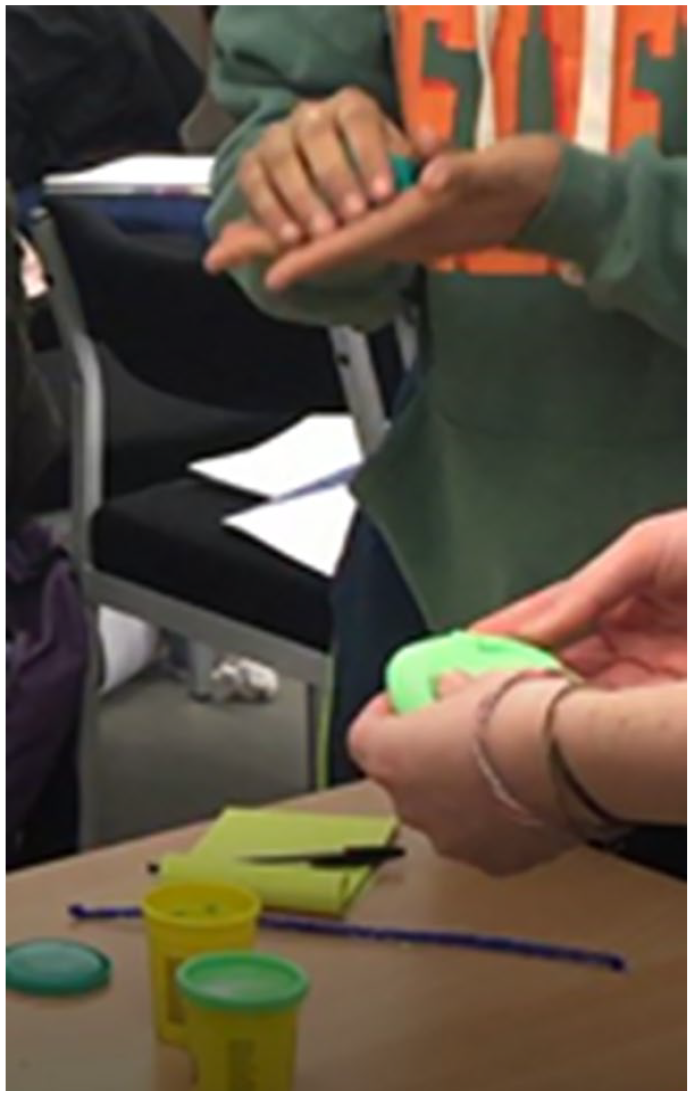
“Playing Out” of Body–Matter Intra-Actions
Some of the group moved quickly onto trying to make a form, trying to impose themselves into or onto the material, with a hylomorphic view (Ingold, 2009) of making and our relationship with the material world. However, our experiences were not an easy story of inert matter (hylo) yielding to the human-designed form (morphic). There were many moments of improvising the body–matter relationship where the initial plans did not work as expected, where different approaches or strategies were needed, or where forms had to develop into new ideas.
Our transdisciplinary exploring of improvising in physical, touchful, playful, material entanglements made us pay attention to the inseparability of improvising within body–matter relationships. In these relationships neither human nor more-than-human materials could dominate or impose themselves on the improvising, which was a becoming together in vulnerable, creative, democratic intra-action. This raised significant questions for us as music student teachers and teacher educators about the role of materials, the role of bodies, and the role of exploratory making in our classrooms. It “troubled” notions of the teacher as facilitating making practices with already expected outcomes, and the separability of teacher/pupils, pupils/materials, teacher/materials in making. Instead, it asked us to re-territorialize making in music education as mutualistic and dialogic, where we are all entangled in vulnerable relationships of making with each other (Braidotti, 2019a; Haraway, 2016).
A second retelling of improvising through our transdisciplinary exploring was our in-the-moment attentionality to voices. This was not just an audible “hearing” of spoken (or written) words, but instead was a re-hearing of voice in improvising as equally belonging to humans and materials. Developing Trausan-Matu’s (2020) argument for a polyphonic view of collaborating in relationships, where there are many “interanimating voices” (p. 455), our experiences of verbal, musical, and material improvising incorporated polyphonic “intra-animating” voices. This was most explicitly seen in a sequence of musical improvisation (see Figure 2) in which a pen emerged into the space.
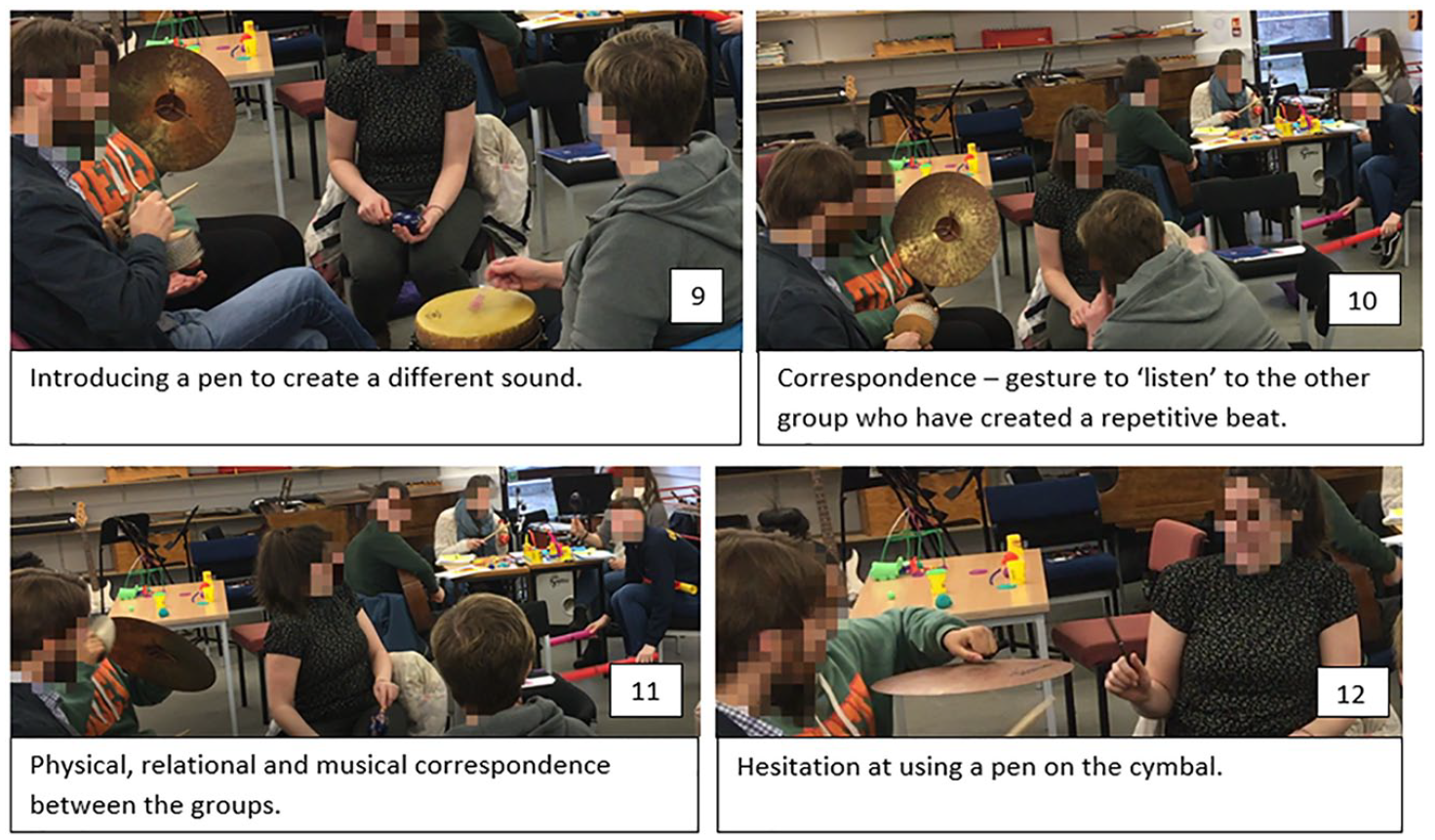
Intra-Animate Improvising Voices
The pen, as synonymous with classroom environments, was “already part of the dialogue” (Hetherington & Wegerif, 2018, p. 31); however, changing the use of the pen to being an active voice in the improvising was not only to change its role, but to interfere with perceptions of who or what is allowed in the musical space (Allsup, 2016). The voice of the pen was not separated or isolated but was intra-animated by bodies, by its entanglement with the other voices in the improvising, by touch and by sight. It was “animated” not only by the sound it produced within the group of music student teachers at the front of the room, but through its ability to pull the attention of the other group in the room towards its voice. In becoming part of the vocal polyphony, it changed the story of “voice,” “instrument,” and “sound,” queering previous expectations, routinized behaviors, and concepts of what was expected, what was allowed, and what voices were privileged in the space.
This retelling of voice within improvising as one of polyphony between human, material, bodily voices—each contributing and making us pay attention—raised questions about our teaching practices. It asked us to consider what voices we privilege over others in our classrooms. Which voices do we allow to be intra-animated, or do we block some from “voicing” themselves as part of making? What are the implications of intra-animating voices for notions of agency and student voice in decision making within the classroom?
This troubling of our existing disciplinary notions of improvising was not to dismiss them, letting go of our disciplinary experiences and understandings of improvising. Rather, it was a significant enhancement, an entanglement which led to deeper, more attentive understandings of our practices and the creative, generative power of allowing improvising to be understood in more-than-disciplinary-expected ways. Evidence from this example points to the first dimension of a reconceived form of education and of being educated—as first outlined by Biesta (2020)—that is, moving away from students as the object of education to being subjects of their own action. The first level of evidence provided here is thus a re-ordering of priorities made visible in music making by the shift from an act of delivery (of the script, or the composition) and mastery of the materials/instruments, to a place of understanding the difference that students can make in their own entangled being, being attentive and attending to the demands of a world in the making.
Second Project: Re-Territorializing Math and Arts Through Mathartworks
The second study features the diffractive reading of one of 200 drawings of the meeting of mathematics and visual art (what we called “mathartworks”) created by secondary school students (Fenyvesi et al., 2019). This example will bring into focus the contribution of transdisciplinary creativity.
Euclid’s statement: I made it clear that Mathematics could have a positive or negative impact. A few examples of how we experience Math daily are measurements of our clothing; which is why you will see the right side has measurements that are in centimetres which is used to measure clothes. Clothes require accurate calculations together with the fact that our bodies are asymmetrical; which you see, the left side does not look like the right side. The simplicity which is how the effect of maths has been ignored and neglected. It shows the reality of Mathematics, that even though it is interesting and effective, Mathematics could prove to be stressful especially for stressed teenagers who have other interests. His head is slightly bowed to show the negative impact. The hands which cover the face are an indication of frustration. The answers to the equations represent that there is always a solution. I placed the equations on different places to show that there are different ways to get the answer. The two sides have different shading as indication to the positive (simple art, no shading) and negative (complicated side with shading) influence of the subject on a person. I call it “The Stressed Vitruvian Man.” It’s a modern version of Da Vinci’s Vitruvian Man with his arms open and legs spread out.
This young man’s drawing (Figure 3) focuses on himself, his hair, his hands and his body, and shares how he thinks of and experiences the consequences of mathematics education. It seems that this young man’s understanding of learning is based on an essentialist view where he is judged (and seen here to be judging himself) in relation to his own mathematical development and progression, and status (or lack of) as a mathematician. The monotonality reflects different shades of black with strong cultural references. The bi-tonal hands are productive of difference that comes to matter, with cultural associations of anxiety, emotions, and bodily reactions which connect and take action with/in his body. He communicates stress, solemnness, and seriousness. Does this produce a view that normalizes young people in accordance with dominant views on mathematical development?
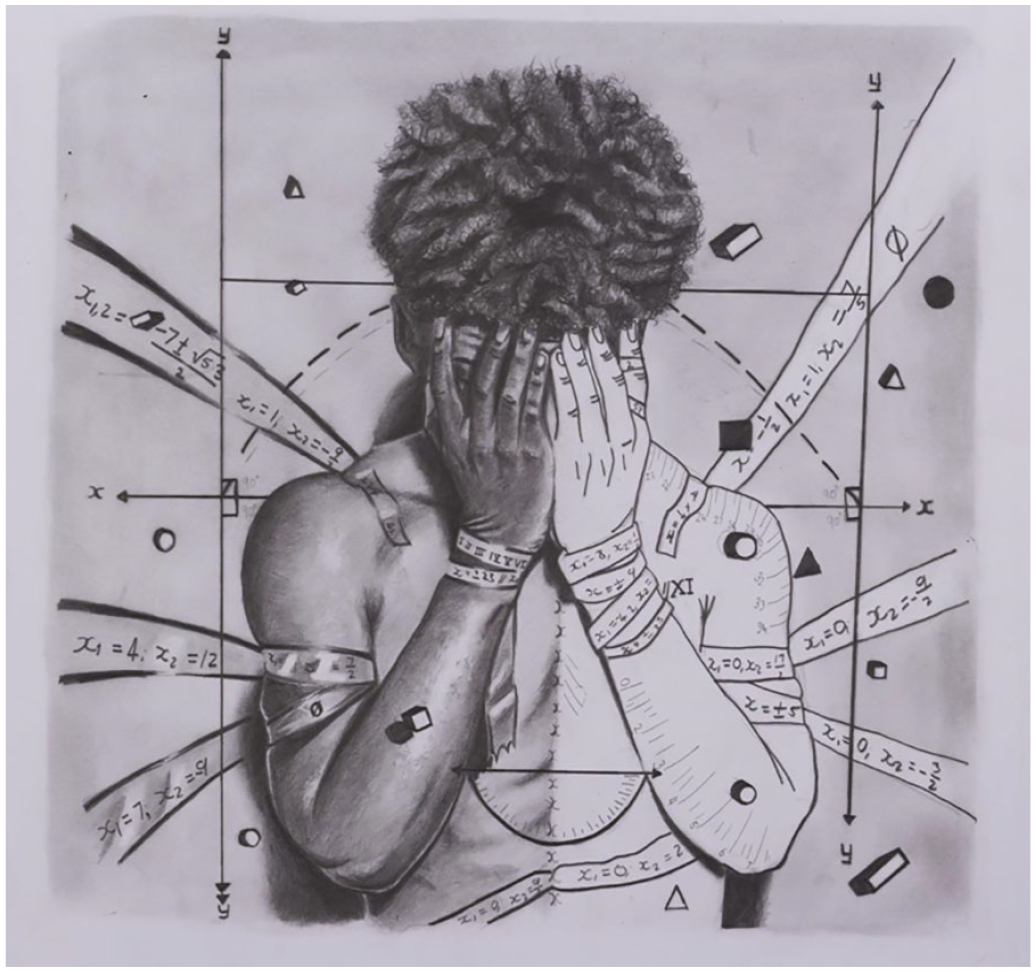
The Stressed Vitruvian Man by Euclid
This young man seems not to separate mathematics from art. He seems to be thinking with and through the relational nature of mathematical concepts, expression, and form. We also see that the human body is the seat of mathematical knowledge. Euclid’s art reveals that he is a knowledge producer: He is making with mathematics and art. We connect with a young man and his creative educational experience of mathematics and art, which is inscribed on his body.
What else is going on here? Karen Barad (2007) argues that you cannot isolate knowing from being, since they are mutually implicated. We see this clearly in this drawing (Figure 3), which is putting to work a mediated image of Leonardo da Vinci’s Vitruvian man. We see a close material-discursive relationship, displaying what appears to be more than a subject–object divide. As Karen Barad states, “knowing is a matter of part of the world making itself intelligible to another part” (2007, p. 185, emphasis added). We connect with a young man. We connect with the math equations inscribed on his body, from his body, through his body. We see the math doing something to him, stressing him out, closing him down. All of these are overlapping forces. They are entangled with/in his body, clothes, gestures, and emotions in the production of his realities as he becomes The stressed Vitruvian man. With his head held and almost hidden between his hands, with just a tiny peephole to see through, his divided body and divided encounter with mathematics materializes in the careful pencil shading. Barad (2007, p. 91) states very clearly that the point is not that knowing has material consequences, but “practices of knowing are specific material engagements that participate in (re)configuring the world.”
What do we hear in the commentary about the learner questioning and experiencing feelings, ideas, shifts in consciousness, and an imagining of different realities? Could he be trying to suspend disbelief and work in fictional contexts using a range of mathematics devices, dilemmas, and demands? Could this be an expression of deep understandings about the need to enact and embody mathematics learning and about his making the familiar strange inside the art “work”? Euclid is thinking with and through mathematics and art and making new patterns of thought (superimpositions), deconstructing power-producing binaries (mind–body, mathematics–art) and showing how these disciplines overlap and change in themselves in intra-action, being concerned with what they do and how they are connected and co-constituted.
This sample of drawings that we called mathartworks (Figure 4) provides further evidence of making with mathematics and art; the power of the other to act to its fullest degree in transdisciplinary creativity. Mapping the posthuman within education research and within education settings is a complicated and lively endeavor. This project aligns with the previous enquiry in raising a new awareness of the dominant discursive and material forces at play in music, mathematics, and art. These have the power to transform or reconfigure a new transdisciplinary field, where disciplines can be integrated, making a multiplicity of connections while enacting a creative educational experience of another’s reality. Returning to our evidence of a new form of education, diffraction pointed to a re-purposing of math as a tool for description (as the anthropometrics of body features, race, and gender) and to a process of interpretative freedom about one’s being and one’s presence in the world.
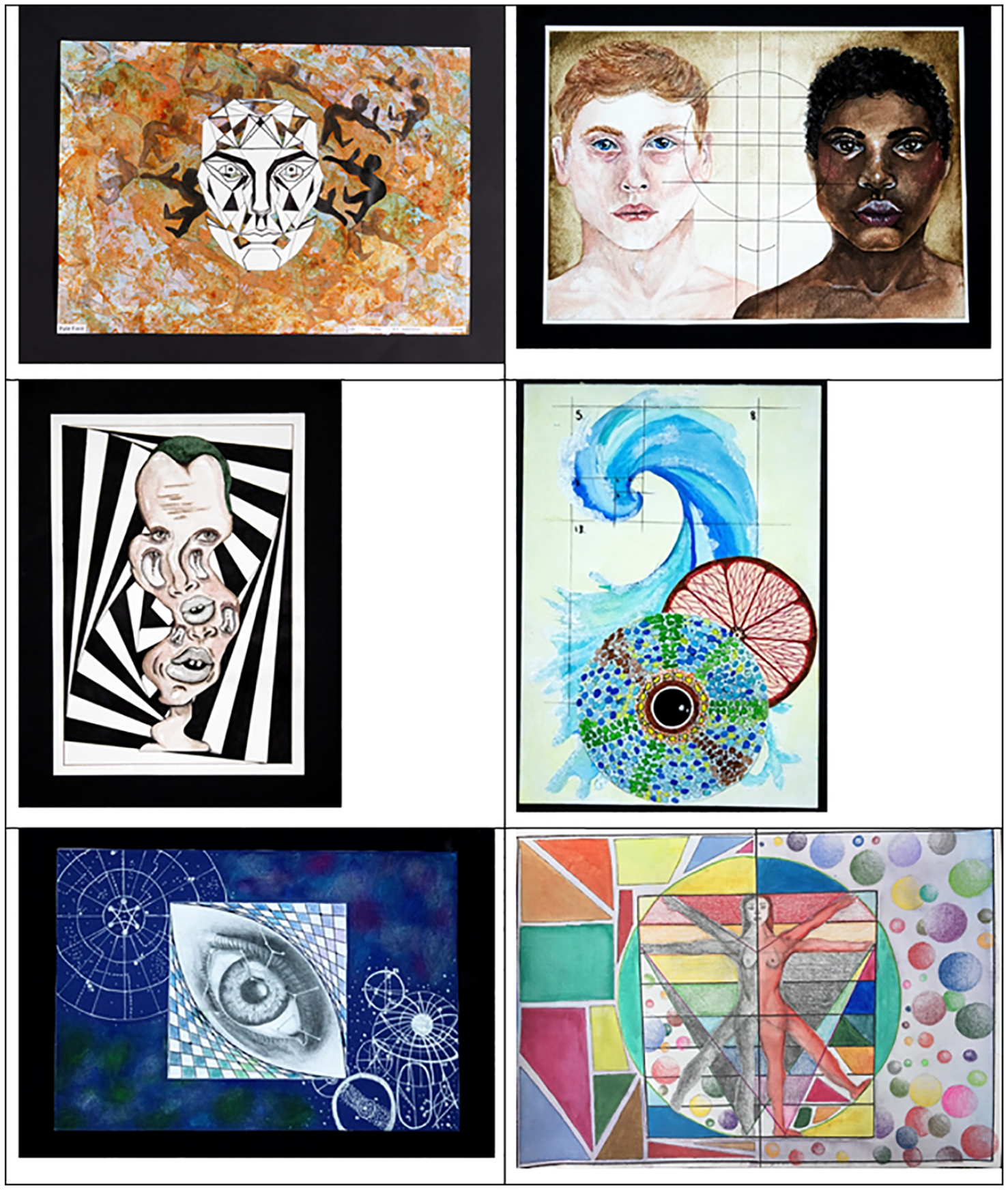
A Sample of Other Mathartworks Drawings
Third Project: Re-Territorializing Science Through the Act of Cultivation: The STEAM Garden
In the third project, in a very different context, primary school children redefined the politics of space in the school grounds through being involved in a food-growing project (Gray et al., 2019). This diffractive analysis of curricular discourses through children’s experiences uncovers the underlying problem of how to justify this as an activity of value for both children and teachers. The project was originally set up “from above,” thanks to funding made available by the city council’s plans to support communities in areas of economic deprivation in the city. Largely seen as infrastructure, the garden was set up in the school as a space for material production (e.g., food), although there is also evidence that gardens have been used as a means to improve children’s learning across different areas of the curriculum (Ohly et al., 2016; Passy et al., 2010).
In recounting this project, however, we are concerned with gardens as heterogeneous assemblages where arts, sciences, and human and non-human agencies meet. As Deleuze and Guattari indicated, assemblages develop in unpredictable ways around actions and events, “in a kind of chaotic network of habitual and non-habitual connections, always in flux, always reassembling in different ways” (Potts, 2004, cited in Fox & Alldred, 2015, p. 401), and work like “machines” (Deleuze & Guattari, 1988, p. 4) that do something, produce something. This notion of “production”—that being the production of material biomass or the production of learning gains—was diffracted in the garden space through divergent discursive lines, from the linear model of extraction/accumulation (of resources, or learning) to the exploration and impetus of the rhizomatic (whereby resources and learning are distributed over a material/relational ecology). Here we provide a selection of “instances” retracing the events and illustrating the enactment of transdisciplinary creativities.
The Plants Need Water
It was an unusually dry spring after the seeds had been sown in the garden, and children were allocated a day of the week to go out into the garden and water. It soon became clear that the plants were calling for more. The watering of the plants was a high-stakes matter for the children, which superseded normal curricular commitments. As predicated by Braidotti (2016, p. 159), we should look not at what entities are, but at their material effects—what they do. As the plants were stretching out and growing into the garden space, growing also was the preoccupation and care of the children who were tasked to repurpose old plastic milk bottles as improvised watering cans. This was a manifestation of a classic form of scientific creativity—as expressed in design and problem solving (Zhao, 2012)—and a familiar dimension of STEAM practices whereby the “arts” stand for the creative impetus, the playful ability to stimulate different ways of seeing, put at the service of an engineering or scientific problem. However, from a socio-material perspective, this type of engagement with the craft of making and design also re-focused the attention of children and their teachers onto the “demands” made by the plants and the socio-material affordances of the learning environment. In the garden, the agency of the children and the agency of the plants, the weather, and the soil intra-acted to produce a new educational and heterogeneous assemblage whereby each element contributed to the making of the others. As Haraway maintains, learning to stay with the trouble of living and dying together on a damaged earth requires sympoiesis, not simply making new things, but “making-with.” “What is at stake. . .is a theory of ecological relationality that takes seriously organisms’ practices, their inventions, and experimenting crafting interspecies lives and worlds . . . an ecology inspired by the feminist ethic of response-ability” (2016, p. 168).
The Act of Cultivation
As the plants continued to grow, so did the children’s status in the school, from pupils and learners to children-gardeners-cultivators. In the acquisition of skilled practice there was a cultivation of an acquaintance, of a relationship of familiarity, of kinship. Figure 5 shows the features of the ecology of mutual experimentation where species met through attentionality, affective connections, entanglements, and significant ruptures with previous patterns of linear production. Children and teachers learnt from and with each other, and they all learnt with and from the living organisms taking form in the garden. A garden is therefore not simply a space of inert matter waiting for humans’ creativity to impose a design or a shape, as in traditional conceptions of science and mathematical knowledge (see Davis, 1996). The very act of cultivation of the garden depends on its existing “wild” nature, that is, the agential capacity of matter; the web of microorganisms and insects in the air and in the soil, and the seasonality and quality of the earth. As Miller (1993, p. 72) states, “The garden matters to people because it mediates between various ‘oppositions that define human experience’, such as ‘man and nature’ or ‘action and contemplation.’” In that sense, gardens are not simply an education about specific plant species and the rate at which they may be grown, but are also an education about ourselves, how we grow, how we learn, and the qualities we can develop.
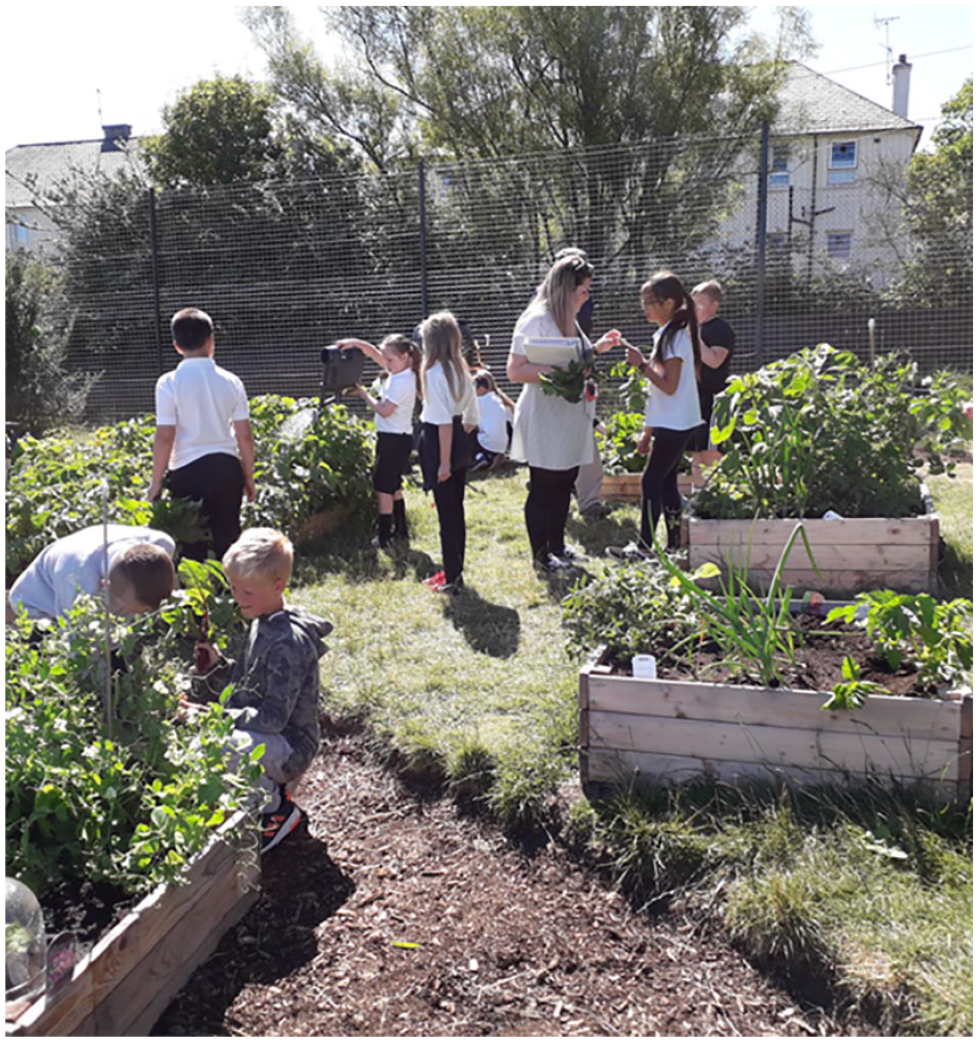
Learning Ecology in the School Garden
Similarly, in its becoming, the garden ecology is not simply science, or geography, or horticulture. Rather, it is a living assemblage. So, too, is the artfulness of the human cultivators in their differential abilities to touch and gauge; to measure themselves up or down to the size of their plants, bringing forth a new aesthetic of the “sensible” and the “tangible” (de Freitas & Sinclair, 2020), whereby the biology of living bodies and the tactility of math meet. Rupturing through the hard and rational lines of disciplinary silos of formal learning spaces, the garden is an enactment of the distributed and interlacing agential aesthetic of “all kinds of practitioners, not only the humans” (Haraway, 2016, p. 168).
A posthumanist reading of STEAM in the garden thus points to a different conception of the body in learning. Traditionally conceived as a passive receiver of stimuli and information, or as a passive transducer of knowledge through linguistic symbols, in the STEAM garden all bodies—human and non-human—were reconfigured by means of their mutual relations of attending and being attended to. In this entanglement lay the opportunity for a third educational turn that speaks back to the previous projects of making and of freedom: that of retracting from mechanical/linear causality in growing as well as in learning to embrace the act of freedom. In posthuman terms, this means turning away from the representationalist epistemology of conventional science learning whereby authoritative voices directs children’s attention to a pre-set curriculum (for example, naming the parts of the plants; following laboratory instructions) in order to transform the act of pointing into the ability to show and to respond to what matters and whose needs matter. This understanding of the role of the body in education resonates with conceptions of knowledge as embedded in action: Knowing is not separate from doings and such doings are not separate from the relational web that both assembles and disassembles. Such creative, posthumanist enactments are also expressions of the radical democratization of human and non-human relations. As Haraway (2008) argues, “to hold in regard, to respond, to look back reciprocally, to notice, to pay attention, to have courteous regard for, to esteem: all of that is tied to polite greeting, to constituting the polis, where and when species meet.” (p. 19)
We conclude by offering some recommendations that researchers, educators, and policy and curriculum writers may consider in co-authoring transdisciplinary education as the key practice of democratizing creative educational experiences.
Part 3: New Insights and New Directions for Re-Visioning Creative Educational Experiences
Painting, a music composition, a new way of seeing and relating to mathematics and science, cannot be confined to the discipline of one artist or the perspective of one beholder. The historicized practices of a creative person who acts alone in a particular domain-specific creativity form part of a broader assemblage and materiality of human and non-human components, where concepts of making and makers require re-seeing as making with and makers with. So, what are the features of the thinking and practice being advanced by these kinds of posthumanist, de-territorializing practices? How might this way of working de-territorialize subject learning systems?
Making With
Across the three projects, the act of de-territorializing invited a new cartography of knowing: moving away from subject silos and subject hierarchies to an ecology of relations and one of proportions, understood as pro-portions (de Freitas & Sinclair, 2020), where each subject played an equal and mutually supporting role in the enactment of creativity and learning. Such proportionate and relational understanding of knowing was evidenced in the example of the Stressed Vitruvian Man where the meeting of visual art, the materials, and the math acted in sympoiesis—“making with” one another in rendering the troubled and yet powerful folding-unfolding of the self and the world. Similarly, in the music improvisation example, the extended tactile and sensorial experiences re-configured music making through an ecology of material, relational, and embodied practice. Such an ecology expanded in the STEAM garden, which was not simply a growing space, but emerged as an enactment of arts and sciences; the pro-portion of forms, patterns, and colors went hand in hand with the more intensive mathematical properties of size and volume, and the extensive engineering qualities of height, bendiness, and sturdiness of plants and the children’s own bodies, as mutually entangled. Across all examples, we have given evidence of the power of transdisciplinarity to reconfigure subjects as “creative enactments” propelled by the properties of the “sensible”: not that which is customary, normative, and rational, but that which can be “perceived” as it enters the realm of our sensibility (Braidotti, 2019b).
Relational (Nondualist) Understanding of Arts and Sciences
In conventional understandings of STEAM as STEM plus arts, the arts are largely conceived as alternative modalities for transferring and presenting content, often without much attention to the particular ways in which content can be interpreted and understood in the arts. Through the evidence provided across the three projects, we have endeavored to show the power of arts and sciences “teaching” together; not in an additive or cumulative way, nor as an individual act of making to further individual content knowledge, as can be seen in some forms of maker education, but instead as a dialectic, each one offering the opportunity for a different type of “attentionality,” a way to “pay attention” and “to make sense” of the sensible. This creative inquiry is truly transdisciplinary in that the mathematics “would not work” without the art, the music “would not sound” without body–matter entanglements, and the biology “would not work” without the plants’ own aesthetics. The material agency and “vibrant matter” (Braidotti, 2019b, p. 41) of the learning ecology transcended dualities and divisions across subjects, along with their baggage of exclusionary, status-driven practices. Both across the sciences and posthumanist philosophy there is a recognition of the necessity of democratizing knowledge by “expertizing democracy” (Carrozza, 2015). In this sense, this chapter makes an important contribution by firmly locating creative educational experiences as enactments of skilled practices of democratizing education. This contribution introduces a radical break from previous literatures on creativity, and pedagogical practices of making, by widening and pluralizing away from one-world, conceptual views of creativity to a multiplicity of mutually entangled and co-constituting but distinct and multiple creativities. Just as Howard Gardner (1983) proposed multiple intelligences, we have pluralized creativities which can be bounded by subject disciplines, but also engendered through different practices in and across the interrelationships between sciences and the arts (Burnard & Colucci-Gray, 2020; Fenyvesi et al., 2020; Sawyer, 2003). Such transdisciplinarity speaks directly to Glaveneau (2018), who asked which creativity are we educating for? The answer offered by this chapter is a creativity stemming from an ontological stance of attentionality and vulnerability, where we democratically allow ourselves and others to “make with one another” in complex entanglements.
Conclusions
The environmental crisis has exposed the materiality of non-human life as central, both as vulnerable but also as a productive and vital force (Barad, 2007; Braidotti, 2016). In this chapter we have provided evidence across three projects of new, future-making transdisciplinary ways of entangling subject disciplines, not simply as production and acquisition (of biomass; knowledges or skills) but as important activities of creation—with the potential to make a real difference on one’s life and one’s community. We have also evidenced the role of subjectivity in learning: not restricted to particular schools, contexts, individuals or subject silos, but rather as a co-operative trans-species effort that takes place transversally, displacing binaries.
We have evidenced the effects of destabilizing the ways in which knowledge about creative educational experiences has been traditionally construed in conventional readings of STEAM. Specifically, we moved away from the imagery of the “pipeline model” of education as a linear progression of acquisition of increasing levels of abstract knowledge (Colucci-Gray et al., 2019). Instead, we have evidenced a phenomenological understanding of knowing and learning which is construed “horizontally,” by re-instating sense experience as a prime locus of learning about ourselves and our surroundings (Johnson, 2007); a prime locus of understanding our dependence on others, human and non-human (Haraway, 2016). In this view the relationship between arts and sciences changes from one of alternate subservience to one of close and integrated correspondence, serving the learner by training faculties of perception, attentive observation, and haptic and affective participation in unfolding phenomena “in-the-world” (Dahlin, 2003, p. 80). While our evidence drew on three specific projects, posthumanizing creativity is in fact a stance on knowing and being which could and should permeate formal curricula and classroom experiences at all levels. For example, in science, we propose a shift from the cognitive to the sensorial/affective domains to inquire into life forms and how they are related both amongst and intra-species. Seeking out patterns and textures connecting the branching of a tree with the human bronchi provides the opportunity to deconstruct binaries (human–non-human), or categories (plants–animals), and in so doing democratize one’s observational capacities by giving meaning to everyday experiences. Similarly, such an approach further democratizes the creativity of working with data. Beyond what is normally considered the realm of mathematics or science, a posthumanizing approach to data would also include the shape of sound, in its intensity and textures that can be modeled and shaped like the making with playdough in one of our examples. Again, we suggest that such a playful, aesthetics approach further democratizes conventional perceptions of music education, which may open one’s sensorial capacity to perceive music as the intra-actions of sound waves diffracted through bodies and materials. Going further, this approach can be extrapolated into other subjects such as geography and art and design, which can be reconfigured as sites for drawing out connections between landscapes and sounds, colors, and shapes, by hybridizing artistic and scientific methods to expand on one’s ability to see worlds anew by cutting-together-apart. Such modalities sit at the core of the resulting discourses of inclusion/exclusion, participation/alienation from the process of co-production of futures (Braidotti, 2019b).
The democratizing of creativities will thus go hand in hand with profound questions about the democratic quality of the educational process which include: (1) What if the “making-with” could cut across all pedagogies and disciplines as a posthumanist ethical practice, generating new transdisciplinary vocabularies and embodied enactments that free up possibilities for focusing on the commonality of difference? (2) What if decentering the human becomes an experimental process that challenges and transforms the formulaic mantra of “what works” and “what speaks” to only some? (3) What if these alternative visions produce affective flows that release/unlock and democratize co-authoring of learning, stemming from the intra-acting agencies of teaching sciences and arts together as transdisciplinarity? and (4) What if there is no bifurcation of “mind” and “body” and the Cartesian privileging of mind over the matter, but rather the re-visioning and democratizing of creativities that inspire and engage with new vocabularies for destabilizing anthropocentric exceptionalism? (Braidotti, 2016).
Importantly, the implications for practice include: (1) Doing the co-authoring of how we come to learn transdisciplinarity together; (2) Seeing transdsciplinarity as intra-actively co-constitutive of the material-discursive practices of diverse creativities; and (3) Focusing on objects and bodies, space and time, as vital materialities which become manifestations of their own agency and vital players through which the democratizing creative educational experiences gets done.
With evidence provided across the three projects we have given a hint of a new form of education, brought forward through a reconfiguration of practices and a re-purposing of inquiry: from describing to enacting, from discovering and labelling to co-authoring and making-with, paying attention to ours and others’ lives, as they come to matter. Yet, we also note that—for all projects—diffraction also meant interruption of discourses and suspension of expectations in order to allow for openness and vulnerability to what might emerge. Arguably, this is the most practical suggestion we are able to offer here. Teachers should allow time and space for such explorations and interruptions and should actively engage in “making with” and co-authoring new ways of doing and knowing, with each other and with their students.
Hence, here we celebrate the conceptual elasticity that feminist new materialism offers in a quest not to find, nor seek, solutions but, rather, to generate new ways to think about transdisciplinary pedagogies as practices of democratizing creative educational experiences.
Footnotes
Notes
Authors
PAMELA BURNARD is professor of arts, creativities and educations at the Faculty of Education, University of Cambridge, UK.
LAURA COLUCCI-GRAY is a senior lecturer in science and sustainability education at Moray House School of Education and Sport, University of Edinburgh.
CAROLYN COOKE is a lecturer at the Open University (UK) who has recently completed her PhD exploring music student teachers’ experiences of improvisation as a radical apparatus for troubling enlightenment epistemology.