




Abstract
Academic faculty face high rates of indicators of low well-being, such as burnout, stress, and even mental illness, making monitoring employee well-being imperative. However, well-being is a complex construct with various conceptualizations and associated measures. This lack of consensus creates difficulties in interpreting well-being findings, with consequences for practice. We have conducted a systematic review by qualitatively analyzing 161 articles from EBSCOhost, Web of Science, PsycNet, ERIC, and Scopus. Our findings provide an overview of how faculty well-being is defined and measured. Well-being is poorly defined in the current research, given that definitions are sometimes implied rather than stated or omitted altogether. Well-being conceptualizations and measures from different categories are often combined to provide a more holistic perspective. Based on these findings, we have developed a series of guiding questions to support researchers in conceptualizing and measuring well-being.
Keywords
Burnout, work-related stress, anxiety, and depression are among the most prominent symptoms impacting the quality of faculty’s working life (Johnson & Lester, 2022; Urbina-Garcia, 2020). These symptoms have been found to affect faculty globally across countries and disciplines, although faculty members with minoritized identities are at higher risk of experiencing additional stressors (Williams, 2019). Psychological distress, for example, is exceptionally high, with rates ranging from 22% for Canadian faculty to three to four times higher than the general working population for Australian faculty (Catano et al., 2010; Winefield et al., 2003). Moreover, a systematic review of research covering publications from 2006 to 2020 (Fernández-Suárez et al., 2021) found consistently high burnout rates of around 37% among academic faculty in different disciplines and institutions. Another systematic review of research on PhD students suggested that 24% of PhDs experienced persistent depressive symptoms, and 17% were affected by anxiety (Satinsky et al., 2021). In other words, low well-being is becoming a growing concern for postsecondary teachers and researchers, or faculty members. Burnout, stress, and other symptoms of low well-being have gained visibility as occupational health risks for faculty to the extent that the current situation has been referred to as a well-being crisis (Johnson & Lester, 2022; Lau & Pretorius, 2019).
Faculty members’ psychological distress also affects universities’ and colleges’ well-being as organizations; low employee well-being is linked with attrition, especially common in early academic careers (Dorenkamp & Weiß, 2018; Kis et al., 2022), talent loss, and decreased quality of teaching and research (Jayman et al., 2022). Research on intention to leave in early academic career stages revealed that 33% percent of German postdoctoral researchers considered leaving academia (Dorenkamp & Weiß, 2018). Aggregate estimates of attrition in European, Australian, and North American PhD candidates are even higher, around 60% (Kis et al., 2022). Studies such as Catano et al.’s (2010) survey on occupational stress in Canadian universities and Shin and Jung’s (2014) cross-cultural study on job satisfaction and stress in academia linked growing well-being issues to changes in job roles, growing student numbers, higher faculty teaching loads, and the high pressure to publish and obtain grants and funding. Stigma from intersecting minority identities further exacerbates the risk of attrition due to gender differences, race, sexual orientation, national origin, and disability, reducing the diversity of perspectives in research and teaching (Williams, 2019). Minoritized employees often experience decreased well-being and higher intention to leave due to poor diversity management. The attrition of women in academia has been linked to gendered expectations of decreased productivity when forming a family and poor application of work–family policies (Ahmad, 2017).
The problem of low well-being in academia has been explored through various constructs, from burnout to stress, mental health, and low job satisfaction, which operationalize different narrow and specific aspects of well-being (Fisher, 2014). However, these variables capture differing employee experiences, making the magnitude and nature of the problem difficult to estimate and address. In some cases, universities limit themselves to complying with labor legislation under the assumption that autonomy is sufficient to promote well-being (Kinman, 2014). In others, efforts to improve communication, build trust, and manage current and future workloads are favored (Kinman, 2014). The impact of policy changes and interventions needs to be assessed using a shared understanding of well-being as the desired outcome.
Employee well-being research is highly fragmented and includes a variety of different positive and negative experiences, without a single well-established definition (Wijngaards et al., 2022). For example, Diener (1984) defined well-being as experiences of high life satisfaction, high positive affect, and low negative affect. In contrast, authors with more holistic perspectives, such as Ryff and Singer (2008), have described it as a broader sense of wellness based on positive relationships, health, purpose, and growth. The qualitative and quantitative measures stemming from these conceptualizations, and measure well-being from distinctly different perspectives, which causes difficulties in identifying trends in the literature (Urbina-Garcia, 2020).
Operationalizing well-being quantitatively presents additional challenges, given that it can be measured through dedicated scales or combinations of highly specific constructs (Fisher, 2014). This nuanced measurement issue is further complicated when linking measures with well-being definitions, as both can refer to different forms of well-being. Although the issue of misalignment, relating to scale construct validity, has been touched upon in scale development and validation literature, it remains underexplored (Cooke et al., 2016). The alignment between definitions and measures of employee well-being in the empirical research has not yet been explored, to our knowledge.
In summary, addressing the well-being of faculty 1 is complicated by the wide range of conceptualizations and measures for the desired outcome. These operationalizations are not sufficiently systematized and can lead researchers and practitioners to be less deliberate in selecting well-aligned definitions and measures that suit the study’s aims. Accurately measuring well-being is necessary to assess the efficacy of policy changes and interventions. This review aims to support practical policies and interventions and facilitate accurate measurement by classifying definitions and measures for faculty well-being and assessing how studies combine them. To this end, we have formulated the following research questions:
RQ1: How is well-being conceptualized in research on academic faculty?
RQ2: How is the well-being of faculty measured?
RQ3: To what extent are conceptualizations and measures of well-being aligned?
Theoretical Framework
The Well-Being of Academic Faculty
Postsecondary education is a high-pressure, competitive domain where faculty members are facing growing administrative and academic (specific to research and teaching) demands. Worrying trends related to waning funding and growing student numbers per teacher have been present for decades. Changes in tasks, culture, and processes throughout the past 20 years have been ill-received and linked with increased managerialism and administrative workloads (Kinman & Johnson, 2019). Jerejian et al.’s (2013) study on email volume and stress exemplifies the aspect of growing administrative tasks, where academics received an average of 48.8 emails per day from students, colleagues and research participants, detracting from attention to a myriad of other work demands.
Pressure to excel extends to various tasks ranging from pastoral care (e.g., supporting student well-being) to education, research, administration, and entrepreneurial activities, with few professional development opportunities to develop these skills (Wray & Kinman, 2021). Work pressure is exacerbated by academic gender norms, where female faculty often face higher emotional work demands in the form of service tasks that are not assigned to their male colleagues (Oliveira et al., 2024). Outcomes in academia are also highly individual, with little or no task interdependence, which has been linked with reduced social support and loneliness (Schmidt & Hansson, 2018). Employees from racialized backgrounds experience additional exclusion struggles in navigating discrimination and micro-aggressions in their everyday interactions (Oliveira et al., 2024). Globally, faculty experience increasingly few protective factors to buffer work pressure. A survey conducted by the nonprofit Education Support on faculty well-being across universities in the United Kingdom revealed lower scores than the benchmark level on health and safety indicators ranging from manager support to role clarity, except for control over their workflow (Wray & Kinman, 2021). Despite the flexible and autonomous working arrangements characteristic of academic work, increased accountability for performance and managerial interference weaken their effect. The previously mentioned conditions are conducive to stress and ill-being and pose a growing threat to faculty’s well-being at work.
Well-Being Conceptualizations: A Fragmented Research Field
Well-being can be explored through many contested conceptualizations, making addressing low employee well-being especially challenging. This construct is typically understood as wellness or satisfaction, applied to outcomes ranging from the economic to the emotional or psychological. It can be operationalized through objective constructs such as life expectancy, income, or self-assessments of one’s mental or psychological wellness. Ryff and Keyes (1995) operationalized subjective psychological well-being as a generalized feeling of happiness, while Schmutte and Ryff (1997) adopted a broader dimensional approach, including aspects such as a positive evaluation of oneself, a sense of growth and self-development, high-quality relations with others, and so forth. The latter perspective is similar to that of the World Health Organization (WHO, 2021) on individual well-being as a positive state, similar to health, which involves quality of life and the ability to contribute to the world with meaning and purpose. Well-being is closely linked with positive concepts such as happiness, perceived quality of life, and satisfaction with different life domains (Fisher, 2014). Despite its positive connotations, some streams of research operationalize it negatively as a lack of negative emotion and mental health conditions and symptoms (Huppert & Whittington, 2003).
Despite growing concerns about faculty well-being, evidence on how it is conceptualized is limited. Past research has focused on well-being combined with symptomatic approaches or graduate student well-being without offering guidelines to operationalize this construct. Systematic reviews on the mental health and well-being of academic employees (Urbina-Garcia, 2021) and PhD students (Schmidt & Hansson, 2018) have found that most of the studies in their sample focused on burnout, stress, cynicism, physical complaints, and self-protection from job demands. In Urbina-Garcia’s (2020) review, only 23% of the articles focused on the psychological well-being of academics as a positive state, while most of the literature explored ill-being, such as burnout, stress, or both combined. When exploring psychological well-being positively, a variety of other related variables were included, such as job satisfaction, work-related quality of life, work engagement, job demands and resources, life satisfaction, absenteeism, and work–life balance. In Schmidt and Hansson’s (2018) review exploring PhD student well-being, articles also frequently conceptualized the construct as ill-being (stress, burnout, cynicism, and depression), including clinical psychological constructs and physical health. However, well-being was also positively conceptualized through life satisfaction and subjective well-being (positive affect and evaluation of one’s circumstances) and through psychosocial approaches such as psychological flourishing and Sen’s (1993) capability-based well-being—as cited in Schmidt and Hansson (2018). These findings, however, were not strictly focused on the well-being of faculty members; their review focused instead on the well-being of PhDs (Schmidt & Hansson, 2018), who are often categorized as students and whose well-being is conceptualized differently than for employees. Urbina-Garcia’s (2020) review included studies on faculty mental health, which, although often conflated with well-being, is a distinct construct operationalizing ill-being and may have contributed to a greater prevalence of negative well-being conceptualizations.
Categorizing Well-Being Conceptualizations
Outside of the context of postsecondary education, there have been considerable developments in understanding the multiple conceptualizations of well-being. Authors such as Fisher (2014) and Taris and Schaufeli (2015) have outlined categories for employee well-being, observing differences in operationalizing well-being as a distinct construct or through related variables. Conceptualizations of well-being also present differences in generality or link with the work context. Additionally, most well-being research identifies a difference between philosophical perspectives that focus on affective states (hedonic) or meaning-making (eudaimonic). Finally, well-being can be conceptualized positively or negatively. Similar categorizations could be applied to studies of well-being in academia, such as Urbina-Garcia’s (2021) and Schmidt and Hansson’s (2018) reviews. However, clear categorizations of well-being in postsecondary education are missing so far. We will outline different categorizations in well-being conceptualizations based on the broader literature.
First, well-being is typically conceptualized as a distinct construct. However, various other constructs can be used to explore well-being-related experiences. These constructs, called outcomes or, more commonly, well-being indicators, act as proxies for defining and measuring well-being. Authors may use one or more proxies to construct a conceptualization for well-being, used in place of established definitions. Life satisfaction (Cooke et al., 2016) is one of the many indicators used to conceptualize well-being and consists of a state of positive emotion and cognitive assessment of one’s life. Other prominent well-being indicators include engagement, a sustained state of high absorption, vigor, and dedication towards one’s work, as well as job satisfaction and positive assessments and emotions toward one’s work and working environment (Fisher, 2014). Research on the well-being of faculty and graduate students also frequently uses indicators to conceptualize well-being, although they may not be referred to as such. Urbina-Garcia (2021) and Schmidt and Hansson (2018) found that studies frequently used constructs such as job satisfaction, work-related quality of life, work engagement, life satisfaction, absenteeism, and work–life balance. The two most frequent conceptualizations in Urbina-Garcia’s study (2021), stress and burnout, can be used to conceptualize well-being. However, these constructs may also be used as predictors or outcomes of well-being or conceptualizations for mental health. As such, the use of well-being indicators is not clearly outlined in research on faculty.
Second, well-being can also vary in specificity. It can be used to reflect wellness in a general sense across life domains or can relate to specific contexts and areas of a person’s life (Taris & Schaufeli, 2015). General well-being can be used to explore wellness in almost any domain but is less relevant when studying context-specific predictors and outcomes. One of the most prominent contexts in well-being research is the workplace, given that most of a person’s waking hours are experienced at work. When adapted to the working context, operationalizations of well-being relate more closely to workplace antecedents and outcomes and capture experiences of positive affect at work, health, and optimal functioning. An example of a work-related conceptualization is Warr’s (1990) definition of well-being as the arousal of positive and negative emotions in a work context. Well-being at work has also been operationalized as indicators such as engagement, job satisfaction, and even burnout, which conceptualize wellness-related experiences specific to work. In research on academic faculty and PhD students, some of the most common conceptualizations for well-being and mental health can be classified as general: stress, subjective well-being, satisfaction with life, and psychological well-being. This finding may be due to Schmitt and Hanssen’s (2018) review not being strictly focused on employees, while the most common conceptualization in Urbina-Garcia’s (2020) review focusing on academic employees—burnout—is work-related.
Third, the construct of well-being can vary according to its philosophical perspective. Our modern understanding of well-being stems from philosophical conceptions, based in antiquity, about what makes a life worth living: happiness (hedonia) or meaning-making (eudaimonia), leading to two distinct currents in understanding wellness. Hedonic or subjective well-being is the prevalence of positive emotions and evaluations related to different areas of one’s life (Fisher, 2014). Anshel et al. (2010) conceptualized subjective well-being as interchangeable with happiness, comprised of low negative affect, high positive affect, and increased life satisfaction. In contrast, eudaimonic or psychosocial well-being is a broader construct referring to patterns of behavior that promote meaning, health, growth, relatedness and self-actualization (Taris & Schaufeli, 2015). Webber et al. (2020) described well-being eudaimonically as a holistic sense of thriving, integrating physical and mental health, meaning, purpose, spirituality, and positive social relations. Regarding faculty well-being, the articles in Schmidt and Hansson’s (2018) review mentioned subjective well-being, or positive emotions and self-evaluations (hedonic well-being), in contrast to more holistic and behavioral approaches (eudaimonic well-being) such as psychological flourishing and Sen’s (1993) capability-based well-being. However, neither review (Schmidt & Hansson, 2018; Urbina-Garcia, 2021) explicitly distinguished conceptualizations based on these differences in perspectives.
Fourth, well-being can be conceptualized positively or negatively. Despite the positive nature of well-being and its association with happiness and growth-oriented behaviors, many studies have equated it with the absence of distress, ill-being, and mental health concerns. Studies exploring negative general well-being can operationalize it as a lack of negative affect when adopting a hedonic perspective and as a lack of mental health symptoms when viewing it eudaimonically (Taris & Schaufeli, 2015). Researchers can also use well-being indicators for negative conceptualizations, especially when addressing work-related well-being. For example, burnout, a state of cynicism, emotional exhaustion, low self-efficacy, and workaholism—a state of intense but unpleasant work involvement—are commonly used to conceptualize low work well-being (Mäkikangas et al., 2015). Stress and psychological distress are indicators used to explore negative well-being beyond the context of work. In Urbina-Garcia’s (2021) systematic review of the mental health and well-being of academics, most well-being conceptualizations used were based on negative indicators—namely, stress and burnout, which were often combined. However, this might have been due to the inclusion of articles on mental health, which is a related construct that is not strictly speaking well-being.
In sum, research on the well-being of academics and faculty can use constructs and conceptualizations from the broader employee well-being literature. However, the characteristics of these conceptualizations in postsecondary education have not been sufficiently analyzed. First, the research explores measures, conceptualizations, and antecedents but does not always distinguish between them. Furthermore, past research was not strictly focused on the workplace, studying PhD candidates who are not always employees, and studying employee mental health, a construct not strictly related to work. We aim to apply frameworks derived from broader conceptualizations of employee well-being to classify and understand how well-being is conceptualized in research on academic faculty.
Measures of Employee Well-Being
Measures for well-being have been developed based on various preexisting conceptualizations with a wide range of characteristics (i.e., generality or specificity to the work environment, hedonic or eudemonic perspectives, positive or negative valence). Consequently, well-being measures can be difficult to disentangle from these conceptualizations and are rarely analyzed independently. In postsecondary education research, authors can use well-being measures and instruments to conceptualize well-being, which is not always defined. Well-being research concerning academics and faculty members has tended to use quantitative measures. Urbina-Garcia (2021) and Schmidt and Hansson (2018) found mainly positivistic, quantitative approaches to measuring well-being and mental health in their systematic reviews. Most studies focused on measuring different variables operationalizing well-being and mental health, neglecting more experiential aspects of faculty and PhD student wellness. A few more phenomenologically oriented studies related well-being to faculty and PhDs’ relationship with aspects of their job, workplace, or community. In those cases, researchers could ask participants open-ended questions about their role in their context (Schmidt & Hansson, 2018).
It is challenging to identify trends in the literature regarding the use of quantitative measures, partly due to the use of numerous proxy measures for well-being (well-being indicator measures). Urbina-Garcia (2021) found that the Maslach Burnout Inventory (MBI; Maslach et al., 1997), often combined with scales for other negative well-being indicators such as stress, is the most widely used measure of faculty mental health and well-being. However, the prevalence of negative measures may be due to the review’s focus on mental health, which is often operationalized as the absence of conditions for ill-being. In Schmidt and Hansson’s (2018) article, positive and negative measures for indicator variables such as perceived stress, job satisfaction, and sleeping problems were also common. However, the scales used were not specified. These indicator measures are also commonly used in employee well-being literature in general, although a combination of employee engagement instruments, such as the Utrecht Work Engagement Scale (UWES; Schaufeli et al., 2006), together with the MBI (Maslach et al., 1997), is often seen (Fisher, 2014).
Regarding well-being as a distinct positive construct, the most common scales in Schmidt and Hansson’s (2018) systematic review study were the Warwick-Edinburgh Mental Well-Being Scale (WEMWBS; Tennant et al., 2007), the PGI General Well-Being Measure (Verma et al., 1983, as cited in Schmidt & Hansson, 2018), and the Ryff Scale of Psychological Well-Being (Ryff, 1989), which are measures of general well-being. Most measures were developed for the general population or employees in nonspecific fields; however, there are some examples of measures specific to the academic context. For example, the Doctoral Experience Survey by Juniper et al. (2012, as cited in Schmidt & Hansson, 2018) focuses on dimensions related to well-being, such as career development, facilities, research, social, supervisor, and university.
In their review of the well-being of doctoral students, Schmidt and Hansson (2018) distinguished between measures based on a subjective or hedonic well-being framework, such as the Satisfaction with Life Scale by Diener et al. (SWLS; 1985), and psychological and psychosocial well-being scales (eudaimonic) such as the flourishing scale by Diener et al. (FS; 2010). Articles focusing on well-being as a distinct construct in Urbina-Garcia’s (2020) study conceptualized well-being as psychological well-being (eudaimonic) and used psychological well-being scales such as the WEMWBS (Tennant et al., 2007) and the Ryff Scale of Psychological Well-Being (Ryff, 1989). These scales were rarely work-related, possibly due to the focus on PhDs in a student role in Schmidt and Hansson’s (2018) review study and Urbina-Garcia’s (2021) focus on mental health and well-being, which is typically general.
In sum, the wide array of well-being measures and conceptualizations indicates a lack of consensus that can create difficulties with operationalizing the construct and interpreting the research. The use of varied combinations of well-being indicators, in particular, exacerbates the difficulties with operationalizing well-being. Furthermore, conceptualizations and measures are rarely explored individually, separately from antecedents and outcomes. To provide greater methodological clarity, we will apply categorizations derived from the general work well-being literature to conceptualizations and measures used in academia in order to facilitate the selection of instruments based on the aim of one’s study. Earlier reviews of research on faculty and PhD students (Schmidt & Hansson, 2018; Urbina-Garcia, 2021) have outlined frequently used operationalizations but lacked comprehensiveness in analyzing the characteristics of measures and conceptualizations. We will analyze conceptualizations and measures separately, which allows us to explore their alignment. To explore well-being as intended, conceptualizations and measures must align.
Methods
Literature Search Procedure
We conducted our review based on the five steps in Petticrew and Roberts’s (2006) guide for systematic literature reviews in the social sciences. First, we formulated the research questions upon which this study’s design is based. Second, we selected search terms and appropriate scientific databases. Third, inclusion and exclusion criteria were developed. Fourth, we applied predefined quality criteria to assess the articles’ scientific quality. Finally, data relevant to our research questions were extracted and analyzed.
Databases and Literature Search Terms
We performed searches for qualitative and quantitative articles in the following databases: EBSCOhost, Web of Science, PsycNet, ERIC (via EBSCO), and Scopus. These platforms have a wide selection of educational, psychological, management, and higher education journals that would enrich our sample. In the databases that allowed it, we limited our search to peer-reviewed empirical articles published in academic journals. Preprints of articles were filtered out when applying the initial exclusion criteria. We also limited ourselves to articles published in English and available in their full-text versions. We did not set date boundaries for the search, given that our research questions were not focused on new developments in operationalizing well-being, and our research could be enriched by including a historical perspective. Searches were performed using a combination of keywords including “Wellbeing” separated by the Boolean term OR “Well-being” AND “Higher Education” OR “University,” AND “Academics,” OR “Staff” OR “Faculty,” OR “Researcher,” OR “Teacher” OR “Instructor,” OR “Professor,” OR “Employee,” NOT “Student.” We included articles that contained our search terms in their abstracts, titles, or keywords when the database allowed for it. This search strategy resulted in 3223 articles, once duplicates were eliminated.
Selection Process
Once duplicates were manually eliminated, we screened articles based on their abstracts and titles, followed by their full texts and applied the following inclusion and exclusion criteria successively. After screening the titles and abstracts, we were left with 406 studies. We applied the inclusion and exclusion criteria to the full texts, leaving 196 remaining articles. After a final quality criteria check, we eliminated 35 articles, resulting in a sample of 161 articles.
First, we assessed whether articles were empirical studies focused on the well-being of academic faculty. Theoretical articles, literature reviews, editorials, press interviews, intervention proposals, and conference proceedings were excluded.
Second, we included studies with academic faculty in their sample, operationalized as salaried college and university employees with teaching and, or research responsibilities. To improve generalizability, we excluded studies on the well-being of PhD candidates and graduate students, given that their status as employees varies by country. Studies could include support staff and other university employees, in addition to faculty. We also excluded studies with samples of non-academic physicians, medical or nursing residents, patients in university hospitals, elderly adults, or retired faculty.
Third, studies that were not sufficiently focused on subjective or psychosocial well-being were excluded. We only included studies that mentioned well-being in the title, abstract or full text related to the study’s aims. Studies that operationalized well-being as variables such as engagement, burnout, quality of life, or happiness were included so long as the text established them as proxy variables. Studies focused on burnout, work engagement, happiness, or job satisfaction, with no mention of well-being, were excluded. Studies focusing solely on economic, physical well-being, or health behaviors were excluded, given that these variables can be framed as predictors for subjective or psychosocial well-being. Studies exploring organizational, institutional, or community well-being were excluded due to a lack of comparability in their operationalizations.
Finally, we only included studies with one or more qualitative or quantitative well-being (or proxy variable) measures. Studies that mentioned well-being in their aims but did not use a well-being or well-being proxy measure, instead measuring variables such as workplace incivility or organizational climate, were excluded. We included qualitative measures ranging from focus group and World Café prompts to semistructured interview questions.
Initial Data Extraction and Quality Check
Throughout the screening of the full-text versions of articles, we extracted relevant content to assess the scientific quality of the articles. The extracted content pertained to quality criteria guidelines developed by Gast et al. (2017), based on criteria established by Petticrew and Roberts (2006). We extracted the following data:
General information: Study title, author, year of publication, country, and research context.
Topic: Well-being conceptualized as itself, as well-being indicators and as measures for well-being and well-being indicators.
Research design: Research questions, objectives or hypotheses, description of the study, research design, research method, and data analysis method.
Research population: Number of participants, gender, age, job roles, and seniority.
Overall results: Results addressing the articles’ research questions, objectives, or hypotheses.
We applied the quality criteria to 196 articles that fit our inclusion and exclusion criteria after reading the full texts. We applied the 11 quality criteria (see Table A1 in the Appendix) developed by Gast et al. (2017), where each criterion is assessed on a 3-point Likert scale, with 0 as the lowest score and 1 as the highest. To be included in the sample, an article had to obtain a total score of 7 or higher. After performing this check, we eliminated one article, resulting in a final sample of 161. To improve reliability, a second rater independently performed the same quality check on 10% of the sample with the lowest scores. Quality criteria were discussed before and after ratings to ensure a shared understanding. In cases of misalignment on specific scores for quality criteria, we discussed our rationale with the goal of achieving consensus. We obtained a strong intraclass correlation score of 89.17% when considering the ratings for each criterion, while complete agreement was reached on which articles to eliminate (see Figure A1 in the appendix).
Sample Characteristics
Given that we performed our searches in February and March 2022, articles in our sample were published between 1992 and 2022, with most published after 2019. This finding aligns with the greater awareness of work well-being risks due to the COVID-19 pandemic. Academic publications with an occupational health focus grew from 2019 to 2022 (Sobirin et al., 2024). This trend contributed to greater visibility of occupational hazards inherent to faculty jobs, including high work pressure, job insecurity, and managerial interference (Shamsi et al., 2021). Studies in our sample were published in journals from various disciplines, including psychology (n = 33), occupational health (n = 28), multidisciplinary journals (n = 23), higher education (n = 19), business and management (n = 14), medicine and medical education (n = 11), educational sciences (n = 10), public health (n = 9), educational management (n = 7), social sciences (n = 4), urban studies (n = 1), leisure (n = 1), and life span studies (n = 1). We aimed to center diverse voices and approaches to research. To ensure fair representation of research outside of Eurocentric cultural norms, which are disproportionately featured in high-ranking journals, we used quality criteria based on articles’ design characteristics, methodological fit, and rigor, rather than journal ranking (Nkomo, 2009). Although most of our sample was from English-speaking countries (n = 93), studies from countries across five continents were represented, indicating that faculty well-being is a problem that is being explored globally. Our sample consists of studies performed at various institutions, ranging from technical colleges to research universities. Our sample exhibited a trend toward quantitative designs to explore faculty well-being (n = 141). Fewer studies employed qualitative (n = 12) and mixed methods designs (n = 8). Regarding participants, studies explored the well-being of lecturers, teaching staff, and faculty in all their roles and functions. Some studies in our sample included support staff, students, and other employees in nonteaching and research roles while also including faculty.
Data Analysis
After extracting the information for our quality criteria check, the articles’ introduction, theoretical framework, and methods sections were analyzed in greater depth. When these sections did not provide enough information on how they conceptualized well-being (well-being definitions, establishing other constructs as equivalent to well-being, etc.), we also analyzed the articles’ discussion sections. When analyzing measures, qualitative measures (interview questions and focus group and World Café prompts) were occasionally unavailable or excessively broad. In those cases, we included the coded themes reported in the studies to support us in our analysis.
Our data analysis was rooted in a framework synthesis approach, where frameworks from employee well-being literature were used as a scaffold for categorizing findings, which were then, in turn, used to build upon existing frameworks (Brunton et al., 2020). We used inductive coding to identify categories of well-being that were not present in the theory and explore hierarchical relations between theoretical categories. We applied the following codes derived from employee well-being research: scope, or whether well-being is operationalized as a distinct construct or using related variables; context, or whether well-being is a general or work-related variable; the philosophical perspective the operationalization is based on; and valence, or whether well-being is a positive or negative variable (see Table A2). These codes were hierarchical, where a well-being conceptualization or measure had certain valence characteristics that were nested within a given philosophical perspective, nested in context, and more broadly nested in a certain scope.
Through inductive coding, we also identified a final broader category reader inference for well-being conceptualizations, or whether well-being is defined explicitly, implicitly through links with other constructs, or measured but not conceptualized.
Results
To answer our first two research questions, we analyzed conceptualizations and measures for well-being based on four categories: scope, context, philosophical perspective, and valence. The frequency of conceptualizations in each nested category is featured in Figure A2. We identified one additional category for well-being conceptualizations, reader inference, or the extent to which a reader must deduce the conceptualization of well-being from links with other variables and implicit equivalencies between these variables and well-being. Finally, to address our third research question, we analyzed the alignment between measures and conceptualizations.
Well-Being Conceptualizations (RQ1)
Reader Inference: Explicit and Implicit Well-Being Conceptualizations
The degree of explicitness with which studies conceptualized faculty well-being differed. Most studies (n = 102) explicitly conceptualized well-being using established definitions (well-being defined as a distinct construct) or stating which well-being indicators, such as burnout or engagement, would conceptualize well-being in the study. When explicit, the definition of well-being could be identified in the article’s introduction or theoretical framework and coincides with its conceptualization in the research questions and hypotheses. However, several studies conceptualized well-being only implicitly (n = 21), for example, by establishing an equivalency in the text. Well-being was mentioned and given as a justification for the research, but not clearly linked with the indicators (i.e., engagement, effort-recovery, job satisfaction, burnout, emotional exhaustion, health, and psychological distress) used in the research questions or hypotheses. Furthermore, a large portion of studies (n = 38) did not conceptualize well-being at all. These studies mentioned well-being-related variables (well-being indicators) and linked them with well-being in the text, but often as antecedents or outcomes, without establishing their equivalency to well-being. In those cases, well-being was conceptualized through mainly quantitative established well-being measures, such as the Warwick-Edinburgh Well-Being Scale (WEMWBS; Tennant et al., 2007), although some studies used well-being indicators instead (n = 6). Three studies using qualitative measures also neglected to clearly conceptualize well-being.
Scope: Established Well-Being Definitions and Well-Being Indicators
Studies in our sample conceptualized well-being based on either an established well-being definition (n = 48), well-being indicators (n = 64), or a combination of both (n = 11). Established well-being conceptualizations referred to well-being as a construct distinct from other variables, such as “Affective well-being is broadly conceptualized as a hedonic balance; [i.e.] balance between pleasant and unpleasant affect” (Arnold et al., 2007, as cited in Ahmad et al., 2018, p. 1350).
Single well-being indicators, or proxy variables for well-being, were used less frequently to conceptualize well-being. In our sample, only 12 articles used a single indicator: quality of working life, psychological distress, health, or burnout. These constructs were more often combined with other well-being indicators or established definitions. A frequently used combination of indicators was burnout and engagement or their components (i.e., vigor and emotional exhaustion; n = 9).
Finally, some authors supplemented an established well-being definition with one or several well-being indicators (n = 11):
We present a more balanced understanding of faculty well-being by including measures of emotional and physical health, as well as traditional measures of job satisfaction. . . . Well-being can be seen as a more holistic construct encompassing work variables (i.e., job satisfaction, intent to leave) and life variables (i.e., emotional and physical health). (McCoy et al., 2013, p. 312)
Context: General Well-Being and Well-Being Rooted in the Working Context
In our sample, 49 studies used a general well-being conceptualization or established well-being definitions and well-being indicators explored across contexts and life domains, 53 articles used a work-related definition or indicator, and 21 articles combined work-related and general well-being. Most of our sample included aspects of work-specific well-being in their conceptualizations. One example is Stan’s (2022) conceptualization of well-being, where affective well-being constitutes the core aspect of subjective well-being at work.
When it comes to established well-being definitions, general well-being (n = 29) and work-related well-being (n = 19) were equally frequent, while definitions combining domains (n = 2) were less common. In our sample, Darabi et al. (2017) conceptualized subjective well-being (SWB) generally as a construct based on the experience of high levels of positive affect, low levels of negative affect, and high levels of life satisfaction, an experience independent of context.
In our sample, most well-being indicators were work-related (n = 34), while general well-being indicators or well-being related variables that are not rooted in a specific context were used less frequently. General indicators including variables such as health or psychological distress were occasionally used on their own (n = 12), or combined with other work-related indicators, such as job satisfaction (n = 11).
Articles could combine contexts, thus creating a broader conceptualization of well-being, either by using established well-being definitions from both contexts (n = 2), by combining established definitions with well-being indicators from a different context (n = 3), or by using several well-being indicators (n = 11) from different contexts. Some indicators, such as work-life balance, inherently address the general and work-related contexts.
Philosophical Perspective: Eudaimonic and Hedonic Perspectives
Our sample’s well-being conceptualizations could be categorized as eudaimonic, hedonic, or both. We classified well-being conceptualizations and well-being indicators as eudaimonic if there was a growth-oriented, meaning-related, health, or behavioral component. The eudaimonic perspective was commonly used in our sample (n = 47), exemplified in Finkelstein et al.’s (2021) conceptualization of well-being as a balance between physical, emotional, intellectual, social, occupational, financial, and spiritual aspects of human experience. Eudaimonic well-being indicators included burnout, engagement, quality of working life, physical illness, and leaving intention, and were used in 38 articles.
Hedonic well-being conceptualizations and indicators were present (n = 34). They were based on an affective balance of positive and negative emotions and on subjective assessments of one’s general circumstances or work. An example of an established hedonic well-being definition is “Subjective well-being (SWB) comes from experiencing high levels of positive affect, low levels of negative affect, and high levels of life satisfaction” (Diener et al., 1999, as cited in Darabi et al., 2017, p. 394). Our sample’s most common hedonic well-being indicators (n = 13) were job satisfaction, life satisfaction, fatigue, and stress.
Some conceptualizations combined eudaimonic and hedonic well-being (n = 38). They could be combined in one established definition (n = 6), as in Raiden et al.’s (2020) well-being conceptualization derived from a holistic perspective, outlining three core dimensions of well-being: psychological (happiness), physical (health), and social (relationships). Combinations of well-being indicators from both philosophical perspectives (n = 19) or of indicators and established definitions from both perspectives (n = 5) were also used across our sample.
Valence: Positive Well-Being or the Absence of Negative Symptoms
Well-being could be explored through positive emotional states and behavior (positive affect and growth-related behaviors), as the absence of negative affect or conditions, or as a combination of positive and negative behaviors or affect. In our sample, it was most common to explore well-being only using its positive conceptualizations (n = 66). When explored positively, established well-being definitions were used most frequently (n = 43). Nevertheless, articles also combined positive and negative well-being (n = 45), especially when using just well-being indicators (n = 34). These indicators were typically from the same (work-related) context and were most frequently eudaimonic—for example, engagement and burnout. Finally, some articles (n = 11) using well-being indicators used only negative well-being conceptualizations. These often referred to the same context and philosophical perspectives but represented distinct emotional and behavioral negative states and experiences. Some examples include psychological distress, burnout, stress, and emotional exhaustion.
Well-Being Measures (RQ2)
Most studies used only quantitative instruments to measure well-being (n = 145). Thirteen studies used only qualitative well-being measures. Only three studies combined qualitative and quantitative well-being measures. Articles in our sample used qualitative measures such as interview questions, focus group prompts and survey questions.
Scope of Well-being Measures
Well-being measures in our sample were often established well-being measures or measures operationalizing well-being as its own construct (n = 72). Some examples of established well-being instruments include the General Health Questionnaire for psychological diseases (GHQ-12; Goldberg & Williams, 1988), the Warwick-Edinburgh Well-Being Scale (WEMWBS; Tennant et al., 2007), Positive and Negative Affect Scale (PANAS; Watson et al., 1988), and the Job-Related Affective Well-Being Scale (JAWS; Van Katwyk et al., 2000).
Authors also frequently used more than one measure to capture different aspects of well-being. When using an established well-being measure, authors often included one or more well-being indicator measures (n = 21). Despite being frequently used in our sample (n = 69), single indicators were used less commonly on their own to measure well-being (n = 15). The Utrecht Work Engagement Scale (UWES; Schaufeli et al., 2006) and the Maslach Burnout Inventory (MBI; Maslach et al., 1997) were the most frequent measures used purely as indicators. They were usually used together (n = 12) or combined with other well-being indicators or well-being measurement scales. The Satisfaction with Life Scale (SWLS; Diener et al., 1985) was used to measure well-being in some studies (n = 2) and as a proxy measure (n = 14) for studies operationalizing well-being as a fragmented satisfaction component of hedonic well-being.
When collecting information qualitatively, researchers did not always address well-being as a distinct construct. Interview questions were often directed at aspects of work (n = 5), such as academic publishing, the impact of workplace interventions, the impact of systemic issues, or reactions to specific work activities, such as preparing and giving feedback, or more general aspects, such as their experiences in a given time period or their “stories” (n = 2). In these cases, researchers either included sub-questions on perceived well-being linked to these aspects or coded for well-being or well-being-related themes. Other articles focused on conceptualizing well-being or well-being antecedents.
Context of Well-Being Measures
The most heavily featured measures in our sample were work-related. Seventy articles used only general well-being measures, 28 combined work-related and general measures, and 48 articles used only work-related measures. General measures were composed of items or questions that did not refer to any particular context, such as “In the past few weeks, I have been able to enjoy day-to-day activities” (GHQ-12; Goldberg & Williams, 1988). Work-related measures, in contrast, included references to the context of work with items such as “My job made me feel happy” (JAWS; Van Katwyk et al., 2000) and “I can do my job well” (WARR; Warr, 1990).
Some authors also integrated several contexts by combining measures, although in our sample, most articles used a single measure for well-being. When combining measures, authors generally used one or more well-being indicators. Quantitative studies in our sample used established well-being measures (n = 21) somewhat more frequently than well-being indicators (n = 19) when focusing on work-specific well-being.
In our sample, some qualitative measures combined the general and working contexts (n = 4). They typically included references to academic working tasks, such as “Please outline the ways that preparing and giving feedback online have impacted on your own health and well-being” (Whittet, 2021, p. 56), or aspects of higher education work roles, as in “What are current barriers to physician wellness?” (Webber et al., 2020, Suppl.), giving them even greater relevance. In addition, seven quantitative measures also focused on more specific aspects of well-being, such as the Teaching Satisfaction Scale (Ho & Au, 2006, as cited in Han, Yin, Wang, & Zhang, 2020) and the Teacher Well-Being Scale (TWBS; Collie et al., 2015, as cited in Zewude & Hercz, 2021). Finally, well-being linked with faculty working tasks globally was measured quantitatively in three instances: the academic well-being subscale in Spasovski and Pecakovska’s (2020) instrument, the Faculty Stress Index (Gmelch et al., 1983, as cited in Davidson et al., 2010), and the National Junior Faculty Survey (NJF; Signoret et al., 2019).
Philosophical Perspective of Well-Being Measures
Well-being and indicator measures from different contexts also exhibited differences in the philosophical perspective on which they were based. Articles could adopt a eudaimonic (n = 55), hedonic (n = 43), or combined perspective (n = 53). Eudaimonic perspectives were often associated with the use of well-being indicator measures (n = 21), such as the Utrecht Work Engagement Scale (UWES; Schaufeli et al., 2006) and Van Veldhoven et al.’s (2002) five-item Sleep Quality Scale (as cited in Van Hooff et al., 2007). Articles with established well-being measures used eudaimonic perspectives (n = 30) more often than those using well-being indicators and combined measures (n = 4).
Hedonic perspectives were most common among articles that used established well-being measures (e.g., JAWS; Van Katwyk et al., 2000; n = 26). Well-being indicator measures, such as job satisfaction and life satisfaction, and combinations of measures went along with a purely hedonic perspective less frequently. Measures for eudaimonic well-being were evenly distributed between work and general categories, while hedonic perspectives were most frequent among articles using general measures.
With regard to qualitative measures, it was sometimes unclear what philosophical perspective the measures (questions or prompts) were based on, which was clarified by looking into the coded themes. Here, the focus on well-being was exploratory, with a perspective emerging from the data.
Valence of Well-Being Measures
Well-being measures and indicators have a positive valence (n = 68) when well-being is measured as growth, meaning, and positive emotions. The valence of well-being is negative (n = 20) when well-being is measured as the absence of negative conditions or emotions. In our sample, a large portion of studies (n = 67) combine positive and negative measures to operationalize well-being.
Studies using positive or negative instruments exclusively tend to use established well-being measures more frequently than well-being indicators. Established well-being instruments tend to include more dimensions or aspects of well-being than well-being indicator measures, which capture more specific wellness experiences. Articles used well-being and well-being indicator measures with similar frequency when solely measuring negative well-being. The most frequently used instrument for this purpose (n = 6) was the GHQ-12 (Goldberg & Williams, 1988).
Certain scales, like the Scale of Positive and Negative Emotion (SPANE; Diener et al., 2009), measure both positive and negative well-being. However, most articles exploring positive and negative well-being use several measures, typically combinations of well-being indicators (i.e., the UWES and the MBI) or established well-being scales and indicators (i.e., the GHQ-12, the JAWS, and a single-item measure for leaving intention).
Alignment of Conceptualizations and Measures (RQ3)
In our sample, well-being measures and conceptualizations in articles were not always aligned (n = 71). Articles using established well-being definitions sometimes showed misalignments in scope, context, philosophical perspective, and valence (n = 14). For example, an article might conceptualize well-being as a distinct construct but measure an indicator such as work-life balance instead, as in Raiden et al.’s (2020) article on the perceived well-being of male academics. Another might use a work-related conceptualization but measure it using two general well-being measures, such as Hartfiel et al.’s (2011) article, which used the Profile of Mood States Bipolar (POMS-Bi; Lorr et al., 2003, as cited in Hartfiel et al., 2011) and the Inventory of Positive Psychological Attitudes (IPPA; Kass et al., 1991, as cited in Hartfiel et al., 2011). Others might use a positive well-being definition but a negative well-being measure. This was most frequent in articles using the GHQ-12 (Goldberg & Williams, 1988) as a measure, such as in Akanni et al.’s (2020) article, which had a positive well-being definition but used several positive and negative measures, including the GHQ-12, or Anshel et al.’s (2010) article, which also used a positive definition and the GHQ-12 as its only measure.
It was more difficult to determine whether the definitions and measures in qualitative and mixed-methods articles were aligned, given that the approach was often exploratory. However, we found misalignments in scope and context between definitions and measures. For example, Raiden et al.’s (2020) article used a general well-being definition and interview questions on work–life balance, a well-being indicator that is both general and work-related.
Articles conceptualizing well-being implicitly and through indicators were even more susceptible to misalignments (n = 19). These misalignments were most frequent between context, philosophical perspective, and valence. However, misalignments sometimes occurred at the level of the individual indicators—for example, Beckers et al.’s (2008) article, which used health and effort recovery to conceptualize well-being but measured fatigue, work engagement, and home engagement instead. Furthermore, articles mentioning well-being in name without defining it, included established well-being and indicator measures without providing a definition of well-being in the introduction or theoretical framework (n = 38). The established well-being measure most frequently used in articles that did not conceptualize well-being was, once more, the GHQ-12 (Goldberg & Williams, 1988).
Discussion
Operationalizing the well-being of academic faculty presents a vast degree of complexity. Not only is well-being not always explicitly conceptualized, but a wide array of definitions and conceptualizations are available, with an overwhelming variety of measures. To untangle the conceptualizations and measures for well-being and the alignment between them, we addressed the following research questions: (1) How is well-being conceptualized in research on academic faculty? (2) What are the main measures of faculty’s well-being? and (3) To what extent are conceptualizations and measures of well-being aligned? The construct of well-being was not always explicitly conceptualized but should be clearly defined to avoid confusion with other positive states and experiences. Well-being was most frequently conceptualized using combinations of indicators, sometimes including well-being definitions. This gave researchers greater freedom to construct a well-being conceptualization that suited their aims. Regarding measures, the use of one or several well-being indicator measures was most common, occasionally combined with measures for well-being as a distinct construct for a broader approach. A few measures for well-being were specific to the faculty’s working context and tasks and could be quantitative or qualitative. Finally, measures and conceptualizations did not always align in studies that define well-being. Furthermore, studies that neglected to define well-being were frequent, leading to a sizeable portion of studies in our review not aligning conceptualizations and measures. We will expand upon these five key takeaways.
First, although most studies in our sample conceptualized well-being explicitly by defining well-being or drawing clear equivalencies with related constructs, several studies in our sample did not explicitly define or conceptualize well-being. This finding implies that readers must infer the conceptualization from equivalencies with other well-being-related variables or from the instruments used for measurement. However, this requires a shared understanding of what it means to be well at work, which is currently not the case, given the lack of consensus in the literature. This ambiguity in operationalizing well-being resembles how positive emotions were studied in the past. From an evolutionary perspective, positive emotional states are seen as less distinct, with less clear adaptive functions than negative emotions (Fredrickson, 2001). This perspective can lead to different positive experiences and emotions being conflated, which occurs as well in research using well-being indicators. This conceptual confusion can lead researchers and practitioners to address aspects of wellness that might not be suited to the study or intervention’s aims.
Second, well-being was most frequently conceptualized and measured using at least one well-being indicator, such as job satisfaction, which could also be combined with operationalizations of well-being as a distinct construct. Combinations of well-being indicators were most common for conceptualizations, while established well-being measures were slightly more frequent in our sample. This finding suggests that authors relate well-being theoretically to various positive experiences to the extent that the term well-being is interchangeable with adaptive behaviors, motivation, positive emotion, and the absence of negative conditions. However, when selecting measures, authors still tend to understand well-being as a distinct construct more frequently. The use of well-being indicators allows researchers to pinpoint specific well-being-related states or experiences (Fisher, 2014). However, the distinction between indicators and established well-being operationalizations was not always clear-cut in our sample, mainly in the case of satisfaction with life, which alternated between being a component of hedonic well-being and a distinct construct used to operationalize well-being.
Some of the most prevalent conceptualizations for well-being use the indicators engagement, job satisfaction, and burnout, which were also the most frequently used ones in our sample. These indicators are integrated into certain widely used well-being models, such as the job demands-resources model (JD-R) and the circumplex model, contributing to their widespread use. The JD-R model incorporates burnout and engagement as the outcomes of well-being processes, which are typically measured using the UWES (Schaufeli et al., 2006) and the MBI (Maslach et al., 1997) scales (Schaufeli, 2017), the most frequently used scales in our sample. Job satisfaction is among the most prevalent and historically used work–well-being constructs (Fisher, 2014). In our sample, it was often measured using Warr et al.’s (1979) intrinsic job satisfaction scale and certain single-item measures (e.g., single-item measure of job satisfaction; Guidetti et al., 2020). Job satisfaction is integrated, along with burnout and engagement, into the circumplex model as one of its four well-being outcomes of different valence and intensity: job satisfaction, engagement, burnout, and workaholism (Mäkikangas et al., 2015). These models exemplify the integration of indicators from different categories, such as the positive and negative indicators of burnout and engagement in the case of the JD-R model, or hedonic and eudemonic ones, such as job satisfaction and engagement in the circumplex model. Our sample’s most commonly used combination of well-being indicators, engagement and burnout, were both eudaimonic but spanned aspects of positive and negative well-being.
Third, authors in our sample frequently combined operationalizations from different categories to broaden their perspective. Studies frequently broadened their operationalization of well-being by combining well-being indicators or using indicators that bridge several categories, such as work-life balance. This finding suggests that addressing only one aspect of well-being is not considered sufficient. Well-being definitions were also occasionally supplemented with well-being indicators, which can provide different contexts, philosophical perspectives, or valences. There is an apparent need to study well-being from a holistic perspective (Fisher, 2014). Although positive operationalizations were most common, the combination of positive and negative operationalizations was also frequent. The inclusion of some negative aspects of well-being in operationalizations was most frequent and might be a way to more accurately assess the experiences of faculty, in which positive well-being may be accompanied by mental health symptoms, burnout, and other negative conditions (Urbina-Garcia, 2020). Combining operationalizations helps bridge the differences in approaches to operationalizing well-being (Huppert & Whittington, 2003). Using combinations of established definitions and well-being indicators also allows researchers greater freedom to choose which experiences, emotions, and behaviors to target.
Fourth, we found that measures could belong to different well-being categories than conceptualizations. Misalignments could occur in articles using definitions for well-being as a distinct construct, such as Diener’s (1984) definition of well-being as high satisfaction with life, high positive affect, and low negative affect; these articles could then use a negative well-being measure such as the GHQ-12 (Goldberg & Williams, 1988). However, misalignments were most frequent in articles conceptualizing and measuring well-being as well-being indicators. These could belong to different categories or be indicators within the same categories, operationalizing different experiences (i.e., anxiety and depression). Another misalignment seen in our sample was when measures for well-being as a distinct construct were included in articles that only conceptualized well-being indicators. This misalignment suggests a need to supplement specific well-being indicators with more holistic well-being measures. Using combinations of well-being indicators or combining them with well-being as a distinct construct can result in more frequent misalignments of conceptualizations and measures. Using various constructs to conceptualize well-being may simply allow for more opportunities for misalignment. However, lack of alignment was most prevalent when well-being wasn’t conceptualized at all. Misalignments were also prevalent when well-being was conceptualized implicitly, which can lead to a lack of precision in addressing the selected well-being experiences, behaviors, and affective states.
Finally, regarding the well-being specifically of faculty members, studies typically used operationalizations developed for other working contexts. Quantitative studies occasionally used instruments focusing on the teaching role of faculty members and used instruments focusing on their broader roles and responsibilities less frequently. Faculty work is characterized by integrating research, teaching, pastoral care, procuring funding, administrative work, and many other tasks (Gwynn-Jones & Warren, 2011), which established work–well-being instruments typically do not capture. Some qualitative measures also achieved a high degree of specificity by relating their questions and prompts to the specific working tasks and demands of faculty members. However, few studies explore well-being qualitatively. The relative lack of qualitative explorations of faculty well-being suggests that the experiential aspect of wellness related to academic work is being neglected.
Development of Guiding Questions to Categorize Well-Being
Prior research has suggested that the variety of operationalizations of well-being and the lack of clear trends in the literature create challenges in assessing well-being and intervening to address it (Urbina-Garcia, 2020). In conducting our analysis of the literature, we developed a framework that can support researchers and practitioners in navigating the complexities of conceptualizing and measuring well-being. We propose several guiding questions based on our structure for classifying well-being with nested categories to help with operationalizing well-being in research and practice. First, what is the scope of well-being? Is well-being understood as a distinct construct, as one or several related variables or as a combination of both? Second, what is the context of the conceptualization of well-being? Is it context-specific, focusing on the workplace and work-related experiences? Is it general? Or a combination of both? Third, what is the philosophical perspective (behavioral and meaning-related, affective, or both) on well-being? Finally, what is the valence of well-being? Is well-being being explored as a positive state, as the absence of negative emotions and conditions, or as different positive and negative dimensions? These questions can guide researchers and practitioners through the different aspects of well-being and assist with its operationalization. In this way, we can also avoid misalignments by comparing the categories for measures and conceptualizations. These guiding questions can help to achieve greater precision in monitoring well-being and developing interventions that target relevant aspects of well-being (see Figure A3).
Limitations and Future Research
This systematic review study has a series of limitations due to the characteristics of the sample and the study’s design. Based on the limitations of our research, we also propose future directions for research.
First, regarding the selection of studies, we were limited by the search terms we selected. We included well-being in the first step of our search query but not specific well-being indicators such as engagement, job satisfaction, life satisfaction, quality of life, and burnout. These constructs are established proxies for well-being, meaning that a study could be focused on well-being without explicitly mentioning it. Not including these search terms might have limited the variety of operationalizations we could analyze. However, indicators are not always intended to be well-being operationalizations. In some cases, they are formulated as predictors of well-being and other positive outcomes, such as performance, or as distinct outcomes in their own right. In the case of one indicator, satisfaction with life, it can be considered both an aspect of well-being as a distinct construct and a well-being indicator, further complicating our categorization. Despite not including search terms for well-being indicators, they were the most frequent operationalizations for well-being in our sample. Our sample’s most prominent well-being indicators can be outcomes in certain models (JD-R, circumplex model, etc.) describing well-being promotion and depletion processes. Adoption of these frameworks might have influenced how well-being was operationalized. Future research could therefore explore the theoretical frameworks used in research on well-being and their link with conceptualizations and measures.
The dates during which we conducted our search may have also influenced our findings. Our sample spans studies from 1992 to 2022, with most articles published between 2019 and 2021. Given publication timelines, our search mainly provides an overview of well-being conceptualizations prior to the COVID-19 pandemic. This may have influenced the types of operationalizations used by researchers; we speculate that research could have trended more negatively, with more of a focus on psychological distress and mental health.
In addition, we excluded studies focused on graduate students and PhD candidates, given that their status as employees varies from country to country. We made this decision to improve the generalizability of our results and restrict our focus to well-being at work. There is a sizable stream of literature exploring the well-being of PhD candidates, which can be operationalized as work or student well-being. However, given that most studies in our sample used conceptualizations and measures not fitted to specific job characteristics or tasks, we do not expect it to change our results significantly.
Our results showed that our sample was skewed toward quantitative designs, despite including articles with qualitative and mixed-method approaches. This finding suggests that positivistic approaches to exploring faculty well-being are preferred over experiential ones. Although the well-being conceptualizations in qualitative studies are similar to those in quantitative studies, how they are measured differs. In our sample, qualitative measures ranged from highly specific questions and prompts focused on faculty work tasks and job characteristics to broader ones on experiences and life stories. A broader sample of qualitative studies would allow us to explore both the highly specific measures and the broader, more life-experience-focused prompts in greater detail. Some quantitative studies also used faculty-specific measures, although they were also uncommon. Greater specificity in measuring faculty well-being is valuable as it can relate well-being more closely to contextual, team, or even personal antecedents, which can be targeted in interventions.
Furthermore, our research was focused on identifying and classifying the different conceptualizations and measures of well-being. Although our research does not explore employees’ well-being experiences, our findings and guiding questions can support researchers in assessing well-being and its relation to job characteristics, such as tenure and job security, and personal characteristics, such as gender, sexual orientation, and ethnicity. This line of research could be furthered by relating the way well-being is conceptualized and measured to different types of interventions or antecedents related to employee wellness. A solid understanding of what aspect of well-being is being targeted is especially relevant for studies assessing the effectiveness of interventions and the influence of environmental factors. Effective, evidence-based interventions can contribute to addressing well-being issues in academia.
In addition, an experiential approach can provide greater detail on faculty’s lived experiences and their well-being needs. Regarding quantitative measures, although some studies used teacher-specific measures, they were infrequent in our sample. There were even fewer measures specific to the well-being of academic employees beyond their role as teachers. A more widespread use of scales to assess the work well-being of academic faculty could help achieve greater precision in research.
Finally, although based on research performed with faculty members, our guiding question for categorizing and operationalizing well-being can be used with employees from other professions. Research on academic faculty rarely uses measures and conceptualizations specific to higher education employees. This categorization could be applied in a systematic literature review on the well-being of employees regardless of discipline. Our guiding questions can also identify well-being categories in empirical qualitative research.
Practical Implications
The proposed four questions for selecting well-being definitions and measures provide a necessary structure for researchers and practitioners when selecting an appropriate definition and aligning it with the measures. In order to address the academic well-being crisis, well-being must be accurately monitored, focusing on aspects relevant to faculty’s work and stressors. In addition, assessing the efficacy of evidence-based interventions and policy changes that may be implemented is necessary. Making operationalizing well-being accessible will support research streams focused on improving working conditions in academia, making academia more equitable and preventing the loss of talent and diversity.
This study and the proposed four questions about well-being can create awareness of ways to connect its scope, context, philosophical perspective, and valence with one’s research aims or intervention target. This awareness simplifies finding an appropriate operationalization for a variable without a single accepted definition or measure. For example, a researcher might be interested in assessing well-being at work but might be unaware of the implications of assessing well-being as itself or as well-being indicators, exploring well-being eudaimonically or hedonically, or in a positive or negative context.
Thus, the results of this study can lead to better alignment between conceptualizations and measures in research. We advocate for explicitly defining or conceptualizing well-being to avoid potential misalignments with measures in order to contribute to the development of well-being research.
Supplemental Material
sj-docx-1-rer-10.3102_00346543251380975 – Supplemental material for Being Well in Academia: A Systematic Review on the Conceptualization and Measurement of Well-being and Well-being indicators
Supplemental material, sj-docx-1-rer-10.3102_00346543251380975 for Being Well in Academia: A Systematic Review on the Conceptualization and Measurement of Well-being and Well-being indicators by Aisha Miren Iqbal Ruiz, Wim Gijselaers, Simon A. J. Beausaert and Inken Gast in Review of Educational Research
Supplemental Material
sj-docx-2-rer-10.3102_00346543251380975 – Supplemental material for Being Well in Academia: A Systematic Review on the Conceptualization and Measurement of Well-being and Well-being indicators
Supplemental material, sj-docx-2-rer-10.3102_00346543251380975 for Being Well in Academia: A Systematic Review on the Conceptualization and Measurement of Well-being and Well-being indicators by Aisha Miren Iqbal Ruiz, Wim Gijselaers, Simon A. J. Beausaert and Inken Gast in Review of Educational Research
Footnotes
Appendix
Codebook for well-being operationalization categories
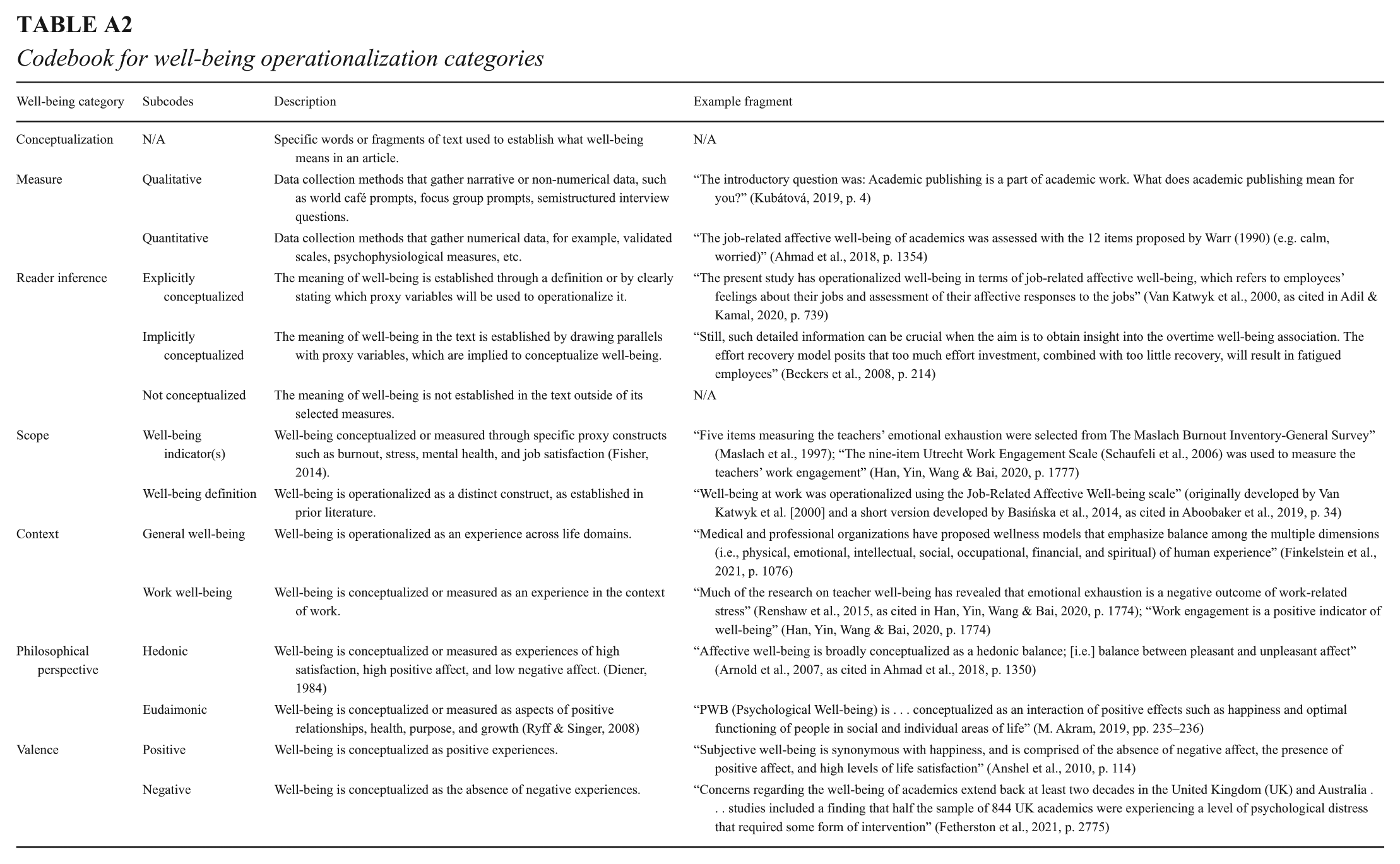
| Well-being category | Subcodes | Description | Example fragment |
|---|---|---|---|
| Conceptualization | N/A | Specific words or fragments of text used to establish what well-being means in an article. | N/A |
| Measure | Qualitative | Data collection methods that gather narrative or non-numerical data, such as world café prompts, focus group prompts, semistructured interview questions. | “The introductory question was: Academic publishing is a part of academic work. What does academic publishing mean for you?” (Kubátová, 2019, p. 4) |
| Quantitative | Data collection methods that gather numerical data, for example, validated scales, psychophysiological measures, etc. | “The job-related affective well-being of academics was assessed with the 12 items proposed by Warr (1990) (e.g. calm, worried)” (Ahmad et al., 2018, p. 1354) | |
| Reader inference | Explicitly conceptualized | The meaning of well-being is established through a definition or by clearly stating which proxy variables will be used to operationalize it. | “The present study has operationalized well-being in terms of job-related affective well-being, which refers to employees’ feelings about their jobs and assessment of their affective responses to the jobs” (Van Katwyk et al., 2000, as cited in Adil & Kamal, 2020, p. 739) |
| Implicitly conceptualized | The meaning of well-being in the text is established by drawing parallels with proxy variables, which are implied to conceptualize well-being. | “Still, such detailed information can be crucial when the aim is to obtain insight into the overtime well-being association. The effort recovery model posits that too much effort investment, combined with too little recovery, will result in fatigued employees” (Beckers et al., 2008, p. 214) | |
| Not conceptualized | The meaning of well-being is not established in the text outside of its selected measures. | N/A | |
| Scope | Well-being indicator(s) | Well-being conceptualized or measured through specific proxy constructs such as burnout, stress, mental health, and job satisfaction (Fisher, 2014). | “Five items measuring the teachers’ emotional exhaustion were selected from The Maslach Burnout Inventory-General Survey” (Maslach et al., 1997); “The nine-item Utrecht Work Engagement Scale (Schaufeli et al., 2006) was used to measure the teachers’ work engagement” (Han, Yin, Wang & Bai, 2020, p. 1777) |
| Well-being definition | Well-being is operationalized as a distinct construct, as established in prior literature. | “Well-being at work was operationalized using the Job-Related Affective Well-being scale” (originally developed by Van Katwyk et al. [2000] and a short version developed by Basińska et al., 2014, as cited in Aboobaker et al., 2019, p. 34) | |
| Context | General well-being | Well-being is operationalized as an experience across life domains. | “Medical and professional organizations have proposed wellness models that emphasize balance among the multiple dimensions (i.e., physical, emotional, intellectual, social, occupational, financial, and spiritual) of human experience” (Finkelstein et al., 2021, p. 1076) |
| Work well-being | Well-being is conceptualized or measured as an experience in the context of work. | “Much of the research on teacher well-being has revealed that emotional exhaustion is a negative outcome of work-related stress” (Renshaw et al., 2015, as cited in Han, Yin, Wang & Bai, 2020, p. 1774); “Work engagement is a positive indicator of well-being” (Han, Yin, Wang & Bai, 2020, p. 1774) | |
| Philosophical perspective | Hedonic | Well-being is conceptualized or measured as experiences of high satisfaction, high positive affect, and low negative affect. (Diener, 1984) | “Affective well-being is broadly conceptualized as a hedonic balance; [i.e.] balance between pleasant and unpleasant affect” (Arnold et al., 2007, as cited in Ahmad et al., 2018, p. 1350) |
| Eudaimonic | Well-being is conceptualized or measured as aspects of positive relationships, health, purpose, and growth (Ryff & Singer, 2008) | “PWB (Psychological Well-being) is . . . conceptualized as an interaction of positive effects such as happiness and optimal functioning of people in social and individual areas of life” (M. Akram, 2019, pp. 235–236) | |
| Valence | Positive | Well-being is conceptualized as positive experiences. | “Subjective well-being is synonymous with happiness, and is comprised of the absence of negative affect, the presence of positive affect, and high levels of life satisfaction” (Anshel et al., 2010, p. 114) |
| Negative | Well-being is conceptualized as the absence of negative experiences. | “Concerns regarding the well-being of academics extend back at least two decades in the United Kingdom (UK) and Australia . . . studies included a finding that half the sample of 844 UK academics were experiencing a level of psychological distress that required some form of intervention” (Fetherston et al., 2021, p. 2775) |

Notes
AUTHORS
AISHA MIREN IQBAL RUIZ is a PhD candidate in the Department of Educational Research and Development at the School of Business and Economics at Maastricht University, Maastricht, the Netherlands; email:
WIM GIJSELAERS is a full professor in the Department of Educational Research and Development at the School of Business and Economics at Maastricht University, Maastricht, the Netherlands; email:
SIMON A. J. BEAUSAERT is a full professor in learning and development in organizations at the Department of Educational Research and Development at the School of Business and Economics, Maastricht University, Maastricht, the Netherlands; email:
INKEN GAST is an assistant professor at the Department of Educational Research and Development at the School of Business and Economics, Maastricht University, Maastricht, the Netherlands; email:
References
Supplementary Material
Please find the following supplemental material available below.
For Open Access articles published under a Creative Commons License, all supplemental material carries the same license as the article it is associated with.
For non-Open Access articles published, all supplemental material carries a non-exclusive license, and permission requests for re-use of supplemental material or any part of supplemental material shall be sent directly to the copyright owner as specified in the copyright notice associated with the article.
