




Abstract
This preregistered meta-analysis investigated whether cultural values moderate the relations between students’ achievement orientations and their tendency to cheat. We identified 80 studies on the associations between performance/learning orientations and academic cheating in 27 countries with 40,867 participants. Performance orientation positively correlates with academic cheating (r = .09, 95% CI = 0.04 to 0.13), and learning orientation negatively correlates with academic cheating (r = −.16, 95% CI = −0.20 to –0.13). Univariate meta-analysis, hierarchical meta-regression, and meta-analytic structural equation modeling (MASEM) revealed that cultural values at the country level significantly moderate the relations between achievement orientations and cheating. These findings suggested that cultural values play a significant role in influencing the relations between achievement orientations and academic cheating, and, thus, cheating prevention programs must consider culture to achieve optimal effects. Based on these findings, we propose a new model that integrates cultural values into the existing model of academic cheating decision-making.
Keywords
Academic cheating is a widespread problem that can have negative impacts on individuals, institutions, and society as a whole (Jensen et al., 2002; Madara & Namango, 2016; Rawwas et al., 2004). Academic cheating is generally defined as the act of breaking the rules in an academic situation to gain an undue advantage (Zhao et al., 2021), which generally includes behaviors such as cheating on examinations, copying others’ homework or assignments, and plagiarism (Anderman & Murdock, 2011; Cizek, 1999). Despite extensive research on the topic, little attention has been paid to the role of cultural values in academic cheating. This meta-analytic study aims to address this gap by examining how country-level cultural values might moderate the relations between students’ achievement orientations and their tendency to cheat.
Achievement orientations, or the motivations behind academic pursuits, have been identified as key factors in academic cheating (Anderman & Won, 2017; Krou et al., 2021; Murdock et al., 2001; Murdock & Anderman, 2006). Students motivated by external factors such as approval seeking—termed as having a performance orientation—are more likely to cheat than those driven by internal desires for self-enhancement and knowledge, known as having a learning orientation (Anderman & Midgley, 2004; Murdock et al., 2001; Murdock et al., 2007; Orosz et al., 2013; Orosz et al., 2016; Rettinger & Jordan, 2005). Murdock and Anderman (2006) proposed an influential theoretical model in which achievement orientations play crucial roles in students’ decisions to cheat. As all students are socialized from childhood in their own culture, which has an important impact on their unique achievement orientations and perspectives about goals, expectations, and costs of cheating, we hypothesized that cultural values might play a significant role in moderating the relations between achievement orientations and cheating (Hypothesis 1). The present meta-analytic study directly tested this hypothesis.
Achievement Orientations and Academic Cheating
All cultures in the world socialize their members early in childhood to be honest (Evans & Lee, 2013; Evans & Lee, 2022). Yet many individuals on occasion behave dishonestly during development for various reasons, such as shirking responsibilities, evading punishment, obtaining rewards, and maintaining reputation (Kotaman, 2017; Wilson et al., 2003; Zhao et al., 2018; see Evans & Lee, 2022 for a review). One of the earliest forms of dishonesty is cheating on academic matters (e.g., Yee et al., 2024; Zhao et al., 2021, 2024). It is universally recognized that academic cheating is a serious problem because it has negative impacts at individual, institutional, and societal levels (Anderman & Murdock, 2011; Zhao et al., 2022). Some have even suggested that academic cheating may be a “gateway” act that leads to all forms of dishonesty in one’s life including relationships, work, and personal finance (Guerrero-Dib et al., 2020). Given the concerning prevalence and negative impacts of academic cheating, empirical research examining this issue has been extensive worldwide since the early 1900s (Grym & Liljander, 2016; Hartshorne & May, 1928; Voelker, 1921).
One of the key factors that have been consistently found to play an important role in academic cheating is achievement orientation. Research on achievement motivations has identified two major achievement orientations based on achievement goal theories (Elliott & Dweck, 1988; Elliot & Harackiewicz, 1996). One is performance orientation, in which individuals tend to be motivated extrinsically by desires to demonstrate their abilities to others, seek approval, and avoid disapproval. Another is learning orientation, also known as mastery orientation, which refers to the tendency of individuals to be motivated intrinsically by such goals as self-enhancement, knowledge-seeking, and skill mastery to enhance their ability or master new tasks. For consistency in this article, we used the term learning orientation exclusively. Extensive research has revealed that the conceptualization of achievement motivations by these two orientations provides a powerful explanation of various individual differences in the learning process, including help-seeking, procrastination, goal-setting, preference for challenge, dependence on teachers, and academic emotions (for reviews, see Givens Rolland, 2012; Meece et al., 2006; Peled et al., 2018).
Achievement orientation also figures prominently in theoretical models to account for individual differences in academic cheating. For example, Murdock and Anderman (2006) proposed a model to account for cheating decision-making on academic matters. The model (Figure 1A) consists of three components: goals, expectations, and costs, which are concerned with three key questions a learner must answer when encountering an academic task: (a) What is my purpose? (b) Can I do this? (c) What are the costs associated with doing it? Murdock and Anderman (2006) suggested that goals were the foremost component driving students’ decision to act honestly or cheat, which was strongly influenced by one’s achievement orientation. According to this model, students with different achievement orientations will differ in their tendency to cheat. More specifically, the theory predicts that individuals with the performance orientation will be more inclined to cheat than students with the learning orientation. This is because students with a strong performance orientation are so concerned about achieving high grades and achieving a high academic standing that they are more willing to compromise their ethics and resort to cheating.
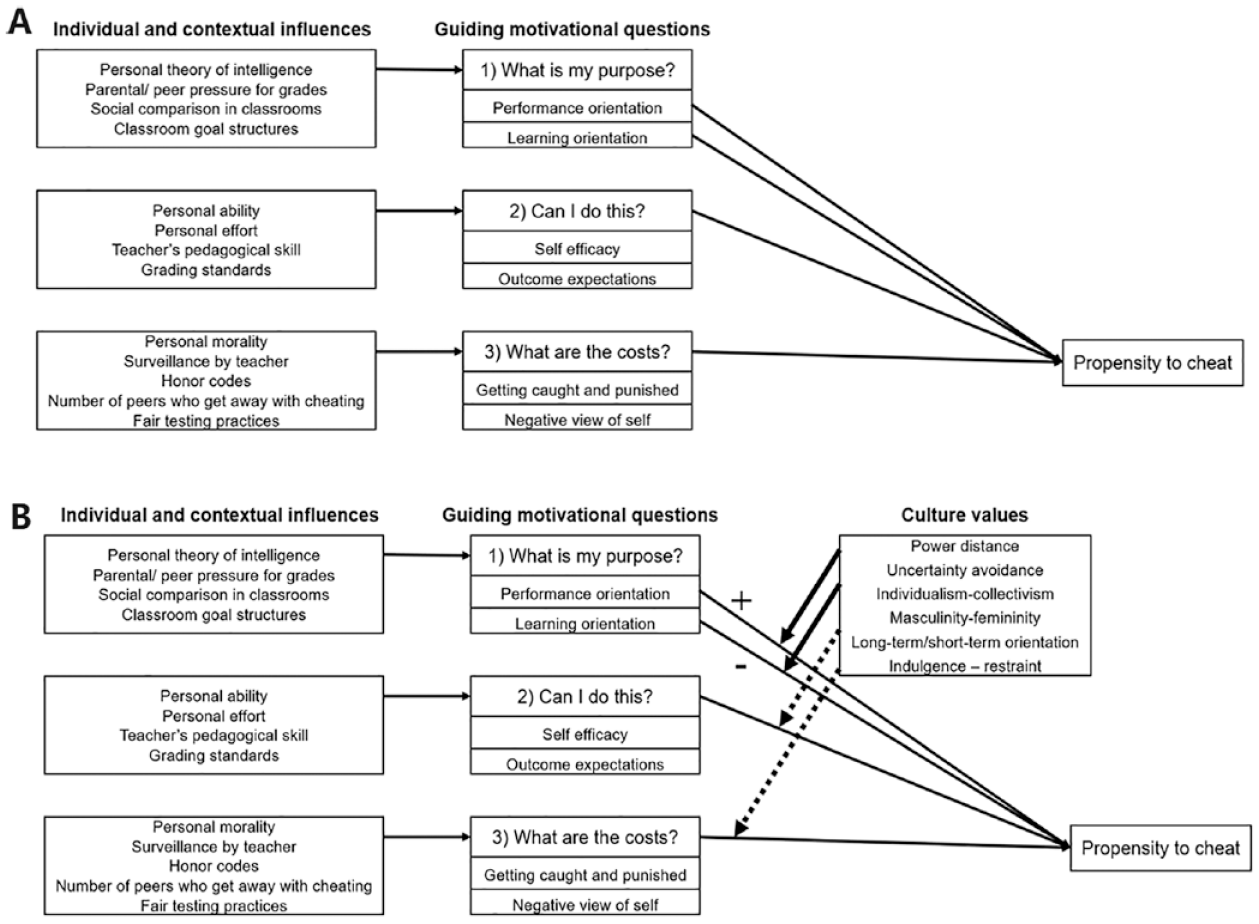
A motivational model proposed by Murdock and Anderman (2006) to account for cheating decision-making on academic matters (A) and our modification of the model (B). Solid bolded lines indicate cultural dimensions known to moderate the relations between motivations and the propensity to cheat; dashed bolded lines indicate the moderating roles of cultural dimensions that are yet to be verified. Plus and minus signs next to the bolded lines indicate the directions of the moderating effect.
Indeed, many studies support the theory’s predictions. For example, Tas and Tekkaya (2010) found that students’ cheating could be predicted positively by their performance-approaching goals, but negatively predicted by their learning orientations. Despite some inconsistent findings (e.g., Anderman & Won, 2017; Niiya et al., 2008), several qualitative narrative reviews all concluded that achievement orientation indeed has a very important influence on students’ cheating behavior (e.g., Khalid, 2015; Murdock & Anderman, 2006).
Although narrative review is a highly useful tool to synthesize research findings in the literature, it is subjective, and its conclusion can be influenced by various biases. For example, there were findings in the literature suggesting that the relations between achievement orientations and cheating might vary depending on the countries or cultures in which the students are socialized (e.g., Stephens et al., 2010). Because the issues of cultural differences were not their main concerns, the narrative reviews have not emphasized these findings (e.g., Peled et al., 2018). Also, because the majority of the existing studies were conducted in North America, the narrative reviews have tended to underrepresent the findings from studies done with students from other geographic regions or cultures. It is thus unclear whether the theoretical model by Murdock and Anderman (2006) is culturally universal. To date, little research has investigated the role of cultural values in academic cheating (but see Zhao et al., 2022). To address this gap, the present preregistered meta-analytic study incorporated country-level cultural value measures and examined how they might moderate the relations between students’ achievement orientations and their tendency to cheat in different cultures.
Meta-Analyses of the Relations Between Achievement Orientations and Academic Cheating
The meta-analysis can address the shortcomings of narrative reviews by providing a quantitative and objective synthesis of the existing research findings with the use of statistical means (Cuijpers, 2016). Modern meta-analytic tools allow for not only the statistical testing of hypotheses derived from existing theories but also statistical evaluations of moderating factors (Borenstein et al., 2009). Further, the methods are particularly adept at assessing whether the existing findings are overly heterogeneous and detecting whether the literature has a publication bias whereby researchers have not published negative findings against the prevailing theories.
To date, only one meta-analysis (Krou et al., 2021) has assessed whether there indeed exists a close relation between achievement orientations and cheating as predicted by the Murdock and Anderman (2006) model. However, this existing meta-analysis has limitations. Like the vast majority of the meta-analysis papers, it used the univariate meta-analysis approach. This approach only tests the potential factors moderating the relations between achievement orientations and cheating individually, akin to performing bivariate correlations in traditional data analysis. Because many moderators tend to be correlated with each other, this approach fails to consider the common contributions of all moderators or the unique contribution of each moderator above and beyond the common contributions.
The meta-regression approach can overcome this shortcoming of the univariate meta-analysis (Tang & Cheung, 2016; Thompson & Higgins, 2002). Similar to traditional multiple regression analysis, meta-regression analysis considers all potential factors when assessing their moderating effects on the effect sizes. Further, one can identify not only the common contributions by all moderators but also the unique contribution of each moderator above and beyond the common contributions. Recognizing the limitation of the existing meta-analysis, the present meta-analysis took this meta-regression approach to identify whether cultural values commonly moderate the relations between achievement orientations and academic cheating. We also explored the unique contributions of specific cultural values in moderating such relations. To further confirm the results of meta-regression analyses, we also used the meta-analytic structural equation modeling (MASEM) approach (Jak & Cheung, 2020) to assess concurrently how culture moderates the relations between achievement orientation and cheating.
Roles of Culture in the Relations Between Achievement Orientations and Academic Cheating
The role of culture in the relations between achievement orientations and academic cheating has not been examined in previous research, including the meta-analysis by Krou et al. (2021). However, culture is likely to play a moderating role for several reasons. Cultural values have a significant impact on people’s behavior and learning habits (Hofstede & Minkov, 2010; Oyserman et al., 2002). Different cultures also have different achievement orientations and approaches to problem-solving and evaluating learning outcomes (Markus & Kitayama, 1991; Trumbull & Rothstein-Fisch, 2011). These cultural differences can influence how students value different achievement orientations (Dekker & Fischer, 2008; Greenfield, 2014).
Indeed, research indicates that achievement orientations are significantly shaped by a society’s cultural dimensions (e.g., individualism-collectivism, power distance, etc.; Hofstede, 2011; see below for details). Students from individualistic cultures tend to have more internal loci of control (Triandis, 2001) and are driven by intrinsic motivation and personal choice (Iyengar & Lepper, 1999). In contrast, collectivist cultures tend to foster more external loci of control (Cheng et al., 2013), with academic motivation stemming from social approval (Wang & Li, 2003), family reputation (Kim & Park, 2000), and group success (A. -B. Yu & Yang, 1994). Power distance also influences achievement orientations—students from high-power-distance cultures anticipate hierarchical, teacher-centered classrooms and show high respect to authority (Hofstede, 1986; Huang & Brown, 2009). In contrast, those from more egalitarian cultures prefer more student-driven approaches (San Antonio, 2018).
Some existing studies on the relations between achievement orientations and cheating have also revealed cross-national differences, such as a negative correlation between performance orientation and cheating in Chinese students (He et al., 2015) and a positive correlation in American students (Tyler, 2015). However, cross-national differences do not necessarily equate to cross-cultural differences, and thus, it is important to confirm whether these differences are due to cultural differences.
To address this significant gap in the literature, the present meta-analysis used a novel approach by examining cultural values at the country level to determine whether they moderate the relations between achievement orientations and academic cheating. Unlike previous meta-analyses that only performed traditional univariate moderator analyses (e.g., Krou et al., 2021; Zhao et al., 2022), we used three meta-analytic approaches: univariate meta-analysis, meta-regression analysis, and MASEM (Jak & Cheung, 2020).
Univariate meta-analysis allows us to determine whether a variable in isolation moderates the relations between achievement orientations and cheating. However, one problem of univariate meta-analysis is that different moderators (e.g., different cultural dimensions) may be highly correlated with each other, and their moderating effects may reflect the result of a common underlying construct. It is possible that when several moderators are significant on their own in univariate analysis, they may not be significant when all moderators are considered together. Thus, it is necessary to conduct a meta-regression analysis to determine the common contributions of the moderators and the unique contribution of each moderator above and beyond the common contributions to the relations between achievement orientations and cheating.
In addition, we used MASEM. Unlike meta-regression analysis, which only considers either the relation between performance orientation and cheating or that between learning orientation and cheating individually, MASEM is a multivariate technique that accounts for sampling covariance between effect sizes. Thus, it can evaluate a model involving both relations concurrently. It provides measures of the overall fit of a hypothesized model, and parameter estimates from structural equation modeling (SEM) with confidence intervals and standard errors (Aguinis et al., 2011; M. W.-L. Cheung, 2015; Ke et al., 2018). Here we used one-stage MASEM (Jak & Cheung, 2020), a novel MASEM method, which is better suitable to explain study-level heterogeneity than the existing methods (e.g., GLS [generalized least squares], TSSEM [two-stage structural equation modeling], FIMASEM [full information meta-analysis structural equation modeling], parameter-based MASEM, or Bayesian MASEM; Becker, 1992; M. W.-L. Cheung, 2014; M. W.-L. Cheung & Cheung, 2016; Ke et al., 2018; J. J. Yu et al., 2016). Further, it incorporates continuous and categorical moderators into the MASEM models (Jak & Cheung, 2020) and, thus, allows us to assess concurrently the common and unique contributions of moderators to both the relation between performance orientation and cheating and that between learning orientation and cheating.
Both meta-regression and MASEM are necessary in this study due to their different functions. We used meta-regression because it allows us to explore separately the impact of various factors on the relation between performance orientation and cheating, and the relation between learning orientation and cheating. It also identifies the extent to which each factor uniquely contributes to each of these relations. We used MASEM to validate the results of the meta-regression because MASEM can concurrently analyze the relations between academic orientations and cheating and the factors affecting these relations. However, MASEM, by its nature, is unable to identify the extent to which each factor contributes to the relation between each academic orientation and cheating. Therefore, the combined use of meta-regression and MASEM is optimal to address our key research questions.
Culture Dimensions
Over the last several decades, cultural psychologists have developed various country-level measures of values. Hofstede’s cultural dimensions is a widely used system that measures cultural values on six dimensions as described below (Hofstede, 2011).
Individualism-collectivism refers to the extent to which people emphasize individual rights versus group rights and independence versus interdependence among group members. Individualistic cultures value personal rights and prioritize the immediate family, while collectivist cultures value collective rights and a sense of group belonging.
Power distance refers to the extent to which inequality and hierarchical power structures are accepted in a culture. Societies with high power distance readily accept hierarchy and inequality, whereas those with low power distance follow democratic principles and favor equalitarianism.
Uncertainty avoidance refers to the extent to which future uncertainty is accepted or avoided by a culture. This includes avoiding novel, unusual, and surprising future situations, as opposed to simply avoiding risky events, which is known as risk avoidance. Cultures with weak uncertainty avoidance are more accepting of chaos and social unrest, whereas those with strong uncertainty avoidance have stricter guidelines.
Masculinity-femininity refers to the extent to which traditional gender roles are emphasized in a culture. Masculine cultures value assertiveness, ambition, and competition; whereas feminine cultures value gender equality, humility, and caring.
Long-term/short-term orientation refers to the extent to which a culture values future-focused, long-term goals over short-term gratification. Societies with a long-term orientation tend to emphasize perseverance and preparation for the future, whereas those with a short-term orientation prioritize the present and immediate past.
Indulgence-restraint refers to the extent to which a culture accepts gratification of basic and natural human desires related to enjoying life and having fun. Indulgent societies tend to permit relatively free fulfillment of these impulses, whereas restrained cultures exert stricter control over such gratification.
Relations Between Culture Dimensions and Achievement Orientations
Although no research has examined the moderating effects of cultural dimensions on the relations between achievement orientations and academic cheating (see Zhao et al., 2022), there has been some research on the relations between cultural dimensions and achievement orientations. This area of research often draws from cross-cultural psychology and educational studies. Several cultural dimensions have been shown to influence achievement orientations such as motivation and achievement goals.
For example, in individualistic cultures, personal achievement and initiative are highly valued, often leading to a learning orientation in academic settings. In contrast, collectivist cultures tend to foster performance orientation with a focus on avoiding losing face and maintaining group harmony (Hofstede, 1986). In cultures with high power distance, students are less likely to challenge or question authority figures, including teachers, which influences their academic engagement and learning strategies (Hofstede et al., 2010). Students in high-uncertainty-avoidance cultures may be more risk-averse and prefer structured learning environments. As a result, their achievement orientations tend to focus on rote learning rather than problem-solving (Hofstede, 2001; Hofstede & Minkov, 2010).
Hypothesized Moderating Roles of Culture Dimensions on the Relations Between Achievement Orientations and Academic Cheating
Given the close relations between achievement orientations and academic cheating and the known associations between cultural dimensions and achievement orientations, some researchers have suggested that academic cheating behaviors can also be influenced by cultural norms and values (McCabe et al., 2001). However, little direct evidence supports this suggestion.
Nevertheless, the influence of culture is known to be greater for individuals with a performance orientation than those with a learning orientation (Benson et al., 2020; Fyans et al., 1983; Salili, 1994). This is because those with a learning orientation have the achievement goal of acquiring more knowledge and developing new abilities (Anderman & Midgley, 2004; Murdock et al., 2001). Cheating leads to inaccurate assessments of one’s learning, which hinders the growth of knowledge and abilities (Chance et al., 2011; Zhao et al., 2023). Thus, external factors such as culture may have a relatively limited influence over one’s pursuit of improving knowledge and abilities (E. Cheung, 2004; Klein et al., 2006). In other words, people with a learning orientation may be less inclined to cheat in pursuit of improving knowledge and abilities regardless of the culture in which they are socialized.
In contrast, culture may have a greater influence over individuals with a performance orientation. For example, people in collectivist societies tend to define success based on the quality of interpersonal relationships (Benson et al., 2020). Studies have shown that people tend to favor those deemed moral over those seen as immoral (Fiske et al., 2007; Goodwin et al., 2014). Cheating will lead to unfair competition, and thus, cheaters are disliked. Therefore, in a collectivist society, people with a performance orientation may be less inclined to cheat to pursue success. Since individualistic societies prioritize personal success (Triandis et al., 1988), cheating can be seen as a way to boost individual performance in such cultures. Therefore, in an individualistic society, people with a performance orientation may be more likely to cheat to pursue self-success. In other words, people with a performance orientation will be more prone to cultural influences. Thus, we hypothesized that the six cultural dimensions together would account for substantially more variance in the relation between performance orientation and cheating compared to the variance between learning orientation and cheating (Hypothesis 2).
Previous research has not found a significant relation between power distance and performance orientation (Akoto et al., 2014). However, it has been found that those from low-power-distance cultures tend to challenge rules set by authority figures (e.g., Taras et al., 2010). This observation led us to hypothesize that students with performance orientation may be more likely to cheat in low-power-distance cultures (Hypothesis 3a). On the other hand, because learning orientation emphasizes personal abilities and learning gains (Dweck, 1986), we hypothesized that power distance would not significantly moderate the relation between learning orientation and cheating (Hypothesis 3b).
We hypothesized that individuals with a performance orientation from low-uncertainty-avoidance cultures may be more likely to take the risk of cheating due to higher acceptance of risk (Hypothesis 4a). However, the moderating role of uncertainty avoidance in the relation between learning orientation and cheating remains unclear. Whether uncertainty avoidance is linked to learning orientation is controversial (Akoto et al., 2014; Badri et al., 2014), leading to two opposing hypotheses: Uncertainty avoidance either significantly moderates the relation between learning orientation and cheating (Hypothesis 4b) or has no moderating effect on the relation (Hypothesis 4c).
Regarding the moderating role of each cultural dimension, the relation between individualism-collectivism and academic cheating is controversial. Some studies have found that group awareness in collectivist cultures may diminish personal responsibility and increase cheating (Chapman & Lupton, 2004; Marhoon & Wardman, 2018; Singelis et al., 1995), However, others have found plagiarism more prevalent in individualistic versus collectivist countries (Martin, 2012; Thomas, 2017). Given individualistic cultures’ emphasis on personal success, we hypothesize a stronger association between performance orientation and cheating in such societies (Hypothesis 5a). However, due to limited evidence, two opposing possibilities exist: Individualism-collectivism either significantly moderates the relation between learning orientation and cheating (Hypothesis 5b) or has no moderating effect on the relation (Hypothesis 5c).
Previous research on the association between masculinity-femininity and performance orientation has been mixed (Akoto et al., 2014), leaving uncertainty about its role in moderating the relation between performance orientation and cheating. Therefore, we tested two opposing hypotheses: Masculinity-femininity either significantly moderates the relation between performance orientation and cheating (Hypothesis 6a) or has no moderating effect on the relation (Hypothesis 6b). However, students in a high-masculinity society have been found to behave very differently in the classroom from those in a high-femininity society: The former tend to be more motivated to learn and gain abilities than the latter (Hofstede & Minkov, 2010). Therefore, we hypothesized that societies higher in masculinity would exhibit a stronger association between learning orientation and academic cheating than those higher in femininity (Hypothesis 6c).
People from short-term-oriented societies are more prone to cheating, as it produces immediate benefits (e.g., Minkov, 2013). We thus hypothesized a stronger linkage between performance orientation and academic cheating in societies exhibiting short-term orientations than those exhibiting long-term orientations (Hypothesis 7a). However, given that learning-oriented students tend to have long-term learning orientations (E. Cheung, 2004), we predicted the short- versus long-term orientation would have no influence on the relation between learning orientation and cheating (Hypothesis 7b).
Because social norms are not valued in highly indulgent societies, individuals in such societies are more likely to violate norms. Thus, we predicted that students from more indulgent cultures would exhibit a greater tendency to cheat when motivated by performance orientation (Hypothesis 8a). However, given that students with learning orientation prioritize internal objectives over external factors (E. Cheung, 2004; Klein et al., 2006), we predicted indulgence versus restraint would not moderate on the relation between learning orientation and cheating (Hypothesis 8b).
Table 1 summarizes our a priori hypotheses about the relations between achievement orientations and cheating and the moderating effects of different cultural dimensions on the relations.
A priori hypotheses about the role of cultural values on the relations between achievement orientations and cheating and evidence for or against them
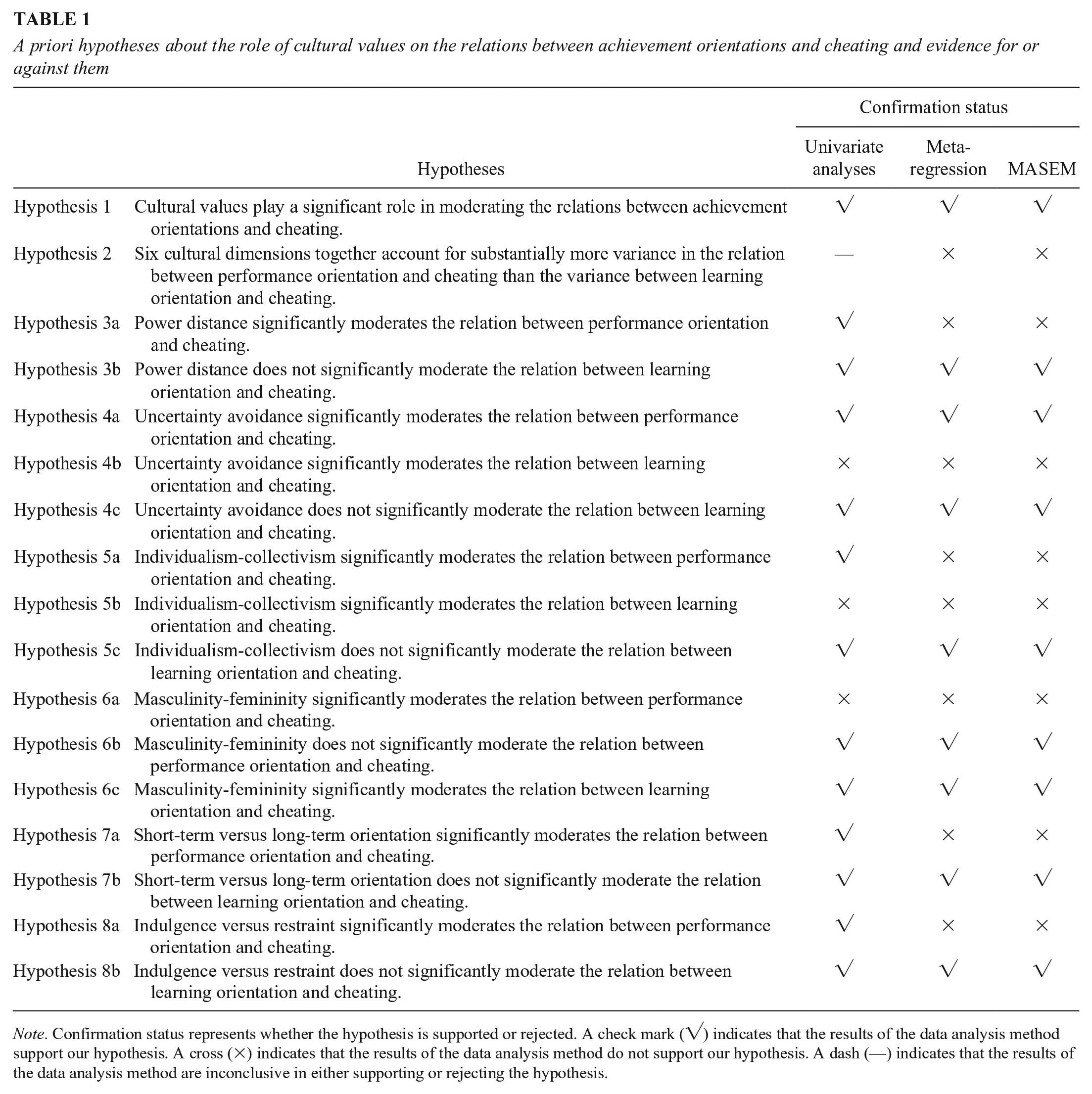
Note. Confirmation status represents whether the hypothesis is supported or rejected. A check mark (√) indicates that the results of the data analysis method support our hypothesis. A cross (×) indicates that the results of the data analysis method do not support our hypothesis. A dash (—) indicates that the results of the data analysis method are inconclusive in either supporting or rejecting the hypothesis.
Method
Transparency and Openness
We preregistered the current meta-analysis at https://aspredicted.org/im77t.pdf, and we followed the checklist of Preferred Reporting Items for Systematic Reviews and Meta-Analyses (PRISMA 2020; Page et al., 2021). The data supporting the findings of this study are available at https://osf.io/m8kcq/.
Literature Search
Between March 2021 and April 2022, we conducted an exhaustive search between 1920 and 2022 to conduct this meta-analysis after we preregistered the present meta-analysis. We used a total of five strategies to identify relevant publications, with the first three strategies used in the first round of the literature search and the last two strategies used in the second round of the search.
First, we conducted extensive searches of published and unpublished papers (e.g., dissertations, book chapters, conference papers) through multiple electronic databases. We searched multiple databases including PsycINFO, ERIC, Web of Science, Taylor & Francis, SpringerLink, Wiley Online Library, ProQuest Dissertations and Theses, Google Scholar, and CNKI using the following search terms: academic cheating, academic dishonesty, academic integrity, academic misconduct, academic deception, unethical academic behavior, plagiarism, cheating, cheat, deception, dishonesty, and honesty.
Second, we examined the reference lists from narrative reviews of academic cheating (e.g., Murdock & Anderman, 2006; Bucciol & Montinari, 2019; Cizek, 1999; Crown & Spiller, 1998; Whitley, 1998) to identify any paper that was not found using the first strategy.
Third, we identified the studies that have been included in the existing meta-analysis paper (i.e., Krou et al., 2021) but were not identified by the above strategies.
Fourth, we performed a second round of searches using the above electronic databases to seek out more studies from different countries, to ensure that the geographic distribution would be as wide as possible. Since the time interval between the second round of the literature search and the first round was 1 year, new studies on the relations between achievement orientations and academic cheating might have been published during this year.
Finally, we also searched exclusively for non-English articles to identify as many as possible studies conducted in non-Western countries to increase the cultural diversity of the studies in the present meta-analysis. Specifically, we translated the search terms listed above into different languages (e.g., Hindi, Korean, Hungarian) and performed the searches on Google Scholar.
In total, we found 1,423 studies. However, after inspecting their titles and abstracts, we found that some articles were duplicated and some were unsuitable for the present meta-analysis (e.g., literature reviews, commentaries, qualitative research), so they were excluded. We also eliminated the studies about which we could not find the full text.
After these eliminations, there were 784 studies left. Then, we assessed these articles carefully and created a coding guide for four main categories: (a) research report characteristics (author, year, title, publication status, region in which study conducted and its GDP that year, school type), (b) participant characteristics (sample size, educational level, mean age, percentage of female), (c) variables of academic cheating (source of data, academic cheating type, measurement of academic cheating), and (d) predictors of academic cheating (e.g., students’ achievement orientations). We identified 167 studies that specifically examined the associations between achievement orientations and academic cheating.
We further narrowed down the number of studies to 83 using the following criteria:
(1) The studies should report at least one measure of students’ achievement orientations. We excluded 56 studies for not reporting any of such measures.
(2) The studies should estimate the participants’ academic cheating. We excluded 17 studies that only measured participants’ self-reported likelihood to cheat in various hypothetical situations, their attitude about cheating, and their reports of others’ cheating behaviors.
(3) The studies should report effect size information regarding the relations between students’ achievement orientations and cheating behaviors, including bivariate correlations, or sufficient data (e.g., standardized beta) to calculate the effect sizes (eight studies excluded).
(4) The studies should report the number of participants (two studies excluded).
(5) Only one effect size should be extracted from a given sample of participants (one study was excluded because the authors used the same dataset to publish three papers).
According to the above criteria, we obtained 63 studies (69 effect sizes) for the relation between performance orientation and academic cheating, which contained 30,819 participants; and 75 studies (81 effect sizes) for the relation between learning orientation and academic cheating, which contained 38,628 participants. We further removed outliers of two standard deviations exceeding the average to reduce the influence of extreme effect sizes on the results (Grubbs, 1950; Seo, 2006). Based on this process, we finally obtained a combined total of 80 studies with 87 samples (N = 40,867). Among them, a final set of 61 studies (67 effect sizes) based on a total sample size of 30,488 participants was used to analyze the relation between performance orientation and academic cheating, and a set of 72 studies (77 effect sizes) based on a total sample size of 36,095 participants was used to analyze the relation between the learning orientation and academic cheating. Please see Figure 2 for the literature search and study selection procedure and Supplementary Material in the online version of the journal for the studies included in the current meta-analysis.
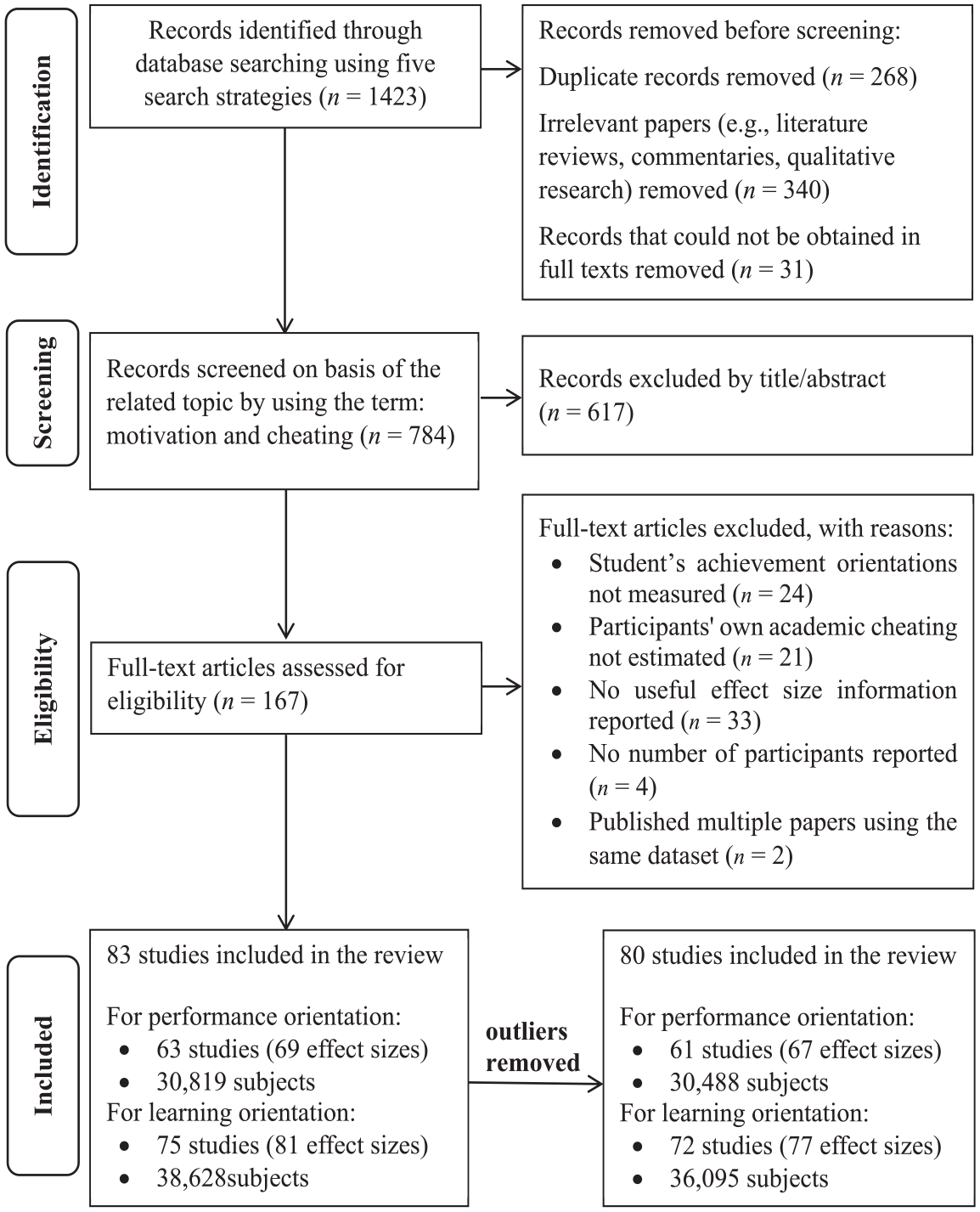
Flow chart of the literature search and study selection procedure.
Coding Procedure
Three research assistants independently coded the studies. They were all graduate students and had at least a bachelor’s degree in psychology. The studies were assigned to two of the three coders. When disagreements arose, the study was recoded until both coders agreed on the result. For the research report characteristics, we coded the last name of the first author, the year of publication, and the publication status. For the other data, we coded them in the following manner:
Country-Level Cultural Value Measures
The Geert’s Database was based on a series of large-scale international surveys of the values of people in different countries and regions. Hofstede then conducted factor analyses and extracted six important cultural value indexes (i.e., power distance, uncertainty avoidance, individualism-collectivism, masculinity-femininity, long-term/short-term orientation, and indulgence-restraint). The database was obtained by standardizing these six cultural value indexes across countries. Based on Geert’s Database (http://geert-hofstede.com/), we used information about the countries where the studies were conducted and obtained their six cultural value indexes. One study was excluded from the analyses involving these measures because it was collected in different countries and did not separate the effect size for each country individually. Two studies were also excluded from the analyses involving these measures because their countries had missing data from Geert’s Database.
Other Country-Level Measures
To examine the moderating effects of cultural dimensions, we needed to control for other noncultural country-level factors that might moderate the relations between achievement orientations and cheating. To this end, we also obtained the following country-level measures to determine whether they moderate the relations between achievement orientations and cheating: gross domestic product (GDP) per capita, education index, and human development index. These variables were collected from the United Nations database (http://data.un.org/Default.aspx).GDP per capita is the ratio of the GDP of a country or region to the total local population. The education index is an average of mean years of schooling (of adults) and expected years of schooling (of children), both expressed as an index obtained by scaling with the corresponding maxima (Adeleke & Mcsharry, 2022). The human development index is a composite index measuring average achievement in three basic dimensions of human development: a long and healthy life, knowledge, and a decent standard of living (Dasic et al., 2020).
Sample Size
We extracted the sample size from each study. In some studies, the number of participants reported in the method section was inconsistent with the number of participants reported in the result section. We used the sample size reported in the result section because the effect size should be paired with the actual sample size.
Gender (Percentage of Females)
Because no studies reported effect sizes for male and female participants separately, we had to use the proportion of females in the study as a proxy to explore the effect of gender on the relations between achievement orientations and cheating. Three studies did not report any gender information, and we coded them as missing.
Age
We coded the mean age of participants reported in each study. Some studies did not report the mean age of participants who were included to compute the effect sizes. For these effect sizes, we used the mean age of the total participants they reported in the method section. The age range of the included participants was from 10 to 64 years. Twenty-three studies did not provide any information about participant age, and we coded them as missing.
Educational Level
We extracted the educational level of participants from each study. Because most of the participants were university or graduate students, to ensure a relatively balanced analysis, we divided the educational levels into two categories: university or above, and high school or below. Three studies did not report any information about the educational level of participants, and we coded them as missing.
School Type
We coded school types into two categories: single-school study and multiple-school study. Three studies did not report such information and were coded as missing.
Source of Data
We divided the source of data into two categories: in-class (e.g., studies that collected data on cheating behavior in the classroom) and out-of-class (e.g., studies that collected data on cheating behavior by a noncentralized method such as online questionnaires). Thirteen studies did not report where the data were collected, and we coded them as missing. Three studies used two categories at the same time. They were excluded from the analyses.
Academic Cheating Type
We coded the type of academic cheating in terms of whether cheating occurred on exams or assignments and excluded 71 studies from the analyses involving academic cheating type because they included both cheating on homework and cheating on exams, and did not separate the effect size for each academic cheating type individually.
Measurement of Academic Cheating
We coded measurements of academic cheating into three categories: continuous (e.g., cheating extent or frequency), dichotomous (e.g., whether cheated or not), and missing (seven studies did not report any measures of cheating).
Meta-Analytic Procedures
Transform and Combine
The present meta-analysis used correlation coefficient r as the preferred effect size estimate because most researchers reported it directly in the studies we analyzed here. For those studies that did not report correlation coefficient r but reported any statistics convertible to correlation coefficient r, we used a web application (https://www.psychometrica.de/effect_size.html#transform) for conversion.
Fifteen studies reported multiple correlations between different academic cheating measures and achievement orientations and the researchers did not aggregate them into a composite. Thirty-seven studies also reported multiple learning orientations or multiple performance orientations under the same subject group, such as mastery approach goals, mastery avoidance goals, performance-approach goals, and performance-avoidance goals. For these two cases, we combined them into one composite correlation in one sample by using Fisher Transformation. After combining, we obtained a final set of 61 studies (67 effect sizes) for analyzing the relation between performance orientation and cheating and a set of 72 studies (77 effect sizes) for analyzing the relation between learning orientation and cheating.
Calculate Average Effect Size
We used metafor package with R (Viechtbauer, 2010) for our average effect and univariate moderator analyses. According to the degree of heterogeneity reflected in Q and I2 statistics, we adopted the random effect model which assumed that the sizes of effect were different due to random error. The average effect was calculated through the inverse variance method proposed by Hedges and Vevea (1998).
Univariate Moderator Analyses
We used a mixed effects model to identify potential moderators that might significantly moderate the relations between academic cheating and performance or learning orientation by making them stronger or weaker. We used the mixed effects model because it has the advantage of being able to generalize the findings to any study belonging to the same population of studies from which effect sizes were obtained (Hedges & Pigott, 2004).
In keeping with the primary goal of the present research, we first conducted a series of moderator analyses of each of the cultural value indexes on the relations between achievement orientations and cheating. Then, we also explored the effects of each of the other potential moderator variables (e.g., age, gender, school type) on these relations.
Meta-Regression Analyses
Unlike previous meta-analyses that only performed univariate moderator analyses, we conducted a hierarchical meta-regression in the following manner, using the R-package metafor (Viechtbauer, 2010). First, based on the results of the univariate moderator analyses, if any of the noncultural moderators were significant, we included them in the first block of our hierarchical regression model. If no such factors were significant, we moved directly to the next step. In the next step, we added cultural moderators to the model. Our goal was to determine how much these cultural values would account for variance in the relations between achievement orientations and academic cheating. Further, we used the resultant regression models to determine whether each cultural moderator would account for a significant and unique amount of variance above and beyond the significant and common contributions of all moderators. We did so because various cultural moderators might be highly correlated with each other. Some of the significant moderating effects from the univariate meta-analyses might be due to the high correlations between the individual cultural moderators, reflecting a common underlying cultural factor, not the unique contribution of a particular cultural moderator. Further, such meta-regression analysis would allow for isolating the unique contribution of each cultural factor, which univariate meta-analysis cannot do.
Meta-Analytic Structural Equation Modeling
We used the R-package metaSEM to perform a one-stage MASEM analysis (Jak & Cheung, 2020). We fitted the model built on performance orientation, learning orientation, and cheating to the observed correlation matrix to evaluate the regression coefficients. Next, we analyzed the data with the six cultural dimensions as potential moderators of the regression coefficients. We put the six cultural values together into one-stage MASEM to evaluate the extent to which cultural dimensions would account for the amount of variance of the regression coefficient from performance orientation to cheating and the regression coefficient from learning orientation to cheating. Then, we inspected the resultant model to ascertain whether each cultural dimension uniquely and significantly would account for the variance in the relations between performance/learning orientations and cheating when both relations were considered concurrently. We did so to replicate the findings of our meta-regression analyses that considered the relations separately.
Publication Bias and Sensitivity Analysis
We used three methods to detect whether there would be a publication bias, including Egger’s regression, funnel plot with trim-and-fill, and p-curve (see below for details), and then leave-one-out analyses and modified meta-analyses to verify the robustness of the results.
Results
Study Characteristics
As mentioned above, a total of 80 studies with 87 samples (N = 40,867, k = 187) were included in the current meta-analysis. Among them, the distribution of publication time of articles was relatively balanced: 10 studies were published before 2000, 8 studies were published from 2000 to 2004, 15 studies were published from 2005 to 2009, 16 studies were published from 2010 to 2014, and 31 studies were published after 2014. Sixty-three studies were published journal articles, and 17 studies were unpublished dissertations, unpublished papers, or raw data.
Among the 80 studies, 37 studies (N = 17,110) were conducted in North Americas, 19 studies (N = 11,335) in Asia, 20 studies (N = 9,534) in Europe, 2 studies (N = 1,441) in Africa, 1 study (N = 954) in Oceania, and the remaining 1 study was cross-regional (N = 493). More specifically, the studies conducted in North America involved two countries or three regions: USA (n = 34, N = 1,5511), Quebec, Canada (n = 1, N = 573), and the rest of Canada (n = 2, N = 1,026). In Asia, the studies involved eight countries or nine regions: Mainland China (n = 5, N = 3,175), Taiwan, China (n = 3, N = 1,023), India (n = 1, N = 150), Thailand (n = 2, N = 4,130), South Korea (n = 4, N = 1,671), Israel (n = 1, N = 115), Iran (n = 1, N = 340), the United Arab Emirates (n = 1, N = 310), and Saudi Arabia (n = 1, N = 421). In Europe, the studies were conducted in 11 countries or regions: Slovakia (n = 1, N = 537), Ukraine (n = 1, N = 189), Slovenia (n = 1, N = 431), Belgium (n = 1, N = 190), Croatia (n = 4, N = 1,969), Germany (n = 2, N = 271), Greece (n = 1, N = 194), Hungary (n = 4, N = 1,994), Poland (n = 1, N = 290), Russia (n = 1, N = 638), and Turkey (n = 3, N = 2,831). In Africa, the studies were conducted in two regions: Hawassa (n = 1, N = 1,154) and Morocco (n = 1, N = 287). In Oceania, the study was conducted in Australia (n = 1, N = 954).
Based on the six cultural dimension scores of each country involved in 87 samples, we conducted a unsupervised cluster analysis using K-means in SPSS. Because information on the cultural dimensions of the countries involved in five samples was incomplete and could not be included in the cluster analysis, we excluded them from this analysis. We found a three-cluster solution to be optimal. The three clusters differed from each other significantly across all cultural dimensions (ps > .001; Table 2). Thus, Cluster 1 consisted of the largest number of samples (48) involving USA, Quebec (Canada), Canada, Hungary, and Australia. It had countries that are characterized by relatively low power distance, low uncertainty avoidance, individualism, masculinity, short-term orientation, and indulgence. Cluster 2 contained 27 samples involving Poland, Morocco, South Korea, Croatia, Germany, Iran, Greece, the United Arab Emirates, Taiwan (China), Thailand, Turkey, Slovenia, Belgium, and Russia, and had countries or regions characterized by relatively high power distance, high uncertainty avoidance, collectivism, femininity, long-term orientation, and restraint. Cluster 3 contained seven samples involving Mainland China, India, the Slovak Republic and had countries or regions characterized by relatively high power distance, low uncertainty avoidance, collectivism, masculinity, long-term orientation, and restraint.
Results of cluster analyses on all cultural dimensions in national level
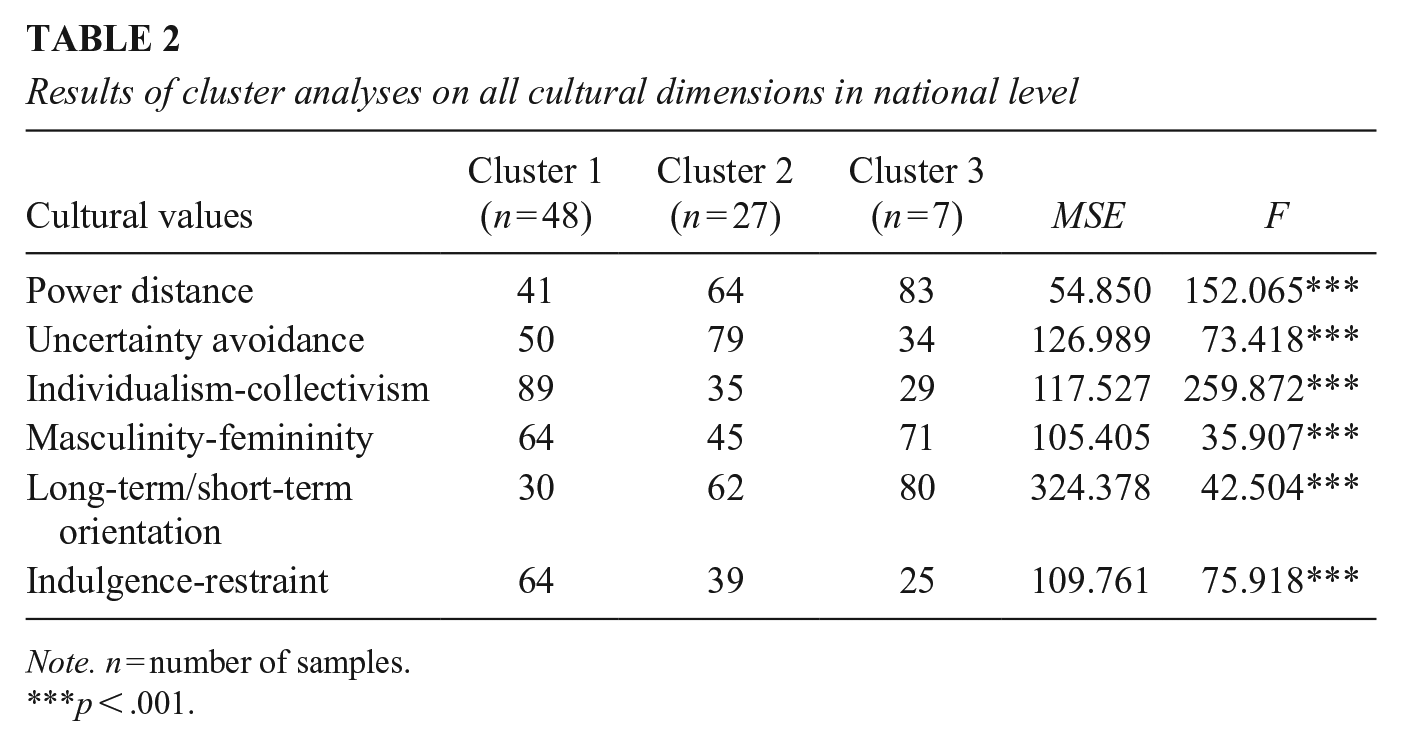
Note. n = number of samples.
p < .001.
Among all the participants involved in these studies (N = 40,867), 60.7% (N = 24,801) had a university education level or above, 36.8% (N = 15,019) had a high school education level or less, and the remaining 2.6% (N = 1,047) did not know their education level. Except for three papers that did not report sex ratios, the remaining 77 studies (N = 37,475) had a mean ratio of females of 48.35% (SD = 0.70).
Performance Orientation
Mean Effect of the Relation Between Performance Orientation and Cheating
We analyzed the effect sizes regarding the relation between performance orientation and academic cheating. After excluding outliers of two standard deviations exceeding the average, we included 67 effect sizes (69 effect sizes without the outliers removed; Figure 3) in the analysis (N = 30,488).
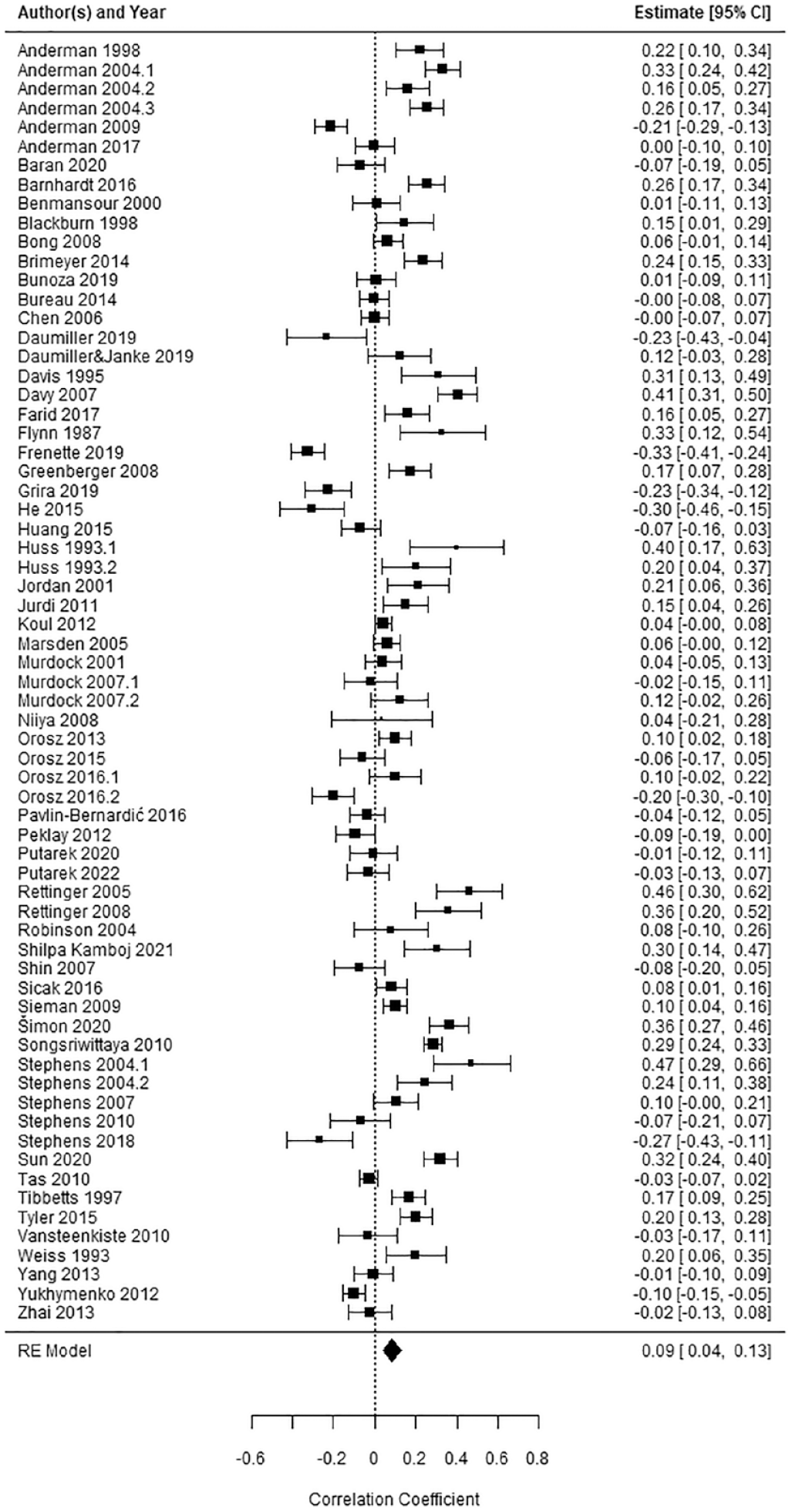
Forest plot of the effect sizes (N = 67) of the relation between performance orientation and academic cheating. Correlations (dots) and 95% confidence intervals are displayed for all effects entered into the meta-analysis. For studies with multiple independent samples, the result for each sample (1, 2, etc.) is reported separately.
We found that the average effect size was significant (r = .09, 95% confidence interval [CI] = .04 to .13, p < .001), suggesting that the stronger students’ performance orientation, the more likely they would cheat. The forest plot is shown in Figure 3. The heterogeneity of this overall effect size distribution was measured as Q and I2, Q (df = 66) = 805.03, p < .001, I2 = 92.97%. According to the advice of Borenstein et al. (2009), if I2 is large, the analysis of the subgroup and moderator is likely to be worthwhile. Thus, we performed the following moderator analyses.
Univariate Moderator Analyses of Cultural Value Indexes
Here we examined whether cultural value indexes would moderate the significant relation between performance orientation and cheating. We first removed one cross-cultural study that did not report separately the effect sizes for participants from the participating countries. We then calculated the mean correlation between the performance orientation and academic cheating again, and found it to be still significant (r = .08, 95% CI = .04 to .13, p < .001).
Based on this, we performed moderator analyses of each cultural value index on the relation between performance orientation and academic cheating (Tables 3A and 3B). Except for masculinity-femininity, the other five cultural value indexes were significant moderators (b = −.0031, −.0042, .0018, −.0025, and .0030; SE = .0015, .0012, .0008, .0009, and .0012; 95% CI = −.0061 to −.0001, −.0066 to −.0018, .0004 to .0033, −.0042 to .0008, and .0006 to .0054; Q (1) = 4.06, 12.09, 5.90, 8.20, and 5.90, ps < .05, respectively, for power distance, uncertainty avoidance, individualism-collectivism, long-term/short-term orientation, and indulgence-restraint dimensions). Thus, students’ performance orientation was more closely associated with their academic cheating if they were from a low-power-distance, low-uncertainty-avoidance, more individualism, more short-term orientation, or more indulgent culture (Figure 4).
Results of moderator analyses of cultural value indexes on the relation between performance orientation and academic cheating
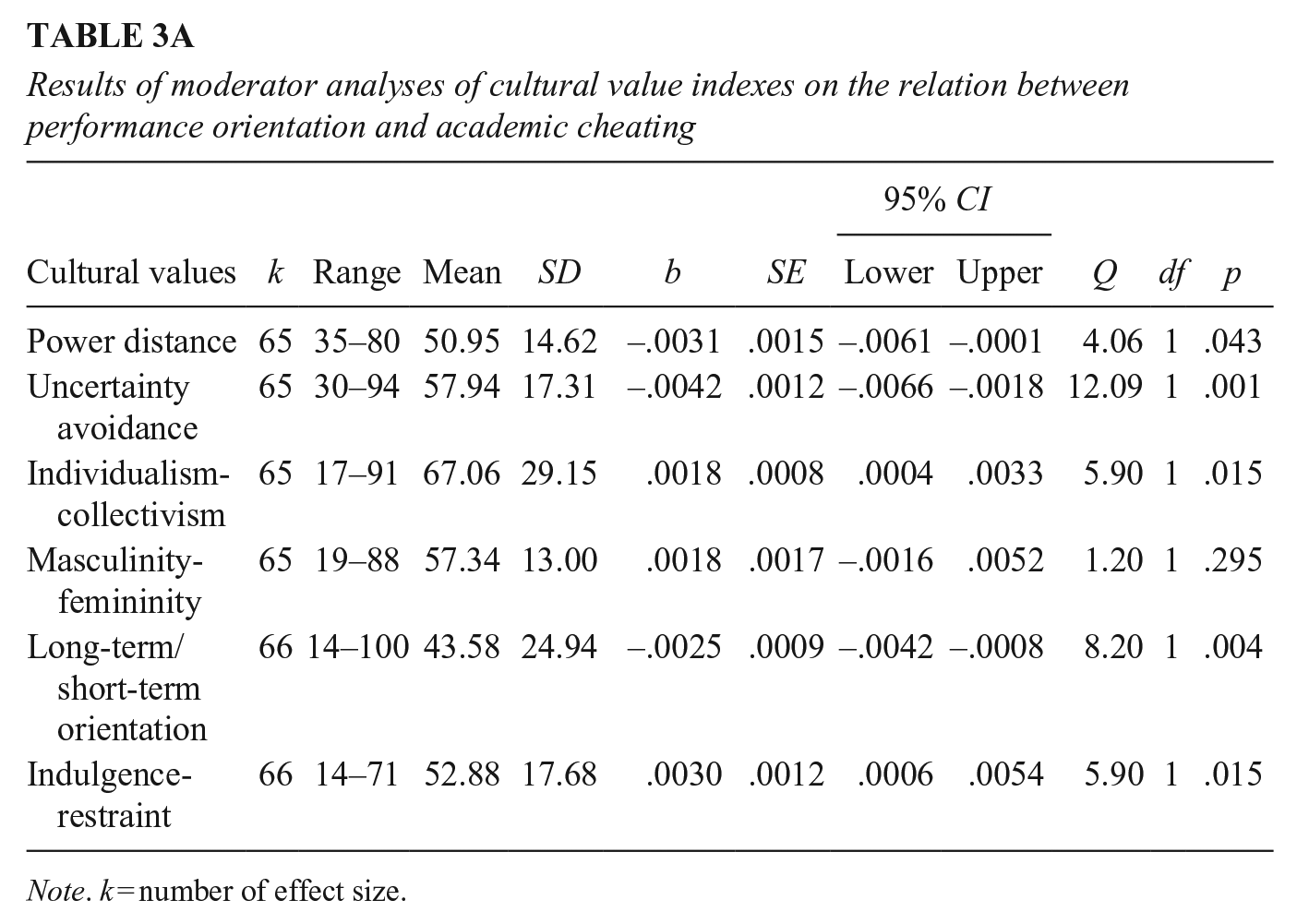
Note. k = number of effect size.
Results of moderator analyses of cultural dimensions on the relation between learning orientation and academic cheating
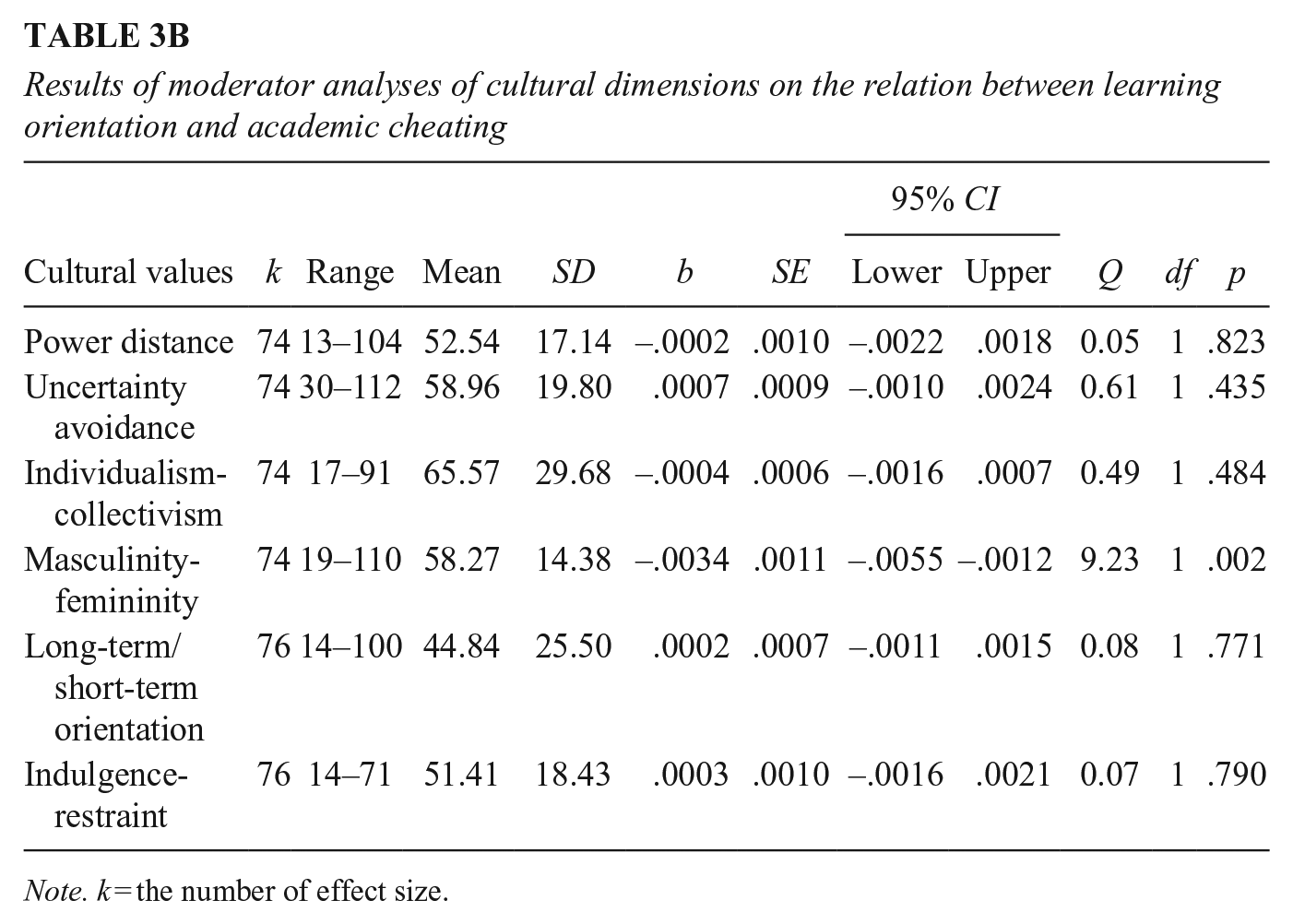
Note. k = the number of effect size.
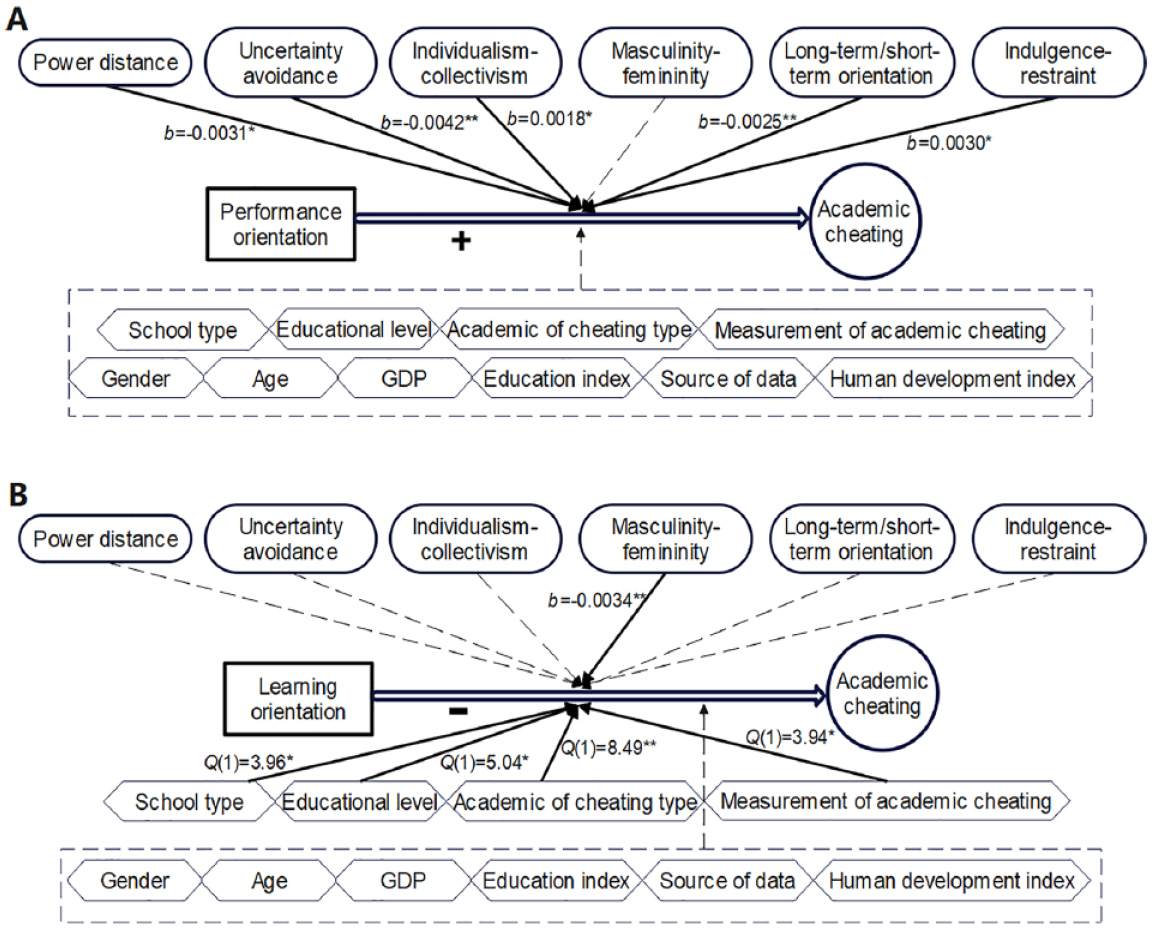
Results of the univariate meta-analyses of significant and nonsignificant moderators on the relations of performance orientation (A) or learning orientation (B) to academic cheating. Solid lines indicate that the results of the moderator analyses were significant; dashed lines indicate that the results of the moderator analyses were not significant. The moderator variables in the upper semicircular rectangle are cultural dimensions; the moderator variables in the lower diamond rectangle are the other moderators; The b coefficients are shown for significant moderator effects only. *p < .05; **p < .01; ***p < .001.
Univariate Moderator Analyses of Other Variables
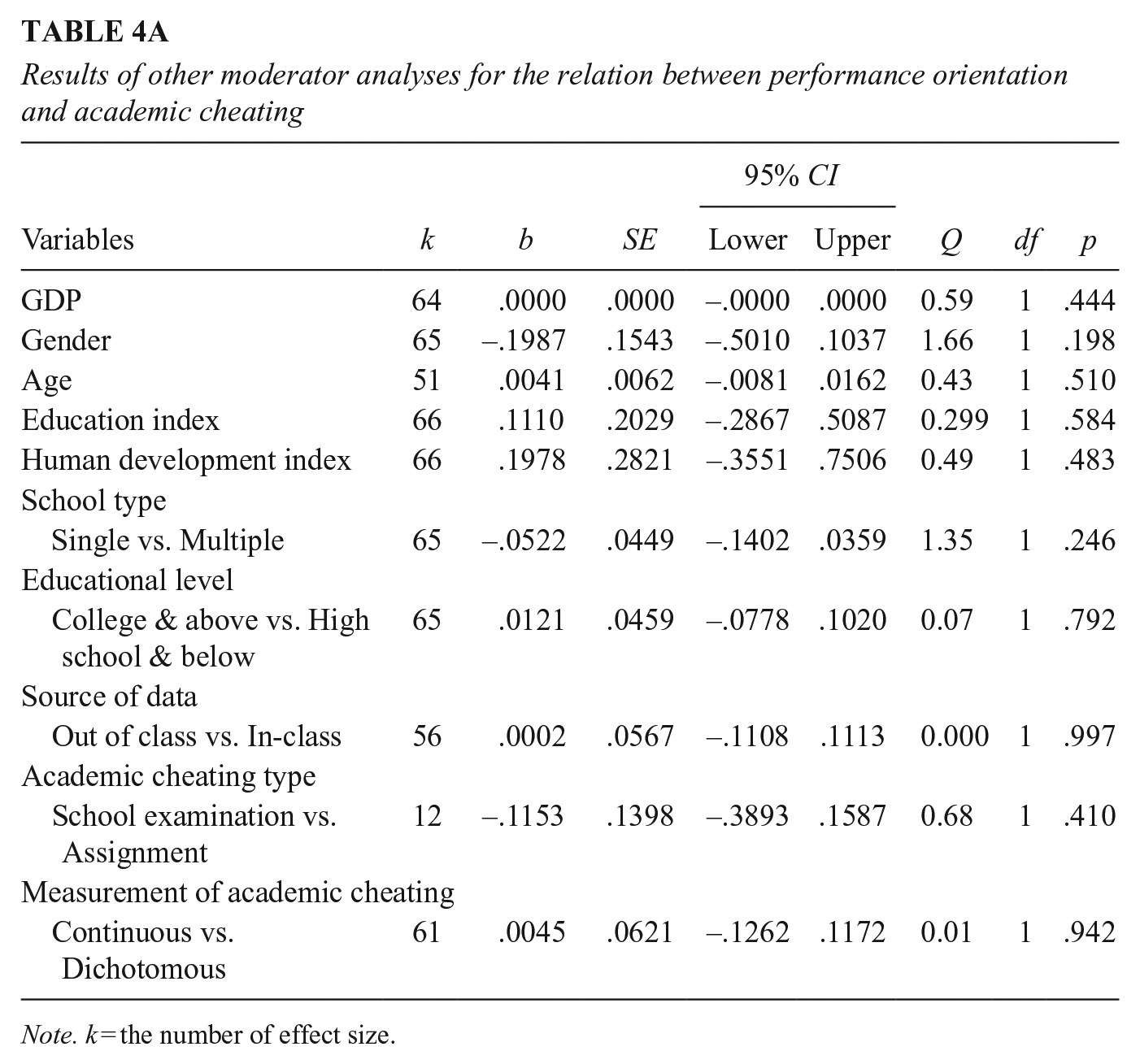
We examined 10 additional potential moderators on the relation between performance orientation and cheating, including GDP, gender, age, education index, human development index, school type, educational level, source of data, academic cheating type, and measurement of academic cheating (Tables 4A and 4B). None of them were significant moderators (ps > .05).
Results of other moderator analyses for the relation between performance orientation and academic cheating
Note. k = the number of effect size.
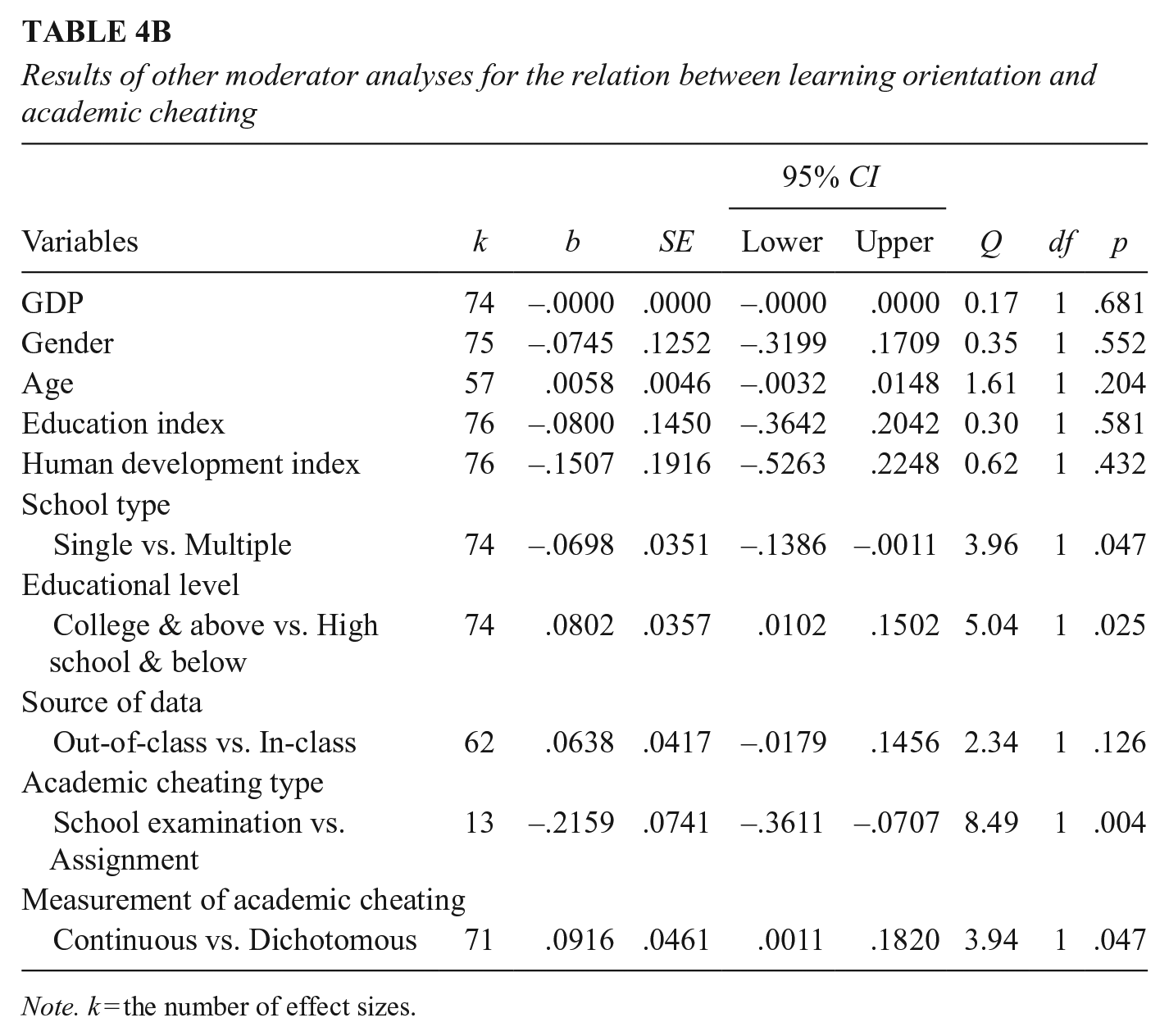
Results of other moderator analyses for the relation between learning orientation and academic cheating
Note. k = the number of effect sizes.
Meta-Regression Analyses
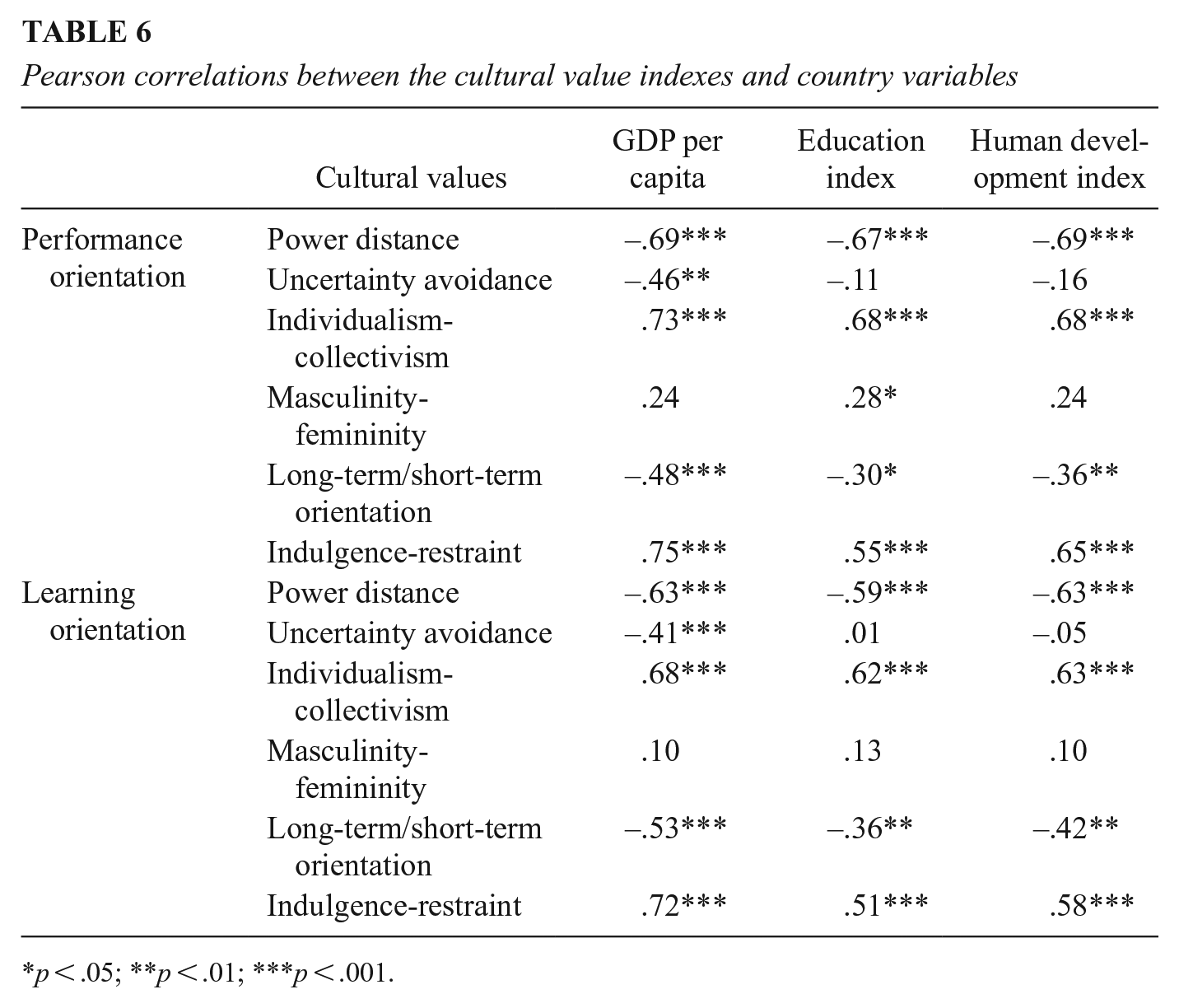
We computed the Pearson correlational coefficients between the cultural value indexes. Table 5 shows that some of these indexes were significantly correlated, whereas others were not (i.e., those between masculinity-femininity and long-term/short-term orientation, masculinity-femininity and indulgence-restraint). We also computed Pearson correlations between the cultural value indexes and country variables, as shown in Table 6.
Pearson correlations among the indexes of the cultural values
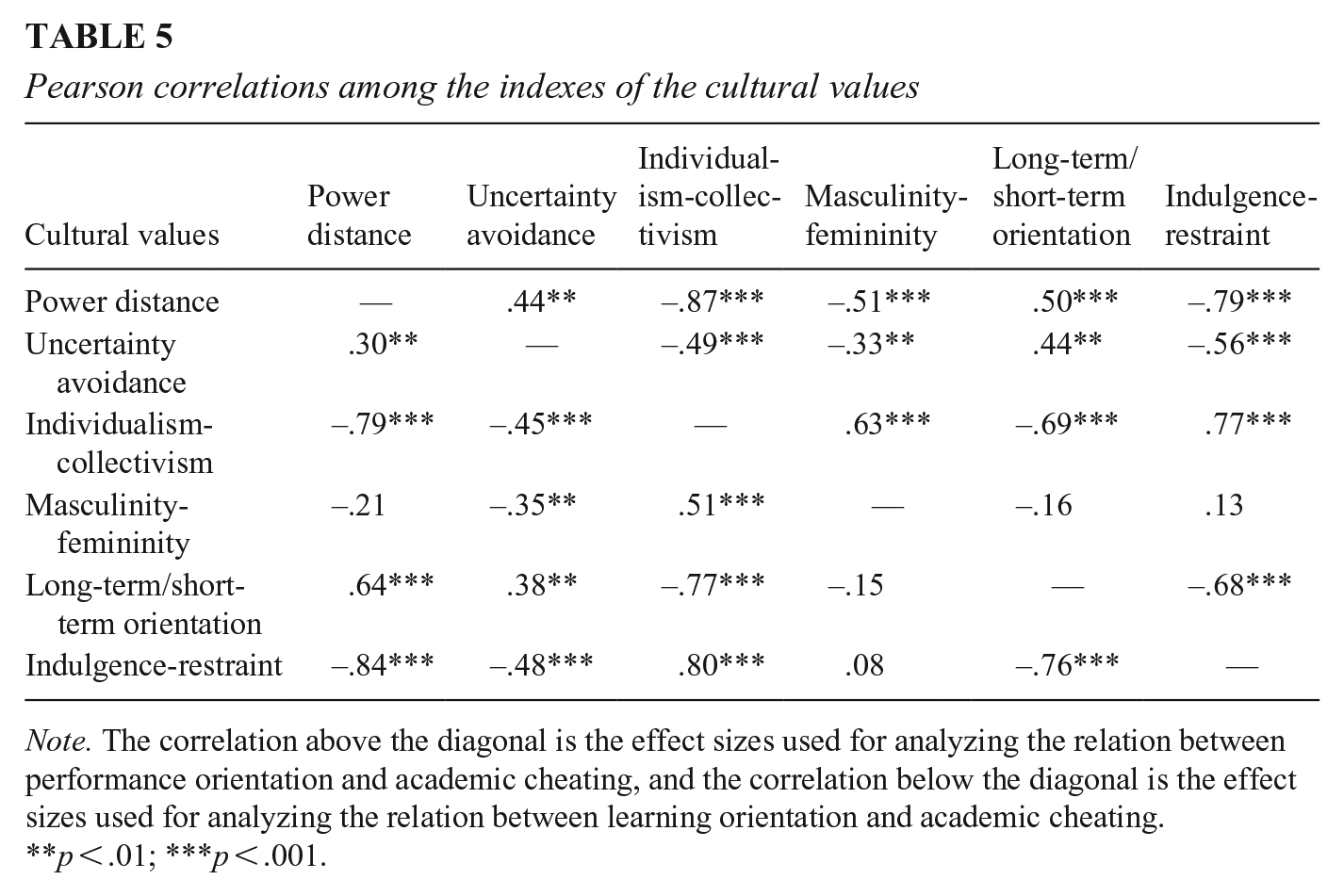
Note. The correlation above the diagonal is the effect sizes used for analyzing the relation between performance orientation and academic cheating, and the correlation below the diagonal is the effect sizes used for analyzing the relation between learning orientation and academic cheating.
p < .01; ***p < .001.
Pearson correlations between the cultural value indexes and country variables
p < .05; **p < .01; ***p < .001.
Given the mutual correlations among cultural moderators, we further explored whether all cultural moderators together would account for a significant amount of variance in the relation between performance orientation and academic cheating, and which cultural moderators would also have a significant and unique contribution to moderate the relation.
To this end, we used meta-regression to examine the effects of six cultural moderators on the relation between performance orientation and academic cheating. Because no noncultural moderators were significant based on the univariate meta-analyses reported above, we directly entered all six cultural moderators into the model (Figure 5). We found the model was significant. It accounted for 12.72% of the variance in the correlation between performance orientation and academic cheating (ΔR2 = 12.72%, Q = 15.09, p = .020). Thus, it was evident that cultural moderators together exerted a significant influence on the connection between performance orientation and academic cheating.
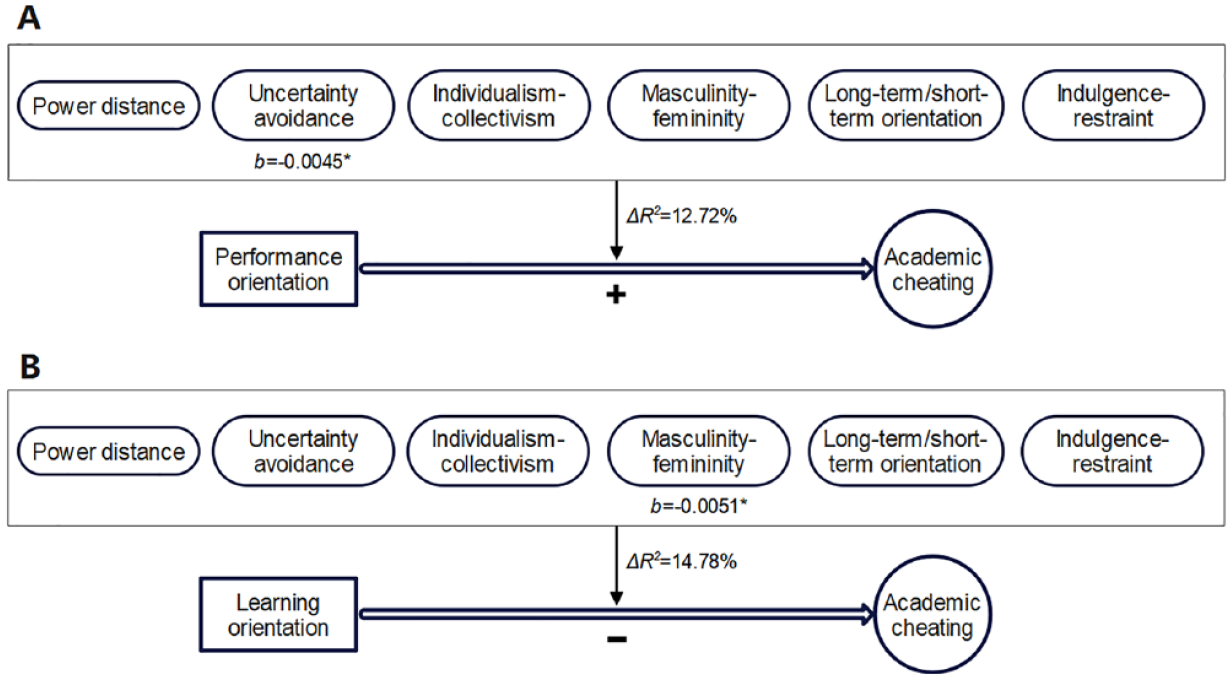
Results of the meta-regression models for the moderators of cultural dimensions on the relations from performance (A) or learning orientation (B) to academic cheating. Plus and minus signs indicate the direction of the relation. The b coefficients are shown for uniquely significant cultural moderators only. *p < .05; **p < .01; ***p < .001.
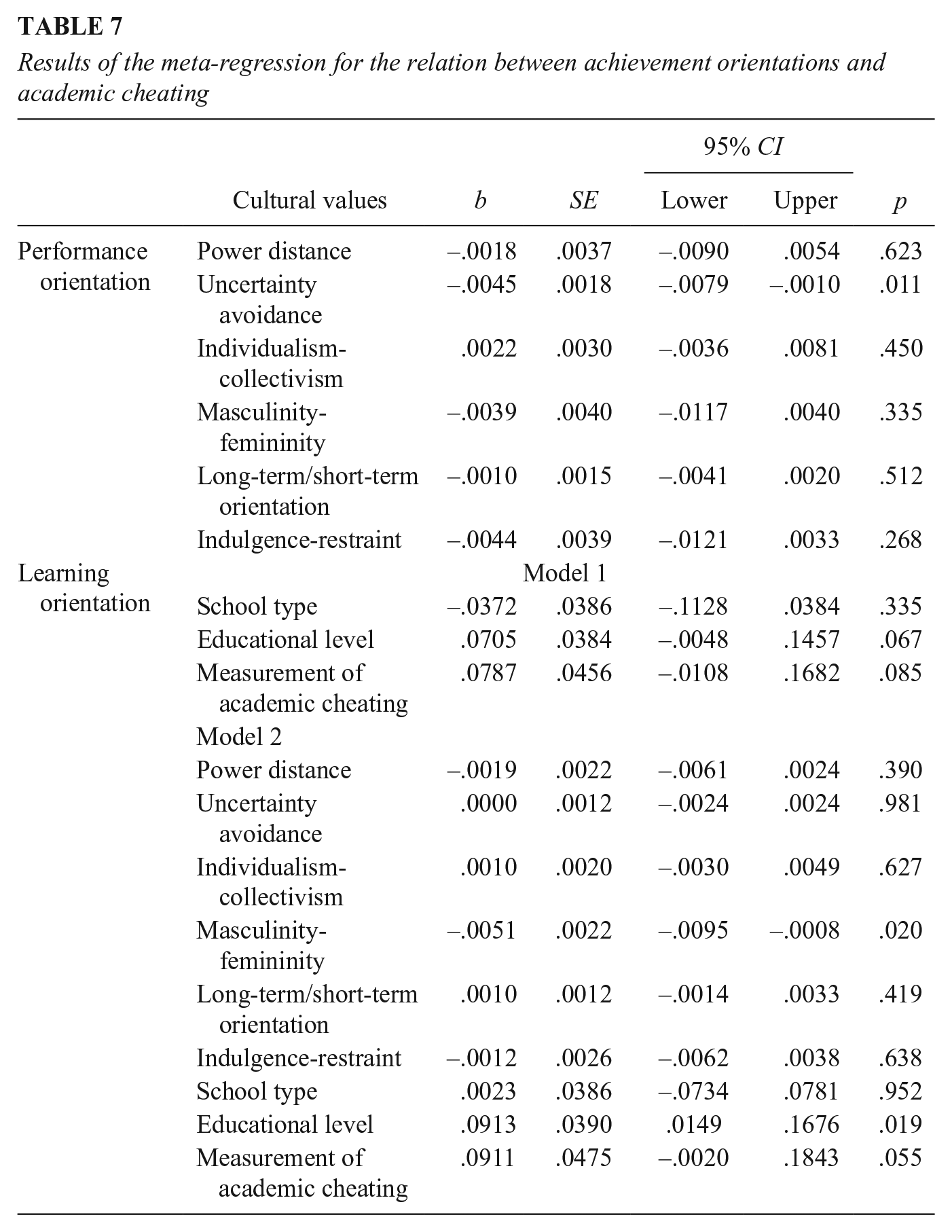
Next, we inspected the model and found that uncertainty avoidance was the only significant unique moderator above the common contributions of all six cultural moderators. As shown in Table 7, uncertainty avoidance negatively predicted the correlation between performance orientation and academic cheating (b = −.0045, SE = .0018, 95% Cl = −.0079 to −.0010, p = .011, part correlation = .305) and it accounted for 9.29% of the variance in the relation between performance orientation and cheating, beyond the common contributions of all the six cultural dimensions. The higher a country’s uncertainty avoidance, the weaker the connection between performance orientation and academic cheating.
Results of the meta-regression for the relation between achievement orientations and academic cheating
Publication Bias
Egger’s regression
Following the method proposed by Li et al. (2020), we conducted a mixed-effects version of Egger’s regression test (Egger et al., 1997) to examine publication bias. Egger’s test was not significant (b = −.0014, 95% CI = −.1232 to .1261, z = 1.41, p = .16).
Funnel plot with trim-and-fill
The trim-and-fill method is one of the main statistical methods to estimate potentially missing effect sizes (Duval & Tweedie, 2000). The funnel plot (please see Figure S1 in the online version of the journal) revealed that the distribution of the published effect sizes was nearly symmetrical. To confirm this conclusion, we included the imputed effect size in the meta-analysis to obtain an adjusted mean effect size. We then compared it to the actual mean effect size without the imputation. We found that the two mean effect sizes were not significantly different from each other (adjusted mean effect size after imputation: r = .06, 95% CI = −.01 to .10, p < .05; actual effect size without imputation: r = .08, 95% CI = .02 to .12, p < .05), again confirming that there was no evidence of publication bias.
P-curve analysis
Because some researchers might selectively report significant results, or some researchers may keep collecting data until the effect of the result is significant (e.g., p-hacking), the p-curve analysis has been developed to address this issue (Simonsohn et al., 2014). A p-curve depicts the distribution of statistically significant p-values (p < .05) for a set of studies, and the p-curve analysis tests the skewness of the p-value distribution. If there is no p-hacking, the p-value distribution should be right-skewed, that is, the p-value is more distributed between .00 and .01. Otherwise, the p-value distribution will be relatively flat.
We ran the p-curve analysis using dmetar package (please see Figure S2 in the online version of the journal). The result of the half p-curve test was Z = −50.786, p < .0001, and the result of the full p-curve test was Z = −50.525, p < .0001. The right-skewed distribution suggested a lack of publication bias.
Sensitivity Analysis
We first performed leave-one-out analyses and found no single study to have an undue influence on our meta-analysis results. We then used the modified meta-analysis of Henmi and Copas (2010) to explore further any possible small-study effects. We found that the true summary effect estimated (r = .07, 95% CI = .02 to .13, τ2 = .025) was similar to that observed by the random effect analysis through restricted maximum likelihood (r = .09, 95% CI = .03 to .13, τ2 = .030). These results suggested that our meta-analytical results regarding the relation between performance orientation and academic cheating were robust.
Learning Orientation
Mean Effects of the Relation Between the Learning Orientation and Cheating
We analyzed the effect sizes regarding the relation between learning orientation and academic cheating. After excluding outliers of two standard deviations exceeding the average, we included 77 effect sizes (81 effect sizes without the outliers removed; Figure 6) in the analysis (N = 36,095).
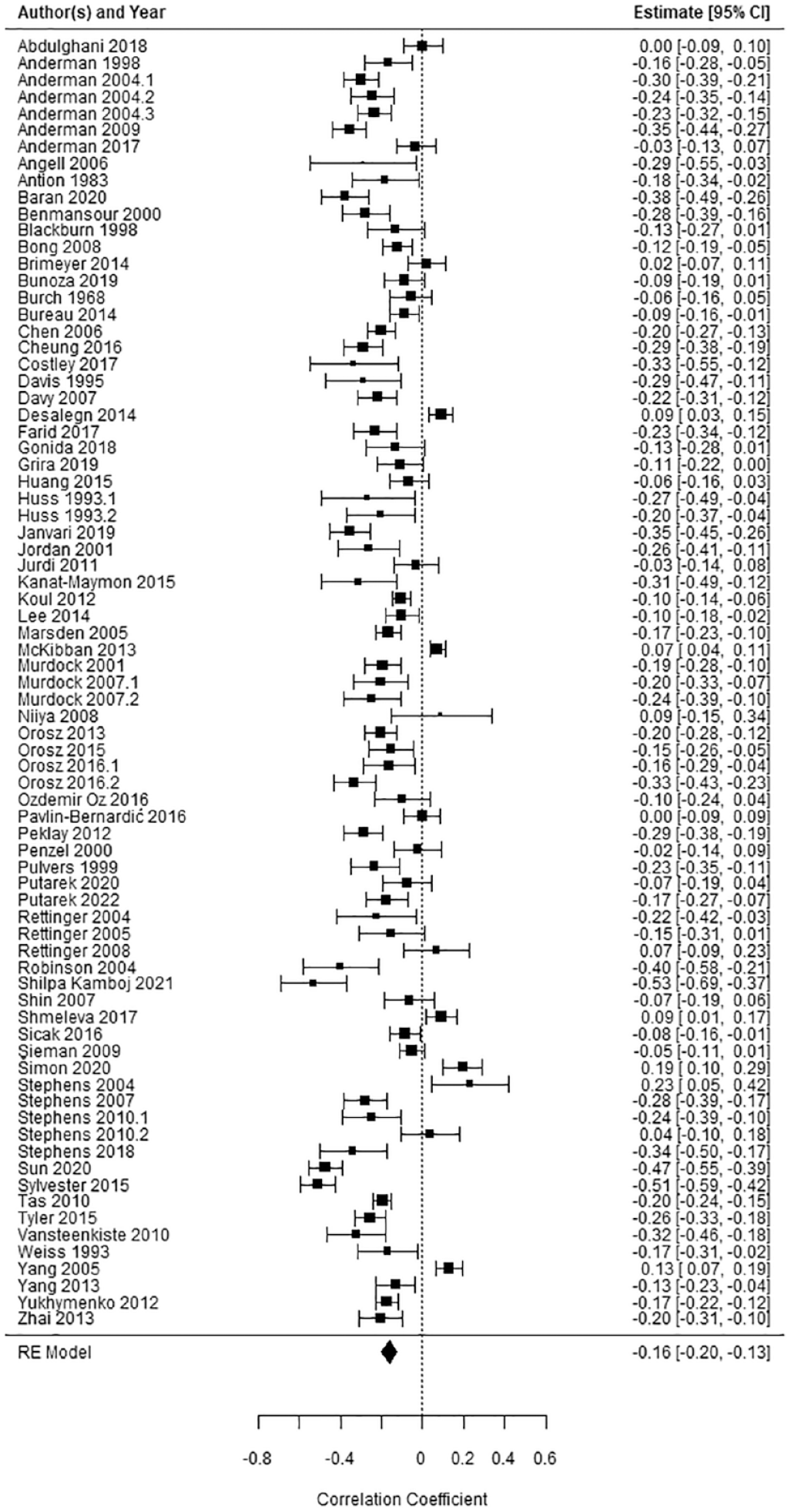
Forest plot of the effect sizes (N = 77) of the relation between learning orientation and academic cheating. Correlations (dots) and 95% confidence intervals are displayed for all effects entered into the meta-analysis. For studies with multiple independent samples, the result for each sample (1, 2, etc.) is reported separately.
We found that the average effect size was significant (r = −.16, 95% CI = −.20 to −.13, p < .001), suggesting that stronger students’ learning orientation, the less likely they would cheat. The forest plot is shown in Figure 6. The heterogeneity of this overall effect size distribution was measured as Q and I2, Q (df = 76) = 812.42, p < .001, I2 = 89.98%.
Univariate Analyses of Cultural Moderators
We examined whether cultural value indexes would moderate the significant relation between learning orientation and cheating. We found that only one cultural value index, masculinity-femininity, was a significant moderator (Table 3B; b = −.0034, SE = .0011, 95% CI = −.0055 to −.0012, Q (1) = 9.23, p = .002). Thus, the negative association between students’ learning orientation and academic cheating was stronger if they were from a high-masculinity country than if they were from a high-femininity country (Figure 4).
Univariate Analyses of Other Moderator Variables
We examined the 10 additional potential moderators (i.e., GDP, gender, age, education index, human development index, school type, educational level, source of data, academic cheating type, and measurement of academic cheating) on the relation between learning orientation and cheating.
As shown in Table 4B, for categorical moderators, we found that school type, educational level, academic cheating type, and measurement of academic cheating were significant moderators (Q [1] = 3.96, 5.04, 8.49, and 3.94, ps < .05). Subgroup analysis showed that the negative relation between the learning orientation and academic cheating was stronger when studies involving multiple schools rather than a single school (r = −.13 and −.20, 95% CI = −.18 to −.08 and −.25 to −.15, k = 43 and 31, for those involving single school and multiple schools, respectively). The negative relation between the learning orientation and academic cheating was stronger among high school students and those with lower educational levels than among college students and those with higher levels of education (r = −.21 and −.13, 95% CI = −.27 to −.16 and −.18 to −.09, k = 27 and 47, for those involving high school students and lower and those involving college students and higher, respectively). Also, the negative relation between the learning orientation and academic cheating was stronger when studies focused on exam cheating rather than assignment cheating (r = −.19 and .03, 95% CI = −.25 to −.12 and −.10 to .16, k = 11 and 2, for those involving exam cheating and those involving assignment cheating, respectively). In addition, the negative relation between learning orientation and academic cheating was stronger when cheating was measured continuously as opposed to categorically (r = −.09 and −.18, 95% CI = −.17 to −.00 and −.22 to −.14, k = 14 and 57, for those involving dichotomous cheating measure and those involving continuous cheating measure; Figure 4). However, the moderator effects of GDP, gender, age, education index, human development index, and source of data were all not significant (ps > .05).
Meta-Regression Analyses
We computed the Pearson correlational coefficients of the cultural value indexes. As shown in Table 5, some of the indexes were highly correlated (i.e., individualism-collectivism and power distance, uncertainty avoidance and indulgence-restraint), whereas others were moderately correlated (i.e., uncertainty avoidance and power distance) or not significantly correlated (i.e., long-term/short-term orientation and masculinity-femininity). We also computed Pearson correlations between the cultural value indexes and country variables (Table 6).
We used a hierarchical meta-regression approach to examine the effects of six cultural moderators on the relation between learning orientation and academic cheating. In the first block, we entered the significant noncultural moderators based on the univariate meta-analyses. They were the school type, student educational level, and measurement of academic cheating. However, we did not include academic cheating types that were also significant in the univariate analyses of other moderator variables. This exclusion was because when performing meta-regression analysis, at least 20 effect sizes were needed to meet the requirements for parameter estimation (Fang & Zhang, 2020). However, only 13 effect sizes were measured for specific academic cheating types (i.e., school exam cheating and assignment cheating). Thus, the academic cheating type was not included in the meta-regression modeling.
We found that the model with noncultural moderators accounted for a significant amount of variance in the relation between learning orientation and academic cheating (ΔR2 = 12.87%, Q = 10.693, p = .014). Inspection of the model revealed that none of these moderators were significant (ps > .05). This finding suggested that despite their common significant contributions to the relation between learning orientation and academic cheating, each noncultural moderator did not make any significant and unique contribution.
In the second block, the six cultural moderators were entered into the model. As shown in Table 7, this block was significant. The six culture moderators together accounted for 14.78% of the variance in the relation between learning orientation and academic cheating (ΔR2 = 14.78%, Q = 21.544, p = .010). Hence, it was evident that cultural dimensions exerted a substantial influence on the connection between learning orientation and academic cheating.
Inspection of the model revealed that masculinity-femininity was the only significant cultural moderator (Figure 5). It significantly and negatively predicted the correlation between learning orientation and academic cheating (b = −.0051, SE = .0022, 95% CI = −.0095 to −.0008, p = .020, part correlation = .316). Masculinity-femininity accounted for 9.98% of the variance in the relation between learning orientation and cheating above and beyond the common contributions of all cultural dimensions. The negative association between students’ learning orientation and cheating was stronger if they were from a more masculinity country.
In addition, the final model revealed that student educational level positively predicted the correlation between learning orientation and academic cheating (b = .0913, SE = .0390, 95% C1 = .0149 to .1676, p = .019, part correlations = .315). That is, the relation between learning orientation and cheating was stronger for students with a high school education or less compared to those with a college degree or higher.
Publication Bias
Egger’s regression
We conducted a mixed-effects version of Egger’s regression test to examine the potential publication bias of the effect sizes regarding the relation between learning orientation and academic cheating. The result was not significant (b = −.09, 95% CI = −.182 to .005, z = −1.66, p = .10), suggesting the absence of publication bias.
Funnel Plot with Trim-and-Fill
The trim-and-fill method (please see Figure S3 in the online version of the journal) revealed that the distribution of the published effect sizes was nearly symmetrical, suggesting that a publication bias, if it existed, would not have significantly affected the conclusion of our meta-analysis. To confirm this, we included the imputed effect size in the meta-analysis to obtain an adjusted mean effect size. Then we compared it to the actual mean effect size without the imputation. We found that the two mean effect sizes were not significantly different from each other (adjusted mean effect size after imputation: r = −.12, 95% CI = −.16 to −.08, p < .05; actual effect size without imputation: r = −.16, 95% CI = −.20 to −.13, p < .05), confirming that there was no evidence of publication bias.
P-curve analysis
A p-curve analysis revealed that the result of the right-skewness test for the full curve was Z = −59.19, p < .0001, and the right-skewness test for the half curve was Z = −58.51, p < .0001. These results showed that the distribution was significantly right-skewed, suggesting no publication bias (please see Figure S3 in the online version of the journal).
Sensitivity Analysis
We first performed leave-one-out analyses and found no single study to have an undue influence on our meta-analysis results. We then used the modified meta-analysis of Henmi and Copas (2010) to explore further any possible small-study effects. We found that the true summary effect estimated (r = −.13, 95% CI = −.18 to −.08, τ2 = .021) was similar to that observed by the random effects analysis through restricted maximum likelihood (r = −.16, 95% CI = −.20 to −.13, τ2 = .020). These results suggested that our meta-analytical results regarding the relation between learning orientation and academic cheating were robust.
Meta-Analytic Structural Equation Modeling
We used one-stage MASEM to fit the model to the observed correlation matrix (Figure 7) to consider concurrently the relations of performance and learning orientations to cheating. It revealed that the correlation between performance and learning orientations was positive and significant, r = .132, p < .001, suggesting that the higher the performance orientation, the higher the learning orientation, or vice versa. Regardless of this positive correlation, performance orientation positively predicted academic cheating, β = .100, p < .001; whereas learning orientation negatively predicted academic cheating, β = −.183, p < .001.
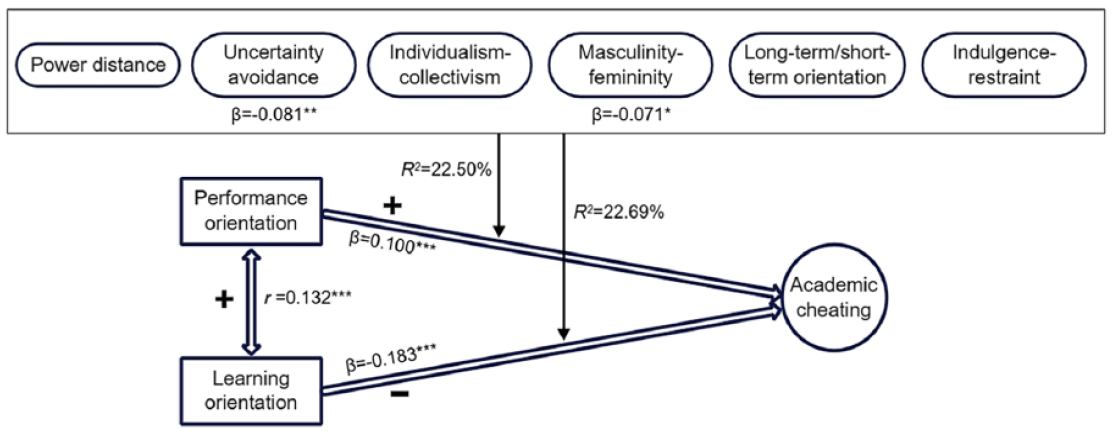
The MASEM of the effects of the relations between performance, learning orientation, and academic cheating and associated moderating effects of the six cultural dimensions. Plus and minus signs indicate the direction of the relation. The β coefficients are shown for uniquely significant cultural moderators only. *p < .05; **p < .01; ***p < .001.
Second, we simultaneously used the six cultural dimensions as moderators accounting for variance in the two regression coefficients (Table 8). The omnibus test of the moderating effects was significant, χ2 (2) = 26.72, p = .008. The calculation of R2 with the between-studies variance of the model with and without the moderators shows that 22.50% of the variance in the correlation coefficient between performance orientation and academic cheating could be explained by the six cultural dimensions, whereas 22.69% of the variance in the correlation coefficient between learning orientation and academic cheating could be explained by the six cultural dimensions. These results replicated the findings of our meta-regression analyses.
Results of the one-stage MASEM analysis on the moderating effects of all cultural dimensions on the relations of performance and learning orientations to academic cheating
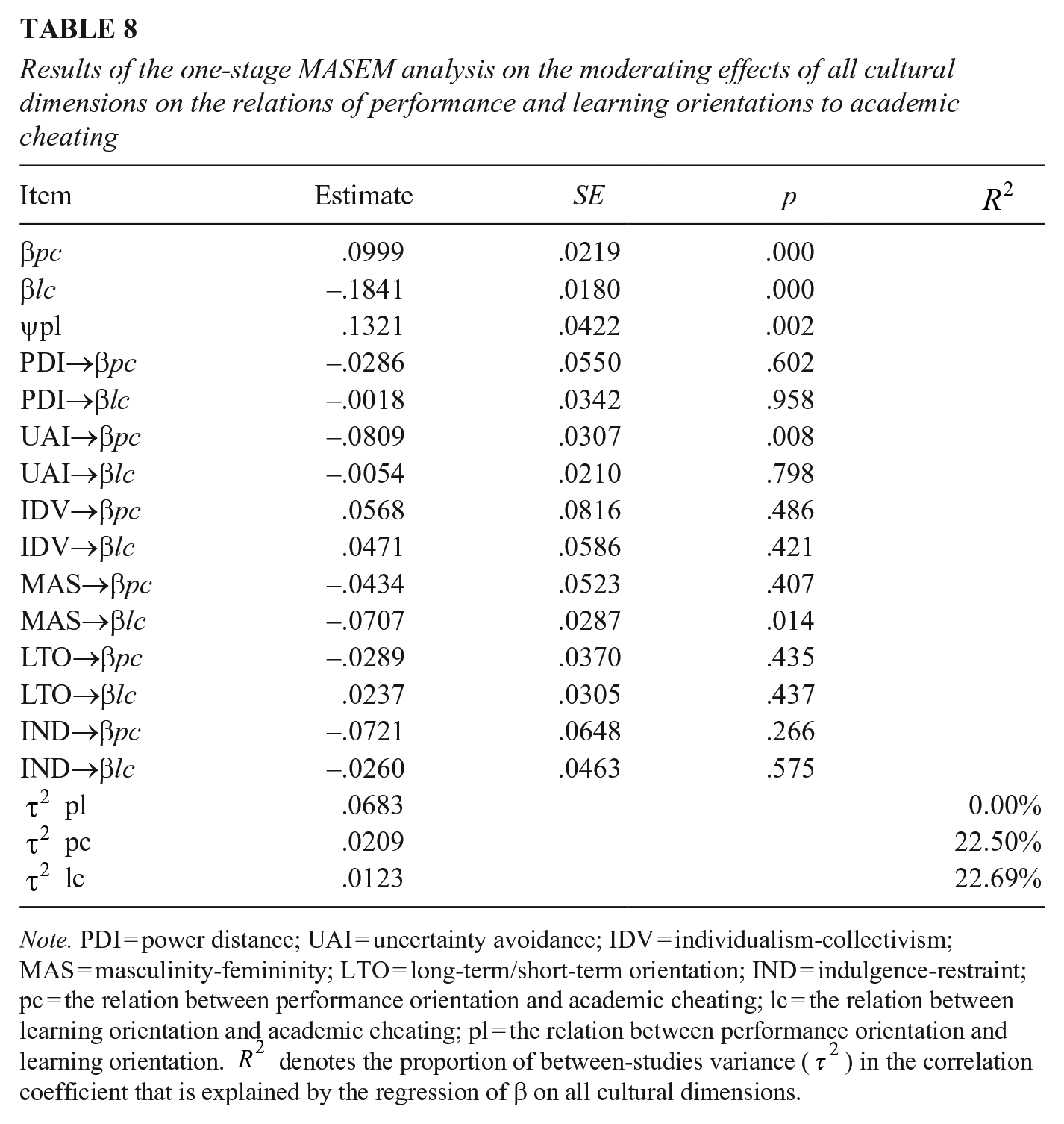
Note. PDI = power distance; UAI = uncertainty avoidance; IDV = individualism-collectivism; MAS = masculinity-femininity; LTO = long-term/short-term orientation; IND = indulgence-restraint; pc = the relation between performance orientation and academic cheating; lc = the relation between learning orientation and academic cheating; pl = the relation between performance orientation and learning orientation.
Further, when we inspected the resultant model, uncertainty avoidance significantly and uniquely moderated the relation between performance orientation and academic cheating above and beyond the common contributions of all cultural dimensions, ΔR2 = 10.17%, p < .05. Also, masculinity-femininity significantly and uniquely moderated the relation between learning orientation and academic cheating above and beyond the common contributions of all cultural dimensions, ΔR2 = 13.93%, p < .05. These results replicated our meta-regression findings.
Discussion
The present meta-analysis investigated quantitatively the relations between students’ achievement orientations and their cheating behavior, and whether cultural values moderate these relations. More specifically, we tested whether students’ academic cheating would be associated positively with their performance orientation but negatively with their learning orientation, and the extent to which country-level cultural values would moderate such relations.
We analyzed 67 effect sizes regarding the relation between performance orientation and academic cheating from studies that were conducted all over the world with participants from elementary school to university. We found that the mean effect size was significant and positive. The mean effect size (r = .09) was small according to Cohen (1988). Thus, students with a stronger performance orientation were more inclined to cheat academically. These findings are highly consistent with the conclusions of most of the existing narrative reviews (e.g., Murdock & Anderman, 2006) and a recent meta-analysis (Krou et al., 2021).
Similarly, we used the same method to analyze 77 effect sizes exploring the association between learning orientation and academic cheating. We found a small but significant and negative mean effect size (r = −.16) according to Cohen (1988). Thus, students with a stronger learning orientation were less prone to cheating, which is also highly consistent with the conclusions of most of the existing narrative and meta-analytic reviews (e.g., Krou et al., 2021; Murdock & Anderman, 2006). Further, our one-stage MASEM revealed that such differential relations exist even though the performance and learning orientations are positively correlated with each other (Figure 7).
More importantly and unique to the present study, our univariate meta-analysis revealed that the relation between students’ performance orientation and academic cheating was significantly moderated by each of the following cultural dimensions at the country level. Specifically, the stronger a culture exhibits low power distance, low uncertainty avoidance, high individualism, high short-term orientation, or high indulgence, the stronger the relation between performance orientation and academic cheating (Figure 4). In contrast, our univariate meta-analyses revealed that the relation between learning orientation and academic cheating was significantly moderated only by masculinity-femininity (Figure 4). Namely, learning orientation is more closely associated with academic cheating among students from highly masculine societies.
When we used the more advanced meta-regression analysis (Tang & Cheung, 2016) and one-stage MASEM analysis (Jak & Cheung, 2020), we found that the six cultural moderators account for a significant amount of variance in the effect sizes regarding the relation between performance orientation and academic cheating (12.72% based on meta-regression and 22.50% based on MASEM). This finding suggested that the relation is significantly influenced by a common underlying cultural construct. As such, the significant univariate meta-analysis findings for the other cultural dimensions may stem from their correlation to this shared factor. In other words, culture indeed moderates the association between performance orientation and academic cheating, supporting one of our general hypotheses.
In addition to the influence of the common cultural construct, the meta-regression analysis and one-stage MASEM analysis showed that uncertainty avoidance was uniquely significant in the model (9.29% based on meta-regression and 10.17% based on MASEM). This finding suggested this moderator might play a particularly strong role in moderating the relation between performance orientation and academic cheating, supporting one of our specific hypotheses. More specifically, the connection between performance orientation and academic cheating is stronger among individuals from low uncertainty avoidance cultures than those from higher uncertainty avoidance cultures. This effect may be because, in low-uncertain-risk cultures, individuals are less tolerant of uncertainty and therefore more accepting of rule-breaking behavior to avoid uncertainty (Haque & Mohammad, 2013).
Regarding the relation between learning orientation and academic cheating, the meta-regression and MASEM analyses revealed that the six cultural moderators together accounted for a significant amount of variance in the effect sizes (14.78% based on meta-regression and 22.69% based on MASEM). This finding supports one of our major hypotheses regarding the role of cultural dimensions in the relation between learning orientation and cheating. In addition, masculinity-femininity accounted for a unique amount of variance in the relation above and beyond all the common contributions of cultural dimensions (9.98% based on meta-regression and 13.93% based on MASEM). This finding replicated the result of our univariate meta-analysis and confirmed one of our specific hypotheses: that students in high-masculinity societies are less likely to cheat because they are more motivated to learn and gain abilities than those in high-femininity societies (Hofstede & Minkov, 2010).
In addition to the masculinity-femininity dimension, the meta-regression analysis revealed that educational levels significantly moderated the relation between learning orientation and cheating. More specifically, the relation between learning orientation and cheating is stronger for students with a high school degree or lower than for students with a college degree or higher. Although we did not hypothesize this association, the existing studies have revealed that the cheating decision made by students at lower educational levels (e.g., middle or high school) tend to be influenced mainly by their learning orientations, whereas many external factors affect college students’ decision to cheat (e.g., employment, career advancement; Simkin & McLeod, 2010). Thus, our finding suggested that one must take a developmental perspective when considering the linkage between learning orientation and cheating.
When we compared the amount of variance accounted for by the six cultural moderators for the relation between performance orientation and academic cheating versus that between learning orientation and academic cheating, we found that the variances were similar (R2 = 12.72% versus R2 = 14.78% based on meta-regression; R2 = 22.50% versus R2 = 22.69% based on MASEM). This finding is inconsistent with our general hypothesis that culture might be more influential on the relation between performance orientation and cheating than that between learning orientation and cheating (Benson et al., 2020; Fyans et al., 1983; Salili, 1994). Instead, we found that for the relation between performance orientation and cheating, the uncertainty avoidance dimension accounted for nearly all the variance shared by the six cultural dimensions, whereas the masculinity-femininity dimension accounted for nearly all the variance shared by the six cultural dimensions in the relation between learning orientation and cheating. Thus, the extent to which the cultural dimensions influence the relation between the two academic orientations and cheating may be similar. However, an important difference in the findings is that two distinct cultural dimensions emerged as dominant moderators for each relation: Uncertainty avoidance was the key dimension moderating the relation between performance orientation and cheating, whereas masculinity-femininity was the key dimension moderating the link between learning orientation and cheating.
The univariate meta-analysis on performance orientation suggested that the relation between this orientation and academic cheating is moderated by power distance, uncertainty avoidance, individualism, short-term orientation, and indulgence. However, these univariate results were not replicated in the multivariate analysis (meta-regression and MASEM). This discrepancy suggests that, for a better understanding of the reported cultural effects, one must consider the strong mutual correlations between cultural dimensions (see Table 5). In addition, the moderating effects identified in the multivariate analysis could be influenced by the uneven distribution of the countries from which the samples came. Our cluster analysis revealed that our dataset overrepresented studies conducted in the USA, Canada, Hungary, and Australia—countries characterized by low power distance, low uncertainty avoidance, high individualism, high masculinity, high short-term orientation, and high indulgence cultural values. With a more culturally diverse dataset in the future studies, we may observe moderating effects of multiple cultural dimensions on the relation between performance orientation and academic cheating.
Overall, the findings of this meta-analysis have important theoretical implications. First, we confirmed the linkages between achievement orientations and academic cheating proposed in the theoretical model by Murdock and Anderman (2006). Based on their systematic narrative review of the studies mainly on American students published almost a decade ago, Murdock and Anderman proposed that students’ goals toward academic tasks are ultimately related to their decisions about cheating. More specifically, cheating is positively associated with extrinsic and performance orientations and is less likely to occur when students pursue intrinsic and learning orientations (Figure 1B). These conclusions were confirmed by our meta-analysis, which includes more literature from different countries and uses quantitative meta-analysis methods. Indeed, as they proposed, students strong in performance orientation are more inclined to cheat than those weak in performance orientation. In contrast, students strong in learning orientation are less inclined to cheat than students who are weak in learning orientation.
Second, we further refined the theoretical model proposed by Murdock and Anderman (2006). Murdock and Anderman proposed that individual factors and contextual factors will also affect the relations between achievement orientations and cheating (e.g., the personal theory of intelligence, parental pressure, and social comparison in classrooms; Figure 1A). However, the present meta-analysis suggests that this model is incomplete and in need of modification. The present meta-analysis revealed for the first time that cultural dimensions, at a more macro level, also significantly moderate the relations between achievement orientations and academic cheating. Also, uncertainty avoidance plays a significant and unique role in moderating the relation between performance orientation and academic cheating, whereas masculinity-femininity plays a significant and unique role in moderating the relation between learning orientation and academic cheating (Figure 1B).
In addition to goals, Murdock and Anderman (2006) proposed that individuals will also consider expectations and costs before deciding to cheat, and these considerations will specifically involve self-efficacy, outcome expectations, the risk of being caught and punished, and a negative view of self. Culture may also play an important moderating role in these considerations (Oettingen et al., 1994). However, unlike the extensive research on the relations between achievement orientations and cheating, cross-national or cross-cultural research on relations between these considerations and the decision to cheat has been extremely limited. This is a significant gap in the literature that future research needs to fill.
The present meta-analysis has several limitations. First, we only examined cultural influences at the country level. It will be important for future research to consider the cultural dimensions at the individual level, such as using the Individualism-Collectivism Questionnaire (Hui, 1988) to measure individualism and collectivism tendencies at the individual level. Additionally, whereas Hofstede’s indexes are widely used and validated, other indexes such as the World Value Survey should also be considered. Second, the studies included in the meta-analysis relied mostly on self-reported measures of academic dishonesty, which are subject to social desirability response bias and may result in underestimated levels of academic dishonesty (Cizek, 1999; Zhao et al., 2022, 2023). Third, academic dishonesty takes many forms including such acts as cheating on exams, tests, and homework, collusion, plagiarism, and fraud. Unfortunately, although many studies included the measurements of different types of dishonesty, most of them tended to report the effect sizes in an amalgamated manner. As a result, there is an insufficient number of effects available to conduct specific meta-regression analyses for each type of academic dishonesty. To address these limitations, future research should include measures of cultural values at the individual level, the assessments of academic dishonesty using both self-report and behavioral methods, reporting not overall effect sizes but specific ones, and using Open Science practices such as publishing the original research datasets.
Conclusions
The present meta-analysis found that a positive relation exists between academic cheating and performance orientation, and a negative relation exists between academic cheating and learning orientation. More importantly, univariate meta-analysis, meta-regression, and one-stage MASEM revealed that cultural factors at the country level together significantly moderate the relations between achievement orientations and cheating. In addition, uncertainty avoidance significantly and uniquely moderates the effect of performance orientation on cheating, whereas femininity-masculinity significantly and uniquely moderates the effect of learning orientation on cheating. These findings, as summarized in Table 1, suggest that cultural values play a significant role in moderating the relations between achievement orientations and cheating, and, thus, academic cheating prevention programs must consider culture to achieve optimal effects.
Supplemental Material
sj-pdf-1-rer-10.3102_00346543241288240 – Supplemental material for Academic Cheating, Achievement Orientations, and Culture Values: A Meta-Analysis
Supplemental material, sj-pdf-1-rer-10.3102_00346543241288240 for Academic Cheating, Achievement Orientations, and Culture Values: A Meta-Analysis by Li Zhao, Xinchen Yang, Xinyi Yu, Jiaxin Zheng, Haiying Mao, Genyue Fu, Fang Fang and Kang Lee in Review of Educational Research
Footnotes

Notes
Authors
LI ZHAO is a professor in the Department of Psychology at Hangzhou Normal University, No. 2318, Yuhangtang Rd, Yuhang District, Hangzhou, P. R. China; e-mail: zhaoli@hznu.edu.cn. Her research focuses on academic cheating from early childhood to adulthood. Li Zhao serves as the corresponding author of this study.
XINCHEN YANG is a postgraduate student in the Department of Psychology at Hangzhou Normal University, No. 2318, Yuhangtang Rd, Yuhang District, Hangzhou, P. R. China; e-mail: yangxinchen@stu.hznu.edu.cn. Her research focuses on academic cheating.
XINYI YU is a postgraduate student in the Department of Psychology at Hangzhou Normal University, No. 2318, Yuhangtang Rd, Yuhang District, Hangzhou, P. R. China; e-mail: yuxinyi0827@stu.hznu.edu.cn. Her research focuses on academic cheating.
JIAXIN ZHENG is a postgraduate student in the Department of Psychology at Hangzhou Normal University, No. 2318, Yuhangtang Rd, Yuhang District, Hangzhou, P. R. China; e-mail: jessis1998@163.com. Her research focuses on academic cheating.
HAIYING MAO is a doctoral student in the Department of Psychology at Heidelberg University, Hauptstr. 47-51, 69117 Heidelberg, Germany; e-mail: haiying.mao@psychologie.uni-heidelberg.de. Her research focuses on academic cheating.
GENYUE FU is a professor in the Department of Psychology at Hangzhou Normal University, No. 2318, Yuhangtang Rd, Yuhang District, Hangzhou, P. R. China; e-mail: zhaoli@hznu.edu.cn. His research focuses on children’s moral socialization and related behaviors.
FANG FANG is a professor in the School of Psychological and Cognitive Sciences and Beijing Key Laboratory of Behavior and Mental Health at Peking University, No. 5, Yiheyuan Rd, Haidian District, Beijing, P.R. China; e-mail: ffang@pku.edu.cn. His research focuses on cognitive processes. Fang Fang serves as the corresponding author of this study.
KANG LEE is a professor in the Dr Eric Jackman Institute of Child Study at University of Toronto, 27 King’s College Circle, Toronto, Ontario, M5S 1A1, Canada; e-mail: kang.lee@utoronto.ca. His research focuses on honesty and dishonesty in children and adults.
References
Supplementary Material
Please find the following supplemental material available below.
For Open Access articles published under a Creative Commons License, all supplemental material carries the same license as the article it is associated with.
For non-Open Access articles published, all supplemental material carries a non-exclusive license, and permission requests for re-use of supplemental material or any part of supplemental material shall be sent directly to the copyright owner as specified in the copyright notice associated with the article.
