




Abstract
The recent COVID-19 pandemic and an emphasis on improving access to international education experiences have spurred researchers and practitioners to consider global experiences without international travel. Domestic study away programs can broaden access to intercultural learning for postsecondary students. This systematic literature review, the first known attempt to review the literature on study away, explores how researchers and professionals have previously discussed these opportunities. We draw from 59 publications to understand how study away is defined; conceptual, theoretical, and methodological approaches to investigating study away; common programmatic features; and learning outcomes. We find that study away is often ill-defined, and many empirical publications do not utilize theoretical or conceptual frameworks in their exploration. Learning outcomes attributed to study away were most commonly either psychosocial or related to attitudes and values. Based on our findings, we provide recommendations for researchers and practitioners and highlight directions for future work.
Among educators who are interested in postsecondary students’ intercultural development, particularly those who work in international education, the recent COVID-19 pandemic has increased enthusiasm for educational programs that do not involve international mobility. In addition to requiring international educators to rethink portfolios that depended almost entirely on international travel, both the pandemic and the concurrent social movement in summer 2020 underscored the often extreme inequality in access to international opportunities in postsecondary education, which has often been reserved for White, female students from high-socioeconomic-status groups (e.g., Lingo, 2019; Salisbury et al., 2011). Although numerous experiences, such as virtual international exchange and virtual study abroad, have emerged as potential solutions to both pandemic-induced international travel limitations and international education’s equity problem, one experience that has received less attention in both empirical research and other professional literature is domestic study away. These domestic experiences hold promise as experiences that are more accessible to historically and currently underrepresented student groups (Book et al., 2015; Manning & Dinges, 2015) and potential alternatives to international travel when such activity is not possible or logical for particular students.
The purpose of this systematic literature review is to explore how both researchers and professionals have previously discussed study away opportunities in published work and to uncover common features of these programs. Here, we adopt a broad definition of the term “study away” on purpose to leave the possibility open that this term receives diverse interpretations in the literature. However, we limit the term to refer to only domestic (rather than international) intercultural opportunities and, similar to common definitions of study abroad, require that programs provide students with academic credit in return for their participation. More specifically, this literature review responds to the following research questions:
How is domestic “study away” defined in the literature?
What are the conceptual, theoretical, and methodological approaches used in empirical literature about domestic study away?
What are common programmatic features of domestic study away programs?
What student learning outcomes have researchers and professionals attributed to domestic study away programs?
The answers to these research questions have clear implications for future research on the topic of study away programming. They provide both an overview of how this term has been defined in previous work, thus helping researchers to refine their own definitions of what it means to “study away”; and highlight conceptual, theoretical, and methodological gaps in our current knowledge of these programs. For professionals who work in higher education, this literature review both offers a conceptual overview of what it means to study away, thus helping educators gain a better understanding of the student study away experience, and provides a typology of domestic study away programming. It also provides an analysis into learning outcomes that accompany study away programs. Such a typology is important for the purposes of benchmarking student outcomes and other program comparisons that educational professionals are often asked to make.
Method
Given a general paucity of literature on study away programming, this review includes both empirical and professional publications for an unrestricted range of publication dates. A publication was included if it (a) focused primarily on domestic study away; (b) was published in an edited/reviewed outlet such as an academic journal, book, academic/professional magazine, or was a doctoral dissertation; and (c) was published in English. This broad search criteria allowed us to work with the “best possible evidence” (Petticrew & Roberts, 2008) to establish a baseline understanding of study away literature.
The authors conducted literature searches independently between November 2020 and March 2022 through electronic, bibliographic databases including Web of Science, Google Scholar, ERIC, ProQuest Dissertation and Theses, and World Cat, each taking responsibility for different databases. These databases allowed for a broad and comprehensive search for relevant publications. We implemented these literature searches multiple times over an extended period to account for work on domestic programs that took place during the COVID-19 pandemic. Given limitations to international travel for many students and scholars during this time, we anticipated that researchers and practitioners would increasingly turn their attention to other approaches to intercultural education, including domestic study away. However, given the slow process of publication and the likelihood that domestic study away accelerated during late 2021 and 2022, we recognize that this review does not fully capture the potential increase in domestic study away due to COVID-19. We searched the titles, keywords, and abstracts of potential publications in each database using several specific search terms: “study away,” “student exchange,” “national exchange,” “faculty-led programs,” and “domestic exchange.” Boolean logic helped to narrow our search. We included AND “postsecondary” OR “higher education” OR “tertiary” alongside our main search terms, as well as NOT “international” OR “foreign” OR “abroad” to exclude publications solely focused on other levels of education and/or international study abroad programs.
Although initial searches returned hundreds of publications, upon further inspection we found that many of these publications focused only on study abroad, or otherwise did not meet the set criteria of this systematic review (e.g., they were published on institutional websites and were not edited or peer-reviewed). In addition to this initial literature search, we utilized backward and forward citation strategies, where we examined the reference list of included publications to find other relevant publications (backward), and used Google Scholar to search for newer publications that cited our initial list of publications (forward). We found three relevant publications through a backward citation search, and one relevant publication through a forward citation search. It is worth noting that although our search was not limited to U.S.-based programs, all articles except one (Yusup & Gemiharto, 2022) that met our criteria were focused on U.S. programs. It is possible that other countries utilize different terms to describe domestic study away and the selection of certain terminologies limited our search.
Once we had each conducted our own independent literature search, including backward and forward citation checking, we added publications to a shared spreadsheet and reviewed each other’s publications to ensure that there were no duplicates and that all publications met the inclusion criteria. In total, 78 publications were initially examined, and 19 were discarded upon further inspection with the determination that they did not meet the study criteria. Of the 59 final publications that were examined, 17 were empirical, which included 13 peer reviewed articles and 4 dissertations. Forty-three publications and one book were classified as professional literature, a count which includes 26 book chapters. One book (Sobania, 2015a, 2015b) was an edited volume with 24 unique chapters related to specific study away programs or an important study away concept. Two relevant chapters were pulled from Hall and Holder’s (2021) edited book. Finally, Carpenter et al.’s (2019) book had nine chapters, but was counted as a single publication because it described various aspects of study away through a single analytic lens.
Analysis
Guided by our research questions, as we read each publication included in our list, we noted specific information to the extent that it was available. For all literature, both empirical and professional, we noted the definition of “study away,” if one was provided. This information informs our first research question. For empirical work, and in response to our second research question, we also noted the purpose of the study, its theoretical and/or conceptual framework, the method employed, and key findings. For both empirical and professional literature, we recorded key characteristics of the programs described, including their location and length, primary content focus, outcome measures mentioned or discussed, and any other program components that were a focus of each particular piece of literature. We used this information to respond to our third and fourth research questions.
Results
Defining Study Away
While the empirical literature that we reviewed offered a number of ways of defining study away programming, as shown in Table 1, the most common approach was not to define this term at all (N = 9), leaving it up to the reader to infer the meaning of “study away” from the context of the study. Other studies (N = 2) adopted a broad definition of study away, suggesting that this term could include either domestic or international travel. For example, Vaz and Quinn (2014) define study away as “off-campus experiential learning in either domestic or international settings” (p. 1). In contrast, two studies defined study away as specifically happening within the United States, to the exclusion of international locations: “A high-impact learning experience within the United States that exposes students to unfamiliar places and cultures” (Homeyer et al., 2017). Another set of studies (N = 2) focused definitions on the experiential component of study away programming, remaining neutral on where experiential learning happened. For example, Phillips and Latosi-Sawin (2013) define “study away” as “a type of applied learning that allows students to integrate subject areas with learning experiences in new contexts” (p. 30). Finally, two studies relied on Sobania and Braskamp’s (2009) definition of “study away”: a “concept and educational strategy that integrates study abroad programs with domestic programs” (p. 23).
Definitions of “study away” in empirical research.

Like empirical literature, the most common way of defining “study away” in professional literature was not to define it at all, leaving it up to the reader to decide what counted as “study away” (see Table 2). We did not find explicit definitions of “study away” in the majority (N = 20) of the publications in this body of literature. A common definition of “study away” in the professional literature labelled it explicitly as a domestic experience that contrasted with study abroad, an international experience (N = 7). For example, Book et al. (2015) defined “study away” as “a clear alternative to the study abroad experience [that], if designed correctly, [can] help reach some of the intercultural learning goals . . . sought through . . . study abroad programs” (p. 145). In contrast, eight publications took a broader definition of “study away” and included international travel in the definition of what it meant to “study away.” For example, Carpenter et al. (2019) admit to conflating the definitions of study abroad and study away under the umbrella term “off-campus study”: “We aim to show how off-campus study, an umbrella term covering study abroad and domestic study away . . . , is more than a desirable educational supplement; rather, it is critical for education today” (p. 2).
Definitions of “study away” in professional literature.

Five publications defined “study away” using terms such as “experiential learning,” “service learning,” or “high-impact practice,” focusing on the quality of students’ learning experiences in these programs. For example, Manning and Dinges (2015) define “study away” as “a cross cultural experience that contains preparatory, experiential and reflective components” (p. 189), while Miller (2015) defines it as “a high-impact practice that has the potential to foster deep learning and student development” (p. 223). Notably, two of the older publications that we reviewed (Bond et al., 1970; Desmond & White, 1972) defined “study away” specifically as an exchange of students between two U.S. universities (e.g., “A program that gives students a year of study at another university” [Desmond & White, 1972, p. 19]). However, this definition was absent from more recent literature.
Theoretical and Conceptual Approaches to Understanding Study Away
While the empirical literature that we reviewed approached study away from a variety of theoretical and conceptual perspectives, around half (N = 8) of the 17 empirical research studies reviewed did not include any information regarding a theoretical or conceptual framework that informed the study. Studies that did use some approach to theoretical or conceptual framing are summarized in Table 3, which includes 10 different frameworks.
Theoretical and conceptual frameworks in empirical literature.

Kolb’s Experiential Learning Theory (Kolb, 1984) was adopted in three studies, which was the most widely utilized theory and the only one used in more than one study. As Engberg and Davidson (2015) indicate in a chapter dedicated to how domestic off-campus programs are evaluated, many domestic study-away programs rely on Kolb for development and evaluation. Kolb’s theory involves four elements, often conceptualized as a cycle: concrete experience, reflective observation, abstract conceptualization, and active experimentation. Most domestic study away programs, particularly structured programs, include active experiential elements, with time for reflection and observation. Andrews (2021) utilized Kolb’s theory to argue that structured activities before a study away program (i.e., prebriefing) can help the learner engage in all four aspects of the cycle, allowing them to enhance their future participation and reduce the potential for students to feel surprised or disconnected from others. Lee (2017) highlighted the intentional, reflective nature of experiential learning as viewed through Kolb’s theory and contrasted it with transformational learning. Experiential learning can be transformational, but only under the condition of reflection. Similarly, Meyers and Arnold (2016) use Kolb’s theory to highlight the experiential nature of domestic study away, claiming that such experiences foster deeper information processing and consequently more learning, than less active learning approaches.
Rust (2015) used Bennett’s Developmental Model of Intercultural Sensitivity (DMIS) (Bennett, 1986), a commonly used theory within studies that examine international learning experiences like education abroad. The DMIS postulates that as one’s experience of cultural differences increases in complexity, so does one’s potential competence in intercultural interactions. Hammer (2009) suggests that individuals experience cultural difference along an intercultural development continuum, beginning with the denial of cultural differences and progressing through defense, minimization, acceptance, and adaptation phases before finally reaching integration. In their study, Rust (2015) adopted the Intercultural Development Inventory (IDI), an assessment instrument used to place individuals along the intercultural development continuum (Hammer, 2011). This study found that students enrolled in a course that was intentionally designed to develop intercultural awareness and knowledge, regardless of whether study away was a component of the course, showed progress along the intercultural development continuum.
Johnstone et al. (2018) used Astin’s Input-Environment-Output Conceptual Model to frame their study (Astin, 1993). This model theorizes that both background characteristics (input) and college experiences (environment) impact a student’s educational outcomes (output). The outputs in this model include students’ knowledge, beliefs, and values after college. Johnstone et al. utilized this model to design their statistical analysis, which accounts for inputs like students’ background and experiences before college alongside additional college experiences, to predict the study’s outcome variables which were measures of critical thinking development and multicultural competence. They found that several of the students’ college experiences (environment) explained variance in the outcome variables, but demographic variables (input) did not. More specifically, they found that domestic study away experiences that are intentionally experiential and have cross-cultural elements can be as effective as international experiences in developing multicultural competence and critical thinking skills. They also found that students who participated in domestic study away experiences with service learning elements showed greater gains in the outcome variables than students who engaged in short-term study abroad experiences without service learning components.
Meloan’s (1991) study examined whether participants in the National Student Exchange (NSE), an organization that provides study away experiences to U.S. college students (see https://www.nse.org/ for additional information) experienced psychosocial growth during their exchange program, as well as how demographics and program components related to different levels of psychosocial development. This study used Chickering’s (1969) Psychosocial Development Theory comprising seven vectors (developing competence, managing emotions, developing autonomy, establishing identity, developing interpersonal relationships, creating purpose, and developing integrity) to articulate how students develop their identity during college. Meloan found that NSE participants had statistically higher development pretest scores than those who did not participate in an exchange, but that pretest-to-posttest development was not statistically significant overall.
Phillips and Latosi-Sawin (2013) used two theories, Attention Restoration Theory (Kaplan, 1995) and Stress Reduction Theory (Ulrich et al., 1991), to frame their study. Attention Restoration Theory posits that characteristics of natural environments, such as the presence of stimuli that are different from urban stimuli, lead to effortless attention and the rebuilding of cognitive resources. Stress Reduction Theory suggests that the natural environment reduces stress through provision of a nonthreatening and aesthetically pleasing setting. Phillips and Latosi-Sawin applied these two theories to assess a 14-week-long study away program in the Great Plains and Rocky Mountains. This study found a positive association between this outdoor-focused study away program and students’ life satisfaction.
In another environmentally focused study, Fickenscher (2005) used Ecological Systems Theory (Bronfenbrenner, 1979), a framework that views human development as a lifelong mutual accommodation between a human and their changing environment. They explored personality-related factors that promote a student’s departure from familiar environments, namely, their immediate, home, local, and community environments, to explore world environments. In other words, this study is concerned with personality traits and types that predict participation in study away. Unlike the majority of empirical studies included in this literature review, this study asks questions surrounding program participation rather than outcomes.
Niehaus and Garcia (2017) utilized Place-Based Education (Gruenwald & Smith, 2008) and Global Service Learning (Hartman & Kiely, 2014) as anchoring theories for their study about the role of place in domestic and international service learning experiences. Global Service Learning is a community service experience that utilizes structure and reflection to aid in understanding different elements of oneself, external issues, and social responsibility within global contexts (Hartman & Kiely, 2014). Place-Based Education, often used in K–12 education, emphasizes how a place influences the pedagogy and outcomes of a course. This approach often utilizes experiential learning elements, such as domestic study away experiences. This study’s results indicated that the place of the learning experience mattered, and students who engaged in domestic experiences desired to continue working domestically rather than internationally.
Finally, Lee (2017), in addition to using Kolb’s Experiential Learning Theory, adopted a Critical Theory of Place (Freire, 1985). This approach views learners as cultural beings who are influenced by their local environments and criticizes the typical “placeless” nature of standardized curriculum. Lee used this theory to examine how student and faculty participants in both domestic and international programs describe their immersion experiences across locations. An important distinction that emerged in this study’s findings was that civic identity was more salient for participants in domestic compared to international experiences.
Methodological Approaches to Understanding Study Away
In total, eight empirical studies used quantitative methods, seven used qualitative, and two studies employed mixed methods.
The quantitative empirical work that explored student learning during study away used a variety of survey instruments to measure student outcomes. For example, Engberg (2013) used the Global Perspectives Inventory to compare study abroad participants and domestic service learning (study away) participants. This study used a comparative approach to better understand what students learn in these two experiential learning situations, including a cross-sectional comparison and two pretest/posttest design analyses. These two research approaches were common in this body of literature. Other survey instruments that researchers used for data collection included the Attributional Complexity Scale (Phillips & Latosi-Sawin, 2013), the Existential Well-Being Scale (Phillips & Latosi-Sawin, 2013), National Survey of Alternative Breaks (Niehaus & Crain, 2013; Niehaus & Garcia, 2017), Satisfaction with Life Scale (Phillips & Latosi-Sawin, 2013), the Student Experience at the Research University (SERU) survey (Johnstone et al., 2018), the Student Development Task Inventory, second edition (SDTI-2) (Meloan, 1991), the Intercultural Development Inventory (Rust, 2015), and researcher-designed surveys (Andrews, 2021; Vaz & Quinn, 2014).
Analytically speaking, the majority of researchers used descriptive statistics along with tests for significance such as t-tests and chi-square tests to examine differences among students in different learning contexts, including study away. Other data analytic methods included ordinary least squares regression to compare learning outcomes of students in study abroad and service learning programs and to analyze longitudinal data from service learning participants (Engberg, 2013). Niehaus and Crain (2013) used multivariate analyses of variance (MANOVA) and post-hoc analysis, and Niehaus and Garcia (2017) used mediation analysis within hierarchal linear modeling (HLM) in addition to other analytic approaches. Finally, Johnstone et al. (2018) used hierarchical ordinary least squares (OLS) to explore relationships among precollege characteristics, collegiate experiences, and the type of experiential, cross-cultural program (domestic or abroad), with critical thinking and multicultural competence outcomes.
The qualitative research in our review exhibited a variety of methodological approaches, including case studies (Ginn et al., 2011; Lee, 2017; Rezvani-Lopez, 1999), interviews (Yusup & Gemiharto, 2022), qualitative content analysis of written survey responses (Meyers & Arnold, 2016), PhotoVoice analysis (Homeyer et al., 2017), and a combination of active ethnography and participant action research, drawing primarily from student journal entries as their data source (Grassi & Armon, 2015). Within the three case studies, researchers used open-ended survey questions and reflective essays written by students (Ginn et al., 2011); in-depth interviews, documents, and participant observation (Lee, 2017); and interviews and questionnaire responses as their data sources. Homeyer et al.’s (2017) PhotoVoice analysis involved students submitting photos that they believed best represented their experiences alongside student-generated captions to describe their meaning.
There were two mixed method studies. Andrews (2021) utilized pretest and posttest surveys and open-ended reflection questions after the study away experience to measure participants’ cultural competence gains. The reflections and surveys asked students about their level of understanding of certain words (i.e., culture, racism, and ethnicity), their understanding of statements about culture (i.e., “Culture and race are synonymous”), and self-reflections (i.e., “I am aware of my own stereotypes”). The goal was to understand whether the prebriefing session increased students’ gains on cultural competence, but because the survey was created for this study and only included five students, meaningful conclusions are not possible. Phillips and Latosi-Sawin’s (2013) mixed method survey involved both a pretest and posttest quantitative assessment of students’ attributional complexity, existential well-being, and life satisfaction alongside a two-page open-ended survey that students completed at the end of their study away program. This survey asked students about surprises they experienced during study away, what they found of value in their experiences, and what they thought could be improved about the program. Students also responded to questions about what they had learned about themselves and others during the programs and whether they thought similar learning could happen in a regular classroom.
A Typology of Domestic Study Away Programs
Given the understudied nature of study away, our third and fourth research questions focused on summarizing common features of domestic study away programs, including program length, focus, location, components, and the outcomes that may result from participation in one of these programs. In this section, we draw from both professional and empirical publications that provide details about specific study away programs.
Program Length
A total of 52 publications in our review (88% of the total) contained information about study away program length. The majority of publications (N = 22; 42%) described programs that were less than a semester, which is comparable to short-term study abroad program classifications. Of the 22 short-term programs, 64% (N = 14) were 2 weeks or less. Fifteen publications (29%) outlined programs that were between one and two semesters long, several of which were through NSE. An additional 15 (29%) publications described programs of varying lengths, which included multiple programs that were either short-term (1- to 2-week programs) or long-term programs (one–two semesters).
Program Focus
In terms of program focus, there were 19 different disciplines or topics mentioned in 52 publications (88% of the 59 publications included here) that described a program focus. Twenty-one publications (40%) described foci under the umbrella of the humanities, education, social sciences, or interdisciplinary, including programs such as political science, education, service learning, psychology, immigration, architecture, economics, and history (i.e., Ginn et al., 2011; Niehaus & Crane, 2013). The other 12 publications (23%) described programs with a STEM (science, technology, engineering, and mathematics) or medical focus, including agriculture, engineering, athletic training, environmental studies/sustainability, and nursing (i.e. Meyers & Arnold, 2016; Min et al., 2020). Nineteen publications (37%) described programs with a variety of disciplines (i.e., Carpenter et al. 2019; Engberg, 2013).
Program Location
Fifty-one publications (86% of those included in this review) described at least one study away program location. A little over a third (N = 19, 37%) described programs taking place in a variety of locations, such as multiple faculty-led programs in different locations or NSE programs on several college campuses (i.e., Johnstone et al., 2018; Morgan & Kollman, 2015). Almost a third of the programs (N = 16) took place in a city, which was often selected due to its cultural diversity, urban issues, or proximity to the higher education institutions. Large and culturally diverse cities such as New York, Los Angeles, and New Orleans were popular destinations (i.e., Andrews, 2021; Book et al., 2015; Castillo et al., 2015). Seven publications described programs that took place exclusively in rural locations, whether to understand the unique challenges of rural life or to explore the ecological variation of places like Western national parks (i.e., Brick, 2015; Phillips & Latosi-Sawin, 2013). Nine other programs described in the reviewed literature took place in locations that have cultures unique to the United States context. This included locations such South Carolina and Georgia, where Gullah and Geechee people live (Benton, 2015), Native American reservations (Burleson, 2015; Huelsbeck, 2015; Pyatt et al., 2015), Hawaii (Lee, 2017; Marajih & Onaga, 2015; Rust, 2015), Alaska (Kassens, 2021), Puerto Rico (Lee, 2017; Min et al., 2020), or the U.S./Mexico Borderlands (Lamson & Merline, 2015). Only one of the publications in this review (Yusup & Gemiharto, 2022) described a study away program outside of the United States, which took place in Indonesia (Yusup & Gemiharto, 2022).
Program Components
We were interested in understanding how study away programs were structured, or what major components were involved in the program. Twenty-nine professionally focused articles or book chapters (69% of all professionally-focused publications and 49% of all publications in this review) described key components of a specific study away program, which included either faculty-led programs or a course run through students’ home institution. Here, we did not include studies that described exchange programs like National Student Exchange because these programs are self-directed and not structured. Students participating in these programs could have vastly different experiences based on their own circumstances and preferences.
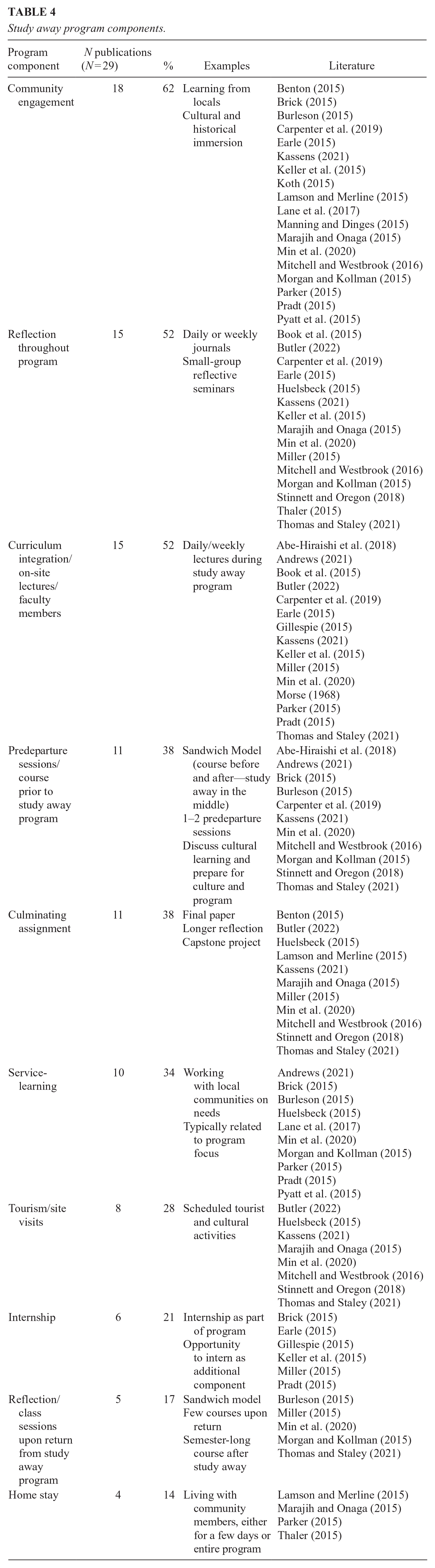
Ten different program components were identified in the literature, which are summarized in Table 4, alongside examples from the reviewed literature. Among the more prominent program components were community engagement (62% of these publications), reflection throughout the course of a program (52%), and curriculum integration/onsite lectures/faculty (52%). Other common but less frequent program components included predeparture sessions/coursework prior to participation (38%), tourism and site visits (28%), service learning (34%), a culminating assignment (38%), and an internship experience (21%). Finally, more infrequent components mentioned in the literature were homestay opportunities (14%) and reflection and/or class sessions after returning from study away (17%).
Study away program components.
Another interesting classification to note is how many publications described a single study away program, multiple study away programs, or something different. Our analysis found that 31 publications (53%) described one single program, with 11 (35%) of these publications describing a single program that was repeated at least once annually. Twelve publications (20%) described multiple programs; and 10 (17%) described study away in the abstract, such as examining study away as a concept or through a pedagogical lens. Six publications (10.17%) discussed NSE, which cannot be classified as a “program.” NSE is a consortium with hundreds of exchange options for students, where they directly enroll in classes at another campus.
Program Outcomes
In the literature we reviewed, a variety of student learning outcomes were either measured as a part of an empirical study or were presented as evidence of student learning during a study away experience. We categorized these learning outcomes using the same categories employed in Mayhew et al.’s (2016) seminal book, How College Affects Students, for consistency with the broader higher education literature. These eight learning outcome categories include: (a) Verbal/Quantitative/Subject Matter, (b) Cognitive and Intellectual, (c) Psychosocial Change, (d) Attitudes/Values, (e) Moral Development, (f) Educational Attainment and Persistence, (g) Career and Economic, and (h) Quality of Life After College.
Verbal/Quantitative/Subject Matter outcomes relate to specific content and are discipline-specific, often including skills like math and reading competence. Cognitive and Intellectual outcomes are described as critical thinking skills, an ability to process new information, communicate effectively, and approach new information objectively (Mayhew et al., 2016). Psychosocial Change refers to one’s identity development, self-concept, self-efficacy, and well-being. It includes both how one thinks of oneself and how one interacts with others. Outcomes falling in the Attitudes/Values category include attitudes related to sociopolitics and community, racial and ethnic differences, gender, sexual orientation, different religions, and educational and occupational diversity. Moral Development outcomes refer to development of a sense of right and wrong, particularly as definitions and actions become more complex (Mayhew et al., 2016). Educational Attainment and Persistence refers to continual enrollment in a higher education institution and subsequent attainment of a postsecondary degree or diploma. Career and Economic outcomes refer to those that involve career development, employment, and earnings. Finally, Quality of Life After College typically refers to “important nonmonetary benefits of education” (Mayhew et al., 2016, p. 491), such as community engagement, happiness, and professional fulfilment, and the extent that these indicators differ by different levels of educational attainment.
Of the 59 total publications reviewed for this study, 49 (83%) indicated some type of outcome that could potentially result from study away participation. We identified 144 total outcomes in the 49 publications, for an average of 2.94 outcomes per publication. There were 133 unique outcomes, with 7 outcomes repeated between two and four times, including critical thinking, communication skills, cultural competence, global learning, independence, multicultural competence, and self-confidence. While some of the authors provided definitions of these outcomes, many authors did not, which meant that we had to rely on contextual information to infer authors’ meaning. We independently classified each of the 144 outcomes within one or two of the categories just described (Mayhew et al., 2016). In only 10 cases (6.84%) did we disagree regarding an outcome’s category. There were an additional 34 outcomes (23.61%), where we had some overlap, but not the exact same outcomes. For example, one person may have chosen Attitudes/Values, while the other person chose Psychosocial Change and Attitudes/Values to classify a particular outcome. In these cases, we discussed our areas of disagreement and came to a resolution as to the outcome’s category. Table 5 summarizes these outcomes and provides information by category, including percentage and number in each category, examples of each category, and publications that included the outcome category.
Study away program learning outcomes.
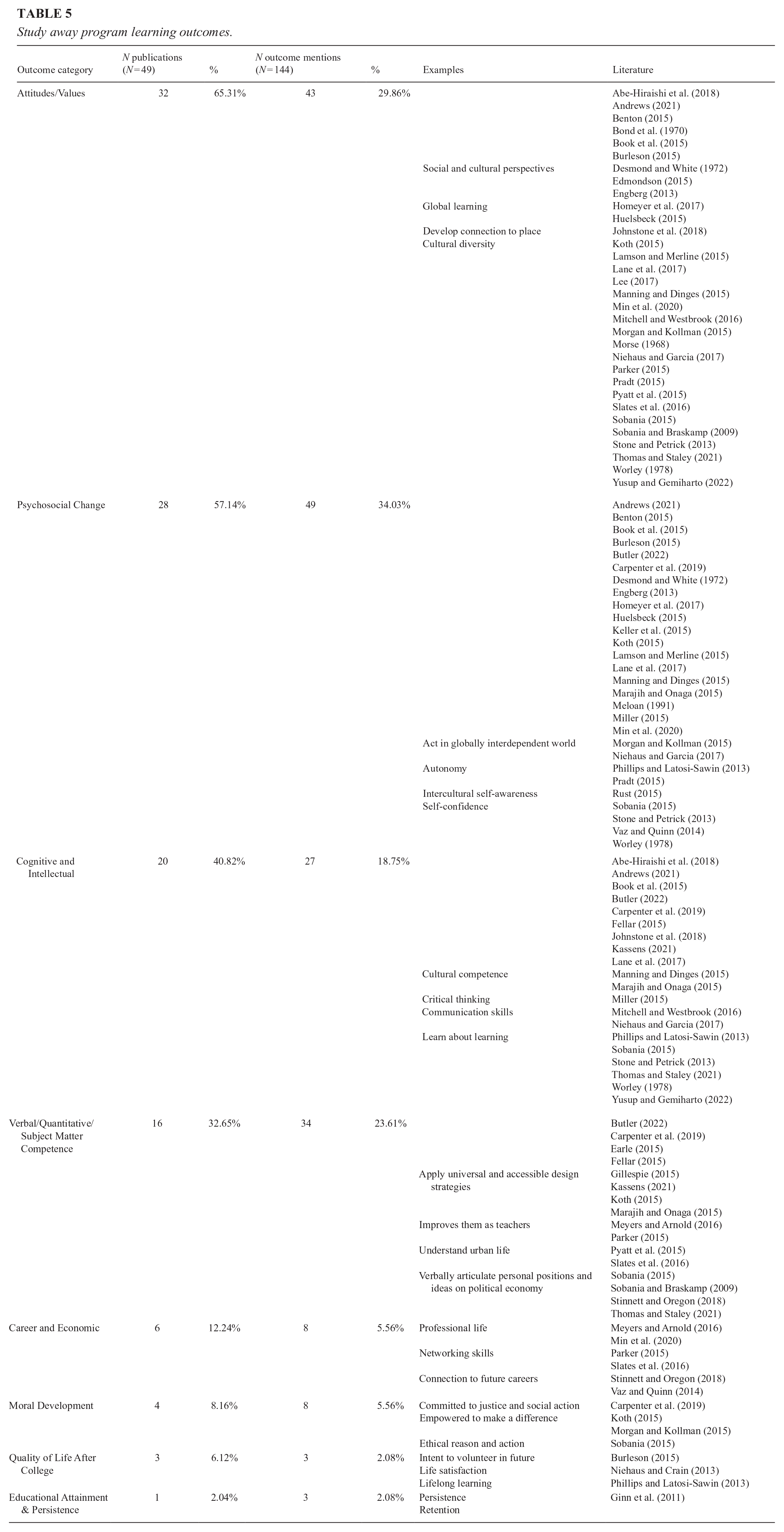
Psychosocial Change was the most common outcome category, representing 34% of the outcomes, and in 57% of the publications. This means over a third of the study away program outcomes were focused on participant identity development, including both how students viewed themselves and how they interacted with others. Outcomes categorized as Attitude and Values were a close second, selected for almost 30% of the outcomes, and found in 65% of the publications. Only one publication included Educational Attainment & Persistence outcomes, and Quality of Life after College outcomes were found in three publications. Thirty-eight outcomes were coded with two categories, and 106 were coded with one category. Psychosocial Change and Attitudes/Values were paired together to describe outcomes 11 times. Other common combinations included Attitudes/Values and Cognitive and Intellectual (8 times) and Psychosocial Change and Cognitive and Intellectual (8 times).
Student Participants
One of the key rationales for creating study away programs is the opportunity to provide intercultural learning for students who may not normally participate in study abroad programs. Indeed, many articles in this review discussed the common barriers to studying abroad (Book et al., 2015; Edmondson, 2015; Ginn et al., 2011; Hawks, 2021; Johnstone et al., 2018; Manning & Dinges, 2015; Marajih & Onaga, 2015; Sobania, 2015; Sobania & Braskamp, 2009; Thomas & Staley, 2021), including financial challenges, academic and career constraints, fear of travel, lack of diverse faculty or fellow participants, familial obligations, and time constraints. Minoritized students, STEM majors, and males are often underrepresented in study abroad. The majority of the articles reviewed either did not discuss key demographic details of students who participated in these programs, or did not do it in a way that facilitated understanding the extent to which study away provides access to marginalized and underrepresented student populations. Most articles instead focused on the actual study away program, the general benefit of these programs, or comparing learning outcomes between different types of programs.
Several articles (Fickenscher, 2005; Johnstone et al., 2018; Phillips & Latosi-Sawin, 2013) discussed general demographic details about the student participants, but did not analyze or discuss how student participation may differ in international and domestic programs. However, there were a few articles that did discuss student participation and accessibility in more detail. Ginn et al. (2011) report that more males participate in the study away program compared to the general student population at the institution in question, but the percentage of minoritized race/ethnicity students is lower than the institution in general. Manning and Dinges (2015) describe how their university created study away opportunities for 15% of students who reported not studying abroad due to financial, academic, or diversity-related concerns. The programs removed many of those barriers, including providing funding for high-need students to participate in these programs. When describing their program to Hawaii, Marajih and Onaga (2015) share that most student participants came from Michigan, but that the group was more racially, ethnically, and socioeconomically diverse than a typical study abroad program. Book et al. (2015) describe Elon University’s Study USA programs, and how 25% of the students who chose to study in the USA had chosen not to study abroad because it was too expensive or did not connect with their career goals. Indeed, they saw high levels of male and minoritized student participation in their domestic programs compared to their international programs.
Discussion
Domestic study away programs hold considerable promise for the future of intercultural education given their potential for engaging historically and underrepresented student groups (Book et al., 2015; Manning & Dinges, 2015) and their feasibility for students who are either unwilling or unable to travel internationally to participate in more traditional experiences such as study abroad. The recent COVID-19 pandemic has served to underscore the importance of providing students with a variety of programmatic options for engaging interculturally within their educational environments, not only options that involve international travel.
The paucity of literature uncovered in this review speaks to underutilization and analysis of domestic study away opportunities, which can open doors to intercultural learning experiences to new groups of students. Given the diversity of people and cultures in the United States and in many global societies, we urge educators and students alike to consider new types of programs and models in addition to study abroad and community-engaged learning. Domestic study away programs offer one such viable opportunity, and more analysis and research should follow these new models.
The purpose of this systematic literature review was to explore how both researchers and professionals have previously discussed study away programs in empirical and professional literature and to assess systematically common features of these programs. The research questions that guided our review of the literature asked about how “study away” was defined; the conceptual, theoretical, and methodological approaches that researchers have used to study domestic study away; common programmatic features of domestic study away programs; and learning outcomes that have been attributed to domestic study away.
Regarding our first research question, which focused on defining “study away,” our primary finding was that this term is often left undefined. Such a situation allows for considerable ambiguity regarding the experiences that are the topic of this literature, and one obvious recommendation for future work that emerges from our review is that “study away” needs to be clearly defined. In this way, researchers and practitioners who work with mobility programs, whether domestic or international, can ensure that they are discussing the same intercultural learning experience when they refer to study away. Aside from this primary result, one pattern that emerged from the publications we reviewed where “study away” was defined is that authors in the professional literature tended to define study away as a domestic experience, while the empirical literature provides a mix of definitions regarding the location of these programs (domestic, international, or both). Whether “study away” refers specifically to domestic programming or is an umbrella term used for all intercultural programs that involve mobility, whether domestic or international, is an issue for future work in this area. Finally, a separate group of publications provided definitions of “study away” that focused on the learning approaches used in study away programs, such as experiential learning, rather than describing the location of these programs. While such definitions are helpful in that they provide more information about the nature of study away programs, context is key to the intercultural learning experience. Defining these programs without reference to learning context seems incomplete.
Regarding our second research question, we found that empirical work that investigates study away programs often does so without a theoretical or conceptual framework. Like publications that did not define the term “study away,” this omission is problematic in that the perspective with which the researcher approaches a particular study is left undefined for readers, and key assumptions and hypotheses are not clearly delineated. Among studies that did mention a guiding framework, Kolb’s Experiential Learning Theory was the only approach repeated across several studies. While the diversity of perspectives and frameworks represented in empirical work on study away is likely a positive contribution to our understanding of these programs, it is important that researchers investigating study away articulate the theoretical and conceptual assumptions that undergird their work. Relatedly, we recognize that none of the analyzed publications about domestic study away utilize a critical framework or problematize assumptions around intercultural learning and who is able to participate in these programs. Without an evaluation of how constructions of privilege may alter the experience and narrative of participating students and the communities with whom they engage, these participants and leaders of these programs miss an opportunity to deconstruct their biases and assumptions. Given that critical studies in higher education have grown exponentially in the last decade (Cruz & Glass, 2024), it is likely the future publications will consider study away through a critical lens.
We also found that researchers used a variety of methodological approaches to understand study away, including quantitative, qualitative, and mixed-methods approaches. In general, such methodological diversity likely enriches our understanding of these programs. Regarding quantitative studies specifically, one key area for future research on study away is the incorporation of analytic approaches that are better able to account for selection bias in the analysis of student outcomes, an issue that study away shares with study abroad (Haupt et al., 2018). That is, students who participate in study away are likely systematically different from those who do not in ways that relate not only to their decision to study away, but also the outcomes that they experience as a result of their participation. Without use of analytic approaches, such as propensity score modelling or quasi-experimental techniques that can address this situation, researchers will remain unable to isolate the potential impact of study away on students’ outcomes. Qualitatively speaking, future research would benefit from moving beyond single case studies, which represent the majority of the qualitative studies in our review. The incorporation of data from multiple cases would allow for cross-case comparisons that enrich our understanding of study away programs and their contexts. Moreover, we encourage future qualitative researchers to describe in depth how they went about the process of data analysis. In most cases, we were unable to document how data were analyzed in particular qualitative studies because this information simply was not provided or it was described in vague terms, such as “qualitative analysis.” A clear and detailed description of the data analysis process would serve to strengthen the contribution of qualitative work to our knowledge about study away programs.
Regarding our third research question, our findings suggest that most study away programs are short term, a characteristic that these programs share with study abroad (IIE, 2021). Additionally, these programs tend to be concentrated in certain subject areas, namely, the humanities, education, social sciences, and interdisciplinary programs. This unequal distribution of study away opportunities across subject areas is potentially problematic from an access perspective, meaning that programs are more available to some student groups compared to others. This finding parallels recent findings that focus on virtual exchange programs and internationalized curriculum in the community college context, where disparities in access along racial/ethnic and gender lines are partially explained by differences in the demographic compositions of students in certain disciplines (Whatley & González Canché, 2022; Whatley et al., 2022). This unequal distribution of opportunity among disciplines should be concerning to individuals responsible for the implementation of study away programs on postsecondary campuses, as it suggests that these opportunities are not equally available to all students. An additional concern for practitioners in study away that our literature review highlights is that many study away programs seem to be focused on urban contexts, such as New York City or Washington, D.C., locations supposedly selected for their diversity (e.g., Lane et al., 2017; Meyers & Arnold, 2016). Although we certainly do not advocate that study away programs should move away from these locations, as they certainly offer valuable learning opportunities for students, we do suggest that practitioners consider diversifying the location of these programs to include a variety of geographic locations, including rural ones. Indeed, to suggest that students must go to an urban location to experience diversity ignores the presence of diversity in rural locations. Additionally, given that people globally are migrating toward cities, study away experiences to rural locations may become more meaningful because they offer unique insights into how different people may live (Migration Data Portal, 2022). It may be that students attending urban institutions are more likely to benefit from or may be more drawn to programs in rural locations, and vice versa, given the cultural and geographic differences that often exist between rural and urban locations. Finally, the finding that only one of the study away publications found in the empirical and professional literature was located outside of the United States is worth noting, considering that these programs likely exist in other countries.
For higher education professionals planning study away programs, Salisbury (2015) offers some advice on creating program outcomes based on program components, spanning our third and fourth research questions. Specifically, in this piece, Salisbury (2015) suggests that four characteristics must be considered when developing study away program learning outcomes: (a) length of the experience, (b) cultural gap between the students and location of program, (c) depth of immersion into the community and culture, and (d) pedagogical approach of the instructors/program leaders. The type of outcome or expected progression toward the outcome should be matched with the four characteristics in mind. He suggests the four characteristics can be organized along a spectrum from simple to complex learning. In other words, the more complex the learning outcome is, the greater the depth of the program in these four areas. A longer program experience would better lend itself to an enhancement of critical thinking skills, or a more immersive experience with the local community could improve students’ intercultural competency to a greater extent than a program only designed for sightseeing.
Finally, our results suggest that the majority of learning outcomes currently associated with study away in the literature are categorized as either Psychosocial Change or Attitudes/Values. We recognize that although we categorize study away program outcomes through a specific framework, it does not mean that the students actually experienced those outcomes, that the program was specifically designed with those outcomes in mind, or that there were any assessment measures to definitely measure the acquisition of said outcomes. In addition to these limitations, program participants are likely to experience different outcomes from the program based on their background, assumptions, and prior experiences. Regardless, these outcomes are certainly important for college students, but we recommend that researchers and practitioners alike consider other ways in which students can benefit from study away participation, particularly as related to Educational Attainment and Persistence and Quality of Life After College. Indeed, emerging literature finds a positive relationship between study abroad participation and a host of academic outcomes, including degree completion and academic achievement (e.g., Bhatt et al., 2022; Raby et al., 2014; Whatley & González Canché, 2022). Other work has highlighted the relationship between study abroad and the likelihood of postcollege volunteering, one aspect of students’ quality of life after they graduate (Mitic, 2020). It is possible that this positive relationship extends to other intercultural learning experiences, including study away.
Conclusion
This literature review serves to summarize how researchers and professionals have discussed study away programs in the literature until the current moment. Recent trends in intercultural learning suggest that these programs stand to contribute significantly to students’ ability to access opportunities to engage with diverse others, especially because these programs do not require international travel. Future research is needed to more clearly define what is meant by “study away” and to advance theoretical and methodological approaches used to examine these programs. Additionally, student and community voices are mostly absent from the literature, which is a concern given the purpose and impact of domestic study away programs on those populations. Future research should include collaborations with these groups. Our findings also point to key areas that may be a source of inequality in study away programming, an additional important line for future attention in the literature. Finally, our results highlight outcomes that remain underexplored in the literature on study away, namely, educational attainment and persistence and quality of life after college. Future exploration into these areas can provide evidence to support arguments in favor of establishing and expanding study away programs, which will enhance access for intercultural learning for postsecondary students.
Footnotes

Authors
NATALIE I. CRUZ is an associate director of global strategy and initiatives at Emory University, Office of the Provost, 1784 North Decatur Rd, Atlanta, GA 30322; e-mail:
MELISSA WHATLEY is an assistant professor of higher education at the College of William & Mary, School of Education, P.O. Box 8795, Williamsburg, VA 23187; e-mail: