




Abstract
A growing amount of educational research employs participatory methods in which young people actively gather and analyze data in collaboration with the investigators. Considering the diverse use of the label “participatory,” we examined participatory studies with young people to understand how researchers justify using this approach and conceptualize its purposes and goals, as well as these studies’ contributions to scholarship and youth’s civic learning. We conducted an interpretive meta-ethnography of 95 studies, identifying four distinct types of participatory studies with youth: technical, capacity building, justice-oriented, and transformative. We conclude that research that labels itself “participatory” but does not benefit the participants and their communities puts the approach’s credibility at risk. To challenge structural inequalities and power relations between participants and researchers, academic studies should better align with the transformative approach that has the potential to support youth in becoming agents of change by engaging them in self-directed civic learning and activism.
A growing body of educational studies challenges traditional research procedures by engaging young people in the inquiry process. A literature search across different academic search engines using the key terms “participatory research methods” and “youth” or “young people” showed a steady increase in the number of studies from 2010 until 2022 in Google Scholar and Academic Search Premier (see Figure 1). Participatory research designs range from having young people create original data through photography, drawing, and poetry to including them in designing, conducting, analyzing, and disseminating research findings (Greene & Hill, 2005). The recognition of the need for more inclusive research methods to engage youth was born out of new streams in educational practice that demand a shift of power and agency towards the learner (Dewey, 1916; Elliot, 1991; Freire, 1970), and an epistemological and methodological shift that recenters participants as the producers and owners of knowledge, criticizing traditional “objective” research methods as exploiting affected communities merely as objects of the study (Fals-Borda & Rahman, 1991).
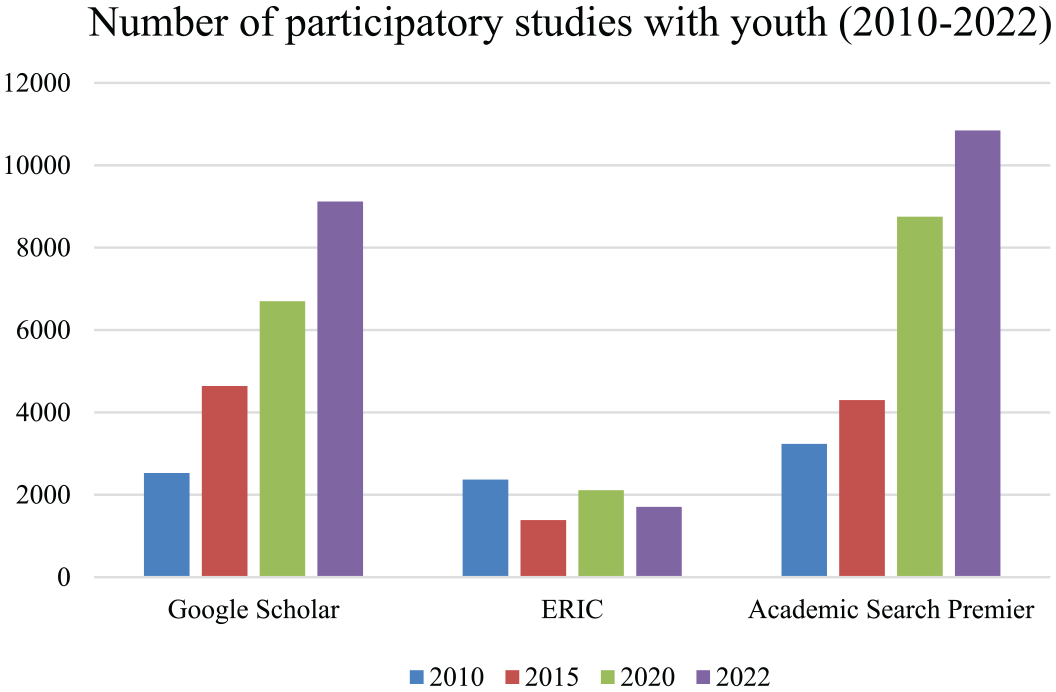
Results of literature search of participatory studies with youth.
Following the legacy of critical pedagogy, the proponents of youth participatory action research (YPAR) 1 recognize young people’s capacities to investigate community issues and systemic inequalities in education critically (Caraballo et al., 2017). YPAR repositions all young people as competent and capable beings who can inform and make decisions about issues that concern them as active members of their schools, communities, and societies (Malone & Hartung, 2010). As a critical research methodology and pedagogical practice, YPAR promotes active engagement of young people in research processes, challenging existing power imbalances by providing youth with research opportunities to inquire about issues that concern them and by engaging them in civic action against social injustices (Cammarota & Fine, 2008; Mirra et al., 2015). Through this process, youth and researchers engage in collaborative and transformative teaching and learning (Caraballo et al., 2017). Noguera (2009) argued that YPAR is particularly relevant for educational research as most studies into educational policies and reforms tend to treat students only as passive objects. YPAR differs from other critical methodologies in several ways. First, it centers young participants as knowledge producers and owners. Second, it adopts an explicit pedagogical approach, enabling mutual learning and teaching between participants and researchers. Finally, its goal is to encourage and facilitate civic action.
Despite these merits, concerns have been raised that participatory research with youth can be conducted in a tokenistic manner, reproducing the same power imbalance that it seeks to scrutinize (Conolly, 2008; Fox, 2013; Malone & Hartung, 2010). For example, Fox (2013) argued that such research often draws on formal participation mechanisms that resemble institutionalized tasks in schools or social work (e.g., homework or group work), reproducing existing power relations between adults and young people and between privileged and less privileged youth. Conolly (2008) raised the issue that when young people conduct research with other youth, they are in a similarly elevated position as adult researchers. Academic culture can also act as a limiting force due to its “requirement to produce something which looks like traditional research’” (Fox, 2013, p. 996). This expectation may distance the research findings from focusing on what is relevant in the lives of youth. Hart (1997) delineated a boundary beyond which research cannot be deemed genuinely participatory, which pertains to cases where youth are subject to manipulation or deception or are merely utilized as resources without the opportunity to express and formulate their own opinions.
In light of the growing amount of participatory research with youth and the concerns about the tokenistic use of this approach, we identified an urgency to investigate the landscape of participatory research with youth in educational settings. Existing review studies on participatory research with youth have already focused on specific contexts (Anyon et al., 2018; Shamrova & Cummings, 2017), particular groups of marginalized youth (Bradbury-Jones et al., 2018), and certain methods such as photovoice and digital storytelling (Greene et al., 2018). These reviews have made essential contributions to various aspects of YPAR. They include analyzing results and outcomes (Anyon et al., 2018), examining the conditions that empower youth as engaged citizens (Greene et al., 2018), exploring methodological and ethical challenges (Bradbury-Jones et al., 2018), and investigating the relationships between the studies and educational inequalities (Caraballo et al., 2017). However, there remains a gap in understanding the diverse ways in which researchers conceptualize, justify, and conduct participatory research with youth. Another research gap concerns how different conceptualizations of participatory research inform and shape researchers’ perceptions of young people’s civic learning and action. This is considered an important goal of YPAR alongside the generation of new knowledge (Cammarota & Fine, 2008; Caraballo et al., 2017; Noguera, 2009). We anticipate that different approaches to participatory research with young people are indicative of varying interpretations of civic learning.
To bridge these gaps, we carried out an interpretive meta-ethnography of contemporary participatory research involving young people. This analysis includes studies across diverse contexts-ranging from formal school settings to informal community environments and encompasses various groups of youth and methodological approaches to participation from multiple academic disciplines. Our goal is to obtain a comprehensive overview of the current landscape of participatory research. This will enhance our understanding of which approaches effectively empower young participants as civic agents, as opposed to those that engage youth in tokenistic manners or align with more passive or traditional forms of civic learning.
The primary research questions guiding this review were, (a) How do researchers conceptualize the purposes and goals of participatory research with youth? (b) What justifications do researchers offer for its use? And (c) what evidence is there of the contributions made by participatory research studies conducted with youth to both scholarship and the civic learning of young people?
In response to these questions, we will discuss how research labeled as “participatory” can greatly vary. This variation is evident in the underlying ontological and epistemological assumptions, axiological orientation, some of the methods, and the nature of the relationship between researchers and participants. Such diversity in approaches indicates that employing participatory methods does not automatically align with the emancipatory and liberatory principles of the participatory research paradigm. Consequently, we argue that researchers involved in participatory work with young people must critically assess their knowledge-production processes. This involves examining whose knowledge is prioritized (the researchers’ or the participants’), the epistemological approaches employed (traditional or critical), and the implications for civic learning.
In the following sections, we will delve into key concepts related to participatory action research (PAR) and its origins and how YPAR and other participatory methodologies have evolved from PAR. Subsequently, we will outline our methodological approach, focusing on meta-ethnography, and describe our literature search and analysis procedures. In the Findings section, we will categorize and discuss the four types of studies we identified, highlighting their differences. Lastly, we will explore the educational, social, and political implications of these findings for both the academic community and broader societal contexts.
Origins and Key Assumptions of Participatory Research With Youth
PAR: A Political and Scholarly Movement
PAR had multiple beginnings (Molano, 1998) and has certainly not been an exclusively academic endeavor but has been strongly inspired by various social and political movements of marginalized communities resisting forms of domination and oppression around the globe (Caraballo et al., 2017; Mirra et al., 2015). For example, in England in the 1960s, action research emerged as a curricular intervention to democratize teacher agency in the classroom (Elliot, 1991; Stenhouse, 1968; Willis, 1978); in Tanzania, PAR was first formed in the 1970s through cooperation between local and international researchers and villagers to challenge and later influence governmental policies in rural areas (Swantz, 2008); and in Latin America, PAR projects have been developed and implemented with the goals of adult education and political action, sparking political protests and the formation of political movements (Fals-Borda, 1987; Freire, 1970). An example of such a popular education project in the United States is the Highlander School, which trained civil rights leaders through a PAR approach (Cammarota & Fine, 2008). In these contexts, PAR has emerged from critiques of colonial scholarship, and imperialistic history, as well as ongoing neocolonialist and neoliberal projects that led both researchers and participants to form alliances and forge academic and everyday knowledge to challenge oppressive policies based on the local people’s political demands and needs (Swantz, 2008).
Over the years, academics have conceptualized an abundance of approaches to participative inquiry, including action research (Lewin, 1946), action science (Argyris et al., 1985), action inquiry (Torbert, 1991), participatory action research (Fals-Borda & Rahman, 1991), or cooperative inquiry (Heron & Reason, 1997). While PAR is not essentially affiliated with any particular discipline or political orientation, these approaches share a common critique and extension of traditional research by acknowledging that research includes a level of epistemic and political participation (Heron & Reason, 1997). According to Heron and Reason (1997), epistemic participation means that the study’s outcome is based on researchers’ and participants’ experiential knowledge, while political participation frames research subjects’ basic human right to fully participate in the research design. Fals-Borda (1987) summarized the goal of PAR as the disruption of the dichotomies of theory and practice; of academic, intellectual, and everyday knowledge; as well as of the researcher and the researched.
Heron and Reason (1997) categorized PAR under a new participatory paradigm, expanding on Guba and Lincoln’s (1994) competing paradigms of inquiry or “worldviews” that guide researchers’ ontological, epistemological, and methodological choices. Influenced by this work, Creswell and Poth (2016) outlined a transformative framework for participatory inquiry, which includes four dimensions: (a) ontological—participation between researchers and participants (usually from marginalized groups); (b) epistemological—multiple ways of knowing that are cocreated, and the recognition that knowledge is not neutral but reflects power relations in society; (c) axiological—the problematization and interrogation of values as well as respect for indigenous values; and (d) methodological—the use of collaborative research processes that aim towards political participation. PAR’s axiological orientation towards change and transformation, as opposed to gaining knowledge as an end, makes it different from other forms of inquiry (Heron & Reason, 1997). It extends constructivist and postpositivist research paradigms by requiring research to be responsive to the needs of marginalized communities, inclusive of their experiential knowledge, and to support political action (Creswell & Poth, 2016; Heron & Reason, 1997).
Its primary goal of social change is a critical defining element for PAR (Walter, 2009) as the approach encourages shifting research from a micro-level initiative to macro-level political action (Fals-Borda, 1991). Writing mainly about social movements in the global South, Rahman (1991) argued that PAR has emerged partly due to people’s disillusionment with official political parties whose political actions have, despite social progress, created new forms of domination over the masses. This has triggered a rethinking of the meaning of social transformation as something that does not only need to be rooted in control over the means of material production but also in the generation of knowledge, specifically the power to determine “what is useful knowledge” (Rahman, 1991, p. 14). Fals-Borda (1991) defined authentic participation as “rooted in cultural traditions of the common people and their real history (not the elitist version)” (p. 9), constituting a break from the asymmetrical relationship of submission and dependence between participants and researchers. By recognizing that “real” social change and political action can only be grounded in the people’s own consciousness and knowledge, PAR seeks to return to the people the legitimacy of their knowledge and their right to use this knowledge in addition to other (scientific) knowledge as a guide for their own action (Rahman, 1991). Through these processes of conscientization and social inquiry (Freire, 1970), participants and researchers seek to achieve their shared goal of social transformation (Fals-Borda, 1991). Since the knowledge acquired belongs to the people themselves, the researchers are obligated to return the knowledge to the communities (Rahman, 1991).
From PAR to YPAR: Recognizing Young People’s Critical and Transformative Capacities
As mentioned earlier, PAR emerged from revolutionary pedagogical projects mainly across the global South, functioning as the research arm of these projects (Cammarota & Fine, 2008). While PAR projects were usually led by adults and addressed adults’ education, there has been increasing recognition of the need to design research that is more inclusive towards young people, shaped by critical youth studies and the “New Social Studies of Childhood.” These academic fields are built on the critique that researchers view young people mainly through the lens of biological determinism as psychological and physical stages of development (Barker & Weller, 2003; Sibley, 2002; Weller, 2007). Instead, these scholars broadened interpretations of childhood by distinguishing between how youth are categorized and presented in social discourses and policies and their actual social experiences (Quijada Cerecer et al., 2013; Weller, 2007). They conceptualized child- or youth-centered research as presenting “a more complex portrait of young people as meaningfully engaged, independent social actors whose activities and practices influence a variety of social contexts and settings” (Best, 2007, p. 21). The acknowledgment of youth as competent and autonomous actors in their own right and an increasing interest in investigating the socially constructed nature of adolescence contributed to a methodological shift towards critical and constructivist modes of inquiry (Best, 2007).
Another impetus for including young people as researchers or coresearchers is the United Nations Convention on the Rights of the Child (UNCRC). The UNCRC formally justifies children’s participation rights and establishes ethical standards of respecting children’s rights within research, recognizing children and young people not only as rights-holders but also as subjects of research who can express their views and experiences and influence their own lives, environment, and society through their actions (Alderson, 1999; Lundy & McEvoy, 2012).
Nevertheless, scholars from the fields of critical race theory, decolonialization, queer theory, and feminist theory among others have voiced concerns about the remaining power relations between adults and young people as well as between other dominant societal groups and those that are structurally and institutionally marginalized (Akom et al., 2008; Cammarota & Fine, 2008; Ginwright & Cammarota, 2007). They reject deficit approaches to young people’s civic (dis)engagement that construe marginalized youth as culturally deprived and as victims of poverty, ignoring the rich civic lives of these young people that exist beyond conventional conceptions of civic engagement (Noguera & Cannella, 2006). Cammarota and Fine (2008) argued that critical youth studies goes beyond the traditional pathological or patronizing view by asserting that young people have the capacity and agency to analyze their social context, to engage critical research collectively, and to challenge and resist the forces impeding their possibilities for liberation. (p. 4)
For them, YPAR is a necessary extension of critical youth studies and a means for youth to engage in transformational resistance against educational and societal inequalities through undertaking critical scientific inquiry. By creating new formal and informal pedagogical spaces of resistance and resiliency, YPAR can be a tool, especially for marginalized and minoritized youth that “challenges the dominant mind set, increases academic engagement and achievement, and builds new understandings of the strength and assets of youth of color and the communities from which they come from” (Akom et al., 2008, p. 6). Building on PAR and Freire’s (1970) work on praxis, critical pedagogy, and critical consciousness, YPAR is explicitly pedagogical with important implications for education when youth study problems that obstruct their well-being or progress and develop solutions to them (Cammarota & Fine, 2010; McIntyre, 2000; Morrell, 2004). As part of this process, YPAR develops young people’s academic capacities by equipping them with critical knowledge about the workings of their social contexts and problem-solving abilities, and by facilitating youth civic engagement (Cammarota & Fine, 2008; McIntyre, 2000; Mirra et al., 2015; Morrell, 2004; L. F. Rodríguez & Brown, 2009).
In summary, it is widely recognized that PAR and YPAR encompass a variety of forms and meanings (Conolly, 2008; Hunleth, 2011). This diversity includes a spectrum of involvement modes, ranging from children setting the research agenda and analyzing data to acting as coresearchers or primary researchers (Bradbury-Jones & Taylor, 2015). Due to the broad array of approaches encompassed by this term, we identified a need to critically examine the justifications, processes, and understandings of young people’s civic learning that underpin these studies. We utilize the theoretical framework of YPAR, conceptualized as a collaborative and critical scientific inquiry between youth and researchers aimed at addressing educational and societal inequalities through research and civic action (Cammarota & Fine, 2008). While YPAR emphasizes the pedagogical aspects of this approach, we also draw on Creswell and Poth’s (2016) transformative framework to scrutinize the scientific inquiry elements of participatory research. We contend that an overview of the various conceptions of participatory research and civic learning can offer valuable insights to researchers on conducting participatory research with youth in a manner that is both critical and transformative.
Methodology
Literature Search
The aim of this review is to provide a comprehensive synthesis of contemporary participatory research involving young people. We specifically focus on the justifications, processes, and conceptions of civic learning in these studies. This review is primarily based on electronic searches for journal articles across the databases ERIC, Academic Search Premier (EBSCO), and Google Scholar, in which we searched for a combination of different terms related to participatory research methods, education, social justice (in a broad sense) and young people (for example: “participatory research methods,” “participatory action research,” “YPAR,” “YPAG,” “young people,” “youth”). The sample included international peer-reviewed articles written in English and published after 2010 that focused on young people of school age that employed a participatory methodology. The choice of this temporal scope is justified by the significant conceptual shifts and advancements that this field has undergone during this period. Technological advancements, globalization, and evolving societal values have all profoundly impacted the educational landscape and, thus, our preference to investigate contemporary developments. Focusing on the school-aged population as the focal demographic, rather than young adults or adult participants, is driven by our desire to comprehend this approach in the context of students’ distinct learning needs and the societal implications arising when engaging with this specific age group. Furthermore, we identified a gap in the review studies that primarily concentrate on formal and informal educational settings, which may be less relevant for post–high school populations. After checking for duplicates, scanning each text for our inclusion and exclusion criteria, and searching for relevant studies in the bibliography lists, our search produced a total of 95 articles (see Figure 2).
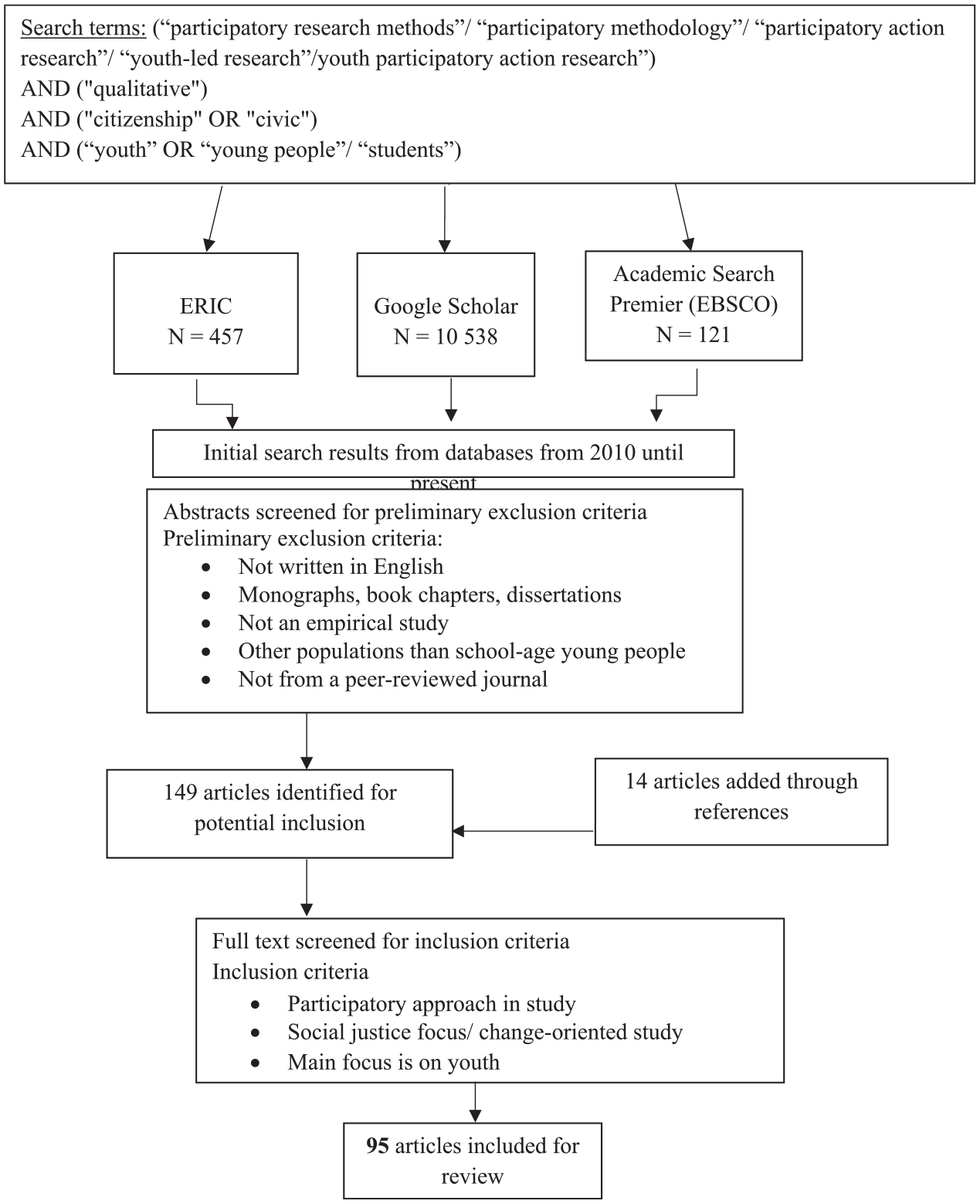
Literature search and study selection process.
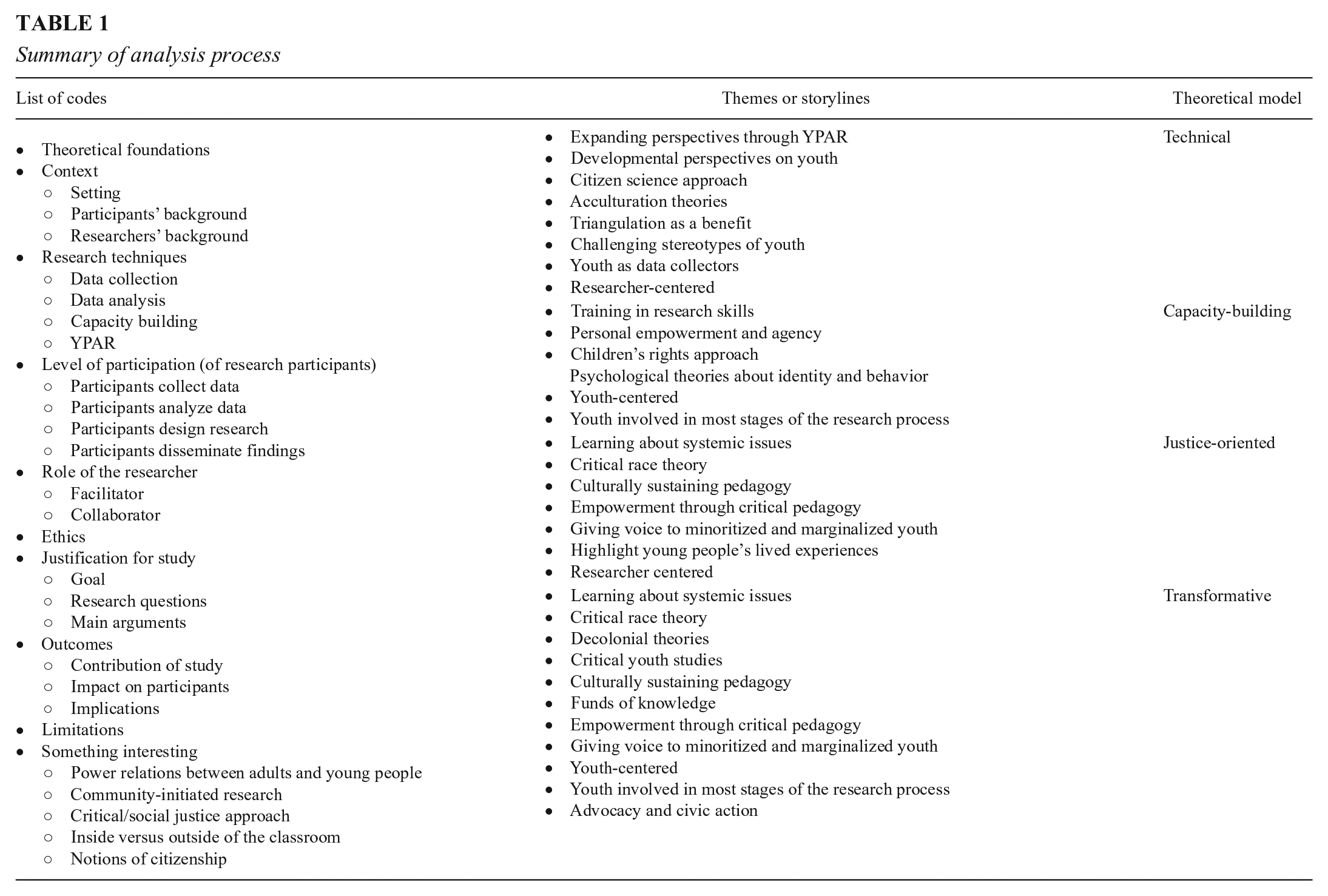
One of the challenges during our search was the diversified definitions of participatory research with young people. To gain an accurate picture of how researchers understand and frame participatory research with youth, we included all articles that specified their approach as “participatory,” “collaborative,” “action research,” or “child- or youth-centered.” Another difficulty was the prevalence of studies that evaluated the use and impact of a participatory approach as opposed to studies that focused on the immediate findings of the research. We decided to include these evaluation studies when they sufficiently described the approach, processes, and findings of the actual research. In Table 1, we demarcate which studies focus on evaluation or reflection and those that focus on the findings of the participatory study.
Summary of analysis process
We were purposive about finding diverse studies for our review in terms of the participatory approach they used and in which contexts they were conducted. By drawing on a broad sample, we aimed to investigate the breadth of different approaches to participatory research with young people. Our focus was on educational issues, yet the studies spanned other disciplines such as social work, sociology, political science, psychology, literature, geography, health, and environmental research. To be included, the studies had to meet the following criteria: authors defined research as “participatory,” peer-reviewed articles written in English, published after 2010, participants were school-age children and young people, and that research questions related to a social justice issue. We excluded studies that primarily focused on adults rather than young people (Bertrand & Ford, 2015; Wrenn & Reed, 2019), those that involved young people above the age of 18 (Goessling, 2017; Pryor & Outley, 2014), or cases where the study focused on researchers’ reflections or syntheses on a participatory study without providing sufficient details about their original study (Call-Cummings et al., 2019). We included reflection and evaluation studies when they provided enough details about the participatory process. While “qualitative” was one of our search terms, we did not aim to include only qualitative studies. Still, qualitative and mixed-methods research were dominant in our sample, which was certainly influenced by our search terms but also reflects the findings of other reviews, such as Anyon et al. (2018), who show that quantitative participatory studies are rare.
Analysis
We conducted a comprehensive synthesis of research to address broader questions about the nature of participatory research with youth. Working as a reflective team of three researchers, we analyzed qualitative research studies using an inductive and interpretive method as a form of meta-ethnography (Noblit & Hare, 1988). Meta-ethnography is a methodological framework for a translation theory of synthesis, a way of translating the written interpretations of qualitative studies as a set and in relation to each other (Noblit & Hare, 1988), forming “an interpretation of interpretations through a new lens” (Doyle, 2003, p. 330). This synthesis process can result in new interpretations, questions, and reconceptualizations beyond those of the individual studies by translating their “storylines” (Noblit, 2018).
We found meta-ethnography to be an appropriate method for this review study due to its aim to explore conceptual or theoretical understandings of a specific phenomenon (Sattar et al., 2021). According to Sattar et al. (2021), this methodological approach distinguishes itself from other synthesis methods in that it involves reviewers reinterpreting secondary data, such as themes and concepts, from the original authors of the studies under review. This process also involves consideration of the primary data, like participant quotes, from these studies, thereby facilitating the creation of higher-order themes. Our “translation” followed a line of argument approach (Noblit & Hare, 1988), as our set of studies tended to promote the same argument that research about young people should be more inclusive towards them; yet the researchers offered different methodologies and epistemologies as part of their justifications and, in this way, the storylines also “critique each other” (Noblit, 2019, p. 1).
Using the qualitative data analysis software Atlas.ti, each researcher read and coded a set of articles individually. This first round consisted of open coding, guided by our research interest in the variations of different participatory approaches. Examples of codes were “level of participation,” “role of the researcher,” and “justification for study” (see Table 1 for a complete list of codes). Through these codes, we identified multiple interpretations of participatory research in the studies that differed in terms of the young people’s participation level, their research goals, and to which extent the study led to collaborative civic action by participants and researchers.
For our second round of coding, we discussed and refined our codes, eventually reducing them to a list of 34 codes (Table 1), which were informed by our literature review and the reviewed articles. Based on this set of codes, we then compared our translations of each study and in relation to each other to explore how their sets of themes or “storylines” (Noblit, 2019) are similar and different. These storylines formed the basis for our theoretical model that we will discuss below (Table 1). Following Noblit’s (2018, 2019) approach, we included three levels of analysis: the first order as the direct participant quotes, the second order as the interpretation by the authors of the studies, and the third order that is our interpretation of the synthesis of those findings. To address the concerns raised by Doyle (2003) that meta-ethnographers risk overriding the original line of argument by the authors through their new interpretation, we largely rely on original quotes from the reviewed articles to which we added our third-order interpretations.
In the following sections, we will detail the results of the analysis process, which involved identifying various themes across the sample of studies. These themes allowed us to categorize the studies into four distinct ideal types of participatory research with youth: technical, capacity-building, justice-oriented, and transformative (see Figure 3). Simultaneously, we aligned these types on two theoretical axes (a) from researcher-centered to youth-centered research, reflecting different methodological and ontological orientations; and (b) from traditional to critical epistemological and axiological approaches.
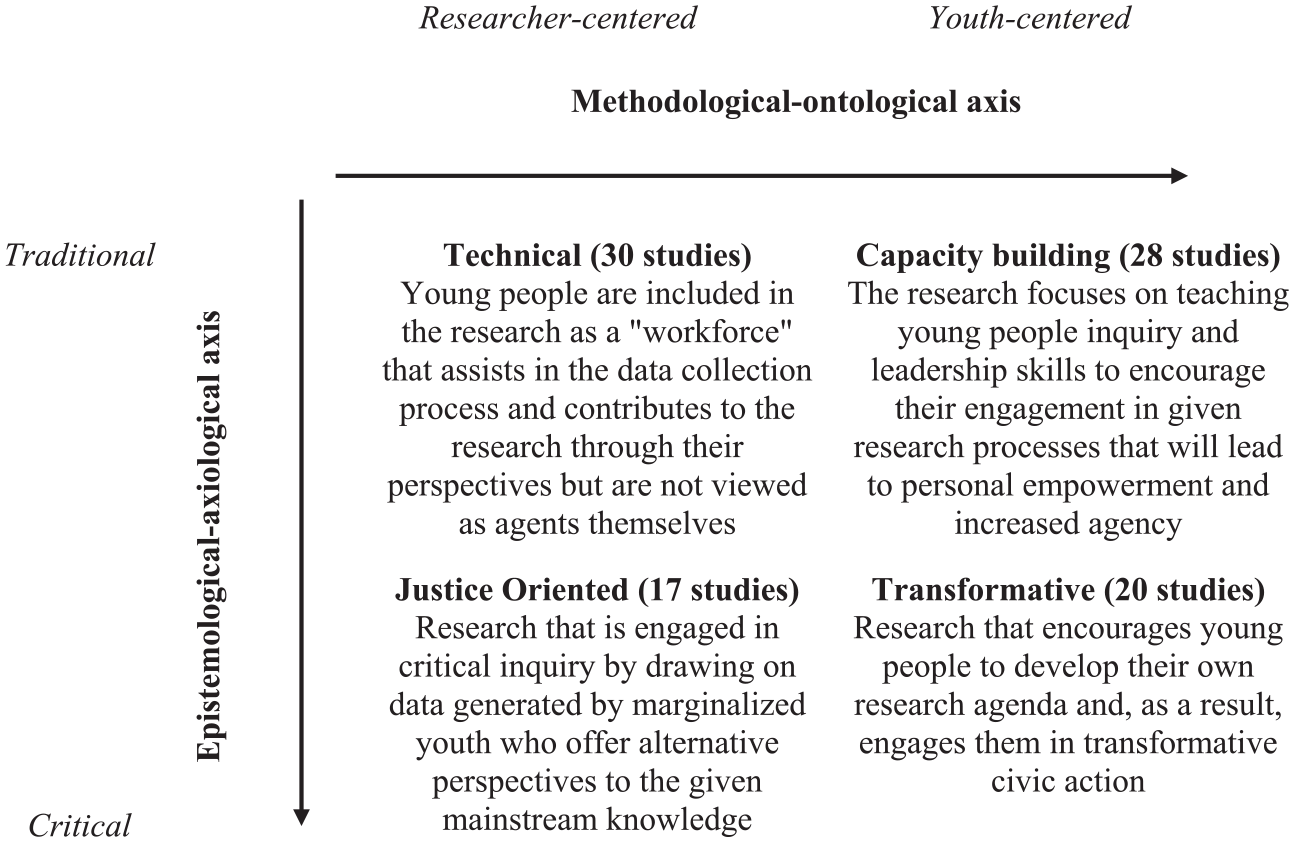
The four types of participatory research.
Positionality
Our interpretation of the synthesis and translation of the reviewed studies is shaped by our positionalities and how we situate ourselves in the theoretical conundrum (Doyle, 2003). We are an international team of three researchers (Israel, Germany, and South Africa) from different and intersecting disciplines (education, philosophy, political science, and criminology). Our journey into participatory research with youth, particularly marginalized groups, stems from the convergence of our personal and professional experiences. We share a deep commitment to democratic civic education and diversity, which is a reflection of our own experiences and beliefs about the transformative power of education in shaping informed, critical, and active citizens. We seek to understand and amplify the voices of youth, especially those from marginalized backgrounds. While our diverse backgrounds provided us with various perspectives on the challenges and opportunities in fostering civic engagement among youth, we are also aware of the limitations of our understandings, particularly when it comes to comprehending the complexities faced by scholars and educators of color and the communities they represent. These limitations have required us to continuously reflect on and challenge our biases and assumptions, particularly when it comes to understanding the experiences of marginalized youth in different cultural and social contexts.
In terms of theory, we align with humanistic traditions and critical theory, which framed our approach to evaluating the reviewed studies. Our preconceptions became evident during our weekly meetings and were manifest in our memos, reflecting on our coding process. We observed that some reviewed studies excited us, while others left us disappointed regarding their approach toward civic learning and action. Instead of dismissing these perceptions as biases, we viewed them as an opportunity to delve deeper into the reasons behind our reactions and explore the underlying implications. Therefore, in addition to our literature review and theoretical framework, these personal perceptions informed our interpretation and influenced the themes presented in the discussion section.
Findings
As an outcome of our research process, we developed a matrix model that categorizes participatory research with youth into four distinct types: technical (Type 1), capacity-building (Type 2), justice-oriented (Type 3), and transformative (Type 4). These types are aligned along two theoretical axes derived from Creswell and Poth’s (2016) model (see Figure 3). The first axis is the ontological and methodological axis (Axis 1), capturing the level of participation and collaboration between researchers and participants in the research process. The second axis is the epistemological and axiological axis (Axis 2), encompassing different ways of knowing and valuing knowledge, as well as the approach to ethics and values in the research. This theoretical model is based on YPAR, which defines participatory research with young people as a collaborative critical inquiry with the goal of civic action. Our model shows a spectrum of the level of participation and civic action (Axis 1) and the extent of criticality in the engagement with knowledge (Axis 2). We will discuss each study type’s key characteristics by drawing on direct quotes from the reviewed studies and explain why we positioned each set of studies at either end of those axes.
Type 1—Technical research with young people
In these reviewed studies, participation was commonly conceptualized as a technical tool that assisted the researchers in collecting original data that could not be accessed in other ways and that involved youth mainly as “data gatherers.” Thus, we aligned the technical type of participatory studies as more researcher-centered on the ontological/methodological axis and more traditional on the epistemological/axiological axis.
Those studies’ researcher focus was exemplified as in most cases young people collected data for the researchers through photovoice (Agha et al., 2019; Brännström et al., 2020; Brickle & Evans-Agnew, 2017; Jackson-Gordon, 2020; Lieblein et al., 2018; Robertson et al., 2016; Tickle, 2019; Wang et al., 2016; Yates, 2010), mapping (Gibbs et al., 2018; Literat, 2013), child-led tours (Agha et al., 2019; Loebach & Gilliland, 2010), through writing and other arts-based methods (Balakrishnan & Narvaez, 2016; Bettney, 2021; Korjonen-Kuusipuro et al., 2019; Liabo et al., 2017), or quantitative methods (Brickle & Evans-Agnew, 2017; Gallerani et al., 2017). These methods were often combined with individual interviews, focus groups, and participant observations. Some researchers involved youth more extensively by consulting them on the research design (Liabo et al., 2017; O’Brien & Dadswell, 2020; Rose et al., 2012; Ruff & Harrison, 2020) and involving them in the thematic analysis of their photos (Lieblein et al., 2018). Brännström et al. (2020), Brickle and Evans-Agnew (2017), and Lieblein et al. (2018) provided participants with the opportunity to showcase their photos in an exhibition; and in Rogers’s (2020) study, participants summarized their findings on advice posters for other students.
Most reviewed studies referred to youth engagement and empowerment as one of their rationales for including young people in their study. Still, other rationales were mentioned that suggest that young people mainly occupied the role as “data gatherers” to expand or enrich the collected data. For example, in their environmental participatory study, Brickle and Evans-Agnew (2017) justified their approach as to empower more youth in collecting air samples from a wider area. Such collection might provide larger datasets to examine geographic disparities in exposure to woodsmoke in addition to mobilizing more youth to become engaged in advocacy for decreases in wood burning. (p. 98)
Thus, they paired goals of youth empowerment with the pragmatic goal of achieving greater data sets by including youth in their study. Pragmatism as a reason for choosing photovoice as a method was mentioned in Tickle’s (2019) study about policing, safety, and security in coastal resorts who advocated photovoice as an “easy” and “flexible” method: Employing photovoice as a method of data collection has many advantages; it is flexible and adaptable to many settings; taking photographs is easy to do and can be used by a wide range of people; and can be utilized alongside other methods, which this paper strongly advocates. (p. 104)
We argue that these rationales point to the researcher-centered focus of these studies by prioritizing what is useful or helpful to the researchers over investigating the needs of the young participants. While most of these studies intended to incorporate young people’s voices and perspectives, they remained largely restricted by only allowing young people to participate in the processes of data collection and research design consultation. Ultimately, this left the power to determine the research agenda with the researcher. In their study about what inclusion meant to young people, Rose et al. (2012) reflected on their approach critically. They consulted with a young people advisory group about the researchers’ interview questions for young people, the data analysis, and how the data should be disseminated. Yet the researchers were ultimately in control of these processes: It is acknowledged that the researcher decided to undertake the project and ultimately retained the decision-making power within it; however, its design attempted to blend the researcher’s thoughts, decisions, and reflections with those of the advisory group at each stage of the project. (p. 259)
Generally, the authors of these studies framed the ontological rationale for using a participatory approach as tapping into young people’s perspectives and, in this way, expanding the researchers’ perspectives on the given research topic. Agha et al. (2019) argued that the use of participatory methods empowers researchers by showing them the children’s point of view: “drawings and photos, in particular, give adults access to secret and children’s ‘own’ places that are otherwise outside of adult visual scope and understanding” (p. 695). Balakrishnan and Narvaez (2016) sought to “test” through the use of participatory methods “how the interests and voices of students can shape the curriculum” (p. 4). Such research goals generate the impression that the purpose of participatory methods is mainly to serve the researchers and less about supporting young people to investigate issues that they are concerned about.
These power dimensions are also reflected in the epistemological aspects of these studies, which seemed to be more directed towards confirming existing research theories than to challenge existing academic knowledge and explore new knowledges through the insights provided by young people. This was particularly evident in cases where researchers drew on psychological theories about child development that specify abilities, skills, and competencies that adults consider as desirable developments and outcomes—a perspective that has been challenged by YPAR researchers (Akom et al., 2008; Quijada Cerecer et al., 2013). For example, Wang et al. (2016) used photovoice to explore the individual enculturation processes of Chinese American adolescents and concluded that “the photovoice method helped to facilitate her [young participant’s] enculturation process” (p. 384). The focus of this study was on testing psychological theories about children’s identity development rather than examining the new knowledges that were generated by the young participants through the photo elicitation task. In another photovoice study, Johansen and Le (2014) drew on contact theory and social identity theory “to examine youth attitude toward multicultural contexts to understand the factors that lead to the apparent negative, as well as the increasingly recognized positive outcomes of diversity and multiculturalism” (p. 551). Such perspectives seem to primarily draw on participatory methods to confirm existing academic knowledge instead of viewing it as a means to explore alternative ways of knowing by young people.
Type 2—Capacity-building research with young people
In contrast to the technical type, studies from the capacity-building type involved youth in most stages of the research processes such as research design, data collection and analysis (Horgan et al., 2017; Linville, 2011), or data collection, analysis and dissemination (Aldridge, 2012; Alegría et al., 2022; Bonati & Andriana, 2021; Byrne et al., 2020; Crook & Cox, 2022; King et al., 2021; Kubiliene et al., 2015; Leung et al., 2017; Liebenberg et al., 2020; Sarti et al., 2018; Shabtay, 2021; C. D. Smith & Hope, 2020; Warne et al., 2013; Wilderink et al., 2021). For example, in Crook and Cox’s (2022) study, young people designed, conducted, and analyzed interviews with adults. Some studies (Blevins et al., 2016; Canosa et al., 2020; Cochrane Bocci, 2016; Duke & Fripp, 2020; Durham et al., 2019; Harden et al., 2015; Kirshner et al., 2011; Koudelka, 2021; Nolan et al., 2021; Pearson & Howe, 2017; L. Smith et al., 2018; Trott, 2019) involved youth at all stages in which the researchers acted as collaborators or researched the students’ experiences of taking part in these research projects. Most studies concluded with youth sharing their findings with their communities through advocacy projects (Blevins et al., 2016; Nolan et al., 2021), the creation of animations (Canosa et al., 2020), documentaries, and a poetry slam (Cochrane Bocci, 2016) or a theater play (Harden et al., 2015).
This second type of participatory research was more youth-focused as these studies involved young people in most research processes and mostly aimed at teaching participants research and leadership skills. A guiding assumption behind the studies included in this type was that teaching such skills would promote personal empowerment and agency among students.
The teaching of research skills was accentuated in several studies. For example, Harden et al. (2015) highlighted as a main outcome of a youth violence prevention and intervention program that “the youth developed skills in leadership, trauma-informed practice, documentary production, theatre, and participatory action research” (p. 65); and Crook and Cox (2022) argued in their participatory study in a primary school that “the research activities would provide opportunities to develop participatory skills, useful for when the young people transferred to secondary school later in the year” (p. 5). Focusing on the cognitive challenges of participatory research with youth, Kirshner et al. (2011) also adopted this approach. They explained that learning how to manage bias is an important skill for inquiry-based learning in school - it is relevant to national science standards that call for students to formulate research questions, ground explanations in evidence, and be open to revising interpretations based on data. (p. 141)
Similarly, Alegría et al. (2022) highlighted how a participatory approach contributed to developing team collaboration abilities, communication, and leadership skills.
We concluded that these efforts to empower youth largely remained restricted to the level of individual empowerment. Such approaches align more with traditional epistemologies that prioritize academic knowledge and achievement as a goal. Eben though individual empowerment is an important first step, the capacity-building approach often falls short of situating young people’s experiences of injustice in larger political and social contexts as well as actively engaging them in transformative civic action. This is exemplified by a quote from Duke and Fripp (2020), whose study was based on a YPAR project with African American girls. While they explain that “biases” against Black girls are “systemic,” their study is limited to a focus on individual stereotypes: To disrupt those negative messages and create positive counter-narratives, our study seeks to examine African American girls’ perceptions of working with girls who have similar identities across race and gender in an YPAR project and explore the components of the YPAR project that may impact the perspectives about their group. (p. 4)
Another example of an approach that is individualistic and epistemologically more traditional was expressed by Blevins et al. (2016) who evaluated the outcomes of a civic program for youth, highlighting “action civics” potential contribution to addressing youth’s achievement and civic “deficits”: “As a new approach to civic education, action civics also has the potential to close both the academic achievement and civic engagement gaps and empower youth” (p. 347).
Type 3—Justice-oriented research with young people
Studies from the justice-oriented type involved youth mainly in data collection processes (Ali, 2016; Angucia et al., 2010; Caraballo, 2017; Durham et al., 2019; Gordon, 2019; Hadley et al., 2019; Johnston-Goodstar & Sethi, 2013; Keegan, 2023; McIver, 2020; Pestana, 2017; S. Rodriguez et al., 2021; Shields et al., 2020; Van Buggenhout, 2020; Zaal & Terry, 2013). Joanou (2017) used photovoice with his participants and allowed them to disseminate their photos through an online album. These studies mostly involved young people as research participants and not as researchers or coresearchers. The only exceptions were the studies by Del Vecchio et al. (2017) and Ingram (2014), in which young people collected data through interviews and analyzed them. Similarly, E. Jiménez (2021) involved a young people’s advisory group for consultation regarding her research design and data analysis. Still, we decided to categorize those studies as more researcher-centered because young people did not have opportunities to shape the research topic and to decide whether and how the findings would be used for social change or civic action.
Yet in contrast to studies from the technical and capacity-building types, these justice-oriented studies adopted a more critical stance, stressing the need to empower participants to question and challenge structural inequalities. Many of these studies problematize power relations—not only between adults and children but between dominant cultures and those historically marginalized and minoritized. As such, students’ participation in research was seen as a way to diversify and counteract the traditional academic discourse and knowledge.
This approach was exemplified, for example, by Johnston-Goodstar and Sethi (2013) who evaluated a youth program that counters the historical misrepresentation of Native Americans: “Youth critiqued the glorification of old White guys as it contrasted with a general absence of Native peoples in the university buildings that housed their program. They expressed disappointment in public institutions for failing to present Native American content” (p. 74).
Similarly, in Gordon’s (2019) study about a participatory project conducted in an English classroom, students were empowered to critically examine dominant ideologies by being exposed to alternative nondominant accounts: “By contrasting her learning goals with the school’s learning goals, Kierra [a participating student] established a power dynamic between what she wanted to know and what those in power wanted her to know” (p. 12).
In contrast to the studies we positioned as Type 1, which mainly engaged participants for the purpose of gathering data, the studies included in this type did not only aspire to offer new perspectives but also wished to empower participants to challenge mainstream academic knowledge by drawing on their critical subjectivities. This approach was explained, for example, by Del Vecchio et al. (2017) regarding their implementation of the photovoice method when engaging with marginalized youth. As they explained, “Taking and discussing photographs of their surroundings was a starting point to explore the significance of place in their lives, complicating and disrupting the prevalent damage-based narratives that tend to dominate depictions of migrant lives” (p. 372). In their study on literacy practices, Hadley et al. (2019) also voiced this critical stance: Equipping youth to contextualize the current policies of the city and issues that their communities face within a larger historical narrative enable youth to consider the ways that dominant assumptions about themselves, their families and their communities might be challenged if they enter civic conversations and provide counternarratives that center their own developing sense of who they are and what they are capable of. (p. 104)
Notably, these studies adopted a critical approach by focusing on systemic and institutional injustices. Ingram (2014) conducted a collaborative study on girls’ perspectives of gender, citizenship, and schooling. She justified this methodological approach by explaining that “the participants were also able to get beyond their own individual experiences and understand how systemic issues reinforced inequalities related to gender, race and culture” (p. 321).
Criticality was inherent in the rationale of these studies. For example, Ali (2016) advocated that researchers should critically reflect on the purpose of their project and whether it benefits their participants: For concerned social investigators, simply finding the most interesting question cannot guide their research projects. They must ask the following questions: (1) Who benefits from this work? (2) What are the ramifications of this research? And (3) In whose interests is this project constructed? If these questions do not place the community and participants’ needs and lives ahead of all else, both in the short and long term, then the research itself should be refocused or abandoned altogether. (p. 92)
Yet while studies that align with this approach are empowering in that they highlight perspectives from marginalized youths, they were limited in that they did not sufficiently involve the young participants in the research design or train them to conduct research and engage in civic activism.
Type 4—Transformative research with young people
Finally, studies of the transformative type involved young people in all stages of the research: research design, data collection, and analysis and dissemination (Akom et al., 2016; Aldana et al., 2016; Bautista et al., 2013; Bertrand, 2016; Buckley-Marudas & Soltis, 2020; Cammarota & Romero, 2011; Caraballo & Lyiscott, 2020; Craven et al., 2017; Davis, 2021; DeBower et al., 2023; DeJaynes & Curmi-Hall, 2019; Dill, 2015; Foster-Fishman et al., 2010; Garcia & Mirra, 2021; Gómez & Castañeda, 2019; C. Jiménez et al., 2021; Krueger, 2010; Mirra et al., 2013; R. Rodriguez et al., 2018; Stoudt et al., 2012). Importantly, the research agenda was usually guided, but research topics were defined by the youth researchers themselves, and these studies included advocacy and civic action. Examples of such civic actions were presentations of the findings to communities, policy and decision-makers, and academics (Akom et al., 2016; Aldana et al., 2016; Bautista et al., 2013; DeBower et al., 2023; Gómez & Castañeda, 2019; R. Rodriguez et al., 2018; Stoudt et al., 2012); documentary films (Bautista et al., 2013; Garcia & Mirra, 2021); a book featuring youth’s poetry (Dill, 2015); and photo exhibitions (Gómez & Castañeda, 2019; C. Jiménez et al., 2021). Notably, the youth researchers coauthored the articles of Craven et al. (2017) and R. Rodriguez et al. (2018).
Using a participatory approach, the researchers collaborated with youth to investigate research topics relevant to young people’s experiences and support them to engage in civic action. Most of these studies targeted young people from communities historically suffering from injustices such as African American, Latinx, LGBTQ, Indigenous, refugee, and migrant youth, among others. Another interesting feature of this type was that all studies were conducted in the United States, whereas other countries were more evenly represented among the other types. It is essential to state that not unexpectedly, our sample is overrepresented by research from English-speaking countries, as we only included studies published in English. Nevertheless, it is noteworthy that scholars in the USA, particularly those from historically marginalized communities, appear to be leading the way in transformative participatory research.
Similar to studies from the justice-oriented type, transformative studies embedded individual experiences in wider social structures and historical contexts, as a study about a photovoice project with diverse inner-city youth demonstrated: “During this activity, youth moved from voicing individual experiences to critically examining patterns of socioeconomic and educational inequity” (Aldana et al., 2016, p. 352). However, such transformative studies extended further to engage youth in civic action: The team spent several weeks organizing and analyzing the information gathered during the tour to identify issues, generate possible solutions, and develop an action plan. The Photovoice tour provided participants with information on local racial and socioeconomic inequalities, which complemented their previous discussions of school funding disparities. (p. 352)
As mentioned, these studies explicitly dealt with topics relevant to young people’s lives and emerged from their experiences. This was emphasized in Cammarota and Romero’s (2011) study, whose YPAR project was grounded on a “funds of knowledge” approach, as knowledge gathered in student research is used for learning purposes as well as for understanding how to improve conditions within their social contexts. Students develop an ontological understanding of how to use their “funds of knowledge” to generate more equitable social relationships by ameliorating conditions and opportunities for themselves, families, and communities. (p. 494)
This also illustrates the different ontological approach of these studies and their educational and civic mission. In Krueger’s (2010) study, students critically examined securitized spaces in their school and their accounts challenged racialized surveillance practices: Student narratives about their lived experience with securitized school space provided rare insights to how the ideology of security is stamping and reshaping the spatial designs of school and increasingly redefining what behavior and interaction is and is not filed as socially permissible. (p. 404).
Through the research project, young people were given tools and an opportunity to bring their experiences to the attention of policymakers, academics, and the community: “with the power of our collected visual and written narratives, members of this research collective felt equipped to initiate and lead actions towards demanding less demonizing and criminalizing and thus more youth-centered school safety practices” (p. 404).
Such transformative forms of participation can be a model for “critical democracy,” as framed by Mirra et al. (2013) who focused on the activities of a youth council in the USA: What does participation in a critical democracy look like? It looks like students using laptops to prepare presentations; it looks like students using technology to interview elected officials; it looks like students reflecting on their experiences and telling their stories in published articles; it looks like students engaging in dialogue with their elected officials; it looks like students organizing for social change. In the Council, critical democracy looks like students using social inquiry to gather, interpret, and disseminate data that represent their voices and views related to the struggles they experience every day. (p. 6)
They explain that in contrast to the usual “top-down approach” of research institutions, “the Council serves as a space where youth begin to speak for themselves in the public sphere and where their interests become represented in the political process - where they begin to embody Freire’s notion of critical consciousness” (p. 6). Therefore, collaborating research teams that employ such a transformative approach to participatory research not only aim to contribute to academic knowledge but first and foremost seek to catalyze social change and redress existing power relations between researchers and participants and between academia and communities.
In summary, while all the studies we reviewed fall under the broad category of participatory research, our analysis showed that this is an umbrella term encompassing a diverse range of studies. These studies differ in their epistemological and ontological assumptions, as well as in their methodological and axiological orientations (see appendix Table S1 in the online version of the journal and Figure 2). We observed significant variations in underlying assumptions, research questions, sample populations, methodological justifications, and the results and insights derived from these studies. In the sections that follow, we will provide a meta-analysis of the four types of participatory research with youth identified through our inquiry. This analysis will specifically highlight the distinctions between traditional and critical studies, as well as between researcher-centered and youth-centered approaches.
Discussion
Through this review study, we aimed to gain a better understanding of the current landscape of participatory research with young people by investigating (a) how researchers conceptualize the purposes and goals of participatory research with youth, (b) how researchers justify its use, and (c) what evidence exists of the contributions made by participatory research studies conducted with youth to scholarship and young people’s civic learning. As an answer to these questions, we organized our findings in the form of a theoretical model that references the different methodological, ontological, epistemological, and axiological dimensions of such studies. Based on these dimensions and the theoretical framework of YPAR we identified four different types of participatory research of youth that we allocated along two axes that reflect orientations towards participation and criticality.
We labeled the first axis youth-centered versus researcher-centered, reflecting the methodological-ontological dimensions of these studies. Youth-centered studies foreground the perspectives of young people and employ methods that engage youth in most stages of the research process, thereby balancing the participation between researchers and participants. While the researcher-centered approach highlights the academic goal of advancing knowledge and remains controlled by the researcher, the youth-centered approach is more educational in its orientation, pointing to how participating in the study may benefit the participants while offering personal empowerment and, in some cases, civic learning. The capacity-building (Type 2) and transformative (Type 4) types of studies are closely aligned to this axis as they involve youth in most research processes and center their views and perspectives. They highlight the entry points identified by YPAR theorists of academic learning and literacy by training youth in research methods, youth development, and organizing by facilitating their development through learning and action (Caraballo et al., 2017).
The second axis, traditional versus critical, represents different epistemological and axiological orientations. It juxtaposes traditional research paradigms that range from postpositivistic to qualitative approaches, critical and transformative participatory paradigms (Lincoln & Guba, 2011). Traditional paradigms, often but not exclusively, follow positivistic understandings of inquiry to expose certain objective and universal truths. Participatory research is viewed as a way to expand the data sample by including various voices, making research outcomes more robust. Critical approaches, however, problematize dominant epistemologies as well as structural and systemic inequalities and draw on young people’s funds of knowledge (Moll et al., 1992) or cultural wealth (Yosso, 2005) as alternative resources that can blend with academic knowledge into a “third space” (Gutiérrez, 2008). Such studies often draw on critical theory, critical race theory, feminist theories, or decolonial approaches as their theoretical frameworks (see Table 1). Critical approaches further acknowledge that this youth-generated knowledge—rooted in their communities and cultures—is the basis for civic action and social change. Relating to the research subjects as partners and building on their everyday experiences drive the studies toward the social justice realms by highlighting the contextual and subjective knowledge that the study generates, and by validating the relevance of funds of knowledge of marginalized communities for academia (Cammarota & Fine, 2010; Mirra et al., 2015). It is not surprising that research within the justice-oriented and transformative categories, which are more closely aligned with the critical orientation axis and the YPAR focus on critical and cultural epistemologies (Caraballo et al., 2017), predominantly addresses youth from historically marginalized populations and communities.
We may now reconsider the four identified types based on this theoretical plane. We coined the first type of studies as technical since researchers build on traditional inquiry traditions while setting the study’s validity, credibility, and robustness as the primary goal. In these studies, participatory research is presented as a way to advance studies in traditional knowledge-based manners, and the authors propose that collaborating with participants is a way to accomplish this goal. The second study type of capacity-building is different since it positions the participants, not the research, at the heart of the process. Nevertheless, studies based on this type still adhere to traditional research paradigms. An emphasis is put on the development of skills, yet without critical engagement with social justice issues and the knowledge generated by young people.
In contrast, the third type of justice-oriented research with youth is critical in its nature but positions the research, not the participants, as the focal point. Thus, this approach emphasizes how YPAR infuses the academic discourse with the perspectives of members of misrepresented groups that are seldom heard and, by doing so, challenges dominant neoliberal and neoconservative regimes of knowledge in education (Apple, 2011; Gillborn, 2005). Finally, the transformative type is seen as both critical in its nature and youth-centered. As such, its main aspiration is not to reach a certain “truth” or to advance the academic discourse, even though this might be an important side effect. Instead, such studies aim to generate and implement a transformative and emancipating process that the participants will experience and from which they will emerge as knowers and agents of change.
In response to our third research question regarding the contributions of participatory research to civic learning, our model serves as an analytical tool to discern differences among the types of studies. We found that technical (Type 1) and capacity-building (Type 2) research aligns with Westheimer and Kahne’s (2004) concept of the “personally responsible citizen.” This citizen is characterized as morally responsible and law-abiding, engaging in societal improvement mainly through volunteering, yet without challenging existing systems and structures. Conversely, our justice-oriented (Type 3) and transformative (Type 4) studies reflect the “justice-oriented citizen” model, where civic learning involves critically examining systemic and structural injustices and advocating for structural change.
Banks’ (2017) concept of the “transformative citizen,” who champions human rights, social justice, and equality by challenging or even violating existing laws to effect social change, resonates strongly with our findings. Particularly in transformative participatory studies (Type 4), civic learning is redefined by placing young people and their diverse experiences—including those of minoritized and indigenous groups—at the core of civic action. This approach not only foregrounds their unique perspectives but also recognizes their various funds of knowledge as essential to civic engagement. Therefore, we argue for transformative participatory research that significantly contributes to a form of civic learning that is more critical, youth-centered, and inclusive.
Our findings lead us to argue that although participatory studies with youth often share common research methods, the rationale and justifications for adopting these methods vary significantly. Consequently, the impact of these studies on participants’ civic stances also differs. While some studies reinforce traditional citizenship models, focusing on fostering personally responsible and law-abiding citizens who adhere to established norms, others embrace more critical, justice-oriented, and transformative approaches. These latter studies challenge existing power dynamics and strive for social and political transformation.
Conclusions
While the increasing adoption of participatory methods by researchers is encouraging, our findings resonate with concerns, such as those raised by Fox (2013), regarding tokenism in some studies. These studies often fail to fully realize the educational and emancipatory potential of YPAR. As Conolly (2008) points out, participatory research is not a simple solution for reversing power dynamics. Merely employing methods like photovoice, mapping, surveys, or interviews, where youth collect data, does not inherently align with the critical principles of the participatory paradigm. Our findings underscore the need for a deeper reflection on research ontology, epistemology, methodology, and axiology. By examining the research traditions (traditional vs. critical) that underpin our analysis, we highlight the significance of their value-based, normative aspects (research-centered vs. participant-centered). Understanding these aspects is crucial, as they hold the potential to significantly transform the lives of the participants.
Janes (2016) stressed the need for researchers to critically evaluate their own knowledge production processes. Such reflection teaches us that even when a research methodology is designed and labeled as participatory, it does not automatically guarantee that it is emancipatory or liberatory in nature. As a result of this analysis, we argue that, from both research and educational perspectives, a participatory methodological approach must better align with what we defined as the transformative approach. Following the tenet of the participatory paradigm that shows how “real” social change is grounded in people’s own consciousness (Freire, 1970; Rahman, 1991), we call for research that not only relies on young people’s lived experiences and perspectives but also actively promotes and cultivates their active participation in self-directed civic learning and engagement. As we have seen in the studies reviewed, involving young people as active participants in the research process may empower them to take ownership of their civic learning. Such transformative civic learning is expressed as young people deeply engage with civic issues, consider diverse and marginalized viewpoints, critically examine societal challenges, and engage in civic action. We believe that the primary value of such research methodologies lies in creating a platform where young people can express their voices, insights, and concerns more meaningfully than in traditional research settings.
To conclude, we contend that participatory research involving young people is a crucial link between educational theory and practice. It renders research more accessible and relevant, extending its significance beyond the confines of academia. As some reviewed studies did, framing its goals principally as improving research outcomes clearly undermines the participatory revolutionary character that precisely seeks to challenge the dominance of traditional research. Such technical approaches may appropriate the participatory research, which originated from postcolonial, antiracist, and working-class critiques of the establishment, for their academic purposes. When participatory research fails to genuinely benefit the communities and individuals under study, it jeopardizes the credibility and integrity of the approach itself.
While we recognize the value of transformative participatory approaches, we do not suggest that every study should adopt this method. Particularly in research that is more theoretical than empirical, a transformative approach may not be desirable or feasible. However, areas of research that stand to benefit significantly from this approach include those aiming to improve the living conditions of marginalized and minoritized groups, foster educational aspirations among study participants, and address issues of structural injustice and systemic inequalities.
It is crucial to acknowledge that academics often face pressure to adhere to rigid bureaucratic structures and formalized guidelines, which can restrict their ability to undertake transformative participatory projects with youth. We advocate for a reevaluation of these structures and guidelines to foster and support more critical, transformative participatory projects. Within the field of education, there is a pressing need for critical dialogue among young people, the academic community, educational practitioners, and policymakers. This dialogue should focus on creating structures and spaces conducive to transformative participatory research, which can then act as a scholarly, educational, and political tool. Such an approach moves beyond a deficit perspective and benefits both marginalized and privileged youth.
Supplemental Material
sj-docx-1-rer-10.3102_00346543241255625 – Supplemental material for From Being a Workforce to Agents of Change: An Interpretive Meta-ethnography of Different Approaches to Participatory Research With Young People
Supplemental material, sj-docx-1-rer-10.3102_00346543241255625 for From Being a Workforce to Agents of Change: An Interpretive Meta-ethnography of Different Approaches to Participatory Research With Young People by Aline Muff, Aviv Cohen and Tanya Hoshovsky in Review of Educational Research
Footnotes
Funding
This work was supported by the Israel Science Foundation (ISF) [grant number: 1768/21].

Notes
Authors
ALINE MUFF is a postdoctoral fellow at the Seymour Fox School of Education at the Hebrew University of Jerusalem, Mount Scopus, Jerusalem 9190501, Israel; e-mail: aline.muff@mail.huji.ac.il. Her research interests include citizenship education, the role of education in conflict settings, and participatory research methods.
AVIV COHEN is an associate professor at the Seymour Fox School of Education of the Hebrew University of Jerusalem, Israel; e-mail: aviv.cohen@mail.huji.ac.il. He serves as the cohead of the Undergraduate Program in Educational and Social Leadership. Aviv’s research focuses on democratic civic education, multicultural education, teacher education, and the use of qualitative methods in educational research.
TANYA HOSHOVSKY holds an MA in Jewish Studies from the Hebrew University of Jerusalem where she also works as a research assistant; e-mail: natanya.hoshovsky@mail.huji.ac.il. She is interested in Jewish thought, education methodologies and general philosophy.
References
Supplementary Material
Please find the following supplemental material available below.
For Open Access articles published under a Creative Commons License, all supplemental material carries the same license as the article it is associated with.
For non-Open Access articles published, all supplemental material carries a non-exclusive license, and permission requests for re-use of supplemental material or any part of supplemental material shall be sent directly to the copyright owner as specified in the copyright notice associated with the article.
