




Abstract
In the U.S. school system, Black, Indigenous, and People of Color (BIPOC) students often experience multiple forms of marginalization at the intersection of racism, ableism, and other forms of subjugation. To reform dysfunctional school systems, teacher education programs must create transformative spaces to nurture future educators committed to equity. These educators then will be equipped to dismantle the (in)visible racist and ableist structures within education systems and envision new alternative futures. Drawing on critical learning sciences and dis/ability justice-oriented theoretical approaches, we conducted a systematic literature review of 11 empirical studies to examine how teacher preparation programs are informed by dis/ability justice theoretical lenses. We synthesized how dis/ability justice-oriented teacher preparation programs organized transformative learning environments aimed at disrupting color-evasive and pathologizing discourses. We discussed the findings on how these programs conceptualized dis/ability, their applications of these conceptualizations in practice, and the transformative learning outcomes for preservice teachers.
In the U.S. school system, students from Black, Indigenous, and People of Color (BIPOC) 1 communities often experience multiple forms of marginalization at the intersection of different social markers (e.g., race/ethnicity, dis/ability). Specifically, BIPOC students with dis/abilities undergo intersectional oppressions within complex systems shaped by the historical and contemporary interplay between racism and ableism (Annamma et al., 2018; Connor & Gabel, 2013). In this literature review, we deliberately employ the term “dis/abilities” instead of “disabilities” to reflect that notions of ability and normalcy are not fixed entities but, rather, fluid, sociocultural constructions at the assemblage of historical, political, economic, and spatial forces that extend beyond biological and neurological human conditions (Baglieri et al., 2011; Davis, 1995; McDermott & Varenne, 1995).
Persistent racial disproportionality in special education and the prevalence of exclusionary school discipline practices are manifestations of historically sedimenting debts in U.S. schooling, entrenched in ableist and racist institutional structures (Artiles, 2019; Ladson-Billings, 2006). For example, Black and Native American students are more likely to be identified as having dis/abilities, particularly within the highly subjective disability categories such as emotional and behavioral disturbance (Bal et al., 2019). Additionally, BIPOC students with dis/abilities are more prone to receiving harsher and more frequent exclusionary school discipline (e.g., office discipline referrals, suspension, referrals to law enforcement) than their White counterparts, which are associated with negative academic, behavioral, and life outcomes. These outcomes include loss of instructional time, the exacerbation of opportunity gap, and increased involvement with the criminal justice system (Welsh & Little, 2018).
To dismantle the intersectional oppressions in school systems, teachers must possess transformative tools that facilitate their critical praxis. This entails engaging in critical reflection on the intersectional dynamics of power, privilege, and marginalization that contribute to differential treatment and learning opportunities of BIPOC students and taking proactive measures to reconstruct oppressive systems. Existing empirical studies have highlighted that teachers armed with transformative tools, such as adopting critical dis/ability perspectives and employing intersectional lenses, can challenge (in)visible ableist and racist structures and nourish the intersectional identities of BIPOC students with dis/abilities (Athanases & De Oliveira, 2008; Broderick et al., 2012). Thus, it is imperative for teacher preparation programs to create learning spaces that enable preservice teachers to develop transformative knowledge, skill sets, and dispositions. Such spaces will empower educators to resist assumed normativity and deficit-laden ideologies and actively take actions as agents of change (Bialka, 2015). Notably, critical scholars in the field of special/inclusive education have proposed restructuring teacher preparation programs through the application of dis/ability justice frameworks, such as disability studies in education (DSE) and disability critical race theory (DisCrit). These frameworks provide critical and intersectional lenses to foster transformative agency among preservice teachers (Ashby, 2012; Broderick & Lalvani, 2017; Collins, 2013a; Danforth & Naraian, 2015).
The current systematic literature review builds on interdisciplinary lenses informed by critical learning sciences (Gutiérrez, 2018; Gutiérrez & Jurow, 2016) and ever-evolving dis/ability justice-oriented theoretical approaches (Annamma et al., 2013; Baglieri et al., 2011). The review aims to synthesize 11 empirical studies that investigated how dis/ability justice-oriented teacher preparation programs organized transformative learning environments for preservice teachers to disrupt ahistorical, acultural, color-evasive, and remedial discourses and practices prevalent within traditional teacher preparation programs. The overarching question guiding this review is: How did teacher preparation programs utilize a dis/ability justice theoretical lens to organize preservice teachers’ transformative learning? To address this, the review seeks to answer the following research questions (RQs):
What were the characteristics of the teacher preparation programs reviewed in this study?
How did the programs conceptualize dis/ability in shaping their teacher preparation?
How did these programs employ the dis/ability justice lens to structure transformative learning experiences for preservice teachers?
What were the reported learning outcomes for preservice teachers who participated in the dis/ability justice-informed teacher preparation programs?
In the following sections, we map out how the historical intertwinement of racism, ableism, and other modes of subjugation constitutes a dysfunctional learning ecology in which BIPOC students with and without dis/abilities disproportionately encounter hyper-labeling and hyper-punishment (Annamma & Morrison, 2018). We then highlight the significance of our systematic literature review, which examines the roles and functions of teacher preparation programs in dismantling intersectional oppressions imposed on BIPOC students. In the methods section, we depict the search steps undertaken to identify the most relevant studies on dis/ability justice-oriented teacher preparation programs. Finally, we discuss the implications for advancing transformative teacher preparation programs and promoting research initiatives centered around dis/ability justice frameworks. Through these efforts, we aspire to ensure that future teachers critically reflect on the intersectional marginalization experienced by BIPOC students and envision new equitable futures for all students.
Intersectional Oppression of Racism and Ableism through Ability Profiling
In the United States, the hegemonic, ideological construction of race serves as a fundamental axis of organizing social hierarchy (Bonilla-Silva, 2015). Furthermore, a deficit perspective on race perpetuates a system of exclusion that privileges Whiteness over racialized others (Harris, 1993; Leonardo, 2009). An example of this can be seen in the experiences of BIPOC youth living in poverty, who face a heightened risk of being subjected to ability profiling. As Collins (2013b) described, ability profiling is “the process of responding to a student as though he is ‘disabled,’ that is, regarding all of his actions and interactions through the lens of deficiency” (p. xiii). Through the lens of ability profiling, Whiteness is reconstructed as normalcy and shapes a power-laden learning ecology. Herein, the varied ways of being, knowing, and doing of BIPOC students are delegitimized and relegated to deviance and pathology, making them susceptible to remedial discourses that aim to eliminate and erase accused deficits (Annamma et al., 2013). Accordingly, the overrepresentation of BIPOC students in the highly subjective dis/abilities categories and the implementation of harsh school disciplinary measures in schools can be attributed to the inherently racist and ableist structure of the education system. This structure valorizes Whiteness as smartness and goodness while simultaneously rendering BIPOC students punishable and ostracized (Artiles, 2019; Leonardo & Broderick, 2011).
Enacting Transformation in the Classroom
Extensive research draws attention to the significant limitations within teacher preparation programs regarding adequate training on dis/ability (see Cosier & Pearson, 2016). Notably, the subject of dis/ability remains taboo in classrooms, and the lack of resources within these programs further hinders the efforts of critical teacher-educators to address dis/ability-related topics (Baglieri & Lalvani, 2019). Although some special education teacher preparation programs have started to explore the intersections of dis/ability with race, ethnicity, and other social markers (Connor, 2006), critical theories on dis/ability are still not adequately represented in teacher education curricula on a broader scale (Dixson & Rousseau, 2005). Graduates of these programs often find themselves constrained by universal teaching metrics that may impede their responsiveness to the diverse learning and support needs of their students later (Delaney, 2018). By bridging the literature on in-service and preservice teacher education, we can address these issues. This approach facilitates knowledge transfer by incorporating successful initiatives or areas of improvements identified in in-service programs around dis/ability to (re)shape preservice programs. It can also inspire collective efforts to develop transformative spaces that span both preservice and in-service teacher education, recognizing teachers’ professional journey in teaching and learning dis/ability as a continuous process.
The literature reveals instances where in-service teachers have developed nuanced and innovative practices to address educational inequity and examples of transformational teaching and learning dis/ability. Broderick et al. (2012) provided a compelling illustration of how teachers “resist and transgress the discursive structures of schooling in ways that enable them to ‘restory’ disability in education” (p. 825). Their study demonstrated how teachers actively seek professional development that offers “counter perspectives” on dis/ability, specifically adopting DSE-oriented approaches. This type of professional development is designed to (a) disrupt dominant curriculum narratives; (b) embrace inquiry-based, constructivist learning projects that prioritize student needs; and (c) foster building alliances with colleagues, who are focused on asset-based and inclusive teaching practices. The authors reported that when DSE-oriented approaches to inclusive education are adopted as the conceptual framework for teaching, in-service teachers are better enabled to grapple with issues around equity and justice. By drawing on DSE perspectives and challenging deficit-based professional development, teachers “engage in the work of resistance” to barriers such as the parameters of normalcy that are often enforced in schools (Broderick et al., 2012, p. 838).
Further research on in-service teachers striving to dismantle intersectional oppression highlights the tensions and contradictions they encounter in their teaching practice. For instance, Friedman et al. (2022) explored how racism and ableism collectively shape teachers’ perception of themselves and their BIPOC students. Overall, the authors reported that when teachers are provided with appropriate tools, language, and support, their understanding of students with intersecting marginalized identities improves. One teacher-participant in the study conceptualized dis/ability using a social model of disability and pushed back on the school’s need to categorize students. Another teacher in the study then raised concerns about the disproportionate representation of students of color in individualized education programs. These examples suggest the potential for teacher-led transformations in shaping school-wide approaches to dis/ability and special education services. However, the study also warned that without a critical consciousness of the racialized history of dis/ability, participant-teachers tended to revert to deficit thinking and struggled to recognize how larger systemic inequities play out in their classrooms. A related area of research navigates the transformative agency of teachers, particularly their role as advocates for equity. For example, Athanases and De Oliveira (2008) examined in-service teachers’ endeavors to advocate for equity. These efforts encompassed teachers actively seeking adequate resources to support diverse youth in schools “in ways that extend beyond the classroom” (Athanases & De Oliveira, 2008, p. 98). The study, yet, also shed light on the persistent challenges these teachers encountered within the schooling system when striving for equity.
The literature on in-service teachers’ experiences with teaching and learning dis/ability reveals that although teachers face ongoing challenges in addressing dis/ability and implementing transformative practices, they also discover and develop innovative tools that help with enacting change, particularly at the microcosmic classroom level ( Baglieri, 2017; Cosier et al., 2016). These findings confirm the need to refocus teacher preparation programs on dis/ability justice theoretical frameworks such as DSE and DisCrit to better prepare teachers for teaching all students (Cosier & Pearson, 2016; Valle & Connor, 2019). Additionally, the literature on teachers as agents of change emphasizes the importance of incorporating dis/ability justice frameworks into teacher preparation programs. According to Lucas and Villegas (2013), several colleges of education are working to equip teachers with the necessary knowledge and skills to navigate more diverse and challenging school settings. Other researchers provide notable instances where teacher preparation programs are proactively engaging in reform initiatives to embrace the subjects of equity and inclusion in program requirements and curricula (Gay & Kirkland, 2003; Lampert, 2010; Lampert et al., 2013). To accomplish such reform initiatives, as Beneke et al. (2022) argued, teacher-educators should “work in solidarity with multiply marginalized children and their families, partnering with (and securing compensation for) local organizations” in the process of preparing future teachers. This paradigm shift toward dis/ability justice in teacher preparation programs can empower future teachers to be effective agents of change. Research consistently indicates that preservice teachers who received specialized training on a topic (e.g., dis/ability) are more confident and successful in their interactions with students than those who have had little or none (Boe et al., 2007; Milner, 2010).
The COVID-19 pandemic has unleashed a multitude of social, economic, and political challenges rooted in structural racism, resulting in significant upheavals for individuals from multiply marginalized communities. Although these challenges have disproportionately impacted BIPOC students in the education systems (J. M. Jones, 2021), they have also increased the burnout and attrition rates among special educators (Cormier et al., 2022). The current political climate further amplifies the crisis through legislative or administrative actions aimed to discourage the teaching of “critical race theory” in higher education and PreK–12 public schools (Liou & Deits Cutler, 2023). This state-initiated prohibition is a political retaliation against emerging social movements and activism dedicated to achieving racial and dis/ability justice in education. It demonstrates yet another enduring pandemic of systemic racism. This epistemic pandemic perpetuates White privilege and is further entwined with neoliberal deprofessionalization of teaching, which is primarily driven by the pursuit of social efficiency (e.g., decreasing resources, the use of scripted and constrained curriculum). In light of these intersecting pandemic circumstances, it becomes crucial to carefully evaluate the opportunities and challenges that arise from in-service teaching in the context of dis/ability. This evaluation can provide valuable insights into the needs and prospects for preservice teachers. By reframing the current crisis as an opportunity, teacher preparation programs can take on a unique role and responsibility in situating future teachers’ learning-to-teach process within the context of intersectional oppression imposed on multiply marginalized populations. However, this process must also incorporate reflective moments, during which teacher preparation programs encourage participants to “suspend one’s own premises and projects, but always with a sense of futurity” (Tuck, 2016, p. xii). By centering these programs on a forward-looking perspective and placing a strong focus on liberation and transformation in the context of dis/ability, the field of teacher education can actively cultivate equity-oriented teachers as field-leading agents of change.
Theoretical Framework
This review incorporates two critical theoretical lenses: “learning as organizing possible futures” (Gutiérrez & Jurow, 2016) and “dis/ability justice theories” such as DSE and DisCrit (Annamma et al., 2013). These lenses serve as theoretical and analytic tools to identify, extract, and synthesize transformative endeavors of teacher preparation programs with a clear political vision of fostering preservice teachers to become future change actors and advocates for dismantling intersectional oppressions (see Figure 1). First, the notion of learning as organizing possible futures offers counterfactual thinking and reasoning to guide how teacher preparation programs deliberately bring future emancipatory imaginations into designing program structure, individual curricula, and practicum experiences (Gutiérrez & Vossoughi, 2010). Second, the dis/ability justice theoretical lenses are useful for helping preservice teachers engage in critical reflections on the intersectional oppressions of ableism and racism and gain new knowledge(s) and skills to better serve all students with ability differences (Annamma et al., 2013).
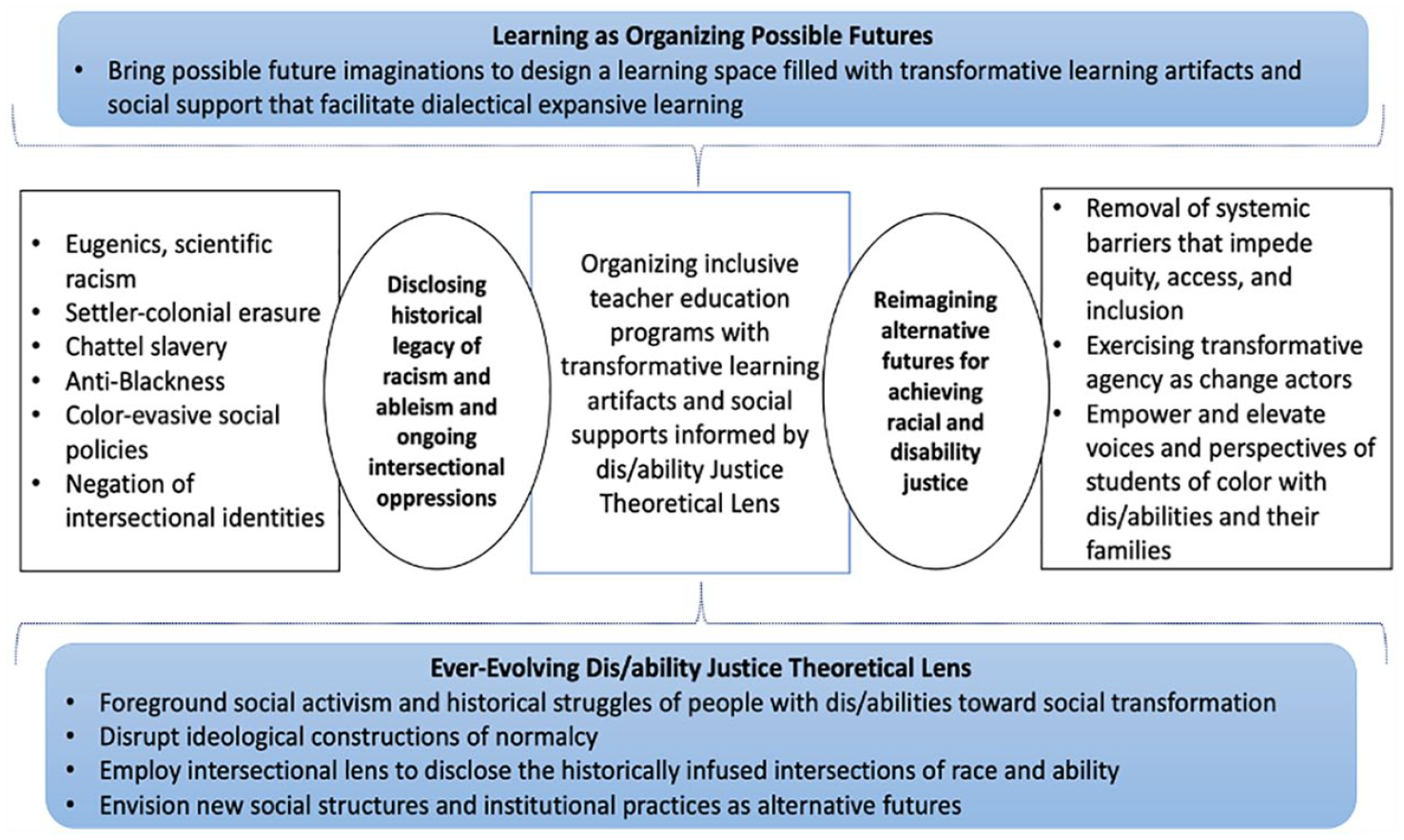
The Cross-Pollination of Disability Justice Theoretical Lenses and the Notion of Learning as Organizing Possible Futures to Design a Transformative Learning Space for Future Educators.
Learning as Organizing Possible Futures
Our framework around learning as organizing possible futures is grounded in cultural-historical activity theory (CHAT). Inspired by Marxist dialectical materialism, CHAT highlights the dynamic transformation of human activities through collaborative endeavors and human agency. As a forward-looking theoretical framework, CHAT scholarship focuses on the “enactment of the future in the present” (Stetsenko, 2020, p. 11) as a means to alter the material conditions of human activities (Engeström, 1987; Engeström & Sannino, 2021). CHAT conceptualizes contradictions that emerge and evolve within any human activity as catalysts for transformation (Engeström, 1987). Engeström and Sannino (2010) elaborated on the role of contradictions in human activity, noting that “the object of an activity is always internally contradictory. It is these internal contradictions that make the object a moving, motivating and future-generating target” (p. 5). Therefore, exposing intersectional oppression and envisioning alternative futures are integral to the development and transformation of human activity (Engeström & Sannino, 2021).
Equity-oriented learning scientists anchored in CHAT have conceptualized learning as organizing possible futures to deconstruct the naturalized notion of privileging White, English-speaking, able bodies and minds. They utilize sociohistorical and sociopolitical lenses to restructure an equity-oriented learning environment for all students (Gutiérrez & Jurow, 2016; Gutiérrez & Vossoughi, 2010). Accordingly, the notion of learning as organizing possible futures stresses designing a transformative learning space filled with available tools, coexistence of multiple voices, human agency, and future imaginations to bring the envisioned transformative learning spaces to life (Gutiérrez, 2018). Meanwhile, this notion de-emphasizes the discourse of remediation pervasive in traditional special education (Gutiérrez et al., 2009). The remediation discourse constructs the concept of dysfunctional individuals and rationalizes subsequent employment of ability profiling that foregrounds the loss and damage of people from vulnerable communities (e.g., BIPOC students with dis/abilities; Danforth & Naraian, 2015; Tuck, 2009). Such remediation discourse targets to fix assumed deficits located in individual students’ minds and bodies through so-called remedial interventions.
Building on the Vygotskian concept of tool mediation (Vygotsky, 1978), the notion of learning as organizing possible futures emphasizes “re-mediation” (Cole & Griffin, 1983) of learning space. Herein, future educators undergo expansive learning that focuses on dialectically dismantling the deficit-based remediation discourses and announcing new possible futures by curating multiple forms of meditating tools (e.g., course materials, assignments, and activities) and social supports (e.g., group discussions; Freire, 2000; Gutiérrez & Vossoughi, 2010). Learning as organizing possible futures in teacher education aims to tap into preservice teachers’ cultural assets, individual and collective histories, experiential knowledge(s), and political imaginations. In doing so, preservice teachers evolve into transformative agents who can resist and challenge ahistoricized, de-politicized, and color-evasive notions of dis/ability that validate and perpetuate educational inequity and injustice (Gutiérrez et al., 2009).
Dis/ability Justice Theoretical Lens
Adding to the theoretical lens of learning as organizing possible futures, we employed two dis/ability justice theoretical lenses, DSE and DisCrit, to unveil and dismantle ableist and racist structures, policies, and practices within U.S. schooling. We highlight that these dis/ability justice theoretical lenses originated from the social activism and historical struggles of people with dis/abilities toward social transformation (Baglieri et al., 2011). For example, DSE draws on an interdisciplinary lens to unravel and disrupt the social construction of normalcy. It also examines how sociocultural practices in schools identify cognitive, cultural, behavioral, and/or linguistic deficits of students with ability differences; confer disability labels; and employ those labels as tools of exclusion to reinforce “the myth of the normal child” (Baglieri et al., 2011). Furthermore, DSE aims to promote social justice by centering the voices, interests, opportunities, and sociopolitical agendas of people labeled with dis/ability while rejecting assumed incompetence of people with dis/abilities and deficit models of disability (Connor et al., 2008). However, despite its critical lens in disclosing how normative assumptions about ability constitute tools of exclusion and in amplifying individuals with dis/abilities’ voices and experiential knowledge toward social changes, critical disability studies were often criticized for their White-centric ontology and epistemology that overlook intersectional systems of oppression (Bell, 2006; Waitoller & Thorius, 2016).
As a cross-pollination of DSE and critical race theory, DisCrit is a conceptual expansion of DSE and foregrounds the interdependency of race, dis/ability, and other social markers of difference in shaping the learning opportunities and life outcomes of BIPOC students with dis/abilities (Annamma et al., 2018; Connor & Gabel, 2013). DisCrit offers a critical and intersectional lens to disclose the historically infused entanglements of race and ability (Annamma et al., 2018). DisCrit uses seven key tenets as its theoretical framework. The first tenet of DisCrit highlights how racism, ableism, and other forms of suppression interdependently function in privileging Whiteness, excluding BIPOC students with dis/abilities, and ultimately reinforcing the existing notions of normalcy and racial order in broader society (Annamma et al., 2013). DisCrit problematizes use of a singular lens of identity to understand and document complex, multidimensional identities (Tenet 2). DisCrit uncovers how historical and contemporary educational policies, programs, and practices constitute a seemingly color-evasive system (Tenet 5). This system, deployed through hyper-labeling and hyper-punishment, engenders profound material and psychological marginalization of BIPOC students with dis/abilities, thereby perpetuating White privilege and power (Tenet 3; Annamma et al., 2017; Bonilla-Silva, 2015). DisCrit also recognizes the role of Whiteness deeply ingrained in advancing disability rights that primarily benefit White, middle-class people with dis/abilities (Tenet 6). One of its emancipatory functions is to secure a counter space in which counter-narratives of people from BIPOC communities are centered and heard, thereby challenging and transgressing the naturalized borders of normalcy (Tenet 4; Annamma et al., 2013). Lastly, DisCrit prioritizes agentic actions to challenge racist and ableist structures and advocate for intersectional justice (Tenet 7).
To conclude, teacher-educators can facilitate “mediated praxis” (Gutiérrez & Vossoughi, 2010) for future teachers by endorsing DSE and DisCrit into their preparation programs as critical conceptual tools. As Figure 1 presents, ever-evolving dis/ability justice theoretical tools could empower preservice teachers to critically challenge assumed normalcy and scrutinize the historical and persistent entanglements of racism and ableism shaping intersectional power, privilege, and oppression. Furthermore, organizing the learning space with transformative conceptual tools could aid future educators in reimagining alternative practices and professional identities. These practices and identities are aimed not only at dismantling systemic barriers that undermine the access and inclusion of BIPOC students with dis/abilities but also at affirming their intersectional identities
Method
We conducted an online literature search to weave findings among teacher education studies that utilized dis/ability justice theoretical frameworks to locate the relevant programs. The initial keywords search was executed in March 2022. Electronic databases, such as Academic Search Premier, Education Resources Information Center (ERIC), APA PsycINFO, and Professional Development Collection, were systematically searched. The scope of our literature review included empirical studies published between 1999 and February 2022. We intentionally selected the year 1999 as our starting point because it was an inflection point in the field of DSE in which critical special/inclusive educators and disability researchers formally formed the field (Baglieri et al., 2011). These scholars aimed to promote “innovative ways of envisioning, writing about, and talking about the lives and possibilities of people with disabilities” (Baglieri et al., 2011, p. 269) while transcending positivist epistemology and behavioralist remedies that were prevalent in special education.
Our literature search strategy included two levels of search terms. The first level of keywords attempted to capture studies that included teacher education and preparation. The terms used in the first level of the search were “teacher educ*,” “teacher prep*,” “student teach*,” “preservice teach*,” or “training.” The second-level search keywords were “disability critical race theory” OR “DisCrit” OR “disability studies” OR “social model of disability” OR “racial justice” OR “disability justice” OR “intersectionality.” We employed broader keywords to capture literature grounded in theoretical tenets or principles of dis/ability justice frameworks (e.g., challenging medical and psychological construction of disability, focusing on intersectional entanglement between race and disability).
Search Strategy
We established the following inclusion criteria: (a) studies conducted in the U.S. context, reported in English, and published in peer-reviewed journals and (b) empirical studies that identified DSE and/or DisCrit as theoretical foundations for the organization of their teacher preparation programs (e.g., course development, programmatic design, instructional materials, and practicum organization). We did not include studies that only used the critical justice lens as an interpretative or analytical tool without making explicit whether the teacher preparation program under investigation was anchored in a disability justice framework. Concurring with Freedman et al. (2019), we acknowledge that by only including studies published in peer-reviewed journals, we might capture a limited purview of transformative movements in teacher education that are reported in book chapters, dissertation studies, or other forms of media. However, we deliberately targeted empirical studies published in peer-reviewed journals to synthesize findings with validity and credibility given that these studies went through the scrutiny of fellow experts in the field.
An initial literature search generated 2,714 e-sources for screening, which resulted in a total of 1,383 studies after the removal of any duplications. A close examination of the titles and abstracts of the yielded e-sources served the second round of screening. After locating titles that mentioned “in-service teacher” or other indicators meeting our exclusion criteria, we confirmed the exclusion by briefly reading the abstracts. This process left a total of 78 e-sources for the full-text review using the inclusion and exclusion criteria, described in the following section. No additional literature was found through hand-searching for the full-text review. Figure 2 details the step-by-step process of this search.
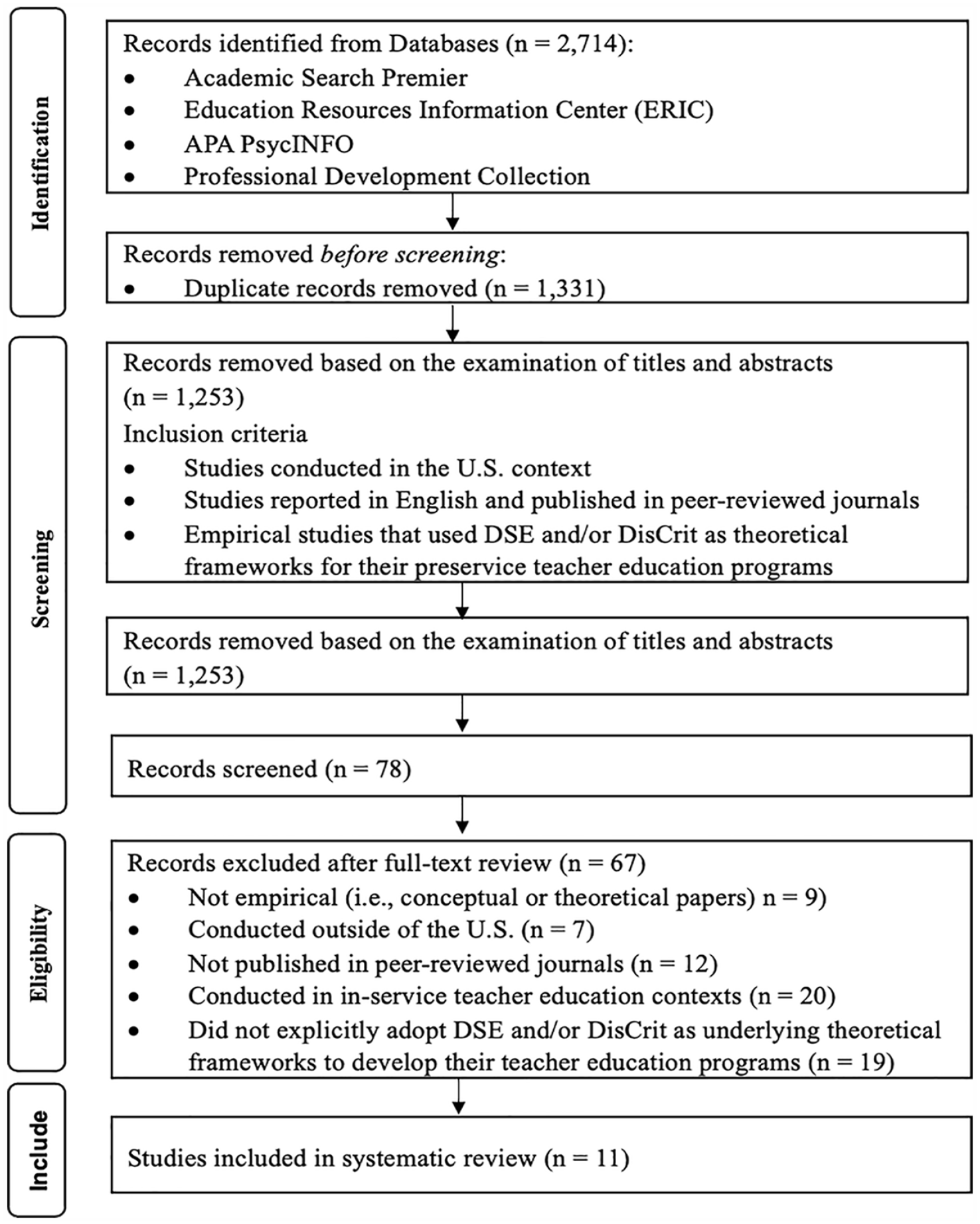
PRISMA Flow Diagram for the Systemic Synthesis.
Consequently, we excluded 67 out of 78 studies because of the following reasons: (a) nine studies that were not empirical (e.g., either conceptual or theoretical articles), (b) seven studies that were conducted outside the United States, (c) 12 studies that were published in non-peer-reviewed journals, (d) 20 studies that were conducted in in-service teacher education contexts, and (e) 19 studies that did not explicitly adopt DSE and/or DisCrit to develop their teacher preparation programs. Whenever disagreements arose between authors on the application of inclusion or exclusion criteria or the determination of whether a study utilized dis/ability justice theoretical frameworks, we resolved these through collective reexamination and dialogue until consensus was reached. For example, Young’s (2016) study was excluded after a team cross-check. The study initially passed the filtering process and was included in the first data pool because it examined teacher preparation programs aimed to prepare future teachers in issues of equity, access, and diversity (e.g., dis/ability). However, after in-depth discussion, the team clarified its reasons for exclusion to include the impossibility of identifying a program’s endorsement of specific DisCrit or DSE components in a reviewed study. This reexamination guided our subsequent review process, distinguishing studies that did not employ DSE or DisCrit as the organizing theory for teacher preparation programs but, rather, used them as the data analysis methods. After this collaborative search process, we selected a total of 11 studies for the current literature review.
Eligibility Criteria for Inclusion/Exclusion
Study Coding
We employed an abductive approach that “moves back and forth between deductive and inductive coding strategies to facilitate an interactive process between theory and data” (Ko et al., 2022). As a team, our initial step was to develop an interdisciplinary analytic framework, integrating dis/ability justice theories, such as DSE and DisCrit, with CHAT-informed learning theories. Next, we strengthened this analytic framework by adopting Freedman et al.’s (2019) data analysis approach. To address the question of how teacher-educators applied dis/ability studies within their programs’ specific social and spatial contexts, Freedman et al. synthesized studies on DSE-informed teacher education programs. Particularly, they utilized multiple analytic prompts to (re)organize their findings (e.g., central roles of DSE in structuring teacher preparation programs or courses). Using the analytic framework that integrated DSE, DisCrit, and CHAT-inspired learning theory, we deductively analyzed data derived from the 11 studies. Each author also inductively coded the data while we added newly emerging codes to the existing analytic framework in an iterative manner. Finally, we coded the studies based on the following aspects: (a) program features, (b) conceptualization of dis/ability, (c) application of DSE and/or DisCrit, and (d) reported learning outcomes of preservice teachers. The codes are reflective of our research questions and our understanding of CHAT and DisCrit and DSE tenets. For instance, the imperative to explore macro-level (i.e., programmatic) to micro-level (i.e., assignment) implementation of the DSE framework in the selected studies (RQ3) and its implication on the learning outcomes of the preservice teachers (RQ4) is theoretically grounded in the belief that learning and development, in this case, preservice learning and development, is a multifaceted mediated cultural process facilitated by tools such as course design, readings, and assignments. It is critical to understand how and to what extent teacher preparation programs mediate the learning of the future educators. Tables 1 and 2 offer a detailed overview of how we organized the findings.
Summary of the Selected Studies
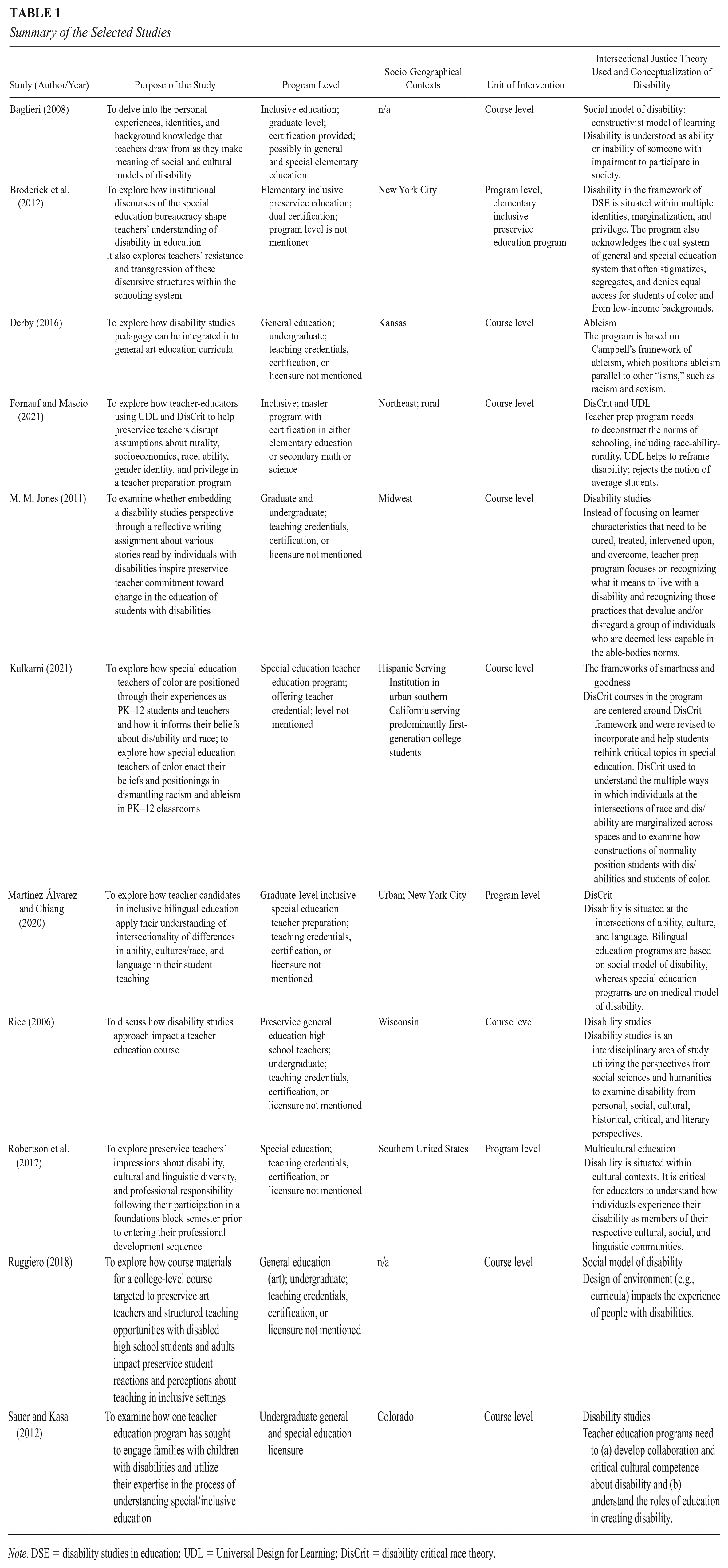
Note. DSE = disability studies in education; UDL = Universal Design for Learning; DisCrit = disability critical race theory.
Summary of Selected Studies
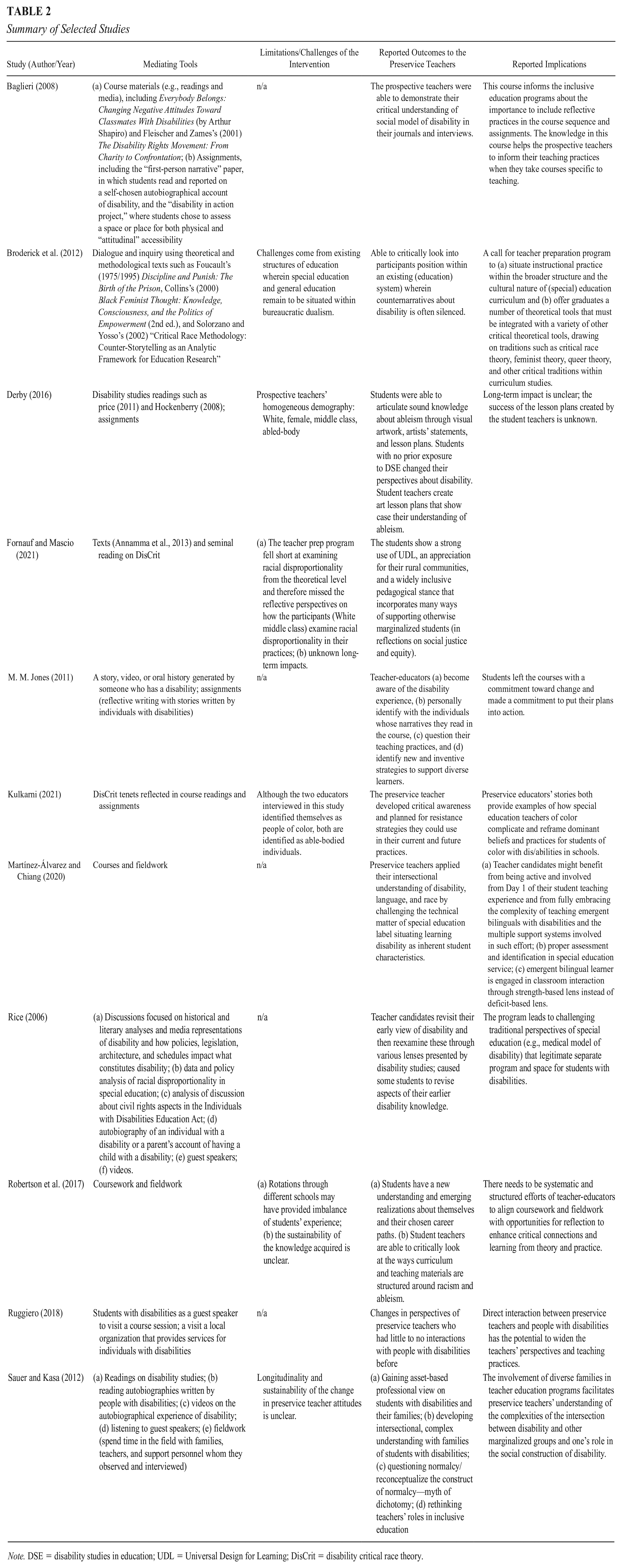
Note. DSE = disability studies in education; UDL = Universal Design for Learning; DisCrit = disability critical race theory.
Our Positioning in Knowledge Production
Our conceptualization of researcher positionality is grounded in the dialectical materialist perspective on identity formation (Esteban-Guitart & Moll, 2014). In this light, we conceptualize the researcher’s positionality as a historical product, shaped by the complex dialectical interplay between their developmental history and the specific social, cultural, and spatial contexts in which they are situated. We notably utilized the positioning framework developed by Boveda and Annamma (2023), which encouraged researchers to transcend conventional approaches of merely listing identities in position statements. They emphasized the significance of iterative and reflective dialogues in the knowledge production process. Such dialogues are informed by researchers’ continuously evolving ontological and epistemological perspectives and their power dynamics and privileges, which are differently exercised within specific sociopolitical and sociocultural contexts.
A team of four educational researchers with a commitment to social justice teacher preparation programs from four different institutions collaborated in this work. Dosun is an Asian immigrant, able-bodied scholar, a former inclusive classroom teacher, and a male teacher-educator nurturing future inclusive elementary educators. His developmental trajectory has shaped his ontological, epistemological, and axiological lens, informing how he documents and interprets the complex, intersectional experiences of people from marginalized communities and builds relationships with BIPOC communities. As a former practitioner, he also witnessed systemic contradictions through which students with and without dis/abilities from immigrant and migrant families experienced marginalization and exclusion. These experiences formulated approaches in teaching, research, and services, focusing on human agency, cultural and linguistic assets, and the everyday resistances of people from nondominant communities for systemic change.
Dian, an able-bodied immigrant scholar of color and teacher-educator, underwent a transformative academic journey focused on equity-oriented teacher preparation programs. During her doctoral training, she explored the intersections of cultures and dis/abilities, which influenced her current ontological and epistemic understanding of racial disproportionality in special education programs. In her teaching and research, she incorporates a disability social justice framework into her teaching, grounding special education programs within social justice perspectives. This includes explicit discussions on racial disproportionality in special education identification and school disciplinary practices in the courses she teaches. By assigning readings such as Baynton’s (2001) “Disability and the Justification of Inequality in American History” and Hatt’s (2012) “Smartness as a Cultural Practice in Schools,” she highlights the social, cultural, and political dimensions of dis/ability. These pedagogical approaches align with the principles of DSE, fostering a deeper understanding of dis/ability as a social construct.
Boris is an able-bodied, cisgendered male; immigrant-refugee; and U.S. citizen. His background, teaching experience, and research training mediate his growth, self-understanding, and motivation for conducting the present literature review. He and his family fled the former Soviet Union as political dissidents and as Jews escaping anti-Semitism and systemic oppression. In the United States, he struggled to navigate the unfamiliar societal terrain and often confronted barriers for accessing public services, such as education, health care, and housing. As a refugee and first member of his family to complete higher education in America, he experienced the affordances and constraints of research-driven education policies. Drawing on cultural-historical activity theory, he believes that transformative teaching-and-learning is a collective activity oriented toward evolving shared goals. As a teacher-educator and former special education teacher, he engages in practices that honor ever-shifting intersectional identities of individual students while simultaneously allowing them to imagine new subjectivities as they learn and grow. He has designed and taught graduate courses on culturally responsive classroom management, social studies methods, and cross-disciplinary disability studies.
Sumin’s background as an immigrant scholar of color and teacher-educator contributes to the ongoing dialogue on systemic inequities faced by BIPOC students in the U.S. educational system. With experience as an inclusive elementary school teacher in urban South Korea, she observed how students from marginalized backgrounds, particularly those in poverty, were disproportionately identified as having disabilities for causes such as academic underachievement or noncompliance. Recognizing that these identifications were influenced by systemic barriers and deficit-based approaches, she pursued special education teacher certification and a doctoral program in the predominantly White Midwest states, deepening her understanding of the social construction of dis/ability and its intersections with race/ethnicity, class, language use, and im/migrant status. Guided by critical theoretical frameworks such as DSE and raciolinguistics, she centers her advocacy efforts on a deep sense of self-reflection and the need to amplify the ever-evolving strength, resilience, and wisdom of BIPOC communities. By honoring the perspectives and lived experiences of BIPOC students and their families in her research and teaching, she strives to dismantle systemic inequalities and foster a transformative educational environment for all students.
Findings
In the following subsections, we organize the findings from the 11 reviewed studies around four primary areas, each corresponding to our research questions: (a) programmatic features of the studies; (b) conceptualization of disability; (c) the application of disability justice frameworks, such as DSE and DisCrit, in teacher preparation programs; and (d) implications of these programs for preservice teachers. This structure allows for an examination of the integration and impact of disability-critical justice frameworks in the programs included in our review.
RQ1: Program Features
The first research question aimed to identify the programmatic features of the programs addressed in the selected studies. To provide readers with a broad understanding of the contexts of the teacher preparation programs scrutinized in this study, we documented the programs’ institutional features, including the types of teacher certification/licensures (e.g., general or special education), the degree levels offered (e.g., undergraduate or graduate level), and/or the socio-geographical contexts (e.g., rural or urban areas; the Northeast, Midwest or South).
Among the 11 studies reviewed, four teacher preparation programs that utilized dis/ability justice theoretical lenses took place in general education (Derby, 2016; M. M. Jones, 2011; Rice, 2006; Ruggiero, 2018). Four programs self-identified as inclusive education programs (e.g., offering dual certification in general and special education; Baglieri, 2008; Broderick et al., 2012; Fornauf & Mascio, 2021; Martínez-Álvarez & Chiang, 2020). Two studies (Kulkarni, 2021; Robertson et al., 2017) reported on teacher preparation within a special education program, whereas Sauer and Kasa (2012) offered their licensure in both general education and special education programs.
The degree programs analyzed in this review were provided at both undergraduate and graduate levels. Four programs prepared teachers at the master’s degree level (Baglieri, 2008; Fornauf & Mascio, 2021; M. M. Jones, 2011; Martínez-Álvarez & Chiang, 2020), four at the undergraduate level (Derby, 2016; Rice, 2006; Ruggiero, 2018; Sauer & Kasa, 2012), and three studies did not disclose information on the degree of the programs (Broderick et al., 2012; Kulkarni, 2021; Robertson et al., 2017). Notably, most of the studies did not provide information about the pathways of their programs (e.g., licensure or credentials; Derby, 2016; M. M. Jones, 2011; Martínez-Álvarez & Chiang, 2020; Rice, 2006; Robertson et al., 2017; Ruggiero, 2018). Of those who provided information, three studies mentioned that their program offered teacher certification (Baglieri, 2008; Broderick et al., 2012; Fornauf & Mascio, 2021), and Sauer and Kasa (2012) and Kulkarni (2021) reported that their programs provided licensure and credentials, respectively.
The locations of teacher preparation programs were diverse, representing the Midwest (Derby, 2016; M. M. Jones, 2011; Rice, 2006), Northeast (Broderick et al., 2012; Fornauf & Mascio, 2021; Martínez-Álvarez & Chiang, 2020), South (Robertson et al., 2017), and East (Kulkarni, 2021; Sauer & Kasa, 2012). Two studies (Baglieri, 2008; Ruggiero, 2018) did not specify their geographical contexts. Among those that reported the type of localities, one teacher preparation program (Fornauf & Mascio, 2021) was set in a rural context, and two other programs (Kulkarni, 2021; Martínez-Álvarez & Chiang, 2020) targeted fostering future educators to serve urban students. Although developing a geographically situated lens for future educators is critical (Bull, 1989; Han et al., 2015), most of the studies we reviewed did not explicitly address the spatial, historical, political, and economic contexts their programs. Among the 11 studies, only two studies provided information about their teacher preparation programs as targeting teachers to teach diverse sociocultural and linguistic contexts, such as a bilingual teacher education program (Martínez-Álvarez & Chiang, 2020) and Hispanic Serving Institutions (Kulkarni, 2021).
RQ2: Conceptualization of Dis/ability
In addressing our second research question, we examined how each program depicted in the reviewed studies conceptualized disability to offer transformative learning experiences for preservice teachers. Although all of the reviewed studies are grounded in a dis/ability justice lens (e.g., DSE, DisCrit), they each have distinctive conceptualizations and expansions of this framework. For instance, the theoretical foundation of DSE and its derivatives dominated the philosophical ground of the teacher preparation programs reviewed in this study. Five programs were philosophically anchored in DSE (e.g., Broderick et al., 2012; Derby, 2016; M. M. Jones, 2011; Rice, 2006; Sauer & Kasa, 2012), indicating that these programs seek to transcend the positivist perspectives that prepare teachers to remedy the body/mind/emotions of students perceived as disabled. Teacher candidates in these programs are challenged to rethink dis/ability as merely individual characteristics. One of the selected studies did not explicitly mention employing the DSE framework (e.g., Derby, 2016), yet it integrated Campbell’s framework on ableism into its program, which positions ableism parallel to other “isms,” such as racism and sexism, thus signifying a linkage to DSE.
Three programs specifically are grounded in DisCrit, a branch of DSE paired with critical race theory (e.g., Fornauf & Mascio, 2021; Kulkarni, 2021; Martínez-Álvarez & Chiang, 2020). By utilizing DisCrit tenets as their theoretical and conceptual framework, these programs located the “problem” of dis/ability within the intersection of ableism and racism. In these studies, teacher candidates were challenged to rethink teaching-and-learning at the intersectionality of multiple forms of discrimination. For example, Kulkarni (2021) anchored their conceptualization of dis/ability in DisCrit Tenets 2, 3, 4, 6, and 7 (Annamma et al., 2013) and the notions of Whiteness as smartness and goodness (Hatt, 2012), situating dis/ability within a complex system of racism and ableism and interactions between race, dis/ability, class, gender, language, and other identities (Annamma et al., 2013). Fornauf and Mascio’s (2021) study serves as another example of appropriating transformative theories of DisCrit to guide the (re)organization of teacher education programs. They drew on DisCrit Tenets 1 through 6 paired with the Universal Design for Learning (UDL) framework to organize preservice teachers’ expansive learning. Their study focused on deconstructing the norms of schooling, including race and ability in rural contexts, as part of their theory-guided practice. Similarly, Martínez-Álvarez and Chiang (2020) drew on a broader framework of DisCrit foregrounding addressing race and disability simultaneously and materialized the framework in the teacher preparation program.
Certain programs in this review are specifically built on the social model of disability (e.g., Baglieri, 2008; Rugierro, 2018). Although the social model of disability is fundamentally grounded in DSE, its unique focus warrants a separate discussion. The teacher preparation programs presented in these studies perceived disability as either the ability or inability of an individual with impairment to participate in society (Baglieri, 2008) or a result of the environment’s design, such as curricula, that generates dis/ability (Rugierro, 2018). Both perspectives interpret dis/ability as an experience rather than an intrinsic physical, emotional, psychological, or neurological impairment. Rugierro (2018) specifically drew a contrast between the social and medical models of dis/ability and argued that the medical model impedes promoting inclusive education. The authors’ personal and professional journeys (e.g., research and classroom experience) also informed their deliberate decisions to adopt the social model as the theoretical framework for their programs (Rugierro, 2018). Robertson et al. (2017) specifically situated the notion of dis/ability in their teacher preparation program within the multicultural contexts of society. In this approach, dis/ability is perceived not as an isolated individual attribute but as a collective, shared experience.
RQ3: Application of Dis/ability Justice Framework in Teacher Preparation Programs
We investigated how the reviewed studies applied dis/ability justice theoretical frameworks to (re)organize their teacher preparation programs. We discovered that the application of the disability social justice lens and philosophy ranged from the macro-level aspects (e.g., programmatic structures; Broderick et al., 2018; Martínez-Álvarez & Chiang, 2020; Robertson et al., 2017) to micro-level elements (e.g., course design; Baglieri, 2008; Derby, 2016; Fornauf & Mascio, 2021; M. M. Jones, 2011; Kulkarni, 2021; Rice, 2006; Ruggierro, 2018; Sauer & Kasa, 2012). In the following subsections, we illustrate how the reviewed teacher preparation programs incorporated the dis/ability justice lenses to their program organization, curricular structure, course materials, and assignments.
Application of Dis/ability Justice Lenses at Programmatic Level
To challenge the medical model of dis/ability, which situates dis/ability as isolated individual problems detached from social, cultural, political, and historical contexts, three teacher preparation programs initiated a philosophical and paradigmatic shift at the programmatic level (Broderick et al., 2018; Martínez-Álvarez & Chiang, 2020; Robertson et al., 2017). These program’s philosophical values are anchored in the dis/ability justice lens and are materialized in course curricula. Martínez-Álvarez and Chiang (2020) reported that transformative changes intended to challenge traditional practice of special education, typically dominated by behaviorist and cognitive theories, commenced at the program level. These researchers described such program-level changes in their inclusive bilingual teacher preparation program, designed to enable teachers candidates to (a) unpack theories that have historically dominated the field of bilingual education and special education; (b) acquire emerging knowledge across bilingual and bicultural education, supplemented by 100 hours of fieldwork; and (c) understand the intersectionality of multiple differences and its role in dis/ability identification for emergent bilingual students through in-depth courses (e.g., cross-cultural communication, classroom ecology, disability-centered methods, and assessment). By providing a holistic perspective on bilingual special education, the program’s application of a dis/ability justice lens was committed to preparing teacher candidates to teach in inclusive environments where children with and without disabilities learn together (Martínez-Álvarez & Chiang, 2020).
Another teacher preparation program, as described in Robertson et al. (2017), also showcased the application of a dis/ability justice framework at the program level. The program was centered on a belief that educators should understand how individuals experience their disabilities as members of their respective cultural, social, and linguistic communities. This belief organized the program across five semesters, with the “foundations block courses” as the first set of mandatory courses, in which preservice teachers began with 88 hours of fieldwork in various urban settings. Following the field-based experience with culturally and linguistically diverse students, preservice teachers were required to enroll in a course called “Sociocultural Influences of [Teaching and] Learning” to study the sociocultural contexts of human learning and development. Other featured courses in the foundation block were “Individual Differences” and “Trends and Issues in Special Education,” which led preservice teachers to engage in discourses around key issues of cultural and linguistic diversity that impact special education policy and practices (Robertson et al., 2017).
The design of the programs in the selected studies indicated an intentional effort from the teacher preparation programs as a mediating tool for their future teachers learning to foreground conceptualization of dis/ability within political and social spheres (Connor et al., 2008).
Application of Dis/ability Justice Lenses at Course Level
To explore how the programs in the selected studies applied dis/ability justice lenses at the course level, we examined the courses’ frameworks, course materials, and assignments. Most teacher preparation programs reviewed in the current study utilized dis/ability justice lenses at the course level to debunk the notion of dis/ability as an isolated individual problem, highlighting its intersectionality instead (e.g., Baglieri, 2008; Derby, 2016; Fornauf & Mascio, 2021; M. M. Jones, 2011; Kulkarni, 2021; Rice, 2006; Ruggierro, 2018; Sauer & Kasa, 2012). The work of Fornauf and Mascio (2021) provides a notable example of how a DisCrit lens was implemented in course design. When teaching the course titled “Collaborating With Families,” these authors initially heavily focused on the concepts of UDL and accessibility while failing to question the normative center of their practices as teacher-educators. Based on self-reflection, they redesigned the course to focus on the intersection of disability and race in schools. This revision required reevaluating their own understandings of ability and normalcy and restructuring the curriculum organization and content in their teacher preparation program.
Regarding individual course-level applications of a dis/ability justice lens, Sauer and Kasa (2012) explained how they endorsed their perspectives on DSE into an introductory special education course. This DSE-informed course focused on (a) developing not only collaborative relationship skills but also a critical cultural competence concerning dis/ability, (b) understanding how school structures and practices significantly contribute to constructing dis/ability by devaluing families or their children, and (c) providing a platform for critical DSE articles, autobiographies written by people with disabilities, and guest speakers, including disability advocates and families of children with disabilities. Similarly, Rice (2006) also reported a case for applying a disability justice lens at the course level. In the focused course (e.g., “Mainstreaming: Educating Students With Disabilities in Secondary Classrooms”), the author, who was also the course instructor, organized the course to “hook students into viewing disability from their ‘home’ discipline; and to challenge the dominant cultural views of disability they likely carry into the course” (Rice, 2006, p. 255). To achieve this goal, preservice teachers in the course were required to read seminal pieces on disability intersectionality (e.g., Baynton, 2001). These studies indicate that although intervention-focused courses are crucial, the incorporation of a dis/ability justice lens augments a teacher preparation program by encouraging critical thinking grounded in social justice perspectives across human development and education, foundations of education, and sociocultural aspects of education.
Application of Disability Justice Lenses to Course Materials
Some teacher-educators from the studies we reviewed deliberately selected their course materials through a dis/ability justice lens to foster preservice teachers’ theoretical or practical understanding of dis/ability within sociocultural-historical contexts. These course materials encompassed seminal texts, resources related to fieldwork, reflections, guest speakers, videos, or autobiographies of people with disabilities. Among those materials, most of the reviewed studies identified course readings as the primary artifact to introduce dis/ability and its intersectionality to preservice teachers (e.g., Baglieri, 2008; Broderick et al., 2012; Derby, 2016; Fornauf & Mascio, 2021; Kulkarni, 2021; Rice, 2006; Sauer & Kasa, 2012). For instance, Baglieri (2008) selected the following course materials to center dis/ability justice: (a) The Disability Rights Movement: From Charity to Confrontation (Fleischer & Zames, 2001); (b) Voices From the Edge: Narratives About the Americans With Disabilities Act (O’Brien, 2004); (c) Bad Boys: Public Schools in the Making of Black Masculinity (Ferguson, 2000); and (d) Why Are So Many Minority Students in Special Education? Understanding Race and Disability in Schools (Harry & Klingner, 2006). Similarly, Kulkarni (2021) carefully selected course materials that center DisCrit tenets, including The Pedagogy of Pathologization: Dis/abled Girls of Color in the School-Prison Nexus (Annamma, 2017) and a documentary, Intelligent Lives (Habib, 2018).
Beyond critical texts, five teacher preparation programs utilized reflective activities as a mediating artifact for preservice teachers to reflect on their readings, fieldwork experiences, or meaning-making of dis/ability (e.g., Baglieri, 2008; Fornauf & Mascio, 2021; M. M. Jones, 2011; Kulkarni, 2021; Robertson et al., 2017). Kulkarni (2021) reported that their program required preservice teachers to reflect on DisCrit texts used in the course such as Connor’s (2008) Urban Narratives: Portraits in Progress, Life at the Intersections of Learning Disability, Race, and Social Class and Lawrence-Brown and Sapon-Shevin’s (2015) Condition Critical—Key Principles for Equitable and Inclusive Education. These texts mediate students’ critical self-reflections in the form of short reflections and long reflection essays. Reflections serve as a platform for preservice teachers to reflect on “a compelling aspect” (Kulkarni, 2021, p. 504) of weekly sessions and to provide a critical lens in understanding existing special education policies and practices such as Response to Intervention (Kulkarni, 2021).
Application of Disability Justice Lenses to Assignments
Five of the studies (Baglieri, 2008; Derby, 2016; M. M. Jones, 2011; Kulkarni, 2021; Ruggiero, 2018) proposed that teacher education programs use assignments to center the narratives of individuals with disabilities. By enabling preservice teachers to deconstruct and reconstruct their understanding of dis/ability through DSE and/or DisCrit lenses, the teacher preparation programs in these studies guided their students to apply critical social justice lenses in teaching-learning artifacts such as lesson plans for inclusive education settings (Derby, 2016; M. M. Jones, 2011; Ruggiero, 2018). These studies also elaborated on how course assignments can be used to advance preservice teachers’ understanding of dis/ability. For instance, Ruggiero (2018) described a course where individuals with disabilities were invited as guest speakers to share narratives advocating for dis/ability justice. The course also included assignments requiring preservice teachers to devise accommodations for students with dis/abilities in their lesson plans and visit a local organization serving people with disabilities. Many preservice teachers in the course, who had limited interactions with individuals with dis/abilities at the entry point, found the learning process valuable.
In a similar vein, M. M. Jones (2011) incorporated stories, videos, oral histories, and written narratives created by people with disabilities in their course. To bring a DisCrit lens into practice, the course presented in M. M. Jones’s study used reflective writing because “by pairing stories told by individuals with disabilities with a critical reflective writing process, an opportunity is created for an individual in a position of privilege to connect with someone of a different perspective on a very personal level” (p. 227). In such assignments, which center on the voices of disabled individuals, the course instructor used firsthand narratives to stimulate the preservice teachers’ critical reflections, thereby providing a grounding for their transformative practices as emerging educators in a predominantly able-bodied teaching force.
RQ4: Preservice Teachers’ Transformative Learning Outcomes
We examined what the reviewed studies reported around the impacts of the dis/ability justice perspectives on preservice teachers’ transformative learning experiences. Most of the reviewed studies reported that teacher candidates have positive impacts on their growth as future educators. Such positive impacts included (a) heightened critical awareness about the intersectionality of dis/ability and other significant identities and a critical realization that dis/ability is a collective property of the community, (b) critical understanding of ableism in the structures of school curricula, and (c) improved teaching practices.
Heightened Critical Awareness about Dis/ability
Preservice teachers in the reviewed studies indicated personal and intellectual growth in understanding dis/ability and its intersectionality (e.g., Baglieri, 2008; Derby, 2016; M. M. Jones, 2011; Kulkarni, 2021; Rice, 2006; Robertson et al., 2017; Rugierro, 2018). For example, in Derby’s (2016) study, preservice teachers, especially those with no prior exposure to critical lenses of dis/abilities, acknowledged a paradigmatic shift in understanding dis/ability justice and ableism. These preservice teachers showed increasing competence in articulating substantive knowledge about ableism through visual artwork and lesson plans within the dis/ability justice-driven teacher preparation. One preservice teacher, for instance, shifted their conceptualization of dis/ability from aberrant to an inherent aspect of human nature (Snow, 2001), using the term “temporarily able” instead of “disability” (Derby, 2016). Such intellectual growth and a shift in perspectives indicate small-scale activism and resistance, a materialization of DisCrit Tenet 7, to challenge taken-for-granted conceptualization of dis/ability (Annamma et al., 2013).
Improved Critical Understanding of Racism and Ableism in School Curricula
Preservice teachers in the reviewed studies reported that their participation in a dis/ability justice-driven program helped them develop more critical perspectives when examining school curricula and teaching materials that remain traditionally structured around racism and ableism (e.g., Broderick et al., 2012; Derby, 2016; Kulkarni, 2021; Robertson et al., 2017; Sauer & Kasa, 2012). Some preservice teachers critically analyzed the “hegemonic domain” of dis/ability and its implications for students with dis/abilities and outlined strategies for resistance they could mobilize in their future teaching (Kulkarni, 2021). One teacher candidate, utilizing her critical awareness of DisCrit and DSE, which she developed at the dis/ability justice-centered program, developed strategies to confront “casual” racism and ableism she had witnessed in her school. Two of the critical resistance strategies identified by the preservice teachers were first, allowing her students to reflect on their learning, development, and personal struggles, which she believed provided room for students to unpack their academic struggles as situated within students’ multiple identities. The preservice teacher also planned to use her students’ narrative as valuable information “to plan and strategize how to challenge them and help them to challenge the systems they live in” (Kulkarni, 2021, p. 508). This preservice teacher materialized her theoretical understanding of DisCrit Tenets 4 and 7 in the real practice. Second, the preservice teacher planned to critically challenge her colleagues’ deficit-oriented narratives about the historically marginalized students they teach, which are often visible in day-to-day conversations. Similarly, this preservice educator indicated an application of DSE framework to challenge assumed incompetence of students with dis/abilities and challenged deficit models of disability as part of day-to-day “casual” conversation between colleagues.
The reviewed studies also found that preservice teachers in dis/ability justice-oriented programs often made connections between theory and practice. In Robertson et al. (2017), preservice teachers employed their theoretical knowledge in conjunction with fieldwork to forge links between their teacher preparation program and their student teaching practices. In another study (M. M. Jones, 2011), preservice teachers with minimal prior interactions with people with disabilities, upon enrollment in the programs adopting dis/ability justice frameworks, changed their perceptions about dis/ability, subsequently adjusting their lesson planning and teaching. M. M. Jones (2011) noted that exposure to firsthand narratives of people with disabilities led preservice teachers to question their teaching practices and identify innovative strategies to support diverse learners. These teachers exited the courses with plans to better serve their students with dis/abilities, particularly those with ADHD. For example, one candidate stated: If I provided hands on, move around type of activities, students with ADHD and other differences may have a learning atmosphere more suitable to their learning types. In addition to this, I may have an area in my room, where my students could go to escape these feelings. While in this corner, the student could journal or could create something that is representative of how they are feeling. This will help the student understand what their feelings are and where they are coming from. (M. M. Jones, 2011, p. 226)
In this context, the preservice teacher viewed ADHD as not a problem but as part of natural human development. The candidate imagined a reorganization of their pedagogical approach as a mediating tool that has the power to shape the learning and development of ADHD students (Gutiérrez & Jurow, 2016).
Improved Teaching Practices
Only one of the reviewed studies (Martínez-Álvarez & Chiang, 2020) discussed how preservice teachers implemented their DSE knowledge and perspectives in real-life teaching. The preservice teachers participating in this bilingual-bicultural education program applied their intersectional understanding of dis/ability, language, and race by challenging the simplistic special education label that portrays learning disability as an inherent student characteristic. For example, one preservice teacher in the study was assigned to work with a Latina student who was at risk for a specific learning disability during literacy instruction. This preservice teacher rejected viewing the student strictly through the lens of disability label. Instead, she applied a holistic approach across linguistic and learning contexts, indicating a rejection to the deficit models of disability (Annamma et al., 2013; Connor et al., 2008). She used retrospective miscue analysis to investigate the student’s learning processes at home and school and discovered that the student did encounter challenges during decoding stimulation at both locations. Armed with this information, the preservice teacher modified existing instructional methods, drawing from the literacy practices at home and school, rather than simply assigning the student a special education label, in this case, learning disability.
In summary, the findings from the reviewed studies suggest that the teacher preparation programs grounded in dis/ability justice theoretical frameworks undergo a paradigmatic shift both at the programmatic level and course level. Critical teacher-educators within these teacher preparation programs drew on DSE and/or DisCrit in designing the program curricula (e.g., course materials and assignments) and employed other parallel social justice lenses to organize the learning and teaching process. These programs indicate positive impacts on fostering teacher candidates’ critical awareness and transformative agency as change actors.
Discussion
In the U.S. education system, the intersection of racism and ableism co-constitutes a detrimental learning ecology that multiply marginalizes and alienates BIPOC students with dis/abilities (Annamma et al., 2013; Leonardo & Broderick, 2011). As demonstrated in the preceding sections, teachers can be transformative change actors, disrupting institutional practices deeply seated in harmful racial ideology and assumed normalcy that has historically privileged the White middle-class, English-speaking able bodies and minds (Annamma & Winn, 2019; Connor et al., 2019). To advance racial and dis/ability justice within the U.S. education system, teacher education programs must facilitate transformative learning experiences through which future educators engage in critical praxis (Gutiérrez & Vossoughi, 2010; Kulkarni, 2021). This entails fostering critical reflections on naturalized deficit-based ideologies, ability|disability binary logic, and pathologizing and remedial discourse and envisioning innovative practices, tools, and professional identities.
In this systematic literature review, we investigated teacher preparation programs that utilized dis/ability justice theoretical approaches (e.g., DisCrit and/or DSE) as levers to create transformative learning spaces. These programs redefined dis/ability as a socially constructed phenomenon, inextricably entangled at the intersection of sociocultural, sociopolitical, and socioeconomic forces that extend beyond biological human conditions (Davis, 1995). When the Education for All Handicapped Children Act (Public Law 94-142, 1975) was enacted to ensure a free appropriate public education for students with dis/abilities, the legal reference of disability was developed based on the medical model of human differences, which centered on individual learners’ physical or mental impairments (Valle & Connor, 2011). Despite consistent efforts to transgress the impairment-centered conceptualization of dis/ability, teacher preparation programs have historically relied on remedial and rehabilitative interventions and support aiming to “fix” one’s cognitive, sensory, communicative, or behavioral differences (Ashby, 2012). However, this pathologizing discourse places blame on individuals with these differences, absolves the existence of an ableist system, and dismisses the activism, strengths, and lived experiences of students with dis/abilities and their families (Tan et al., 2022).
The findings of the current literature review show that the incorporation of sociocultural, sociopolitical, and/or historical reconceptualization of dis/ability within teacher preparation programs helped future teachers redirect their focus from solely identifying the losses, damages, and struggles of marginalized communities to highlighting dysfunctional institutional practices and fostering activism for social change (Baglieri et al., 2011; Tuck, 2009). Significantly, the reviewed studies grounded in DisCrit expanded the understanding of dis/ability through an intersectional lens. They revealed how the intersection of race and dis/ability within hegemonic constructs can limit learning opportunities and life outcomes for BIPOC students. This occurs through the application of stigmatizing labels, segregating practices, and a higher risk of facing harsh punitive measures (e.g., Kulkarni, 2021). This critical reconceptualization of dis/ability, embedded in transformative, inclusive teacher preparation programs, serves as a “tertiary artifact” (Wartofsky, 1979)—a guiding tool that stimulates new imaginations and possibilities, transcending the normative, medical notion of disability prevalence in traditional programs.
Addressing education inequity is a complex systemic challenge that demands adopting a multifaceted, intersectional, and situated lens beyond color-evasive and technical solutions based solely on a single identity marker (e.g., disability, poverty; Artiles, 2019). This literature review echoes the importance of such an approach, highlighting how teacher preparation programs grounded in dis/ability justice theoretical frameworks utilized critical conceptual and tangible materials (e.g., podcasts, histories of civil rights movement, reading materials) as pedagogical tools to facilitate future educators’ development of the intersectional and historicized epistemic lens, which Goodwin (1994) called “professional vision.” The cultivation of this professional vision is crucial for educators because it allows them to critically examine the historical entrenchment of structural inequities, institutionalized racism, and ableism within ostensibly race-neutral policies and practices in education. Such entrenchment contributes to the (re)production and perpetuation of intersectional marginalization through legal segregation, gerrymandering of school attendance zones, systemic disinvestment in BIPOC communities, and the criminalization and pathologizing of BIPOC students’ bodies and minds.
Teacher-educators in the reviewed programs fostered “contact zones” (Pratt, 1991)—hybrid spaces in which competing racial and ability ideologies, asymmetrical power dynamics, and heterogeneous cultures collide and undergo processes of recognition, reinterpretation, and negotiation. These programs employed structured coursework (e.g., enrolling in a bilingual education class), assignments (e.g., conducting family interviews, visiting local organizations serving individuals with disabilities), and course materials (e.g., oral histories of individuals with disabilities, policy analyses) to create dialogic spaces. Within these spaces, the voices, human dignity, educational aspirations, epistemologies, resourcefulness, and experiential knowledge of BIPOC students with dis/abilities and their families were validated and leveraged to develop asset-based pedagogical mindsets among preservice teachers. This artifact-mediated praxis helped teacher candidates: to gain the distance from the world as it is—to lift off the ground to see teaching and learning from a different vantage point, to grapple with the tensions between newly appropriated ideas and tools and their own assumptions and practices, and to use theory as a sense-making tool in situated practice. (Gutiérrez & Vossoughi, 2010, p. 112)
Teachers’ transformative agency plays a pivotal role in breaking away from deeply ingrained institutional norms and practices, allowing for reimagining new strategies, spaces, and relations that ensure meaningful learning opportunities for BIPOC students with dis/abilities. However, teachers’ voices and agency are undermined by neoliberal reforms and policies (e.g., curriculum restrictions, test-based accountability measures), which relegate their pursuit of social justice through/in education to the periphery (Bartell et al., 2019; Philip et al., 2019). Although the evidence is still emerging, teacher education programs aligned with dis/ability justice theoretical frameworks have shown promise in empowering teacher candidates to expand their roles as social change actors (e.g., Martínez-Álvarez & Chiang, 2020) and develop a political sensibility that acknowledges how unjust systems shape the complex, intersectional experiences of BIPOC students through ongoing critical reflection and action (e.g., Kulkarni, 2021; Sauer & Kasa, 2012). Therefore, establishing learning environments infused with equity-oriented artifacts ensures the cultivation of teacher candidates’ agentic potential and ethical commitment. This empowerment equips teachers to exercise their transformative agency, enabling them to not only challenge the status quo but also actively cocreate new sociopolitical futures.
Implications for Teacher Preparation Programs
To respond to increasing diversity within U.S. society and schools, teacher education programs have increasingly embraced (in)equity issues as their central focus. However, the response has been limited to adding superficial supplements to a conventional curriculum centered on White, able-bodied, cisgender, and monolingual virtues instead of reorganizing the response into a decolonizing, restorative, or emancipatory justice framework (Akiba, 2011). This peripheral offering may indicate teacher education’s epistemic threshold, which prefers conservative, festive, or liberal multiculturalism over innovative justice approaches (Cochran-Smith et al., 2009; Jagla et al., 2013; Sleeter, 2008) that provoke fundamental reforms to inculcate teachers with critical praxis. Recently, equipping teachers with dis/ability justice frameworks and practices has become more urgent than ever to dismantle the racist and ableist underpinnings of mass education (Beneke & Love, 2022). To proactively achieve this goal, teacher education, particularly its preparation programs, needs to confront their un/willful negligence, recognizing how such negligence has disguised their epistemic limits and biases behind multicultural celebrations that were never intended or capable of addressing systematic and intersectional marginalization of BIPOC students with dis/abilities across measures of human well-being.
As a field, teacher education evaluates manifold sets of theoretical or conceptual frameworks brought forth by stakeholders and selects the most competitive to advance their status quo in society while organizing its policy and practice according to the prevailing framework. Although each teacher preparation program tends to cooperate with the field’s predominant frameworks, they can also compete against the frameworks as innovative entities leading to paradigm shifts in the field. Emancipatory frameworks, such as dis/ability justice frameworks, would be a useful tool to such entities for reimagining the unjust realities of BIPOC students with dis/abilities. By reinventing their institutional mission, knowledge, or system aligned with a dis/ability justice framework, teacher preparation programs can become sites of transformative justice that empower the stakeholders (e.g., teacher-educators, teacher trainees) to transform their abstract, affective agreement with the dis/ability justice imperatives into concrete, actualized commitment by nurturing the dis/ability justice potentials in and beyond the programs.
To be more proactive and activist-turned, teacher preparation programs must provide preservice teachers with transformative experiences in which these teachers can envision possible futures for marginalized students and reflect and act on that future to transform the present world. Such opportunities should be systematically and organically arranged across multiple layers of the institutional scheme—including activities such as curriculum development, program operation, practicum arrangement, and/or university collaboration with local PreK–12 schools. For example, endorsing a dis/ability justice framework (e.g., DisCrit, DSE) should be consistent and cohesive throughout an entire 2- or 4-year preparation program—not in a token course or a single field practicum but as part of an iterative or spiral sequence for the entire program. Centering course goals, teaching/learning materials, instructional or assessment approaches, and relevance to the teacher certification eligibility/procedure on a dis/ability justice framework will serve as a practical guideline and benefit all new teachers and their future students.
Implications for Future Research
The sociopolitical climate and socio-structural literacy reflected in American teacher education have become unprecedentedly diversified. We would like to recognize subsequent challenges in actualizing dis/ability justice frameworks in the field and devise implications for future research by inputting explanatory praxis to the challenges across the institution, policy, and practice arenas. First, teacher education, as one of the primary social institutions, faces myriad challenges in validating its conventional frameworks and its reason to either cooperate with the frameworks as a facilitator for the status quo or to rail against them as an abolitionist agent. These two opposing stances are situated on a continuum of more or less challenging moral ends to which each teacher preparation program may adopt. The continuum provides no enforceable metastandard, however, for directing the programs to which end they should commit. The only authoritative guidance lies on the state or national accreditation requirements for producing teachers equipped with a set of skills for planning, instruction, assessment, and knowledge of subject matter. Meanwhile, the growing private sector (e.g., Pearson’s edTPA) is complemented by a strong outsourcing need for public higher education institutions to fill the American market demand (Ledwell & Oyler, 2016). Social efficiency-driven frameworks pave over a whole host of teacher preparation programs and attribute the low priority to social justice in institutional agendas (Tuck & Gorlewski, 2016). Further research should conduct an in-depth analysis of the institutional limits or barriers pertaining to (a) the epistemic projection of neoliberal, neocolonial ideals that manifest through the field-governing frameworks, (b) insufficient agential deliberation of the alternative frameworks (e.g., dis/ability justice framework) that are superior in a moral outlook on a program-wide commitment toward social justice, or (c) the lack of moral or intellectual integrity that would denounce institutionalized hypocrisy, which taps into justice frameworks for self-preservation or tokenistic gestures.
Identifying how policymaking rhetoric and policy implementation initiatives or sustainment efforts are mediated by teacher preparation programs is another research area that calls for special attention. As intermediaries, teacher preparation programs ought to interpret written policy—in literal and figurative senses—and provide technical assistance accordingly “through the intentional application of specific implementation strategies” to (future) service providers (Bullock & Lavis, 2019, p. 2). If adopting field-changing, transformative frameworks can serve for an implementation strategy to strive for higher moral standards, studying how to promote a teacher preparation program’s intermediary capacity that effectively inculcates in or unites dis/ability justice initiatives across policy and practice would be imperative. For example, cultivating preservice teachers’ transformative mindset to pursue a justice-oriented educational environment is central to restructuring oppressive school ecologies. Despite a well-intended and nourished mindset, novice teachers often encounter limited resources, color-neutral policies, scripted curricula, fragmented division of roles, or punitive school cultures. These structural contradictions bring forth moral dilemmas (Levinson, 2015), inconsistencies between the moral obligation to enact socially just practice and structural constraints that discourage the moral obligation. These moral dilemmas prevent teachers from carrying out their agency to bring imagined future possibilities to their transformative practices in teaching or relationship building with students. The field would benefit from research that investigates such challenges in relation to the intermediary functions of transformative teacher preparation programs. Empirically identified challenges will help these programs dialectically open opportunities to develop a fidelity system bridging the policymaking landscape and policy-implementation infrastructures and to fulfill and sustain congruence between them. To this end, future research needs to investigate (a) what systemic challenges novice teachers trained in a dis/ability justice framework-driven preparation program encounter outside the program and (b) how these novice teachers navigate and resist systemic challenges to enact dis/ability justice pedagogical practices.
Lastly, the current literature review leads future research to specify practical imperatives on how to ensure procurement, maintenance, or sustainment of the intermediary capacity of the dis/ability justice framework-driven teacher preparation programs. A few studies in the review reported how dis/ability justice-oriented programs could serve a new vision impacting teacher candidates’ raising critical consciousness, acquiring professional visions, or forming an identity as a change actor. Future research, then, needs to trace the clinical value, long-term impact, and sustainability of these programs by examining the degree to which and how long teacher candidates apply their newly equipped theoretical lenses or refined professional visions to their field practicum practice and in-service classroom practices after graduation. As the review concluded, one-shot exposure to critical coursework or fieldwork cannot be an antidote to dismantling preservice teachers’ deficit-oriented mindset regarding BIPOC students—if present. Artifact-mediated critical praxis needs to be embedded across a 4-year program’s curriculum sequence and assignments through intersectional faculty coalitions (Pugach et al., 2021). Yet teacher education programs are sites within which competing ideologies and priorities clash and continuous negotiation, resistance, and attunement occur (Zeichner, 2018). Thus, future research needs to interrogate what institutional challenges teacher-educators undergo in interprofessional collaboration for designing and enacting teacher licensure programs or individual curricula that are seated in the dis/ability-justice theoretical frameworks. Further investigation needs to shed light on how critical teacher-educators encounter epistemological backlash from their colleagues whose teaching philosophies and practices are ingrained in different theoretical and epistemological standpoints, such as the medical model of disabilities.
Conclusion
In today’s teaching and learning landscape, sociopolitical censorships and challenges are on the rise, evident through the banning of teaching critical theories or relevant books in public educational institutes, spanning from PreK to higher education in certain states (Liou & Deits Cutler, 2023). To not only survive but also thrive in these harsh realities, teacher preparation programs can greatly benefit from creating transformative learning environments that empower future teachers to critically reflect on and take activist measures in addressing intersectional dynamics of power, privilege, and marginalization from which dis/ability emerges. Through such environments, these teachers can envision new, equitable social arrangements and outcomes for BIPOC students with and without dis/abilities, becoming field-leading agents of change. The current literature review suggests that organizing transformative learning environments with critical artifacts informed by dis/ability justice theoretical lenses offers a promising approach for teacher preparation programs. By actively engaging in this approach, both teacher-educators and preservice teachers can create a dialogic space for “pedagogy of pause” (Patel, 2016) where they can interrogate the underlying logics of intersectional systemic oppressions and prefigure new practices, tools, and professional identities, ultimately working toward creating equity-oriented possible futures for all learners.
Footnotes

Notes
Authors
DOSUN KO is assistant professor in the Department of Education at Santa Clara University. His research focuses on the racialization of disability and school discipline. Additionally, he is at the forefront of a community-driven, speculative design effort to create a transformative, inclusive school system.
DIAN MAWENE is assistant professor in the Rehabilitation Psychology and Special Education Department at the University of Wisconsin-Madison. Her research focuses on the intersection of race, class, space, and disability. In particular, she examines the socio-spatial-historical contexts of racial disproportionality in special education and school disciplinary practices.
BORIS KRICHEVSKY is a researcher and teaching associate in the College of Education at the University of Washington–Seattle. His research is situated at the intersection of teacher education, educational policy, and organizational theory. Using qualitative methods, he explores two interrelated strands: (a) the role of cultural and historical conditions in interorganizational and cross-sector collaboration and (b) national, state, and local education policies that enable and constrain the preparation and support of teachers.
SUMIN LIM is assistant professor at the University of Texas at El Paso. Her research focuses on enhancing teacher education through speculative experiments to expand bilingual special education that promotes plurilingual and pluricultural competence in preparation for the multilingual future of the United States.