



Abstract
The purpose of these meta-analyses was to examine the effectiveness of home-based interventions aimed at improving literacy and mathematics outcomes for preschool-age children (mean age = 4.29 years; range = 3.07–5.32 years) and to develop an understanding of what home-based interventions work in different contexts. A total of 32 studies met the inclusion criteria for these meta-analyses; 30 studies included sufficient data for inclusion in the meta-analyses, and two studies did not contain sufficient quantitative data and instead were summarized in a narrative review. The average weighted effect size for interventions with literacy (d = 0.10; CI = [−0.17, 0.38]; n = 27) and mathematical outcomes (d = 0.18; CI = [−1.62, 1.99]; n = 8) were minimal. Hence, these meta-analyses showed that home-based interventions had minimal effect on literacy and mathematical outcomes for preschoolers. There were more home-based interventions with literacy (N = 28) than mathematical outcomes (N = 10). The heterogeneity showed no variability, indicating that all intervention impacted on children’s outcomes to similar effect. Overall, many interventions were relatively light touch (i.e., time spent engaging in parent training), and the engagement requirement of the parent in some studies was minimal (e.g., reading a short text message). More in-depth research into the components of interventions (e.g., focus, training approaches) and evaluation of interventions before they are implemented is essential for ensuring that early interventions will be effective and lead to the development of the intended skills.
Introduction
There is increasing consensus by researchers and practitioners that children’s experiences during the first 5 years of life influence many aspects of development and can have considerable, long-lasting effects throughout childhood, adolescence, and adulthood (Hoff, 2003; World Bank, 2015). Achievement in literacy and mathematics skills at preschool entry (i.e., broadly 3 to 5 years old; Duncan et al., 2007) predicts later educational attainment, employment, and health outcomes in adulthood (Entwisle et al., 2005; Morrisroe, 2014; OECD, 2013). However, approximately one third of children age 3 to 4 years old do not reach appropriate developmental milestones in literacy and numeracy across 72 countries worldwide (United Nations, 2019). Therefore, it is important to target interventions at this age group to avoid literacy and mathematical skills gaps from widening and children from falling developmentally behind in their literacy or mathematics skills (Cahoon et al., 2021; Sheridan et al., 2011). However, it is important to understand what mathematical and literacy interventions are most effective for improving early educational outcomes before executing an extensive and expensive intervention. Hence, this systematic review and meta-analyses aim to examine the effectiveness of home-based interventions aimed at improving literacy and mathematics outcomes for 3- to 5-year-olds and to develop an understanding of what home-based interventions work in different contexts.
Research indicates that early learning usually starts informally in the home when parents interact with their children (LeFevre et al., 2009; Niklas & Schneider, 2014; Skwarchuk et al., 2014). A predictive relationship between the quality of the home environment and educational outcomes has been long established. Studies have found the quality of the home environment to be among the most important predictors of reading and mathematics achievement for children (Anders et al., 2012; Belsky et al., 2007; Melhuish et al., 2008; Skwarchuk et al., 2014). The quality of the home learning environment is often defined by the availability of educational resources (e.g., books and board games) used for engagement in reading and number play (Anders et al., 2012; Cankaya & LeFevre, 2016; Melhuish et al., 2008; Skwarchuk et al., 2014). The literature on the home learning environment also regularly focuses on frequency of engagement with numeracy and literacy activities rather than the quality of interactions in this setting (Hornberg et al., 2021). Many parents engage their children in numerical activities such as counting, an activity involved in the home mathematics environment (HME), and literacy activities such as reading, an activity used in the home literacy environment (HLE), to prepare their children for school (Duncan et al., 2007; Sénéchal & LeFevre, 2002).
The Home Literacy Environment
Research demonstrates that home literacy activities are associated with children’s literacy and language skills (Sénéchal & LeFevre, 2002, 2014). The HLE is generally defined as the activities that happen within the home that focus on learning literacy skills (Bracken & Fischel, 2008) and access to literacy resources (e.g., radio, storybooks; Inoue et al., 2018; Puglisi et al., 2017). The HLE also incorporates broader factors such as parents’ literacy expectations and parental education (Dong et al., 2020). These interactions and attitudes are recognized as having broader impacts on the interconnected skills of language comprehension and vocabulary (Grolig, 2020).
The home literacy model (Sénéchal & LeFevre, 2002) identifies two pathways of literacy learning in the home: formal and informal. The formal literacy experiences pathway was assessed through the frequency of parent involvement in literacy activities (e.g., reading and writing words), which predicted children’s word reading, whereas the informal literacy pathway was investigated through children’s exposure to shared reading with parents and predicted children’s vocabulary (developed by Sénéchal et al., 1996). Results from a meta-analysis including 59 studies indicated that the frequency of engagement with HLE activities has a positive, moderate impact on reading comprehension (z = .32). Specific components of the HLE have an effect on reading comprehension, with parental beliefs, parental education, and parental involvement in literacy activities having moderate effects (z = .32, z = .27, z = .30, respectively) and access to literacy resources having a weak effect on reading comprehension (z = .21; Dong et al., 2020). Overall, findings on the influence of the HLE support the information transfer theory (Dearing et al., 2006) that suggests that parents transfer knowledge and skills associated with literacy via interactions in the home environment.
Joint storybook reading is a commonly reported HLE activity (Grolig, 2020). Although many studies capture the frequency of engaging in these activities through parent self-report questionnaires, joint storybook reading has also been rigorously assessed through observational methods. Roberts et al. (2005) tracked low-income African American children and their parents from 9 months to 4 years old and established that the amount of time spent engaging in shared book reading or a child’s enjoyment of the activity was not predictive of child literacy skills. In contrast, maternal sensitivity during shared book reading and the use of recognized book reading strategies predicted child receptive vocabulary. The broader home environment as measured by the Home Observation Measurement of the Environment tool was also identified as predicting receptive vocabulary and early literacy skills over and above the book reading observation measures, emphasizing the importance of the general home environment for early development.
The Home Mathematics Environment
Kleemans and colleagues (2012) established that the frequency of engagement in parent-child numeracy activities and parents’ numeracy expectations were unique predictors of early numeracy, even after controlling for child-level linguistic and cognitive factors. This emphasizes the importance of home numeracy experiences on early numeracy skills development. Additionally, Huntsinger et al. (2016) found that participation in parent-child formal mathematics activities learned through explicit instruction (i.e., using rules, principles, and procedures, e.g., calculations of both addition and subtraction) were predictive of a child’s mathematical knowledge. Skwarchuk and colleagues (2014) proposed a theoretical model of the home numeracy environment (HNE), inspired by the home literacy model (Sénéchal & LeFevre, 2002). Parent-reported frequency of engagement in formal home numeracy practices (e.g., learning sums) accounted for unique variance in children’s symbolic number knowledge, whereas informal exposure to games with numerical content predicted children’s nonsymbolic arithmetic performance (Sénéchal & LeFevre, 2002). This hypothesized conceptual model of the HNE has been the basis for much research in the area (e.g., Lira, 2016; Susperreguy et al., 2020, 2021).
Evidence regarding the relationship between frequency of home numeracy experiences and mathematics skills is not conclusive, and several studies have failed to find a relationship (e.g., Leyva et al., 2017; Missall et al., 2015). A meta-analysis involving 51 quantitative studies found a small overall effect size for this relationship (r = .13 , SE = .03, p < .0001; Daucourt et al., 2021). In addition, a systematic review established an overall positive effect of the frequency of HME activities on mathematics skills; this was specifically true for those activities defined as developmentally “advanced” (e.g., basic arithmetic for 4-year-olds; Mutaf-Yıldız et al., 2020). Overall, these two reviews identify a significant correlation between frequency-based HNE measures and children’s mathematical skills, providing evidence to support the importance of home-based mathematical learning. It is important to note that there is a vast amount of literature that examines the role of the HLE in comparison to the HNE (Burgess et al., 2002; Frijters et al., 2000; Kirby & Hogan, 2008; Sénéchal & LeFevre, 2002), perhaps reflecting parental beliefs that literacy activities were more vital than numeracy activities (Blevins-Knabe et al., 2000; Early et al., 2010). Nevertheless, there has been an increase in recent years investigating the role of the HME on later educational achievement (e.g., LeFevre et al., 2009; Hart et al., 2016; Sammons et al., 2015). An outstanding issue in this research is understanding the influence of the quality of the interactions in the home environment rather than simply the frequency (Hornburg et al., 2021). This could be addressed through investigating interventions that focus on changing parent/caregivers’ behavior in the home.
Improving the Home Learning Environment
Given the known correlation between the HLE and HNE and academic outcomes, a target for interventions could be to improve the home-based learning environment. The benefits of this focus could be twofold. First, these studies could build evidence on the causal relationship between the home environment and children’s outcomes. Second, there is a lack of consensus on how to successfully intervene to improve home-based learning to benefit early outcomes. Thus, intervention studies could help identify successful strategies. Some researchers propose that intensive interventions are important (Sheldon & Epstein, 2005; Starkey & Klein, 2000), whereas others state that even nonintensive interventions can be effective, concluding that even with constrained budgets, interventions should be undertaken (Niklas et al., 2016). Interventions may not have consistent findings across children from different demographic origins (Dodge, 2018). Therefore, individual differences should also be considered.
Given the focus of the current literature base, interventions could focus on either increasing the frequency of engagement with HLE/HME activities and/or improving the quality of the engagement with these learning events. More information is needed to distinguish what specific experiences these interventions should focus on (e.g., access the resources, parents’ skills, or attitudes). A potential target may be the quality of parent-child interactions. For example, Bjorklund et al. (2004) examined the relationship between parental guidance and children’s numeracy behavior in a game context (e.g., chutes and ladders) and mathematics context (e.g., arithmetic problems) and found that parents provided varying levels of support and appropriately adjusted their behaviors to meet their child’s abilities. However, parents’ instructions (e.g., prompting or using cognitive directives, such as demonstrating a strategy) did not always lead to their children effectively using the identical strategy that the parent had displayed (e.g., single item counting, adding from 1, adding from larger addends) in both contexts. This demonstrates that the influence of parent guidance is contingent on both children’s abilities and the context in which numeracy is presented (Benigno & Ellis, 2004; Niklas et al., 2016).
There are some characteristics of an effective home environment that could be considered when developing interventions, for instance, in the domain of mathematics, the influence of parents’ attitudes and beliefs about how children learn at home (Cahoon et al., 2017; LeFevre et al., 2010), parents’ mathematical anxiety and its impact on child learning outcomes (e.g., Foley et al., 2017), and the beneficial role of mathematical language input (Purpura et al., 2017, 2021). In addition, from the domain of literacy, evidence suggests that the nature of reading interactions is important. Specifically, studies have established that positive storybook reading interactions resulted in more frequent reading engagement and led to higher reading scores for children (Sonnenschein et al., 2010; Sonnenschein & Munsterman, 2002).
Current Review
It is important to understand what mathematical and literacy interventions are most effective for improving early educational outcomes, especially in the context that researchers have identified that interventions targeting children’s numeracy learning at home are lacking in comparison to literacy (Niklas et al., 2016; Starkey & Klein, 2000). Recent reports have emphasized the need for more systematic investigations of educational interventions to inform decisions about educational changes (Department for Education, 2013). Most reviews on intervention studies focus on those delivered in preschool or school settings (e.g., Cheung & Slavin, 2013; Simms et al., 2017). This review will focus only on home-based interventions because the home environment is recognized as an important setting of early learning for children and a contributing factor in a child’s educational outcomes (Lehrl, Linberg, & Kuger, 2021). The aim of this review is to obtain an understanding of what home-based literacy and mathematics interventions work in different contexts and why they are effective or ineffective for early educational outcomes. Focusing on interventions that employed randomized control trial methodology ensures that potential confounding variables, such as genetic inheritance or socioeconomic status, is accounted for between experimental and control groups in individual studies (Kramer, 2016). Therefore, synthesizing these types of studies enables conclusions to be drawn about the specific impact of home environment on outcomes, an important contrast to correlational studies that cannot account for these factors in this manner. This review will also provide systematic insight into the potential causal influence of the quality of the home environment on children’s early learning outcomes.
Research Questions
This systematic review will aim to answer the following questions:
Are there more robustly assessed literacy interventions than mathematical interventions?
What types of home-based literacy and mathematical interventions or programs are most effective for improvements in early educational outcomes for children between the ages of 3 and 5? 1
What are the demographics of the participants that take part in these interventions, and are there individual differences that impact the efficacy of these interventions?
What are the resource requirements (i.e., materials) of these interventions?
Method
The purpose of this meta-analysis was to review mathematics and literacy interventions in the home for children between the ages of 3 and 5. All eligible studies were published between January 2000 and May 2020, which ensured that the materials included were relevant in terms of curriculum context to the time of literature search conclusion. Full texts had to be available in English. This systematic review was preregistered on OSF (doi:10.17605/OSF.IO/NM74Z). No ethical clearance was required for this study.
Literature Search
Ten literature databases and seven unpublished gray literature databases were searched during this period. The 10 literature databases that were selected and searched were (a) Education Resources Information Center (ERIC, platform ProQuest), (b) PsycINFO (platform ProQuest), (c) British Educational Index (platform EBSCO), (d) Social Sciences Citation Index (platform Web of Science), (e) International Bibliography of the Social Sciences (platform ProQuest), (f) Applied Social Sciences Index and Abstracts (platform ProQuest), (g) Cochrane Central Register of Controlled Trials (platform Cochrane Library), (h) Education Abstracts (platform EBSCO), (i) Academic Search Complete (platform EBSCO), and (j) MEDLINE (platform ProQuest). The seven unpublished gray literature databases included (a) ProQuest Dissertations and Thesis, (b) Conference Proceedings Citation Index, (c) websites of charitable and funding organizations (i.e., Nuffield Foundation, National Numeracy Trust, the Education Endowment Foundation and National Science Foundation [USA]), (d) government departments (e.g., Department of Education), (e) World Health Organization trials website and clinicaltrials.gov, (f) Google and Google Scholar (e.g., first 150 hits recorded, exact URL and date of access recorded), and (g) OpenGrey. The preregistered protocol had intended to also use Dissertation Abstract International. However, it was discovered that all content previously contained in this database had been moved to ProQuest Dissertation & Theses Global and that Dissertation Abstracts International was no longer available. Ulster University has no access to Dissertation Abstracts International, and therefore, this database was excluded at this time.
Each database was searched independently with the following comprehensive search terms: (child* OR kindergarten OR preschool* OR "early years*" OR parent* OR guardian OR "care giver" OR "3 year old*" OR "4 year old*" OR "5 year old*" OR teach* OR learn* OR instruct* OR train* OR program*) AND ("early num*" OR "math* intervention" OR "num* environment" OR "math* language intervention" OR "num* skills" OR math* OR num* OR "early literacy*" OR read* OR "reading intervention" OR "literacy intervention" OR "literacy skills" OR "storybook intervention" OR vocabulary) AND ("school readiness" OR "educational achievement" OR "educational outcomes" OR "developmental milestones") AND (home* OR "intervention study" OR random* OR "control trial" OR "control group" OR RCT OR "home based intervention" OR "early intervention" OR pre-test OR post-test OR "pre assessment" OR "post assessment" OR Quasi OR experimental).
Inclusion and Exclusion Criteria
To be included in the present meta-analyses, each study had to meet the following criteria.
The study design must be a randomized control trial; this includes cluster randomized controlled trials or quasi-randomized designs. Studies must include a comparison control condition (e.g., no intervention, practice as usual, waiting list, or active control group). Matched subject or group designs, crossover designs, single-subject designs, and/or correlational designs are excluded.
Studies were included if the study involved children between the ages of 3 and 5 and their parents. If a study included a broader age range encompassing 3- to 5-year-old children, the first author and/or corresponding author was contacted to investigate if it was possible for data to be extracted for only the targeted age groups. Children must not be attending formal education (e.g., mainstream primary/elementary-level school) because this study aims to understand the effects of a home-based intervention.
Studies were excluded if the children were exclusively diagnosed with learning difficulties or developmental disorders. Interventions aimed at children screened or suspected of developmental disorders were also excluded.
Studies were included if they involved interventions aimed at improving mathematics (e.g., additional resources, practicing counting, recall of numbers, etc.) and/or literacy (e.g., additional resources, letter recall, etc.) skills. The intervention had to be carried out at home or aimed at parents and requiring parent participation. Delivery methods included those delivered by researchers, parents, early years practitioners, or other trained professionals, such as those who work for programs (e.g., Head Start). Interventions that include cognitive training (i.e., studies aimed at enhancing general cognition, not literacy and mathematical skills) were excluded.
The primary outcomes had to be mathematics and literacy ability, as measured by standardized tests of mathematics (e.g., British Ability Scale, Early Number Concepts), and/or standardized tests for literacy (e.g., Dynamic Indicators of Basic Early Literacy Skills), and/or cognitive experimental measures of specific mathematics and literacy skills (e.g., speeded recall of arithmetic facts, flexible strategy use, etc.). Secondary outcomes included (a) attitudes toward learning mathematics and literacy for both parents and children and (b) parents understanding the appropriate level of learning for their children for that age group.
At least one follow-up at posttest was necessary for inclusion, whether that was immediate posttest results (e.g., up to 30 days after intervention) or longer duration. If there are longer follow-up periods (e.g., after 6 months, after 12 months), then similar follow-up periods may be grouped.
Screening Process
The PRISMA flow diagram summarizing the screening process is shown in Figure 1. The literature database search yielded 18,700 articles and 4,930 records through gray literature searching; results were saved in RefWorks. Gray literature searching included examination of all included articles’ reference lists. An expert researcher was contacted to review the final included articles and suggest any articles they knew that might be relevant to our objective. This experienced researcher suggested six additional articles that they were aware of (only three of these articles met our inclusion criteria).
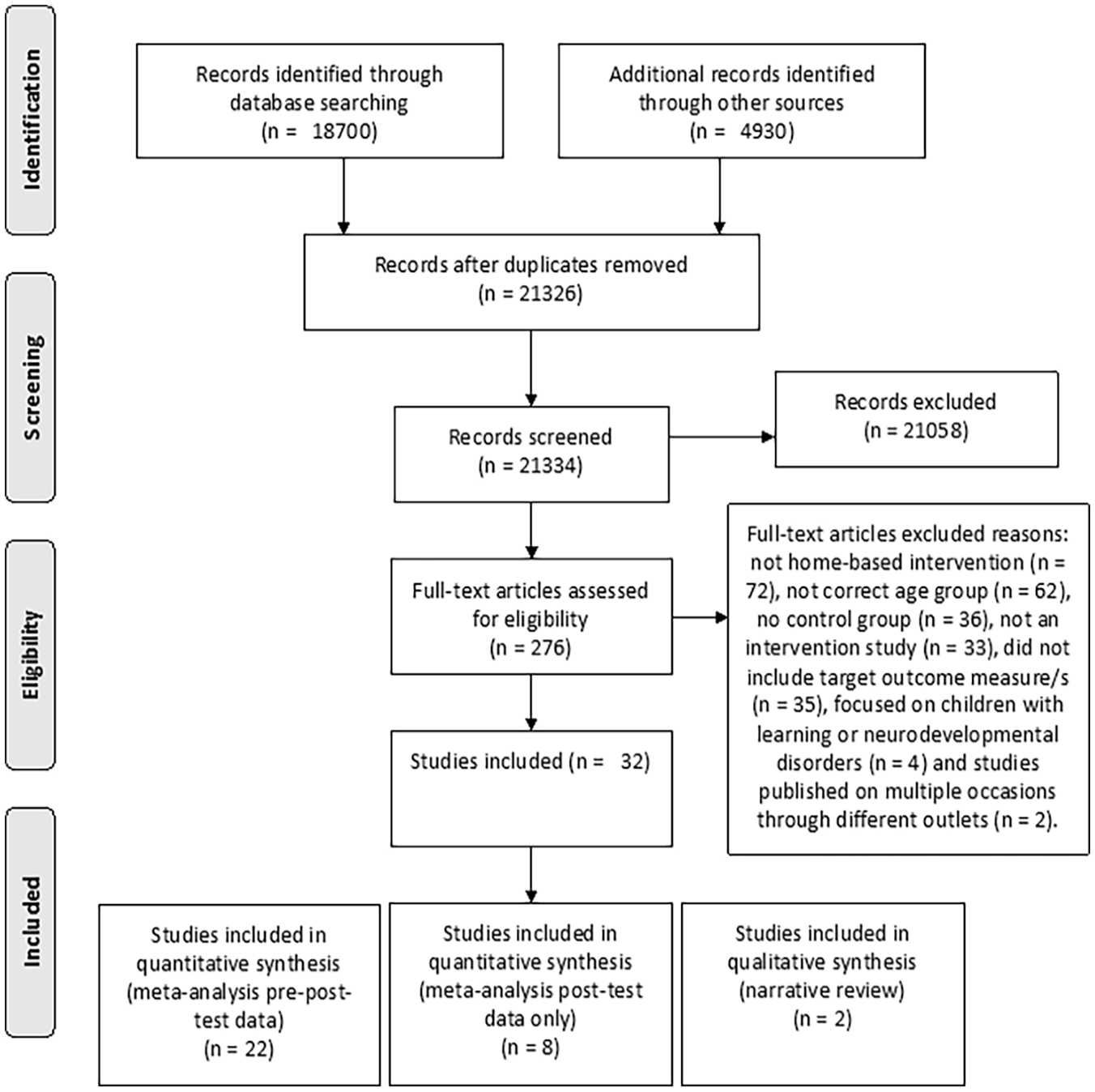
PRISMA Flow Diagram Article Selection.
During the first review of articles, 2,296 of the articles were rejected as duplicates. An additional 20,427 were excluded based on title screening. Approximately 80% of the articles were title screened by the first author, and 20% were screened by the last author. After title screening, 10% of first author’s articles were screened by the last author and vice versa. An interrater reliability of 99% was obtained at this stage. Two articles had no abstract, so they bypassed abstract screening and were included at full text review. Six hundred thirty-one articles were excluded based on reviewing abstracts. We could not gain full text access to 15 articles; four of these articles were excluded at the abstract screening stage. Again, 80% of the articles were abstract screened by the first author, and 20% were screened by the last author. After abstract screening, 10% of first author’s articles were screened by the last author and vice versa, ending with interrater reliability of 99%.
Two hundred seventy-six articles were full text screened. At this stage, we did not have access to the full text for 11 studies. Therefore, the first and/or corresponding author of these articles were contacted a total of three times over a period of 6 to 8 weeks. If they did not respond or were unable to give access to the article, the article was excluded. Three articles were excluded at this stage because the authors of these articles did not respond. We gained access to the full texts of eight articles by contacting the first or corresponding author. One article that made it through to full text review was a conference abstract (Klein et al., 2011), and although the study was relevant, the conference abstract did not provide enough information to be included in the review. After contacting the authors of the conference abstract, they provided a published article. Subsequent reasons for exclusion at the full text screening stage were as follows; not home-based intervention (n = 72), not correct age group (n = 62), no control group (n = 36), not an intervention study (n = 33), did not include target outcome measure(s) (n= 35), focused on children with learning or neurodevelopmental disorders (n = 4), and studies published on multiple occasions through different outlets (n = 2). 2
The outcome of the screening process resulted in 32 articles meeting inclusion criteria. Thirty studies included sufficient data for quantitative synthesis or inclusion in meta-analyses. Two studies did not contain sufficient quantitative data and instead were summarized in a narrative review. A reference list of all included studies is contained in Supplementary Materials A.
Coding Procedure
For the present meta-analysis, the studies that met the inclusion criteria were coded, and data were extracted from each article (e.g., outcome measures, sample size, country of data collection) and recorded. The information that was extracted was coded under the following characteristics: study information (e.g., year of publication, country of data collection), methods (e.g., data points, total sample size), participants (e.g., age, gender), interventions (e.g., type of intervention), outcome measures (e.g., standardized tests used), and risk of bias (e.g., blinding of participants; see Supplementary Materials B for table showing coding procedure for studies included in this meta-analysis).
Coding Interrater Agreement
Full texts of the final set of eligible studies were allocated and screened again by two members of the review team (e.g., second and third authors), and their inclusion was confirmed. The 30 articles that were to be used in the meta-analyses were divided for main data extraction among the three teams in Mexico, Cuba, and the UK; each team involved two data extractors. The data/information that was extracted were then checked by the first author, who undertook the coding of all identified studies. Disagreements between the review team (e.g., the first and last authors) were resolved by a different review team member (e.g., the second author), and consensus was achieved.
Data Analysis Plan
Effect sizes are calculated to evaluate the impact of interventions, which allows for a common scale to synthesize and compare studies effects in terms of magnitude and direction (Borenstein et al., 2009). The effect sizes were calculated using an online calculator (Lenhard & Lenhard, 2016). Most studies included in this meta-analysis reported statistics that allowed the calculation of effect sizes (i.e., Cohen’s d). However, if the authors needed further information (e.g., the mean and standard deviation of the intervention and control groups separately), the corresponding author and/or the first author of that study were contacted. Two articles (i.e., Bierman et al., 2017; Nievar et al., 2018) had to be excluded from the meta-analyses because there was not enough information to calculate the effect size of the intervention. The authors had been contacted three times with no response/follow-up. A narrative summary of these two studies has been provided at the end of the results section.
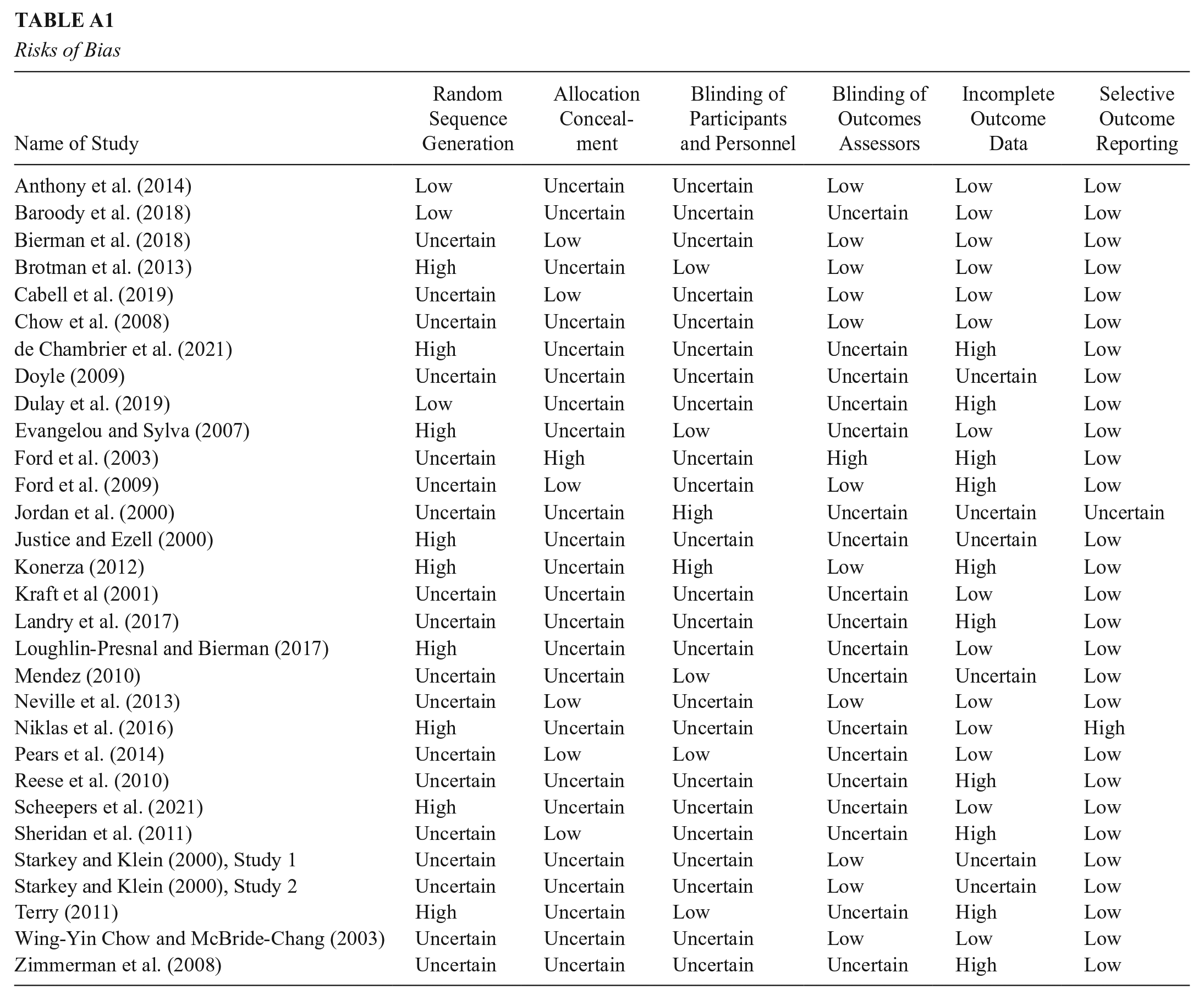
Six risks of bias criteria (i.e., random sequence generation, allocation concealment, blinding of participants and personnel, blinding of outcome assessors, incomplete outcome data, and selective outcome reporting) were used to quantify potential risk of bias in study methodology or reporting (see Appendix A, Table A1 for breakdown of risk of bias; see Table 1 for summary of overall risk of bias per study). Two authors (i.e., the first and last authors) completed the risk of bias on the 30 studies, with an interrater reliability of 95.6%.
Study and Intervention Information
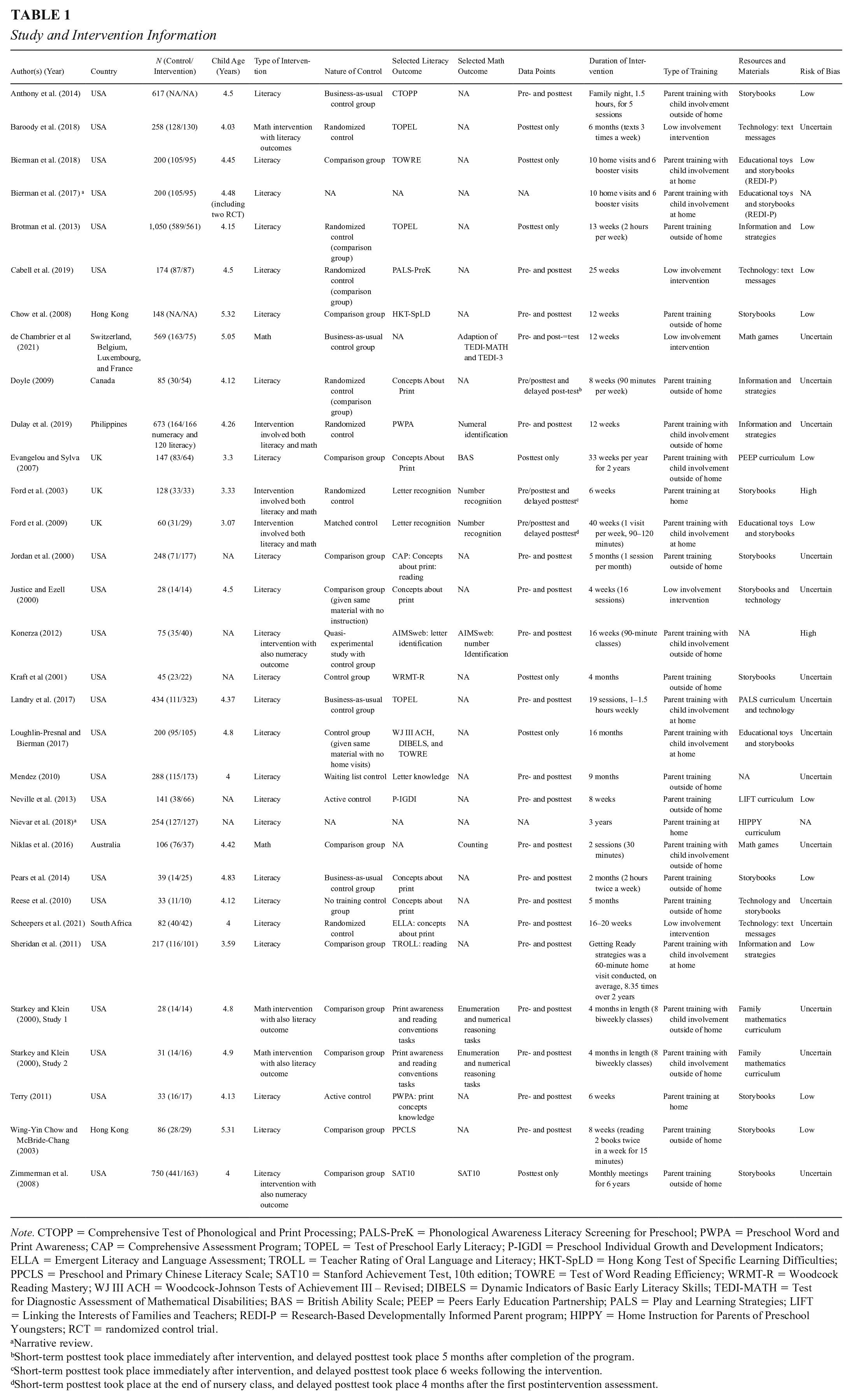
Note. CTOPP = Comprehensive Test of Phonological and Print Processing; PALS-PreK = Phonological Awareness Literacy Screening for Preschool; PWPA = Preschool Word and Print Awareness; CAP = Comprehensive Assessment Program; TOPEL = Test of Preschool Early Literacy; P-IGDI = Preschool Individual Growth and Development Indicators; ELLA = Emergent Literacy and Language Assessment; TROLL = Teacher Rating of Oral Language and Literacy; HKT-SpLD = Hong Kong Test of Specific Learning Difficulties; PPCLS = Preschool and Primary Chinese Literacy Scale; SAT10 = Stanford Achievement Test, 10th edition; TOWRE = Test of Word Reading Efficiency; WRMT-R = Woodcock Reading Mastery; WJ III ACH = Woodcock-Johnson Tests of Achievement III – Revised; DIBELS = Dynamic Indicators of Basic Early Literacy Skills; TEDI-MATH = Test for Diagnostic Assessment of Mathematical Disabilities; BAS = British Ability Scale; PEEP = Peers Early Education Partnership; PALS = Play and Learning Strategies; LIFT = Linking the Interests of Families and Teachers; REDI-P = Research-Based Developmentally Informed Parent program; HIPPY = Home Instruction for Parents of Preschool Youngsters; RCT = randomized control trial.
Narrative review.
Short-term posttest took place immediately after intervention, and delayed posttest took place 5 months after completion of the program.
Short-term posttest took place immediately after intervention, and delayed posttest took place 6 weeks following the intervention.
Short-term posttest took place at the end of nursery class, and delayed posttest took place 4 months after the first postintervention assessment.
The data used in the meta-analyses (i.e., both literacy and mathematics interventions) and the R script used to run both meta-analyses (for studies that had mathematical or literacy outcomes) and publication bias are available on the first author’s OSF profile (i.e., doi:10.17605/OSF.IO/NM74Z). The coding procedure for the studies is available in Supplementary Materials B.
Results
Descriptive Results
A summary of the studies and intervention details is reported in Table 1. For a comprehensive list of literacy and mathematical outcomes (and their details) used within the included studies, see Supplementary Material C, Tables 1 (literacy outcomes) and 2 (mathematical outcomes).
Study Information
All eligible studies were published between 2000 and 2020, with 27% being published between 2015 and 2020. The majority of the studies were conducted in the United States (n = 20; 67%). Additionally, studies were conducted in the UK (n = 3; 10%) and China (n = 2; 7%), and four separate studies were conducted in Canada, South Africa, Philippines, and Australia. A final study was cross-cultural involving data collection in Switzerland, Belgium, Luxembourg, and France. See Table 1 for further details.
Methodological and Participant Characteristics
Most studies included pre- and posttest measures (n = 20; 67%), with some studies either only including posttest measures or having different measures used at pre- and posttest (n = 7; 23%). In the case of different measures being used at pre- and posttest, only the posttest measure was used. Two studies involved pre/posttest and delayed posttest (i.e., Doyle, 2009; Ford et al., 2003), and one study involved a posttest and delayed posttest (i.e., Ford et al., 2009). In these studies, the duration between posttests and delayed posttests were 5 months, 6 weeks, and 4 months, respectively. Overall, one third of participants in studies included in the review were recruited through HeadStart programs. See Table 1 for further details.
Research Question 1: Are There More Robustly Assessed Literacy Interventions Than Mathematical Interventions?
The types of interventions conducted were literacy-focused (n = 22; 73%), two of which also collected mathematics outcomes; mathematics-focused (n = 5; 17%), two of which also collected literacy outcomes and one of which collected only literacy outcomes; and three interventions that involved both literacy and mathematics outcomes (n = 3; 10%).
In relation to potential for bias in these studies, 16 (53%) studies did not provide enough information to determine an overall risk of bias (i.e., the six risks of bias variables mentioned earlier, e.g., random sequence generation, allocation concealment; see Table 1). Only two studies (i.e., Ford et al., 2003; Konerza, 2012) were given an overall rating of high risk of bias. There were 12 (40%) studies classified as low risk of bias. Of these studies classified as having low risk of bias, 11 were literacy-only interventions, and one intervention involved both literacy and mathematics outcomes. Therefore, there are not only more literacy interventions meeting our inclusion criteria for the systematic review compared to mathematics interventions, but after closer scrutiny, more literacy interventions are classified as having low risk of bias compared to mathematics interventions.
Research Question 2: What Types of Home-Based Literacy and Mathematical Interventions or Programs Are Most Effective for Improvements in Early Educational Outcomes for Children Between the Ages of 3 and 5?
The interventions varied in the way in which training was delivered. Specifically, most studies involved parent training outside of the home (n = 18; 60%) and at home (n = 7; 23.3%). There were five fully remote interventions (16.7%) that did not involve parent training per se but, rather, included resources (e.g., storybooks) or reminders (e.g., text messages) being sent to parents on a weekly basis but required little parental input. Of the interventions that included parent training, 48% of the studies also involved direct training with the target children (n = 12). The types of interventions included within the review are summarized in Table 2.
Breakdown of the Types of Interventions
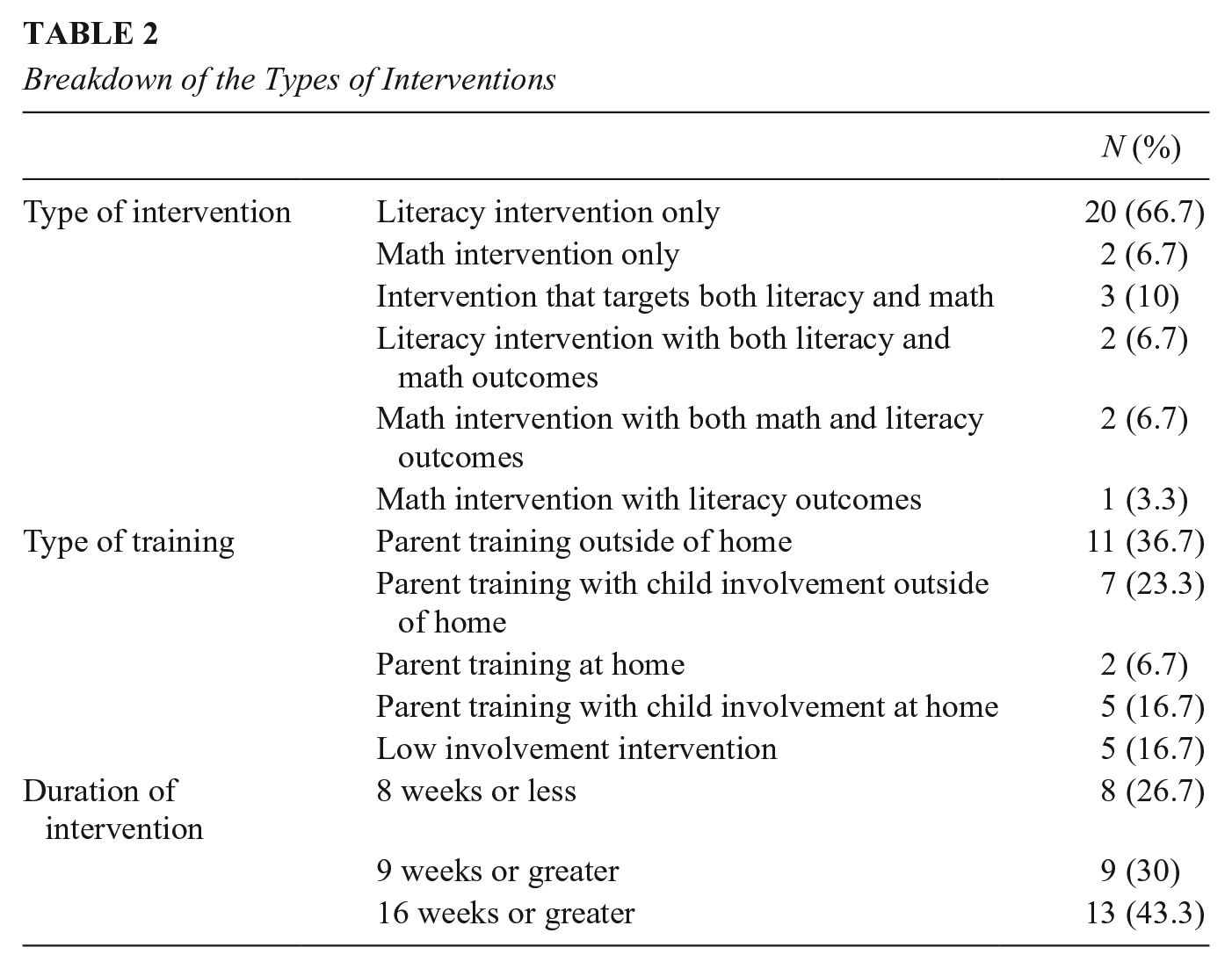
The average number of sessions per included study was 13.52, with studies with mathematics outcomes having substantially more sessions than those with literacy outcomes (20.43 vs. 14.12). Overall, the average intensity of the interventions was 2.23 sessions per week, with studies with literacy and mathematics outcomes being of similar intensity (2.27 vs. 2.31 sessions per week, respectively). The average time spent engaging with the training for all included studies was 78 minutes, with longer time spent engaging in interventions with literacy outcomes (81.2 minutes) compared to mathematics outcomes (65.75 minutes).
Meta-Analysis Results
Weighted Random Mean Effect Size: Interventions With Literacy Outcomes
The overall weighted random mean effect size was small to moderate, Cohen’s d = 0.35 (SE = 0.21; range = −0.06 to 0.75), for interventions with literacy outcomes (n = 28; Cohen, 1988). The test of heterogeneity was nonsignificant, which suggests that the included studies share a common mean effect size, Q(27) = 25.93, p = .52, and 31.8% of the variability in effect sizes was due to heterogeneity rather than sampling error. A Baujat plot (Baujat et al., 2002) was created and was used as a diagnostic plot to detect studies that substantially contributed to the heterogeneity of the meta-analysis. Studies that fall to the top right quadrant of the Baujat plot contribute most to both summary effect size and standard error (Appendix B, Figure B1). To understand which studies may exert a high influence over the meta-analysis results, influence analyses were conducted (Appendix B, Figure B2), which established that five studies had a high influence over the results (i.e., Justice & Ezell, 2000; Neville et al., 2013; Sheridan et al., 2011; Starkey & Klein, 2000, Studies 1 and 2).
The leave-one-out method was used to understand the influence of these identified studies. In leave-one-out method analyses, the study with the highest influence is left out and the results of the meta-analysis are recalculated. This allows for a better understanding of what influence individual studies may have in distorting the pooled effect size (Viechtbauer & Cheung, 2010). Justice and Ezell (2000) had a larger residual than other studies and was hence identified as an outlier and selected as the study to be removed. After removal of this study, the overall weighted random mean effect size was small, Cohen’s d = 0.10 (SE = 0.14; range = −0.17 to 0.38; see Figure 2), for the 27 interventions with literacy outcomes. The test of heterogeneity was also nonsignificant, which suggests that the final set of included studies share a common mean effect size, Q(26) = 2.88, p = 1.00, and 0.00% of the variability in effect sizes was due to heterogeneity rather than sampling error (see Baujat plot, Appendix B, Figure B3; influence analysis, Appendix B, Figure B4).
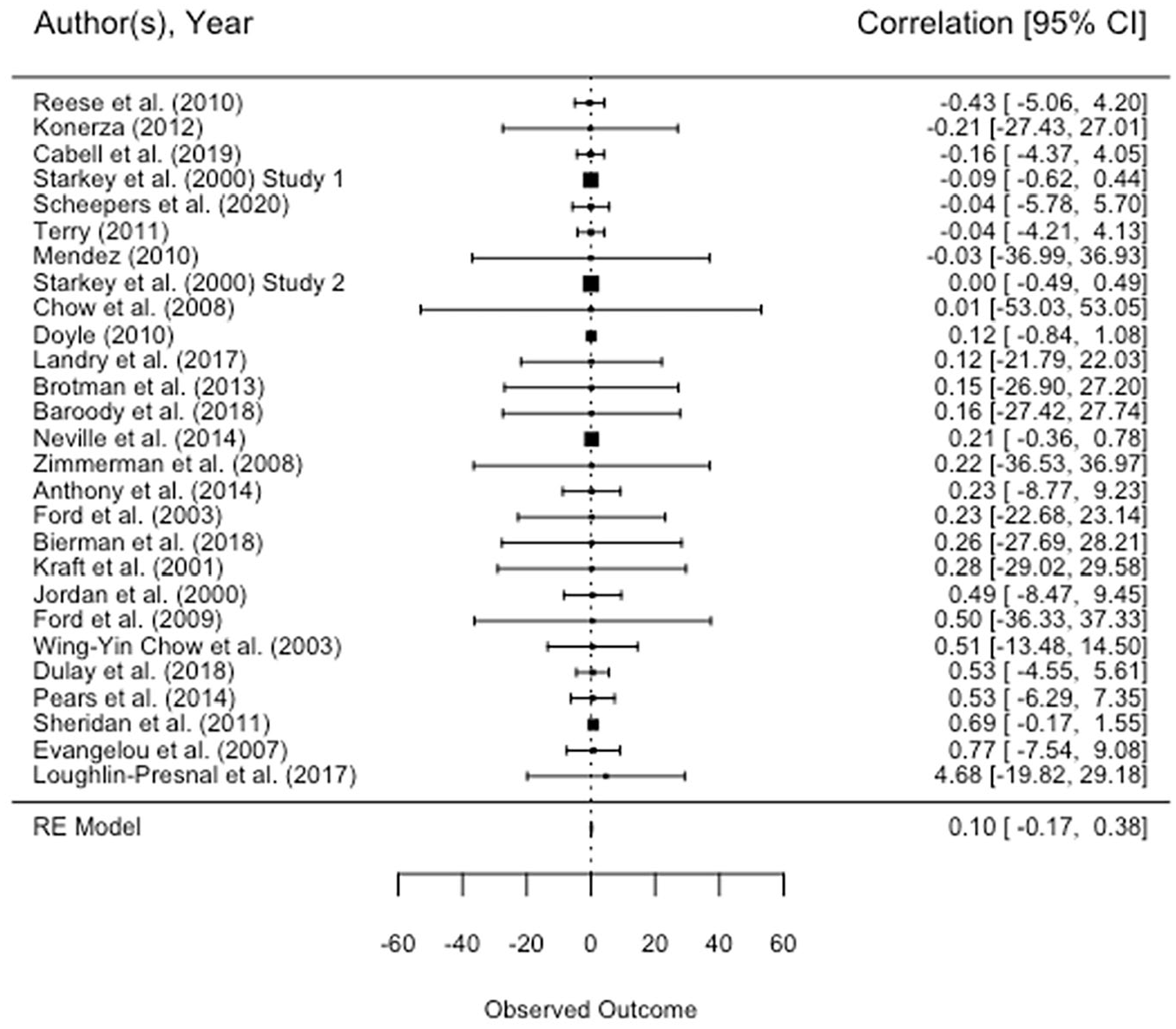
Forest Plot of Interventions With Literacy Outcomes (n = 27).
Publication Bias
There was evidence of publication bias when Justice and Ezell (2000) was included (n = 28) because the rank correlation test (p = .04) was statistically significant. However, once Justice and Ezell was removed (n = 27), Egger’s regression test (p = .80) was not statistically significant, indicating no evidence of publication bias. The rank correlation test (p = .90) was also not statistically significant, corroborating that there was no evidence of publication bias across the included studies (see funnel plot, Appendix B, Figure B5).
Weighted Random Mean Effect Size: Interventions With Mathematics Outcomes
The overall weighted random mean effect size was moderate, Cohen’s d = 0.65 (SE = 0.14; range = 0.37 to 0.92), for interventions with mathematics outcomes (n = 10). The test of heterogeneity was nonsignificant, which suggests that the included studies share a common mean effect size, Q(9) = 0.37, p = 1.00, and 0.00% of the variability in effect sizes was due to heterogeneity rather than sampling error.
A Baujat plot was created, and an influence analysis was run (see Appendix C, Figures C1–C5 for Baujat plots, influence analyses, and funnel plot). Two studies had a high influence over the results (i.e., Starkey & Klein, 2000, Studies 1 and 2). After removing the two identified studies, the overall weighted random mean effect size was small, Cohen’s d = 0.18 (SE = 0.92; range = −1.62 to 1.99; see Figure 3). The test of heterogeneity was nonsignificant, which suggests that the final set of included studies share a common mean effect size, Q(7) = 0.03, p = 1.00, and 0.00% of the variability in effect sizes was due to heterogeneity rather than sampling error.
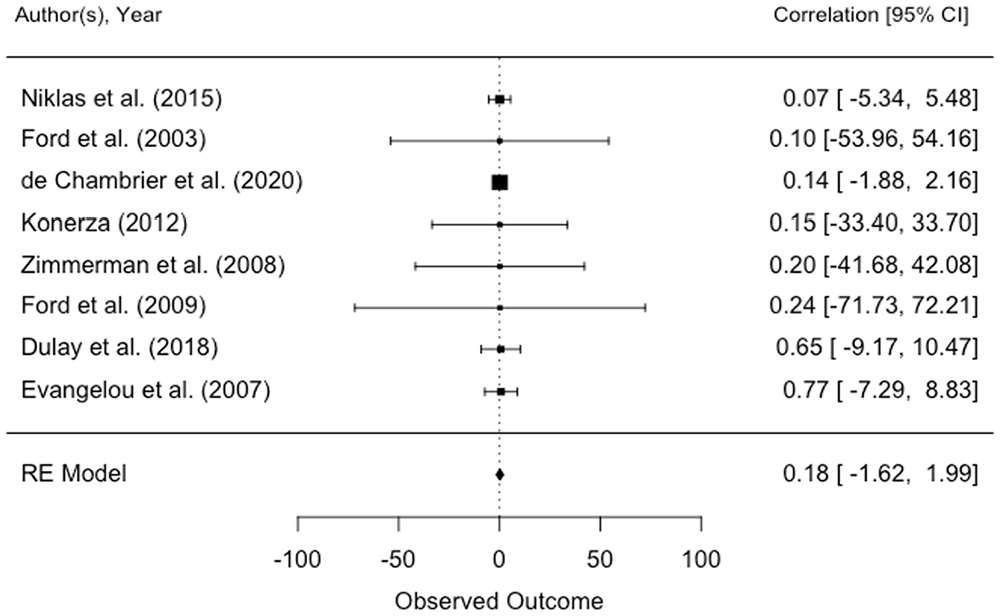
Forest Plot of Interventions With Math Outcomes (n = 8).
Publication Bias
Before the removal of the influential studies (i.e., Starkey & Klein, 2000, Studies 1 and 2), Egger’s regression test (p = .82) and rank correlation test (p = .60) were not statistically significant. After the removal of the influential studies, Egger’s regression test (p = .94) and the rank correlation test were not significant (p = .55), corroborating that there was no evidence of publication bias.
Summary of Meta-Analyses Results
In summary, the overall weighted random mean effect size was 0.10 (SE = 0.14; range = −0.17 to 0.38) for the interventions with literacy outcomes, and the overall weighted random mean effect size was 0.18 (SE = 0.92; range = −1.62 to 1.99) for the interventions with mathematics outcomes. The overall effect sizes for both types of interventions were defined as small (Cohen, 1988). Therefore, the types of literacy and mathematics interventions that are most effective for improving early educational outcomes for children are unclear.
Research Question 3: What Are the Demographics of the Participants That Take Part in These Interventions, and Are There Individual Differences That Impact the Efficacy of these Interventions?
Across all studies (n = 30), the average sample size was 232 participants (SD = 250.9; range = 28–1,050). The children ranged in age from 3.07 years to 5.32 years (overall mean age = 4.29 years; mean age in interventions with literacy outcomes = 4.26 years; mean age in interventions with math outcomes = 4.23 years; 49.2% male).
The age of the child participants did not significantly moderate the observed impact of the interventions on literacy outcomes (p = .16). Gender (i.e., the total number of males and females in the control and intervention groups used for the effect size) also did not significantly moderate the observed relationship (p = .77). In addition, the age and gender of the children did not significantly moderate the observed impact of the interventions on mathematics outcomes (p = 0.8, p = 0.98, respectively).
Research Question 4: What Are the Resource Requirements (i.e., Materials) of These Interventions?
The resources and materials used within these studies involved storybooks (n = 9), educational toys and storybooks (n = 3), math games (n = 2), parent information and strategies (n = 4), technology used for text messages (n = 3), and technology used with curriculum or storybooks (n = 2). One intervention involved a program (i.e., Research-based Developmentally Informed Parent program [REDI-P]), and five interventions involved the following curriculum: Peers Early Education Partnership (PEEP; n = 1), Play and Learning Strategies (PALS; n = 1), Linking the Interests of Families and Teachers (LIFT; n = 1), and family mathematics curriculums (n = 2; see Table 1 for more detail). PEEP curriculum involves circle time (e.g., rhymes), talking time (e.g., parents share experiences), story time, book sharing, home activities (e.g., games and activities), and borrowing time (i.e., play packs). The PALS curriculum is guided by a manual and videotapes that aid parents to support their children during play and learning activities (e.g., shared book reading). The LIFT curriculum involves small group instructions, support calls, instruction points, and suggestions on home-practice activities. Family mathematics curriculum aids parents’ understanding on the level of support to provide to their children and a set of math activities.
Narrative Review
Two articles did not report sufficient information to be included in the meta-analyses (i.e., Bierman et al., 2017; Nievar et al., 2018); both studies included literacy and mathematics outcomes. Full details of these interventions are summarized in Table 1.
Bierman et al. (2017) investigated the influence of a home-visiting program (REDI-Parent) over and above an existing Research-Based Developmentally Informed Classroom (REDI-C) program intervention on children’s outcomes 3 years later (i.e., the end of second grade). The REDI-P program offered parents activities that taught letters and letter-sound recognition. Parents received 12 of the 16 planned home visits on average (SD = 5.48, range = 0 – 16). For the REDI-P program, 200 families were assessed and received either learning materials via home visits (REDI-P intervention; N = 105) or an alternative set of materials via mail (control group; N = 95). The three academic outcomes were emergent literacy skills, sight words, and phonemic decoding scales, which were direct assessments with children. In addition, teachers rated academic performance (reading and math skills). The REDI-P plus REDI-C group showed significantly higher second grade scores on three of the five academic outcomes (i.e., sight words, teacher-rated reading, and math skills) compared to those who received REDI-C alone.
In addition, Nievar et al. (2018) focused on the impact of the Home Instruction for Parents of Preschool Youngsters (HIPPY) program, a 3-year, home-based, early intervention program. Children who participated in the HIPPY home visits program (n = 127) were compared to children who participated in prekindergarten but did not receive home visits (254 families in both groups). Due to the nature of the study, the exact age of the children during the intervention is unknown; however, HIPPY participation occurs at enrolling before entering kindergarten, hence the children would be approximately 3 to 5 years old, the age group for inclusion in the current review. Because this study was not a randomized trial, results from the study are limited. Results indicated that children in the prekindergarten-only comparison group had lower reading and mathematics achievement scores at third, fourth, and fifth grades than those children who received HIPPY and prekindergarten. Growth curve modeling indicated that the group that experienced home visiting displayed higher academic achievement than those who did not through to fifth grade.
Overall, these two home-visiting-based interventions indicate long-term benefits for children’s literacy and mathematics outcomes. However, due to the insufficient reporting of outcome data, the extent of the benefits cannot be quantified.
Discussion
Overall, the results of the current systematic review and meta-analyses show that home-based interventions aiming to improve literacy and mathematics outcomes for preschool-age children had a minimal effect on literacy and mathematical outcomes. The residual heterogeneity showed no variability in the association between the interventions and children’s literacy and mathematics outcomes, indicating that all interventions impacted on children’s outcomes to similar effect. However, a wide range of types of strategies and methodologies were found to be used in interventions, from training inside or outside the home to using technology or other resources. However, the meta-analyses indicated that these interventions had no differential impact on outcomes. Due to the preregistration of these meta-analyses, the moderators (i.e., age and gender) were investigated even though there was a lack of variability between studies. As expected, the age and gender of the children did not significantly moderate the observed impact of the interventions with literacy or mathematics outcomes.
This systematic review established that there are substantially more home-based interventions focused on improving literacy (N = 28) than mathematical outcomes (N = 10). This is consistent with most narrative reviews of the literature indicating that research has predominantly focused on the HLE (i.e., parents helping their children to read words and the frequency of shared reading; Skwarchuk et al., 2014) in comparison to the HME (i.e., parents helping their children to count; Kirby & Hogan, 2008; LeFevre et al., 2009; Sénéchal & LeFevre, 2002). Children’s activities in formal educational environments are dominated by literacy-based activities. For example, Paro et al. (2009) observed that 28% of preschoolers’ time was spent on language and literacy instructions. Meanwhile, less than 10% of instructional time was spent on other areas of the curriculum (e.g., mathematics). The current review indicates that this imbalance of focus is also reflected in the development and assessment of interventions focusing on informal contexts (i.e., the home). Given that evidence suggests that school-entry mathematical skills are more important predictors of later mathematical, reading, and science achievement than school-entry reading skills (Claessens & Engel, 2013), the current findings emphasize the need for an increased focus on the development and assessment of efficacy of home-based interventions for preschoolers’ mathematics skills.
In the context of the growing body of literature on the importance of the home learning environment and parent-child interactions for early learning (Hornburg et al., 2021; Nelson et al., 2022), the overall findings of the meta-analyses may appear surprising. Previous correlational and longitudinal studies have emphasized the relationship between resource-rich home environments and supportive parental scaffolding for early and later academic achievement (Lehrl, Evangelou, & Simmons, 2021). Our meta-analyses have established a minimal but consistent positive effect of parent-focused interventions on both early mathematics and literacy skills. A recent meta-analysis of large-scale efficacy and effectiveness randomized control trials in education (including children from preschool through to the end of secondary school) indicated negligible gains in attainment (SD = .06; Lortie-Forgues & Inglis, 2019). Thus, in this context, the minimal but stable overall effect size for home-based interventions may be encouraging. The heterogeneous impact of the interventions included in the current review was striking, suggesting that the specific interventions included in the studies, although broad in their approaches, had similar effects. These data add to the building correlational literature on the relationship between the home environment and educational outcomes, indicating that this relationship is, in fact, causal. However, we must recognize that these meta-analyses suggest that the impact of home-based interventions are not as substantial as previously thought. Nevertheless, there are several potential explanations as to why the impact of these interventions may have been so low.
Overall, the interventions included in this synthesis were relatively light touch in their approach, exemplified by a low average time spent engaging in parent training (i.e., 78 minutes). Furthermore, the engagement requirement of the parent in some studies was minimal (e.g., reading a short text message). Therefore, the expectation for parents to implement and transfer relevant information from training (generally delivered outside of the home) to their interactions with their child at home may have been overly ambitious. A recent broader meta-analysis, involving home- and school-based mathematical interventions for 3- to 8-year-olds, indicated that the level of parental training is the only significant moderator of the impact of interventions on child outcomes (Nelson et al., 2022). Therefore, the low intensity of the interventions of studies included in the current review may explain the overall observed minimal effect. Several interventions provided parents with resources with minimal support or instruction. This, too, may have led to issues with implementation of desired interactions between parents and their children.
In addition, the content focus of the interventions may have also led to the observed minimal effect on outcomes. The outcome measures were diverse and required different skill sets to be developed to ensure success. The development of literacy and numeracy skills are reliant on bolstering foundational skills (e.g., phonetic awareness and basic quantity processing, respectively). However, especially in relation to early numeracy development, there is a lack of clarity on the specific skills that are important for future development and the order in which they should be learnt (e.g., Cahoon et al., 2021). Thus, it is not perhaps unsurprising that interventions that are based on somewhat unclear theoretical grounds may be minimally successful. Literacy skill development is much better understood, with a more developed evidence base indicating that shared book reading is an important activity for children’s literacy development (Sim & Berthelson, 2014). The current review notes a dominance of literacy interventions using storybooks as an intervention resource. However, it is important to note that the overall effect on literacy skills was also minimal. Some interventions focused on literacy skills but measured both literacy and numeracy outcomes. In this context, the weak impact on numeracy skills, especially in this age group, may be expected given that mathematical-specific interventions have been previously observed to be most effective for improving early numeracy outcomes (Raghubar & Barnes, 2017). Some interventions (e.g., Ford et al., 2003) were very broad, including a wide range of training activities rather than focusing on specific skills. Therefore, these types of interventions may have required great intensity to gain improvements in quite targeted outcome measures.
Finally, it is important to note that many of the included studies in the review did not include assessment of the fidelity of the intervention application (N = 20; 62.5%). Also, many studies did not assess if there were any changes in parent behavior (N = 19; 59.4%) in response to the intervention. Therefore, in this context the potential reasons that only minimal impact of interventions were observed are twofold: (a) that well-developed interventions training procedures were not applied in a consistent and rigorous way and/or (b) that training elements of interventions did not lead to changes in parental behavior. Previous literature has indicated the importance of considering the differential ways in which parents implement activities that they have been trained to engage in when independently interacting with their children at home (see Linder et al., 2013). Because data on these aspects of the interventions were not captured in many cases, the reasons for minimal impact remain unclear. Importantly, 53% of included studies did not contain sufficient information to inform a decision on risk of bias. Therefore, there is potential that implementation of these interventions may have affected their impact. However, this cannot be ascertained from the published materials. It should also be noted that three articles were excluded at the full text screening stage because the authors of these three articles did not respond to our request. Although this was out of our control, we acknowledge that these three articles could have met our screening criteria but that we could not make that judgment.
Despite these potential explanations (as to why the impact of the interventions was minimal), it is important to note that perhaps home-based interventions may simply not be effective. However, the assessment of well-designed home-based interventions (i.e., that complete theory of change models, logic models, feasibility studies, pilot evaluations, quality assurance systems, etc.) are necessary to understand if home-based interventions are effective (Early Intervention Foundation; Asmussen et al., 2019).
Implications for Future Research
Overall, the current review identified considerably more home-based interventions focused on improving literacy rather than numeracy skills. Given the known importance of preschool numeracy skills for future achievement and economic success (Hoff, 2003; World Bank, 2015), attention should be given to theoretically grounded, rigorously assessed numeracy interventions for this age group. This should be a priority for education and psychological researchers both in terms of understanding the causal influence of the home environment on children’s numeracy development and providing practical evidence-based advice for parents to improve children’s outcomes.
Due to the homogeneous impact of the interventions included in this review on child outcomes, future research should not only examine the type of intervention but also look more closely at the specific skills that are being delivered through training (e.g., verbal counting, letter recognition) or whether the information provided was more conceptual or procedural in nature (Methe et al., 2011). This may provide further insight into the specific components that are important to support children’s learning. In addition, future interventions should be manipulated in length and intensity to understand the necessary level of input to affect change in parent behavior. This requires researchers to measure the fidelity of the delivery of any training and measurement of parent behavior. However, no studies used measures of treatment fidelity to evaluate the change in parenting behavior; therefore, we cannot comment on whether parents actually engaged with the interventions as intended.
Many studies included in the current review provided training outside of the home with the expectation that parents would transfer these skills to the home environment. Few interventions provided ongoing support to parents (e.g., check-in phone calls) to address queries or difficulties that parents may have during the intervention process. Thus, training for transfer of skills—such as worked examples of how to use specific activities within individual home contexts—and top-up support may lead to more favorable outcomes. This should be explored systematically in future research.
The inconsistences of the duration of follow-up across studies (i.e., Doyle, 2009; Ford et al., 2003, 2009; see Table 1 note) meant that the long-term effectiveness and efficacy of the interventions could not be explored. Thus, there is no way to conclude the long-term effectiveness and efficacy of home-based interventions due to lack of follow-up data, a significant missed opportunity. Long-term follow-ups are essential to ascertain the longevity of impact of (often expensive) interventions; these data are essential to inform public policy and evidence-based investment. In addition, this finding highlights the difficulty in undertaking intervention studies, such as the problematic nature of long-term follow-up because of attrition and lack of long-term funding to collect follow-up data. Assessments of long-term effects of preschool interventions show a declining impact of interventions at follow-up, even for interventions that show success initially (Bailey et al., 2017; Durkin et al., 2022; Puma et al., 2010). Bailey et al. (2017) suggested that intervention evaluations should extend beyond the “fadeout window” of 12 months so that foundational skill-based mechanisms that help provide children with the necessary skills at key developmental time points can be rigorously tested in the long term. Intervention-induced impacts of foundational skill-based mechanisms may fade out because children may have coincidentally acquired these types of skills without intervention. Therefore, to truly investigate the building blocks for the development of numerical skills, long-term follow-up studies are required (Cahoon et al., 2021). Our study highlights the need for investment in generating these types of data.
The review team experienced difficulties in accessing the necessary data to screen identified articles, perform meta-analyses, and assess risk of bias. Researchers should be encouraged to follow reporting standards for intervention research (Simms et al., 2019) to aid evidence synthesis and assess rigor of research. Similar standards have been commonly adopted in medical sciences, for example. In addition, preliminary research, such as the use of participatory research groups and feasibility studies, may also be necessary to develop interventions and increase their potential to generate positive benefits for child outcomes (Asmussen et al., 2019).
Conclusion
These meta-analyses demonstrate a minimal but consistent positive effect of parent-focused interventions on both early mathematics and literacy skills, and this may be encouraging because this is larger than high-powered school-based interventions (SD = .06; Lortie-Forgues & Inglis, 2019). Hence, perhaps interventions should target informal learning environments rather than school-based learning environments. Given that the findings of the current review revealed a minimal effect of home-based interventions on both literacy and mathematical outcomes, it is important to conduct more in-depth research into the components of theoretically driven interventions (e.g., focus of the intervention, parent training approaches) that may lead to the development of these skills. There is an imbalance in intervention types (i.e., literacy or mathematics) focusing on informal contexts. Given that school-entry mathematical skills are so important, attention should be given to theoretically grounded, rigorously assessed mathematical interventions. Implementation of science principles should be applied to these types of studies to pinpoint the source of the weak effects identified in the current meta-analyses. This will enable practitioners and researchers to determine how best to provide and target effective interventions within the home.
Supplemental Material
sj-docx-1-rer-10.3102_00346543231212491 – Supplemental material for Meta-Analyses and Narrative Review of Home-Based Interventions to Improve Literacy and Mathematics Outcomes for Children Between the Ages of 3 and 5 Years Old
Supplemental material, sj-docx-1-rer-10.3102_00346543231212491 for Meta-Analyses and Narrative Review of Home-Based Interventions to Improve Literacy and Mathematics Outcomes for Children Between the Ages of 3 and 5 Years Old by Abbie Cahoon, Carolina Jiménez Lira, Nancy Estévez Pérez, Elia Veronica Benavides Pando, Yanet Campver García, Daniela Susana Paz García and Victoria Simms in Review of Educational Research
Footnotes
Appendix A: Risks of Bias
Risks of Bias
| Name of Study | Random Sequence Generation | Allocation Concealment | Blinding of Participants and Personnel | Blinding of Outcomes Assessors | Incomplete Outcome Data | Selective Outcome Reporting |
|---|---|---|---|---|---|---|
| Anthony et al. (2014) | Low | Uncertain | Uncertain | Low | Low | Low |
| Baroody et al. (2018) | Low | Uncertain | Uncertain | Uncertain | Low | Low |
| Bierman et al. (2018) | Uncertain | Low | Uncertain | Low | Low | Low |
| Brotman et al. (2013) | High | Uncertain | Low | Low | Low | Low |
| Cabell et al. (2019) | Uncertain | Low | Uncertain | Low | Low | Low |
| Chow et al. (2008) | Uncertain | Uncertain | Uncertain | Low | Low | Low |
| de Chambrier et al. (2021) | High | Uncertain | Uncertain | Uncertain | High | Low |
| Doyle (2009) | Uncertain | Uncertain | Uncertain | Uncertain | Uncertain | Low |
| Dulay et al. (2019) | Low | Uncertain | Uncertain | Uncertain | High | Low |
| Evangelou and Sylva (2007) | High | Uncertain | Low | Uncertain | Low | Low |
| Ford et al. (2003) | Uncertain | High | Uncertain | High | High | Low |
| Ford et al. (2009) | Uncertain | Low | Uncertain | Low | High | Low |
| Jordan et al. (2000) | Uncertain | Uncertain | High | Uncertain | Uncertain | Uncertain |
| Justice and Ezell (2000) | High | Uncertain | Uncertain | Uncertain | Uncertain | Low |
| Konerza (2012) | High | Uncertain | High | Low | High | Low |
| Kraft et al (2001) | Uncertain | Uncertain | Uncertain | Uncertain | Low | Low |
| Landry et al. (2017) | Uncertain | Uncertain | Uncertain | Uncertain | High | Low |
| Loughlin-Presnal and Bierman (2017) | High | Uncertain | Uncertain | Uncertain | Low | Low |
| Mendez (2010) | Uncertain | Uncertain | Low | Uncertain | Uncertain | Low |
| Neville et al. (2013) | Uncertain | Low | Uncertain | Low | Low | Low |
| Niklas et al. (2016) | High | Uncertain | Uncertain | Uncertain | Low | High |
| Pears et al. (2014) | Uncertain | Low | Low | Uncertain | Low | Low |
| Reese et al. (2010) | Uncertain | Uncertain | Uncertain | Uncertain | High | Low |
| Scheepers et al. (2021) | High | Uncertain | Uncertain | Uncertain | Low | Low |
| Sheridan et al. (2011) | Uncertain | Low | Uncertain | Uncertain | High | Low |
| Starkey and Klein (2000), Study 1 | Uncertain | Uncertain | Uncertain | Low | Uncertain | Low |
| Starkey and Klein (2000), Study 2 | Uncertain | Uncertain | Uncertain | Low | Uncertain | Low |
| Terry (2011) | High | Uncertain | Low | Uncertain | High | Low |
| Wing-Yin Chow and McBride-Chang (2003) | Uncertain | Uncertain | Uncertain | Low | Low | Low |
| Zimmerman et al. (2008) | Uncertain | Uncertain | Uncertain | Uncertain | High | Low |
Appendix B: Interventions With literacy outcomes
Appendix C: Interventions With Mathematical Outcomes

Notes
Authors
ABBIE CAHOON is a developmental psychologist at Ulster University. Abbie’s PhD focused on the rigorous development of a home mathematical environment questionnaire and longitudinal tracking of preschool children in the UK.
CAROLINA JIMÉNEZ LIRA is a developmental psychologist at Universidad Autònoma de Chihuahua. Carolina has a specific interest in the impact of the home environment on learning. Carolina’s PhD focused on this topic with children living in Mexico.
NANCY ESTÉVEZ PÉREZ is an educational neuroscientist. Nancy is an expert in conducting longitudinal studies and the use of neuroscientific techniques with children and young people.
ELIA VERONICA BENAVIDES PANDO, Universidad Autònoma de Chihuahua, has substantial experience in human development research and education.
YANET CAMPVER GARCÍA, Cuban Neurosciences Centre, was a master’s student specializing in educational neuroscience.
DANIELA SUSANA PAZ GARCÍA is a doctoral student at Universidad Autònoma de Chihuahua specializing in developmental psychologist and early mathematical development.
VICTORIA SIMMS is a developmental psychologist at Ulster University. Victoria is an expert in the development of numerical cognition with specific interest in the impact of domain-specific and domain-general skills on typical and atypical development. Victoria has experience in conducting systematic reviews.
References
Supplementary Material
Please find the following supplemental material available below.
For Open Access articles published under a Creative Commons License, all supplemental material carries the same license as the article it is associated with.
For non-Open Access articles published, all supplemental material carries a non-exclusive license, and permission requests for re-use of supplemental material or any part of supplemental material shall be sent directly to the copyright owner as specified in the copyright notice associated with the article.
