




Abstract
Unequal access to advanced learning opportunities is among the most complex and controversial issues in American K–12 schools. Interventions that address policy, programming, and instruction can provide opportunities for students with advanced learning needs in school systems that prioritize minimum grade-level standards. Excellence gaps are differences in advanced performance among student subgroups that result from inequities in education and society. In this systematic review of the literature, the authors identified 80 empirical research studies on strategies for reducing excellence gaps published between 2010 and 2021 and identified themes related to the seven facets of the Excellence Gap Intervention Model (K–12 school accountability support, teacher professional learning, expanded advanced learning opportunities, universal screening with local norms, frontloading, flexible ability grouping, psychosocial interventions). This analysis revealed substantial evidence of intervention development over the past decade and suggests a revised approach to equitable, advanced education that begins with preparation (e.g., teacher professional learning, student frontloading) and is followed by placement, evaluation, and adjustment as students’ learning needs change.
When moving from the platform onto a train car, passengers in the London Underground have long been reminded to mind the gap, or pay attention to the open space between the waiting area and the car. Similarly, educators and researchers have been guided by policy makers and broader societal concerns about equity to identify student achievement gaps and develop empirically supported strategies for closing them. Just as passengers entering the subway can sustain serious injuries by failing to notice the gap, societies with education systems that fail to identify and address performance gaps among student subgroups may have students who fall short of their educational potential, leading to negative outcomes for students and their communities (Haycock, 2001; Ogbu, 2002; Peske & Haycock, 2006). Consequently, closing achievement gaps at basic levels of performance in core subjects, such as reading and math, has been a focus of school accountability and reform initiatives, most notably as embodied in the No Child Left Behind Act of 2001 (NCLB).
Ensuring that students from all racial, cultural, linguistic, and economic backgrounds and students who receive special education services can demonstrate grade-level achievement in core academic content areas is a goal all stakeholders should support. However, scholars (e.g., Banks, 2016; Ford & Grantham, 2003; Lohman, 2009; Wells, 2019) have challenged the single-minded focus on achievement gaps as short sighted and suggested that the issues go deeper and stem from early and persistent gaps in opportunities to learn (e.g., early childhood education, enrichment). Opportunity gaps can be addressed by interventions that identify and dismantle the systemic barriers that prevent equitable access to advanced learning for students from culturally, linguistically, and economically diverse backgrounds (Azano et al., 2020; Gentry & Fugate, 2012; Olszewski-Kubilius & Clarenbach, 2012). For example, although Advanced Placement (AP) courses may be offered in a school and open-enrollment policies may allow any interested student to take the courses, students may perceive other barriers to enrollment, including uncertainty about whether they will have a social support network or a responsive learning environment (Davis et al., 2020; Hinojosa, Robles-Piña, & Edmonson, 2009; Olszewski-Kubilius & Corwith, 2018). Simply providing opportunities for advanced content is insufficient to close excellence gaps, and other factors, such as retention supports and teacher training, can bridge the gap between opportunity and excellence (Graefe & Ritchotte, 2019; Ogbu, 2003; Vela et al., 2020). Addressing opportunity gaps at the policy, school, and classroom levels is a vital part of reducing achievement gaps and excellence gaps.
An exclusive emphasis on basic proficiency may fail to consider the bigger picture and can come with unintended consequences (Plucker & Peters, 2016), many driven by a mistaken belief that educational equity and educational excellence are mutually exclusive goals. Equity initiatives in several states (e.g., California, Virginia) recently made headlines for their efforts to restructure the grade level at which students can begin advanced math coursework, pushing it into later grades (e.g., Mathews, 2021; Meckler, 2021). High-profile school systems (e.g., New York City Public Schools) have been in the spotlight for plans to redesign gifted identification and service models for young students with advanced learning needs (e.g., Shapiro, 2021).
In trying to address equity, prepare students for challenging coursework in later grades, and expand access to accelerated classes in high school—all laudable goals—these policies may inadvertently remove or limit advanced-level course options in elementary and middle school, a choice that can delay access to appropriate academic placements for students with advanced learning needs and widen excellence gaps (e.g., Gentry et al., 2020). Local solutions that reject one-size-fits-all approaches, such as identifying what students on each campus need in each core content area and designing programs around those needs, are gaining traction (Dixson et al., 2020; Plucker & Callahan, 2020). Equity interventions alone may not eliminate gaps in advanced performance among student subgroups, so a combination of interventions that target equity, opportunity, and excellence may be more effective (e.g., Hemmler et al., 2022).
Recent events, including a global pandemic and a surge in social justice activism, have caused education professionals and policy makers to examine how they can equitably serve students with diverse learning needs. These cultural shifts exposed existing structural inequities and highlighted the continuing need to prepare students to solve complex social problems through academic talent development in advanced learning programs. In the past decade, researchers have worked to identify systemic barriers and develop interventions to expand access to resources for students with advanced learning needs (e.g., Azano et al., 2020). Evidence-based interventions often focus on policy, school district practices, or instructional strategies in isolation, but we argue that a multifaceted approach is required to address the complex issues of equity and excellence. This systematic review of literature adds to that body of work by identifying a revised approach to advanced education that begins by preparing students in supportive learning environments and making individualized adjustments as needs change.
Excellence Gaps in Education
Academics have focused on issues of equity and excellence for decades, but under NCLB (2001), policy makers and K–12 educators focused resources, teacher training, and accountability systems on grade-level performance as the primary goal of K–12 education to the detriment of advanced education and advanced learners (e.g., Jolly & Makel, 2010). In an effort to broaden the national discussion of achievement gaps beyond grade-level proficiency, Plucker, Burroughs, and Song (2010) coined the term excellence gaps to represent “differences between subgroups of students performing at the highest levels of achievement” (p. 1). It is a challenge for some students to meet minimum levels of achievement, but there are many students performing above grade level even before the school year begins. Indeed, Peters et al. (2017) found evidence that not only are students working above grade level not rare, they are likely found in every school in the country.
Excellence Gaps in the United States
Under NCLB (2001), many states saw increases in the number of individual students performing at the advanced level, and although the advanced designation varied from state to state, most states also saw more pronounced excellence gaps among student subgroups. One report analyzed American students’ performance on the National Assessment of Educational Progress test and noted that excellence gaps among students from diverse cultural, linguistic, and economic backgrounds and their White peers were increasing in fourth grade and eighth grade (Plucker et al., 2010). In particular, these national data from 2007 indicated that higher percentages of White English-speaking students were scoring at the advanced level in math (7.6% in fourth grade, 9.4% in eighth grade) compared with Black (0.8% in fourth grade, 0.9% in eighth grade) and Hispanic (1.5% in fourth grade, 1.8% in eighth grade) students. Gaps in advanced reading performance were also concerning, with 10.3% of White students scoring at the advanced level in fourth grade but only 3.8% in eighth grade. Similar differences were noted for Black (1.9% in fourth grade, 0.4% in eighth grade) and Hispanic (2.8% in fourth grade, 0.7% in eighth grade) students. In other words, little progress was made in lessening excellence gaps and many of the gaps in advanced performance, particularly in reading, widened. Subsequent analyses have shown that these trends persist (Gentry et al., 2020; Morgan et al., in press; Plucker, Hardesty, & Burroughs, 2013).
A Research-Based Framework for Reducing Excellence Gaps
In a review of empirical literature on effective strategies for closing excellence gaps, Plucker and Peters (2016) proposed a preliminary intervention model with seven key research-based strategies for reducing excellence gaps, including (a) addressing advanced performance in school accountability systems, (b) improving teacher preparation and professional development, (c) providing accessible advanced learning opportunities, (d) frontloading to prepare students for those opportunities, (e) equitable screening and placement in advanced learning contexts, (f) grouping students so they can move flexibly through content, and (g) using psychosocial interventions in postsecondary settings (see also Plucker & Peters, 2018; Plucker, Peters, & Schmalensee, 2017).
The Excellence Gap Intervention Model (EGIM) is based on two main assumptions. The first is that the sociocultural interactions between people and their environments shape learning and talent development (Plucker, McWilliams, & Guo, 2021). Therefore, interventions should take individual and environmental differences into account. In other words, if observed talent, defined broadly, results from the interaction of personal and contextual factors, then excellence gaps are likely the result of external factors, especially opportunity gaps, and should not be blamed on students themselves. For example, economic insecurity does play a prominent role in opportunity and excellence gaps, so more support from the federal government, including funding for local interventions and targeted teacher training, could go a long way toward creating school-based solutions to increase opportunities and decrease excellence gaps. States and local education agencies can address “low-hanging policy fruit” (Plucker et al., 2013, p. 25) by identifying and dismantling implicit or explicit policies that may hinder the academic achievement of students from diverse backgrounds.
The second assumption of the EGIM is that moving away from deficit thinking, which encourages educators to focus on perceived weaknesses, toward asset-based thinking that guides educators to proactively look for student strengths, can help create learning environments that support equity and excellence in academic contexts (e.g., Dixson et al., 2020; Ford & Grantham, 2003; Plucker & Peters, 2016). Asset-based approaches have the potential to transform schools into places where students from all cultural, linguistic, and economic backgrounds can maximize their potential through personally meaningful and culturally relevant learning experiences. Excellence gaps, which require different approaches than achievement gaps, must be addressed with concerted efforts by policy makers, school district leaders, and classroom teachers. Reporting and monitoring achievement testing results and the gaps at both ends of the spectrum (e.g., achievement gaps, excellence gaps) may encourage school systems and educators to not only address minimum grade-level standards but also support students capable of advanced performance through increased opportunities and culturally responsive learning environments.
The seven strategies in the EGIM are a useful framework for organizing and analyzing interventions focused on achieving equity and excellence in advanced education (see Figure 1). In the following section we provide a brief description of each of the seven EGIM interventions to clarify terminology and provide context for the literature search procedures and findings.
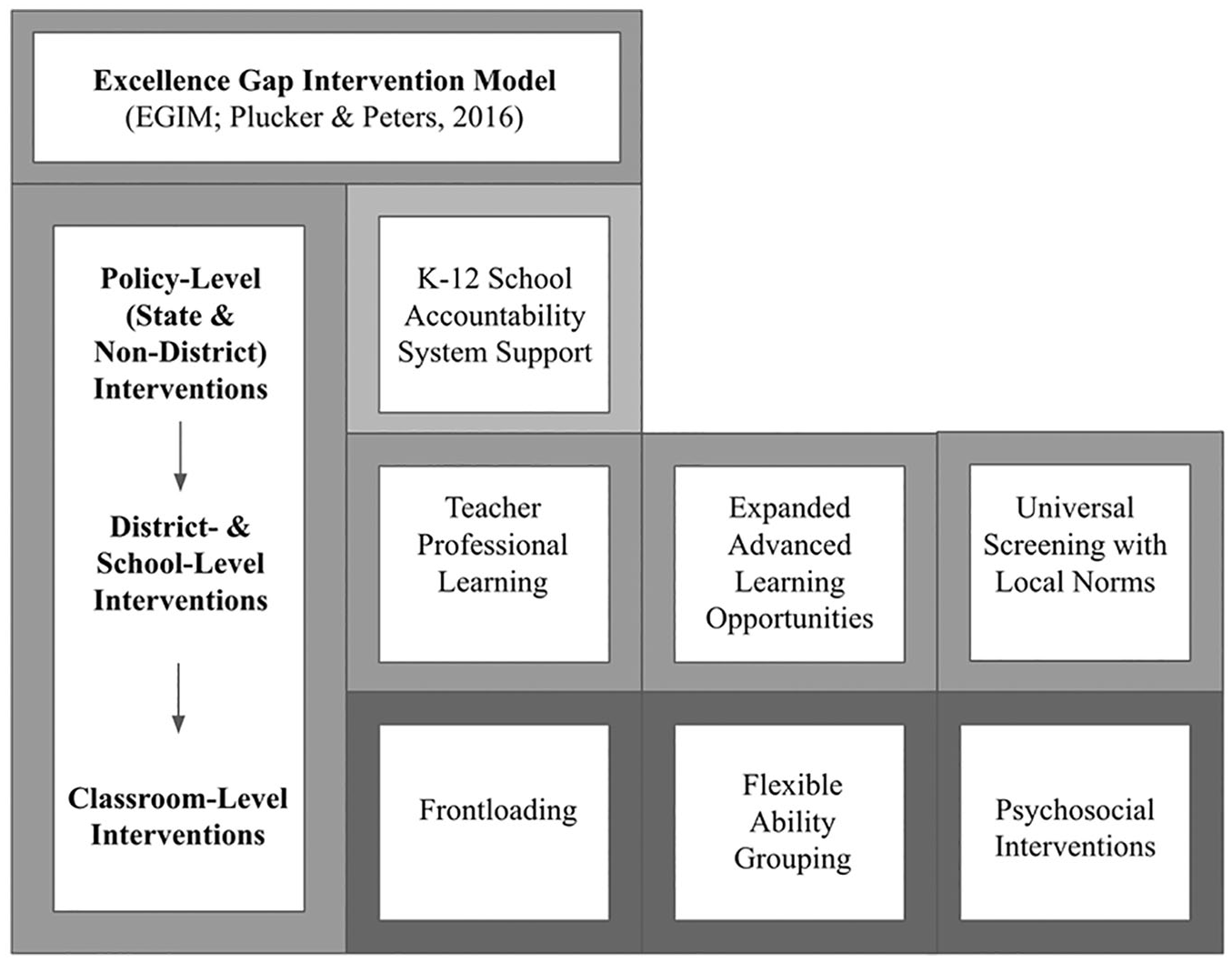
Facets of the Excellence Gap Intervention Model.
School Accountability System Support
Schools are accountable for the educational outcomes of the students in their care (Hutt & Polikoff, 2020). Although it is fairly standard for school districts to report on individual student achievement and to identify achievement gaps between student subgroups, it is less common for states to require the tracking and analysis of advanced performance (Plucker et al., 2017; Rinn, Mun, & Hodges, 2020). K–12 school accountability systems can support equity and excellence by requiring schools to report on student achievement, student growth, progress toward closing gaps at all levels of achievement, and postsecondary readiness. Current thinking on the impact of accountability systems is mixed, with some research suggesting little impact on schools and learning and other studies providing evidence of significant impacts (see French, 2018; Hutt & Polikoff, 2020). But most experts believe the systems have some impact and should be improved in several ways, such as inclusion of a broader set of student outcomes and credit for schools that close excellence gaps and increase the number of students achieving at advanced levels (i.e., increased resources, higher ratings; see Callahan et al., 2020).
Teacher Preparation and Professional Learning
Teachers are responsible for a wide range of duties. Just as students need opportunities, experiences, and explicit instruction to learn subject-area content, teachers also need training coupled with opportunities to apply that new learning to effectively meet the needs of students in their classrooms (Plucker & Callahan, 2020). Preservice and in-service teacher training that focuses only on strategies to bring students up to grade-level standards neglects the needs of students who have the potential to perform at advanced levels and only partially prepares teachers for their job duties (Plucker & Peters, 2016; Robinson & Kolloff, 2015). Yet few states require any coverage of advanced learners or learning in their preparation programs (Plucker et al., 2015, 2018), despite encouragement in Title II of the Elementary and Secondary Education Act for states to ensure teachers receive training on identifying and adjusting instructional strategies for students with advanced learning needs (Every Student Succeeds Act, 2015; Kaul & Davis, 2018). It is important for professional learning to address the needs of all students, including those who could benefit from advanced learning opportunities.
Expand Advanced Learning Opportunities
In many schools, advanced learning opportunities, such as gifted and talented programs, AP courses, and International Baccalaureate (IB) diploma programs, are offered. However, the availability, quality, and accessibility of those opportunities vary widely across school contexts (Dixson et al., 2020; Peters, Carter, & Plucker, 2020). Advanced learning opportunities benefit students only if (a) they are aware of the options, (b) they identify the options as beneficial, and (c) they can reasonably access the option without barriers (e.g., transportation, program fees; Plucker & Peters, 2016). Expanding options for advanced learning requires attention to equity, access, program goals, and student needs.
Frontloading to Prepare for Advanced Learning
Frontloading is a proactive approach that teaches students the content and skills they need to be successful in future advanced learning contexts. For example, there are algebra readiness skills that students need before high school in order to move through the sequence of higher level math courses (e.g., calculus) often required for entry into postsecondary science, technology, engineering, and mathematics (STEM) degree programs. Frontloading for advanced math courses can start in elementary grades if school systems understand the importance of early preparation for advanced learning. Two questions that are helpful for school districts to ponder when making policy and programming decisions are “How will this affect our brightest students?” and “How will this help other students begin to achieve at high levels?” (Plucker et al., 2010, p. 30). Frontloading has the potential to positively affect all students through intentional vertical alignment of content and skills with a focus on preparing students for future opportunities to excel.
Screening and Placement in Advanced Learning Contexts
Advanced learning contexts, such as gifted and talented programs, have traditionally required teacher referrals, extremely high scores on cognitive ability tests, and qualification in multiple domains (e.g., verbal, quantitative, nonverbal). These requirements can function as gatekeepers and keep students in need of advanced learning opportunities from accessing them (Plucker & Peters, 2016). Two identification strategies that have shown promise for increasing the proportional representation of students from culturally, linguistically, and economically diverse backgrounds in advanced learning programs are universal screening and the use of local norms (Peters et al., 2020). Universal screening involves evaluating all students in a grade level to identify those with advanced learning needs. Then, rather than using national norms and comparing students with the highest performing students across the country, local norms can be used to compare students within a school district or on a campus to identify those most in need of additional academic challenge (Peters, Makel, & Rambo-Hernandez, 2021).
Flexible Grouping
Flexible ability grouping allows educators to evaluate students’ current academic needs, place them in instructional groups with students who have similar needs, and adjust those groups as students show mastery and as topics change. Conversely, tracking is the inequitable practice of assigning students to educational trajectories without providing opportunities to adjust those placements. Flexible ability grouping differs from tracking in that the across-class or within-class grouping configurations are based on students’ current academic needs and placement can be changed as student needs change (Plucker & Peters, 2016; Steenbergen-Hu, Makel, & Olszewski-Kubilius, 2016). The wide range of ability levels in most classrooms can make it challenging for teachers to individualize instruction and meet the needs of each student. Flexible ability grouping can limit the range of levels in a single class to allow teachers to manage the individual differences between learners more efficiently (Plucker & Callahan, 2020). Flexible ability grouping can be undertaken at the district or school level by designating advanced course sections (e.g., gifted, honors, AP, IB) or within a mixed ability class. With targeted student groupings, instructional approaches can be tailored to allow acceleration and free up time for enrichment or inquiry.
Psychological and Social Skills Training
The challenges inherent in talent development require a set of well-developed psychosocial skills for coping with setbacks and maintaining motivation toward long-term goals (Subotnik, Olszewski-Kubilius, & Worrell, 2011). Self-beliefs and motivation are psychosocial skills related to academic achievement and talent development and evidence suggests that they can be strengthened through interventions (Rinn, 2020). Psychosocial interventions tend to be “cost-effective and rarely time-intensive, suggesting that they can be applied widely” (Plucker & Peters, 2016, p. 188). Questions remain about for whom and in what contexts these types of interventions are most effective. There is evidence that postsecondary psychosocial interventions (e.g., stereotype threat; Good, Aronson, & Harder, 2008) can affect motivation and achievement, but less evidence exists about the efficacy of these interventions in K–12 settings (Macnamara & Burgoyne, in press; Plucker & Peters, 2016).
Pursuing the Compatible Goals of Equity and Excellence
The rhetoric surrounding education policy often advances a false dichotomy by suggesting that stakeholders must choose one option over another. These narratives also frequently promote a sense of scarcity by implying that limited resources require prioritizing one option to the exclusion of another. We argue that the choice between equity and excellence in education is not an either-or proposition and that these complementary goals can be pursued simultaneously. Systemic barriers must be addressed, and wise decisions about the use of resources must be made, but equity does not have to come at the expense of excellence, and excellence does not have to come at the expense of equity. The EGIM is a set of coordinated strategies that can help close excellence gaps and the opportunity gaps that lead to them.
Researchers and practitioners have been working to support equity, accessibility, and retention in advanced learning programs for decades by raising awareness about the underrepresentation of diverse students and by creating targeted interventions to decrease opportunity gaps. Gentry et al. (2020) conducted a detailed analysis of the extent to which culturally, linguistically, and economically diverse students are underrepresented in gifted education programs across the United States. The report provided evidence of “missingness” (p. 4) and created state-specific recommendations to guide efforts to build advanced learning programs that “develop and reveal talent in all children, and especially those that have been underserved for generations” (p. 5). Reframing observed differences in academic performance among diverse student groups necessitates a shift away from minimum grade-level standards and toward identifying systemic issues that stand in the way of equity and dismantling barriers to high-quality learning opportunities. The work of expanding equitable access to advanced education is vital and ongoing, but to effectively direct those efforts, it is critical to examine the empirical research conducted over the past decade to highlight that progress and provide a foundation for future efforts.
Purpose and Research Questions
Given the sharp increase in intervention studies focused on equity in advanced education and the need for continued efforts, the time is ripe for a review of this scholarship. This systematic review of literature was conducted to examine research on strategies for reducing excellence gaps in advanced learning published between 2010 and 2021. The following research questions guided data collection and analysis. Since the concept of excellence gaps was introduced (Plucker et al., 2010):
What empirical research has been conducted on excellence gaps?
What overarching themes are present across empirical research studies for each facet of the EGIM (K–12 school accountability system support, teacher professional learning, expanded advanced learning opportunities, universal screening with local norms, frontloading, flexible ability grouping, and postsecondary psychosocial interventions)?
Method
Empirical articles published between 2010 and 2021 that addressed strategies for reducing excellence gaps were identified, screened, and analyzed to develop themes from the literature (Gough, Oliver, & Thomas, 2017). The Preferred Reporting Items for Systematic Reviews and Meta-Analyses checklist provided a guide for the data collection, data analysis, and reporting methods used in this study (Page et al., 2021).
Data Collection
Advanced searches were conducted in the Google Scholar web search engine (https://scholar.google.com). Nine separate searches were conducted between March and July 2021 (see Table 1). The primary search terms, which included excellence gaps, K–12 school accountability, psychosocial interventions, advanced learning opportunities, frontloading, local norms, universal screening, ability grouping, and teacher professional development, were entered in the “with the exact phrase” line. The secondary search terms excellence gaps and gifted education were entered in the “with all of the words” line. The primary and secondary terms for each search could be present “anywhere in the article.” Articles published from 2010 to 2021 were eligible for inclusion.
Search results and article totals after initial screening, eligibility screening, and category assignment
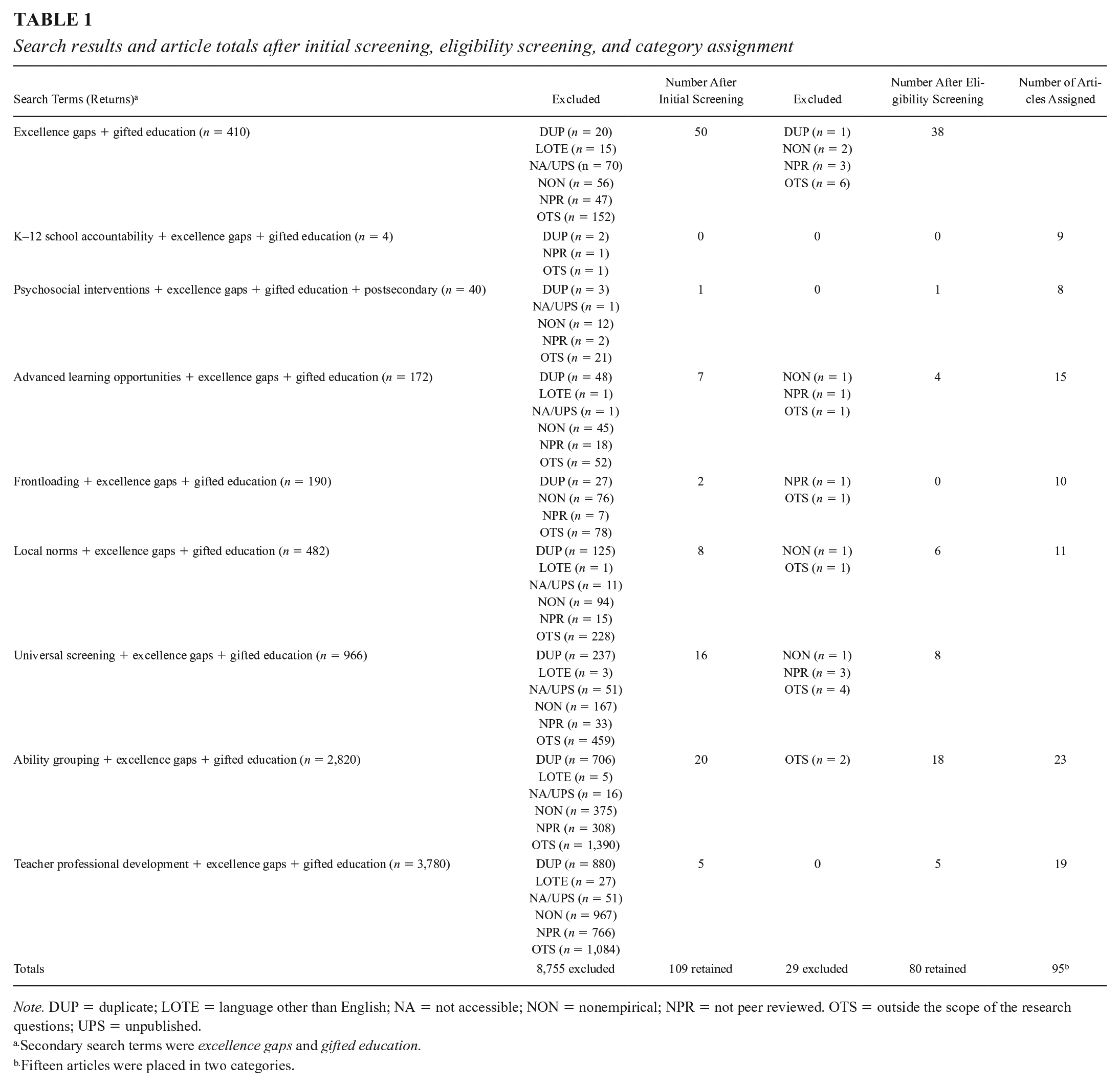
Note. DUP = duplicate; LOTE = language other than English; NA = not accessible; NON = nonempirical; NPR = not peer reviewed. OTS = outside the scope of the research questions; UPS = unpublished.
Secondary search terms were excellence gaps and gifted education.
Fifteen articles were placed in two categories.
Article Screening
Full-text articles that were peer reviewed, published in English, and addressed at least one of the seven elements of the research-based framework for reducing excellence gaps, the EGIM, were included in the review. Articles were excluded if they were (a) not peer reviewed (e.g., dissertations, theses); (b) not empirical (e.g., theoretical, descriptive); or (c) not accessible from the Google Scholar link, subsequent searches on the Internet, or the authors’ university library systems. Additionally, articles were excluded if they (a) were duplicate files, (b) were published in languages other than English, or (c) were outside the scope of the research questions (see Figures S1–S9 online). Reports were considered outside the scope of the research questions if they did not address strategies focused on advanced academic policy, programming, or pedagogy.
Initial screening
For each search return, we read the abstract to determine if the article was peer reviewed, empirical research published between 2010 and 2021 that addressed one or more strategies for reducing excellence gaps. If it was unclear whether the article was empirical (e.g., quantitative, qualitative, mixed methods), the full text was scanned to locate and read the method section. The first two authors independently screened the same 50 search returns and met to discuss whether each return should be included or excluded. Once consensus was achieved on the calibration set, the remaining search returns were divided and screened independently. In the initial screening phase, reasons for exclusion included duplicate files, publication in a language other than English, inaccessibility, texts that were not empirical, texts that were not peer reviewed, and texts that were outside the scope of the research questions for the present study. A large number of articles were classified as outside the scope of the research questions, which may be related to the use of Google Scholar as the sole search engine (e.g., high recall, low relative precision; Gusenbauer & Haddaway, 2020). These excluded studies did not address students with advanced learning needs or any of the seven facets of the EGIM and ranged in topic from specific learning challenges (e.g., special education, school discipline [Williams et al., 2017]) to articles that had no discernible connection to education (e.g., corporate human resources [Rao, 2014], microfinance [Zulfiqar, 2017]). After the initial screening, 109 articles were retained for further analysis (see Table 1).
Eligibility screening
For each retained search return, the full text was read to determine if the article (a) had clear research questions and (b) had enough information to answer the research questions in the present study. Articles were excluded in the eligibility screening phase if closer inspection of the full text revealed that it was a duplicate file, not an empirical text, not peer reviewed, or the topic was outside the scope of the research questions for the present study. After the eligibility screening, 80 articles were retained for further analysis (see Table 1).
Article sorting
In examining the full text of each of the articles in the eligibility screening phase, it became apparent that although some articles were identified by using specific search terms (e.g., K–12 school accountability, teacher professional learning), the primary focus of some articles was on a different but related topic. For example, no articles were retained from the K–12 school accountability search, but upon reading the full text of each of the articles, 9 articles from other searches clearly addressed K–12 school accountability system support for reducing excellence gaps (e.g., Peters, Gentry, et al., 2019). As a result, all articles were reread to determine which category or categories best described the focus of the article and the recommendations in the text. The authors assigned the articles independently and then met to negotiate agreement on the final category or categories. Articles were assigned to seven categories, including K–12 school accountability system support (n = 9), teacher professional learning (n = 19), expanded advanced learning opportunities (n = 15), universal screening with local norms (n = 11), frontloading (n = 10), flexible ability grouping (n = 23), and postsecondary psychosocial interventions (n = 8). In some instances, articles focused on two related facets of the framework for reducing excellence gaps (e.g., Missett et al., 2014; Mun et al., 2021), so 15 of the 80 articles were assigned to two subcategories (see Table 1).
Data Gathering
Each article was reread and analyzed using the Mixed Methods Appraisal Tool (Hong et al., 2018), which includes two screening questions and five questions to evaluate the risk for bias in quantitative, qualitative, and mixed-methods studies. Using the Mixed Methods Appraisal Tool questions, all 80 studies were classified as having a low risk for bias. Each study was then analyzed to determine the country, sample, context, data collected, results or findings, and the implications of the study related to reducing excellence gaps. The data collected from the screening, method-specific, and study-specific questions were recorded for analysis. The first author conducted the data collection for each article independently and then debriefed with the other authors to finalize the summaries of the results and implications.
Data Analysis
Using the research-based framework for reducing excellence gaps (Plucker et al., 2017; Plucker & Peters, 2016), three a priori categories were formed: policy-level strategies, district- or school-level strategies, and classroom-level strategies (see Table 2). Using the EGIM framework, seven a priori subcategories (K–12 school accountability systems, teacher professional learning, expanded advanced learning opportunities, universal screening with local norms, frontloading, ability grouping, psychosocial interventions) were also established. Given that many educational decisions are controlled at the local level, there is likely some overlap between whether excellence gap reduction strategies fall under the policy, district or school, or classroom category. For the purposes of this analysis, K–12 school accountability system support is designated a policy-level strategy because such systems are usually created and monitored by centralized education agencies (e.g., state departments of education). Teacher professional learning, expanded advanced learning opportunities, and universal screening with local norms were designated as district- or school-level strategies because decisions about professional development, course offerings, and identification procedures are most often made by administrators at the district or campus level, although some may be mandated at the state level. Frontloading, ability grouping, and psychosocial interventions were categorized as classroom-level interventions because these strategies are most often conducted by classroom teachers, although decisions about these strategies may be influenced by state- or district-level policies. The articles assigned to each subcategory were reread and coded to identify common themes.
Themes from literature on strategies to reduce excellence gaps
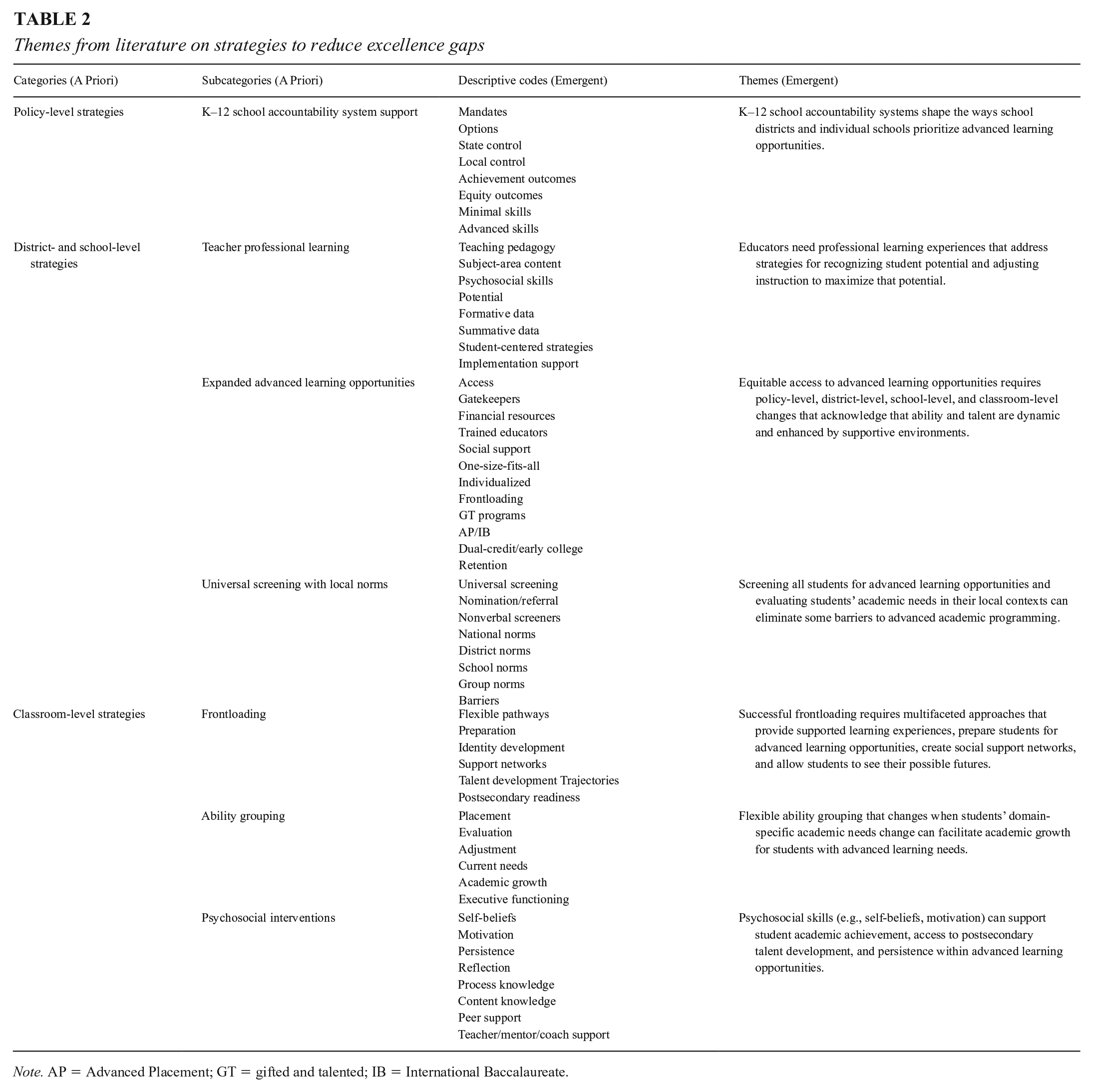
Note. AP = Advanced Placement; GT = gifted and talented; IB = International Baccalaureate.
Descriptive Coding
All of the articles in each subcategory were inductively analyzed to generate descriptive codes (Thomas, 2006). The first and second authors coded independently and then met to negotiate agreement on the final codes. The analysis of the expanded advanced learning opportunity articles identified 12 descriptive codes. The K–12 school accountability, teacher professional learning, universal screening with local norms, and psychosocial interventions articles each yielded eight distinct descriptive codes. The analysis of the frontloading and ability grouping articles highlighted six distinct descriptive codes for each subcategory. The descriptive codes were then examined for patterns and developed into thematic statements that captured the major findings of the studies (Saldana, 2016; see Table 2).
Thematic Analysis
Thematic analysis is a technique that can be used with large data sets to develop codes and themes directly from the data (Nowell et al., 2017; Ryan & Bernard, 2003). This technique can also distill large amounts of raw data down to focus on relevant aspects of a data set (e.g., reducing excellence gaps; Saldana, 2016; Thomas, 2006). In the present study, 80 empirical research articles were identified across seven subcategories, so thematic analysis was selected to sort through the sheer volume of data and focus the analysis on patterns among the collective findings and recommendations. The descriptive codes within each subcategory were analyzed to develop themes (Braun & Clarke, 2006; Clarke, Braun, & Hayfield, 2017; see Table 2). In the data collection process, each study was examined to identify major results or findings related to strategies for reducing excellence gaps. In each of the seven subcategories, the explanation of the results/findings of all studies were labeled with emergent descriptive codes. The codes were compared across each subcategory to identify patterns and common threads. The authors collaborated to create one thematic statement that collectively reflected the articles in each subcategory (see Table 2).
Trustworthiness
The elements of trustworthiness (e.g., credibility, confirmability, dependability, transferability) were addressed in the planning, data collection, and data analysis phases of this study. The first two authors used independent parallel coding, negotiated agreement, and peer debriefing with the third author, an expert in education policy and talent development, to triangulate the findings and establish credibility (Saldana, 2016). Clear descriptions of the methods used to collect and analyze data enhance dependability and provide a guide for other researchers to replicate this study (Nowell et al., 2017). A detailed audit trail of search returns, initial screening, and eligibility screening was maintained to allow confirmation of the findings. Tables and figures were created to increase the transparency of the search, screening, and data analysis processes that led to the creation of themes (Braun & Clarke, 2006; Gough et al., 2017). Exemplar studies were summarized and linked to the findings so that readers can make assessments about the transferability of these findings to their contexts (Nowell et al., 2017).
Findings
The systematic review of literature identified 80 empirical research articles across three categories and seven subcategories (see Table S1 online). Fifteen articles were assigned to two different subcategories because the studies addressed two excellence gap reduction strategies. The findings in this study are organized by category and the themes derived from the articles in each subcategory are discussed.
Policy-Level Strategies
K–12 School Accountability System Support
Nine articles addressed the role of school accountability systems in reducing excellence gaps. Each of the articles focused on school accountability in the United States. Five of the articles were quantitative research studies (Hamilton et al., 2018; Hodges & Lamb, 2019; Kim, Watkins, & Yoon, 2016; Peters, Gentry, et al., 2019; Rambo-Hernandez, Peters, & Plucker, 2019) and four were qualitative (Kaul & Davis, 2018; Lockhart, Meyer, & Crutchfield, 2021; Mun et al., 2021; Turner & Spain, 2020). A theme that was identified about school accountability system support for reducing excellence gaps was that K–12 school accountability systems shape the ways school districts and individual schools prioritize advanced learning opportunities.
Hodges and Lamb (2019) examined advanced course offerings in schools across the state of Washington during the era of NCLB (2001). They noted that between 2006 and 2013, the percentage of school districts offering gifted and talented programming dropped from 77% to 62%. The discontinuation of advanced level classes was most common in school districts that did not meet adequate yearly progress benchmarks on state standardized tests. These findings underscore the fact that when strong accountability measures, such as NCLB, emphasize minimum proficiency, school and district resources previously allocated to advanced learning opportunities may shift to remediation efforts, leaving students who have advanced learning needs with fewer options. Similarly, Hamilton et al. (2018) noted that school poverty had a negative relationship with gifted program identification even after controlling for math and reading achievement. This suggests that both individual poverty and institutional poverty can be barriers to participation in advanced learning programs. When resources are limited, interventions to help students meet minimum grade-level requirements are often prioritized over advanced learning, decreasing the number of advanced learning options and widening excellence gaps for students with fewer resources and those who attend schools with fewer resources.
Mun et al. (2021) identified several ways to build systemic capacity for positive change among administrators, advanced academic program coordinators, and classroom teachers. For the stakeholders in this qualitative sample, building systemic capacity required a focus on shared goals, regular reflection on program outcomes (e.g., equity, excellence), and collaborative efforts that allowed best practices to be adapted to the local context. School accountability systems that prioritize basic levels of achievement can overlook the needs of students who have mastered those minimal competencies; however, even in the absence of federal or state policy-level support, district and schools can create cultures that provide for the needs of all learners.
District- and School-Level Strategies
Teacher Professional Learning
Nineteen articles discussed the role of teacher professional learning in reducing excellence gaps. Fourteen articles focused on teacher professional development in the United States; one study investigated the process in Cyprus (Valiandes, 2015), one in Israel (Benny & Blonder, 2018), one in the United Kingdom (Dimitriades, 2016), and one in a graduate class with teachers from Kuwait, Oman, the United Arab Emirates, and the U.S. (Dodman et al., 2018); and one article examined studies across several cultural contexts (Lee, Meyer, & Crutchfield, 2021). Of the 19 studies, 14 were qualitative (Appova & Arbaugh, 2018; Benny & Blonder, 2018; Dimitriades, 2016; Dodman et al., 2018; Lee et al., 2021; Missett et al., 2014; Mullett et al., 2018; Mun et al., 2020, 2021; Park & Datnow, 2017; Rubenstein et al., 2015; Spoon et al., 2020; Szymanski & Shaff, 2013; Tomlinson & Jarvis, 2014), 3 were quantitative (Harradine, Coleman, & Winn, 2014; Robinson et al., 2018; Valiandes, 2015), and 2 used mixed methods (Gentry, Steenbergen-Hu, & Choi, 2011; Ihrig et al., 2018). One theme related to teacher professional learning is that education professionals need learning experiences that address strategies for recognizing student potential and flexible options for adjusting instruction to maximize that potential.
Quality professional learning experiences can empower educators to recognize student potential. Harradine et al. (2014) examined the use of the Teacher’s Observation of Potential in Students (TOPS) tool. More than a thousand teachers across four states were trained on the TOPS observation protocol and then used the tool in their classrooms to focus on student strengths for 3 to 6 weeks. Teachers noted that after learning about and using TOPS, they were more likely to look past disruptive behaviors and other variables to identify students with advanced learning needs. These findings highlight the fact that teacher training may be more effective if it is followed by opportunities for application and reflection. In a systematic review of published research, Mun et al. (2020) noted that professional learning emphasizing the dynamic nature of ability and talent can help teachers shift their thinking. The professional learning experiences described in the review included increased collaboration among school personnel that led to novel solutions for providing early interventions, strategies for language support, and alternative identification pathways (e.g., observation, planned experiences, portfolios) for English learners and other students from diverse backgrounds. These findings underscore the fact that what happens in professional development is important, but what happens in districts, schools, and classrooms as a result of that learning is even more important.
One role of teacher professional development is to provide flexible strategies for adjusting instruction to meet the needs of all students, including those who have already mastered some or all of the grade-level course content. Dodman et al. (2018) described the experiences of 30 teachers who participated in equity audits of their schools and developed action plans to remove barriers to advanced learning and talent development. One teacher in the course noted the lack of proportional representation in her school’s gifted and talented program and developed a professional learning plan focused on (a) how to identify potential in students from diverse backgrounds and (b) why removing obstacles to advanced learning benefits the whole school. This graduate program gave teachers the skills to take ownership of issues in their schools and to use data to communicate how equity and excellence goals align with school and district goals. Similarly, Ihrig et al. (2018) detailed the STEM Excellence out-of-school math and science preparation program for students from rural communities. The training element of the program supported teachers in creating and delivering challenging STEM curriculum to high-ability middle school students. Applying what they learned over 6 months helped teachers identify contextual factors (e.g., local context, postsecondary settings) that affect STEM talent development so they could proactively (e.g., increased rigor, inquiry methods) and reactively (e.g., formative classroom data) adjust instruction in the STEM Excellence program and their classrooms to prepare students for future advanced learning opportunities. Gentry et al.’s (2011) study of student perceptions of excellent teachers and Lee et al.’s (2021) systematic review of literature on classroom environments that support creativity both noted that professional learning experiences for teachers should go beyond domain-specific content and teaching pedagogy to include strategies for building classroom culture and establishing supportive working relationships with students. Collectively, these findings highlight the importance of teacher professional learning that helps educators identify potential and adjust instruction to maximize that potential.
Expanded Advanced Learning Opportunities
Fifteen articles discussed expanding advanced learning opportunities. Twelve of those articles used data from students in the United States, 1 study focused on data from Egypt (Ayoub, Alabbasi, & Plucker, 2021), 1 used a sample of students in Spain (Hernández-Torrano, 2018), and 1 study compared students from the United States and India (Makel et al, 2016). Twelve of the studies used quantitative methods (Assouline et al., 2020; Ayoub et al., 2021; Brigandi, Rambo-Hernandez, & Schwartz, 2020; Crabtree, Richardson, & Lewis, 2019; Hernández-Torrano, 2018; Kettler & Hurst, 2017; Lu & Weinberg, 2016; Lu, Weinberg, & McCormick, 2020; Makel et al., 2016; Peters et al., 2017; Wai & Allen, 2019; Yaluma & Tyner, 2021), 2 used qualitative methods (Collins & Jones Roberson, 2020; Tomlinson & Jarvis, 2014), and 1 used mixed methods (Ihrig et al., 2018). A key theme that was developed from the findings in these articles is that equitable access to advanced learning opportunities requires policy-level, district-level, school-level, and classroom-level changes that acknowledge that ability and talent are dynamic and enhanced by supportive environments.
Peters et al. (2017) noted that in reading, 20% to 49% of students in Wisconsin, California, and Texas scored 1 or more years above grade level. In math, 16% to 37% of students in Grades 3 through 7 scored 1 or more years above grade level. In a national sample of students who took the Measures of Academic Progress (MAP) test, 14% of students in math and 35% of students in reading scored 1 or more years above grade level. These findings indicate that there are many students across the United States who are ready for advanced learning opportunities, which challenges the current system of grade-level instruction in most school districts and indicates the importance of interrogating current practices to identify obstacles to equity and excellence at the district and school level.
Collins and Jones Roberson (2020) interviewed four Black male students about their perceptions of STEM talent development in K–12. For the participants in the sample, STEM identity was related to a strong personal interest in applied problem solving but was supported by a school culture that built students’ confidence in their STEM abilities. These findings highlight the fact that early opportunities to engage in academic talent development must be facilitated by educators who are competent in their subject matter, in culturally responsive instruction, and in helping students develop the psychosocial skills (e.g., confidence) needed for continued engagement in the domain. Ayoub et al. (2021) also noted the importance of environmental supports in and out of school (e.g., cultural, scientific, sports activities, clubs). For the Egyptian students in rural schools from low-income households, environmental, social, and psychological supports explained 44% of the variance in academic achievement, and environmental supports appeared to contribute the largest amount of variance. Taken together, these findings suggest that expanding advanced learning opportunities requires the coordinated efforts of policy makers, school district leadership, and education professionals to create supportive learning environments for students with advanced learning needs.
Universal Screening With Local Norms
Eleven articles addressed universal screening and the use of local norms when identifying students for advanced learning opportunities. Ten of the articles discussed data on students and schools in the United States, and 1 study examined articles from Australia, Belgium, Canada, Chile, Germany, New Zealand, Russia, the United Kingdom, and the United States that were part of a systematic review comparing academic and sports talent development (Faber et al., 2022). Eight of the studies used quantitative methods (Carman, Walther, & Bartsch, 2018, 2020; Grissom et al., 2019; Jordan et al., 2012; Lamb, Boedeker, & Kettler, 2019; Peters, Gentry, et al., 2019; Peters, Rambo-Hernandez, et al., 2019; Wai & Lakin, 2020), and 3 used qualitative methods (Faber et al., 2022; Matthews & Rhodes, 2020; Mun et al., 2020). A theme about reducing excellence gaps that was common to all 11 articles was that screening all students for advanced learning opportunities and evaluating students’ academic needs in their local contexts can eliminate some barriers to advanced academic programming.
Resources are almost always limited (e.g., funding, personnel). As a result, school districts put protocols in place to identify the students most in need of specific services. To ensure that students are given equal consideration for placement in advanced learning programs, universally screening all students in one or more grade levels (e.g., kindergarten, third grade) is a strategy that can be used to equitably identify students with demonstrated ability and students with the potential to perform at advanced levels if given more preparation. Across the articles, different screening tests were examined (e.g., verbal, quantitative, nonverbal). Carman et al. (2018, 2020) noted that the nonverbal batteries of assessments, such as the Cognitive Abilities Test (Lohman, 2011) and the Naglieri Nonverbal Ability Test (Naglieri, 2008), have been recommended as a way to increase demographic representation in advanced learning programs because of decreased emphasis on verbal ability. In both studies (Carman et al., 2018, 2020), nonverbal assessments, regardless of norming method (e.g., national, district, building), were less likely to lead to gifted program identification for students from traditionally underrepresented student groups than their White peers. However, school norms identified a sample that most closely mirrored the demographics of the district.
Wai and Lakin (2020) noted that beyond traditional cognitive achievement measures in math and reading, screening with measures of spatial ability, conscientiousness, and potentially leadership and creativity, may improve the proportional representation of diverse students in advanced learning programs. However, the authors cautioned that identification for services should (a) use “an ‘OR’ rule of combining multiple measures (e.g., a student can qualify on a spatial or math or verbal measure)” (p. 12) and (b) align identification measures with the services provided. The findings of this study suggest that broadening the scope of screening measures and using those measures to match students with available academic opportunities may be another way to equitably expand access to advanced learning programs and reduce excellence gaps.
Peters, Gentry, et al. (2019) noted that in 2014 and 2016, 42.4% of schools in the United States identified no students for gifted services, which highlights the fact that identification processes are often focused on national, rather than local, comparisons. Further research (Peters, Rambo-Hernandez, et al., 2019) using MAP data demonstrated that using local norming criteria (e.g., building norms versus national, state, or district norms) increased the proportionality of culturally, linguistically, and economically diverse students who would qualify for gifted and talented services. Although the magnitude of the changes in proportionality varied across schools and by student group, local norming positively affected proportionality more than dropping national cut scores from 5% to 15%. In addition, a combination of building-level and national norms appeared to provide advanced learning opportunities to the most students from traditionally underserved groups. Taken together, these findings indicate that although the careful selection of screening and identification assessments is important, how those tests are used (e.g., matrices, “and” rules, “or” rules) in combination with other requirements is also important. These findings further indicated that combining universal screening and local school-level norms can help reduce excellence gaps by identifying and serving the students in each building with advanced learning needs.
Classroom-Level Strategies
Frontloading
Ten articles described frontloading strategies to prepare students for success in future advanced learning opportunities. All of the articles presented education settings in the United States. Two of the articles were qualitative (Renbarger & Long, 2019; Wu, Pease, & Maker, 2019), 6 were quantitative (Hodges, McIntosh, & Gentry, 2017; Little et al., 2018; Olszewski-Kubilius et al., 2017; Ricciardi, Haag-Wolf, & Winsler, 2020; Ricciardi & Winsler, 2021; Robinson et al., 2018), and 2 used mixed methods (Davis, Davis, & Mobley, 2013; Matthews & Mellom, 2012). A theme that was present across these articles was that successful frontloading requires multifaceted approaches that provide supported learning experiences, prepare students for advanced learning opportunities, create social support networks, and allow students to see their possible futures.
Between 2000 and 2013, Project Excite provided early acceleration opportunities and enriched supplemental programming to prepare 14 cohorts of high-potential third through eighth grade students from diverse backgrounds for advanced learning opportunities in high school and beyond (Olszewski-Kubilius et al., 2017). After program completion, on average, these participants scored higher than their Black, Latino, and lower income peers on achievement tests (e.g., Illinois state test, ACT Explore, MAP) and, in many cases, scored at levels similar to their non-low-income and White peers. After completing the program, Project Excite participants also had higher rates of advanced math course placement, enrollment in 4-year colleges (84.5%), and admission to selective colleges (27.6%). These findings highlight the fact that frontloading designed to pave the way for secondary and postsecondary talent development opportunities requires multiple facets, including early intervention (third grade), sustained support (through eighth grade), and consideration of nonacademic factors (parent engagement).
On a smaller scale, Davis et al. (2013) studied a collaboration among a school counselor, a counseling intern, and an AP psychology teacher that created social support networks for African American students taking their first AP course. Recruited students prepared for the AP psychology course with a 2-week summer session that helped them build a network of fellow classmates and develop systems for managing rigorous, above-level coursework. Students were enrolled in the same AP psychology class and participated in weekly group counseling sessions throughout the class. At the end of the year, students who participated in the intervention performed better than national norms on the AP exam, and there were no statistically significant differences between the performance of the African American students who took part in the intervention and their White counterparts in the course. Students reported that their persistence in completing the course and taking the exam was related to the encouragement of the faculty members and the students in their cohort. This collaboration represents a multifaceted approach that included recruitment, the intentional development of a social network prior to the course, challenging advanced academic coursework, and sustained support through group counseling.
Robinson et al. (2018) studied an engineering intervention designed for first grade students from low-income households that included professional development for teachers and two curriculum units (e.g., engineering, biography). The engineering curricular intervention provided a hands-on design experience for young learners and participants showed gains on an out-of-level science achievement test and on measures of science engagement compared with students in the control group. In addition, the intervention functioned as a talent spotting opportunity for teachers. This frontloading program combined early intervention (first grade), exposure to challenging curriculum, teacher training to identify potential, and the use of biographies so students could envision their possible futures in STEM domains. Taken together, these frontloading studies emphasize the importance of preparing students for future talent development opportunities, helping them create support networks, and exposing them to potential education and career paths through supported learning experiences.
Flexible Ability Grouping
A total of 23 articles discussed flexible ability grouping as a strategy to reduce excellence gaps. Fourteen of those studies used quantitative methodologies (Adelson & Carpenter, 2011; Assouline et al., 2013; Barber & Wasson, 2015; Becker et al., 2014; Brulles, Peters, & Saunders, 2012; Catsambis & Buttaro, 2012; Decristan et al., 2017; Dougherty et al., 2017; Garrett & Hong, 2016; Preckel & Brüll, 2010; Redding & Grissom, 2021; Steenbergen-Hu et al., 2016; Valiandes, 2015; Vogl & Preckel, 2014), 8 used qualitative approaches (Benny & Blonder, 2018; Faber et al., 2022; Galanti, 2021; Meyer et al., 2020; Missett et al., 2014; Mullett et al., 2018; Park & Datnow, 2017; Rubenstein et al., 2015), and 1 used mixed methods (Murphy et al., 2017). Sixteen of the studies focused on learning contexts in the United States, and 7 studies examined learning contexts in other countries, including 4 in Germany (Becker et al., 2014; Decristan et al., 2017; Preckel & Brüll, 2010; Vogl & Preckel, 2014), 1 in Cyprus (Valiandes, 2015), and 1 systematic review that evaluated studies in nine different countries (Faber et al., 2022). A theme that was evident across the studies on ability grouping was that flexible ability grouping that changes when students’ domain-specific academic needs change can facilitate academic growth for students with advanced learning needs.
Decristan et al. (2017) identified cognitive activation (i.e., differentiation) and supportive classroom climates as factors that positively moderated the relationship between class heterogeneity and conceptual understanding of new science content. In other words, in classes with a wide range of ability levels, differentiated learning and high levels of teacher support were also necessary to facilitate the acquisition of challenging new content. These findings suggest that flexible ability grouping combined with quality teaching, differentiation strategies, and a supportive classroom climate may support academic talent development and the reduction of excellence gaps. In a second-order meta-analysis of ability grouping studies, Steenbergen-Hu et al. (2016) noted that collectively the studies pointed to small but positive effect sizes for within-class grouping, cross-grade subject grouping, and gifted grouping configurations. This highlights the fact that a variety of grouping strategies have the potential to meet students’ advanced learning needs if the instructional groups are (a) based on current ability or potential, (b) configured to decrease the range of ability levels for teachers to address in a single classroom, and (c) changed as students’ academic needs change.
Dougherty et al. (2017) examined a district plan for math acceleration in one North Carolina school district. The district used the Education Value-Added Assessment System to identify students who had a 70% or higher probability of success on the state Algebra I exam. This study found that placement in accelerated math in 7th grade under this plan was related to a 14% increase in precalculus enrollment by 11th grade, which suggests that “the pipeline beyond middle school is fairly leaky” (Dougherty et al., 2017, p. 153). This finding indicates that even when more students have early opportunities to take advanced math courses, there may be other factors, such as retention, to address. Access to accelerated mathematics coursework is a start, but ability grouping alone cannot guarantee academic achievement or postsecondary readiness without attention to other factors related to persistence in rigorous coursework (e.g., supportive classroom cultures, social networks, psychosocial skills coaching). Murphy et al. (2017) examined interactions between students in small groups of fourth and fifth grade students who were assigned to homogeneous or heterogeneous groups on the basis of oral reading fluency scores. These students engaged in text-based discussions using the Quality Talk framework to scaffold productive academic discourse. On average, all students exhibited statistically significant increases in basic and high-level reading comprehension in both grouping configurations using the Quality Talk lessons. Although group composition (e.g., homogeneous ability, heterogeneous ability) was not related to basic comprehension, it did explain differences in high-level comprehension between students in the highest and lowest homogeneous ability groups. This finding indicates that the quality of the interactions between students in within-class ability groups can play a role in the mastery of course material. Together, these studies provide support for adapting instruction to move students beyond their current achievement levels. However, they also emphasize that grouping students may not yield results without strategic planning, formative assessment, and intentional adjustment of groups on the basis of student progress.
Psychosocial Interventions
Eight articles discussed psychosocial interventions for reducing excellence gaps. Although the research-based framework for reducing excellence gaps notes that these interventions appear to be more effective in postsecondary contexts (Plucker & Peters, 2016; Plucker et al., 2017), some of the articles focused on interventions in K–12 school contexts (e.g., O’Brennan et al., 2019; Renbarger & Long, 2019). All eight of the articles described educational settings in the United States. Four of the articles used qualitative methods (Collins & Jones Roberson, 2020; McGee, 2016; Renbarger & Long, 2019; Rinn & Plucker, 2019), two used quantitative methods (Saw & Chang, 2018; Workman, 2020), and two used mixed methods (O’Brennan et al., 2019; Steenbergen-Hu, Olszewski-Kubilius, & Calvert, 2020). A theme that was identified among the psychosocial intervention articles was that psychosocial skills (e.g., self-beliefs, motivation) can support student academic achievement, access to postsecondary talent development, and persistence within advanced learning opportunities.
Rinn and Plucker (2019) identified 52 empirical studies published from 2004 to 2019 to examine the characteristics of college honors programs and the effects of honors programming on student outcomes. Participation in postsecondary honors programming was related to higher academic achievement and higher rates of retention and degree attainment. These findings indicate that psychosocial interventions aimed at supporting motivation and positive self-perceptions can support postsecondary educational outcomes and play a role in reducing excellence gaps between student groups. In another systematic review, Renbarger and Long (2019) featured programs that increased access to postsecondary talent development options, which included summer interventions, AP and IB courses, early college and dual credit options, college information access, financial aid, and the Gates Millennium Scholars program. High-quality programs with successful outcomes (e.g., enrollment, persistence, degree attainment) and high student perceptions of effectiveness were related to sustained engagement with students and multifaceted approaches. Although much of the literature on interventions to expand college access describes programs that are designed to frontload the academic content and skills high-ability students from low-income households will need for postsecondary success, the literature in this systematic review also stressed the importance of supporting students in developing noncognitive (e.g., psychosocial, executive functioning) skills as well.
O’Brennan et al. (2019) described the use of motivational interviews as part of an intervention to support the enrollment and retention of high school freshmen in AP and IB coursework. A total of 49 students enrolled in AP and IB courses across two schools participated in motivational interviews with preservice school psychologists, which included a preintervention assessment with items to identify effective coping styles, ineffective coping styles, school engagement, and home support, as well as two motivational interviews, and a postintervention assessment. Students in the sample, including those who had self- or teacher-identified signs of risk (e.g., ineffective coping styles, lack of engagement, lack of home support), had generally positive perceptions of the MAP intervention as a way to access additional support to persist in their studies and to work on the psychosocial and executive functioning skills required for advanced coursework.
Discussion
This systematic review of literature identified empirical research studies across the seven facets of the EGIM (Plucker & Peters, 2016). The themes developed in this review suggest four key considerations when school systems are working to reduce excellence gaps: vertical alignment, flexible pathways, support structures, and contextual awareness (see Figure 2). Typically, students are evaluated for advanced learning opportunities then placed in programs or courses. The considerations that emerged from this analysis suggest an alternative sequence where preparation happens first, but is also ongoing. Students can then be placed in advanced learning programs with responsive support, have their progress evaluated through regular formative assessment, and have their placements adjusted as needed to maximize student learning. These four steps (prepare, place, evaluate, adjust) create a recursive process to ensure students’ current, domain-specific educational needs are met.
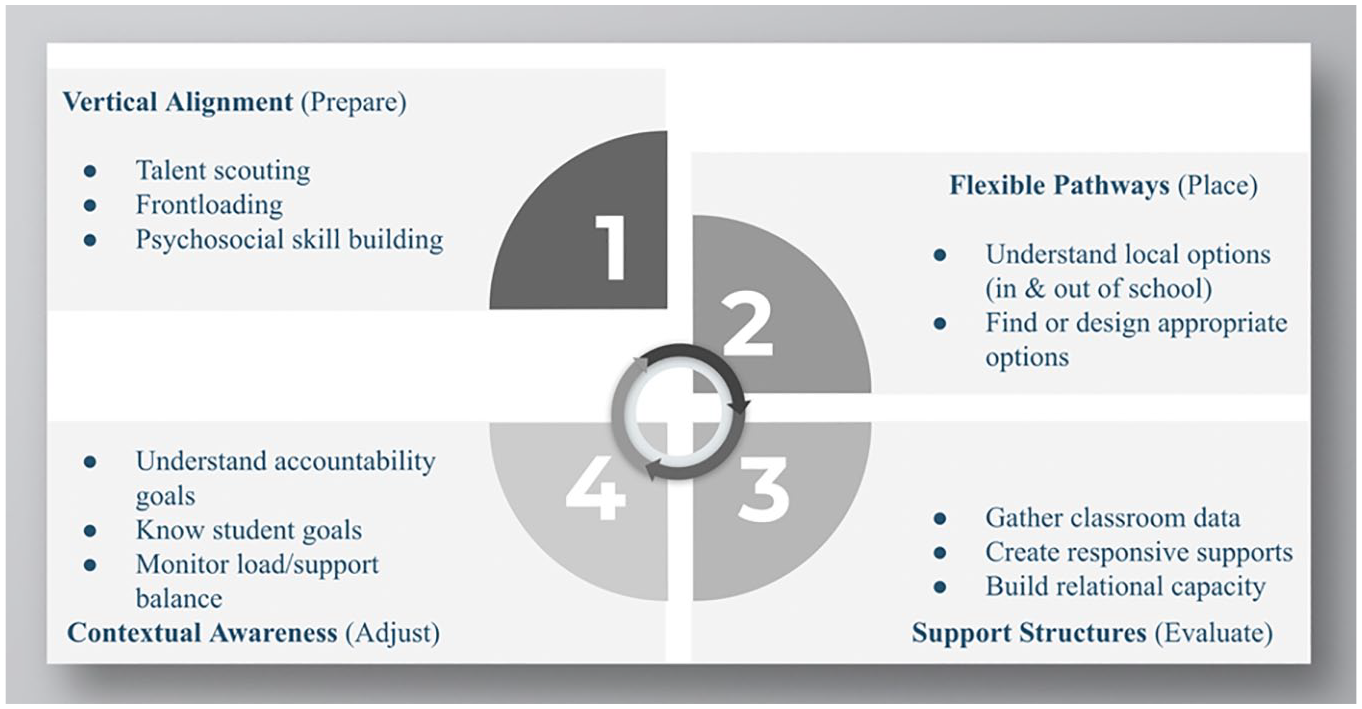
Considerations for school-based excellence gap reduction.
Vertical Alignment (Prepare)
Preparation for advanced learning opportunities requires educators to have a clear understanding of the content and skills required at multiple levels (i.e., vertical alignment). Several articles in the review (e.g., Mun et al., 2021; Park & Datnow, 2017) stressed that for students who have not yet had opportunities to engage with advanced academic content, educators can provide a strengths-based learning community where talent can be revealed and further developed. Researchers (e.g., Robinson et al., 2018) also suggested that a challenging curriculum can give teachers opportunities to function as talent scouts to identify potential, leverage student strengths and interests to support new learning, and help students develop the skills to tackle increasingly complex problems in a domain. However, effective talent spotting requires educators to understand existing advanced academic program options and to create individualized opportunities in the classroom.
It was clear from the articles in the review that preteaching domain-specific content (e.g., vocabulary, processes) is important, but early intervention (e.g., Ricciardi & Winsler, 2021), sustained engagement (e.g., Olszewski-Kubilius et al., 2017), and an emphasis on developing transferable skills (e.g., problem solving, academic discourse, written communication; e.g., Faber et al., 2022; Little et al., 2018) are also critical steps in the preparation process. It was apparent that many students need advanced learning options (e.g., Peters et al., 2017) and that engagement in advanced courses can contribute to academic growth (e.g., Wai & Allen, 2019), but there were indications that psychosocial skills (e.g., self-beliefs, motivation) can further support successful engagement in advanced academic coursework, which is consistent with prior research (e.g., Rinn, 2020; Subotnik et al., 2011). The studies in this review noted that teachers can support psychosocial growth by building strong relationships with students through coaching (e.g., Collins & Jones Roberson, 2020; Gentry et al., 2011; Lee et al., 2021; Mullet et al., 2018; O’Brennan et al., 2019; Steenbergen-Hu et al., 2020; Wu et al., 2019), helping students create social support networks in the classroom (e.g., Davis et al., 2013; Matthews & Mellom, 2012; Rinn & Plucker, 2019), and understanding the psychosocial skills required at the next level (e.g., evaluating and incorporating criticism; Workman, 2020).
Proactive preparation for advanced learning opportunities is a crucial step in developing talent and reducing excellence gaps. If students are not confident in their skills and abilities, they may be less likely to accept invitations to participate in advanced academic coursework (e.g., Assouline et al., 2020). On the other hand, when teachers focus on strengths to identify talent and help students develop cognitive and noncognitive skills, students may have more confidence in their ability to apply those skills to complex problems in advanced learning contexts. Teachers have a wide variety of duties and time is limited, so district personnel (e.g., supervisors, curriculum specialists, professional learning coordinators) can support frontloading efforts by providing information about local domain-specific vertical alignment that includes the content and skills required for advanced achievement in the current grade, the next grade, and beyond.
Flexible Pathways (Place)
Across the studies in this systematic review, it was evident that culturally, linguistically, and economically diverse students are underrepresented in gifted and advanced academic programs (e.g., Hamilton et al., 2018; Peters, Gentry, et al., 2019). Several recommendations focused on adapting identification processes (e.g., Carman et al., 2018, 2020; Peters, Rambo-Hernandez, et al., 2019; Wai & Lakin, 2020) and providing flexible placement options in school (e.g., Brigandi et al., 2020; Ihrig et al., 2018; Wai & Allen, 2019) and beyond the school day (e.g., Hodges et al., 2017; Little et al., 2018; Wu et al., 2019). Educators, students, and their families must know about advanced learning options in and out of school and know how to access them (e.g., Lu & Weinberg, 2016; Lu et al., 2020). However, it was also noted that shifting mind-sets away from identifying the gifted to maximizing learning for all students, including students who are twice exceptional and who come from diverse backgrounds (e.g., Dixson et al., 2020) requires changes at the policy, district, school, and classroom level (e.g., Mun et al., 2021). In addition, several studies in this review (e.g., Davis et al., 2013; Matthews & Mellom, 2012; Rinn & Plucker, 2019) suggested that identification and placement in advanced learning programs should be followed by close attention to retention supports within those placements, an idea that is consistent with prior research (e.g., recruitment and retention model; Ford, 2013).
Support Structures (Evaluate)
To create school systems that value the needs of advanced learners, the articles in this review suggested gathering classroom data to adjust instruction and creating classroom supports. Simply placing students in advanced courses does not reduce excellence gaps unless students also experience individualized instruction and responsive support (e.g., Ayoub et al., 2021; Davis et al., 2013; Kettler & Hurst, 2017). Assigning students to ability groups does not boost achievement in the absence of good teaching pedagogy and productive interactions with others in the classroom (e.g., Decristan et al., 2017; Murphy et al., 2017). Instead, the literature in this review suggests that educators gather information about student strengths and identify or create learning environments where students can maximize their potential. It was clear from the studies in this review that supportive classroom cultures (e.g., strengths-based approaches, social support networks, positive working relationships) are valued by students and related to positive academic and nonacademic outcomes (e.g., Davis et al., 2013; Dougherty et al., 2017; Gentry et al., 2011; Matthews & Mellom, 2012; Steenbergen-Hu et al., 2020; Tomlinson & Jarvis, 2014). However, because many programming decisions are made locally, teacher professional learning may need to address how educators in the classroom can identify talent, create strengths-based curriculum, and ensure appropriate educational interventions for students with advanced learning needs in specific state, district, and campus contexts. This contextual approach is consistent with sociocultural conceptions of advanced learning and talent development (Plucker et al., 2021). Another issue that was not fully addressed was how educators can build relational capacity with students so they can ask them to engage in difficult learning tasks.
Contextual Awareness (Adjust)
An old business adage suggests that supervisors inspect what they expect. In other words, if there is no oversight, some processes may be overlooked, abandoned, or kept in place when they no longer serve the goals of the organization. It is important for educators to understand state and district accountability goals, but it was clear in several of the articles that it is equally important for educators to understand individual student goals when they adjust instruction or educational placements (e.g., Mullet et al., 2018; Tomlinson & Jarvis, 2014). The articles in the systematic review suggested that contextual awareness of school system goals and students’ personal goals and readiness levels can allow educators to individualize instruction to work toward both outcomes (e.g., Rambo-Hernandez et al., 2019; Ricciardi et al., 2020; Turner & Spain, 2020). Additionally, Faber et al. (2022) suggested that educators could benefit from adopting load monitoring strategies used in sports training. Coaches track their athletes’ workouts to ensure they are tolerating the load and recovering between training sessions so they can adjust as needed. In education, this could translate to monitoring the balance between academic load and responsive support. For example, if formative assessment indicates that a student has mastered a concept, the load may need to be increased. However, if that assessment reveals academic or psychosocial distress, in-class support may need to be increased. If educators evaluate fit in terms of student interests, goals, and load tolerance (Faber et al., 2022), they can adjust placement as necessary. However, this is probably easier said than done in many school systems. If the individuals who design school accountability systems acknowledge the importance of academic growth for all students by collecting data on excellence gaps, school districts and campuses may begin to pay closer attention to students with advanced learning needs and support flexible placements that can be adjusted as student needs change.
Limitations
This systematic review of literature identified 80 articles that addressed strategies for reducing excellence gaps in education and themes related to those strategies. Some limitations of this study, including the search strategies, search terms, and article retention rules, may have inadvertently left out articles that could have provided additional viewpoints. As a search tool, Google Scholar has some documented limitations (Gusenbauer & Haddaway, 2020). Although the search engine typically delivers higher recall (i.e., more returns), there can be issues with relative precision (i.e., whether the content of the article actually matches the search parameters) and the reproducibility of the searches (i.e., return lists change frequently as the search engine updates). The choice to use Google Scholar as the sole search engine and the search terms (e.g., excellence gaps vs. opportunity gaps, gifted education vs. education) shaped the return list, and we may have missed relevant articles that could have informed the findings. In addition, we chose not to retain articles unless they were empirical research studies, which meant that we eliminated many high-quality books, book chapters, monographs, and theoretical articles, which can also shape policy and practice in gifted education and talent development. However, choosing to include only qualitative, quantitative, and mixed-methods studies for this review highlighted the need for more empirical research on the effectiveness of excellence gap reduction strategies in different contexts. Another limitation of this study is the consistency of the terminology across the articles. After the searches, initial screening, and eligibility screening, the articles were sorted into subcategories and categories. It is possible that we interpreted some terminology across the articles to mean the strategies were similar, or at least related, when in fact, the application of the term was different. For example, one qualitative article (Turner & Spain, 2020) used the term ability grouping, which is a research-based strategy for reducing excellence gaps (Plucker & Peters, 2016). However, this study equated ability grouping with tracking, and the negative connotations associated with this inequitable practice were applied to ability grouping. Regardless, this systematic review identified and analyzed a sampling of articles across the seven EGIM interventions and identified avenues for future research.
Future Research
In light of the findings in this systematic review, there are many opportunities for research on the seven facets of the EGIM. It would be beneficial to develop guidance for policy makers, school leaders, and educators on how to accurately measure excellence gaps. Systematically documenting differences in advanced performance among student subpopulations will allow education professionals to reflect on the effectiveness of equity interventions and use EGIM strategies to increase that effectiveness. In addition, as context is related to how excellence gaps are created and to the impact of interventions, each facet of the EGIM framework could be investigated in a range of local contexts to analyze the impact on outcomes for diverse groups of students with advanced learning needs (e.g., twice exceptional, rural, indigenous). A larger scale inquiry could also examine the implementation of all seven aspects of the framework for reducing excellence gaps in order to examine how the strategies work in combination when applied in and adapted to local educational contexts. The findings of this study suggest that preparation (e.g., frontloading) paves the way for equitable access to advanced learning programs and then placement, evaluation, and adjustment can form the steps of an iterative process that ensures students are matched with learning environments that meet their current educational needs (see Figure 2). However, the recommendation to prepare and then place, evaluate, and adjust needs to be examined in a broad range of grade levels and learning contexts in order to identify obstacles to implementation, areas where educators and administrators might benefit from training and support, and systemic changes that may need to occur for this excellence gap reduction approach to be successful.
Conclusion
The idea of excellence gaps was introduced more than a decade ago, and these critical gaps have not closed in that time. If anything, the pandemic appears to have grown these gaps. At the same time, there has been a shift toward creating supportive learning environments that account for the individual needs of learners. One promising approach identified in this review is to prepare students for advanced learning opportunities, place them in supportive environments in which their current academic needs can be met, and use ongoing formative assessment to evaluate progress and adjust grouping configurations, in-class supports, or course placements as student needs change. The seven facets of the EGIM (Plucker & Peters, 2016) provide a road map for educators and policy makers who are committed to pursuing equity and excellence for the students they serve, but more work is needed to ensure that advanced options are available and accessible. The surge in research on equity in advanced academics in the last 10 years has created new locally focused approaches, and researchers and practitioners can build on this scholarship to improve educational outcomes and support meaningful contributions to society. Pursuing the goals of equity and excellence in education requires intentional action and constant reflection, but the EGIM strategies provide practical guidance to help policy makers, district leaders, and educators continue moving in the right direction.
Supplemental Material
sj-docx-1-rer-10.3102_00346543221148461 – Supplemental material for Reducing Excellence Gaps: A Systematic Review of Research on Equity in Advanced Education
Supplemental material, sj-docx-1-rer-10.3102_00346543221148461 for Reducing Excellence Gaps: A Systematic Review of Research on Equity in Advanced Education by Melanie S. Meyer, Yuyang Shen and Jonathan A. Plucker in Review of Educational Research
Supplemental Material
sj-docx-2-rer-10.3102_00346543221148461 – Supplemental material for Reducing Excellence Gaps: A Systematic Review of Research on Equity in Advanced Education
Supplemental material, sj-docx-2-rer-10.3102_00346543221148461 for Reducing Excellence Gaps: A Systematic Review of Research on Equity in Advanced Education by Melanie S. Meyer, Yuyang Shen and Jonathan A. Plucker in Review of Educational Research
Footnotes

Authors
MELANIE S. MEYER is a lecturer at Baylor University, One Bear Place, Waco, TX 76798; e-mail
YUYANG SHEN is a PhD student at the University of North Texas, 1155 Union Circle, #311335, Denton, TX 76203; e-mail
JONATHAN A. PLUCKER is the Julian C. Stanley Endowed Professor of Talent Development at Johns Hopkins University, 5801 Smith Avenue, Suite 400, Baltimore, MD 21209; e-mail:
References
Supplementary Material
Please find the following supplemental material available below.
For Open Access articles published under a Creative Commons License, all supplemental material carries the same license as the article it is associated with.
For non-Open Access articles published, all supplemental material carries a non-exclusive license, and permission requests for re-use of supplemental material or any part of supplemental material shall be sent directly to the copyright owner as specified in the copyright notice associated with the article.
