




Abstract
Knowledge about the smallest meaningful units of language, morphemes, is crucial for vocabulary and reading comprehension. This meta-analysis of 43 studies examined differences in morphological knowledge in the societal language between language-minority and language-majority children. There was a moderate to large mean group difference in morphological knowledge in favor of the language-majority children. Studies that examined inflectional knowledge (walk–walked, rose–roses) reported larger differences than studies that examined knowledge of derivations (coexist, serious) and compounds (bluebird, highlight). Studies that used oral tests and tests of expressive language reported larger differences than studies that used written tests and tests of receptive language. These findings show that morphology is an area of weakness in language-minority children. Paired with the evidence that morphological instruction improves general language ability and reading comprehension, the results suggest that morphology could be an essential component in language interventions for language-minority children.
Children from homes that use a different language than the language used in school and the mainstream society (i.e., the societal language) are the fastest growing population in schools, presently accounting for more than 20% of primary school students in the United Kingdom and the United States, and expected to grow to nearly 25% by 2025 (Department for Education, 2019; Federal Interagency Forum on Child and Family Statistics, 2017; National Education Association, n.d.). A number of these language-minority children do not start their systematic exposure to the societal language until they enter school (e.g., Mancilla-Martinez & Lesaux, 2011). As schools become more linguistically diverse, it is critical to pay attention to the language and literacy skills of language-minority children. By language-minority children we mean children whose parents have a different native language than the mainstream societal and official language (August & Shanahan, 2006), which entails more restricted possibilities for use compared with the majority language. Language-minority children primarily comprise children with immigrant backgrounds (i.e., immigrants or native-born to immigrant parents).
Many language-minority children understand and speak both the minority and majority language, though to different degrees. Mastering two languages clearly has many advantages. Being bilingual can support children in having close relationships with their family and culture (Zelasko & Antunez, 2000). Also, a large percentage of adults speak at least two languages, and in a time of globalization, this may yield benefits such as better job opportunities. Bilinguals have a unique possibility to take part in the global society, and they can more easily access information worldwide and learn to understand the nature of other cultures and societies. Thus, there are numerous reasons why learning two languages can give advantages across many areas in life. However, there are also some challenges related to learning two languages in a language-minority context: Although language-minority children constitute a highly heterogeneous group, we know that they are at risk of receiving less and poorer exposure to the societal language than their language-majority peers, which in turn may lead to linguistic and academic difficulties (Prevoo et al., 2016). Schools still struggle to accommodate this challenge, evidenced by studies showing that language-minority children in Europe and North America experience relatively lower levels of educational attainment than their language-majority peers (Organization for Economic Co-operation and Development, 2010, 2016).
Thus, language-minority children are one of the largest groups of children in need of adapted education worldwide. Yet teachers report feeling underprepared for supporting language-minority children in developing academic language and literacy (Santibañez & Gándara, 2018). One of the keys to designing interventions to narrow the achievement gap between language-minority children and language-majority peers is understanding similarities and differences in the linguistic profiles between these groups. This meta-analysis examines differences between language-minority children and their language-majority peers in a foundational language skill that is critical for vocabulary development and reading comprehension: morphological knowledge (knowledge about the basic units of meaning in language).
Traditionally, professionals in childhood education have recommended that children, and especially those with language-minority backgrounds who have limited exposure to the societal language, should be taught as many words as possible in school (Hart & Risley, 1995, 2003). Importantly, such differences in language exposure are linked to later vocabulary skills (Hoff & Naigles, 2002; Hurtado et al., 2008; Rowe, 2012) and thus represent a foundation for literacy acquisition (Hjetland et al., 2019; Ouellette, 2006). However, whereas vocabulary interventions have been effective in teaching specific words, they often do not lead to transfer effects to untaught vocabulary (Elleman et al., 2009; Rogde et al., 2019). The difficulties with obtaining transfer effects is a major problem, as a child may come across approximately 150,000 unique words during their educational pathway (Zeno et al., 1995), and therefore, teaching words item by item will never be sufficient (Kirby & Bowers, 2017, 2018). This realization has led researchers to explore whether targeting other dimensions of language may lead to more transferrable knowledge. Specifically, they have looked to morphology, the study of the basic units of meaning in language.
Morphological Knowledge
Figure 1 gives an overview of morphological knowledge and morphological processes in language. Since as much as 60% to 80% of words in school reading materials consist of several morphemes (Nagy & Anderson, 1984), and the same morphemes recur in a large number of words, morphological knowledge has a large potential for expanding a child’s vocabulary. Figure 2 illustrates how this generalization can occur. For instance, the word coexists consists of three morphemes (co- “joint or jointly,” exist “be alive,” and -s “present tense third-person singular”). Thus, knowledge about one basic linguistic building block such as co- may give a clue to the meaning of a large number of novel words (e.g., cooperate, copilot, coauthor, collateral), and thus lead to transfer effects on measures of vocabulary and reading comprehension. Also, many words are members of large morphological families—in English there are 2,451 families with an average of 4.61 members each (Hiebert et al., 2018). Thus, knowledge of common affixes can make the student able to expand their comprehension from a root word to all members of a family. In this sense, morphological knowledge may be regarded as a gateway skill as it opens the door to a range of advanced language skills.
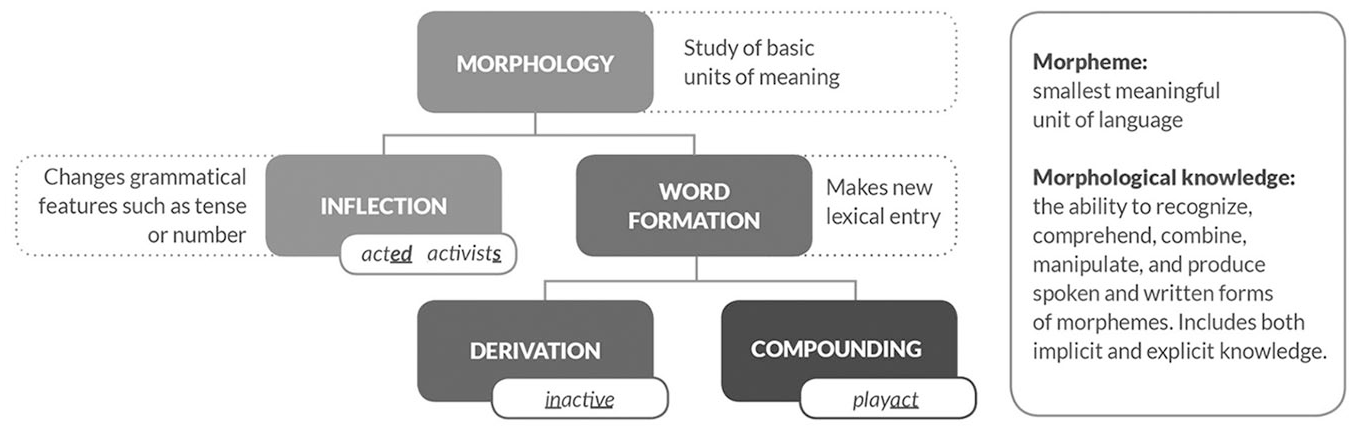
Morphology, morphological knowledge, and morphological processes.
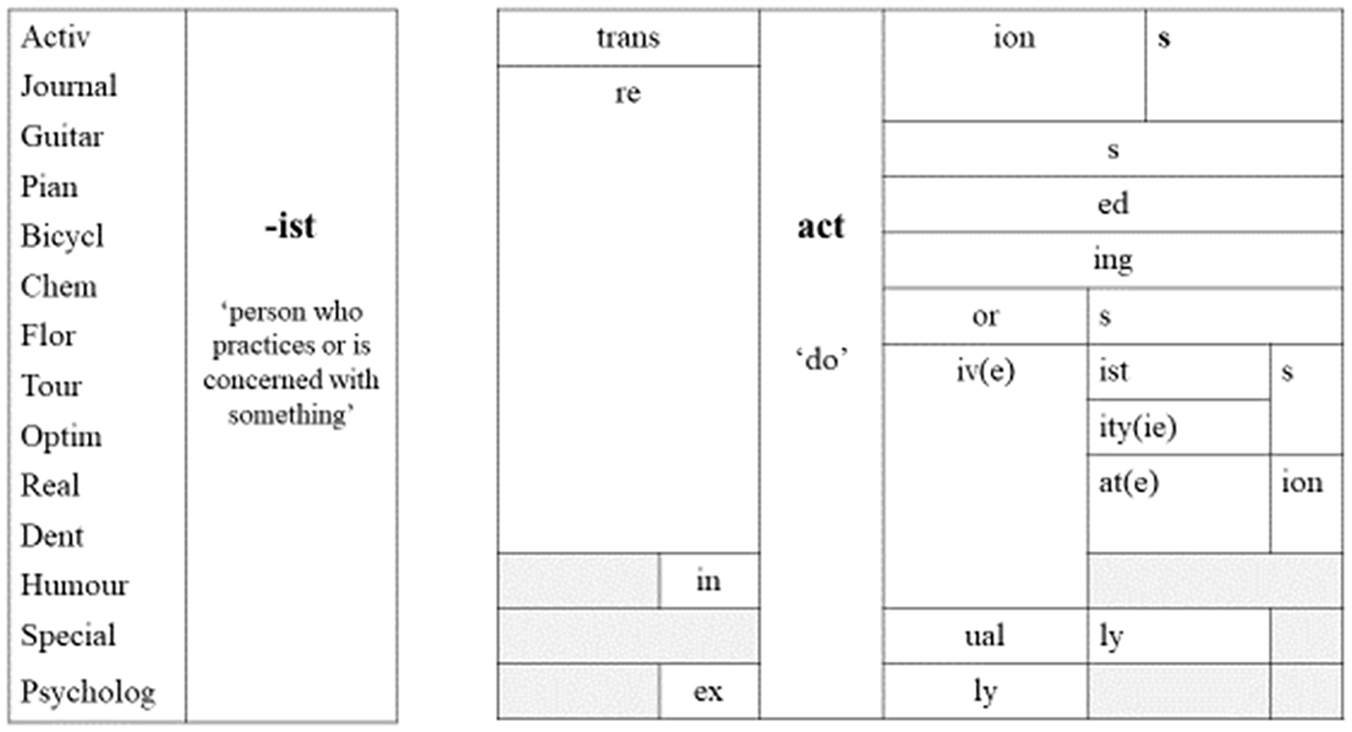
How morphological knowledge can support generalization across words.
There is increasingly stronger support for morphological knowledge as a gateway to language and literacy skills. Mediation modeling studies show support for both direct and indirect longitudinal contributions from morphological knowledge to other language and literacy skills (e.g., Kieffer & Box, 2013; Levesque et al., 2019; Nagy et al., 2006). Several studies also indicate that there are reciprocal relationships between morphological knowledge on the one hand and decoding, vocabulary, and reading comprehension on the other (e.g., Deacon et al., 2014; Hulme et al., 2019; Kruk & Bergman, 2013; McBride-Chang et al., 2008). In studies with language-majority children, morphological knowledge has been found to make a unique and predictive contribution to spelling, decoding, and reading comprehension, over and above robust predictors, such as phonological awareness, vocabulary, and nonverbal ability (Deacon et al., 2013; Deacon et al., 2014; Deacon & Kirby, 2004; Diamanti et al., 2017; Kruk & Bergman, 2013; Levesque et al., 2017). Importantly, mounting evidence for a causal relationship between morphological knowledge and literacy comes from training studies, including several randomized controlled trials (see reviews by Bowers et al., 2010; Carlisle, 2010; Goodwin & Ahn, 2010, 2013; Reed, 2008). Many of these studies have demonstrated transfer effects from morphological training to measures of phonological awareness, vocabulary, decoding, spelling, and reading comprehension. It should be noted that transfer seems to be more pertinent on decoding measures rather than reading comprehension. For reading comprehension, results are more mixed (Goodwin & Ahn, 2013).
Still morphology has received little attention in previous studies of language-minority children. This is surprising, given that, for several reasons, morphological knowledge can be particularly important for language-minority students. One reason is that morphological knowledge may be easier to acquire than word-specific knowledge. While low-frequency words are seldom encountered, morphology involves a limited set of building blocks and rules that are frequently encountered. Knowledge of these morphemes and morphological patterns may help language-minority children deduce the meaning of complex words that they have not been exposed to previously (Goodwin et al., 2013; Nagy et al., 2014). Thus, morphological knowledge may compensate for a smaller vocabulary in the societal language. Some morphemes are shared across many languages (e.g., morphemes of Latin origin shared between English and Spanish), and therefore, language-minority students may even recognize them from their home language and use this information to infer meaning (Goodwin, 2011).
It has also been claimed that language-minority learners have a better ability to discover structure in language and develop meta-linguistic awareness through comparison of their languages (Kim et al., 2015; Schwartz et al., 2016). If this is the case, their morphological skills may be more advanced than their vocabulary skills. Evidence supporting this suggestion comes from recent studies showing an advantage in morphological awareness in bilingual and trilingual children (Krenca et al., 2020, English-French; Melloni et al., 2019, Albanian-Italian and Romanian-Italian; Vender et al., 2018, mixed languages—Italian). Consequently, targeting morphology may be especially effective for language-minority students as it capitalizes on their meta-linguistic skills to a larger degree than item-by-item vocabulary teaching. Moreover, school-aged language-minority children have a relative strength in code-related literacy skills in the societal language and may thus use orthographic morphological knowledge in particular as a link to vocabulary and reading comprehension. In line with this reasoning, the meta-analyses by Goodwin and Ahn (2010, 2013) found that morphological instruction was particularly effective for English language learners. Furthermore, some studies have indicated that morphological knowledge makes a unique longitudinal contribution to oral and written vocabulary in language-minority children (Goodwin, 2011; Luo et al., 2018), although they have not tested whether this contribution is stronger than for language-majority children.
Whereas morphology has been identified as a dimension of language that may be easier for language-minority children to acquire than vocabulary, and is thereby a particularly promising target for interventions, the research base on morphological knowledge in language-minority children is relatively small. Thus, there is a discrepancy between the large educational potential of morphological instruction and our current knowledge of the skills of language-minority children in this domain of language. As the research field is increasingly focused on designing morphological interventions, we need a better understanding of morphological knowledge in language-minority children, which can serve as a foundation for this work. The present meta-analysis aims to synthesize what we know about differences in morphological knowledge between language-minority and language-majority children and pinpoint areas where further research is needed.
Differences Between Language-Minority and Language-Majority Children in Morphological Knowledge and Other Language Skills
There is substantial variation in the results of studies that have examined group differences in morphological knowledge between language-minority and language-majority children. Some studies show almost zero or only small group differences (de Zeeuw et al., 2013; Ip et al., 2017; McNeill & Everatt, 2013). Other studies show large group differences in favor of the language-majority children (e.g., Droop & Verhoeven, 2003; Verhagen & Leseman, 2016; Verhoeven et al., 2011; Vermeer, 2004). To date, no meta-analysis has summarized, quantified, or looked for moderators in studies that compare the morphological knowledge of language-minority children and their language-majority peers.
However, studies that have compared the performance of language-minority and language-majority children on measures of other language-literacy skills show that language-minority children tend to perform at a comparable level to their language-majority peers on measures of decoding (reading fluency or reading accuracy) and phonological awareness, which are often labeled code-related language skills (e.g., Babayiğit & Shapiro, 2020; Lesaux & Geva, 2006; Melby-Lervåg & Lervåg, 2014; O’Connor et al., 2019; Verhoeven et al., 2018). In contrast, these studies show that language-minority children tend to perform more poorly than language-majority children on measures of vocabulary and listening comprehension, which are often labeled meaning-based language skills. For instance, in their meta-analysis, Melby-Lervåg and Lervåg (2014) found moderate differences between language-minority and language-majority children in reading comprehension, but small differences in phonological awareness and decoding. Conversely, they found a large difference (above 1 SD unit) in language comprehension, which primarily included measures of vocabulary, but also tests that tap syntactic and morphological knowledge (i.e., oral cloze), and listening comprehension. Melby-Lervåg and Lervåg (2014) did not examine directly whether there were discrepancies between the different language comprehension skills, but they found smaller differences in studies that used oral cloze tests than those that used other types of receptive or expressive vocabulary tests.
A common explanation for comparable code-related skills but poorer performance on meaning-based skills is that whereas language-minority children may benefit from the transfer of first language (L1) code-related skills to the same skills in their second language (L2), the transfer in meaning-based language skills is small (Melby-Lervåg & Lervåg, 2011). These meaning-based language skills constitute a much larger problem space than decoding, which is restricted to 26 letters in the standard European alphabet and below 50 phonemes in most languages. Alternatively, the discrepancy between meaning-based and code-related skills in language-minority children may reflect the emphasis on teaching decoding in the early elementary school years, often due to the assumption that children already have substantial oral experience in the instructional language when they enter school. Although this approach may be well tailored to the needs of language-majority children, it runs the risk of overlooking the oral language needs of language-minority children (Burgoyne et al., 2011).
Theoretically, several predictions can be derived from the literature comparing language skills in language-minority and language-majority children. As morphological knowledge is often considered a meaning-based language skill along with vocabulary, syntax, and listening comprehension (as suggested by Melby-Lervåg & Lervåg, 2014), we would expect large group differences in favor of language-majority children. However, there is also evidence that morphological knowledge is related to code skills and phonological awareness (e.g., Apel et al., 2012; Carlisle & Nomanbhoy, 1993; Casalis et al., 2011; Deacon et al., 2013; Diamanti et al., 2017; Rispens et al., 2008; Wolter et al., 2009). Morphological tasks often involve similar processes as phonological tasks and decoding, such as segmentation or combination of sub-lexical units, and morphology comprises a limited set of building blocks and rules that are more frequently encountered than specific words. Therefore, it is unclear to what extent the group differences in morphological knowledge are similar to group differences in other meaning-based skills (i.e., vocabulary, listening comprehension, syntax) or code-based skills. Moreover, as discussed previously, if morphological knowledge is easier to acquire than word-specific knowledge, and enables language-minority students to capitalize on their meta-linguistic awareness, we would expect smaller group-differences in morphological knowledge than in vocabulary.
Factors Related to Differences in Morphological Knowledge Between Language-Minority and Language-Majority Children
Based on the previous outline, we expect that performance on tests of other language and literacy skills will be a critical factor associated with group differences in morphological knowledge. We anticipate smaller group differences in the morphological knowledge of language-minority and language-majority children in studies where group differences in other language and literacy skills are smaller. In particular, vocabulary and morphology are strongly related (e.g., Goodwin, 2011; McBride-Chang et al., 2008), but as mentioned above, there are also studies that show a strong relationship between morphology and phonology (e.g., Deacon & Kirby, 2004; Goodwin, 2011). As will be discussed next, however, the magnitude of the group difference in morphological knowledge may depend on several other factors, such as participant characteristics, the type of morphological process that is measured, and the way morphological knowledge is measured.
One factor that may explain variation in study results is the morphological process that is examined (inflection, derivation, and compounding). In language-majority children, knowledge of inflections and compounds is typically acquired earlier than derivational knowledge (see the review by Kuo & Anderson, 2006). Derivational knowledge develops with schooling and possibly reading experience (Fejzo et al., 2018). However, although language-majority children have extensive early exposure to inflectional suffixes, verb inflection is acquired relatively late. Moreover, inflectional morphology distinguishes well between children with different language proficiency levels (see, e.g., Tomblin, 2019) and persistent difficulties with inflectional morphology have been found for language-minority children (Paradis, 2016; Soto-Corominas et al., 2020). Currently, we do not know whether these morphological processes have different developmental trajectories for language-minority children, and thus whether there is an association between morphological process and the size of group difference between language-minority and language-majority children.
Task and test types can also be related to the study outcomes. Numerous tasks, differing in terms of task demands, type of manipulation, modality, and the lexicality and regularity of the morphological processes, have been used to assess morphological knowledge. Deacon et al. (2008) outline a taxonomy of morphological tasks based on characteristics such as modality (oral vs. written presentation or response), task content (e.g., inflections vs. derivations), and task type (e.g., judgment vs. production, explicit vs. implicit). Some tasks are presumably mastered earlier than others. For instance, children’s judgment of whether two words are related (bake–bakery) has been found to reach ceiling earlier than children’s performance on tasks that require selecting or producing a derivate word in a sentence completion or analogy task (love–lovely, current–?) (e.g., Fejzo et al., 2018; Tyler & Nagy, 1989). Similarly, judgment tasks appear to be mastered earlier than production tasks, supposedly because they tap implicit and explicit knowledge, respectively (e.g., Diamanti et al., 2018). Consequently, task type might affect group differences in morphological knowledge. Moreover, since vocabulary appears to be closely related to morphological knowledge, the degree to which the different morphological tasks depend on vocabulary could be important for study outcomes. Shahar-Yames et al. (2018) found that L2 learners performed more poorly on morphology tasks that relied more on vocabulary knowledge but similarly to language-majority children on morphology tasks that relied less on vocabulary knowledge (i.e., nonword tasks). Thus, we expect that if nonwords are used, group differences will be smaller.
Given the distinct developmental trajectories for inflections and derivations, differences in the age of the participants may also explain divergent results between studies. For instance, older school-aged language-majority children may reach ceiling in oral inflectional tasks, which can conceal between-group differences. There are also reasons to expect smaller differences between older children, as language-minority children’s exposure to the societal language increases with age and schooling experience. Hence, factors related to age are potential moderators of group differences in morphological knowledge.
A range of other factors could potentially moderate differences in morphological knowledge between language-minority and language-majority children. These factors include socioeconomic status (SES), age of first exposure and amount of exposure to the majority language, differences in first and second language skills, and similarity between the minority and majority language (for further description of these factors, see Supplementary Material A, available in the online version of this article).
The Current Study
The main purpose of the present study was to synthesize research that compares the morphological knowledge of children with language-minority and language-majority backgrounds. Based on the research discussed above, the current study was guided by the following research questions:
How does morphological knowledge in the societal language differ between children with language-minority and language-majority backgrounds? How does the magnitude of this difference compare to differences within other areas of language and literacy, such as phonological awareness, vocabulary, and reading comprehension? Which language and literacy skills moderate group differences in morphological knowledge?
Which other factors moderate the difference in morphological knowledge between language-minority and language-majority children? How are group differences in morphological knowledge related to the morphological process (i.e., inflection, derivation, compounding), and age? How are group differences in morphological knowledge related to measurement characteristics and indices of methodological quality?
It is important to shed light on and potentially resolve these questions for several reasons. Theoretically, it will give us an enriched understanding of the nature of morphology in terms of how morphological knowledge is related to other language and literacy skills and whether it is a relative strength or weakness in language-minority children. Methodologically, it can illuminate how methodological choices in this area (i.e., how morphological knowledge is assessed) are related to study results and how the methodology can be improved in future studies. Finally, it can indicate directions for what content to include and test in language intervention studies for language-minority children.
Method
The design and reporting of this meta-analysis are consistent with the Preferred Reporting Items for Systematic reviews and Meta-Analyses (PRISMA) statement (http://www.prisma-statement.org/) and was preregistered in PROSPERO International’s prospective register of systematic reviews. The preregistration protocol is available online at https://www.crd.york.ac.uk/prospero/display_record.php?ID=CRD42017049325 The project is registered in the Open Science Framework (OSF), https://osf.io/pywfz/?view_only=15e39646f42d4929badc03ceb653afca, and the search syntax, data set, and all R scripts are published there.
Inclusion Criteria and Literature Search
We included all identified empirical studies available from 1987 (not older than 30 years at the starting point of the review) in English or Scandinavian languages comparing groups of children (from 3 to 18 years) with language-minority backgrounds to children with language-majority backgrounds on measures of morphological knowledge in the majority (societal) language. Children with language-minority backgrounds were defined as children whose parents have a minority language as their native language. Notably, a language-minority child can either have been born in the country of residence or have immigrated there. We used a rather broad definition of minority language, referring to a language that differs from the language used in school and mainstream society. For instance, in the United States, children whose parents have Spanish as their native language can be considered language-minority children. In Europe, there is a large variation in minority languages, such as Turkish in Germany and the Netherlands, or Arabic in France. Children who have the same home language as the language used in school and mainstream society (i.e., language-majority children) constitute the comparison group. Many studies have included language-minority children as participants but use different, partly overlapping terms (e.g., bilinguals, Second Language Learners, English Language Learners, Dual Language Learners, and children learning English as an additional language). Unfortunately, many studies do not report inclusion or exclusion criteria for study participation or provide clear definitions and descriptions of sample characteristics. Therefore, when reviewing studies, unless language-minority children are explicitly excluded, we assumed that studies using one of the partly overlapping terms were of relevance.
We excluded the following study types: studies lacking a language-majority control group, studies with groups of adults (18+), foreign language learners, children with intellectual disabilities or hearing loss. We also excluded studies that only focus on the children’s morphological knowledge in the minority language, studies where the bilingual children had a home language that was an official language in the country of the study (e.g., French in Canada, or Basque in Spain), or studies where a majority of the bilingual children were from bilingual families in which one of the parents spoke the majority language as their native language. Figure 3 shows the flow chart for the literature search and screening.
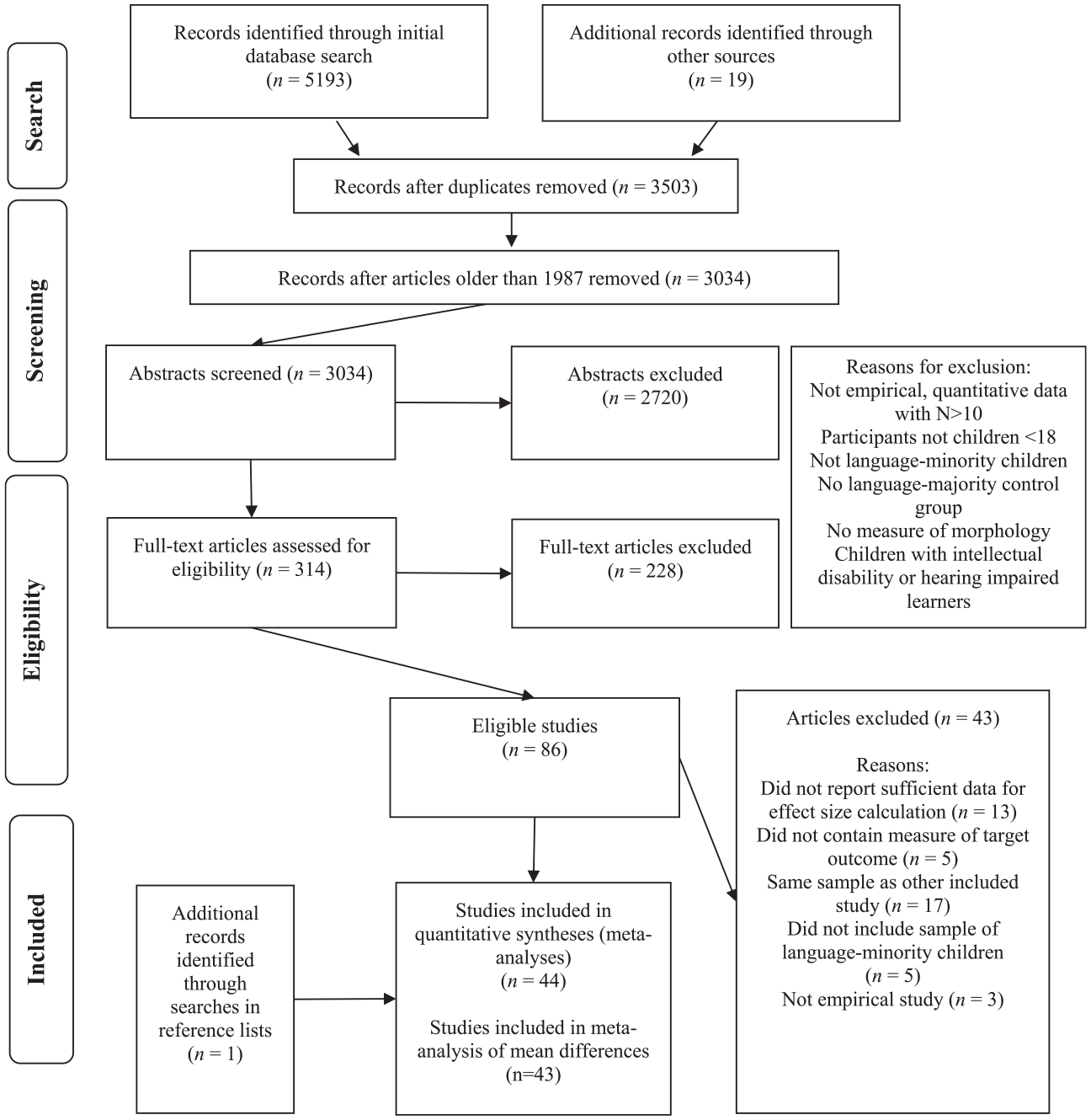
Article selection process for meta-analysis.
The studies were identified through a search based on the keywords language minority, language majority, and morphological knowledge (with synonyms and elaborations). The search was conducted under guidance from information retrieval experts and conducted in the following databases: ProQuest Dissertation and Theses, Medline, Embase, Web of Science, Eric, Open Grey, PsycInfo, Linguistics and Language Behavior Abstracts, and Google Scholar. Online Table S1 (Supplementary Material A) shows the search string for Ovid, covering the most common databases (Eric, Embase, Medline, PsychINFO). For search syntax for all databases, see OSF(https://osf.io/pywfz/?view_only=15e39646f42d4929badc03ceb653afca). The search comprised peer-reviewed studies, non-peer-reviewed studies, book chapters, dissertations, conference proceedings, and reports. Special efforts were made to locate and retrieve gray literature by conducting searches in databases with gray literature (Open Grey and ProQuest Dissertation and Theses). In addition, a manual search was conducted in annual issues of international journals that specialize in bilingual research (International Journal of Bilingualism, Bilingualism: Language and Cognition, International Journal of Bilingual Education and Bilingualism, TESOL Quarterly, Journal of Multilingual and Multicultural Development). Moreover, we cross-checked references, checked for studies in relevant meta-analyses and syntheses, and contacted experts in the field.
Screening for Eligibility
All the titles and abstracts were imported into EndNote and to the DistillerSR software. The first and second authors evaluated all the identified titles and abstracts and excluded the studies that clearly contained no measures of the morphological knowledge of language-minority children and their language-majority peers. Approximately 20% of the titles and abstracts (599 of 3,040) were randomly drawn and independently screened by both the first and second authors. This gave a satisfactory interrater reliability (Cohen’s kappa) of 0.77. Subsequently, any disagreements about the double-screened abstracts were discussed until consensus was achieved. Approximately 20% of the full texts (70 of 304) were randomly drawn and double-screened by the first and second authors, yielding a satisfactory overall interrater reliability (Cohen’s kappa) of 0.88. Disagreements were discussed until consensus was achieved.
Data from studies found eligible for inclusion were extracted to the data coding form in the Comprehensive Meta-Analysis Software (CMA; Borenstein et al., 2014). To be included in the meta-analysis, the studies had to report statistical information on the performance of both children with language-minority and language-majority backgrounds on at least one test of morphology. The following statistical measures were accepted: means and standard deviations for both groups, correlations between group and performance, and t-tests or one-way ANOVAs. If studies did not include any of these statistical measures, we attempted to contact the authors to request this information. Studies from the same authors were examined to avoid duplicates and to determine whether samples were independent.
Data Extraction and Coding
The first and second authors conducted the coding. The first author and a trained research assistant double-coded a random sample of the articles, approximately 20% of the total sample. The interrater correlation (Pearson’s r) for the main outcomes was 0.90. The agreement rate was 73%. The interrater correlation for the continuous moderators was 1, with an agreement rate of 85%. For the categorical moderator variables, we used Cohen’s kappa, which yielded a coefficient of 0.90. The agreement rate was 93%. We solved disagreements by consulting the original paper, either through discussion or by consulting another author.
Other language and literacy measures than morphological knowledge were also coded if data on such measures were reported, including measures of phonological awareness, vocabulary, syntactic knowledge, decoding, spelling, and reading and listening comprehension. Criteria were established to determine the types of measures that represented each construct based on previous meta-analyses in the area of L2 learners (e.g., Jeon & Yamashita, 2014; Melby-Lervåg & Lervåg, 2014). Detailed descriptions of these criteria can be found in online Supplementary Material A.
To be considered a measure of morphological knowledge, the test(s) had to address either the children’s specific morphological knowledge (knowledge specific to a multimorphemic word), their knowledge of morphological rules and regularities (e.g., rules of word formation), or the children’s morphological processing (use of morphological knowledge to recognize, comprehend, or produce words; Berthiaume et al., 2018). The tests could address one or more morphological processes (i.e., composites of compounding, derivation, inflection, or mixed morphology). Online Table S2 (Supplementary Material A) displays the different morphological test categories that were identified during the data extraction. All measures of morphological knowledge in each study were coded.
Moderator Variables
Several moderator variables were coded to examine factors that could account for variation between studies. These moderator variables belonged to three broad categories (described in detail below). Studies that lacked information about one or more of these characteristics were excluded from the moderator analyses for which data were missing but retained for the overall effect size estimation.
In addition to the moderator variables described below, we also prespecified and coded additional moderators which are only described in online Supplementary Material A. These additional moderators were either not reported in enough studies to use in the analyses, or the results concerning these moderators were difficult to interpret due to the presence of confounding factors. Results for the additional moderators are reported in online Table S3 in Supplementary Material A.
Measurement Characteristics
We coded the modality of the test (whether it was a written or an oral test); whether the words used in the test were real words, nonwords, or a combination of these; the morphological process (i.e., derivation, inflection, compound or mixed); and whether it was an expressive or receptive test (involving judgment or choice; cf. the taxonomy by Deacon et al., 2008).
Participant and Study Characteristics
The mean ages (and SD, if available) of the language-minority and language-majority children were coded. When the study reported grade level only and not the age of the participants, the corresponding median age was coded. Studies reporting an age range exceeding 2 years were excluded from the age moderator analysis. Effect sizes for group differences (g) on the other available language and literacy measures, as well as SES, were coded as possible moderators of morphological knowledge. We also coded the language-minority children’s exposure to L1 (in broader categories, such as mostly L1, equal exposure to L1 and L2, mostly L2).
Methodological Quality
We coded whether the studies reported interitem reliability of the measures used and whether there were ceiling or floor effects. Furthermore, we coded whether the study was published in a scientific, peer-reviewed journal or not, the year of publication, and sample size.
Deviations From the Preregistration Protocol
In the preregistration protocol, we wrote that we would include studies from 1965, but we changed this to 1987 later in the process after a discussion among the authors. This was done for two main reasons: First, the immigration patterns and the multilingual and multicultural composition, as well as the educational context of many countries, has changed considerably since the 1960s to the 1980s. The proportion of language-minority students in schools and the size of the study samples are much smaller in the studies published 30 years ago. Thus, we had reservations about generalizing from these older studies to today’s context. Second, we expected the methodological quality and the reporting of information to be better in later articles.
Furthermore, we coded and examined the mean correlations between morphological knowledge and other language and literacy skills for the language-minority and language-majority children in the 13 studies that reported this information (see online Tables S4 and S5, Supplementary Material A).
Handling Dependency in the Data
In the meta-analysis, we coded all measures that met the criteria for indicators of morphological knowledge. We also coded information from studies where the same group was used as a control in several comparisons. This means that many studies brought more than one effect size into the analysis, and thus there were dependencies in the data. Dependencies are problematic because they can lead to artificially reduced estimates of variance (inflate Type 1 errors), and give more weight to studies with multiple measures or groups if dependencies are not controlled for or modelled (Borenstein et al., 2009). Robust variance estimation (RVE) has been recommended as the preferred method for handling dependencies in meta-analyses (Hedges et al., 2010; Tanner-Smith et al., 2016; Tanner-Smith & Tipton, 2014), and we therefore chose this approach in the present study. RVE applies heteroscedasticity-robust and clustered standard errors (SE) to meta-analysis so that it can deal with the weighting of studies and dependencies that commonly occur when aggregating studies.
Meta-Analytic Procedures
We used CMA to compute effect sizes (d) that were corrected for small sample sizes with Hedges’ g formula (Hedges, 1981). A positive effect size implied that the language-minority children achieved a higher group mean than language-minority children. Furthermore, we imputed the effect sizes calculated in the CMA software into Robumeta for R (Fisher & Tipton, 2015; Tipton & Pustejovsky, 2015). There, we analyzed the data by using RVE with correlational weights (corresponding to a random-effects model). Additionally, we used small sample corrections. Notably, correlational weights take into account that there are dependencies between studies because multiple outcomes were collected from the same samples or the same group was used as a control in several comparisons. Hence, each independent comparison (m) could contribute to the meta-analysis with more than one effect size (k), from multiple comparisons and multiple outcomes. Correlations between different morphological outcomes were set to 0.7, based on the results of previous studies (Goodwin et al., 2017; Spencer et al., 2015). We also conducted a sensitivity analysis to examine how robust the results were across different correlation magnitudes. For details about computations and formulas, see Fisher and Tipton (2015) as well as Tipton and Pustejovsky (2015).
As for heterogeneity between studies, we performed a twofold examination. First, we used tau to examine the magnitude of the variations in effect sizes between studies (Borenstein et al., 2009). Tau is on the same metric as the effect itself, and its interpretation is as follows: If a mean effect is zero and tau is 0.3, a rough estimate of the range of true study effects is the mean effect = ±2 SD (two times tau), that is, d from −0.6 to 0.6 (Borenstein et al., 2009). Second, we calculated I2 to quantify the amount of true variation in the effect sizes (Borenstein et al., 2017).
We examined moderators of the effect sizes in regression models in the R Robumeta package. Due to statistical power and risk of bias, the moderator analyses were only reported when there were four or more degrees of freedom (Fisher & Tipton, 2015).
Multiple comparisons were conducted using the approximate Hotelling’s T2 test that was proposed by Tipton and Pustejovsky (2015), and based on a procedure by Alexander and Govern (1994). This method has been further developed by Cai and Hayes (2008) to be suited for RVE for a heteroscedastic, one-way ANOVA. We used the Wald test function in the clubSandwich package in R for this purpose.
The continuous moderators mostly comprised data on different metrics, except for age and publication year. To get the moderators into a common standardized metric, we calculated effect sizes (standardized mean differences [g]) from the mean and SD of each group. Thereafter, we used these effect sizes as predictors in the meta-regressions. The categorical moderator analyses were based on an overall significance test and comparison of effect sizes and confidence intervals between different categories with subsets of studies, as well as the examination of the reduction in heterogeneity.
Publication Bias
We examined publication bias first by doing a moderator analysis of differences between published versus unpublished studies. Thereafter, we used contour-enhanced funnel plots, where effect size was plotted against precision, which is the inverse of the SE. If there is publication bias, the funnel plot will be asymmetrical and have missing effect sizes on the lower right side (i.e., small studies with zero or positive effects). To make the funnel plots, we created composites of the effect sizes from each study by correcting for the correlation between effect sizes within each study via the Borenstein formula (Borenstein et al., 2009). We used Egger’s meta-regression test (Egger et al., 1997) to estimate symmetry in the funnel plot. Egger’s test statistically tests whether or not the SE is related to the effect size (i.e., the SE is used as a moderator variable). We also used the precision-effect test (PET; Sterne & Egger, 2005) and the precision-effect estimate with standard errors (PEESE; Stanley & Doucouliagos, 2014). The PET-PEESE analyses are meta-regressions that aim to adjust the true effect by partialling out the small study effect (Egger et al., 1997; Stanley, 2008). The PET-PEESE method examines the intercepts and can give an estimate of the size of the effect when small studies are removed.
Results
The result section will first present characteristics of the included studies and their participants. Then it will show results for morphological knowledge overall, and for other language and literacy measures as a comparison. After this, we present results from categorical and continuous moderator analyses. Information about nonsignificant moderators is displayed in Tables 2 and 3. Finally, we present results from publication bias analyses.
Participants and Study Characteristics
In total, 43 studies (including two studies with the same sample of children), 56 independent group comparisons, and 163 effect sizes were included in the meta-analysis of group differences in morphological knowledge between language-minority and language-majority children. Each study brought in on average 1.33 independent group comparisons and 3.88 effects sizes to the meta-analysis, and each independent group comparison brought in on average 2.91 effects sizes. The studies involved 5,991 language-minority and 6,240 language-majority children (M total sample size for each effect size = 195.64 [20–1,412], Mdn = 57). These studies were conducted in the United States (14 studies); the Netherlands (10 studies); Canada (6 studies); England (3 studies); Germany (3 studies); Australia (2 studies); Israel (2 studies); the United States and Canada (1 study); New Zealand (1 study); and Sweden (1 study). Thus, in 27 of the 43 studies, English was the societal language. All but one of the studies that examined compound knowledge and derivations were conducted in an English majority-language context, whereas a majority of the studies that examined inflectional knowledge (15 of 21 studies) were conducted in a non-English majority-language context (i.e., the Netherlands, Germany, Sweden, and Israel). The mean age of the language-minority children varied between the studies that examined different morphological processes (inflections: M = 6.9, compounds: M = 9.1, derivations: M = 10.0, mixed morphology: M = 6.9). The language-minority children spoke a variety of home languages, of which the most frequent were Romance/Spanish (13 independent samples, n = 974), Chinese (10 independent samples, n = 325), and Turkish (10 independent samples, n= 525). However, the majority of the studies included samples of children with mixed language backgrounds (28 independent samples, n = 3,677). Table 1 shows characteristics of each of the included studies. See online Supplementary Material B for all descriptive data.
Characteristics of studies comparing children with language-minority backgrounds and monolingual children on measures of morphological knowledge
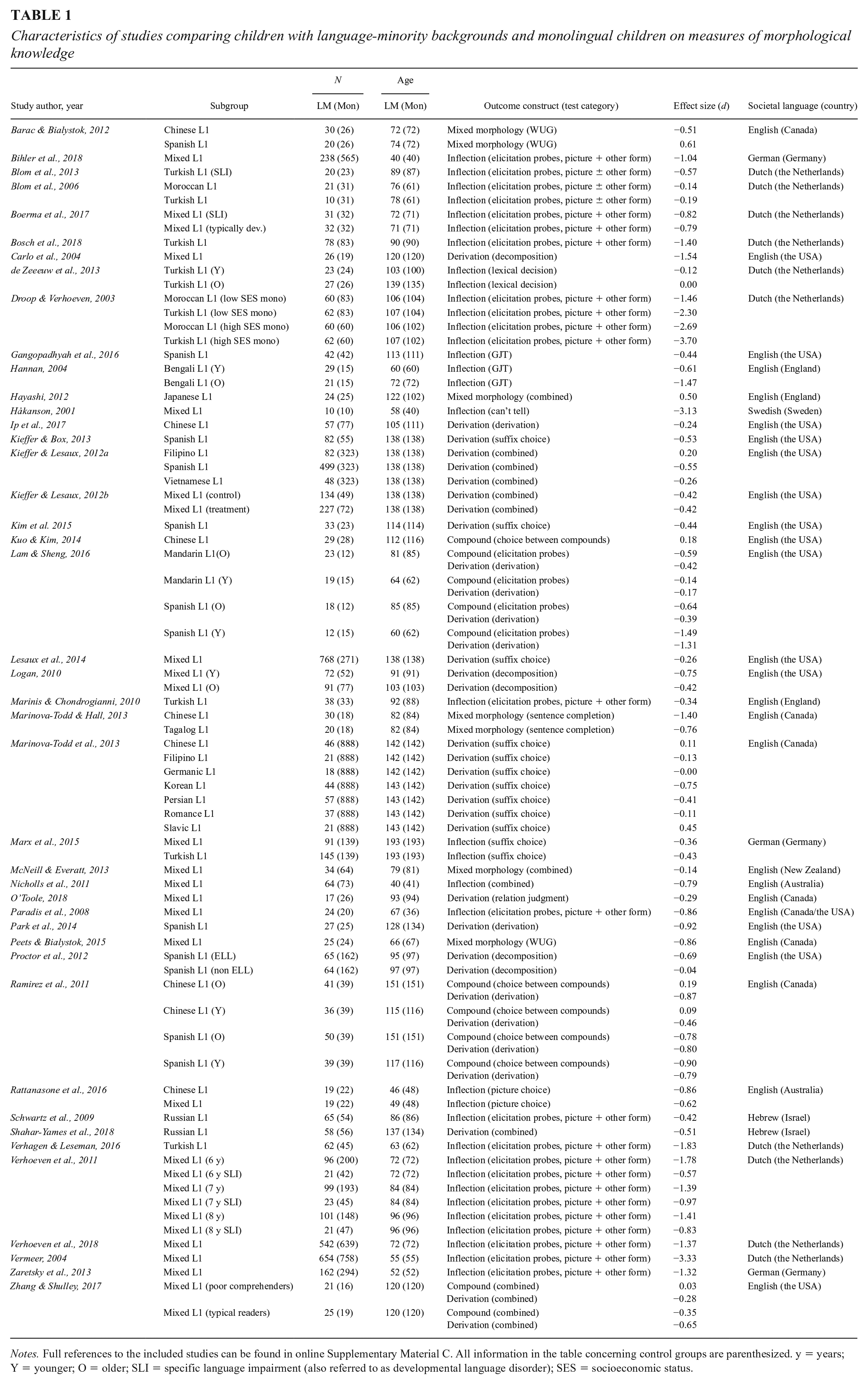
Notes. Full references to the included studies can be found in online Supplementary Material C. All information in the table concerning control groups are parenthesized. y = years; Y = younger; O = older; SLI = specific language impairment (also referred to as developmental language disorder); SES = socioeconomic status.
Comparisons of Morphological Knowledge in Children With Language-Minority and Language-Majority Backgrounds
There was a significant and moderate to large mean effect size in favor of the language-majority controls for morphology overall (g = −0.76, 95% confidence interval [CI; −0.95, −0.58], p < .0001). A sensitivity analysis showed no difference in effect size or SE with the correlational level of outcomes set to the range from 0 to 1. We also conducted an RVE analysis with hierarchical weights (online Table S6). The mean effect size was not significantly different from the analysis using correlational weights, as indicated by the highly overlapping confidence intervals (g = −0.65, 95% CI [−0.86, −0.44], p < .0001).
However, there was a very large proportion of true heterogeneity in the results from the studies included (I2 = 96.33). This implies that the overall mean effect size should be interpreted with caution. The estimate of the SD of the true effect (Tau) is 0.88; thus, we expect that some 95% of the distribution of the true effect size would fall in the range of −2.52 to 1.00 (−0.76 ± 1.76 [2 SD]). The changes in tau were trivial in the sensitivity analysis (from 0.8825 to 0.8826), indicating that this heterogeneity was stable across different correlations between outcomes. Thus, examining whether moderators can reduce this large heterogeneity in effect sizes between studies is essential.
Other Language and Literacy Measures
Figure 4 shows the mean difference between language-minority and language-majority children in the different language and literacy domains: morphological knowledge overall, inflectional knowledge and derivational knowledge separately, phonological awareness, decoding, syntactic knowledge, vocabulary, and reading and listening comprehension (see also online Table S6, Supplementary Material A). There were significant and large mean effect sizes in favor of the language-majority controls for both listening comprehension (k = 12, m = 8, g = −0.97, 95% CI [−1.28, −0.65], p < .001) and vocabulary (k = 53, m = 40, g = −1.16, 95% CI [−1.34, −0.98], p < .0001). Vocabulary showed a significantly larger effect size than morphological knowledge, but this was not the case for listening comprehension. For syntactic knowledge, there was a significant and moderate to large mean effect size in favor of the language-majority controls, similar in size to the effect for morphological knowledge (k = 26, m = 15, g = −0.79, 95% CI [−1.00, −0.57], p < .0001). For reading comprehension, there was a significant and moderate mean effect size in favor of the language-majority controls, but not significantly smaller than for morphological knowledge (k = 25, m = 13, g = −0.50, 95% CI [−0.72, −0.28], p < .001). For decoding (k = 43, m = 19, g = −0.18, 95% CI [−0.30, −0.05], p = .01) and phonological awareness (k = 27, m = 17, g = −0.19, 95% CI [−0.30, −0.07], p = .004), there were significant yet trivial mean effect sizes in favor of the language-majority controls. The mean effects on these measures were significantly lower than those for morphological knowledge, as the confidence intervals do not overlap. The I2 and tau indicated that there were considerable proportions of true heterogeneity in the results from the studies included (listening comprehension: I2 = 83.56, T = 0.39; vocabulary: I2 = 92.64, T = 0.60; syntactic knowledge: I2 = 79.51, T = 0.38; reading comprehension: I2 = 79.09, T = 0.32; decoding: I2 = 70.05, T = 0.29; phonological awareness: I2 = 51.77, T = 0.15). Still, it should be noted that there seemed to be less heterogeneity for these outcomes than for morphological knowledge. There were too few studies reporting measures of spelling to calculate a mean difference.
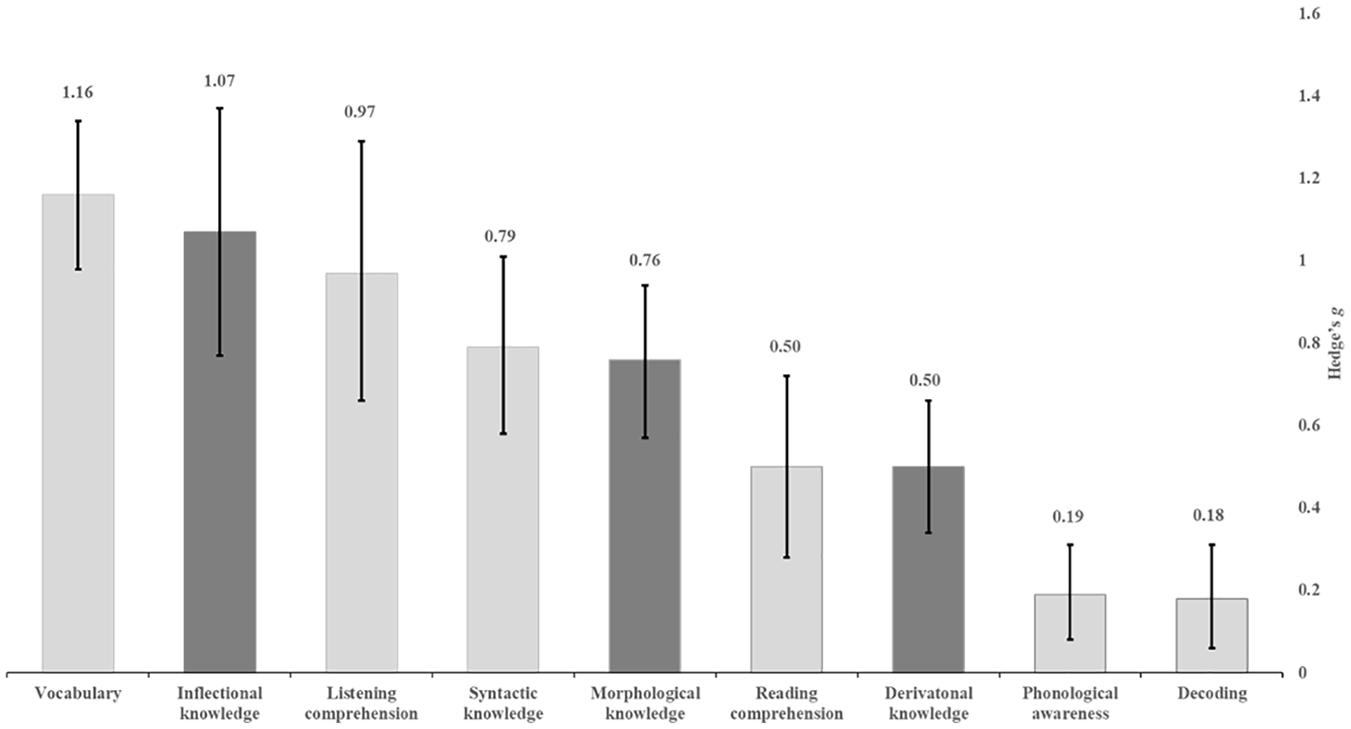
Mean difference between language-minority and language-majority children in the different language and literacy domains.
Categorical Moderators (Morphological Processes and Test Format)
Table 2 shows the results of the categorical moderator analyses. There was a reliable difference overall in effect sizes between studies assessing different morphological processes (F = 8.01, df = 12.6, p = .0067). The overall mean effect size for inflectional knowledge (k = 70, m = 29, g = −1.07, 95% CI [−1.37, −0.77], p < .0001) was large in favor of the language-majority controls, and significant. This effect size was significantly larger than for both compound and derivational knowledge (cf. nonoverlapping confidence intervals in Table 2). The overall mean effect sizes in compound knowledge (k = 18, m = 7, g = −0.22, 95% CI [−0.64, 0.21], p = .244), and derivational knowledge (k = 66, m = 21, g = −0.50, 95% CI [−0.65, −0.35], p < .0001) were small to moderate in favor of the language-majority controls, although the between-group differences did not reach significance for compound knowledge. There was a substantial reduction in heterogeneity in studies that measured derivational knowledge (T = 0.33).
Moderator analysis with categorical variables on morphological knowledge in studies that compared language-minority and language-majority children
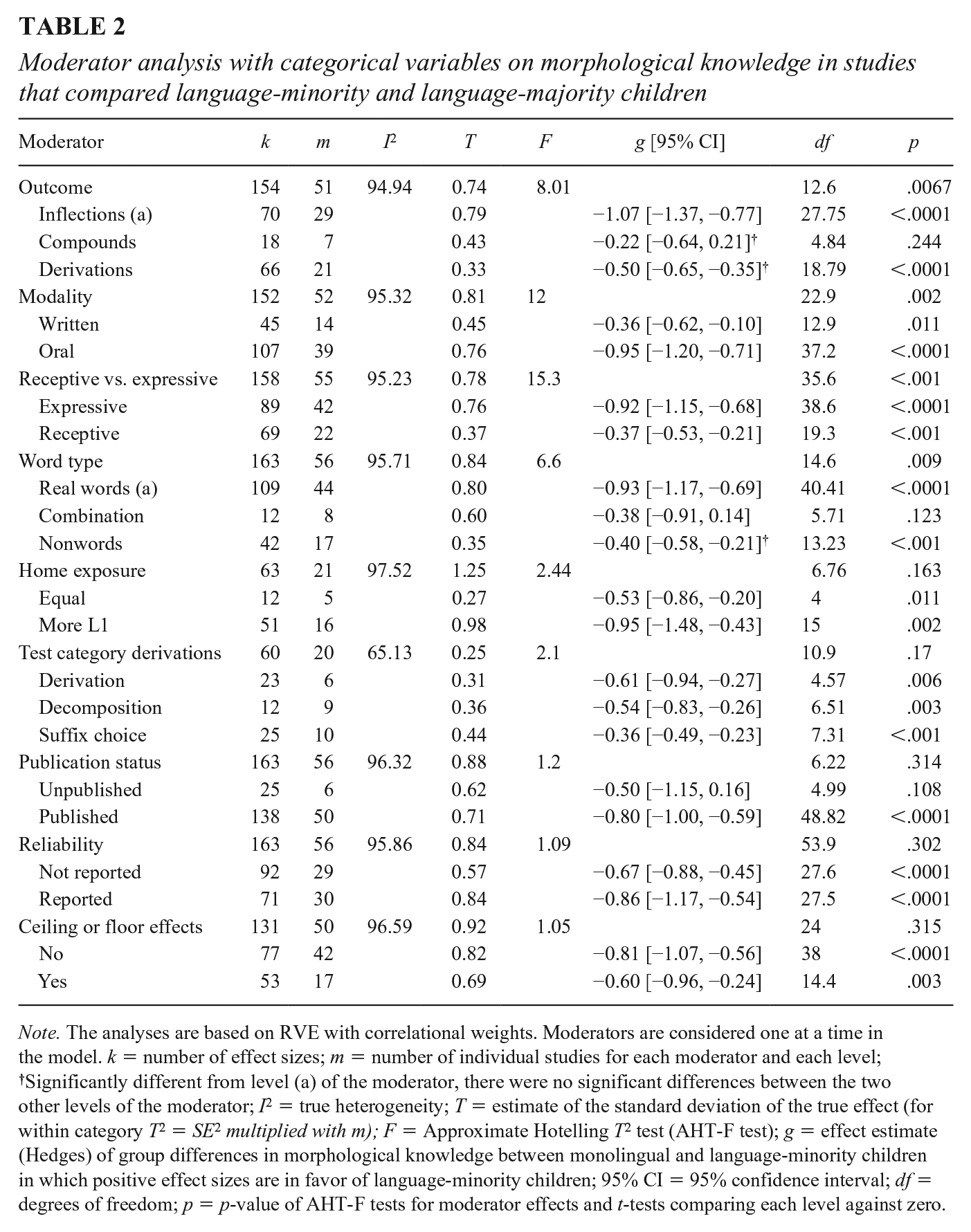
Note. The analyses are based on RVE with correlational weights. Moderators are considered one at a time in the model. k = number of effect sizes; m = number of individual studies for each moderator and each level; †Significantly different from level (a) of the moderator, there were no significant differences between the two other levels of the moderator; I2 = true heterogeneity; T = estimate of the standard deviation of the true effect (for within category T2 = SE2 multiplied with m); F = Approximate Hotelling T2 test (AHT-F test); g = effect estimate (Hedges) of group differences in morphological knowledge between monolingual and language-minority children in which positive effect sizes are in favor of language-minority children; 95% CI = 95% confidence interval; df = degrees of freedom; p = p-value of AHT-F tests for moderator effects and t-tests comparing each level against zero.
As for test- and measurement-related moderators, modality (F = 12.00, df = 22.9, p = .002), receptive versus expressive (F = 15.3, df = 35.6, p < .001), and word type (F = 6.6, df = 14.6, p = .009) were significant moderators: There were significantly larger group differences in studies that used oral tests (k = 107, m = 39, g = −0.95, 95% CI [−1.20, −0.71], p < .0001) than in studies that used written tests (k = 45, m = 14, g = −0.36, 95% CI [−0.62, −0.10], p = .011). Moreover, there were significantly larger group differences in studies that used expressive tasks (k = 89, m = 42, g = −0.92, 95% CI [−1.15, −0.68], p < .0001) than in studies that used receptive tasks (k = 69, m = 22, g = −0.37, 95% CI [−0.53, −0.21], p < .001). Finally, there were significantly larger group differences in studies that used tests with real words (k = 109, m = 44, g = −0.93, 95% CI [−1.17, −0.69], p < .0001) than in studies that used tests with nonwords (k = 42, m = 17, g = −0.40, 95% CI [−0.58, −0.21], p < .001).
Continuous Moderators (Differences in Other Language Skills and Age)
Table 3 shows that larger group differences in reading comprehension, vocabulary, and syntactic knowledge were significantly associated with larger group differences in morphological knowledge (with R2 = 0.63, 0.59, and 0.61, respectively). The year of publication was also related to the group differences in morphological knowledge, as smaller mean differences were reported in later studies (R2 = 0.14). Furthermore, language-minority children’s age was related to the size of the group differences in morphological knowledge, as group differences decreased with age (R2 = 0.32).
Moderator analysis with continuous variables on morphological knowledge in studies that compared language-minority and language-majority children
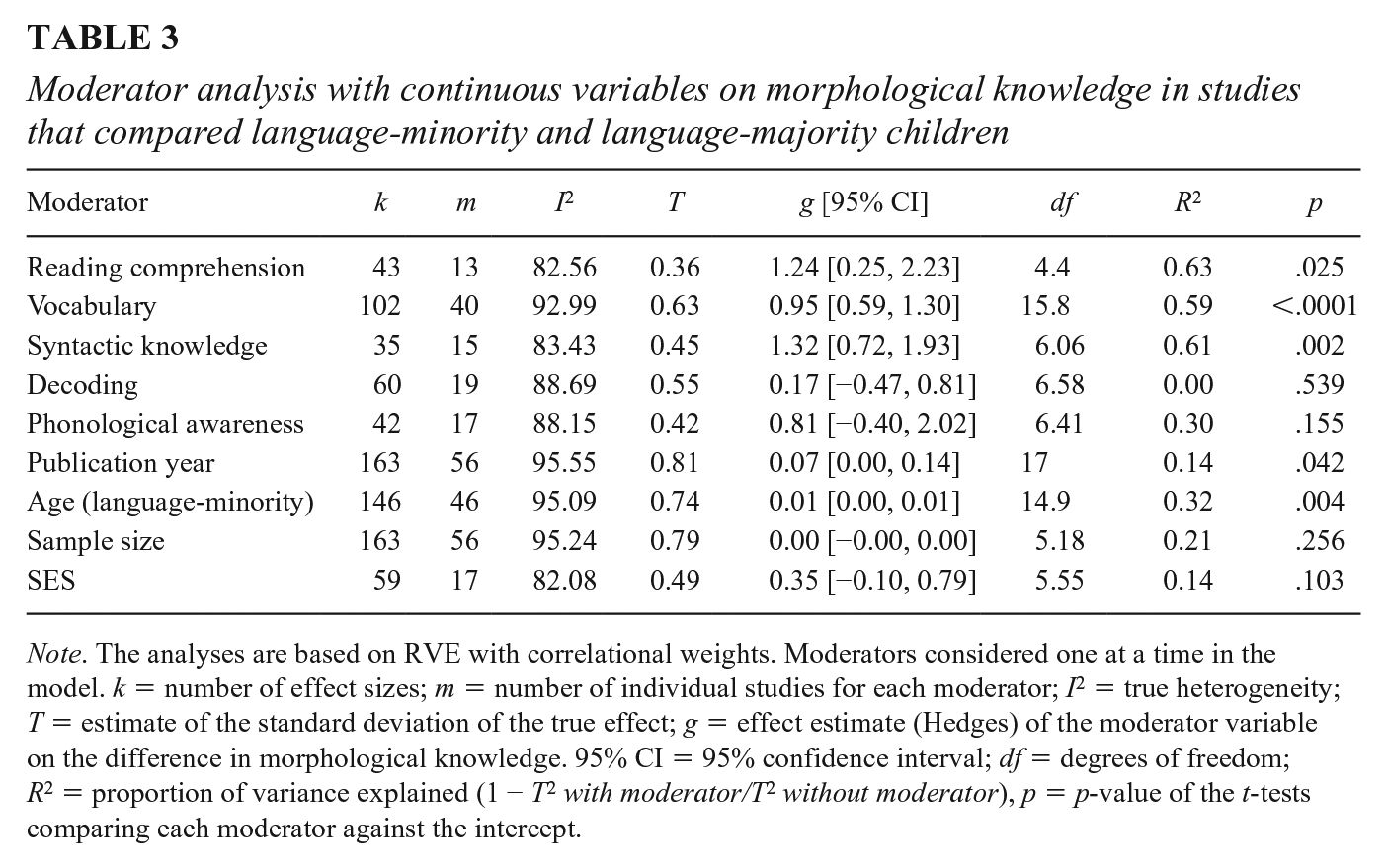
Note. The analyses are based on RVE with correlational weights. Moderators considered one at a time in the model. k = number of effect sizes; m = number of individual studies for each moderator; I2 = true heterogeneity; T = estimate of the standard deviation of the true effect; g = effect estimate (Hedges) of the moderator variable on the difference in morphological knowledge. 95% CI = 95% confidence interval; df = degrees of freedom; R2 = proportion of variance explained (1 − T2 with moderator/T2 without moderator), p = p-value of the t-tests comparing each moderator against the intercept.
Publication Bias
The results from our publication bias analyses did not indicate publication bias. For more information about the results from Egger’s regression, PET, and PEESE, see online Supplementary Material A (Table S7 and Figure S1).
Discussion
This meta-analysis and systematic review of morphological knowledge revealed several critical findings with implications for theory, methodology, and for the design of intervention studies. First, the results overall show that there were moderate to large differences in morphological knowledge in favor of language-majority children. The only language domain that showed larger group differences was vocabulary. Morphological knowledge was also strongly related to other domains of language and literacy, consistent with its proposed role as a gateway to advanced language and literacy skills. Vocabulary, syntactic knowledge, and reading comprehension all explained significant—as well as similar levels of—variation in group differences in morphology.
Furthermore, the type of morphological process mattered, as language-minority children demonstrated poorer results on inflections compared with language-majority children than they did for compounds and derivations. However, inflectional knowledge was mainly measured in younger children with presumably less exposure to the majority language, and studies of younger children reported larger group differences.
The format of the morphological test was related to the size of the group differences. Expressive morphological tests showed larger effects than receptive measures, and morphology tests with real words generated larger group differences than those with nonwords. Oral measures also showed larger effects than written measures. However, the larger differences for oral tests and those with real words may be due to age, as studies with younger children typically used oral tests with real words.
Differences in Morphological Knowledge and the Relation to Other Language and Literacy Skills
The moderate to large mean group difference in morphological knowledge implies that it is not only the well-studied word- and sentence-level language skills that constitute a challenge for language-minority children, but that this group also faces challenges at the sub-word level. The differences in morphological knowledge were larger than the differences in code-related skills, implying that the semantic and grammatical features of morphological tasks may represent a larger challenge for language-minority children than the combinatorial skills that are shared between morphological and code-related tasks. Compared with morphological knowledge, the group differences were significantly larger for vocabulary, whereas differences in reading comprehension, listening comprehension, and syntactic knowledge were on a similar level as morphological knowledge. These results are in line with the pattern found in previous reviews (e.g., Melby-Lervåg & Lervåg, 2014; Zhao et al., 2016), with larger group differences in meaning-based skills such as vocabulary, and smaller group differences in phonological awareness and code-related skills. In sum, our findings suggest that language-minority children do not seem to pick up morphological knowledge at a level comparable to their language-majority peers simply through ordinary universal classroom instruction.
However, it is important to emphasize that we found large variability in results between studies, and thus moderating factors need to be considered. Group differences in meaning-based language skills moderated the differences in morphological knowledge: Smaller group differences in vocabulary, syntactic knowledge, and reading comprehension were associated with smaller differences in morphological knowledge. Conversely, group differences in phonological awareness and code-related skills were not related to the group differences in morphological knowledge. Thus, our results support an interpretation of morphological knowledge as more closely associated with meaning-based skills than with code-related skills. This interpretation is consistent with findings from Hjetland et al. (2019) and Storch and Whitehurst (2002), who found that code-related skills and general language skills (semantics and grammar) were separate but correlated abilities.
In sum, the examination of different domains of language and literacy revealed that language-minority children appeared to have uneven linguistic profiles in the societal language. Morphological knowledge was a relative weakness. However, the between-study variance was large, and group differences in other meaning-based language skills were strong moderators of the size of the group difference in morphological knowledge. Below, we discuss the significance of additional moderating factors.
Variation in Group Differences Across Morphological Processes and Age
A second main finding in the current meta-analysis is that there were reliable differences between studies of the different morphological processes. There were larger differences between language-minority and language-majority children in studies assessing inflectional morphology compared with studies assessing the other morphological processes, derivation, and compounding. Given previous meta-analyses, which have found the largest differences between language-minority and language-majority children in meaning-based language skills (Melby-Lervåg & Lervåg, 2014), it could be regarded as surprising that group differences were larger for inflections than for other morphological processes, which carry more lexical-semantic information. On the other hand, our findings are in line with a recent study reporting that there were still differences between language-minority and language-majority learners in inflectional knowledge after more than 7 years of schooling in the societal language (Soto-Corominas et al., 2020), suggesting that this morphological process may represent a particular challenge for language-minority children.
In our sample of studies investigating inflectional knowledge, there was an emphasis on younger children, as only three of the 29 independent comparisons had samples of children over the age of 9 years. Consequently, we did not have a large enough sample of studies with older school-aged children to test whether there were smaller differences in this group compared with samples of younger school-aged children. However, a recent study of Turkish-German bilinguals found native-like derivational processing in the societal language regardless of the age of acquisition, whereas inflectional processing was only native-like for those who started to acquire the societal language in the preschool years (Veríssimo et al., 2018). Thus, further studies on the development of inflectional knowledge in school-aged language-minority children are warranted. This is particularly important as there is typically less focus on inflectional knowledge than derivational knowledge in school, as oral use of inflections often is assumed to be mastered by school entry.
Although the differences in inflectional knowledge were larger, the differences in derivational knowledge were also substantial. Compared with inflections, which are abundant in informal language, many derivations are more frequent in written and academic language. Thus, derivational knowledge may have a more important role in the later school years, particularly for literacy skills (Carlisle, 2000; Kieffer & Lesaux, 2008). Interventions targeting language-minority students’ derivational knowledge are receiving increasing attention (e.g., Goodwin, 2016; Lesaux et al., 2014), but further experimental studies are required to examine their effects on more advanced literacy skills.
Studies with younger language-minority children yielded larger differences in morphological knowledge than studies with older learners, on average. However, we suspect that confounding factors, such as the amount of exposure to the societal language, may partly explain this finding: Older children have likely received more systematic exposure to, and explicit instruction in, the societal language at school, which may even out initial differences. Unfortunately, the only reported information about societal language exposure we could use in the analyses was concurrent home exposure, which was not a significant moderator. Separating effects of language exposure and age is thus an issue for future studies.
A second putative confound to age was test modality, as younger children were usually assessed in the oral modality and older children were more often assessed in the written modality. The difference between oral and written tests leads us to our third main finding, which concerns measurement characteristics as moderators.
Variation in Group Differences Across Different Measurement Formats
The third main finding was the association between measurement format and group differences between language-minority and language majority children. The way morphological knowledge was measured varied substantially between studies, in terms of the modality of the test (written vs. oral), whether the task involved words or nonwords, and the format of the test (expressive vs. receptive task).
One measurement characteristic that was associated with differences in the effect size between studies was test modality. We found smaller differences between language-minority children and language-majority peers in studies that used written tasks. Performance on written tasks depends on the child’s orthographic knowledge and decoding skills in addition to their oral language skills. Language-minority children have a relative advantage in decoding compared with other language and literacy skills, and they may use this ability to compensate for lower language comprehension skills. This interpretation is in line with the meta-analysis by Melby-Lervåg and Lervåg (2014), in which there were larger differences between second language learners and their language-majority peers in language comprehension tasks than in reading comprehension tasks. The same pattern of results was found when comparing differences in language comprehension and reading comprehension in the current meta-analysis.
A second measurement characteristic associated with differences in the effect size between studies was the real word versus nonword distinction, with larger differences in studies that used real words. In real-word tasks, children may exploit their previous experience with word meanings and their encounters with several morphologically related forms of the target words (Shahar-Yames et al., 2018). Accordingly, the achievement differences between language-minority and language-majority children may be enhanced in studies with real words, because such tasks make more demands on lexical knowledge, which we know is an area of weakness in language-minority children. However, even tasks with nonwords will draw on other language abilities to some extent. Thus, performance for language-minority children is likely to be poorer even in tasks involving nonwords.
A third measurement characteristic that was associated with differences in the effect size between studies was the expressive-receptive distinction. There were larger group differences in studies that used expressive tasks compared with studies using receptive tasks. Tasks that require children to produce an answer may be more demanding than receptive tasks, which involve some sort of a judgment or a choice. A developmental sequence in which judgment tasks are mastered before production tasks has been found in Norwegian and Greek language-majority children (Diamanti et al., 2018; Grande & Diamanti, 2019). However, the discrepancy could also be due to factors specific to bilingual language acquisition, as studies have found production-comprehension asymmetries for tense morphology and vocabulary (Chondrogianni & Marinis, 2012; Gibson et al., 2012; Ionin & Wexler, 2002).
Future Directions
The results and analyses in a meta-analysis will always be restricted to the information that is reported in the included studies. Future studies of morphological knowledge in language-minority children should report data on potentially important moderators that we were unable to examine properly in the current study, such as language-minority children’s L1 skills, exposure to L2, SES, immigration status, and the reliability of measures. In fact, less than half of the included studies reported reliability of their measures. Since poor reliability attenuates bivariate relationships and has unpredictable consequences in multivariate studies (Cole & Preacher, 2014), reliability measures should be included in the standard reporting requirements for research papers in this field.
The present study examined morphological knowledge in the societal language only. Thus, we cannot draw any conclusions about the morphological knowledge of language-minority children in their L1. Moreover, many of the studies in the current review included language-minority children with heterogeneous language backgrounds, and among the studies that examined language-minority children with homogeneous language backgrounds, many different language groups were represented. In the current meta-analysis, specific minority-majority language combinations were not associated with the size of group differences in morphological knowledge. Specifically, there were no significant differences between studies of Chinese L1 children acquiring English, Spanish L1 children acquiring English, or Turkish L1 children acquiring Dutch (see online Supplementary Material A for these results). The results are somewhat surprising, given that several studies have found that similarities between language-minority children’s L1 and L2 are associated with better morphological proficiency in their L2 (e.g., Barac & Bialystok, 2012; Lam & Sheng, 2016; Paradis, 2011; Ramirez et al., 2011). Therefore, there is a need for more studies of the effects of L1–L2 similarities on language-minority children’s L2 morphological knowledge.
A critical next step for the field is to investigate knowledge of different morphological processes (inflection, derivation, compounding) within the same samples of language-minority and language-majority children, in different age groups and in longitudinal studies. Such research is necessary to determine whether inflectional, compounding, and derivational knowledge are separate constructs with different developmental trajectories and different influences on vocabulary and reading development. The results from such studies will have practical implications for the development of intervention programs and can help answer which morphological processes that should be targeted in interventions at different ages.
Few of the included studies report more than one measure of morphological knowledge with different test characteristics. To capture the development in morphological knowledge in language-minority children, it is important to include test formats where progress is not masked by other limitations such as restricted vocabulary or poor oral skills. Notably, none of the tests that were used in the included studies required the children to convey the meaning of multimorphemic words or affixes (as in the definition task used in, e.g., Carlisle, 2000). Instead the tests focused on combinatorial skills (e.g., adding or subtracting affixes). Hence, the tests included in the meta-analysis did not test the depth of semantic knowledge of morphemes, which presumably develops with reading experience in the school years. The optimal approach would, therefore, be to include a battery of different types of morphological tests, ideally comprising both oral and written tasks, combinatorial and semantic skills, receptive and expressive tasks, and including measurement formats with minimal vocabulary demands, such as nonword tasks (see, e.g., Levesque et al., 2019; Smolka et al., 2019).
Including a battery of different types of morphological tasks would also enable modeling with latent variables. Very few of the studies included in this meta-analysis use results from several measures to create a latent morphological knowledge variable. Latent variables can reduce problems with measurement error, and also, if the tests are of the same format, help disentangle methodological variation and construct-specific variation, so that dimensionality can be examined. Our results indicated more heterogeneity in results for morphological knowledge than other domains of language such as phonological awareness, syntactic knowledge, and vocabulary, which may indicate that there are several dimensions to morphological knowledge. Previous studies of the dimensionality of morphological knowledge in both language-minority and language-majority children are inconclusive as to whether it is a multidimensional (Goodwin et al., 2017) or unidimensional construct (Muse, 2005; Spencer et al., 2015), and whether it is a separate but correlated construct from vocabulary and syntax (Kieffer et al., 2016; Neugebauer et al., 2015; Tighe and Schatschneider, 2015) or a part of a larger vocabulary construct (Spencer et al., 2015).
Note that the majority of the moderator analyses reported here are bivariate and cannot be interpreted causally, because third variables and confounders might be involved. We have also included a rather large set of moderators, and this increases the Type 1 error rate. Future experimental studies will likely be able to pinpoint important factors that influence morphological development and thus enable meta-analyses to focus on a narrower set of theory-based moderators. An especially interesting moderator in this regard would be the amount and quality of instruction in morphology, and whether the instruction targets language-minority children specifically.
Conclusion
Although morphology is receiving increased attention, it appears to be one of the least studied language domains in language-minority children. This is a paradox because morphemes, the basic building blocks of many academic words, may serve as a gateway to advanced language and literacy skills. This meta-analysis shows that it is important not to neglect this key area of language development. There are substantial group differences in morphological knowledge between language-minority and language-majority children favoring language-majority children. Consequently, future studies should examine the effects of including morphological components in language interventions. As morphology is a combinatorial system, working with morphemes also holds potential for generalizability. As a lack of knowledge transfer is a major challenge for vocabulary-oriented interventions (Elleman et al., 2009; Marulis & Neuman, 2010; Rogde et al., 2019), incorporating morphology may offer substantial improvements to such interventions. This is a promising avenue of research that should be explored in future studies.
Supplemental Material
sj-pdf-1-rer-10.3102_00346543211073186 – Supplemental material for Morphology—A Gateway to Advanced Language: Meta-Analysis of Morphological Knowledge in Language-Minority Children
Supplemental material, sj-pdf-1-rer-10.3102_00346543211073186 for Morphology—A Gateway to Advanced Language: Meta-Analysis of Morphological Knowledge in Language-Minority Children by Siri Steffensen Bratlie, Ellen Irén Brinchmann, Monica Melby-Lervåg and Janne von Koss Torkildsen in Review of Educational Research
Supplemental Material
sj-pdf-2-rer-10.3102_00346543211073186 – Supplemental material for Morphology—A Gateway to Advanced Language: Meta-Analysis of Morphological Knowledge in Language-Minority Children
Supplemental material, sj-pdf-2-rer-10.3102_00346543211073186 for Morphology—A Gateway to Advanced Language: Meta-Analysis of Morphological Knowledge in Language-Minority Children by Siri Steffensen Bratlie, Ellen Irén Brinchmann, Monica Melby-Lervåg and Janne von Koss Torkildsen in Review of Educational Research
Supplemental Material
sj-pdf-3-rer-10.3102_00346543211073186 – Supplemental material for Morphology—A Gateway to Advanced Language: Meta-Analysis of Morphological Knowledge in Language-Minority Children
Supplemental material, sj-pdf-3-rer-10.3102_00346543211073186 for Morphology—A Gateway to Advanced Language: Meta-Analysis of Morphological Knowledge in Language-Minority Children by Siri Steffensen Bratlie, Ellen Irén Brinchmann, Monica Melby-Lervåg and Janne von Koss Torkildsen in Review of Educational Research
Footnotes

Notes
Authors
SIRI STEFFENSEN BRATLIE, PhD, is now a postdoctoral research fellow at the Department of Education at the University of Oslo, Sem Sælands vei 7, 0371 Oslo, Norway; email:
ELLEN IRÉN BRINCHMANN, PhD, is an associate professor at the Department of Special Needs Education at the University of Oslo, Sem Sælands vei 7, 0371 Oslo, Norway; email:
MONICA MELBY-LERVÅG, PhD, is a professor at the Department of Special Needs Education at the University of Oslo, Sem Sælands vei 7, 0371 Oslo, Norway; email:
JANNE VON KOSS TORKILDSEN, PhD, is a professor at the Department of Special Needs Education at the University of Oslo, Sem Sælands vei 7, 0371 Oslo, Norway; email:
References
Supplementary Material
Please find the following supplemental material available below.
For Open Access articles published under a Creative Commons License, all supplemental material carries the same license as the article it is associated with.
For non-Open Access articles published, all supplemental material carries a non-exclusive license, and permission requests for re-use of supplemental material or any part of supplemental material shall be sent directly to the copyright owner as specified in the copyright notice associated with the article.
