




Abstract
Young children (birth to age 5) are more likely to be expelled or suspended than school-aged children, but we know comparatively little about the precursors to and prevention of exclusion in early childhood settings. Furthermore, what research has been conducted has not been systematically synthesized to inform policy and funding decisions. The present review seeks to determine how early childhood exclusion is defined and assessed in the academic literature. Studies measuring early childhood suspension or expulsion were systematically gathered and coded for study characteristics, definitions, and measures of exclusionary discipline and disparity, and factors associated with exclusion rates. Results (n = 20) show an accelerating pace of inquiry that attends to multiple levels of the ecological system (children, teachers, and programs) across diverse settings (home-, center-, and school-based care). Additional research that draws on data spanning multiple types of early care and education settings is needed to inform legislation and intervention funding decisions.
Research has consistently shown that high-quality early childhood education significantly improves children’s social-emotional skills and readiness to learn at school (Meloy et al., 2019; Yoshikawa et al., 2013). However, 250 children are excluded from learning every day because they struggle to manage strong emotions or control their behavior (Zeng et al., 2019). Children are more than three times as likely to be expelled from early child care and education (ECCE) settings than from kindergarten through 12th grade. Yet, we know comparatively little about the causes, consequences, and interventions to prevent the exclusion (e.g., suspension and expulsion) of our youngest learners. One of the many unfortunate consequences is that the very children expelled for behavioral reasons are often those who can benefit the most from preschool (Murano et al., 2020).
Although we have numerous systematic reviews of elementary and secondary school discipline (e.g., Fisher & Hennessy, 2016; Novak, 2018; Valdebenito et al., 2018; Welsh & Little, 2018), no unifying resource draws together the parallel literature in ECCE. Instead, research on early childhood exclusion is siloed across numerous disciplines (e.g., social work, educational psychology, infant mental health), mirroring the disconnected delivery systems and funding mechanisms of ECCE (e.g., home-, center-, and school-based programs blending private, state, and federal dollars). Therefore, the present systematic review seeks to draw together these disparate studies on early childhood exclusion and describe our current understanding of this early adverse experience. Specifically, with this review, we aim to (1) collate and synthesize the methods of studies explaining or predicting exclusion of children aged birth to 5 from ECCE settings; (2) report definitions, rates of, and disparities in exclusion across the accumulated literature; and (3) categorize and describe evidence of associations predicting ECCE exclusion. Such a review is critical to guide investments in future research and intervention efforts, inform policy and funding decisions, and shed light on which voices have been privileged in the extant literature.
Infants, Toddlers, and Preschoolers Are Suspended and Expelled
It has been more than 20 years since the first report of child care and preschool programs pushing children out because their behavior was deemed too challenging. While more reports and studies have been published, the problem itself has not dissipated. A study from the 1998 school year in the Detroit, Michigan, area found that 27.5 out of every 1,000 preschoolers were expelled in the past school year because the program felt it could not handle the child’s behavior (Grannan et al., 1999). Around the same time, Cutler and Gilkerson (2002) reported that nearly a third of Illinois’ infant and toddler child care providers had recently expelled children for behavioral concerns.
The 2005 white paper by Walter Gilliam first brought large-scale attention to the frequency of early childhood expulsion. In their sample of 4,000 public prekindergarten classrooms across the country, they found a national average rate of exclusion outpacing that of public elementary and secondary schools three-fold. Almost a decade later, data from the U.S. Office for Civil Rights in the Department of Education (which only just started including school-based prekindergarten in their annual collections in 2011–2012) showed that the relative rates were unchanged (U.S. Department of Education Office for Civil Rights, 2014). Preschool still represents the highest-risk period for expulsion and suspension in a child’s educational journey.
Furthermore, this 2014 report showed alarming gender and racial disparities regarding who gets disciplined. These disparities are the same as those commonly observed in older ages (Welsh & Little, 2018). Even though boys only make up 54% of children enrolled in public prekindergarten, they were 79% of those suspended. Black children make up only 18% of those enrolled but were 42% of those suspended. Half a decade later, unfortunately, this trend still holds. In the 2017–2018 school year, Black boys make up 18% of the male preschool enrollment, but 41% of male preschool suspensions, and Black girls make up 19% of female preschool enrollment but accounted for over 50% of female suspensions (Fabes et al., 2020).
Although there have been numerous state agency reports, policy briefs, and white papers produced providing descriptive data on ECCE exclusion, it is unclear whether and to what extent this topic has received attention from academic researchers and how inferential analyses and rigorous designs have yielded insight into the causes of exclusion and disparities in discipline practice.
Defining Exclusion
In this text, we use the term exclusionary discipline to encompass various ways children can be removed from a child care or preschool arrangement for behavioral reasons. Some of the most common explanations for the program’s exclusion of a child is that they are too disruptive (e.g., excessive crying, inattention, and inability to follow directions) or too dangerous (e.g., biting, hitting, or otherwise harming themselves, other children, or staff; Conners-Edge et al., 2018, Martin et al., 2018; Zinsser et al., 2021). Challenging behaviors are quite normative, occurring in 10% to 30% of children between the ages of 2 and 5 (Dunlap et al., 2006; Vinh et al., 2016).
Many researchers have adopted the school-based language of “suspension” and “expulsion,” but ECCE practitioners themselves rarely use these terms. Instead, one may hear discussions of a child not being a “good fit” with the program or being counseled out (Zinsser, Main, et al., 2019; Zinsser, Silver, et al., 2019). Families can also be pushed out of care through a process deemed “soft expulsion.” In these instances, rather than telling a family not to return, programs will engage in practices to make the care arrangement untenable, leaving the family with little choice but to withdraw their child. For example, a program may repeatedly call parents to pick their child up early because of their behavior, forcing them to leave or miss work. Whether or not studies include all or just some of these forms of exclusionary discipline will influence the rates reported. Likewise, the way that exclusion is described in survey and interview questions can influence reported rates by program staff who may not ascribe to the belief that their exclusion of a child counts.
Consequences of Exclusion
Whether a parent is told explicitly not to return or voluntarily withdraws their child to avoid repeated harassment and hostile interactions, in all instances, the child is forced out of a setting to which they had grown accustomed. They are also potentially subject to the immediate and long-term negative consequences associated with suspension and expulsion. Although research into the exact consequences of early childhood exclusion is minimal, we know from the study of older children that implications can be academically and psychologically severe and touch the lives of families and communities at large.
By definition, school exclusion means removing a child from a structured learning environment, thereby decreasing their opportunities to keep up academically. A recent meta-analysis synthesizing over 30 studies of suspension between 1986 and 2012 (mostly in middle school and high school samples; Noltemeyer et al., 2015) demonstrated that even temporary removals from school (fewer than 10 days) were significantly and negatively associated with students’ achievement test scores. In a more recent examination using over a decade worth of school records, Anderson et al. (2019) compared the impacts of the type of discipline on test scores for students in Grades 3 to 8 and grade retention for students in Grades 9 to 12 and found that more exclusionary and reactive approaches (e.g., out of school suspension) were associated with significantly more negative outcomes than less exclusionary practices (e.g., parent conferences), even controlling for the type of behavior and prior test scores. Exclusionary discipline likely plays a role in the widening of achievement gaps (Arcia, 2006; Christle et al., 2007; Chu & Ready, 2018; Lee, 2016). Given that such gaps already exist at kindergarten entry (Loeb & Bassok, 2012), it is important to consider whether, why, and how children are experiencing exclusion during the critical developmental period of early childhood.
Being excluded, either temporarily or permanently, is also associated with students losing affinity for school. Unsurprisingly, in older samples, this alienation is linked to students dropping out altogether (Archambault et al., 2009). This social-emotional learning time loss is incredibly costly in early childhood, a critical period for developing skills related to emotion recognition and regulation and forming and maintaining relationships (Denham et al., 2012). Studies with older students have demonstrated how feeling scorned and unwelcome can negatively impact motivation and achievement, especially for students of color (Walton & Cohen, 2007). This negative feedback loop results in an uptick in unwanted behaviors as children who are suspended or expelled react poorly to feeling unwelcome at school and miss out on meaningful socialization opportunities (Li et al., 2020).
Longitudinal studies of older excluded students show that repeatedly suspended children were eight times more likely to be incarcerated than those never suspended (Shollenberger, 2013). Because students who have been suspended or expelled are more likely to struggle academically and drop out, they are more likely to experience financial insecurity (Waldfogel et al., 2007). There is also correlational evidence connecting school exclusion and later substance use and abuse (Townsend et al., 2007). Although many of these frightening outcomes may feel far removed from the preschool classroom, early experiences of exclusion may trigger a cascade of negative interactions with schools, increasing the risk of future exclusions.
Much of the research reviewed above is correlational in nature and cannot produce causal estimates linking school removals and unfavorable outcomes. More recent studies leveraging unique longitudinal data sets are addressing this gap in the K–12 literature. For example, Hwang (2018) controlled for unobservable time-invariant child characteristics in a large sample of middle and high school students and replicated the previously reported links between school suspension and poorer academic performance (Morris & Perry, 2017). Likewise, Petras’ (2011) use of longitudinal data from first graders showed that children’s first school removal was predicted by their initial individual and classroom levels of aggression. Robust designs will be critical to continuing to advance our understanding of the behavioral and contextual dynamics that may be involved in the school removal process at any age. Looking across these studies of the consequence of exclusion, however, it is clear that the earlier the pattern of exclusion is established, the more likely children are to be expelled in elementary school, resulting in greater losses in cumulative instructional time and more significant achievement gaps separating removed children from their included peers, particularly during critical development periods.
The Ecology of Exclusion
Children’s exclusions are the result of a series of adult decisions that themselves are informed by context. We can use the ecological systems theory (Bronfenbrenner & Morris, 2006) to structure our exploration of the multitude of factors potentially influencing children’s exclusion, including teachers’ perceptions of and responses to behavior. The use of this framework is in line with discussions of exclusion at later ages (e.g., Theriot et al., 2010; Zinsser & Wanless, 2020). Although ECCE settings differ from K–12 environments in many ways, they are at their core educational settings situated in communities that utilize relationship-based instruction to promote student learning. As such, we can expect to see empirical attention to similar factors across levels of the ecological model (e.g., student characteristics [Wallace et al., 2008], teacher perception and motivation [Skiba et al., 1997; Watson & Stevenson, 2019], school policy and administrator characteristics [Raffaele Mendez et al., 2002; Skiba et al., 2014; Theriot et al., 2010]). In ecological systems theory, children’s development is conceptualized as occurring in and being influenced by various contexts. Transactions within and between spheres of influence can, directly and indirectly, influence a child’s lived experience (Bronfenbrenner, 2005). For this review, we use the ecological systems theory levels to organize our synthesis of factors related to ECCE exclusion (i.e., the micro-, meso-, and exo-systems).
At the microsystems level, children’s development is influenced by the immediate resources and relationships in their home and the interaction of those proximal factors with individual characteristics. For our purposes, these included individual characteristics of the child or her family and reported experiences or home-life conditions. The mesosystem “comprises the linkages and processes taking place between two or more settings containing the developing child” (Gauvain & Cole, 2005, p. 6) and therefore encompasses relationships between home and school. Mesosystems have also been described as a system of microsystems. Under this interpretation, we conceptualize the mesosystem as including the experiences and characteristics of the nonfamilial peers and adults (i.e., classrooms and teachers) interacting with the child and family.
The final component of the ecological model that we consider in this review is the exosystem, which has been described as the setting or level at which “the occurrence of events indirectly influences processes within the immediate setting” (Gauvain & Cole, 2005, p. 6) of the child. We conceptualize the exosystem as comprising program-level factors such as administrative practices and policies and the investment in or procurement of resources for classroom use.
We anticipate that program-type (home-, center-, or school-based ECCE) could be an important factor to consider, given their structural differences. Home-based programs typically consist of one or two adult caregivers in a private home and serve a small mixed-aged group ranging from infants to elementary-aged children before and after the school day. Center-based care—whether for- or not-for-profit—often serves a greater proportion of preschool-aged children in classrooms divided by age. Centers can vary substantially in size and resources ranging from small two-room programs to larger publically funded Head Start programs with 15 to 20 classrooms. Compared with home-based programs, these centers have more formalized curricula, but teacher education and licensure requirements vary substantially state to state. School-based ECCE programs typically consist of prekindergarten programming for 4-year-olds housed within elementary school buildings. They tend to be more formalized than community-based ECCE, have a set curriculum, and have access to the mental and behavioral health service of a school district. School-based teachers often hold credentials or licenses and receive compensation on par with other district personnel (including union membership; Zinsser, Zulauf, et al., 2019). These setting-level differences, especially in access to resources and formal training requirements, could play an important role in how ECCE programs respond to children’s behavioral needs.
If represented in our studies, this may also include local or state-level policies and licensing requirements as they indirectly shape the ECCE setting in which the child is developing. Notably, Bronfenbrenner’s model includes two additional levels: the macrosystem, which describes overarching aspects of culture, and the chronosystem, which describes changing sociohistorical circumstances. Because each involves contextual factors that evolve over extended periods of time (e.g., generations), we do not anticipate identifying research that captures phenomena at these levels.
By categorizing assessed factors related to exclusion at each ecological level, we can identify gaps in the literature, representing opportunities for greater study or blind spots in our understanding of the phenomena.
The Policy Context
Another key contextual factor that makes this systematic review so urgent is the rapidly changing federal and state policy landscape. The 2014 Child Care Block Grant (CCBG) Act stipulates that state beneficiaries must reduce exclusion rates (Child Care and Development Block Grant Reauthorization Act, 2014). To comply, school districts and states across the country are finding ways to ban young children’s suspension and expulsion from preschool and early learning programs. For example, Chicago Public Schools banned the use of out-of-school suspensions in response to young children’s behavior (preschool through second grade). Some states, such as Colorado and Louisiana, address expulsion by denouncing the practice in administrative guides and reporting and reimbursement requirements. At least 15 other states have passed or are working toward passing legislation. States differ in the types of programs they target with these efforts (e.g., only school-based pre-K or publicly funded child care), the steps they mandate programs take, and their reference to implicit bias and disciplinary disparities (Grossman-Kahn et al., 2018; Padilla et al., 2020). Though such groundbreaking legislative momentum is exciting, many of the laws aiming to ban exclusions have been passed quickly and are not grounded in research. They are legislators’ “best-guesses” on how to solve this problem. As more states seek to adopt policies and strategies to reduce overall exclusion rates and mitigate disparities, policymakers will look for evidence to guide their allocation of funds. This review will synthesize what is known and what remains unknown about factors associated with ECCE exclusion.
Present Study
Regardless of how children are excluded from ECCE settings, these practices deprive children of valuable early learning experiences and place them at risk of disengagement and diminished educational opportunities. There is a bipartisan agreement (Silver et al., 2021) that children should not be expelled or suspended from ECCE, yet it continues to happen to thousands of young children every year. Investments are being made at record levels into ECCE infrastructure, professional development, and social and emotional learning programming, but without empirical evidence informing policy crafting, these investments may be misguided.
The present study will systematically gather and synthesize the peer-reviewed literature explaining or predicting exclusion of children ages birth to five from ECCE settings early childhood exclusion. Specifically, we address the following research aims: (1) describe the methods employed in the study of ECCE exclusion, (2) examine how definitions of exclusion and reported rates of exclusion differ across studies, and (3) synthesize study findings to highlight factors associated with exclusion at each level of the ecological model. Our review will identify areas of convergence in the literature and gaps in need of further attention.
Methodology
Search Parameters
The initial search was conducted in March 2020 but was repeated in October of that year when the analysis was delayed due to the COVID-19 pandemic. Below, we describe the search parameters used and numbers across both searches. Using PsycINFO and Web of Science, a set of location terms (e.g., early childhood, preschool, pre-K, child care, daycare, home care, family child care) were paired with an exclusion term (e.g., expulsion, suspension) for a total of 14 unique search terms entered into each search engine. While there are additional terms colloquially used to refer to expulsion and suspension practices as defined above (e.g., pick-ups, dismissal, push out), these terms also refer to many unrelated phenomena yielding hundreds of irrelevant articles. Although there were no restrictions imposed on publication year, all included publications were dated from 2006 to 2020, again highlighting this work’s recency. Acceptable publications included empirical, peer-reviewed studies and excluded book chapters and published theses and dissertations. Across these databases, 610 articles were discovered, of which 61 were duplicates found in both search engines, leaving us with 549 abstracts to review more closely.
Inclusion and Exclusion Criteria
To address our specified research questions, studies were screened to ensure they met our inclusion criteria. Specifically, studies were included if they (1) included a sample of either children under the age of 6 living in the United States or early childhood care and education programs located in the United States; (2) included a measure of exclusion (e.g., suspension, early pick-ups, or expulsion) or exclusion risk (e.g., teachers’ requests of expulsion or perceived expulsion risk); and (3) were published in English in a peer-reviewed academic journal. These criteria were used because of the nature of the phenomenon we are studying. The exclusion of older samples or the use of those practices in programs serving older children have already been thoroughly reviewed (e.g., Welsh & Little, 2018). We geographically restrained our sample to only U.S.-based programs because ECCE structures vary drastically by country, and federal guidance on expulsion only pertains to this country. In order to address factors associated with exclusion, studies needed to include some measure of the phenomenon; however, as is described below, we broadened our criteria here to additionally include studies assessing expulsion risk. This is justified because it is a precursor measure, and its inclusion could help reveal upstream factors to consider. The present study reviews only studies that have undergone peer review and does not include those in the “gray literature,” such as white papers and reports by state agencies. Articles were not excluded based on methodology, and the current review includes quantitative, qualitative, and mixed-methods studies, so long as they met our other inclusion criteria.
Screening Procedures
Our screening procedures are summarized in the CONSORT diagram presented in Figure 1. The 549 abstracts were screened by a team of four coders (all authors of this review). Prior to the abstract screening, coders met to discuss the criteria for abstract exclusion. During this meeting, coders also practiced applying screening criteria to several abstracts and discussed any areas of disagreement or confusion. Abstracts were either coded as “screen full text” or “exclude.” Coders also recorded the first or primary reason for exclusion. Of 549 studies, 98 were deemed eligible for further review. The remaining articles were excluded for at least one of the following reasons: the abstract described a sample that was too old—children over the age of 6 or programs serving children outside of the birth-to-six scope (n = 95, e.g., Wright et al., 2014); the study included a non-U.S.-based sample or published in a language other than English (n = 13, e.g., Parker et al., 2016); and finally, the abstract covered topics not relevant to the discussion of school discipline (n = 343). A sizeable number of excluded abstracts primarily stems from the use of the terms “expulsion” and “suspension” in other disciplines (e.g., the “expulsion of food” in infant feeding studies; e.g., Ahearn, 2002).
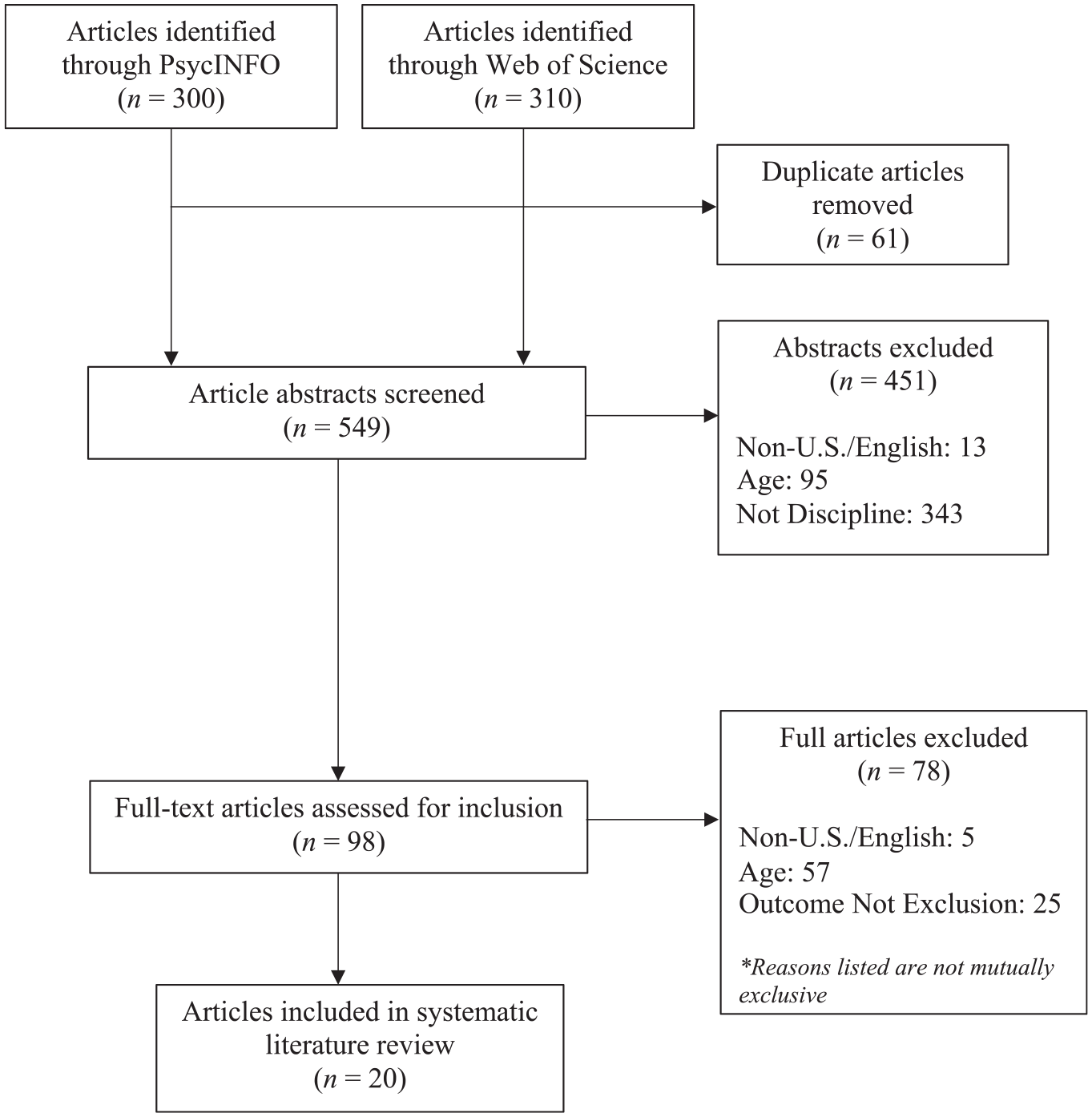
CONSORT diagram for ECCE expulsion literature search. ECCE = early child care and education.
From the 98 abstracts selected for full article review, full papers were divided and reviewed by the coding team. From here, articles were excluded if they did not meet all of the inclusion criteria stated above. If the assigned coder was unsure whether or not the paper met inclusion criteria, two other coauthors also independently reviewed the paper. The first author then reviewed the tricoding and finalized inclusion decisions. This process occurred for five papers, four of which were ultimately included. At this stage, the inclusion criteria were refined to include studies that assessed a child’s risk of exclusion (i.e., parents’ reports that they were warned their child may be excluded or teachers’ reports that they were considering or asking to have a child removed). For example, Gilliam et al. (2016) and Gilliam and Reyes (2018) measured children’s risk of being expelled with a teacher report measure but did not collect data on eventual exclusions. Coders agreed upon the addition of the broader definition of exclusion. Previously screened papers were rereviewed, but no additional papers were added to the analysis set based on the revised inclusion criterion. In sum, 20 articles met our inclusion criteria.
Coding Procedures
The 20 articles included in the analysis set were double-coded following the methods, units, treatments, outcomes, and setting framework (UTOS; Cronbach & Shapiro, 1982). Two coders each completed an electronic form capturing various elements of the study, including study design, intervention studied (if applicable), the unit of analysis (child, teacher, classroom, program), sample demographics, definition/measure of exclusion (included quotes and page numbers), and predictors of exclusion at various ecological levels (micro-, meso-, exo-). Across all 20 included studies, codes for the first two aims (represented in Tables 1 and 2) were in exact agreement. Both coders further agreed on the coding of 90% of the factors listed in Table 3. Disagreements only arose around the assignment of predictors to ecological levels. In these rare cases, the lead author provided a third set of codes, and the research team discussed the coding assignment until consensus was reached. Throughout this paper and in tables, we refer to individual studies included in our analysis set by the first author and publication year. Full citations for included studies are included in the reference section and marked with an asterisk.
Study characteristics
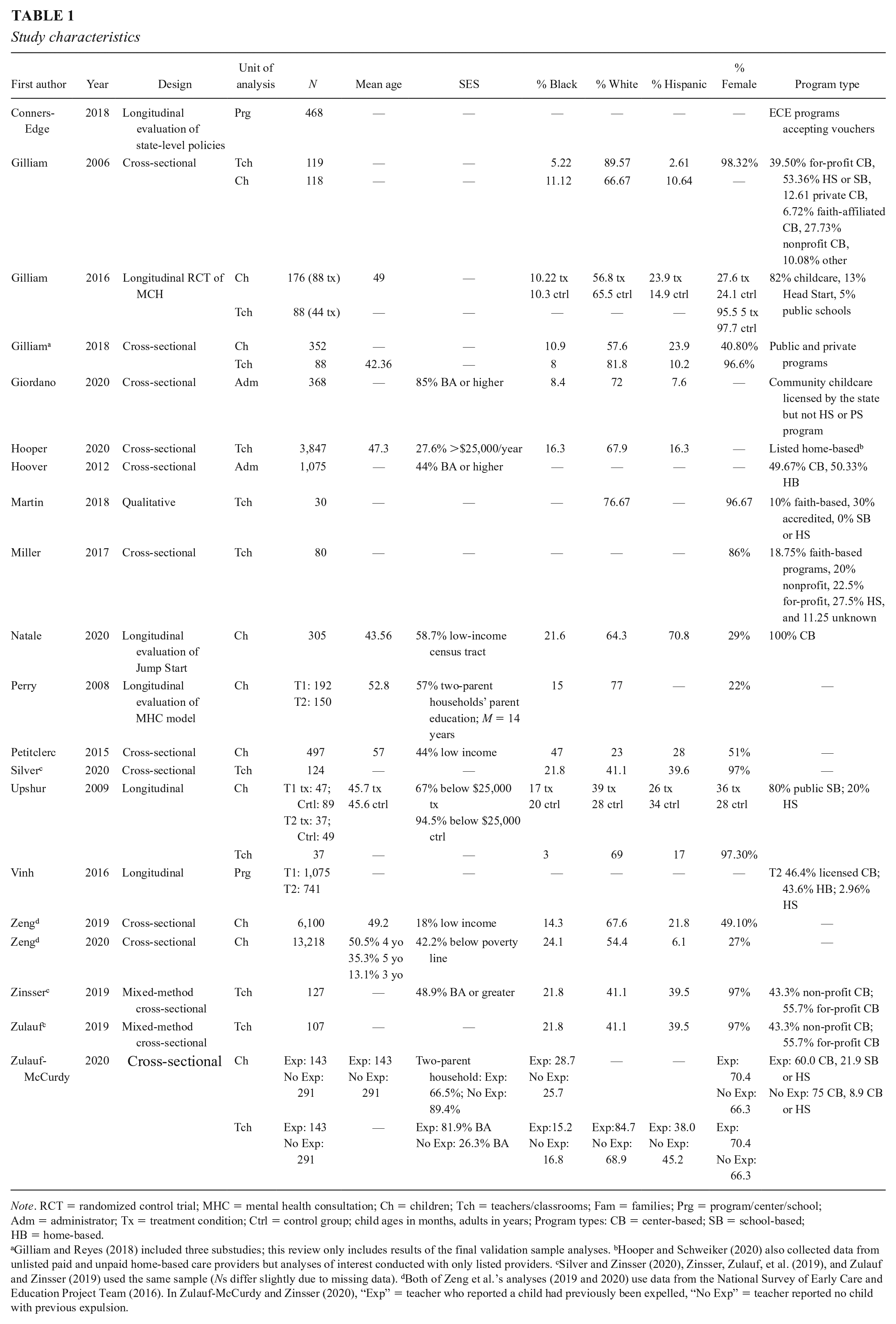
Note. RCT = randomized control trial; MHC = mental health consultation; Ch = children; Tch = teachers/classrooms; Fam = families; Prg = program/center/school; Adm = administrator; Tx = treatment condition; Ctrl = control group; child ages in months, adults in years; Program types: CB = center-based; SB = school-based; HB = home-based.
Gilliam and Reyes (2018) included three substudies; this review only includes results of the final validation sample analyses. bHooper and Schweiker (2020) also collected data from unlisted paid and unpaid home-based care providers but analyses of interest conducted with only listed providers. cSilver and Zinsser (2020), Zinsser, Zulauf, et al. (2019), and Zulauf and Zinsser (2019) used the same sample (Ns differ slightly due to missing data). dBoth of Zeng et al.’s analyses (2019 and 2020) use data from the National Survey of Early Care and Education Project Team (2016). In Zulauf-McCurdy and Zinsser (2020), “Exp” = teacher who reported a child had previously been expelled, “No Exp” = teacher reported no child with previous expulsion.
Definitions, measures, and rates of exclusionary discipline
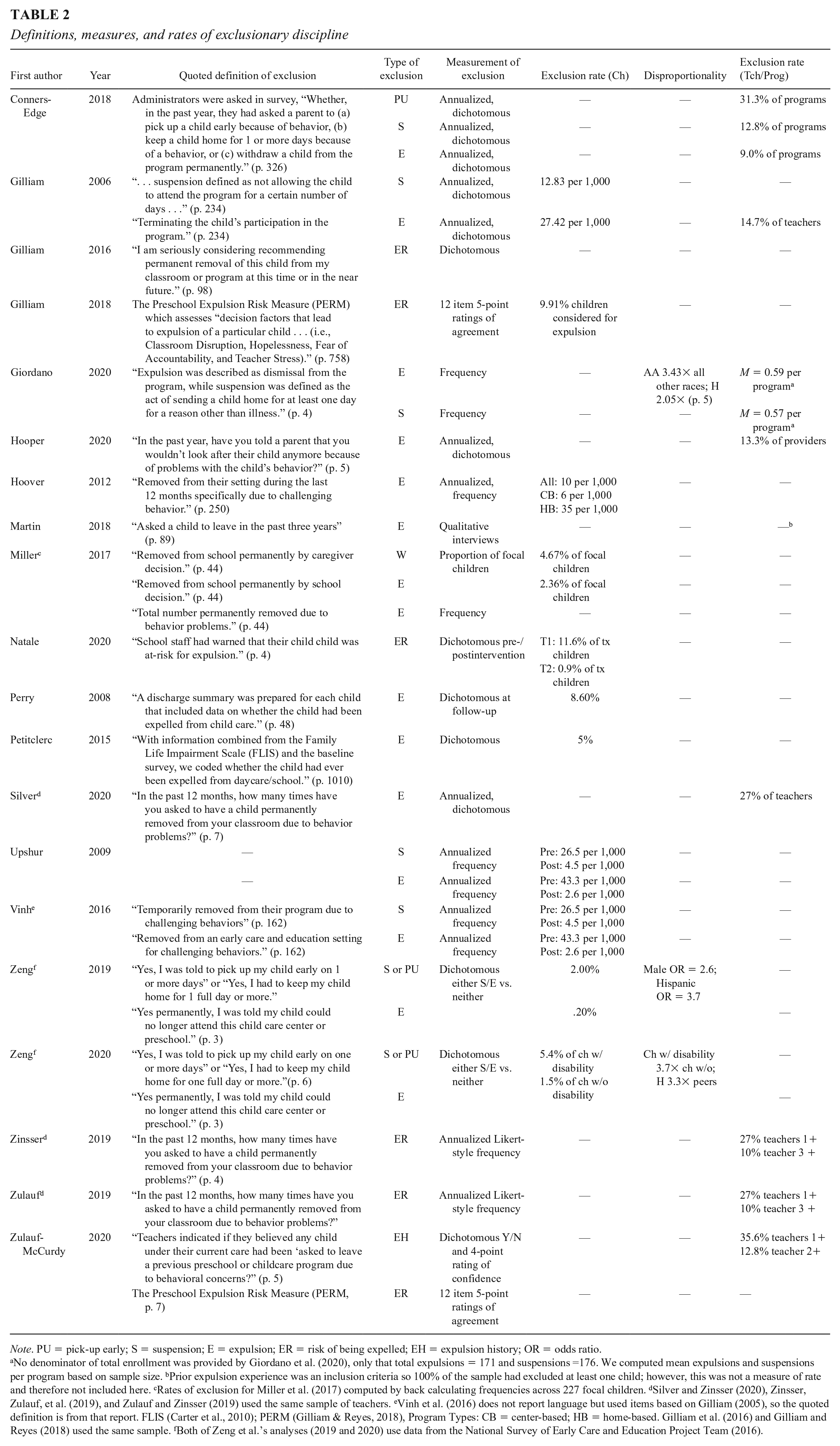
Note. PU = pick-up early; S = suspension; E = expulsion; ER = risk of being expelled; EH = expulsion history; OR = odds ratio.
No denominator of total enrollment was provided by Giordano et al. (2020), only that total expulsions = 171 and suspensions =176. We computed mean expulsions and suspensions per program based on sample size. bPrior expulsion experience was an inclusion criteria so 100% of the sample had excluded at least one child; however, this was not a measure of rate and therefore not included here. cRates of exclusion for Miller et al. (2017) computed by back calculating frequencies across 227 focal children. dSilver and Zinsser (2020), Zinsser, Zulauf, et al. (2019), and Zulauf and Zinsser (2019) used the same sample of teachers. eVinh et al. (2016) does not report language but used items based on Gilliam (2005), so the quoted definition is from that report. FLIS (Carter et al., 2010); PERM (Gilliam & Reyes, 2018), Program Types: CB = center-based; HB = home-based. Gilliam et al. (2016) and Gilliam and Reyes (2018) used the same sample. fBoth of Zeng et al.’s analyses (2019 and 2020) use data from the National Survey of Early Care and Education Project Team (2016).
Factors associated with early childhood exclusionary discipline
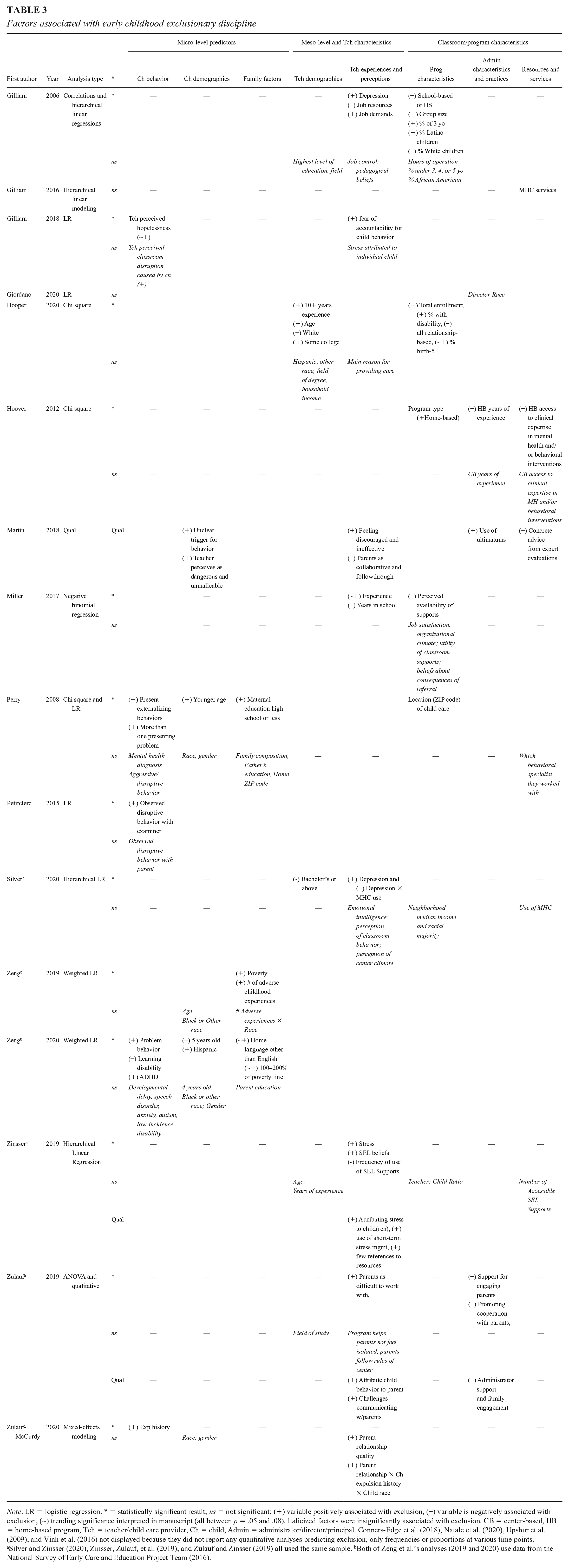
Note. LR = logistic regression. * = statistically significant result; ns = not significant; (+) variable positively associated with exclusion, (−) variable is negatively associated with exclusion, (~) trending significance interpreted in manuscript (all between p = .05 and .08). Italicized factors were insignificantly associated with exclusion. CB = center-based, HB = home-based program, Tch = teacher/child care provider, Ch = child, Admin = administrator/director/principal. Conners-Edge et al. (2018), Natale et al. (2020), Upshur et al. (2009), and Vinh et al. (2016) not displayed because they did not report any quantitative analyses predicting exclusion, only frequencies or proportions at various time points.
Silver and Zinsser (2020), Zinsser, Zulauf, et al. (2019), and Zulauf and Zinsser (2019) all used the same sample. bBoth of Zeng et al.’s analyses (2019 and 2020) use data from the National Survey of Early Care and Education Project Team (2016).
Results
Study Characteristics
Our search criteria yielded an analysis sample of 20 peer-reviewed studies published between 2006 and 2020, of which 60% were published in the last 3 years. Studies used a variety of designs, but the majority (65%) were cross-sectional. Of the six longitudinal evaluation studies, only one utilized random assignment (Gilliam et al., 2016). Three drew on qualitative interviews with teachers (Martin et al., 2018; Zinsser, Zulauf, et al., 2019; Zulauf and Zinsser, 2019) though it should be noted that the latter two (along with Silver and Zinsser, 2020) all leveraged data from the same sample of teachers. Parents’ reports of expulsion collected as part of the National Survey of Early Care and Education Project Team (2016) informed two studies by the same author (Zeng et al., 2019; Zeng et al., 2020). Half of the studies included samples of children (50%), a third sampled only teachers, and four (20%) included samples of administrators or programs. Sample sizes varied by study design, but most—save for secondary analyses of national surveys (e.g., Zeng et al., 2019; Zeng et al., 2020; Hooper & Schweiker, 2020)—relied on convenience samples of a few hundred teachers.
The degree to which studies included demographic data on participants varied widely, with administrator reports of programs often only describing the setting (program type) and others like Upshur et al. (2009) and Zulauf-McCurdy and Zinsser (2020) providing full descriptive data on children and teachers. Socioeconomic status (SES) was inconsistently reported, and we captured a level of education when no other approximation was available. Child-level SES was most often reported when samples included public prekindergarten or Head Start students. Seventeen studies provided racial identity data on some or all participants. All but two studies’ samples (Petitclerc et al., 2015; Upshur et al., 2009) were majority White. When studies included teachers, samples were predominantly female, which aligns with reports of the ECCE workforce (National Research Council, 2015). However, when studies were made up of children participating in an intervention or prevention program (e.g., referred for services), most samples were majority male. Five studies did not specify an ECCE program type. Three papers included home-based child care, and six included public school-based preschool classrooms, but the majority of samples attended or worked at a mix of for-profit and nonprofit center-based child care programs.
Definitions and Approaches to Measuring Exclusion
One of this review’s key aims was to gather and compare how ECCE exclusion was being defined and assessed. Table 2 summarizes the codes for definitions, types, measurements, and exclusion rates reported in each paper. The way exclusion was defined varied across studies, and we include in Table 2 direct quotes from each paper when available. The only study that provided no definition was Upshur et al. (2009). Nine of the 20 studies captured more than one form of exclusion (e.g., suspensions and expulsions), but these were not always analyzed separately. For example, Zeng et al. (2019, 2020) collapsed parent-reported suspensions and expulsions into a single, dichotomous variable. Some studies separately measured early pick-ups from suspensions (e.g., a parent being asked to come to retrieve their child for part of the day vs. not bringing their child for one or more days). Only one study (Miller et al., 2017) captured voluntary withdrawals, which may be an indicator of the soft-exclusion or push-out described above.
Studies collecting data at the program level were more likely to summarize exclusion as a frequency or count of excluded children across a school year. Those assessing teacher practices tended to use dichotomous categorization of whether they had excluded any children in the past year. Similarly, child-focused studies tended to use dichotomous ratings of whether or not a child had been excluded in a set amount of time or ever in the past (e.g., Zeng et al., 2019; Zeng et al., 2020; Zulauf-McCurdy and Zinsser, 2020). Two studies used ratings on a Likert-style rating scale developed by Walter Gilliam, the Preschool Expulsion Risk Measure (PERM; Gilliam & Reyes, 2018), which measures teachers’ perceptions of children.
The unit of analysis for each study tended to determine the level at which exclusion rates were reported, thus making comparison difficult, especially when accounting for the multiple forms of exclusion. When total enrollment rates for programs were available, six studies reported exclusion rates per 1,000 children enrolled. Annual rates of expulsion ranged from 6 per 1,000 children enrolled (center-based care in Hoover et al., 2012) to 43.3 per 1,000 children enrolled (Vinh et al., 2016). It is likely that rates vary by program type studied and state/jurisdiction supports around behavior and mental health. Rates for suspension were only reported by one study (26.5 per 1,000 enrolled; Upshur et al., 2009) and were never reported in studies examining expulsion risk. Evaluations of interventions tended to report rates of exclusion by the proportion of focal children. That is, of the children referred for services in five study samples, the proportion that was excluded ranged from 0.20% to 8.6%. Studies with units of analysis at the program or classroom/teacher level, in contrast, tended to report the proportion who had engaged in any exclusion in the prior year. Across studies, between 9.0% and 39.3% of teachers or programs had used exclusionary discipline, indicating that this is common across care settings.
Although several studies collected child-level race and ethnicity, few also collected the demographic characteristics of children enrolled in the excluding ECCE programs. Therefore only two studies (Giordano, 2020; Zeng et al., 2019) were able to compute and report rates of racial disproportionality. The limited attention to this topic was surprising given the emphasis disproportionality has received in public policy and media accounts of exclusion. However, as seen in K–12 settings (Welsh & Little, 2018), according to these two studies, boys, African American, and Hispanic children were at greater disproportionate risk for being excluded. Similarly, Zeng et al. (2020) reported that children with disabilities were overrepresented.
Factors Associated With Exclusion
Table 3 summarizes how the included studies assessed factors associated with ECCE exclusion. Although our inclusion criteria required studies to capture data on child exclusion or exclusion risk, not all studies used those data as the dependent variable in inferential analyses. Specifically, four articles (Conners-Edge et al., 2018; Natale et al., 2020; Upshur et al., 2009; Vinh et al., 2016) are not included in Table 3 because they did not report analyses predicting exclusion. Instead, these papers reported only the frequencies or proportions of children excluded at various time points. At the same time, we include Martin et al. (2018) and the mixed-methods studies by Zinsser, Zulauf, et al. (2019) and Zulauf and Zinsser (2019) in Table 3 because each seeks to explain the reason for or mechanism of exclusion through qualitative inference. We refer to all reported results for simplicity, whether qualitative or quantitative, as associated factors, but qualitative findings are separated in Table 3. Positive associations can be interpreted as increasing the rate or risk of exclusion, and negative associations reduce the risk or rate of exclusion. Trending associations are only presented if they were interpreted by the study authors. More than half of the studies in Table 3 conducted some form of logistic regression, which is in line with dichotomous exclusion measures, as seen in Table 2. Studies assessing expulsion with linear scales (i.e., frequencies or rates) tended to use regression models, but ANOVA and nonparametric models were also represented.
Micro-Level Child and Family Factors
In the first panel of Table 3, we present reported child- and family-level variables tested as predictors of exclusion. When teachers provided ratings about specific individual children (including their perceptions or beliefs about a child), those ratings were included in the micro-level. Ratings about children or families in general (not specific individual children) are presented below under meso-level characteristics. Of the 16 articles that assessed predictors of exclusion, seven included predictors of exclusion at the child or family-level, and six of these found both significant and insignificant associations. The majority of studies relied on subjective reports of children’s behavior from classroom teachers, while two studies found moderate positive associations between ratings or assessments of a child’s behavior by an outside evaluator (e.g., clinician instead of teacher; Perry et al., 2008; Petitclerc et al., 2015) and their exclusion. Both Gilliam and Reyes (2018) and Martin et al. (2018) reported teachers’ perceptions of aspects of children’s behavior. However, notably, in Gilliam’s study, the disruptiveness of the behavior was not a significant predictor, and instead, there was a small trending association with teachers’ hopelessness about the behavior’s malleability and expulsion risk. Zulauf-McCurdy and Zinsser (2020) was the only paper to assess children’s prior expulsion experiences and found a significant and positive association with expulsion risk. As with Gilliam and Reyes (2018), Zulauf-McCurdy and Zinsser (2020) used teacher reports, however, which may be akin to teachers’ perceptions of the malleability of children’s behavior. Those who have previously been expelled were at greater risk of future expulsion, according to these same teachers.
Papers testing child demographic characteristics yielded inconsistent findings. In Perry et al. (2008) and Zeng et al. (2020), older preschoolers were less likely to be expelled, but age was not significant in the Zeng et al. (2019) study. Both studies conducted by Zeng et al. (2019, 2020) and one by Perry et al. (2008) tested for associations between a child’s home life and exclusion. Perry et al. (2008) found that children with mothers who held a high school diploma or less were moderately more likely to be excluded. Interestingly, in this same logistic regression analysis, fathers’ level of education was not a significant predictor of exclusion. In Zeng et al. (2019), which used a nationally representative sample and parent-reported exclusion data, children were more likely to be expelled when they had experienced a greater overall amount of adversity (odds ratio = 1.8). In addition, several individual adversities were strongly associated with increased risk of exclusion (with odds ratios between 2.99 and 10.56 for adversities including witnessing or being the victim of violence, living with someone with a mental illness, or substance abuse problem, or having divorced or incarcerated parents). In both Zeng et al. (2019, 2020) papers, poverty was also related to the risk of exclusion, but in the 2020 paper, this association was only approaching significance (as was that of speaking a language other than English at home). Notably, as is depicted by the italicized text in Table 3, when child gender and race were included in regression models along with other micro-level factors (e.g., family socioeconomic status), they were not significantly associated with exclusion in the studies reviewed here.
Meso-Level and Teacher Characteristics
In the middle panel of Table 3, we present reported meso-level factors tested as predictors of exclusionary discipline (e.g., teachers’ demographic variables and their reported well-being, workplace experiences, and perceptions). Eight studies assessed the degree to which the teacher’s characteristics accounted for variance in expulsion rates or risk. Only one study (Hooper & Schweiker, 2020) assessed the association between teachers’ race and ethnicity and exclusion and only found a small significant and negative association with teachers’ identifying as White. It is notable that no studies assess the congruence of teacher and child race/ethnicity, even when those data were collected (e.g., Gilliam & Shahar, 2006; see Table 1).
Three studies found significant associations between exclusion and at least one aspect of teachers’ backgrounds (years of experience, age, and education level). There were mixed findings related to whether teachers’ age and experience were associated with expulsion. Hooper and Schweiker (2020) and Miller et al. (2017) found positive associations with expulsion, but these factors were nonsignificant in Zinsser, Zulauf, et al. (2019). However, each study drew on different samples (home-based, community-based, etc.), likely pointing to the need for further research in this area. Teachers’ field of study (e.g., having a degree in early childhood) was tested in three studies and never significantly explained exclusion. Three studies tested associations with education levels, but due to differences in measurement (dichotomous [bachelor’s degree or not] vs. a count of years in school), it is not easy to compare the relationships. Hooper and Schweiker (2020) found that teachers in home-based child care with some college courses expelled moderately more children than those without any college courses. Conversely, total years of schooling and having at least a bachelor’s degree were negatively correlated with expulsion in Miller et al. (2017) and Silver and Zinsser (2020), respectively.
Nine studies tested factors such as teachers’ well-being, experiences at work, and perceptions, and this category proved the most fruitful with regard to significant associations. Reading across these studies, there is consistent evidence that teachers’ emotional health and well-being are significantly negatively associated with exclusionary discipline. Two studies each found that teachers who were more depressed (Gilliam & Shahar, 2006; Silver and Zinsser, 2020) or more stressed (Gilliam & Shahar, 2006; Zinsser, Zulauf, et al., 2019) were more likely to exclude children. Two studies also reported that greater access to and use of supports was associated with fewer expulsions (Gilliam & Shahar, 2006; Zinsser, Zulauf, et al., 2019). It is important to remember that all of these studies drew on self-reported data, and there were no objective assessments employed (e.g., physiological assessments of stress or administrator reported resources).
Three studies pointed toward teachers’ perceptions of parents as uncooperative as a contributing factor to expulsion (Martin et al., 2018; Zulauf and Zinsser, 2019). Finally, one study each found that exclusion was more likely when teachers feared being held accountable (effect size = −1.77; Gilliam & Reyes, 2018), felt less effective (Martin et al., 2018), or held less strong beliefs about the value of social-emotional learning (r = −0.2; Zinsser, Zulauf, et al., 2019). No studies included parents’ reports of their relationships with teachers. Other pedagogical beliefs and broader perceptions of children’s behavior and organizational climate were insignificant. Interestingly, when Gilliam and Reyes (2018) assessed the degree to which teachers attributed their stress to an individual child using the PERM, the results were insignificant—though this was a consistent qualitative theme among teachers who expelled children in Zinsser, Zulauf, et al.’s (2019) interviews.
Exo-System Factors
The rightmost panel of Table 3 depicts reported associations between exo-system level factors and exclusionary discipline. Within this panel, eight studies reported aspects of the early childhood program, four reported on characteristics of the administrator or their management of the program, and six included factors pertaining to the use of or access to resources and services related to preventing exclusion.
Program type was only directly tested in two studies. In Gilliam and Shahar (2006), center-based programs (as opposed to school-based or Head Start programs) were 58% more likely to exclude students. At the same time, Hoover et al. (2012) found that rates were nearly six times higher in home-based programs compared with center-based programs. Hooper and Schweiker (2020) also found that the number of families served by home-based programs was positively associated with greater expulsion risk (but the same was not true for other program types in their sample). Group size was associated in Gilliam and Shahar (2006; 103% per unit SD increase in group size), but the ratio of teachers to students was not associated with increased exclusions in Zinsser, Zulauf, et al. (2019). The age and composition of the programs also had mixed effects. Serving a higher percentage of 3-year-olds (as opposed to other ages birth to 5) resulted in a 91% increased likelihood of exclusion, according to Gilliam and Shahar (2006). Hooper and Schweiker (2020) also reported a trend of exclusions being more common in programs serving more birth-to-5-year-olds (as opposed to school-aged children).
Four studies examined administrator characteristics or practices as predictors of exclusion, and within this set, no factors were tested in multiple studies. This represents a significant gap in the literature and makes meaningful synthesis challenging. Gilliam and Shahar (2006) was the only paper to test program racial and ethnic composition as predictors of exclusion and reported that each standard deviation unit change in the proportion of Latino children served was associated with a 75% increase in the likelihood of suspension (there was no association with the proportion of Black students). Perry et al. (2008) found that the location (ZIP code) of the child care program in Maryland was moderately associated with a child’s risk of expulsion; no details were provided about the included neighborhoods. Conversely, Silver and Zinsser (2020) found no association between neighborhood type and exclusion rates when ZIP codes were grouped by the racial majority and median income. Giordano et al. (2020) explored the contributions of the program administrators’ own racial identity and found no significant associations with exclusion risk. Likewise, associations between exclusion rates and administrators’ years of experience varied across program types in Hoover et al. (2012) and were only significantly predictive of exclusion in the more intimate setting of a home-based program.
Six studies reported how access to or use of resources or services to support children’s behavior (e.g., infant and early childhood mental health consultation [IECMHC]) explained exclusion, but many of these relied on teacher-reported data. Of these, only one reported a direct association between access to clinical expertise and decreased exclusion rates. Specifically, Hoover et al. (2012) found that 17.6 fewer children were excluded for every 1,000 enrolled when home-based programs had access to early childhood mental health consultation services. Martin et al. (2018) also identified qualitative themes around the quality of the advice provided by outside experts (such as mental health consultants). However, Gilliam and Shahar’s (2016) evaluation of consultation services found no association between the use of the service and reduced expulsion risk at the child-level. Notably, Silver and Zinsser (2020) found consultation acted as a moderator and reduced the effect of teacher depression on exclusion (log odds = −2.83). Interestingly, though, the access to a consultant did not have a direct effect on teachers’ reported depressive symptoms.
Multilevel Ecological Inquiries
Looking across all three panels of Table 3, nine studies explained exclusionary discipline using data from more than one ecological system level. Specifically, six studies included meso- and exo-system factors, mostly testing both teachers’ experiences and one program-level factor such as administrative practices. Given the numerous different predictors tested, few themes stand out. Only two studies attended to micro and meso factors (Gilliam & Reyes, 2018; Zuluaf-McCurdy & Zinsser, 2020), and only two studies (Martin et al., 2018; Miller et al., 2017) attended to issues at all three of our ecological levels. In the case of Martin et al. (2018), this qualitative study relied solely on teacher-reported child and program-level factors. Miller et al. (2017) aggregated reports of child behavior and similarly relied on teachers’ reports of perceived supports at the program level. Conversely, studies that tested child demographic or family factors generally did not account for higher-level factors (save for Perry et al., 2008, which accounted for program location—ZIP code). This lack of ecological breadth points to a significant gap in the literature.
Discussion
For the first time, the current study provides a comprehensive and systematic review of peer-reviewed studies of exclusionary discipline in early childhood settings. Such a synthesis of the evidence explaining why, how, and from where very young children are excluded is critical to inform prevention efforts and guide future research. This review sought to assess the size of the literature base and describe the methods, definitions, and measures employed. Finally, we organized our review around the ecological systems theory and can therefore describe the depth of evidence for the various child-, teacher-, and programmatic-factors associations with exclusion. This discussion addresses both what the field has learned to date and necessary future directions for the study of exclusionary discipline in early childhood.
State of the ECCE Exclusion Literature
While very young children being suspended and expelled have been on the radar of practitioners and policymakers for nearly two decades, the phenomena have limited attention in the academic literature, especially compared with the school-aged literature base. Recent systematic reviews of suspension and expulsion in later grades have drawn on much deeper pools of evidence (e.g., Welsh & Little, 2018). Although comparatively small, the ECCE exclusion literature is steadily growing. More than half of the reviewed studies in our analysis set were published within the last 3 years and cover a wide range of settings serving diverse populations.
Studies included in this review used a mix of terminology to describe how a child was excluded from their child care or preschool programs. While many did specify that the exclusion occurred due to challenging behavior, some studies kept temporary exclusions (suspensions, early pick-ups) separate from permanent removals (expulsions) while others combined them. Less represented were “soft expulsions,” where families are encouraged to withdraw their child voluntarily before being expelled. Only one study (Miller et al., 2017) reported on these informal removal processes. Future studies will need to incorporate more inclusive terminology (and likely several items) in surveys of parents, teachers, and administrators to better account for these less recognized and documented exclusionary practices. Still, other studies assessed the likelihood of a child being expelled in the future (e.g., Gilliam & Reyes, 2018; Zulauf-McCurdy & Zinsser, 2020). To ease interpretation and synthesis across papers, we collapsed all categories together, but further research will be needed to understand the factors that predict one kind of exclusion over another and whether temporary and soft exclusions are indeed precursors to formal expulsion. Given the low incident rate of exclusion overall, the adoption of metrics of expulsion precursors, such as the PERM (Gilliam & Reyes, 2018), could be an important step toward studying prevention measures—especially in smaller convenience sample studies. Alternatively, more attention could be paid to the other ways children are excluded while still remaining enrolled; that is, how often they are sent to sit by themselves in a corner, ignored by teachers, or temporarily relegated to the directors’ office or a younger classroom as a way of excluding them without formally suspending or expelling them? These exclusionary practices are likely more frequent but, to our knowledge, are not currently being assessed systematically.
Studies in this review leveraged various data sources (e.g., surveys, interviews, program outcome data), but most relied on correlational designs and single time points, limiting our ability to make causal inferences. Although these studies are further enhancing our empirical understanding of the behavioral and contextual dynamics that may be involved in the exclusionary discipline process, many continue to rely on the comparison of children who have and have not been excluded, which likely results in biased estimates. The disconnected nature of ECCE data may hamper research. Many studies in this review utilized convenience samples because there are no coordinated data systems that span all types of care (e.g., home-, center-, and school-based). Partnerships with state agencies that oversee licensure or funding of various care programs could facilitate more rigorous analysis. Better yet, the inclusion of data reporting on exclusions in funding stipulations could significantly improve the research landscape.
Which Children Are Being Excluded?
Agency reports at the state and federal levels routinely identified disparities in who is most likely to be excluded from care (e.g., U.S. Department of Education & U.S. Department of Health and Human Services, 2014). In contrast to our expectations, the peer-reviewed studies included in this synthesis do not meaningfully contribute to discussions of gender and racial disparities in exclusionary discipline. The vast majority of our reviewed studies cited disparities reported in the gray literature as a rationale for undertaking their investigations. However, only two reported on differential rates of exclusion groups, and only four included child race or gender as a predictor in their analyses (none of which were significant in the final models). In order to properly compute disproportionality, researchers need to know the demographic characteristics of all enrolled children in the ECCE programs of interest. This is why most accounts of disproportionality draw on the federally reported data from public prekindergarten programs collected by the Office of Civil Rights (e.g., Fabes et al., 2020). By comparison, the disproportionality in school discipline among K–12 students has been well documented for decades (e.g., Skiba et al., 1997) due to federally mandated reporting of complete student demographic data for enrollment and disciplinary actions. Without a similar coordinated data system spanning all birth-to-5 care settings (e.g., private center-based care), a robust estimation of disproportionality cannot be computed. Furthermore, to ensure adequate data quality, efforts to promote data literacy and accessibility of reporting for ECCE administrators are paramount. Unlike K–12 superintendents, ECCE settings do not have access to a full cadre of district personnel to collect, organize, and upload requisite data.
Why disciplinary disparities exist in early childhood remains an open question. Research in school-aged children has pointed to the potential contributions of uneven or biased disciplinary policies, discriminatory practices, and the underresourced or inadequate support for teachers (U.S. Department of Education & U.S. Department of Health and Human Services, 2014; Welsh & Little, 2018). More research will be needed to ascertain whether these or unique mechanisms drive disparities in early childhood and whether exclusion pathways differ across vulnerable subgroups. Descriptive reports from state and local governmental agencies in jurisdictions with robust data systems that allow for disaggregation (e.g., Chicago Public Schools, Colorado; Administration for Children and Families, U.S. Department of Health and Human Services, 2016) have replicated the disparities of federal data but add little to our understanding of processes and associated factors predicting exclusion.
Furthermore, the relatively sparse attention to child-level factors, including demographic characteristics, has left this literature unable to speak about intersectional identities and the confounding impacts of poverty and other early adversities on children’s exclusion. The one exception was a study by Zeng et al. (2019), wherein Black children were twice as likely to be expelled as their White peers, but adverse childhood experiences (ACEs; e.g., living in poverty or having an incarcerated parent) were a stronger predictor of expulsion than race. Given the high correlations among ACEs and race in the United States (Sacks et al., 2014) and the influence of adversity and trauma on early childhood brain development (Shonkoff et al., 2012), future studies of exclusion should include factors related to children’s home-life and lived experiences. This is not to say that ECCE programs do not need to be equipped to support children who have experienced adversity, but rather guidance around implicit bias training to reduce disparities in exclusion may fall short in the absence of parallel efforts to increase trauma-informed care (Dobbin & Kalev, 2018).
Most studies in this review that assessed child-level factors included some metrics of child behavior or behavioral need (e.g., diagnosed learning disability). Data about children’s behavior was provided by teachers, parents, or outside evaluators (e.g., clinicians). Although children’s observed disruptive behavior was inconsistently associated with their exclusion, teachers’ perceptions of the child’s behavior were related to exclusion in multiple studies. Given the potential for rater bias, however, these teacher reports may be better interpreted as measures of teachers’ ability to cope with behavior than the behavior itself. Challenging behavior is relatively common throughout early childhood (ranging from 10% to 30% of children; Dunlap et al., 2006; Vinh et al., 2016), but most children who display these behaviors do not face exclusion. The field of early childhood has increasingly endorsed the notion that young children’s behaviors themselves are symptoms of their environments. Further research is needed to understand what factors influence a teachers’ perception of children’s behavior. Social experiments, such as those conducted by Goff et al. (2014), have revealed implicit biases in the perception of children’s guilt and innocence starting at very young ages. Likewise, Martin et al.’s (2018) interview with teachers showed how teachers’ perceptions of the same challenging behavior could shift in severity over time. However, it is unclear whether and how this negative account-making can be interrupted by training or supportive resources. Future studies that seek to focus on child-level predictors of expulsion would benefit from the use of standardized measures of child behavior conducted by unbiased evaluators.
Why Are Children Being Excluded?
As with child-level factors, this review revealed scant and inconsistent attention to factors at the mesosystem, particularly regarding teacher characteristics, like levels of education. Past research indicated that teachers’ educational levels were correlated with the quality of their instruction and their students’ development (e.g., Burchinal et al., 2002). However, more recently, scholars have challenged these findings (Early et al., 2006; Early et al., 2007), and the debate continues today (Manning et al., 2019). This review continues this debate and reveals mixed findings of the role of teacher education and years of experience on rates of exclusion (Hooper & Schweiker, 2020; Miller et al., 2017; Silver & Zinsser, 2020; Zinsser, Zulauf, et al., 2019). One takeaway from this synthesis is that exclusion likely cannot be wholly prevented through policy stipulations raising educational requirements for early educators. Instead, more nuanced attention to the contextual factors and experiences of educators will likely be necessary.
To this point, nearly half of the studies reviewed in this synthesis identified intrapersonal teacher factors associated with exclusion, including their own well-being (e.g., stress and depression), workplace experiences (e.g., efficacy and use of available resources), and perceptions (e.g., of parents, and of accountability). Several studies found that exclusion was more frequent when teachers were more depressed or stressed (e.g., Gilliam & Shahar, 2006; Silver & Zinsser, 2020; Zinsser, Zulauf, et al., 2019). The qualitative results of Martin et al. (2018) and Zinsser, Zulauf, et al. (2019) provide a rich narrative explaining these associations and suggest that more research is needed that focuses on the adult-level processes that precede a child’s exclusion. The attention to ECCE teacher wellness and emotional health within the study of exclusionary discipline is in line with the broader attention this topic has garnered in the ECCE workforce literature. Studies of teacher stress are particularly pervasive in early childhood, which has long been described as both highly rewarding and emotionally exhausting (Thomason & La Paro, 2013; Whitaker et al., 2015). At the same time, there is considerable evidence that teachers’ negative workplace emotions and experiences of stress are detrimental to the quality of instruction and, ultimately, children’s academic and social-emotional learning (Smith & Lawrence, 2019; Zinsser et al., 2016) when combined with what is known about ECCE practitioners’ high rates of trauma (Hubel et al., 2020) and inadequate compensation (Phillips et al., 2016), the findings of this review highlight the fact that efforts to reduce exclusion must include adequate and multifaceted support for the well-being of these educators.
Another theme at the mesosystem level is the role of parents and parent-teacher relationships as contributors to exclusion. Both Martin et al. (2018) and Zulauf (Zulauf and Zinsser, 2019; Zulauf-McCurdy and Zinsser, 2020) describe how teachers’ negative perceptions of parents globally and interactions with parents individually can contribute to a child’s exclusion risk. Notably, however, parents were mostly missing from the samples analyzed. Out of all the studies in our review, only two included parent-reported data (Zeng et al., 2019; Zeng et al., 2020). It is evident that parents play a pivotal role in the exclusion process, and future research should more deliberately incorporate their perspectives.
From Where Are Children Excluded?
Exclusion appears to occur at different rates across the ECCE system. Rates of exclusion appear consistently lower in school-based and Head Start programs than center- and home-based care. These differences in rates are not surprising given that Head Start has an explicit policy against expulsion (Administration for Children and Families, 2016). Many school districts around the country have implemented similar restrictions on discipline for younger ages and grades (e.g., Chicago and Washington, D.C.).
Unfortunately, fewer studies in this review sampled the settings that appear to have the higher rates of exclusion (center- and home-based child care and preschools), suggesting that, despite the numerous recent publications on ECCE exclusion, we are likely still underestimating the scope of the problem across all sectors of ECCE (Meek & Gilliam, 2016).
We know especially little about children’s home-based child care experiences, even though these providers are the most numerous nationwide (National Survey of Early Care and Education Project Team, 2016). This review identified only three studies that included home-based settings in their sample, and only one of these (Hoover et al., 2012) included setting as a predictor of exclusion. Future research will be incredibly challenging without better-coordinated statewide or federal data systems that include all ECCE settings. Over one million U.S. providers are paid to care for children in their homes, but less than 10% appear in state registries (Paschall & Tout, 2018). As these settings are more likely to care for infants and toddlers, we are likely underestimating the exclusion of children younger than preschool-aged. Given the uniqueness of these settings and the personal nature of the settings (in a private home), policymakers will benefit from research specifically focused on the experiences of home-based providers and children in their care.
Promising Pathways for Intervention
Beyond policy differences, it is conceivable that exclusion rates vary across settings because of dissimilarities in resources and supports, such as IECMHC or social-emotional learning programming. However, this hypothesis received only limited attention in the studies reviewed here. Prior state agency evaluations and gray literature reports lead many states to emphasize IECMHC in policies to curtail exclusionary discipline (e.g., Gilliam, 2005; Davis et al., 2020). As such, we expected significant attention to this intervention in the academic literature as well. Instead, only a handful of studies identified in this review assessed the impacts of IECMHC (e.g., Gilliam et al., 2016; Perry et al., 2008), and associations between such services and exclusion were inconsistent. Specifically, Gilliam et al.’s (2016) randomized wait-list control trial is one of the most rigorous evaluations of consultation to date. At the end of the 12-week intervention, teachers who received consultations for specific children rated these children as less hyperactive as displaying fewer problem behaviors than control group children, but the intervention did not significantly impact the classroom environment, nor did it affect the likelihood of a child being expelled.
No other interventions have been held up to be as promising in preventing exclusion from ECCE, but our understanding of how consultation acts on expulsion risk could be significantly improved with added attention from the research literature. For example, findings from the handful of studies presented here suggest that while having access to resources does not explain expulsion rates (Zinsser, Zulauf, et al., 2019), having access to a consultant also does not universally prevent exclusion (Hoover et al., 2012). Instead, there is some indication that we need to attend better to the mechanisms by which consultants interact with teachers. Silver and Zinsser (2020) showed that consultation works indirectly through teachers’ well-being to reduce exclusion rates. Similarly, Martin et al. (2018) suggest that how a teacher perceives the advice given by observing experts can influence whether and how they act on the recommendations. While the theory of change for IECMHC reducing exclusionary discipline is clear, more research is needed to cultivate empirical evidence of each mechanism and pathway.
Another promising prevention effort that was ill-attended to in these reviewed studies was the Pyramid Model for Promoting Young Children’s Social-Emotional Competence (Fox et al., 2003). The Pyramid Model aims to provide early educators with guidance on practices that can be implemented within early childhood programs to promote young children’s social-emotional development and address challenging behavior. It is a tiered system of support akin to positive behavior intervention and support (PBIS) frameworks used in elementary schools, which have been shown to decrease the number of office referrals, especially for kindergarteners, and reduce (but not eliminate) the racial disparities in who is disciplined (Bradshaw et al., 2010; Vincent et al., 2011). Although no study in our sample directly evaluated the potential for the Pyramid Model to reduce exclusionary discipline, the longitudinal data collected by Vinh et al. (2016) from Colorado childcare programs in 2006 and 2011 bookended the 2009 passage of a policy initiative to implement the Pyramid Model statewide. The authors suggest that the substantial drop in exclusion rates over time can be at least partially attributed to the Pyramid Model adoption. Just recently, Clayback and Hemmeter (2021) posit that the Pyramid Model may reduce exclusionary discipline by providing the support that teachers desperately need to prevent challenging behavior in the classroom, in addition to strategies of how best to respond when it does occur. Furthermore, the Model’s guidance on how to effectively communicate with families may help build mutually respectful and trusting relationships. Further research will be needed to evaluate this promising intervention more fully, especially in light of prior implementation fidelity challenges (Hemmeter et al., 2016; Hemmeter et al., 2018).
Finally, a key component of the success of PBIS frameworks is the availability of data to drive decision making by teachers and administrators. Although not a direct intervention at the child level, the expansion of coordinated data systems at the state or local level spanning all ECCE settings (home- and center-based, public and privately funded, etc.) is a critical component of understanding and ultimately ending the use of expulsion. Without knowledge of how pervasive and disproportionate the practice is, individual programs and policymakers cannot adequately adjust and invest in systems of support.
Limitations
The present systematic review was not without limitations. Our use of search terms to describe formal exclusions (expulsion and suspension) may have resulted in us missing studies that attend to less formal exclusion practices. Although Miller et al. (2017) reported parental withdrawals in addition to expulsion rates, a study focused only on the informal pushing out of children for behavior problems (and not formal expulsions) would have been missed in our searches. Furthermore, although we used a two-pronged search approach in multiple databases, it is possible that we did not identify all relevant published literature. As with any review (Bartolucci & Hillegass, 2010), this study was subject to publication bias, otherwise known as the “file-drawer” problem. It is likely that additional analyses, including assessments of suspension and exclusion of birth-to-5-aged samples, have been conducted but unpublished, likely due to insignificant results.
Our stringent inclusion and exclusion criteria enabled us to offer specific information about the state of the scholarly literature but explicitly excluded white papers, policy briefs, and dissertations or theses. It is also important to acknowledge that the peer-review process is especially biased against studies addressing racism (Roberts et al., 2020). Therefore, it is probable that additional studies addressing racial disparities in early childhood discipline have been conducted but either were not accepted for publication or were published outside of peer-reviewed journals. Notably, our use of these criteria means that this review did not include two studies commonly cited by policymakers and advocates (Padilla et al., 2020): Gilliam (2005) and Gilliam et al. (2016). Both reports were published outside of academic journals (by a foundation and through a university website) but filled a vacuum of evidence informing legislation and rule writing for a long time. Specifically, the 2005 study was the first to provide detailed estimates at the state level of how many children were being excluded from public prekindergarten programs and demonstrated how access to IECMHC drastically reduced expulsion rates. In the 2016 white paper, Gilliam and Reyes experimentally demonstrate how implicit biases contribute to the disproportionate expulsion of Black children and boys. These studies fill critical gaps in the peer-reviewed literature included in this review but regardless, more and more comprehensive studies are necessary to continue guiding policy. A future review that incorporates gray literature will be an important extension of the present study and will additionally capture studies published since this systematic search was conducted (e.g., Boonstra, 2021; Garro et al., 2021).
Conclusion
In this systematic review of early childhood exclusionary discipline studies, we have identified and described a small but growing body of peer-reviewed literature and highlighted gaps and opportunities for future research. In addition to the future research recommendations highlighted throughout this discussion, this review’s findings also have implications for current and future policy efforts to reduce ECCE exclusion. As states across the country pass legislation and craft licensure rules aiming to prohibit expulsion, this review suggests that changing discipline processes will require attention to and support improved mesosystem interactions, including supporting teacher well-being and parent-teacher relationships and teachers’ preparation to address children’s diverse needs. To gain more clarity in our understanding of why and how children are excluded from care, public policy may also need to stipulate the formation and maintenance of an adequate data infrastructure spanning all ECCE system sectors. Future research and the evaluation of public policy and intervention programming will require data that can be disaggregated by child and program characteristics. The proactive formation of research-policy partnerships (e.g., Silver et al., 2021) can help inform data systems development and ensure that exclusionary discipline is monitored before and during legislation implementation. In sum, research into exclusionary discipline in early childhood is lagging behind that of school-aged children, but the research to date spans various settings and levels of the ecological model. The diverse approaches to this topic have yielded a thin but complex literature base, and room remains both for replication across settings and continued novel investigations of causes of and in disparate use of exclusionary discipline in early childhood.
Footnotes

Authors
KATHERINE M. ZINSSER, PhD, is an associate professor of community & prevention research in the Department of Psychology at the University of Illinois at Chicago, 1007 W Harrison St., MC 285, Chicago, IL 60607, USA; email:
H. CALLIE SILVER is a doctoral candidate in the Community & Prevention Research program in the Department of Psychology at the University of Illinois at Chicago, 1007 W Harrison St., MC 285, Chicago, IL 60607, USA; email:
ELYSE R. SHENBERGER is a doctoral student in the Clinical Psychology program in the Department of Psychology at the University of Illinois at Chicago, 1007 W Harrison St., MC 285, Chicago, IL 60607, USA; email:
VELISHA JACKSON is a doctoral student in the Community & Prevention Research program in the Department of Psychology at the University of Illinois at Chicago, 1007 W Harrison St., MC 285, Chicago, IL 60607, USA; email: