




Abstract
Self-control plays a significant role in child and adolescent development. The school environment is suggested as an important factor associated with individual differences in self-control. Among the many facets of school environment, school discipline is thought of as a critical factor that effectively develops students’ capacities for self-control. However, existing findings are mixed. To take stock of the literature, this meta-analysis summarizes the overall association between three school discipline components (i.e., structure, support, and teacher-student relationship) and self-control from preschoolers to high school students. Based on 68 studies reporting 278 effect sizes (N = 57,798), the results revealed that the overall effect size for the association between school discipline and self-control was small to medium (r = .190, p < .001, 95% confidence interval [.151, .229]). Moderator analyses showed that effect sizes were similar in magnitude across school discipline components, gender and age of students, region, report informant of school discipline measures, reliability of school discipline and self-control measures, and research design. The effect sizes were stronger for the studies using self-report measures to assess self-control (compared to studies using observation/tasks or other-informant measures) and for studies that examined general self-control (compared to cognitive self-control). Moreover, the effect sizes for the association between school discipline and social-emotional self-control were stronger for older students. These findings point to the importance of school discipline associated with individual differences in self-control in students from preschool to high school.
Keywords
Developmental outcomes in childhood and adolescence have a long-lasting impact on the physical and psychological well-being in adulthood (Patton et al., 2018; Pulkkinen et al., 2002). Successfully navigating day-to-day challenges requires, among other capabilities and competences, self-control (Caspi et al., 2016; Moffitt et al., 2011; Moffitt et al., 2013). Self-control refers to the ability to alter cognition, emotion, impulsive tendencies, and behaviors in the service of social norms, personal standards, and goals (Baumeister et al., 2007; Tangney et al., 2004). Children and adolescents with high levels of self-control, compared to their counterparts with low levels of self-control, have better academic performance, school readiness, physical health, well-being, social competence, and less school dropout and fewer emotional and behavioral problems (De Ridder et al., 2012; Duckworth & Seligman, 2005; Eisenberg et al., 2001; Li & Lau, 2019; Moffitt et al., 2011).
The importance of self-control for a wide array of life outcomes has triggered a number of studies examining its etiological sources. Although self-control has biological underpinnings, existing studies have also suggested that self-control can be substantially shaped by the environment (Willems, Dolan, et al., 2018; Willems et al., 2019). Many studies have considered family as the primary context that nurtures child and adolescent self-control (Davis et al., 2017; Karreman et al., 2006; Li et al., 2019; Pallini et al., 2018; Willems, Li, et al., 2018). Besides family, the school is another important developmental context for children when they start formal education (Bronfenbrenner, 1979; Downer et al., 2010). Scholars commonly agree that school environment is a critical context for the development of self-control (Gottfredson & Hirschi, 1990; Sameroff, 2010). Among the many facets of school environment, school discipline, defined as schoolwide efforts and environmental supports that aim to further students’ self-discipline (Osher et al., 2010), may play an important role in nurturing students’ self-control. Compared to classroom management, which refers to all actions and strategies teachers use to solve problems related to maintaining order in classrooms (Doyle, 2006), school discipline comprises broad, schoolwide efforts and is less dependent on individual teachers than classroom management. Scholars have proposed that school discipline pertains to practices and policies in school settings such as structure, support, and teacher-student relationship, which affect all school-based activities (Gregory et al., 2010). The core function of school discipline is to nurture students to develop good self-control abilities (Bear, 2010). Thus, examining school discipline as a construct could be critical in understanding how the school context facilitates students’ self-control.
An increasing number of studies have examined the relation between school discipline and students’ self-control (e.g., Brody et al., 2002; Cadima et al., 2019; Intravia et al., 2012), but the findings are inconsistent in terms of magnitude and directionality. Policymakers and school authorities often rely on scientific research to determine which practices should be used to further students’ social-emotional competence (Luke, 2009), but inconsistent results prevent the identification of the most effective approach. Thus, it is crucial to take stock of the existing findings and inform the field about whether school discipline is related to self-control in children and adolescents; and if it is, how strong these associations are and which factors moderate these associations.
Recently, Vandenbroucke et al. (2018) conducted a meta-analysis to summarize the association between the teacher-student relationship and executive functions (EF) in children up to 12 years. Based on 23 studies, they found that a high-quality teacher-student relationship is positively related to better general EF, working memory, and inhibition, but not to cognitive flexibility. Cumming et al. (2020) presented a systemic review examining the association between school-, classroom-, and dyadic-level experiences and EF. Based on 20 studies, they found that classroom emotional support and teacher-student conflict were the most consistent predictors of student EF development. The current meta-analysis adds important knowledge in several aspects. First, school discipline is a broad construct that is composed of different components. The previous meta-analysis and review mainly focused on the teacher-student relationship, neglecting other crucial components that define school discipline (e.g., structure). The current study considers teacher-student relationship and two other components of school discipline, namely, structure and support, simultaneously to identify their unique associations with self-control. Second, the previous meta-analysis focused on children, but did not consider middle school students. Most middle school students are in the adolescent period, a stage characterized by substantial changes in social relationships and increased sensitivity to external stimuli (e.g., peer pressure) that may cause self-control failure (Steinberg, 2004; Steinberg & Morris, 2001). Given that self-control is a critical factor that assists adolescents to overcome developmental challenges (Caspi et al., 2016; Moffitt et al., 2011), understanding whether school discipline is associated with adolescent self-control is critical. The current study focuses on multiple developmental periods ranging from preschool to high school, which provides a more complete picture of the quantitative association between school discipline and self-control. Third, the prior meta-analysis and review focused on EF. Although EF (a construct often studied in psychology) is related to self-control, self-control (a construct used in research spanning the behavioral and social science) is typically considered as a broader concept (Nigg, 2017). This study focuses on self-control, thus providing complementary information. Finally, the prior meta-analysis did not decompose variance at the sample, within-study, and between-study levels, which may inflate the utility of school discipline in explaining students’ EF. This study employs a three-level meta-analysis to decompose the variance at different levels, which may provide a more accurate estimate for the “school discipline–self-control” association.
Conceptualization of School Discipline
The school has a clear interest in maintaining discipline and ensuring an organized and safe environment to develop students’ skills to manage their own behavior so that they can make choices that help them achieve self-determined goals and improve academic performance (Gregory et al., 2010; Lee & Croninger, 1996). There have been wide variations in the approaches school authorities adopt to manage their students’ behavior, ranging from strict and demanding behavioral conformity to autonomy granting and independent decision making (Kupchik, 2010; Stronach & Piper, 2008). Inspired by studies that identified structure and support as two effective parenting practices (Baumrind, 1996; Darling & Steinberg, 1993), scholars have applied them to the school context. Several studies showed that structure and support are two major school discipline components facilitating students’ school and social-emotional functioning (Gregory & Cornell, 2009; Gregory et al., 2010; Jia et al., 2016; Konold et al., 2014). In addition to structure and support, teacher-student relationship has also been considered as a crucial way to enhance students’ school and social-emotional functioning. For instance, Roorda et al. (2011) postulated that school may facilitate students’ school functioning by providing structure (e.g., setting clears rules), supporting autonomy (e.g., giving students’ freedom to make their own choices), and showing affective involvement (e.g., showing closeness and establishing attachment). Taken together, existing research identifies three school discipline components that may nurture students’ social-emotional skills: structure, support, and teacher-student relationship.
In this study, structure refers to the extent to which school authorities manage students’ behavior by setting limits clearly, implementing school rules consistently, and creating a safe, well-organized, and fair environment and climate conducive to students’ learning and internalizing rules (Gregory & Cornell, 2009). Support refers to the extent to which school authorities manage students’ behavior via caring and autonomy support (Gregory et al., 2010; Gregory et al., 2011). Teacher-student relationships refers to the quality of relationship and affective bonding between school authorities and student; it denotes the affective quality of the interaction between school authorities and students rather than school authorities’ management of students’ behavior (Vandenbroucke et al., 2018).
Although some studies did not distinguish support from teacher-student relationship (e.g., Gregory et al., 2010), other studies suggest that they differ in terms of whether school authorities’ caring is more instrumental or more affective (Roorda et al., 2011). Similarly, Vandenbroucke et al. (2018) distinguished support from teacher-student relationship in that support concerns the teacher-student interaction that manages students’ behavior via providing supportive care (e.g., granting autonomy/general support), while teacher-student relationship concerns the affective quality of the relationship (e.g., establishing closeness and attachment). Another reason to distinguish between these two components in this study is that it allows us to examine their relative strength in associating with students’ social-emotional functioning, particularly self-control.
Conceptualization of Self-Control
Since self-control is widely studied in different social and behavioral disciplines, its conceptualization differs by theoretical tradition, with developmental psychologists often referring to effortful control, while personality and social psychologists often interchangeably refer to self-control and self-regulation (Li et al., 2019). Despite the different labels or definitions, theories agree that self-control and analogous terms (e.g., self-regulation, effortful control, self-discipline, executive control, delay of gratification) tap into a common ability. The common thread underlying these terms is the involvement of voluntary self-management, an ability individuals use to govern their cognition, emotions, impulses, performances, and behavior (Bridgett et al., 2015; Nigg, 2017). This is supported by different lines of research. For instance, factor analyses of tasks developed based on different conceptualizations of self-control found that these tasks were best reflected by a one-factor model (Allan et al., 2014; Allan & Lonigan, 2011). Moreover, a meta-analysis of the correlations between self-control measures revealed moderate convergence (Duckworth & Kern, 2011). In addition, studies from neuroscience suggested that the neural substrates related to different conceptualizations of self-control overlapped (Fan et al., 2003; Garavan et al., 2002).
Despite that self-control can be seen as an overall construct, there also seems a need to focus on different components of self-control, as some components may develop earlier in life while others develop later. For instance, Schel et al. (2014) proposed that intentional control in cold contexts (e.g., cognitive control involved in cognitive tasks without tapping emotion or motivation) has an early development but intentional control in hot contexts (e.g., control involved in social-emotional and motivational contexts) continues to develop throughout the adolescent period. Similarly, Duckworth and Steinberg (2015) showed that impulsigenic and volitional processes of self-control do not develop in parallel patterns from late childhood to emerging adulthood. Such imbalances in the development of self-control underline the need to examine the role of different types of self-control in the “school discipline–self-control” association. Therefore, in this study, we not only operationalize self-control as general self-control, as many other meta-analyses about self-control did (De Ridder et al., 2012; Li et al., 2019; Willems et al., 2019; Willems, Li, et al., 2018), but we also differentiate between different types of self-control and examine whether the type of self-control moderates the association between school discipline and self-control.
School Discipline and Self-Control
School discipline should be important to students’ development of self-control (Bear, 2010). The literature provides evidence that each of the three components we consider in the current study may indeed be conducive to students’ development of self-control.
The Association Between Structure and Self-Control
Schools that emphasize structure ask students to comply with rules and focus on directly correcting/modulating students’ behavior (Gregory et al., 2010; Gregory et al., 2011). Ways to provide good structure include punishing misbehavior (e.g., monitoring students’ behavior, recognizing students’ misbehavior, and correcting such behavior), promoting good behavior (e.g., drawing students’ attention to appropriate behavior, helping them recognize those behavior, and reinforcing students’ good behavior), and creating an environment and climate that scaffold students’ development of social skills (e.g., ensuring the environment to be safe, providing clear feedback and instruction, and providing model behavior). In contrast, poor structure includes ambiguous rules, loose monitoring, unfair and inconsistent enforcement of rules, provision of little or no feedback, reinforcement, or instructions, and chaotic and unsafe environments that hamper students’ development of social skills.
Reflecting this diversity of structure, studies have used a range of instruments to measure the indicators of structure, including the class organization and instruction subscales of the Classroom Assessment Scoring System (e.g., Pianta et al., 2008), self-created questions (e.g., school’s ability to teach students right from wrong; school’s ability to maintain discipline; e.g., Turner et al., 2005), and categorically coding based on school logs (e.g., punitive vs. nonpunitive school; Talwar et al., 2011). Many instruments measured the positive approaches that foster structure (e.g., rule clarity, organized/safe environment/climate). Only a small proportion measured the negative approaches of too much or too little structure (e.g., disorganized/chaotic environment, punitive control, unsupervised time). Most measures had satisfactory reliability but some had below-satisfactory reliabilities probably due to a small number of items.
Existing literature has discussed how structure impacts self-control. According to Gottfredson and Hirschi’s (1990) general theory of crime, self-control develops through authorities’ (e.g., teachers) monitoring, recognition, and discipline of children’s misbehavior. These discipline encounters provide children with abundant feedback and instructions regarding rules, boundaries, and others’ expectations. It is during this process that children learn what they are permitted and not permitted to do and develop self-control to initiate what they should do and inhibit what they should not do (Bergin & Bergin, 1999). In addition, the deterrence theory considers that the violation of socially appropriate behavior can be curbed by making noncompliance costly for individuals (Gibbs, 1975). Applied to school settings, by exerting self-control, students intentionally control their behavior and obey rules to abide by school norms and standards, because they want to avoid the negative consequences associated with their misbehavior. Gregory et al. (2010) posited that when exposed to structure that involves fair and consistent supervision and monitoring, students experience legitimate and nonarbitrary use of authority, which helps them internalize rules that guide their self-controlled behavior in the long-run (Bergin & Bergin, 1999).
Previous studies examining the association between structure and self-control found mixed results. For instance, in a study among Korean secondary students, teachers’ monitoring and recognition of students’ misbehavior were not related to self-control, but teachers’ discipline was (Moon et al., 2014). In a study among preschoolers, teachers’ managing children’s misbehavior in the classroom was related to more self-control in children (Bennett et al., 2005), while in another study teachers’ socialization of preschoolers’ misbehavior was related to less self-control in children (Degol & Bachman, 2015). In a study among preschoolers, instruction and behavioral self-regulation were weakly but positively related (Rimm-Kaufman et al., 2009), but in another study among a similar group of children instruction and cognitive self-control were unrelated (Choi et al., 2016).
The Association Between Support and Self-Control
Similar to structure, support is a way to manage students’ behavior; but instead of directly providing instruction and rules as structure does, schools that favor support believe that caring about and responding to students’ needs (especially autonomy) is the foundation to nurture students’ good behavior and thus allow students to make their own choices and develop their potential (Ryan & Deci, 2000). Strong support can be reflected in high levels of involvement, caring, child-oriented belief and behavior, granting autonomy, and emotional responsiveness and support. In contrast, weak support can be reflected in low involvement, emotional indifference toward child well-being, teacher-oriented behavior, and provision of little or no autonomy. Prior studies have used different instruments to measure indicators of support, but most included the emotional support subscale from the Classroom Assessment Scoring System (Pianta et al., 2008). Other measures included subscales from questionnaires that measure school climate (e.g., School Climate Scale; Simons-Morton et al., 1999). Overall, most measures had satisfactory reliability with a few exceptions.
The self-determination theory proposes that relatedness, competence, and autonomy are the three basic needs that comprise the fundamental motivations that drive human behavior such as self-control (Deci & Ryan, 2000, 2008; Reeve et al., 2008). In line with this theory, when students perceive that the school and teachers care about them, grant them autonomy, provide them with support when needed, and allow them to make decision on their own, students are more willing to voluntarily comply enduringly with school authorities’ rules, which promotes their self-control in the long-run (Niemiec et al., 2006). Moreover, when students perceive that they are in a supportive environment and feel being supported and respected, they are more open and willing to comply with authorities’ rules and discipline (Gregory et al., 2010).
Although a number of studies have examined the relationship between support and self-control, the results are inconsistent. For instance, a study conducted among Turkish and U.S. adolescents found that high levels of school support were significantly related to emotional and behavioral self-control with medium effect size (Telef & Furlong, 2017). However, some studies conducted among preschoolers revealed that teachers’ emotional support was not related to behavioral self-control among U.S. and Dutch kindergarten children (Broekhuizen et al., 2017).
The Association Between Teacher-Student Relationship and Self-Control
High-quality relationships can be described as relationships with high levels of closeness, warmth, sensitivity, liking and fondness, close bonds, and secure attachment. In contrast, low-quality relationships can be described as relationships with low levels of closeness, warmth and sensitivity, alienation and conflict, insecure attachment, and disliking and avoidance. Prior studies mainly used the Student-Teacher Relationship Scale (e.g., Pianta, 2001) and the School Liking and Avoidance Questionnaire (e.g., Ladd & Price, 1987) to measure the teacher-student relationship. Some studies used self-created questionnaires as well. In general, these different measures had satisfactory reliability with some exceptions.
According to the attachment theory (Bowlby, 1969), a secure attachment with parents is the foundation for children to regulate their emotions and behavior, which serves as the prototype for subsequent self-control (Cassidy, 1994). Specifically, when children feel secure and safe with significant attachment figures, they are more willing to work out self-control challenges without being afraid of rejection by attachment figures even though they may fail. Besides parents, teachers become attachment figures after children enter school. Applying the attachment framework to understand the association between teacher-student relationship and students’ outcomes, scholars postulate that a secure attachment and a close relationship with teachers are preconditions for students to explore and internalize rules (Vandenbroucke et al., 2018; Verschueren & Koomen, 2012). In addition, the general theory of crime implies that an effective management of misbehavior is crucial to instill self-control in children and that a good relationship is the foundation for effective discipline (Gottfredson & Hirschi, 1990). This theory also claims that students who like and attach to school are willing to comply with school rules and are afraid of being punished.
Many studies have examined the association between teacher-student relationship and self-control, but results are disparate. For instance, a study conducted among African American and Hispanic boys found that teacher reports of teacher-student relationships were significantly related to higher attentional and emotional control, but children’s reports of teacher-student relationships were not (Barbarin et al., 2013). In addition, some studies found that attachment to school was positively related to self-control at medium-to-large effect sizes (Xia et al., 2016), while others only revealed small effect sizes (Cheung & Cheung, 2008).
Moderators
Study Variables
School discipline components
Although all three school discipline components are supposed to be related to students’ self-control, they affect self-control through different mechanisms. Therefore, the strength of the association between each component and self-control may vary. Some scholars consider the teacher-student relationship as a foundation for support and structure (Vandenbroucke et al., 2018). Other scholars posit that without structure, support and teacher-student relationship are insufficient to teach students self-control (Gregory et al., 2010). To examine the relative strength of the three components in relation to self-control, we explore the moderating effect of school discipline components.
Types of self-control
Prior studies have used different measures to assess self-control as a general construct or as domain-specific constructs (e.g., cognitive/attentional control and emotional control). While most self-control scales measure the general construct (e.g., the Self-Control Scale and its brief version; Tangney et al., 2004), many tasks and questionnaires focus on a specific type of self-control. For instance, cognitive self-control is often measured with laboratory tasks that are related to executive control (e.g., Stroop or Go/No-go), with other more ecologically valid tasks (e.g., pencil tap; Diamond & Taylor, 1996), or with questionnaires targeting cognitive self-control (e.g., Attentional Regulation Scale; DuPaul et al., 1998). Social-emotional self-control is measured with tasks (e.g., delay of gratification task) and scales (e.g., The Social Skills Rating System–Teacher Form; Gresham & Elliott, 1990) that assess self-control involved in social interactions or in contexts involving impulses and emotional arousal. To examine the relative strength of school discipline in relation to different types of self-control, we explore the moderating effect of self-control types.
Participant Demographics
Student gender
According to the gendered socialization perspective, girls may benefit more from close relationships with teachers because closeness is consistent with the gender role of girls and teachers show more intimacy toward girls (Maccoby, 1998). Moreover, teachers usually tolerate girls’ misbehavior less and have stricter attitudes toward girls’ misbehavior than boys’ misbehavior (Ewing & Taylor, 2009). However, according to the risk perspective, boys are more at-risk than girls in misbehavior and thus require more assistance and discipline (Bristol, 2015; Monroe, 2006). In this study, we explore whether students’ gender moderates the association between school discipline and self-control.
Student age
Literature has suggested that younger children are more likely to be influenced by environmental factors than are older children and that middle school students become less connected to teachers and parents than younger students (Hargreaves, 2000; Lynch & Cicchetti, 1997). Therefore, the association between contextual factors and children’s self-control could be stronger for younger than for older children. The parenting literature found that attachment to mothers is significantly related to self-control in children but not in adolescents (Meldrum et al., 2012). However, empirical evidence shows that school discipline (e.g., support) was significantly related to self-control in adolescents but not in children (Broekhuizen et al., 2017; Rimm-Kaufman et al., 2009; Schuitema et al., 2016). In this study, we explore whether age moderates the association between school discipline and self-control. In addition, given that cognitive and social-emotional self-control matures at different developmental periods (Schel et al., 2014), we also explore whether age interacts with self-control types to influence the association between school discipline and self-control.
Study Characteristics
Region
The association between school discipline and self-control has been examined in a range of countries. School discipline may be exercised more disparately in some countries than in other countries. For instance, in the United States, students in ethnic/racial minority groups often receive more punitive, harsh, and coercive reactions from adults and are exposed to lower expectations and biased practices and policies (Barbarin & Crawford, 2006; Harradine et al., 2014). Thus, students from these groups in the United States may perceive school discipline and develop their self-control skills in the school context in a different way than the majority group. To explore whether the association between school discipline and self-control varies across studies conducted in different regions in the world, we examined whether region serves as a moderator.
Report informant
Research often uses diverse approaches to assess school discipline as well as self-control. Some studies employ self-report measures, some utilize other-report measures (e.g., teacher-report), some use behavioral and observational methods, and some even adopt more than one approach. Since teachers, observers, and parents may have different attitudes toward and experiences with school discipline and students’ self-control (Duckworth & Kern, 2011; Lanz et al., 2001), results may vary across informants. In this study, we explore whether report informant of school discipline and self-control moderates the “school discipline–self-control” links.
Reliability of measures
Most instruments used to measure school discipline components and self-control had satisfactory reliability, but reliabilities of some measures were below satisfactory. Relying on measures with unsatisfactory reliability may increase the internal error, which may affect the robustness of the association between school discipline components and self-control. Hence, we differentiated between correlations based on measures with satisfactory versus unsatisfactory reliability. We explored whether reliabilities of the school discipline and self-control measures would serve as moderators.
Study design
Prior studies employed both cross-sectional and longitudinal designs to investigate the association between school discipline and self-control. In a cross-sectional design, data regarding school discipline and self-control are collected at the same time point. As a result, the common method variance is likely to inflate the correlation between the two constructs, thus causing the cross-sectional correlations to be higher than longitudinal correlations (Lindell & Whitney, 2001). In this study, we explored whether study design (cross-sectional vs. longitudinal) moderates the association between school discipline and self-control.
In sum, in the current study we employed a three-level meta-analysis to examine the association between school discipline and self-control from preschoolers to high school students and to examine whether the factors proposed above would moderate the association.
Method
We set up this meta-analysis following the PRISMA (Preferred Reporting Items for Systematic Reviews and Meta-Analyses) flowchart (Moher et al., 2015) and preregistered this study (Preregistration Number: 15602) to facilitate transparency.
Search of Studies
We searched articles that were published up to the end of October 2018 through three electronic databases 1 : the Education Resources Information Center, PsycINFO, and PubMed with three categories of key phrases: (1) key words regarding school terms (teach* or class* or school* or teacher-child* or teacher-student* or academic* or educat* or disciplin* or preschool* or kindergarten), (2) key words regarding self-control terms (self-control or self-regulation or self-discipline or effortful control or executive* or impul* or delay of gratification), and (3) key words regarding students/children/adolescents (adolescen* or youth* or teen* or child* or student* or pupil*). In addition to electronic databases, we also traced the reference lists of the prior meta-analysis and systematic review of similar topic (Cumming et al., 2020; Vandenbroucke et al., 2018) and added potentially eligible studies for further coding.
Inclusion Criteria
We used the following criteria to determine whether the studies were eligible for this meta-analysis. First, the study had to examine the association between any component of school discipline and self-control or interrelated concepts such as self-regulation, effortful control, delay of gratification or domain-specific forms of control (e.g., attentional, emotional, or behavioral control). If no correlations were reported in the article, we contacted the corresponding author. Our main focus was about the ability to alter dominant cognition, emotion, and behavior (e.g., inhibition, regulation, or initiation). Thus, for studies that examined EF, we included only correlations involving components such as inhibitory/executive control, but excluded other EF components such as phonological loops, visual sketchpad, shifting, and working memory, as done by prior meta-analyses about self-control (Li et al., 2019; Willems et al., 2019; Willems, Li, et al., 2018). Second, the study had to focus on community-based samples. We excluded clinical samples with physical (e.g., diabetes) or psychological (e.g., attention deficit hyperactivity disorder) symptoms, or criminal offenders, because these populations may affect the magnitude and/or direction of effect sizes (Rothbaum & Weisz, 1994). Third, the study had to focus on preschoolers to high school students. We did not include university students, because universities rely more on students’ autonomy and responsibility for their accomplishments rather than the structure of the learning environment and teachers’ activities. Moreover, preschoolers and most middle school students are still under legal age and are supposed to be more closely guided by family and school authority than university students. Fourth, the study had to be published in English and the full-text had to be downloadable.
Selection Procedure
The selection procedure is illustrated in Supplement Figure 1 (available in the online version of the journal). The initial search resulted in 13,756 hits after duplicates were removed. 2 The first author, who was familiar with the field, screened all abstracts and selected 226 articles for text reading. A number of these articles were excluded because they did not meet one or more of the inclusion criteria. Specifically, 114 studies did not examine the topic we were interested in or did not use appropriate measures to assess school discipline and/or self-control, 5 studies focused on populations we were not interested in (e.g., university students, clinical samples), 14 studies were not published in peer-reviewed journals, 18 studies were not downloadable, and 23 studies did not provide the correlation coefficients in the text. For the latter 23 studies, we contacted the corresponding authors by e-mail. We received four replies that provided us with the correlation, and the remaining e-mails did not receive a response. In addition, we retrieved nine eligible articles from the reference list in a prior meta-analysis, which summarizes relationship between teacher-student relationship and children’s EF (Vandenbroucke et al., 2018). Besides, we included three additional eligible dissertations after we searched for the grey literature. Finally, a total of 68 studies were included in this meta-analysis.
Coding of the Studies
Following the guidelines proposed by Lipsey and Wilson (2001), we developed a coding scheme to record study descriptors (e.g., author names, year of publication, sample size, etc.) and study characteristics (e.g., effect sizes and potential moderators).
Study Variables
School discipline components
We subdivided school discipline components into three categories: (1) structure (e.g., monitoring, supervision), (2) support (e.g., emotional support, autonomy support), and (3) teacher-student relationships (e.g., closeness, attachment). These components were coded categorically (1 = structure, 2 = support, and 3 = teacher-student relationships). We considered both the definitions and measurements in determining the category of a specific school discipline component. In most primary studies, the definitions of the constructs and the measurements were matched and aligned with the coding used in the current study. For example, if a study examined the role of structure and measured the perceptions of the extent to which rules are fairly enforced, we coded it as structure. A small proportion of studies did not define the constructs clearly. In this case, we coded the construct as falling into one of the three categories by additionally considering its measurement. For example, if a study used the term teacher-student interaction, it might refer to both support and the teacher-student relationship. In this case, we looked at the measure that assessed the construct in the primary study. If the measurement assessed the dyadic relationship between teacher and student, we coded it as teacher-student relationship; if it assessed teachers’ support for students’ choices, we coded it as support. Thus, our coding considered both the definitions and measurements in determining the category of a construct.
Self-control types
We subdivided types of self-control into three categories based on the definitions and the measures of self-control: (1) general self-control (e.g., the instrument did not differentiate cognitive and social-emotional self-control but contain items assessing both of them), (2) cognitive self-control (e.g., attentional control and inhibition control in cognitive tasks), and (3) social-emotional self-control (e.g., emotional control, delay of gratification, and impulsive control). These components were coded categorically (1 = general self-control, 2 = cognitive self-control, and 3 = social-emotional self-control). In most primary studies, the definitions of the constructs and the measurements were matched and aligned with the coding used in the current study. For example, if a study examined executive control and used laboratory (e.g., Go/No-Go) or ecologically valid tasks (e.g., pencil tap) to measure the construct, we coded it as cognitive self-control. However, in a small proportion of studies the construct did not align with the measures. In this case, we coded the construct as falling into one of the three categories used in our study by additionally considering its measurement. For example, if a study used the term self-regulation, it might refer to socioemotional self-control or cognitive self-control or general self-control. In this case, we looked at the measure that assessed the construct in the primary study. If the measurement used the integrative self-control measure as primary outcome, we coded it as general self-control. If the measurement assessed attentional regulation, we coded it cognitive self-control.
Participant Demographics
Student gender
We coded gender continuously according to the proportion of boys included in the study, such that a higher percentage indicates the study included more boys.
Student age
We coded students’ age continuously. When studies reported grade instead of age, we coded the average age of that grade. For instance, sixth graders in the United States are on average between 11 and 12 years, which we coded as 11.5 years for this sample.
Study Characteristics
Region
Based on the countries where the studies were conducted, we coded region categorically: 1 = Asia, 2 = Europe, 3 = Latin America, and 4 = North America. It should be noted that three effect sizes from an Australian sample and two effect sizes from an African sample were not coded because there were too few cases (<5) in each category to detect the moderation effect with sufficient statistical power.
Report informant
For both school discipline and self-control, we coded informant categorically: 1 = student self-report, 2 = other-report (e.g., parent- and teacher-report), 3 = observation or behavioral tasks, and 4 = composite (i.e., combining measures of multiple informants or assessment modalities).
Reliability of measures
Most studies provided a reliability index for measures of school discipline and self-control (e.g., internal reliability or interrater reliability). Some did not provide such information. We coded satisfactory reliability when values were .70 or higher for internal reliability (Nunnally, 1978) and .60 or higher for interrater reliability (McHugh, 2012). Accordingly, we coded reliability categorically: 1 = measures with satisfactory reliability and 2 = measures without satisfactory reliability.
Research design
Finally, we categorically coded research design to reflect whether the associations were cross-sectional or longitudinal, 1 = cross-sectional design and 2 = longitudinal design.
Interrater Reliability
Among the 68 studies, the first and the second authora double coded 20% of the randomly selected articles. We calculated the intraclass correlation (ICC; for continuous variables) and Cohen’s Kappa (κ; for categorical variables). The results showed excellent interrater reliability, ranging from .91 (research design) to 1.00 (boys-girls ratio). The first and the second author coded all the studies independently with high interrater reliability (>.90). We solved any disagreement by rereading the articles and solving discrepancies through in-depth discussions within the research group.
Effect Sizes
Pearson’s correlation coefficients (r) were used as effect sizes in this meta-analysis. In order to keep the effect sizes in the same direction, we recoded the correlation coefficients if (1) school discipline pertained to negative components (e.g., unorganized, unsupervised, teacher-student conflict) and (2) self-control pertained to negative expressions (e.g., low self-control, impulsivity). Fisher’s r-to-z transformation was conducted to convert the raw correlation coefficients into an ES z score. This ES z corrects for skewness in the sampling distribution of the raw correlations and is assumed to approach normality, a necessary premise to ensure accurate estimation of the mean effect size and unbiased tests of statistical significance (Lipsey & Wilson, 2001). After that, we used Fisher’s z-to-r transformation to convert the mean effect size ES z back to Pearson’s r for interpretation purpose (Lipsey & Wilson, 2001). Regarding categorical moderators, we transformed categories to k − 1 dummy variables through binary coding (Assink & Wibbelink, 2016).
Publication Bias
In this study, we dealt with publication bias by utilizing Egger’s test (Egger et al., 1997). If the test was significant, we would use the trim-and-fill method by imputing the missing effect sizes (Duval & Tweedie, 2000a, 2000b). However, it should be noted that imputing nonexisting effect sizes is controversial and does not necessarily reflect the true effect, and thus one should interpret the results with caution (Sutton et al., 2000).
Dependency Problem
Many studies report more than one effect size. Because the studies rely on the same sampling and data collection approach, the assumption of traditional meta-analysis that observations should be independent and error terms are uncorrelated is violated (Lipsey & Wilson, 2001; Rosenthal, 1984). Dependency problems can result in biased standard errors and yields incorrect inferences (Hox et al., 2010; Viechtbauer, 2010). Three-level meta-analysis allows researchers to deal with the dependency issue, because it considers all the effect sizes and thus maximizes the information and yields greater statistical power (Assink & Wibbelink, 2016; Hox et al., 2010; Van den Noortgate et al., 2013). The three-level meta-analysis allows us to calculate the variance at the sample level (Level 1), at the within-study level (Level 2, effect sizes within the same study), and at the between-study level (Level 3, effect sizes between studies). As such, no greater weight will be placed on studies with more effect sizes than those with few effect sizes. Using the three-level model thus allows us to include all effect sizes, generate higher statistical power, and provide more precise estimation compared to traditional approaches.
Data Analyses
We analyzed the data analyses in R Studio (R Core Team, 2017) with the Metafor package (Viechtbauer, 2010), with .05 as significance level throughout. After conducting descriptive analyses, we performed a three-level analysis with random effects model in steps following the guidelines by Assink and Wibbelink (2016). First, we calculated the overall mean effect sizes to assess the magnitude of the association between school discipline and self-control. Second, we assessed publication bias with Egger’s test. Trim-and-fill method would be applied if significant bias was present. Third, we conducted a likelihood test to estimate the within-study and between-study heterogeneity. Fourth, if the heterogeneity (QE) was significant and substantial (i.e., <75% of the variance due to the sampling variance), we continued testing the proposed moderators (Hunter & Schmidt, 1990). To ensure the reliability of the results, moderation analyses were carried out only if each category of the moderator contained at least five effect sizes. In the moderation analyses, we first tested each moderator individually. Then, we examined all the moderators in a single multiple-moderator model to control for multicollinearity.
Results
Descriptive Statistics
The current study included a total of 68 studies reporting 278 effect sizes with a total sample size 3 of 57,798 participants and a mean age of 8.95 years (ranging from 3 to 16.5 years). The included studies were published between 1990 and 2019. 4 Most studies included both boys and girls. Studies were conducted worldwide, spanning six continents (except Antarctica), but most of them were from North America (62.2%; see Table 1).
Counts of effect sizes of moderators and subcategories
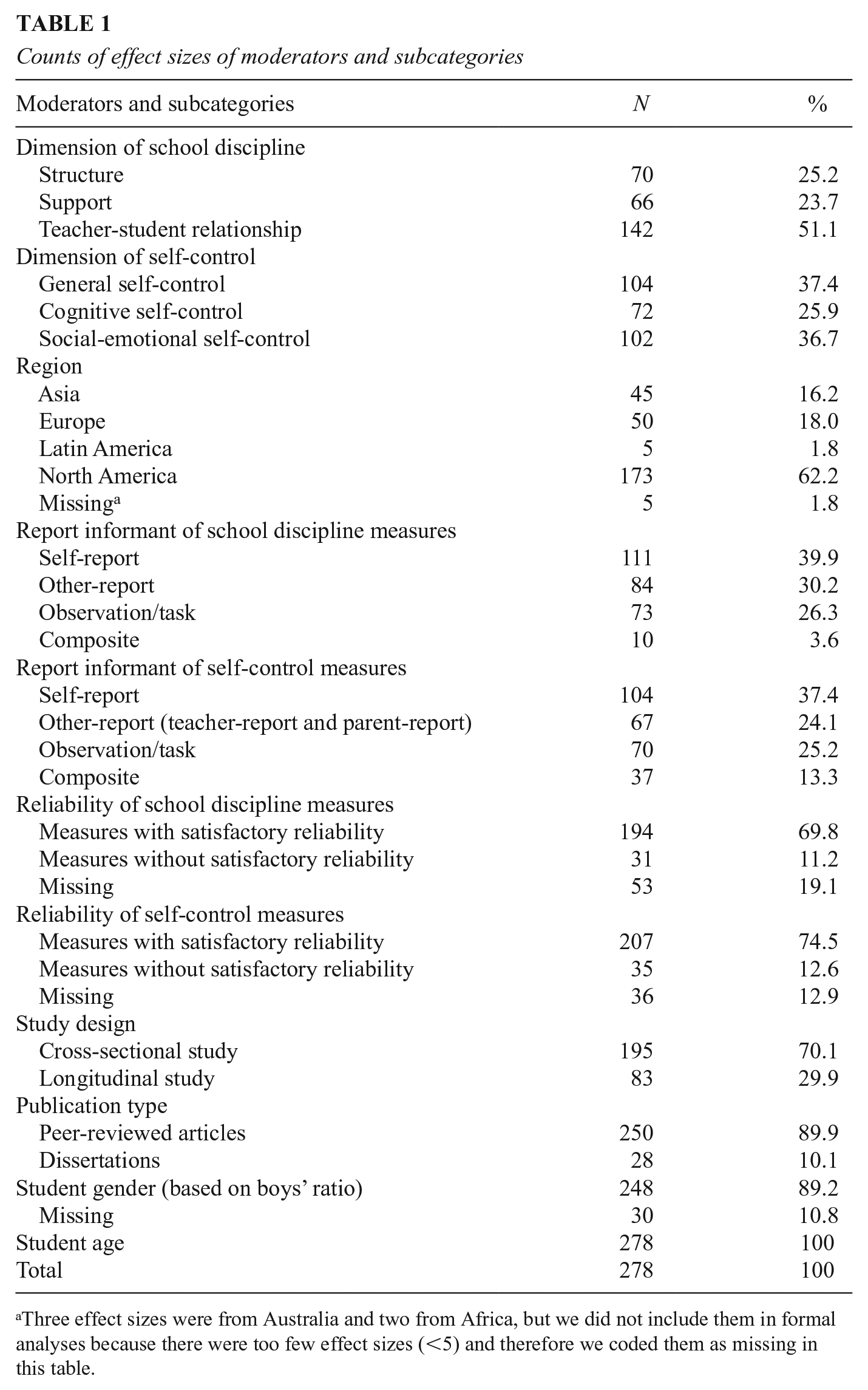
Three effect sizes were from Australia and two from Africa, but we did not include them in formal analyses because there were too few effect sizes (<5) and therefore we coded them as missing in this table.
Table 2 lists the specific terms in each included study that were coded into one of the three school discipline components. Classroom organization/management accounted for most cases in the structure component. Emotional support and autonomy support accounted for most cases in the support component. Regarding the teacher-student relationship component, teacher-student closeness, teacher-student conflict (reversely coded), and students’ attachment to school/teacher prevailed in this component.
Counts of terms of each school discipline component
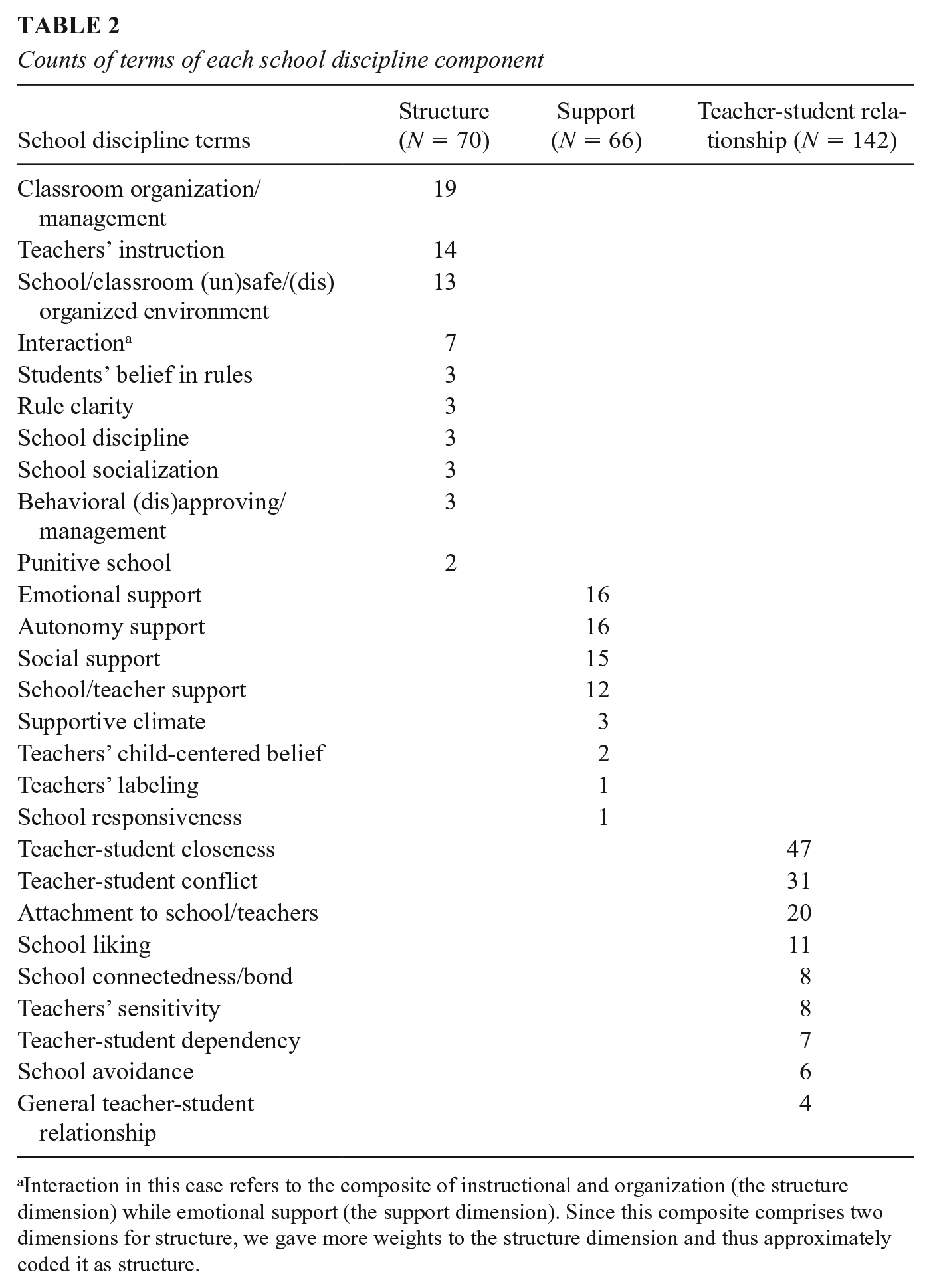
Interaction in this case refers to the composite of instructional and organization (the structure dimension) while emotional support (the support dimension). Since this composite comprises two dimensions for structure, we gave more weights to the structure dimension and thus approximately coded it as structure.
Overall Effect
The overall effect size was significant, k = 68, Neffect size = 278, ESz = 0.192, SE = 0.021, t = 9.347, p < .001, 95% confidence interval [CI: 0.152, 0.233], with substantial heterogeneity, QE(277) = 5356.848, p < .001. Using an inverse version of the Fisher’s r-to-z formula to transform back the overall effect size and its 95% CI back to Pearson’s correlation r for interpretational purpose, we found that the overall association between school discipline and self-control was r = .190, 95% CI [.151, .229]. 5 The model fit of the three-level model was superior to the two-level model either without the within-study level (Akaike information criterion [AICthree-level] = −214.722 vs. AICtwo-level = 601.426; Bayesian information criterion [BICthree-level] = −203.850 vs. BICtwo-level = 608.674; likelihood ratio test [LRT(1) = 818.148], p < .001) or the one without the between-study level (AICthree-level = −214.722 vs. AICtwo-level = −127.496; BICthree-level = −203.850 vs. BICtwo-level = −120.248; LRT(1) = 89.226, p < .001).
Publication Bias
We applied Egger’s regression test (Egger et al., 1997) with standard error as predictor to statistically examine the issue of publication bias. The results were not significant (z = −1.806, p = .071), suggesting that there was no significant publication bias.
Variance of Overall Effect
The variances at the within-study level (estimate = .015, p < .001) and at the between-study level (estimate = .021, p < .001) were significant. Follow-up analyses found that the variance at the sampling, within-study, and between-study levels was 4.60%, 40.18%, and 55.22%, respectively. According to Hunter and Schmidt (1990), if less than 75% of the variance is composed by the sampling variance, then exploring the moderation effects of other factors on the overall effect size can be meaningful. In this study, only 4.60% variance was attributed to the samples, and thus we continued examining the potential moderators.
Moderator Analyses
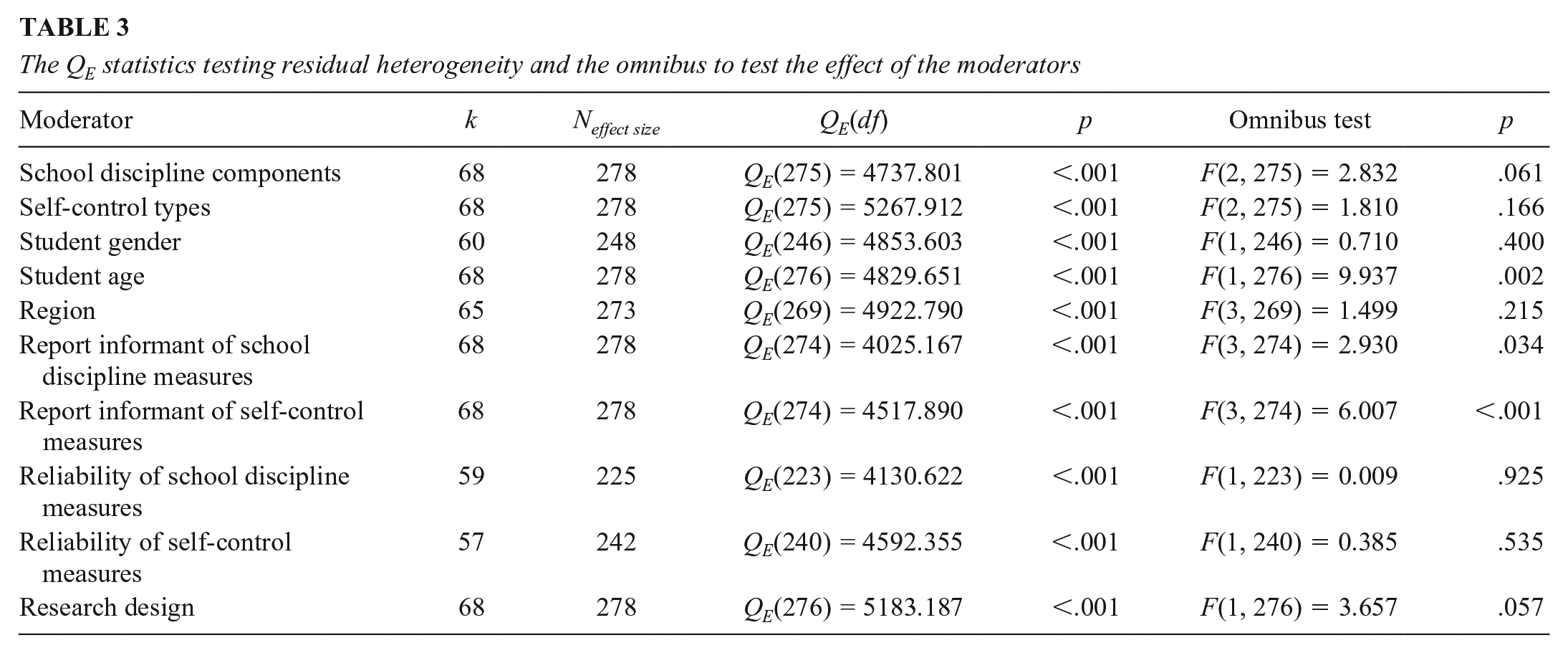
In a first step, we tested the proposed moderators individually. As shown in Table 3, we found that student age, report informant of school discipline measures, and report informant of self-control measures were significant moderators. No other moderators were statistically significant. Using a LRT, we did not find a significant interaction between age and self-control types, AIC = −219.917 (interaction effect model) versus −219.927 (main effect model), BIC = −190.896 (interaction effect model) versus −198.161 (main effect model), LRT(2) = 3.990, p = .136.
The QE statistics testing residual heterogeneity and the omnibus to test the effect of the moderators
Significant Moderators
We continued with follow-up analyses based on the significant moderators found above (see Table 4). Regarding student age, the regression coefficient was significant and positive. This suggested that the magnitude of the “school discipline and self-control” association was larger for older students.
Summary of results for significant moderators
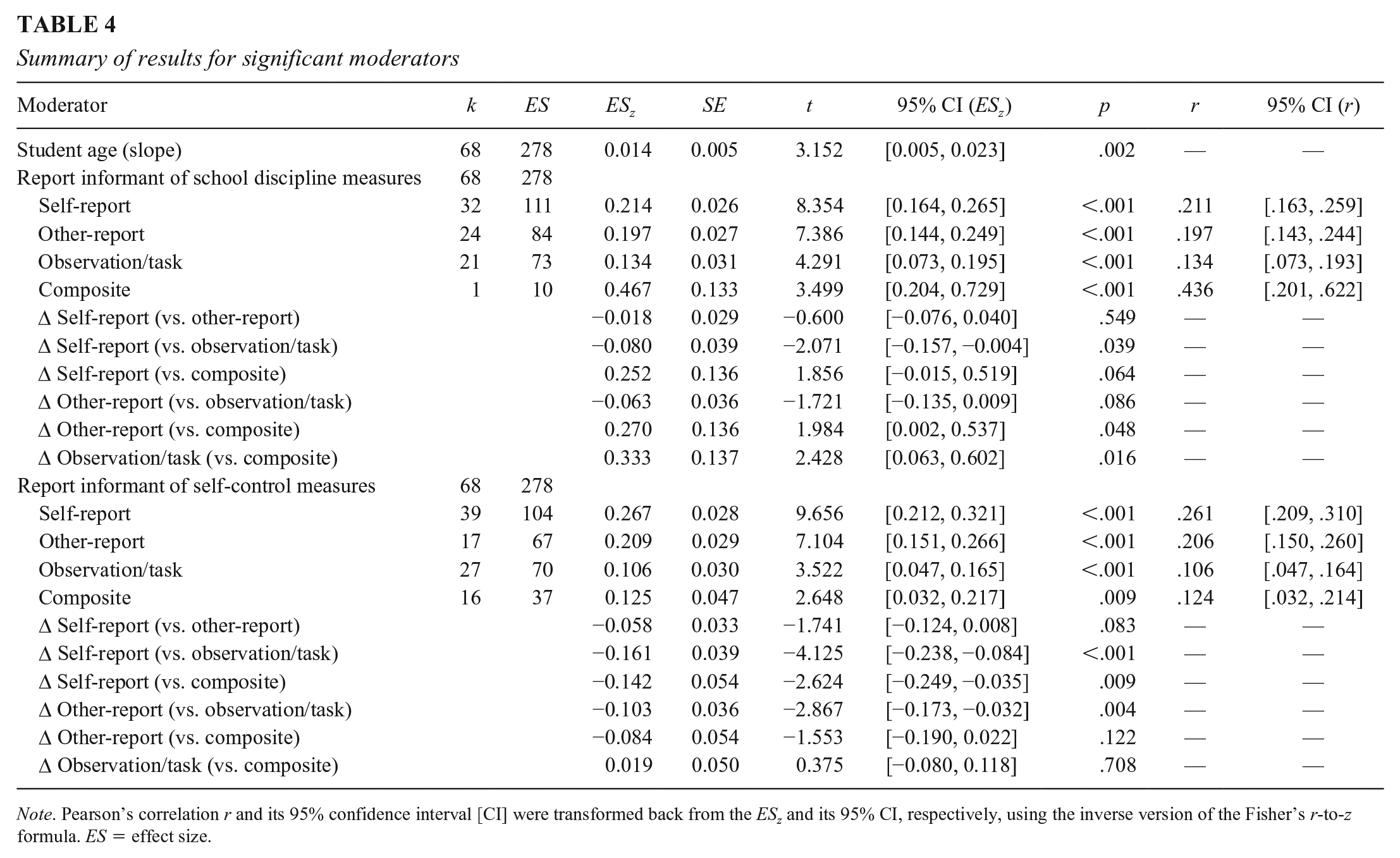
Note. Pearson’s correlation r and its 95% confidence interval [CI] were transformed back from the ESz and its 95% CI, respectively, using the inverse version of the Fisher’s r-to-z formula. ES = effect size.
Regarding the report informant of school discipline measures, the association between school discipline and self-control was significant when school discipline was assessed with self-report measures, other-report measures, observation/task, and composite measures. Results of pairwise comparisons further showed that the effect sizes of studies using self-report informants were significantly larger than the ones using observation/task informants and that the effect sizes of studies using composite informants were significantly larger than the ones using other-report and observation/task informants. However, none of these effects was significant at the Bonferroni-adjusted significance level (i.e., .05/6 = .008).
Regarding the informant of self-control measures, the association between school discipline and self-control was significant when self-control was assessed with self-report measures, other-report measures, observation/task, and composite measures. Results of pair-wise comparison further showed that the effect sizes of the “school discipline–self-control” association was stronger for studies using self-report measures to assess self-control compared to the ones using observation/task and composite measures. Moreover, the magnitude of the association was also stronger for effect sizes using other-report measures to assess self-control compared to the ones using observation/task. Except for the comparison between self-report and composite informants, the other two comparisons were significant at the Bonferroni-adjusted significance level (i.e., .05/6 = .008).
Multiple-Moderator Model
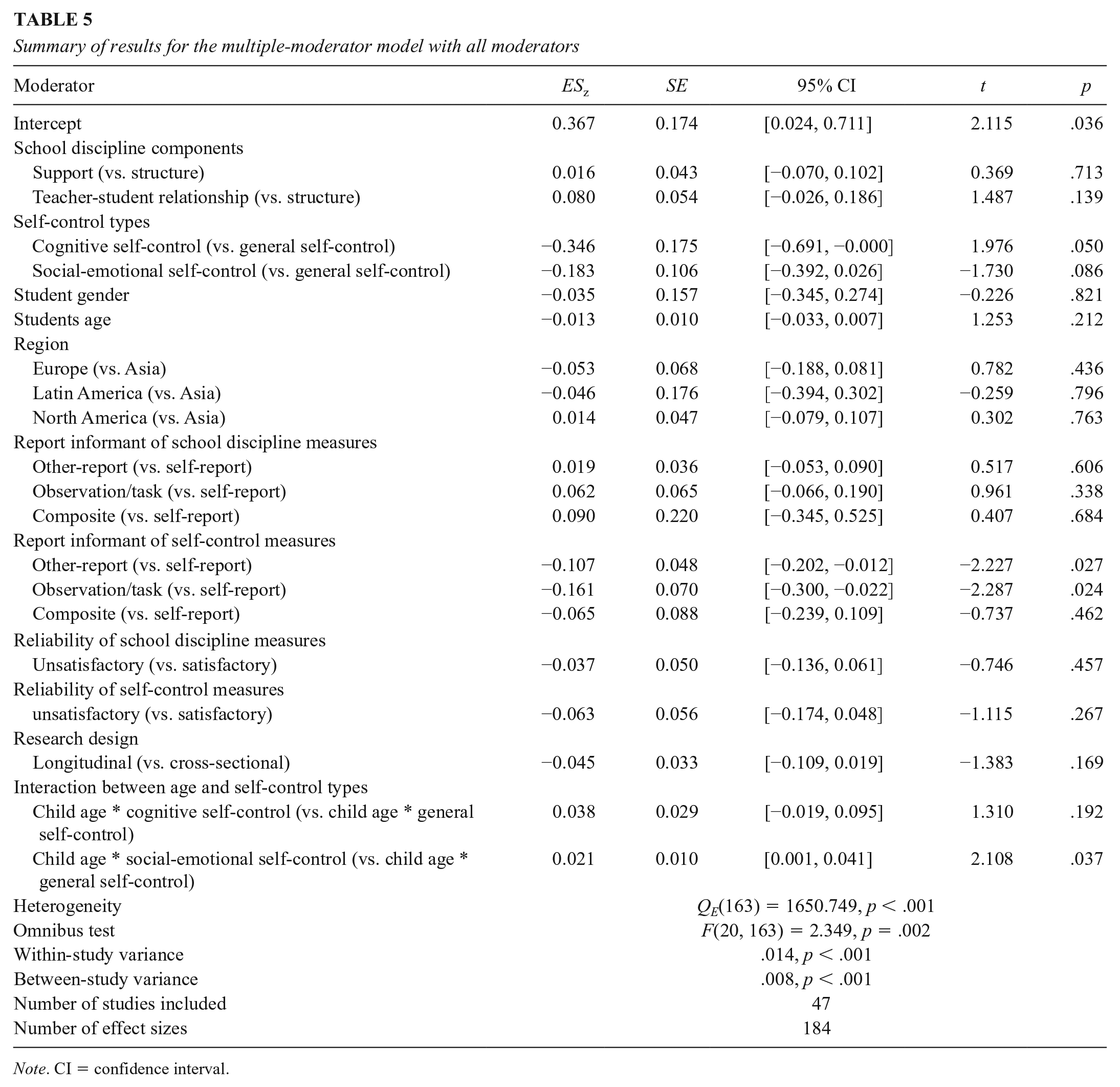
Multicollinearity among moderators may inflate the moderation effect of individual moderator (Hox et al., 2010). To deal with this problem and explore which moderators have a unique moderating effect on the overall effect size, we conducted a multiple-moderator model. In this model, we included all moderators in a single regression model (Table 5). Results of the Omnibus test showed that the model was significant, F(20, 163) = 2.349, p = .002, which suggested that at least one coefficient of the moderators significantly differed from zero. The model fit of the three-level multiple-moderator model was better than the two-level model either without the within-study level (AICthree-level = −130.864 vs. AICtwo-level = 300.277; BICthree-level = −65.640 vs. BICtwo-level = 362.396; LRT(1) = 433.142, p < .001) or the one without the between-study level (AICthree-level = −130.864 vs. AICtwo-level = −118.010; BICthree-level = −65.640 vs. BICtwo-level = −55.892; LRT(1) = 14.854, p < .001). The variances at the within-study level (estimate = .014, p < .001) and at the between-study level (estimate = .008, p < .001) were significant. Follow-up analyses found that the variance at the sampling, within-study, and between-study levels were 7.32%, 59.37%, and 33.31%, respectively.
Summary of results for the multiple-moderator model with all moderators
Note. CI = confidence interval.
Moreover, the results showed that the effect sizes for studies using self-report measures for self-control (e.g., the Early Adolescent Temperament Questionnaire) were stronger than the ones using other-report measures (e.g., the Social Skills Rating System) and observation/task (e.g., Pencil tap). Also, effect sizes for studies examining the association between school discipline and general self-control were stronger than effect sizes for studies examining the association between school discipline and cognitive self-control. Furthermore, the interaction between age and social-emotional self-control was significant, indicating that the association between school discipline and social-emotional self-control was stronger for older students. It is worthwhile to note that several studies were excluded in the multiple-moderator test because they did not contain all the moderators. Nevertheless, the number of studies included in the test exceeded the smallest acceptable number of units at the highest level (in this case, studies) in the multilevel framework (i.e., 30; Van den Noortgate et al., 2013). In this regard, we assumed that the number of studies included in the test should be adequate to generate reliable results.
Discussion
School is a crucial context for human development (Bronfenbrenner, 1979; Downer et al., 2010). Scholars have theorized school discipline as a critical factor that instills students with self-control (Gottfredson & Hirschi, 1990; Sameroff, 2010). Extending studies that reveal the importance of a good teacher-student relationship in the development of EF (Cumming et al., 2020; Vandenbroucke et al., 2018), this three-level meta-analysis is the first to synthesize the association between three school discipline components (i.e., structure, support, and teacher-student relationship) and self-control from preschooler to high school students. Our findings showed that school discipline is positively related to self-control, and this association is at small-to-medium effect size, according to Cohen’s (1992) benchmarks. The overall effect size was largely invariant across school discipline components, gender and age of students, region, report informant of school discipline measures, reliability of school discipline and self-control measures, and research design, but it was moderated by the report informant of self-control measures, types of self-control, and the interaction between child age and types of self-control. Although nine studies overlapped with Vandenbroucke et al.’s (2018) meta-analysis, our study contributes to the existing literature and extends previous findings by including a large number of studies not considered in Vandenbroucke et al. (2018), covering a wider age range and broader theoretical concepts, and revealing more theoretical and methodological moderators.
The effect sizes we found for studies that examined the association between school discipline and general self-control were larger than the effect sizes for studies that examined the association between school discipline and cognitive self-control and marginally larger than the ones for studies that examined the association between school discipline and social-emotional self-control. A possible explanation may be that general self-control presents a more complete picture of the self-control construct than cognitive or social-emotional self-control alone (Li & Vazsonyi, 2019; Tangney et al., 2004). In the school context, schools and teachers comprehensively nurture students to develop cognitive and social-emotional self-control with activities ranging from requiring them to concentrate in the class to teaching them skills in various social-emotional contexts such as taking turns, regulating emotions when interacting with classmates, resisting temptations, and overcoming destructive impulses (e.g., retaliating aggression). Given the schoolwide efforts, school discipline may be associated with general self-control more strongly than with its specific elements.
The effect sizes for studies using self-report measures for self-control were stronger than the effect sizes for studies using observation/task measures and other-reported questionnaires to assess self-control. Regarding the differences between self-report measures and observation/task, possibly self-report measures for self-control capture the central tendencies of aggregates of many different instances of behavior and general, cross-domain self-control, whereas task-based measures of self-control capture momentary, narrow, domain-specific performance of self-control (Wennerhold & Friese, 2020). Regarding the differences between self-report and other-report measures of self-control, it is possible that self-report questionnaires reflect self-control more accurately than other-report questionnaires, because informants have less access to students’ attitude and inner perceptions or are unfamiliar with the target participants (Kelley et al., 2017). Additionally, it is possible that informants’ perceptions are based on observations in a specific context and that these observations do not necessarily generalize to other contexts (e.g., teachers observe student self-control only in the school context but not in the home context). Another explanation for these differences may be that common method bias may inflate the association between school discipline and self-control if only self-report measures are used.
We found that age moderated the overall association between school discipline and self-control initially, but this effect was no longer observed in the multiple-moderator model. Nevertheless, child age interacted with types of self-control to affect the “school discipline–self-control” association: The relation between school discipline and social-emotional self-control became stronger as children grew older. This may be because different components of self-control develop at different developmental stages. Schel et al. (2014) proposed that self-control involved in cold contexts (e.g., attentional control) has already developed largely in infancy and childhood but that the more mature aspect of self-control, the one involved in hot contexts (e.g., impulsive control), would only be fully developed until late adolescence/young adulthood. Similarly, other scholars suggested that the ability to control the temptation of externally rewarding stimuli continues to improve throughout adolescence (Duckworth & Steinberg, 2015). These suggestions converge to suggest that older students may need more external support (e.g., school discipline) to maintain and strengthen their social-emotional self-control than younger students.
Although the moderation of school discipline components was not significant, the three components had differential associations with self-control, with the association between the teacher-student relationship and self-control being the strongest and the one between structure and self-control being the weakest. One possible explanation is that a good teacher-student relationship could be the foundation for effective discipline that teaches self-control (Gottfredson & Hirschi, 1990). In addition, the effect sizes for teacher-student relationships were more varied than the effects sizes for structure and support. This finding may be due to the different numbers of studies that examined each component. Although all effect sizes showed significant heterogeneity, teacher-student relationship associations with self-control showed the greatest heterogeneity, suggesting that the association may vary considerably across groups, schools, contexts, or other moderating factors (Card, 2012). Examining such factors exceeded the scope of the present meta-analysis, yet scholars who are interested to examine the factors that moderate the association between a specific school discipline component and self-control could revisit this issue with our data available online.
Because research suggests that in some countries students in ethnic/racial minority groups receive more negative discipline (Barbarin & Crawford, 2006; Harradine et al., 2014), we examined whether the association between school discipline and self-control varied across the countries in which the study was conducted. Because we lacked diverse studies, we had to pool studies carried out in different countries into larger world regions (e.g., Asia, Europe). We found no significant moderation effect for world regions. This approach represents the first step in examining cultural differences. More nuanced analyses and studies with greater diversity (e.g., comparing schools/classrooms with more or less diverse student populations) are warranted to examine the influence of culture, ethnicity, and/or racial minorities. This suggestion is consistent with recent calls for the examination of the interplay of culture, development, and acculturation (Motti-Stefanidi, 2018) and more inclusive developmental science (Syed et al., 2018). As in our meta-analysis, developmental research on ethnic/racial minorities is skewed by research in the United States, and there is a great need for a better understanding of the experiences and development of ethnic/racial minorities within an international context (Syed et al., 2018). Coding of ethnic/racial minorities in each country where a study is conducted could be a crucial step toward addressing this issue.
Implications for Theories, Policy, and Practice
The importance of self-control for child and adolescent development spurred the investigation of the etiological sources of self-control. The bioecological model underlines that both biological and environmental factors coshape developmental outcomes (Bronfenbrenner & Morris, 2006). The existing literature has primarily focused on the family context (Davis et al., 2017; Karreman et al., 2006; Li et al., 2019; Pallini et al., 2018; Willems, Li, et al., 2018). The current meta-analysis contributes to the field by providing a nuanced synthesis of the association between school discipline, a particularly important yet undersummarized environmental factor, and self-control. Our results largely support the tenets from the general theory of crime (Gottfredson & Hirschi, 1990) and the transactional model of self-regulation (Sameroff, 2010). Nevertheless, one point should be noted regarding the general theory of crime. A central tenet of the general theory of crime is that insufficient discipline is the source of low self-control which accounts for misbehavior (Gottfredson & Hirschi, 1990). Students in ethnic/racial minority groups (at least in U.S. schools) often receive disproportional negative and harsh discipline (Barbarin & Crawford, 2006; Harradine et al., 2014). Thus, the capacity of the general theory of crime as a framework to understand students’ misbehavior in the classroom may be limited. Our results also support attachment theory (Bowlby, 1969), showing that teachers and school can be viewed as critical attachment figures and contexts for students and play an important role in students’ self-control.
School discipline has been linked to a wide range of positive outcomes in students, such as higher school engagement, better academic achievement, and less bullying (Gregory et al., 2010; Roorda et al., 2011; Vandenbroucke et al., 2018). With the findings of this study and the beneficial role of self-control to numerous outcomes (De Ridder et al., 2012), self-control could be a candidate that links school discipline and different outcomes, implying that self-control may be a mechanism explaining how school discipline relates to a number of positive outcomes.
There is a wide debate about which practice should be used to manage students’ behavior and develop their social skills, ranging from strict behavioral conformity to autonomy granting and independent decision making (Gregory et al., 2010; Gregory et al., 2011; Kupchik, 2010; Stronach & Piper, 2008). We found that each of the three discipline components is positively related to self-control. Given the importance of school discipline to students’ self-control, schools could consider adopting policies and practices that strengthen the structure in schools that fosters students’ social-emotional learning. Also, it would be important to cultivate a workforce of teachers with strong social skills necessary to show involvement, caring, emotional responsiveness, granting autonomy, and provide emotional support. And finally, schools may invest in strengthening teachers’ relationship with students.
As the brain matures, individuals become better able to learn, understand, internalize, and implement the rules that direct self-controlled behavior (e.g., Casey & Caudle, 2013). It is sensible that the association between school discipline and social-emotional self-control would be stronger for older students. Although self-control is challenging in adolescence (Casey & Caudle, 2013), the adolescent period could be a time window for individuals to improve their social-emotional self-control (Duckworth & Steinberg, 2015; Schel et al., 2014). The current findings, albeit correlational in nature, suggest that enhancing different aspects of school discipline might be a promising way to aid adolescent students to develop better self-control. Prior studies have suggested different ways to improve school discipline such as schoolwide policies and practices targeting classroom management, positive behavioral interventions and supports (PBIS), and social and emotional learning (Durlak et al., 2011; Osher et al., 2010). For instance, PBIS aims to reduce students’ disruptive behaviors and to enhance students’ academic achievement by altering school environments through creating improved systems and targeting staff behavior to promote positive change in student behavior (Bradshaw et al., 2008; Bradshaw et al., 2010). Thereby, comprehensive practices such as PBIS may be conducive to creating a facilitative environment and consolidate teachers’ support as well as teacher-student relationship to improve students’ self-control.
Limitations
First, the number of effect sizes was disproportionally distributed in some subcategories. For instance, for school discipline components, the teacher-student relationship component had nearly twice as many effect sizes than the structure and support components, which may make the associations for each component less comparable. In addition, although the multiple-moderation regression model is methodologically robust because it controls for all the individual moderators, readers should interpret the findings with caution because a number of effect sizes were lost in the model.
Second, although we considered a wide range of moderators, we were unable to include other moderators that are relevant to the “school discipline–self-control” association. Some interesting moderators contained too few cases (e.g., teachers’ teaching experience). Other moderators were not in the same unit preventing combination. For instance, for family socioeconomic status (SES) some studies reported family income while others reported parental occupation. Not controlling for SES represents an important caveat for this study. It is possible that schools in poorer neighborhoods or with a larger proportion of students from lower SES backgrounds may systematically use different disciplinary practices. Also, family SES may explain individual differences for some components of self-control such as delay of gratification (Watts et al., 2018). Thus, students living in low SES environments may have lower levels of self-control. Research examining the association between school context and self-control that considers environmental factors such as adversity would be promising.
Third, the generalizability of the findings is limited. This meta-analysis only focuses on typically developing students, and thus the findings cannot be readily generalized to clinical samples such as students diagnosed with attention problems or autism spectrum disorder. Besides, although the effect sizes were drawn from six continents, most of them were from the United States and European countries. Future research focusing on diverse, especially the underrepresented, populations or integrating findings published in different languages into our open-access data set to update the results would be promising.
Fourth, we must point out that although we used Egger’s test to examine the publication bias, so far little research has examined which predictor of the Egger’s test is the best in the three-level meta-analysis (Viechtbauer, 2015). Therefore, readers may need to interpret the findings of the publication bias with caution.
Last, in our analyses we quantified concurrent and longitudinal associations, which does not necessarily measure change in self-control since we did not control for baseline levels or autoregressive effects. Some studies did control for the baseline levels of self-control, but they also controlled for other covariates and these covariates were not consistent across studies. Besides, we need to reiterate that the association meta-analyzed in this study is correlational and therefore no causality can be deduced. Nevertheless, future research may reexamine these issues with our openly accessible materials.
Future Directions
First, the current study, as well as Vandenbroucke et al. (2018), examined the main effect of different school discipline components on self-control. However, the different components complement each other and interact to facilitate students’ development (e.g., Gottfredson & Hirschi, 1990; Gregory et al., 2010). It would be critical to investigate whether different school discipline components jointly affect self-control in students.
Second, Sameroff (2010) theorized that self-control is coshaped by biological underpinnings and multiple environmental contexts. Some existing studies have examined how biological factors interact with environmental contexts to affect self-control, but these studies almost exclusively highlight the family context (Beaver et al., 2010; Willems et al., 2020), neglecting the interaction between biological factors and the school context. In addition, although some studies have examined the interaction between home and school in forging students’ self-control (Li & Lau, 2019; Turner et al., 2005), this line of research is still in its infancy. The investigation of the interaction between other ecological systems and school discipline and the one between biological factors and school context on students’ self-control would be promising.
Third, the transactional model of self-regulation (Sameroff, 2010) suggests that contextual factors affect self-control and vice versa. Evidence on the relationship between parenting and self-control reveals that parenting predicts adolescents’ later self-control, and that adolescents’ self-control also predicts later parenting (Li et al., 2019). In future studies, modeling whether school discipline and self-control show a bidirectional association could be another crucial topic. For example, when teachers perceive students to be good at self-control, they may grant more autonomy and support and provide less assistance. Moreover, students with high self-control may have better academic achievement and relationships with others (e.g., Duckworth & Seligman, 2005; Tangney et al., 2004), which could be beneficial for a good teacher-student relationship. Thus, examining the bidirectional association is a promising way to understand the transactional development of self-control.
Fourth, a number of measurements have been developed to assess self-control, including self-/other-report questionnaires as well as self-control tasks such as Stroop task (Duckworth & Kern, 2011). In this study, only few studies used more than one measure to assess self-control (i.e., composite), while the overwhelming majority used only one assessment modality. Since self-control is a multifaceted construct, it has been argued that using more than one approach to assess self-control may better represent the breadth of this construct (Duckworth & Kern, 2011; Li & Vazsonyi, 2019). Future research may consider using multiple modalities to assess self-control and examine its relation to school discipline.
Fifth, Hunter and Schmidt (1990) proposed that if less than 75% of variance is attributed to sampling variance, examination of moderators would be meaningful. Our findings showed that only 4.6% and 7.32% of the variance should be attributed to the sampling level in the overall effect model and the multiple-moderator model, respectively. This suggests that future research may continue searching other factors that may moderate the association between school discipline and self-control.
Last, many existing studies did not consistently report important information on moderators (e.g., teachers’ experience, SES, ratio of ethnic/racial minorities), which underlines the limitations of the current study. To circumvent this shortcoming, it would be promising if researchers were to engage in harmonization efforts on which information to report and which metric to use. For instance, whenever possible, research should report detailed individual (e.g., gender and age), family (e.g., parents’ educational levels, income, and family structure), and school features (e.g., school location, class size, and teacher experience) with standardized metrics (e.g., using educational levels and income to indicate SES). We are aware that some of these indicators may concern sensitive information, and therefore the provided examples here are just for future research reference. In addition, the variety of covariates included in different studies makes it difficult to compare the findings across studies and to model the growth of self-control. One way to meet this challenge may be to encourage future researchers to report raw correlation matrix between all variables, including the ones referring to the stability of a construct over time. Future meta-analyses could then test all covariates as moderators as well as the growth of self-control.
Conclusion
Self-control aids children and adolescents to navigate the challenges during the developmental process to achieve optimal outcomes (Caspi et al., 2016; Moffitt et al., 2011; Moffitt et al., 2013). This meta-analysis suggests that school discipline is significantly associated with self-control spanning the developmental period from preschool to high school. The association was not affected by school discipline components, gender and age of students, region, report informant of school discipline measures, reliability of school discipline and self-control measures, or research design. The association was stronger for the studies that assessed self-control with self-report measures (compared to observation/task and other-informant measures) and for the studies that examined general self-control (compared to cognitive self-control). Moreover, the association between school discipline and social-emotional self-control was stronger for older students. In sum, these findings highlight that school discipline is an important etiological source of the individual differences in self-control from preschoolers to high school students.
Supplemental Material
sj-docx-1-rer-10.3102_0034654320979160 – Supplemental material for The Association Between School Discipline and Self-Control From Preschoolers to High School Students: A Three-Level Meta-Analysis
Supplemental material, sj-docx-1-rer-10.3102_0034654320979160 for The Association Between School Discipline and Self-Control From Preschoolers to High School Students: A Three-Level Meta-Analysis by Jian-Bin Li, Shan-Shan Bi, Yayouk E. Willems and Catrin Finkenauer in Review of Educational Research
Supplemental Material
sj-xlsx-2-rer-10.3102_0034654320979160 – Supplemental material for The Association Between School Discipline and Self-Control From Preschoolers to High School Students: A Three-Level Meta-Analysis
Supplemental material, sj-xlsx-2-rer-10.3102_0034654320979160 for The Association Between School Discipline and Self-Control From Preschoolers to High School Students: A Three-Level Meta-Analysis by Jian-Bin Li, Shan-Shan Bi, Yayouk E. Willems and Catrin Finkenauer in Review of Educational Research
Footnotes

Notes
Authors
JIAN-BIN LI is an assistant professor in the Department of Early Childhood Education of the Education University of Hong Kong, 10, Lo Ping Road, Tai Po, New Territories, Hong Kong; email:
SHAN-SHAN BI is a PhD candidate at Utrecht University, Sjoerd Groenmangebouw Padualaan 14, 3584 CH Utrecht, Netherlands; email:
YAYOUK E. WILLEMS received her PhD degree from the Vrije Universiteit Amsterdam, Department of Biological Psychology, Vrije Universiteit Amsterdam, van der Boechorststraat 1, Amsterdam, Netherlands; email:
CATRIN FINKENAUER is full professor at Utrecht University, Sjoerd Groenmangebouw Padualaan 14, 3584 CH Utrecht, Netherlands; email:
References
Supplementary Material
Please find the following supplemental material available below.
For Open Access articles published under a Creative Commons License, all supplemental material carries the same license as the article it is associated with.
For non-Open Access articles published, all supplemental material carries a non-exclusive license, and permission requests for re-use of supplemental material or any part of supplemental material shall be sent directly to the copyright owner as specified in the copyright notice associated with the article.
