




Abstract
The purpose of this meta-analytic review was to investigate the relation between motivation and reading achievement among students in kindergarten through 12th grade. A comprehensive search of peer-reviewed published research resulted in 132 articles with 185 independent samples and 1,154 reported effect sizes (Pearson’s
Literacy is a critical social issue related not only to education but also to economic growth and public health. As such, the development of reading proficiency is a central educational outcome (National Reading Panel, 2000; Snow et al., 1998), and there is strong evidence that students who struggle with reading are at risk for continuing to experience difficulties throughout their school years and beyond (Francis et al., 1996; Reynolds & Ou, 2004; Wagner et al., 2005). There is growing evidence that motivation accounts for unique variance in predicting reading performance, beyond what has been explained by academic and cognitive skills (Conlon et al., 2006; Katzir et al., 2009; Retelsdorf et al., 2011; Taboada et al., 2009; Wang & Guthrie 2004). Furthering our knowledge on the relations between motivation and reading has the potential to improve our understanding of reading development and achievement, and to inform explorations of how we might apply motivation in reading instruction and intervention.
Prior research has explored this topic in several ways. In their systematic review, Morgan and Fuchs (2007) examined studies published between 1975 and 2006 that reported relations between reading and motivation (k = 15) for students in preschool to second grade. Their operationalized definition for motivation was competency beliefs (i.e., judgments of one’s ability toward a given task) and goal orientations (i.e., objectives that determine how a task is managed). The researchers reported evidence that children’s level of reading skill correlated with reports of reading motivation, and that differences observed in early reading skills predicted differences in reading motivation and reading skills in later years. To build on this knowledge, there is a need to systematically explore the relations between motivation and reading with students across all school grades (kindergarten through 12th grade) as there is ample evidence that both constructs change developmentally (Gottfried, 1985; Gottfried et al., 2001; Guthrie & Wigfield, 2000). In another review, Petscher (2010) conducted a meta-analysis of studies investigating the relations between attitudes toward reading and reading achievement for elementary and secondary grades, including studies published prior to 2007 (k = 32). He reported a significant relation between attitudes (i.e., feelings, readiness, and beliefs about reading) and reading, noting that this relation was stronger for elementary students than middle school students. These findings offer an important contribution, although the scope is limited by the focus on attitudes toward reading. Taken together, these two systematic reviews provide evidence that there are significant relations between motivation constructs and reading achievement. However, they also call attention to gaps in our knowledge and challenges with the study of motivation.
There is scholarly agreement that motivation is a multidimensional construct (see Schiefele et al., 2012, for a review) with an extensive literature base derived from myriad theories (and subtheories). This has led to inconsistency in the terminology used to describe motivation constructs and motivation-related terms often being used interchangeably by researchers (e.g., Conradi et al., 2014; Murphy & Alexander, 2000). Relatedly, many researchers have attempted to narrowly define the construct under investigation in response to this issue (cf. Petscher, 2010). While there may be value in this approach, the multidimensional nature of motivation suggests that we may be distorting our interpretations when motivation theories are taken up in isolation. This issue was addressed in a recent study by Neugebauer and Fujimoto (2018) wherein they examined the constructs operationalized in three of the most commonly used reading motivation measures. They reported distinctions between constructs, as well as conceptual overlap across constructs. These issues present unique challenges in understanding this area of research. As such, there is value in examining how reading achievement is associated with “motivation” as a broad construct—as well as how these relations may differ when we consider the various theory-driven constructs used to operationalize and measure motivation.
The present investigation sought to contribute to the literature base and expand our understanding of the relations between motivation and reading for K–12 students by addressing questions that previous work did not or could not answer. Specifically, we use a meta-analytic method to systematically investigate the concurrent relation between motivation and reading with a focus on several moderators that might explain variations in this relation. We first consider the complexity of motivation as multidimensional, yet underspecified, by testing the moderating effect of motivation construct. We also explore moderation related to reading domain (i.e., code-focused, meaning-focused), reading ability based on sample type (i.e., typically developing [TD] students, students with or at risk for learning disabilities [LD]), and grade level (i.e., elementary vs. secondary). Moreover, we examine key interactions between these moderators, and consider the influence of year of publication and type of motivation measure (i.e., domain-specific vs. domain-general) in all analyses. Finally, we examine the directionality of the relations between motivation and reading within longitudinal investigations, which offers empirical evidence to inform future theory and practice.
Investigating the Construct of Motivation
As previously described, interpreting studies of “motivation” can be challenging as lack of clarity in operationalization and measurement means we understand neither the extent to which different constructs are conflated nor the extent to which similar constructs are treated as distinct. This complexity should perhaps be expected as the study of human motivation has evolved from several research traditions, resulting in an extensive literature base and list of constructs. While it is beyond the scope of this article to present a satisfactory listing of motivation theories and constructs, we refer readers to comprehensive texts that have been written by leading scholars in this field—including self-efficacy (Bandura, 2013), achievement motivation (Elliot & Dweck, 2013), academic self-concept (Marsh, 2014), motivation applied to education (Schunk et al., 2012), self-regulated learning (Schunk & Zimmerman, 2012), and attributional perspectives (Weiner, 2012).
Prior to describing our approach to investigating the construct of motivation in the present study, we first introduce theory that frames much of the work on motivation and how it has been studied. Motivation is generally concerned with the energization and direction of human behavior (Pintrich, 2003). It can be understood within the context of social-cognitive theory, from which hypotheses about relations between motivation and reading may be derived. This theory posits that individual actions are driven by thoughts, goals, beliefs, and values rather than predicted behavioral consequences (Schunk & Zimmerman, 2012). In addition, it suggests a reciprocal relationship between psychosocial processes and achievement. That is to say, academic performance is a predictor of psychosocial development and these factors reciprocally influence academic performance (e.g., Pekrun et al., 2002; Weiner, 1985). Within this overarching theory, types of motivation can be further divided. To begin with, motivation is often considered to be either intrinsic (individual’s desire to perform the task for its own sake) or extrinsic (contingent rewards). There has been cumulative evidence to support the belief that intrinsic motivation supports human learning, resulting in increased engagement and achievement (Schutz & Pekrun, 2007), and that external rewards actually serve as a threat to individuals’ intrinsic drive (Deci, 1972, 1976). Furthermore, there are a multitude of constructs within the operationalization of intrinsic motivation. Underpinning the wide array of constructs of motivation is the notion that these processes can influence an individual in their engagement with or avoidance of reading. Thus, these processes are self-reinforcing in nature (Walton & Cohen, 2011; Yeager & Walton, 2011).
In the current meta-analysis, we operationalized motivation within Conradi et al.’s (2014) hierarchy of constructs as presented in Figure 1. We sought to examine motivation through both a broad lens that is comprehensive of various related constructs and a fine-grained lens. Conradi et al. expanded on Murphy and Alexander (2000) to operationalize motivation by generating consensus definitions organized in a hierarchy. They used motivation terms typically applied in reading research, as well as broadening to include terms used by educational psychology, to categorize within three constructs: goal orientation 1 , beliefs, and disposition. Goal orientation refers to an individual’s habitual approaches toward reading and the intentions they set related to their reading actions (including performance and mastery goals). Beliefs refers both to beliefs about self, an individual’s perceptions and judgments related to their competence, abilities, and capacity (i.e., self-efficacy, self-concept, agency), as well as beliefs about reading, an individual’s perceptions and judgments about reading as an activity and their experiences with reading (i.e., expectancy, value). And finally, disposition refers to an individual’s feelings about reading or their positive orientation toward reading about a particular topic (i.e., attitudes, interest). As noted in a number of works discussed, there is little direction on how motivation should be operationalized nor a tested model that supports classification of motivation-related constructs and terms. We opted for a conceptualization that has theoretical grounding and would allow for coding of motivation constructs into meaningful categories.
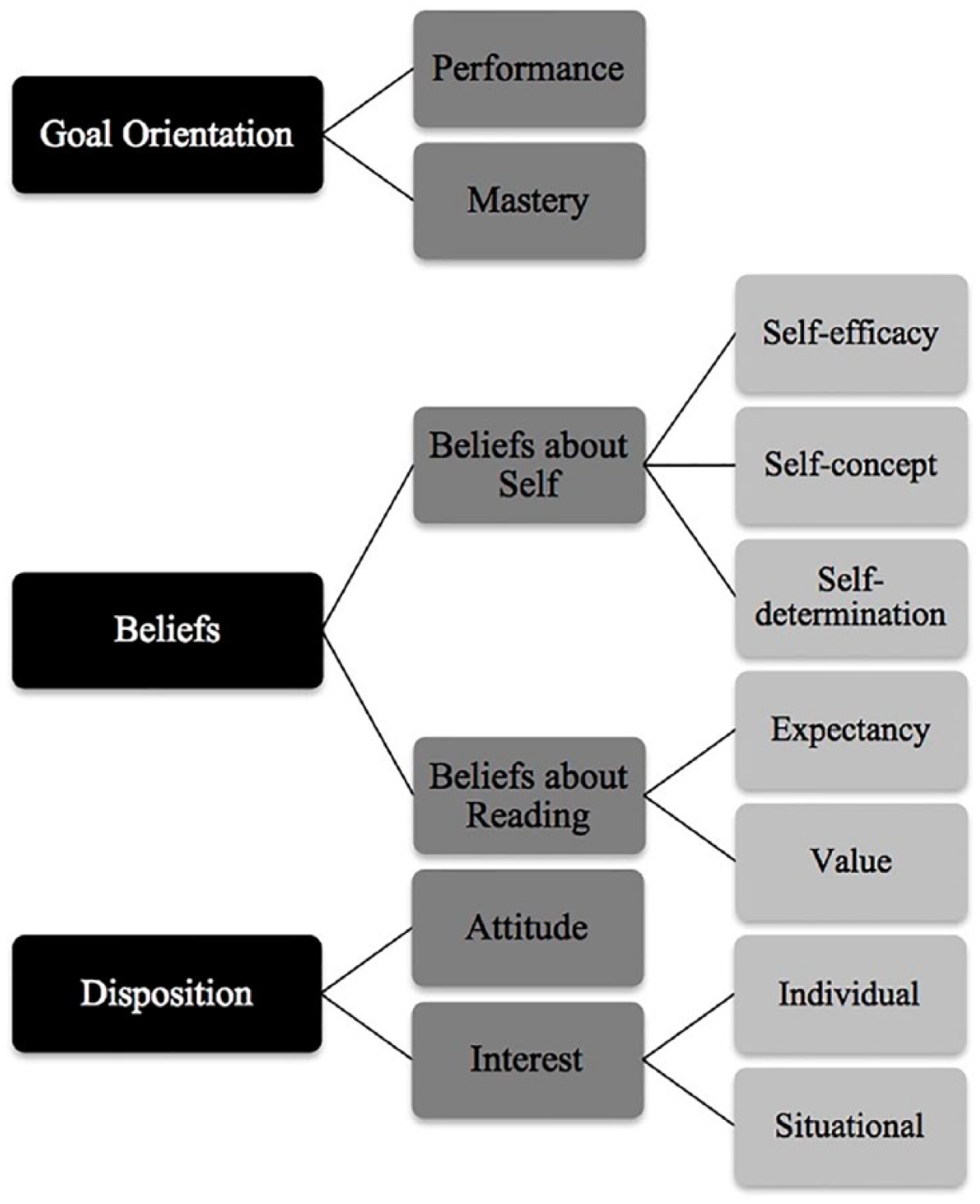
Hierarchy of motivation constructs from Conradi et al. (2014).
It is unlikely that these constructs hold equal relevance for students’ reading performance. However, as we lack clear direction to suggest that one motivation construct would be more strongly related to reading achievement over others, we approach this moderation analysis as exploratory. Systematic investigation of how these constructs may differ in their associations with reading allows for broader understanding of the current literature base. In addition to considering how motivation construct might influence the motivation-reading relation, we also set out to explore other moderators of interest. In the following sections, we specifically discuss empirical findings and hypotheses related to other potential moderators of the relation between motivation and reading.
Reading Domain
Reading proficiency includes two broad domains: the ability to read words accurately and fluently (code-focused skills), as well as the ability to comprehend and gain knowledge from reading text (meaning-focused skills). Across studies, it is possible that the reading domain being measured may influence the magnitude of the motivation-reading relation. For example, Chapman et al. (2000) found that primary students’ prereading skills (i.e., phonological awareness and alphabetic knowledge) were highly predictive of self-concept, as an indicator of motivation. Guthrie et al. (2007) also reported that students’ reading efficacy was mostly related to their perceptions of how they read words. The authors proposed that the slower process of decoding words or not being able to read words might frustrate students and lead to disengagement with text. Studies by Katzir et al. (2009) and Taboada et al. (2009) reported that fourth-grade students’ motivation (operationalized as self-concept and teacher report of intrinsic motivation, respectively) contributed to their reading comprehension performance. There is also evidence to suggest that students with high levels of motivation may be more likely to connect background knowledge to text, engage in strategy use, and read with the goal of understanding text (e.g., Katzir et al., 2009; Logan et al., 2011).
To date, there has been no systematic review that accounts for differences based on code-focused and meaning-focused domains of reading achievement. Most research in this area, especially with older students, has focused on reading comprehension, suggesting that motivation is an underlying factor explaining performance. While factors that influence comprehension (e.g., working memory, background knowledge) are important to models of reading development, evidence would suggest that motivation is also associated with word reading skill development (Cartwright et al., 2016; Snow, 2017). Based on this view, we posited that both reading domains would have similar associations with motivation. However, we sought to explore the potential effect of the interaction between reading domain and motivation construct (i.e., goal orientation, beliefs, disposition) on the motivation-reading relation. We hypothesized that the disposition construct would have stronger relations with code-focused reading than meaning-focused reading. This is based on prior research suggesting that attitudes are more strongly related to reading achievement in the elementary grades (Petscher, 2010), wherein key instruction is generally focused on code-focused reading skills (e.g., word reading, fluency). We also hypothesized that the interaction between reading domain and grade level would significantly affect the relation between reading and motivation—in that motivation would have stronger relations with code-focused reading in the elementary grades and meaning-focused reading in the secondary grades.
Reading Ability
It has been posited that students’ reading performance may be facilitated by self-reinforcing experiences triggered by initial success or failure. This is often referred to as Matthew effects (Scarborough & Parker, 2003; Stanovich, 1986, 1988), the notion that the achievement gap between poor and good readers widens over time. Investigation of this phenomenon has resulted in mixed findings (Pfost et al., 2014), although there is some suggestion that Matthew effects are more likely to be experienced by students at risk for reading disabilities (Morgan et al., 2008; Schatschneider et al., 2016). Few studies have examined the self-reinforcing causal mechanisms often suggested to contribute to widening of the achievement gap: motivation.
Researchers generally believe that motivation supports cognitive ability, rather than operates independent from it (Schunk & Zimmerman, 2012). Highly motivated students demonstrate increased goal-directed actions and engagement (Vansteenkiste et al., 2006), show continued persistence in the face of obstacles and adversity (Multon et al., 1991; Schunk, 1991), and spend more time reading outside of school than their peers (Wigfield & Guthrie, 1997). There is also evidence demonstrating a further connection between these learning-supportive behaviors and reading performance. For example, Schaffner et al. (2013) reported that amount of time spent reading fully mediated the effect of intrinsic reading motivation on reading comprehension performance.
Students who struggle with reading, by definition, have had more experiences of failure or strain with reading and reading-related achievement tasks. Thus, it would seem reasonable to posit that less skilled readers would have more negative motivational beliefs than their peers—and that students who have more positive beliefs have more successful reading experiences and read more often, leading to greater reading achievement. Previous research provides support for this assumption. For instance, in a sample of upper elementary students, Logan et al. (2011) examined motivation as a predictor of reading comprehension skill among high-ability and low-ability readers. Findings revealed that motivation, defined as students’ ratings of interest and engagement in reading, and decoding skill explained significant variance in reading comprehension skill for poor readers but not for the group of good readers. Furthermore, when controlling for previous reading comprehension performance, motivation explained significant variance in reading comprehension growth for the low-ability reading group. In a study of adolescent motivation, Wolters et al. (2014) found that struggling readers held more negative beliefs and attitudes about their competence in reading but were similar to adequate readers in their values and goals for reading—that is to say, enjoyment and perceived importance of reading as well as their intentions related to personal reading-related tasks.
Although there is evidence to suggest that struggling readers may have lower motivation for reading and hold more negative beliefs about their competence in reading, there is also evidence that struggling readers do not necessarily have lower motivation. For instance, it could merely be that motivation is more highly related to reading comprehension growth for struggling readers as compared to higher ability readers (Logan et al., 2011). In addition, some studies have reported contradictory findings when comparing students based on reading ability, with no significant group differences on measures of motivation (e.g., Lau & Chan, 2003; McGeown et al., 2012). It has been suggested that these differences might be explained by the motivation construct under investigation or students’ age. Thus, we hypothesized that sample type (i.e., TD students or students with or at risk for LD) would significantly moderate the relation between motivation and reading—in that student samples identified as with or at risk for LD would have larger effects. Meanwhile, we posited a possible interaction between motivation construct and sample type such that the construct of beliefs would have a stronger relation to reading for students with or at risk for LD.
Grade Level
Students’ developmental period (i.e., grade level) may also influence the relations between motivation and reading. Certain domains of reading are more critical during certain development periods—the oft-cited shift from “learning to read” in the primary grades to “reading to learn” in the upper elementary and secondary grades (Chall, 1983). There is reason to believe that there may also be a developmental trajectory for motivational processes. Correlational and experimental studies have provided evidence that children’s understanding of factors such as effort and ability change dramatically with age (Nicholls, 1979; Nicholls & Miller, 1984) and this affects motivational processes. Specifically, for young children, ability and effort are positively related concepts—they believe that smart students are hard workers and that not-so-smart students do poorly because they do not work hard enough. For older children, ability and effort are reciprocally related concepts—they believe that smart students do not need to work hard and, conversely, that students who do need to work hard must not be so smart (Fincham & Cain, 1986; Folmer et al., 2008). These changes may be due to developmental maturation, specific changes in cognitive skill levels, or even accumulation of experiences with academic success and failure.
Correlational studies have noted a marked decrease in intrinsic motivation for reading as students enter the upper elementary grades and middle school (Gottfried, 1985; Guthrie & Wigfield, 2000). In a study of intrinsic motivation development, Gottfried et al. (2001) investigated the continuity of academic intrinsic motivation from ages 9 through 17 years—measured as enjoyment of learning, orientation toward mastery, curiosity, persistence, and interest in subject-specific tasks. Results indicated that academic motivation was found to be a stable construct over time and, more interestingly, that mean levels of motivation declined with age. Furthermore, investigations of students’ competence and value beliefs (i.e., expectancies for and value placed on success) have reported similar trajectories (Eccles et al., 1989; Fredricks & Eccles, 2002). Muenks et al. (2018) provided a comprehensive review of students’ expectancy beliefs for various achievement tasks across developmental periods and noted that decline is consistently reported in the literature.
In the present meta-analysis, we hypothesized that grade level would significantly moderate the relation between motivation and reading. Based on the evidence reviewed, we posited a stronger relation for students in the elementary grades versus secondary grades as motivation tends to decline as academic demands increase. We also examined, as previously noted, the effect of the interaction between reading domain and grade level. Based on previous meta-analytic findings (Petscher, 2010), we posited that the disposition construct (which includes attitudes toward reading) would have a stronger relation to reading for elementary students than secondary students.
Research Questions
The purpose of the current meta-analytic review was to further our understanding of the relations between motivation and reading achievement for students in kindergarten through 12th grade. Through systematic review of the published literature, we sought to address four major research questions:
Method
Literature Search
An overview of search and screening procedures is presented in Figure 2. Articles for this meta-analysis were identified in two ways. First, we searched PsycInfo, ERIC, Education Source, and Google Scholar databases for articles published in peer-reviewed journals prior to August 2018. The earliest publication date among records that appeared in our initial search was 1964. Titles and abstracts were searched for the following terms that allowed for inclusion of a wide range of motivation constructs: motivat* or self-concept or self-efficacy or self-belief* or performance goals or mastery goals or achievement goals or attitudes toward reading or interest* or value* or agency or expectancy AND reading or literacy. The initial search yielded 12,606 articles. Second, we searched the references lists of relevant prior reviews (Conradi et al., 2014; Morgan & Fuchs, 2007; Petscher, 2010) for referrals to other primary research. The additional hand search yielded 14 articles. After excluding 3,912 duplicate articles, the first author and two doctoral students closely reviewed the remaining 8,694 abstracts using specific study inclusion criteria.
Participants were students enrolled in kindergarten through 12th grade (i.e., elementary, middle, or secondary school).
Study included at least one quantitative measure of a motivation construct and at least one quantitative measure of reading performance. In order to be considered a motivation construct, the measure(s) had to focus on students’ motivation as rated by self, teacher, or observer. Measures of reading performance had to directly assess students’ skills.
Study reported at least one correlation (r) between any measure of motivation and any measure of reading. The measures of motivation and reading used to calculate the direct correlation (not partial correlation) had to be taken at the same time point, because we were interested in the concurrent relation between the two constructs and how this relation was affected by the moderators proposed for this meta-analysis.
Experimental and quasi-experimental studies were included as long as at least one correlation between motivation and reading was reported at the pretreatment time point (i.e., pretest measures) to ensure that neither measure was influenced by the intervention. Case studies (sample size of one), qualitative, and single-case designs were excluded from the current meta-analysis.
Study was published in English, in a peer-reviewed journal prior to August 2018.
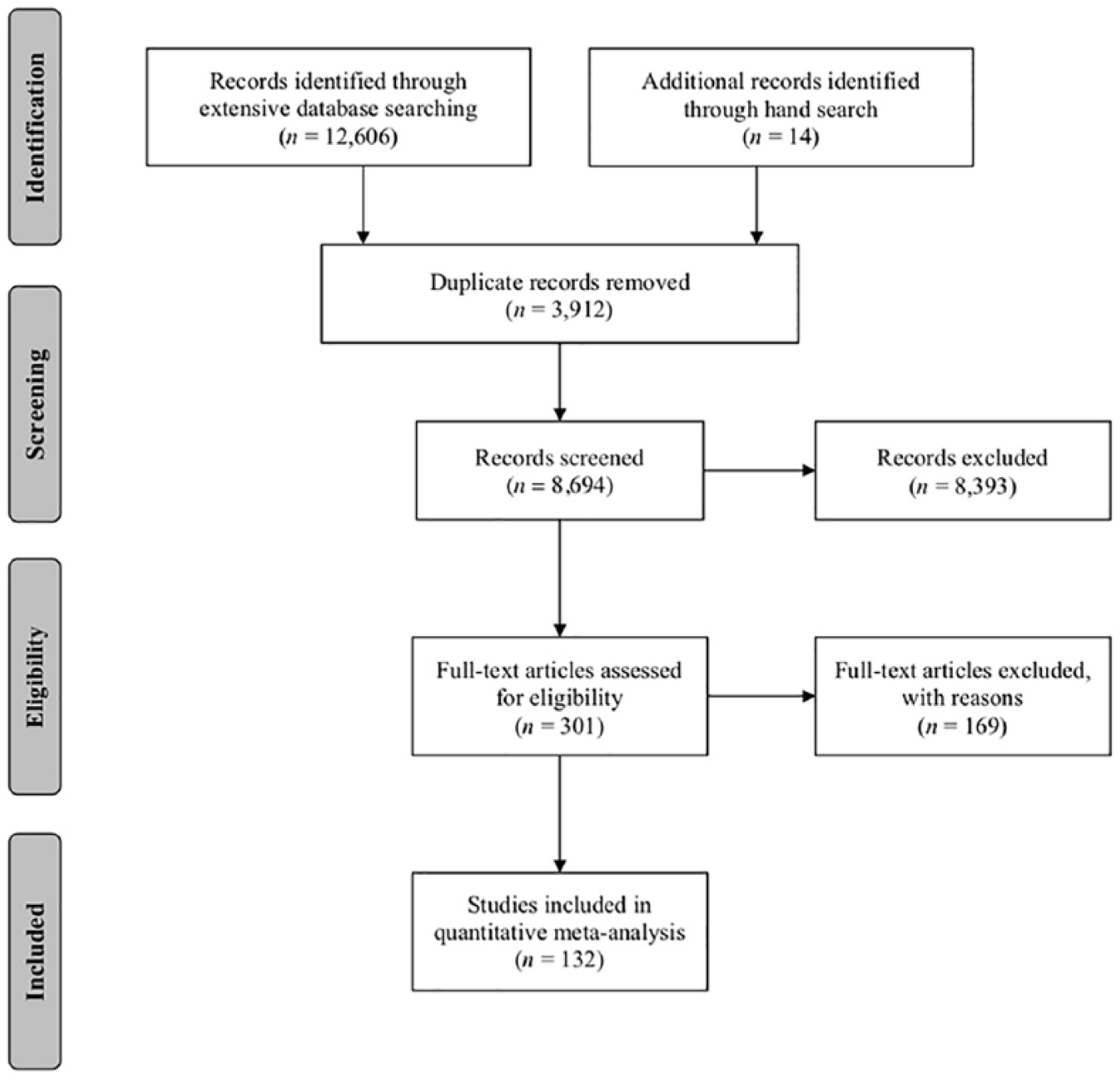
Search and screening procedures.
After screening the 8,694 article abstracts based on the above-mentioned criteria, a total of 301 articles appeared to meet inclusion criteria. A full-text review was conducted of these articles, and a further 169 articles were excluded as they did not meet the inclusion criteria. Most commonly, articles were excluded because they did not report correlations between measures of motivation and reading (e.g., Kaniuka, 2010; Lipsky, 1983; Matthew, 1996). Other articles were excluded because the study sample was college students (e.g., Widyasari, 2016), there was no motivation construct as per our operational definition (e.g., behavioral self-regulation; Connor et al., 2016), or there was a measure of academic achievement but no reading achievement (e.g., Neugebauer, 2016). In the end, a total of 132 articles were included in the current meta-analysis. The full list of all included articles can be found in the supplemental material, available in the online version of the journal.
Coding Procedures and Interrater Reliability
The 132 identified articles were coded according to measures of motivation and reading, as well as the characteristics of participants. Motivation construct was coded as goal orientation, beliefs, disposition, or broad intrinsic motivation. Intrinsic motivation included measures that broadly tapped motivation and were not directly aligned with one construct. These were further coded within subconstructs presented in Figure 1: performance, mastery, beliefs about self, beliefs about reading, attitude, and interest. Reading domain was coded as code-focused, meaning-focused, or general reading. General reading included measures that were not explicitly and inclusively focused on code- or meaning-focused skills (e.g., state test scores, generalized reading measures, school grades). The code-focused domain was further coded as phonological awareness, word identification, decoding, or oral reading fluency; and the meaning-focused domain was further coded as vocabulary or comprehension. Finally, student characteristics were coded by sample type (i.e., TD students, students with or at-risk for LD) and grade level. Grade level was categorized as elementary (kindergarten–5th grade), middle school (6th–8th grade), and high school (9th–12th grade). Reported correlations were extracted from each article and, for longitudinal studies, we further calculated partial correlations to examine whether motivation was related to earlier or later reading performance. The full coding protocol is available from first author, upon request.
Not all articles provided sufficient information related to the variables of interest. In case of insufficient information, authors were contacted to obtain the missing information. In addition to these variables, we also coded the number of participants used to obtain each correlation. The latter was needed to weight each effect size, so that correlations obtained from larger samples were given more weight in the analysis than those obtained from smaller samples. Coding was conducted by three doctoral students. All articles were coded and double-coded to ensure accuracy. The first author reviewed any discrepancies and resolved issues through further discussion and review of relevant articles. Across the total variable matrix, the mean interrater agreement was 93.57%. The interrater agreement was 94.78% for research design, 94.16% for participant characteristics, 92.53% for motivation measures, 93.46% for reading measures, and 93.67% for effect sizes.
Table 1 provides a summary of key features coded for each article. Details of all data sources are included in the online supplemental material; specifically, relevant study features for all individual studies are summarized in the online Supplemental Table S1. Furthermore, we coded data points in longitudinal studies by the time the measurement took place (e.g., Time 1, Time 2, Time 3) with details about the time of year (e.g., fall Grade 5). The features of these longitudinal studies are also reported in the online Supplemental Table S1, and the partial correlations between time points are reported in the online Supplemental Table S2.
Summary of key features coded for included studies
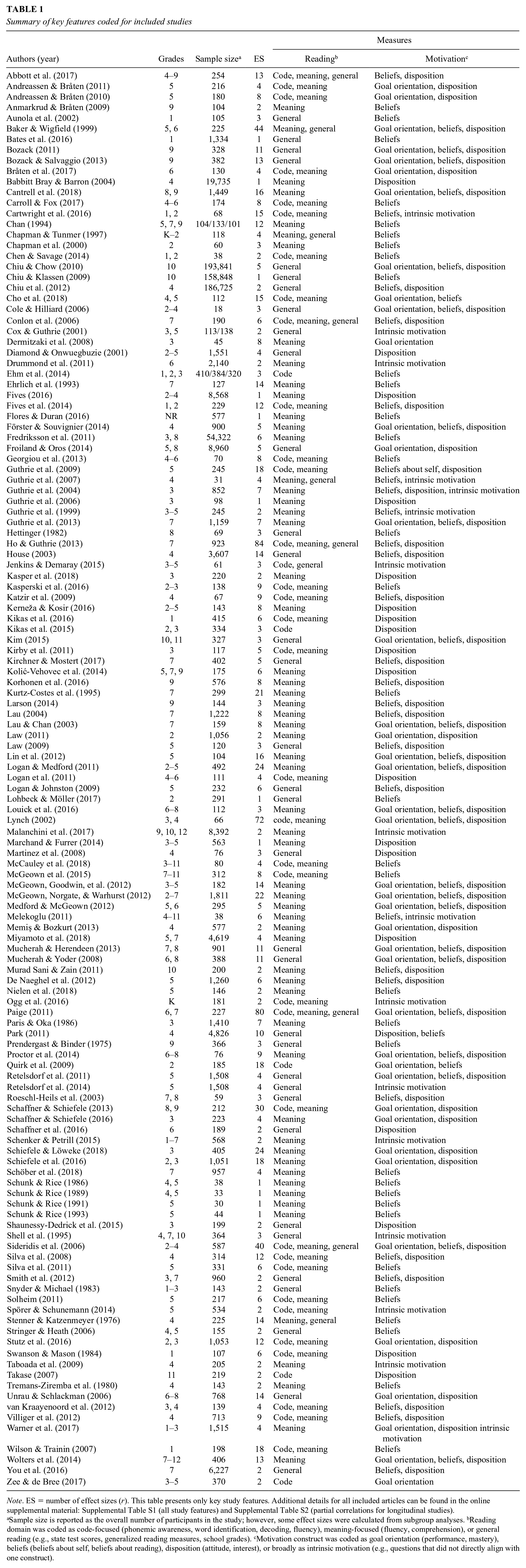
Note. ES = number of effect sizes (r). This table presents only key study features. Additional details for all included articles can be found in the online supplemental material: Supplemental Table S1 (all study features) and Supplemental Table S2 (partial correlations for longitudinal studies).
Sample size is reported as the overall number of participants in the study; however, some effect sizes were calculated from subgroup analyses. bReading domain was coded as code-focused (phonemic awareness, word identification, decoding, fluency), meaning-focused (fluency, comprehension), or general reading (e.g., state test scores, generalized reading measures, school grades). cMotivation construct was coded as goal orientation (performance, mastery), beliefs (beliefs about self, beliefs about reading), disposition (attitude, interest), or broadly as intrinsic motivation (e.g., questions that did not directly align with one construct).
Analytic Strategies
The effect size index used for all outcome measures in this meta-analysis was Pearson’s r, the correlation between motivation and reading. Convention for interpretation of effect sizes often relies on J. Cohen’s (1988) benchmarks (i.e., 0.20 small, 0.50 medium, and 0.80 large). However, the education research literature has since provided ample evidence to inform a greater basis for interpretation (see Kraft, 2019, for review). The What Works Clearinghouse, which reviews research on programs, products, practices, and policies in education, has identified effect sizes of 0.25 or larger as “substantively important” (2014, p. 23). Others have indicated that effects above 0.20 should be considered educationally meaningful or even large (Bloom et al., 2008; Lipsey et al., 2012).
For the purposes of analysis, we considered all eligible effect sizes from each study. That is, studies could contribute multiple effects as long as the sample for each effect size was independent. For studies that reported multiple effects from the same sample, all of our analyses accounted for statistical dependencies using the random-effects robust standard error estimation technique developed by Hedges et al. (2010). This analysis allowed for clustered data (i.e., effect sizes nested within samples) by correcting the study standard errors to account for the correlations between effect sizes from the same sample. The robust standard error technique requires that the mean correlation (ρ) between all the pairs of effect sizes within a cluster be estimated for calculating between-study sampling variance estimates. As per recent recommendations related to reporting of heterogeneity in meta-analyses (see Borenstein et al., 2017), tau-squared (τ2) was used to calculate between-study variance sampling variance and assign study weights in the random-effects model. τ2 is an absolute measure of heterogeneity between studies, calculated as the standard deviation of the random effects across studies and reported as the same metric as the average effect. In all analyses, we estimated τ2 with ρ =.80; sensitivity analyses showed that the findings were robust across different reasonable estimates of ρ.
Analyses were based on Borenstein et al.’s (2005) recommendations. Specifically, we converted the correlation coefficients to Fisher’s z scale, and all analyses were performed using the transformed values. The results, such as the summary effect and its confidence interval, were then converted back to correlation coefficients for presentation. Also, because we hypothesized that this body of research reports a distribution of correlation coefficients with significant between-study variance, as opposed to a group of studies that attempts to estimate one true correlation, a random-effects model was appropriate for the current study (Lipsey & Wilson, 2001). Weighted, random-effects metaregression models using Hedges et al.’s (2010) corrections were run with ROBUMETA in Stata (Hedberg, 2011) to summarize correlation coefficients and to examine potential moderators. We first estimated only the overall weighted mean correlation between motivation and reading outcomes. Next, we estimated the overall weighted mean correlation by subgroup: motivation construct, reading domain, sample type, and grade level.
Metaregression analyses were used to examine whether motivation construct, reading domain, sample type, or grade level moderated the relation between motivation and reading. For the moderation analyses, each moderator was examined with other moderators controlled in one metaregression model. For moderators that were dichotomous, we entered them directly into the metaregression model. For moderators with more than two categories, we created several sets of dummy coded variables to examine the comparisons among categories (P. Cohen et al., 2014). Four sets of interactions were also added to the model (i.e., sample type × motivation construct, grade level × motivation construct, reading domain × motivation construct, or reading domain × grade level). We controlled for two other variables in our model; first, we included year of publication as Petscher (2010) reported stronger relations between reading attitudes and reading in more recent studies. We also coded for the type of motivation measure, domain-specific (reading motivation) or domain-general, as some researchers have posited that academic motivation should be operationalized as domain-specific because it relies on situation or context (see Pintrich et al., 1993; Steinmayr & Spinath, 2009). Our models simultaneously included covariates, moderators, and interactions of interest. Because we had multiple sets of dummy coding for motivation construct and reading domain, we ran two metaregression models to fully present the interaction effects between motivation and reading.
Publication Bias
As previously noted, the aim of this study was to address our research questions within the context of peer-reviewed published literature in this area. Nevertheless, we evaluated potential publication bias using the method proposed by Egger et al. (1997). This approach tests for asymmetry in the correlations as a function of the standard errors reported. Asymmetry of effect sizes may indicate, among other potential factors (i.e., true heterogeneity, chance, sampling variation, methodological quality), publication bias (e.g., selective reporting of outcomes to promote publication; Sterne et al., 2011). Egger et al.’s (1997) publication bias statistic has been considered less meaningful when the number of studies is small (k < 20; Vevea et al., 2019); however, it is appropriate for the current meta-analysis as it includes 132 articles, 185 independent samples, and a large number of effect sizes. Results indicated that the standard errors of correlations did not significantly predict correlations among studies with ROBUMETA in Stata, p = .40. As significant asymmetry was not found in the gathered data set, and sensitivity analysis yielded similar results, publication bias likely did not influence findings.
Results
Based on our inclusion criteria, 132 published articles with 185 independent samples, involving over 690,000 participants and reporting 1,154 correlations between motivation and reading were included in the final analysis. Summary of key study features are presented in Table 1. The country of origin most common across articles was the United States (41%; n = 55), followed by Germany (n = 16), the United Kingdom (n = 9), Canada (n = 7), and Norway (n = 6). There were fewer than five articles from each of 23 other countries. Overall, the relation between motivation and reading was moderate and significant, r = .22, p < .001, 95% confidence interval [CI; .19, .25].
Next, we examined the relation between motivation and reading for each subcategory of each moderator (Table 2). As previously noted, motivation was operationalized based on the hierarchy of constructs presented in Figure 1. That is to say, we first examined the average correlations between each of the four motivation constructs and reading: goal orientation, r = .05, 95% CI [.02, .09]; beliefs, r = .27, CI [.23, .31]; disposition, r = .17, CI [.14, .20]; and intrinsic motivation, r = .32, CI [.22, .41]. We also coded motivation into the six subconstructs to examine the average correlation between motivation and reading for each: performance, r = .05, CI [.00, .09]; mastery, r = .12, CI [.05, .19]; beliefs about self, r = .28, CI [.24, .32]; beliefs about reading, r = .16, CI [.09, .23]; attitudes, r = .18, CI [.15, .21]; and interest, r = .13, CI [.08, .18].
Relation between motivation and reading achievement
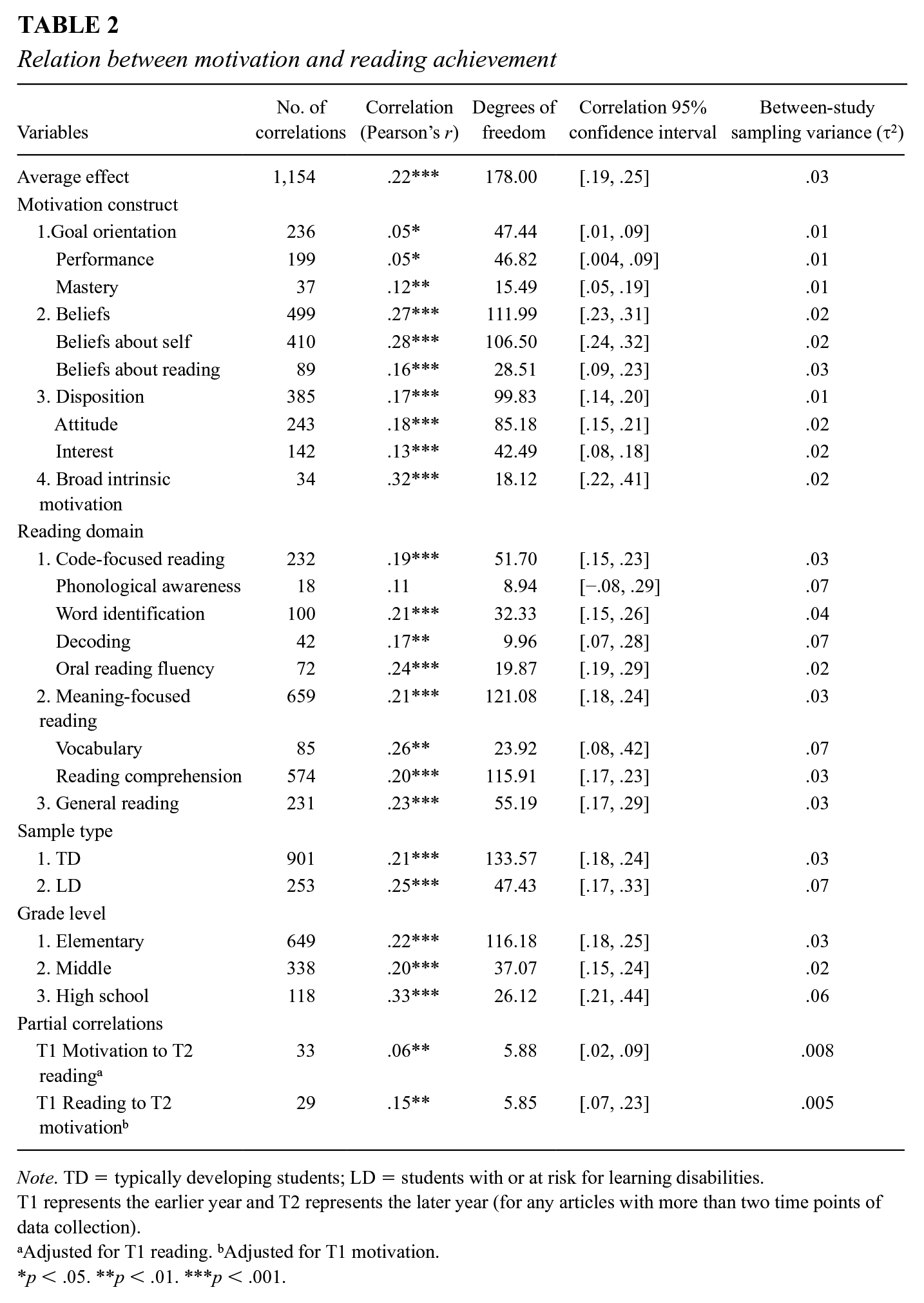
Note. TD = typically developing students; LD = students with or at risk for learning disabilities. T1 represents the earlier year and T2 represents the later year (for any articles with more than two time points of data collection).
Adjusted for T1 reading. bAdjusted for T1 motivation.
p < .05. **p < .01. ***p < .001.
We examined the average correlation between motivation and each domain of reading: code-focused reading, r = .19, 95% CI [.15, .23]; meaning-focused reading, r = .21, CI [.18, .24]; and general reading, r = .23, CI [.17, .29]. We further coded domains of reading into six subcategories, and examined the average correlation between motivation and each: phonological awareness, r = .11, CI [-.08, .29]; word identification, r = .21, CI [.15, .26]; decoding, r = .17, CI [.07, .28]; fluency, r = .24, CI [.19, .29]; vocabulary, r = .26, CI [.08, .42]; and comprehension, r = .20, CI [.17, .23].
Sample type included students with or at risk for the LD sample and the TD sample. The average correlation between reading and motivation is r = .25, 95% CI [.17, .33] among the LD sample, and r = .21, CI [.18, .24] among the TD sample. Grade level included three categories: elementary, middle, and high school. The average correlation between reading and motivation is r = .22, CI [.18, .25], among children in elementary school; r = .20, CI [.15, .24], among children in middle school; and r = .33, CI [.21, .44], among students in high school.
Moderating Effects and Interactions
We included multiple moderators of interest in each model to control for potential confounding effects (see Table 3). Specifically, we examined whether reading domain, motivation construct, sample type, or grade level would moderate the relation between motivation and reading. We dummy coded each moderator to examine contrasts. We also included year of a publication and motivation measure (domain-specific vs. domain-general) to the full model. Neither variable had a significant influence on the relation between motivation and reading (β = −.002, p = .43; β = −.017, p = .72, respectively).
Metaregression of the moderation analysis on the relation between motivation and reading achievement
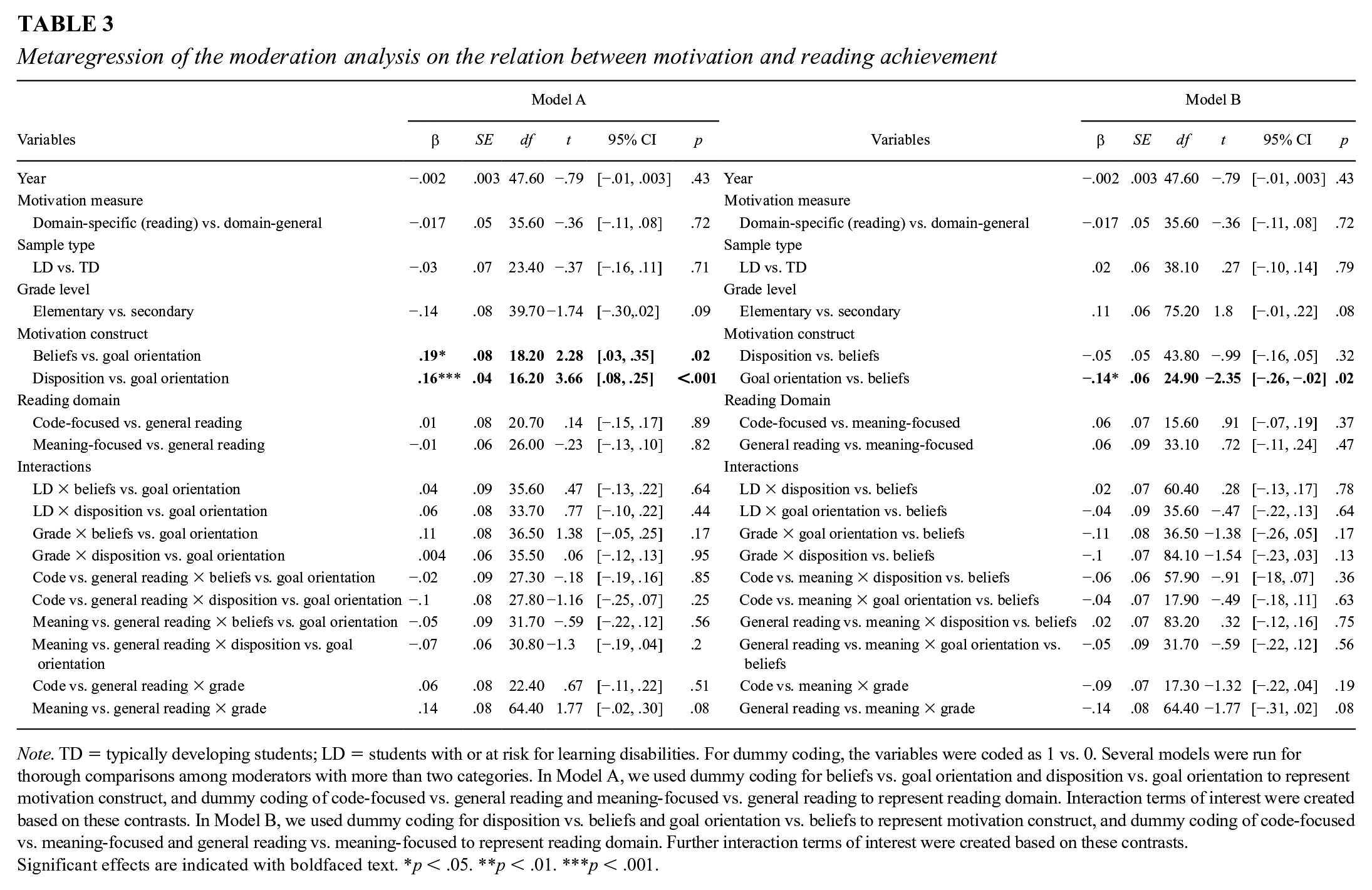
Note. TD = typically developing students; LD = students with or at risk for learning disabilities. For dummy coding, the variables were coded as 1 vs. 0. Several models were run for thorough comparisons among moderators with more than two categories. In Model A, we used dummy coding for beliefs vs. goal orientation and disposition vs. goal orientation to represent motivation construct, and dummy coding of code-focused vs. general reading and meaning-focused vs. general reading to represent reading domain. Interaction terms of interest were created based on these contrasts. In Model B, we used dummy coding for disposition vs. beliefs and goal orientation vs. beliefs to represent motivation construct, and dummy coding of code-focused vs. meaning-focused and general reading vs. meaning-focused to represent reading domain. Further interaction terms of interest were created based on these contrasts.
p < .05. **p < .01. ***p < .001.
Significant moderation effects were revealed for motivation construct; such that beliefs showed a stronger relation with reading than goal orientation (β = .19, p = .02), and disposition showed a stronger relation with reading than goal orientation (β = .16, p < .001). We did not find any additional significant moderators of the relation between motivation and reading. We examined interactions that we had hypothesized to be potentially relevant to understanding the relation between motivation and reading. There were no significant interactions between sample type and motivation construct, grade level and motivation construct, reading domain and motivation construct, or reading domain and grade level.
Relations Between Motivation and Reading Over Time
Finally, we ran a partial correlation model with longitudinal studies (k = 8), from seven articles, to examine relations between motivation and reading across time points. All described their study samples as TD students, with four articles including students in the elementary grades and three articles including students in the secondary grades. The partial correlation between the constructs of motivation at Time 1 (T1) and the constructs of reading at Time 2 (T2), with the construct of reading at T1 partialled out was compared to the partial correlation between the constructs of reading at T1 and the constructs of motivation at T2, with the construct of motivation at T1 partialled out. This was done for all time points and measurements in longitudinal studies. T1 refers to the earlier year and T2 refers to the later year in the following text and Table 2. Overall, from a longitudinal perspective, findings suggest that reading is a stronger predictor of motivation than motivation is of reading, β = .08, p = .02. The average partial correlation of motivation at T1 to reading at T2 with reading at T1 partialled out is r = .06, 95% CI [.02, .09]; the average partial correlation of reading at T1 to motivation at T2 with reading at T1 partialled out is r = .15, CI [.07, .23].
Discussion
Through a systematic review of the literature, we identified articles that reported associations between motivation and reading achievement among students in kindergarten through 12th grade. We also sought to address questions related to whether the motivation construct, reading domain, sample type, or grade level influenced this relation. We found that the average effect size was moderate and that this relation was significantly influenced by the motivation construct being measured but not by the reading domain, sample type, or grade level. We also found evidence to support the bidirectional nature of the relation between motivation and reading based on analysis of effects from longitudinal studies.
Relations Between Motivation and Reading
We reported a statistically significant, moderate relation between motivation and reading, r = .22, p = < .001, derived from the combined results of 132 articles and 185 independent samples. These meta-analytic findings are consistent with past literature that has reported that intrinsic motivation is positively associated with reading in samples from preschool through high school grades (e.g., Guthrie & Wigfield, 2000; Logan et al., 2011; Morgan & Fuchs, 2007; Retelsdorf et al., 2011; Taboada et al., 2009). Although most researchers agree that motivation influences student performance, models of reading development generally fail to consider motivation or other social-emotional processes. While we argue that motivation may be a factor that serves as a determinant or regulator of performance over time, supported by the finding from our subanalysis of longitudinal studies, we caution interpretation of motivation as a general predictor of reading. That is to say, the reported effects do not account for the range of student-level characteristics associated with reading achievement (e.g., background knowledge, processing speed, executive functions, attention).
Moderation Analyses
We sought to examine whether the relation between motivation and reading was influenced by motivation construct (i.e., goal orientation, beliefs, disposition), reading domain (i.e., code-focused, meaning-focused, general reading), sample type (i.e., TD, LD/reading disabilities), or grade level (i.e., elementary, secondary). We further considered potential interactions between sample type and motivation construct, grade level and motivation construct, reading domain and motivation construct, and reading domain and grade level. After including all moderators and interactions in one metaregression model, only motivation construct emerged as a significant moderator of the relation between motivation and reading achievement. We discuss findings related to each moderator in the following sections.
Motivation Construct
We approached investigation of this moderator analysis as exploratory in an effort to understand whether one motivation construct would have significantly stronger relations to reading than others. The results from the present meta-analysis suggest that the constructs of beliefs and disposition both have significantly stronger relations to reading achievement than goal orientation. We did not report a significant difference between beliefs and disposition in their relation to reading, although the average correlation was .27 for beliefs and .17 for disposition (Table 2). These findings offer some insight into potentially meaningful differences across motivation constructs. Schools often promote motivation as a general concept within reading, suggesting that students are motivated or unmotivated. However, the findings across studies of motivation would suggest that motivation constructs may play out differently for students. For instance, a student may have a low sense of self-efficacy regarding their own reading ability but maintain a high level of engagement with classroom reading tasks (Jang et al., 2015; Moje et al., 2008). We discuss specification of the construct of motivation in more detail in a later section.
Reading Domain
We examined reading domain as a potential moderator of the relation between motivation and reading but posited that both code-focused and meaning-focused domains would have similar associations with motivation. However, we also predicted an interaction effect between reading domain and motivation construct. The hypothesis that the disposition construct would have stronger relations with code-focused reading was not supported. Furthermore, we did not find evidence of an interaction effect between reading domain and grade level. Throughout the primary grades, reading instruction is generally focused on students’ foundational skills and developing proficient word reading (e.g., code-focused instruction). By the third grade, word reading instruction is not often provided (Vaughn et al., 2003) and the primary instructional goal of language arts teachers is to improve students’ ability to gain knowledge from text (e.g., meaning-focused instruction). The present findings suggest that motivation is related to reading across domains, regardless of students’ grade level. However, it is important to note that few studies have looked at these reading outcomes together within the same children and how these relations change over time. Past research has shown that prereading skills (e.g., phonological processing, letter-name knowledge) are related to motivation (Chapman et al., 2000) and that these skills strongly predict reading performance—and it is possible that the relations between motivation and comprehension are influenced by this early reading development. That is to say, the relations between motivation and skills that are precursors to proficient reading may influence later associations between motivation and reading comprehension. There is a need to further investigate longitudinal predictive relations between motivation and reading, whether these relations are invariant over time, and the potential mediating role of motivation of reading skills (and vice versa).
Sample Type
We did not find evidence that sample type moderated the relation between motivation and reading or the hypothesized interaction between motivation construct and sample type. This was most surprising as there is empirical and theoretical evidence to suggest that struggling readers are more likely to have lower levels of motivation. As children experience repeated failure acquiring basic skills, their motivation to read decreases (Aunola et al., 2002). This experience is twofold in that as students lose motivation because of repeated failure to master requisite skills, their low motivation makes them less inclined to engage in reading practice (Aunola et al., 2002; Chapman et al., 2000). Research has shown that students who are unable to read fluently often become frustrated and resistant toward academic tasks and that this negatively influences their effort, persistence, willingness to ask questions, and overall interest at school (Margolis & McCabe, 2006). As such, it was surprising that our findings revealed neither a moderating effect of sample type nor an interaction between sample type and motivation construct. It is worth noting that the correlation between motivation and reading was larger for the LD sample than the TD sample; however, there were a limited number of study effects for LD student samples (effect size n = 253) compared to TD student samples (effect size n = 901). It is possible that we did not have adequate power to detect an effect in the full model. To better understand the mechanisms through which reading may affect motivation (and vice versa), there is a need to more fully explore the reciprocal relations between reading skills and learning experiences over time.
Grade Level
Past research has noted decline in levels of motivation as students get older, and this trend has been reported for a range of motivation constructs (e.g., motivations for reading, academic intrinsic motivation, competence and value beliefs; Gottfried et al., 2001; Guthrie & Wigfield, 2000; Muenks et al., 2018). Correspondingly, we predicted that we would find an effect of grade level, with stronger relations between motivation and reading for students in the elementary grades. We did not find support for this hypothesis, nor did our findings support an interaction between motivation construct and grade level. This was surprising; however, these findings do not suggest that there was an absence of decline in levels of motivation (i.e., goal orientation, beliefs, disposition) over time but that its association with reading did not significantly differ between elementary and secondary students. The average correlation was .33 among high school students, which perhaps offers a suggestion that students’ reports of motivation more accurately represent or align with their reading performance over time. This would be consistent with the notion that adolescents tend to view ability, effort, and performance as interrelated (Fincham & Cain, 1986; Folmer et al., 2008; Muenks et al., 2018).
In prior work, Petscher (2010) reported a stronger relation between reading attitudes and achievement for elementary students. As previously described, Petscher narrowly defined the construct under investigation—attitudes toward reading—which resulted in 32 studies (118 effect sizes) with samples between K and eighth grade. The current meta-analysis included broad search terms to capture a wide range of motivation constructs, which resulted in a larger study sample with greater variability—132 articles (1,154 effect sizes) for students ranging through 12th grade, and 417 of these correlations focused on disposition (attitude and interest for reading). Additionally, our moderation analysis compared elementary (K–5) versus secondary (6–12) students as the variability within study samples did not allow us to identify individual grade levels associated with effect sizes in each study. It is possible that we were unable to detect a meaningful effect in comparing these two periods. Previous studies have suggested that students’ intrinsic motivation generally begins to decrease dramatically as they enter the late elementary grades and through middle school (Gottfried, 1985; Gottfried et al., 2001; Guthrie & Wigfield, 2000). As previously noted, the instructional shift from “learning to read” to “reading to learn” (Chall, 1983), wherein students are expected to learn subject area content through independent reading, presents a drastic change for students starting at the fourth-grade level. At the same time students are expected to read independently for meaning, texts become more challenging, leading many students to begin to struggle during this time, a phenomenon noted by Chall and Jacobs (1983) as the “fourth grade slump.” As reading ability has been demonstrated to be linked to motivation, and reading starts to become more challenging at the fourth-grade level, there could be a shift in motivation that we were unable to capture due to the way in which grade level was reported.
Longitudinal Relations Between Motivation and Reading
It has been posited that poorer reading performance can lead to disengagement with text; for instance, Guthrie et al. (2007) reported that students’ self-efficacy was strongly associated with their own perceptions of reading performance. The findings from the current meta-analysis provide further evidence that motivation and reading mutually influence one another (cf. Morgan & Fuchs, 2007). We were able to examine longitudinal associations between motivation and reading in eight independent study samples, and found significant relations between motivation and reading in both directions. However, earlier reading was found to be a stronger predictor of later motivation than motivation was a predictor of reading.
These findings may have implications for theories of reading motivation, as well as for improving reading instruction and intervention. From a theoretical standpoint, the current study provides evidence to suggest that reading performance may be driving the development of motivation over time, although motivation can further influence continued reading development. From a practical standpoint, considering the importance of early reading instruction and intervention, it is possible that these early experiences with reading performance can not only lay the foundation for the development of reading skills but also indirectly influence reading through impact on motivation. A recent study by Hebbecker et al. (2019) provided additional evidence of this. Across three points of measurement in third and fourth grades (966 students followed), they found that the effect of reading achievement on later motivation was higher than the opposite effect.
Taken together, because motivation does not necessarily promote reading achievement absent of existing reading skills, these findings suggest that integration of direct skills instruction and motivation interventions might produce synergistic effects and optimize gains in reading performance over time. The malleability of motivation is generally accepted, although there have been few empirical tests of motivation in educational contexts. Lazowski and Hulleman (2016) conducted a meta-analytic review of educational interventions that experimentally manipulated motivation in kindergarten through postsecondary settings. The authors reported that interventions were generally effective, with an average effect size of d = 0.49. Interestingly, 41 effects (of the 92 identified) were from studies conducted in postsecondary settings and only 10 were from studies conducted in the elementary grades (K–5). There is a critical need for future research to expand our understanding of how motivation is intertwined with early reading failure and explore mechanisms through which we might interrupt trajectories of declining motivation.
Specification of the Construct of Motivation
The diverse nature of motivation has resulted in a field of study with an extensive set of theories and constructs. This meta-analysis sought to conduct a comprehensive meta-analytic review of the relations between motivation and reading. In acknowledging the multidimensional nature of motivation, our search purposefully included articles that examined a broad range of motivation constructs. We then coded each within the hierarchy of motivation constructs proposed by Conradi et al. (2014) to test for potential moderating effects. While we feel that the three broad constructs (i.e., goal orientation, beliefs, disposition) are inclusive of motivation terms applied within education and educational psychology research, the motivation variables were difficult to categorize for some of the articles included in our meta-analysis. This was not unexpected. In their synthesis of motivation terminology in reading research, Conradi et al. (2014) noted that only 17% of the studies reviewed (k = 92) provided an explicit definition of the target construct and 22% were atheoretical.
Indeed, the study of motivation is faced with the challenge of jingle-jangle fallacies 2 (Kelley, 1927). The assumption that two different constructs represent the same thing, or that two similar constructs are entirely different, is a reference that has been used in debates related to the distinction between self-concept and self-efficacy (Marsh et al., 2019) for the past two decades (Marsh et al., 1997). While there is scholarly agreement on various concepts that guide the study of motivation—intrinsic motivation supports human learning in a way that extrinsic motivation does not, for example—the field is plagued by inconsistency in the terminology used to describe motivation-related terms. To what degree is the same terminology used to conflate truly different constructs (jingle fallacy), and to what degree is different terminology used to describe two extremely similar constructs (jangle fallacy)? Neither of these challenges can be resolved without fully understanding the conceptualization of motivation in the extant literature—and the present meta-analysis makes an attempt to contribute to this literature.
We build on previous work that has attempted to identify terminology within the motivation literature (Murphy & Alexander, 2000), motivation terminology in reading research (Conradi et al., 2014), dimensions of reading motivation (Schiefele et al., 2012), and examination of distinguishable and overlapping aspects of reading motivation across commonly used measures (Neugebauer & Fujimoto, 2018). These issues presented a challenge with coding in the present meta-analysis. Great care was taken by the author team to code motivation variables—we generated an extensive list of measures and variables from studies, discussed coding as a team, and developed guidelines for commonly used measures to ensure that we used consistent coding procedures. We established interrater reliability through a multistep process (as previously described) and verified reliability once the data set was complete.
Study Limitations and Future Directions
Despite the scale of this meta-analysis, there are several limitations to note. First, our study was limited to peer-reviewed published literature and we did not include unpublished works in our search (e.g., reports, dissertations). Even though Egger et al.’s (1997) statistic was calculated and suggested little influence of publication bias in the data, we recognize that there remains potential for publication bias. As such, the estimates of the relationship between motivation and reading achievement included here could be an overestimate of these relations given the lack of unpublished literature. Second, our meta-analysis does not account for the reliability and validity of motivation measurement. This is an issue with many systematic reviews and across studies of motivation, more broadly. While two studies have specifically examined the dimensions of commonly used measures of reading motivation (Neugebauer & Fujimoto, 2018; Schiefele et al., 2012), there were myriad other measures used across the 132 articles included in this meta-analysis. While it is beyond the scope of the present study, future investigations should examine the psychometric properties of motivation measures across populations as well as how reliabilities might influence relations with reading and other achievement outcomes.
Furthermore, some study categories were limited in the number of effect sizes and we may not have been able to detect small, but potentially important, differences. As previously mentioned, there were only 253 effects for LD samples. Furthermore, the majority of our effects were for meaning-focused reading outcomes (effect size n = 659). Considerably fewer accounted for code-focused reading outcomes (effect size n = 232), with few effects reporting outcomes related to foundational reading skills such as phonological awareness, decoding, and oral reading fluency. Longitudinal research is necessary to understand developmental trends of and interactions between reading skills and motivation—especially because motivational processes may change as students have continued experiences with success (or failure) in school. For example, in studies of reading self-concept, Chapman and Tunmer (1997) noted that the association between reading performance and self-concept increased dramatically from the first through second year of school—and that self-concept is relatively unstable over these first two years of school. Students have a range of experiences (both successes and struggles) when first learning how to read, so it would seem logical that students’ patterns of performance in reading “take a few years to develop, with achievement-related self-perceptions taking longer to stabilize and reflect the emerging patterns of achievement” (Chapman et al., 2000, p. 704).
As motivation remains underspecified in reading research, there is a need to further examine the commonalities between the myriad theories of motivation reported in the literature. Are there constructs that can be generalized to broaden motivation theory? Are there constructs that play more important roles in reading development? Are there individual differences (i.e., student-level characteristics) that may interact with these constructs and their relations to reading achievement? Findings from this meta-analysis contribute to current knowledge though the systematic investigation of the relation between motivation and reading. While past research has provided accumulating evidence that motivation is associated with reading, this is the first meta-analysis that has been conducted in which this relation is shown to be significant and stable across K–12 students. Findings further suggest that the theoretical construct used to operationalize motivation may moderate associations with reading, and lend evidence for the bidirectional nature of this relationship. We would argue that motivation is not tangential to but a critical component of reading development. Models of reading development that do not account for motivation, or psychosocial aspects of learning, are missing critical aspects of student learning and achievement. That said, there is the need to continue to investigate factors that moderate the relations between motivation and reading within a longitudinal framework. The task for future research is to develop more nuanced theory and richer data to decipher these mechanisms in order to apply this knowledge within educational contexts.
Supplemental Material
ReferenceList_TosteSupplementalMaterials – Supplemental material for A Meta-Analytic Review of the Relations Between Motivation and Reading Achievement for K–12 Students
Supplemental material, ReferenceList_TosteSupplementalMaterials for A Meta-Analytic Review of the Relations Between Motivation and Reading Achievement for K–12 Students by Jessica R. Toste, Lisa Didion, Peng Peng, Marissa J. Filderman and Amanda M. McClelland in Review of Educational Research
Supplemental Material
TableS1_TosteSupplementalMaterials – Supplemental material for A Meta-Analytic Review of the Relations Between Motivation and Reading Achievement for K–12 Students
Supplemental material, TableS1_TosteSupplementalMaterials for A Meta-Analytic Review of the Relations Between Motivation and Reading Achievement for K–12 Students by Jessica R. Toste, Lisa Didion, Peng Peng, Marissa J. Filderman and Amanda M. McClelland in Review of Educational Research
Supplemental Material
TableS2_TosteSupplementalMaterials – Supplemental material for A Meta-Analytic Review of the Relations Between Motivation and Reading Achievement for K–12 Students
Supplemental material, TableS2_TosteSupplementalMaterials for A Meta-Analytic Review of the Relations Between Motivation and Reading Achievement for K–12 Students by Jessica R. Toste, Lisa Didion, Peng Peng, Marissa J. Filderman and Amanda M. McClelland in Review of Educational Research
Footnotes

Notes
Authors
JESSICA R. TOSTE is an assistant professor in the Department of Special Education at The University of Texas at Austin, 1 University Station, D5300, Austin, TX 78712; email:
LISA DIDION is an assistant professor in the Department of Teaching and Learning at the University of Iowa, 240 South Madison Street, Iowa City, IA 52242; email:
PENG PENG is an assistant professor in the Department of Special Education at The University of Texas at Austin, 1 University Station, D5300, Austin, TX 78712; email:
MARISSA J. FILDERMAN is currently a PhD candidate in the Department of Special Education at The University of Texas at Austin and a scholar with the Office of Special Education Programs, 1 University Station, D5300, Austin, TX 78712; email:
AMANDA M. MCCLELLAND is currently a PhD candidate at The University of Texas at Austin and a scholar with the Office of Special Education Programs, 1 University Station, D5300, Austin, TX 78712; email:
References
Supplementary Material
Please find the following supplemental material available below.
For Open Access articles published under a Creative Commons License, all supplemental material carries the same license as the article it is associated with.
For non-Open Access articles published, all supplemental material carries a non-exclusive license, and permission requests for re-use of supplemental material or any part of supplemental material shall be sent directly to the copyright owner as specified in the copyright notice associated with the article.
