




Abstract
Within education, the importance of creativity is recognized as an essential 21st-century skill. Based on this premise, the first aim of this article is to provide a theoretical integration through the development of a framework based on the principles of complex dynamic systems theory, which describes and explains children’s creativity. This model is used to explain differing views on the role of education in developing children’s creativity. Our second aim is empirical integration. On the basis of a three-dimensional taxonomy, we performed a systematic review of the recent literature (2006–2017, 184 studies) on primary school students’ creativity. Our results show that creativity is most often measured as a static, aggregated construct. In line with our theoretical model, we suggest ways that future research can elaborate on the moment-to-moment interactions that form the basis of long-term creative development, as well as on the mechanisms that connect different levels of creativity.
The capacity to imagine and create new, unique solutions to complex problems is a distinctive human trait that is integral to our human design (Welch & McPherson, 2012). Today, we live in an increasingly complex world that demands individuals who can develop sophisticated creative solutions to the increasingly complex problems facing communities and schools (Thurlings, Evers, & Vermeulen, 2015). Consequently, within education, the importance of creativity is now widely recognized as an essential 21st-century skill (Donovan, Green, & Mason, 2014; Rotherham & Willingham, 2010). The role of creativity in educational policies, however, is somewhat ambiguous. On the one hand, education experts and policymakers have emphasized the role of education in fostering creativity (National Advisory Committee on Creative and Cultural Education, 1999; Shaheen, 2010). On the other hand, a number of prominent educators have argued that the increasing standardization of education through policy with an emphasis on basic skills and standardized testing has led to children’s creativity actually diminishing as they move through the educational system (Hall & Thomson, 2005; Robinson, 2011).
Forming an understanding of children’s creativity is fundamental for teachers, parents, and educational authorities who wish to provide optimal conditions for its development. A key question is, “What is creativity?” Is creativity an individual characteristic or ability, similar to the way in which many scholars view intelligence? Is it a characteristic of a product, like an original drawing or an elegant solution to a mathematical problem? Or is creativity a process of generating, trying out and evaluating novel ideas? The answer to this question naturally has consequences for how creativity is measured in scientific research. But perhaps it also works the other way around: The “mainstream” of creativity research with its specific operationalizations of the concept also influences the discourse about creativity and, consequently, attempts to embed creativity in educational policy and practice.
The aim of this article is twofold. Since research on children’s creativity is quite widespread, the field needs integration and focus to progress further. The first aim, therefore, is to integrate the main theoretical approaches to defining and understanding creativity into one complex dynamic systems model of creativity. The complex systems model presented in this article connects the different levels on which creativity can be defined by two mechanisms: emergence and constraint. The different levels range from moment-to-moment creative processes to creativity on the personal level and creative development over the life span, both on the individual and the social dimension of creativity.
A second, related aim of the article is to integrate the recent empirical research on children’s creativity. A taxonomy, based on the theoretical model, is presented that categorizes all studies on two dimensions that describe how children’s creativity is defined and measured. This analysis allows us to determine where the possible gaps in the literature occur and which themes we consider relevant with regards to children’s creativity.
A Complex Dynamic Systems Perspective on Creativity
Complex Dynamic Systems in Education and Development: Main Principles
Research on creativity and research on education and human development deal with the same fundamental question: Where does novelty come from (Sawyer, 2003)? In the words of Piaget (1971, as cited in Sawyer, 2003), who, as a developmental psychologist, saw links between the two processes: “The real problem is how to explain novelties. I think that novelties, i.e. creations, constantly intervene in development” (p. 5). Developmental and educational psychologists seek to determine how children learn new skills, from learning to use language and learning to walk to learning how to read and write. In research on creativity, we seek to understand how children can engage in everyday forms of creativity, but also how individuals are able to create pieces of creative output that are truly innovative, or discover scientific laws that push our society forward. This fundamental link makes the study of creativity highly relevant for educational scientists and educational psychologists (Plucker, Beghetto, & Dow, 2004).
Next is the question of how creativity can best be approached. One way to approach fundamental questions about learning, teaching, and education is from the perspective of the theory of complex dynamic systems. In the past two decades, this theory has been advocated more and more in the field of education as an approach to better understand processes of learning and teaching (Jörg, Davis, & Nickmans, 2007; Koopmans & Stamovlasis, 2016; Steenbeek & van Geert, 2013; van Geert & Steenbeek, 2005). Applied to education, a first core principle of this approach is that learning is socially situated. Learning does not occur in isolation in the student’s mind. Rather, it exists in interactions. These can be the interactions between the student and the direct social environment, such as the teacher (Steenbeek & van Geert, 2013; Vygotsky, 1978), as well as between the student and the physical environment (learning by doing or “enactment”; Rowlands, 2010). Of course, the fact that the environment plays a key role in learning has been widely recognized in educational sciences as evidenced, for instance, by Hattie and Timperley (2007), who reviewed the effect of feedback on learning, or more recently Stockard, Wood, Coughlin, and Rasplica Khoury (2018), who analyzed the effect of direct instruction on various learning outcomes. In a large body of education research, however, the environment is seen as an outside factor affecting students’ learning. For instance, giving direct and constructive feedback is related to positive learning outcomes (Hattie & Timperley, 2007). The key difference with research from a complex dynamic systems approach is that the student and the student’s environment shape each other. The teacher not only influences the student, but also the other way around. Learning and teaching thus take place in constant interaction with the environment. This fundamental principle in the complex dynamic systems approach is shared with the core principles of social-constructivist theories of learning (Lave & Wenger, 1991; Vygotsky, 1978), as well as in work on situated or embodied cognition (Foglia & Wilson, 2013; Smith, 2005). The complex dynamic systems approach specifies this general principle by combining it with other characteristics of complex dynamic systems, applied to the nature of teaching and learning processes.
The second principle is that these interactions between the child and the child’s environment are self-organizing. This means that there is no external force that pushes learning into one direction or another; rather, learning and teaching emerge through socially embedded interactions. Sawyer (1999, 2002, 2003) explicitly linked developmental psychology and creativity through the concept of emergence. Emergence has its roots in philosophy and natural sciences. Although theorists differ in the exact definition of the term, a shared definition is as follows: “Emergent entities (properties or substances) arise out of more fundamental entities and yet are ‘novel’ or ‘irreducible’ with respect to them” (O’Connor & Wong, 2015, p. 1). Emergence is a core characteristic of all complex systems. It is the mechanism that connects higher order and lower order variables, as higher order variables are thought to emerge from the interaction between lower level variables over time (O’Connor & Wong, 2015). Therefore, all complex systems can be considered to display creativity, through the processes of emergence, self-organization, and interactions among their various components (Sawyer, 1999).
The principles of self-organization and emergence also imply that it can be meaningful to distinguish between different levels of organization in teaching and learning. These different levels of organization take place on different timescales. An example of lower order components are the interactions in the here-and-now between a teacher and student as the student is solving a mathematical problem. Here, the timescale is on the level of minutes or even seconds. Higher order variables, such as the student’s mastery of mathematics, or the student’s motivation for mathematics, emerge out of repeated interactions among lower level components. Here, the timescale is months or even years. The influence can also work the other way around: Higher level variables put constraints on lower level processes. For instance, a general low level of motivation for mathematics influences the range of possible next teacher–student interaction during a math class.
The third principle is that, as a consequence of self-organization, complex systems display variability over time. According to a complex dynamic system’s view, variability across time within the same individual (intraindividual variability) is an intrinsic property of learning and development. Intraindividual variability occurs through continuous transactions between the child and the child’s (direct) environment. This creates flexibility in the system because multiple behavioral states are explored, ultimately giving rise to novel and higher states of functioning. Therefore, increases or decreases in variability over time can provide information about the current state of the system. For instance, a temporary increase in intraindividual variability can be seen as an indicator of a phase transition. This proposition has been supported by empirical evidence, where peaks of intraindividual variability have been associated with developmental phase transitions in different domains (e.g., cognitive development: Dixon, Holden, Mirman, & Stephen, 2012; Siegler & Svetina, 2002; van Dijk & van Geert, 2015). For instance, when children are solving a series of matrix completion tasks, there is often a peak in the number of mistakes they make just before they discover a new strategy (Siegler & Svetina, 2002).
Theories of Creativity on Four Levels
Creativity has been a topic in psychological and education research for decades. Creativity remains somewhat of an elusive concept however, and therefore many different definitions and theories exist concerning what creativity is and how it comes about in children and adults. In 1961, Rhodes proposed a framework to classify different approaches to creativity, which became known as the “four Ps of creativity”: approaches on the level of the Person, the Product, the Process, and the Press (the latter referring to environmental influences; Rhodes, 1961). This framework remains influential to this day: It has been used many times to categorize empirical research (as well as theoretical approaches to a lesser extent), and has thus served as a “backbone for creativity theory” and research in the past decades (Glǎveanu, 2013).
Rhodes’s (1961) framework has allowed us to separate creativity research in different research lines or “strands” (although Rhodes was to the first to remark that some research fits into more areas). However, this has also led to the conclusion that different schools of thought within creativity research develop in isolation, rarely informing each other (Hennessey & Amabile, 2010; Runco, 2004; Sternberg & Lubart, 1999). In order to take the field of creativity research further, we therefore need to go a step beyond classifying different strands of creativity research. What is needed is a meta-theoretical model of how the different strands relate to and interact with one another. In our view, a complex dynamic systems model of creativity offers an appropriate extension for conceptualizing and studying creativity.
We will construct the complex dynamic systems model of creativity in two steps. First, we will use the framework of Rhodes (1961) as a means to categorize today’s main theories on creativity. Next, we will use these levels, which are now often treated as separate or even contradictory, and reinterpret them in terms of the complex dynamic systems approach. It should be noted that some creativity approaches or theories encompass more than one level; however, usually one level can be used to best characterize that specific theory.
Creativity on the Level of the Person
In the early days of creativity research, creativity was often studied as a characteristic of one’s personality, with research focusing on questions relating creativity to other personality traits (Runco, 2004). Another important issue regarding creativity on the level of the person is the relation between creativity and intelligence, or alternatively, creativity as an aspect of intelligence. Gardner and Sternberg are noted theorists who both give creativity a prominent place in their theories of intelligence (Gardner, 2011; Sternberg, 1985). The idea of creativity as a part of intelligence initially gained prominence in research on intellectual giftedness (Lubinski, Benbow, Webb, & Bleske-Rechek, 2006). According to Gardner (1995, 2011), intelligence is more than the capacity for logic reasoning and literacy, although those two components have been given the most attention in the educational system. In his theory of multiple intelligences, creativity is an important aspect of different kinds of intelligence, such as musical intelligence (the capacity to produce and make meaning of sound patterns) and bodily kinesthetic intelligence (the ability to use one’s own body to create products or solve problems; Gardner, 2011, [italics added]). In Sternberg’s triarchic theory of intelligence, creativity also takes a central stage. In his theory and subsequent empirical work, Sternberg (1985) distinguishes between three components of intelligence: analytical, creative, and practical. Sternberg and Lubart’s work subsequently focused on what distinguishes creative individuals from others: a mixture of skills, personality traits, and the willingness to take risks with an intuition for good ideas; the strategy of “buying low and selling high” (Sternberg & Lubart, 1992).
As is the case with intelligence (Grigorenko & Sternberg, 1998) and many other psychological constructs such as attitudes (Dalege et al., 2016) and self-esteem (de Ruiter, van Geert, & Kunnen, 2017), an important source of debate is whether creativity is a latent, personal, often stable, trait or a fluent, situation-dependent state. Gardner (2011), for instance, stated that every type of intelligence should be associated with a “neural basis” to be considered as intelligence, while Sternberg was optimistic about the development of intelligences over time (Sternberg, 1985). This is an important distinction, because it implicitly or explicitly says something about the potential for change. We will come back to this point in the Discussion. But first, we will discuss two other levels on which creativity can be studied: the level of the product and the level of the process.
Creativity on the Level of the Product
Amabile’s (1983) theory of creativity shifts the attention from creativity as a personal ability, to creativity as a characteristic of a product or response. She emphasizes that the question of “What is creativity?” cannot be answered objectively; that is, outside of social and cultural norms. A product or response is creative when experts in the field agree that it is creative. This theory is the basis of the consensual assessment method of measuring creativity on the level of finished products or creative responses. In this sense, her theory of creativity is strongly related to the systems model of creativity by Csikszentmihalyi, which is discussed in more detail below.
Creativity on the Level of the Process
First proposed in 1960 and later refined by Simonton (2011), Campbell’s (1960) theory of creativity and discovery centers on the two coupled processes of “blind variation and selective retention (BVSR).” According to Campbell, all creative processes meet three conditions (Simonton, 1999): First, there is a process that generates variations. These variations are blind in the sense that the person engaged in the creative process can never know in advance what the optimal solution to a problem might be. Campbell originally specified two attributes of blind variation: “the variations omitted must be independent of the environmental conditions of their occurrence” and “the occurrence of trials individually must be uncorrelated with the solution, in that specific correct trials are no more likely to occur at any one point in a series than another, nor than any specific non-correct trials” (Campbell, 1960, p. 381) The second condition that the creative process meets is that the generated variations are subjected to a certain selection mechanism. For either cognitive or cultural reasons, some variations are deemed to be more useful or promising than others. And third, there is a process of retention taking place, which involves the selected variations to be memorized or communicated to others (Campbell, 1960; Simonton, 1998, 2011). Campbell’s theory has served as a foundation for later theories on creativity, but has also been criticized. More specifically, some scholars disagree on the blind variation part of his proposed model, and are in turn more in favor of stage models of creativity, such as the well-known stage model of Wallas (1926; Lubart, 2001). According to these theories, the creative process unfolds more orderly, in consecutive stages (problem identification, preparation, response generation, and response validation). The empirical evidence relating to stage theories is mixed, but there are strong indications to believe that the creative process is more random and chaotic than stage models suggest (Lubart, 2001).
Creativity as Socially Embedded (“Press”)
The core of Csikszentmihalyi’s (1988) system theory is that creativity does not occur in isolation within individual minds. Instead, creativity is a process that occurs through continuous interactions between the person and the environment. His systems theory distinguishes between three levels of creativity, which are interconnected: the level of the individual, that of the field (within a society), and that of the domain (within a culture). The field consists of the direct, relevant environment of the individual. The people in the direct environment of the creative individual (e.g., teachers, parents, music critics, museum directors, etc.) evaluate the creative product and judge whether or not it is creative (Csikszentmihalyi, 1988). This is in accord with the “consensual agreement” approach to measuring creativity (Amabile, 1983, 1996). These evaluations of the field codetermine which ideas or products are “kept” long-term. Therefore, the field or direct environment of the individual can be said to play an important role in the “selective retention” part of the creative process. The field is nested within the society, which in turn contributes to the next level of creativity: the culture. Through the function of being “gatekeeper,” the field selects the ideas or products that can eventually become part of the larger culture. Cultures are made up of a variety of domains, for instance, music, dance, technology (Csikszentmihalyi, 1988, 1999). The history and values present within a certain culture are in turn internalized by the individual. By gaining knowledge and experience within a certain domain, the individual is said to have acquired a certain intuition concerning “good” and “bad” ideas. Because the culture is in that sense also embedded within the individual creator, the creator already implicitly or explicitly judges his or her own ideas or (sub)products. In this way, culture/domain, field, and individual are interrelated and cannot therefore be viewed separately from each other.
A Complex Dynamic System Model of Creativity
The complex dynamic system’s model we present here integrates the main theoretical approaches to creativity. According to this model, the different levels on which creativity can be defined are viewed as different levels of organization that are connected through two main processes: emergence and constraint. Also, the individual and social sides of creativity are interrelated. In Figure 1, we see the basis of the model: interactions between the student, the student’s direct social environment (such as the teacher), and the task. These real-time interactions (“real time” because they occur from moment to moment) are the basis for creative processes. The role of the teacher is recognized widely in the literature on creativity in educational settings (Beghetto & Kaufman, 2011; Burnard, 2011; Sawyer, 2011), but the role of the task has been recognized much less in the creativity literature (Glǎveanu, 2013). Especially in educational settings, however, tasks or assignments are a fundamental component of what and how students learn. From a dynamic system’s perspective, a task is characterized by affordances. The notion of affordances was developed by Gibson (1977), who recognized that ideas and cognition do not reside in the minds of individuals but are instead shaped in interaction with the (physical) environment. Task affordances are elements or characteristics of the task that provide opportunities in the interactions with that task. For instance, open-ended tasks, in which there are no “right” or “wrong” responses and many different solutions are possible, provide different opportunities with regard to creativity compared to closed-ended tasks, where there is one solution or correct response. In addition, some affordances are more inviting than others (Withagen, Araújo, & de Poel, 2017; Withagen, de Poel, Araújo, & Pepping, 2012), meaning that some aspects of the environment “call for action” more readily (for instance, placing a big red button in an empty room urges people to push it). In a sense, well-known creativity tests use this principle in reverse: divergent thinking tasks offer many possible responses (such as the task to think of as many uses of a paperclip as possible), and the ones that are least inviting or obvious are considered the most creative. This also implies that individual differences play a role in task affordances. In other words, a task can have different affordances for a highly creative individual compared to a less creative individual.
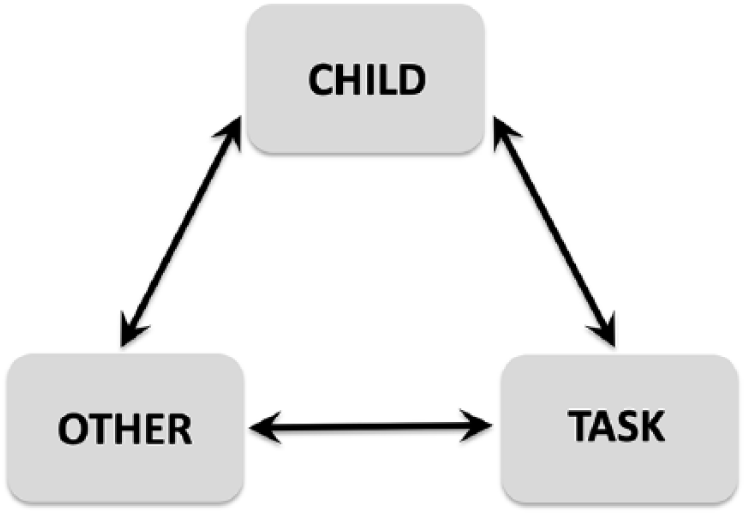
Real-time transactions between child, other, and task.
Over time, the creative process is iterative, because each state of the interaction among the child, teacher or peers, and task is dependent on the previous state of the system and serves as direct input for the next state (this is displayed visually in Figure 2). This “iterativeness” is a central characteristic of complex dynamic systems (van Geert & Steenbeek, 2005). Such dependence of the system on its own history means that it is both dependent on its immediate (short term) history (the previous state changing into the current state) but also on its “longer term” history (Lewis, 2000; Thelen & Smith, 1994).
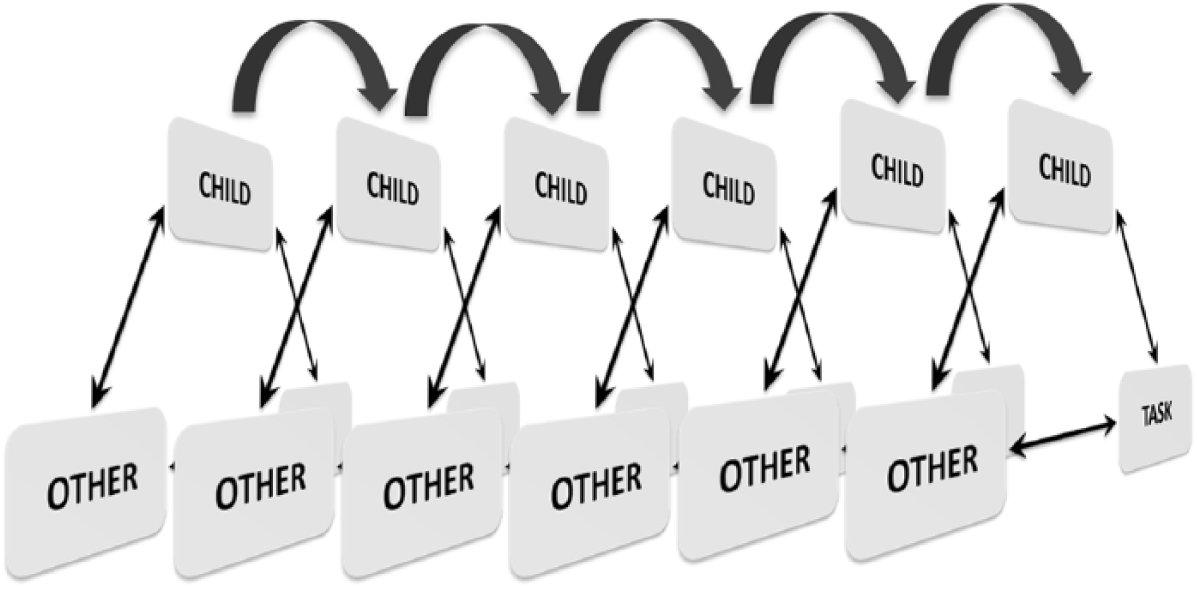
Creative transactions as iterations over time.
The complete model (Figure 3) displays different levels of organization on which creativity occurs. These levels correspond with the levels of creativity theories described earlier, based on the “four Ps” framework. Each level is connected to the next level through emergence of novel ideas or (sub)products, and in reverse the higher levels (for instance previously created products) pose constraints on the processes on lower levels. It is important to note that emergence and constraint are continuous processes that take place together continuously. Also, the model specifies the relationship between the individual and the social sides of creativity. The way in which Csikszentmihalyi and other sociocultural theorists of creativity (Glǎveanu, 2010, 2014; Sawyer, 1999) describe creativity as nested within various levels of social organization already corresponds closely with the mechanisms and principles of a complex dynamic systems perspective.
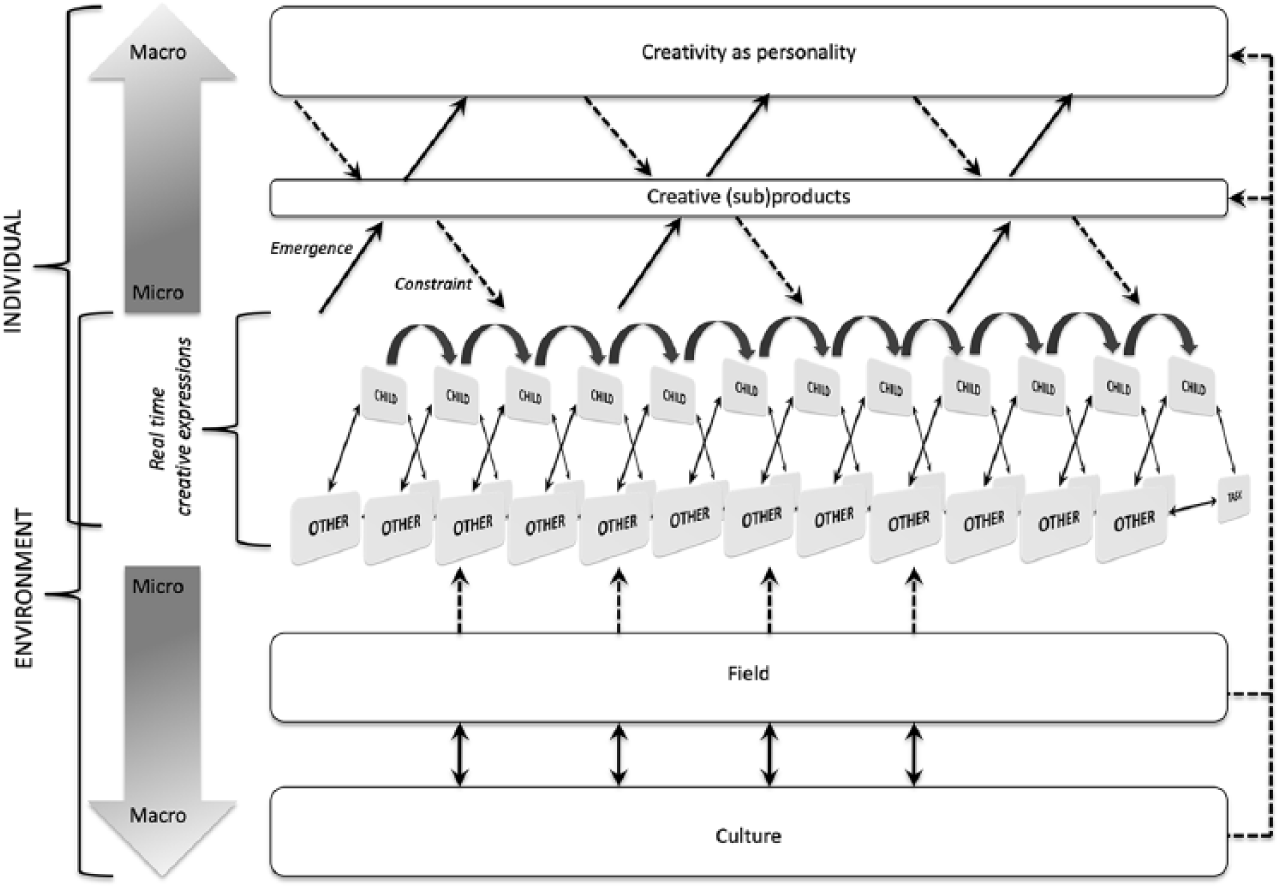
A complex dynamic systems model of creativity.
The mechanisms of emergence and constraint can be connected to the “blind variation” part of the BVSR theory. However, a complex dynamic system’s perspective on creativity requires two alterations of Campbell’s original definition of “blind variations” in his BVSR theory. Alterations on this aspect of the theory have been proposed by both proponents (Simonton, 2003, 2011) and opponents (Dasgupta, 2004). By explaining these alterations from a complex dynamic system’s perspective, we create a coherent account in which the core of Campbell’s model is preserved.
The first alteration concerns Campbell’s attribution that “the variations omitted must be independent of the environmental conditions of their occurrence” (Campbell, 1960, p. 381). According to a complex system’s perspective on intraindividual variability, which serves precisely the same function in development as it does in creativity (the emergence of novelty), variability over time is actually a characteristic of interactions between the person and his or her direct environment over time (Thelen & Smith, 1994; van Dijk & van Geert, 2015; van Geert & van Dijk, 2002). Thus, instead of either the environment playing no role in processing creative variations (original position of Campbell), or the environment directly and one-sidedly “steering” creative processes (opponents of the Darwinian perspective), person and context actually shape each other through their continuous transactions over time (Fogel, 2009; Howe & Lewis, 2005; A. Sameroff, 2009; A. J. Sameroff & Chandler, 1975). This idea is also central to Csikszentmihalyi’s work (1988, 1999).
The second alteration concerns the following assumption: “The occurrence of trials individually must be uncorrelated with the solution, in that specific correct trials are no more likely to occur at any one point in a series than another, nor than any specific non-correct trials” (Campbell, 1960, p. 381). Here, Campbell states that variations are not only independent of their environment, they are also independent of each other, or perhaps better: of their own history. An important property of complex dynamic systems theory, however, is precisely the contrary, namely, history dependence. As stated before, history dependence can refer both to both the dependence of a behavioral state to the immediately preceding state, as to dependence on a relatively long-term past. Empirical studies on a large variety of topics show that behavior over time is indeed history-dependent (Coey, Hassebrock, Kloos, & Richardson, 2015; de Ruiter, Den Hartigh, Cox, van Geert, & Kunnen, 2014; Kupers, van Dijk, & van Geert, 2017).
The assumption made here that variability stems from ongoing interactions between components of complex systems (in the case of creativity, the child and the child’s social context) has two important consequences regarding (a) the patterns of variability over time and (b) the distribution of variations. The first consequence relates to the difference between “white noise” and “pink noise” (Den Hartigh, Cox, Gernigon, Van Yperen, & van Geert, 2015; Van Orden, Kello, & Holden, 2010). Repeated measures of behavior over time can result in different kinds of temporal patterns. White noise refers to completely random variation; the measurement points are completely uncorrelated, which is the kind of variation Campbell describes. Pink noise, however, which is characteristic for complex systems, is an optimal mix of “randomness” and structure, because behavior is dependent on its own history. Pink noise can be seen, for instance, in the temporal structure of the heart rates of healthy individuals (white noise is associated with heart failure; Beckers, Ramaekers, & Aubert, 2001), in the timing of strikes of expert rowers (Den Hartigh et al., 2015), as well as in higher level psychological processes such as self-esteem (de Ruiter et al., 2014; Fortes, Delignières, & Ninot, 2004; Van Orden et al., 2010). The second consequence is that variations (for instance the degree of novelty of each variation) are not normally distributed. Variations that arise from interactions among components of the model usually take the shape of a power law distribution (Den Hartigh, van Dijk, Steenbeek, & van Geert, 2016). In the case of the degree of novelty of each variation, this means that there is no normal distribution with most ideas or variations having a “moderate” degree of novelty. Rather, by far most ideas have a very low degree of novelty, while some ideas have a moderate or high degree of novelty, and few ideas (but more than expected based on a normal distribution) have a very high degree of novelty.
Next to the role of intraindividual variability, the model emphasizes the intertwining between person and context in the development of creativity. On the “environmental side” of the model, the mechanisms of selective retention and Csikszentmihalyi’s systems model are brought together. Three layers of social “situatedness” are defined: the environment as the context in the here-and-now transactions, the field, and the broader culture in which a child is brought up. The higher level layers serve as “filters” for the retention of emerged ideas and can similarly act as constraints on variations in the here-and-now.
In conclusion, our theoretical model defines creativity as a complex dynamic system, thereby building on the work of Campbell, Simonton, Csikszentmihalyi, Sawyer, and others. In this model, the primary process is the emergence of novelty from moment to moment. This process of emergence happens over time through continuous interactions between the individual and the (social) environment and that it is dependent on its own immediate and long-term history (see Glăveanu & Lahlou, 2012; Macdonald, Miell, & Mitchell, 2002, for empirical illustrations of these types of transactions). The secondary process is constraint of these variations, by previously emerged products as well as the cultural context, which correspond to the “selective retention” part of the BVSR theory as well as Csikszentmihalyi’s system’s theory. Together, these mechanisms of emergence and constraint explain particular structures in the patterns of variations over time as well as the shape of the distributions of creative ideas.
An important source of debate concerns the extent to which the processes of emergence and constraint, which together make up creativity, are conscious or unconscious. For example, the “blind variations” part of the creativity model of Campbell and Simonton has been controversial because the term “blind” hints at something that happens below the surface of consciousness (Dasgupta, 2004; Simonton, 2005). Moreover, scholars have come to associate “blind” with complete randomness; the absence of a goal. From a complex dynamic systems perspective, we can see the conscious and unconscious aspects of creativity as interconnected. Regarding this interconnection, two things are important to note. First, the fact that creativity can be seen as a goal-directed process does not mean that all aspects of it are completely conscious and intentional. Bargh (1990) has argued that goal-directed behavior can be unconscious as well as conscious. Second, with “blind,” Campbell meant that the variations appear without “knowledge” of the final result (which is by definition the case when the result of a creative process is supposed to be something novel), but not necessarily unconscious.
Explaining Students’ Creative Development With the Model
Although there is a growing interest in research on children’s creative development, scholars have radically different opinions about the extent to which they view children as creative, and the role that their close environment should or should not play in stimulating children’s creativity.
The first point of view, popularized by Robinson (2011), is that young children are naturally creative and that they become less and less capable of thinking creatively as they move through the educational system, which he suggests is overly focused on conformation and standardization. This view is in accord with a number of prominent thinkers such as Einstein, who stated that
it is in fact, nothing short of miracle that the modern methods of instruction have not entirely strangled the holy curiosity of inquiry; for this delicate little plant, aside from stimulation, stands mostly in the need of freedom; without this it goes to wreck and ruin without fail. It is a very grave mistake to think that the enjoyment of seeing and searching can be promoted by means of coercion and a sense of duty. (in Simonton, 1999, p. 118)
The second point of view questions assertions that children are naturally creative. To understand this perspective, it is important to clarify what is actually meant by “creativity” and how it can be conceptualized. Feldman (in Sawyer et al., 2003) makes the point that children do not possess the level of creativity that is required to make truly innovative creations in the sense of products or ideas that significantly propel our knowledge or culture forward. In that sense, children are not creative (and by that definition, neither are the vast majority of adults). This means that children’s creativity must refer to more “everyday” forms of original thinking or problem solving, comparable with what Kaufman and Beghetto (2009) call “little-c” or “mini-c” creativity, and which is not necessarily comparable with the creativity of professional artists or genius-level innovators. Furthermore, Csikszentmihalyi argues that this emergent creativity which children display cannot be separated from the social system in which children operate (i.e., the school or their home environment, in Sawyer et al., 2003). He sees a more traditional role for schools: They are by definition conservative because their primary job is to transmit culture and knowledge. By transmitting culture to children, an educational system lays the basis for more “adult” forms of creativity in later life. According to Feldman (in Sawyer et al., 2003) some of the emergent creative qualities present in very young children such as their originality and nonconformity to rules, must to some degree be refined or even diminished to make room for a more focused, coherent form of creativity.
Similar to the views of Csikszentmihalyi and Feldman, in our complex dynamic systems model of creativity, the environment is not an outside force that stands in the way of children’s inborn creativity, but an intrinsic part of creative development: Creativity emerges through continuous interactions between the child and his or her close environment. That does not necessarily mean, however, that this development always unfolds in an optimal manner. A characteristic of complex systems modeling is that many different developmental trajectories are possible, even when departing from the same initial stage because the connections between different components of the system might be different for each person. For instance, a teacher with a general directive style of teaching can result in a negative spiral when a student becomes more passive and reluctant to voice his or her own ideas, causing the teacher to become more directive and so on (see Kupers et al., 2017, for an example). The same starting condition, however, can also result in a positive developmental spiral, for instance, when a student is very chaotic and needs structure that the teacher provides, resulting in higher levels of creativity, to which the teacher responds adaptively by becoming less directive, and so forth.
A Taxonomy for Classifying Research on Children’s Creativity
Based up our theoretical model, we propose a taxonomy to frame the recent literature on children’s creativity (Figure 4). Similar taxonomies have been developed to integrate literature on identity development (Lichtwarck-Aschoff, van Geert, Bosma, & Kunnen, 2008), self-esteem (de Ruiter, 2015), and children’s empowerment (Boelhouwer, 2013). The taxonomy we present here is useful because it organizes the main theoretical approaches to creative development according to the way in which creativity is operationalized. By looking at how creativity is measured, we also get an insight in what scholars believe creativity is (primarily a characteristic of the person, product, process, or a combination of the three). This is a typical example of how epistemology—in the sense of reflecting on one’s knowledge and how that knowledge comes about—is directly connected with an ontology, that is to say, a general theory or metaphysics of “what there is,” of what exists, or of what the nature of reality is. In this particular case, it concerns the nature of creativity as a property of the real world. Given a particular ontological belief on the nature of creativity, researchers will adopt particular procedures for investigating creativity, which is a matter of epistemology (how does our knowledge of a particular kind of reality emerge?). Furthermore, a taxonomy is useful to evaluate where a certain field of research is heading, and where the empty slots in the literature are (Lichtwarck-Aschoff et al., 2008). The taxonomy for creativity research organizes the literature on two dimensions and one subdimension: (a) the micro–macro dimension; (b) the static–dynamic dimension; and (c) the causality dimension, a subdimension of the static–-dynamic dimension.
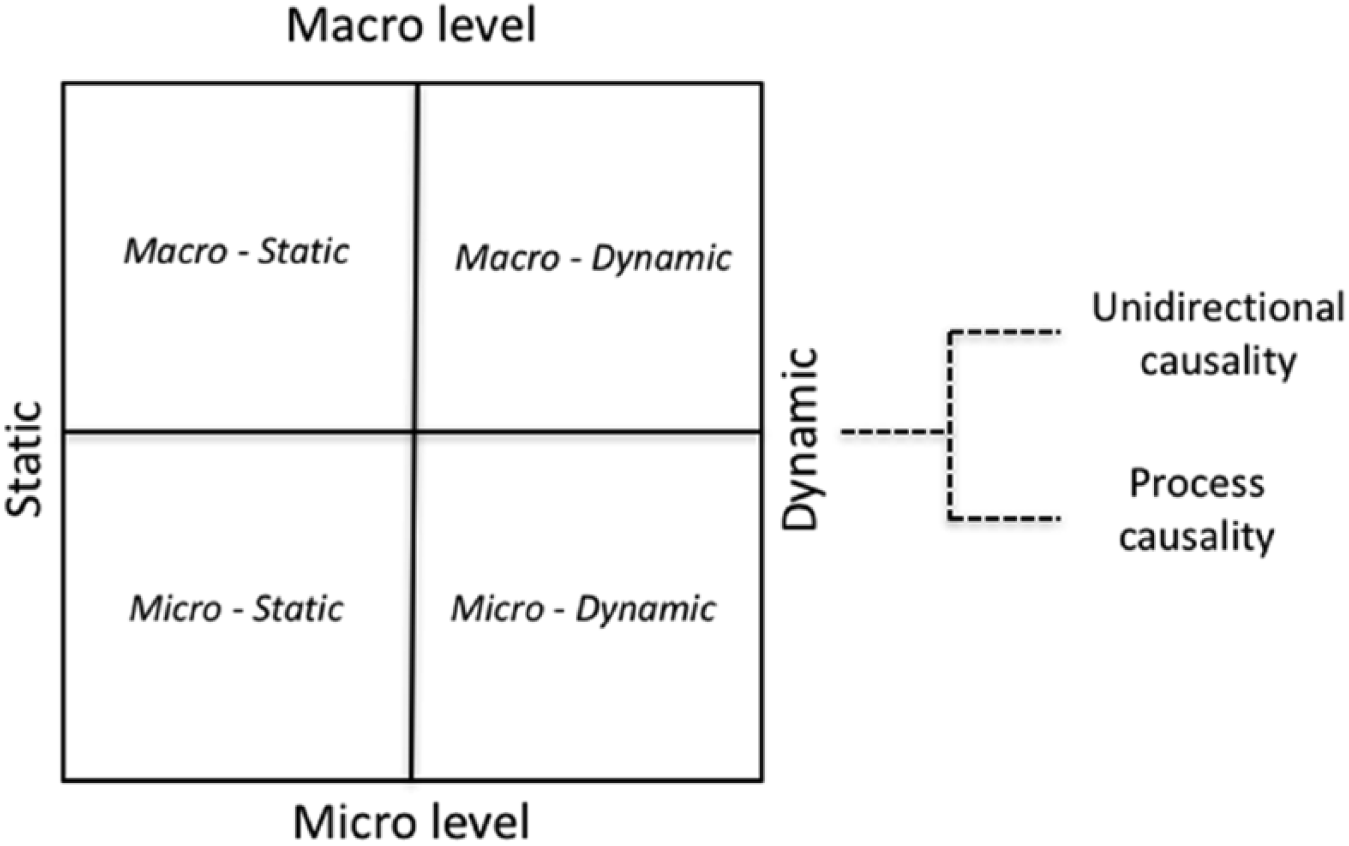
A taxonomy of creativity research.
Micro–Macro Dimension
The first dimension relates to creativity on different levels of organization, which is a distinction we also made in the theoretical model. As noted earlier, creativity theories differ in the extent to which they define creativity as a characteristic of the person, product, or process. Depending on the employed definition (or rather, the level of organization), creativity can be measured from moment to moment, across days or months, and even across a person’s life span. On the micro-level, creativity encompasses the cognitions, behaviors, and emotions that emerge while working on a creative task (which can be everything from solving a puzzle to composing a musical piece), either alone or in interaction with the direct social environment. In other words, the micro-level deals with creative processes within the creative task. One level up, the unit of analysis is the creative product (i.e., the between tasks level). At this level, creativity is often assessed through consensual assessment; that is, experts within the field of interest rate the level of creativity (Amabile, 1983). On the third level, the unit of analysis is creativity as a personal trait, meaning that creativity is conceived to be a characteristic of the person. In general, the higher we go up from the micro to the macro levels, the more aggregated the creativity measures are. For instance, the product level entails that we aggregate all the decisions, variations on ideas and emotions to one overall assessment of the creative product. Similarly, if we move from the product to the person level, this means that all creative products or processes become aggregated into one personal trait.
Creativity as a personality trait can be seen as a (relatively) stable characteristic, similar to IQ. However, personality traits can also be seen as emergent, dynamic, and changing over the course of a person’s life (Den Hartigh et al., 2016). This difference is apparent in the next dimension of the taxonomy: the static–dynamic dimension.
Static–Dynamic Dimension
The second relevant dimension is the static–dynamic dimension. This dimension refers to the way time is considered in the study of creativity. In our theoretical model, creativity (whether on the level of the person, product, or process) is susceptible to change over time. It is not a static “trait,” but develops in interaction with the social environment. In other words, creativity can be seen as an enacted property rather than an internal disposition (Glǎveanu, 2013, 2014). However, other theoretical approaches may approach creativity more as a trait, which should be apparent in the way creativity is measured. Therefore, we are interested in knowing whether creativity is defined and measured in a static versus dynamic way in the empirical literature on children’s creativity. Dynamic means that time is considered in the analysis: The analyses are focused on change over time (for instance, patterns in interactions over time between students and peers as they are working together on a creative task). Static means that associations between variables (a dependent and one or multiple independent variables) are measured, without time being included in the analysis (for instance, the association between intrinsic motivation and creative output; see Lichtwarck-Aschoff et al., 2008, for a similar distinction in identity research).
Causality Subdimension for Intervention Research (Unidirectional vs. Process Causality)
Given the rise in interest in children’s creativity, researchers have also become more interested in ways in which children’s creativity can be improved. It is therefore important to look more in detail at the ways in which intervention research fits with our theoretical model. The third dimension is a subdimension of the static–dynamic dimension, because intervention research naturally assumes creativity to be a changeable, thus dynamic, concept. All studies aimed at improving children’s creativity by means of a lesson program or other intervention can be seen as dynamic (since time is considered, at minimum with a pre- and posttest). However, studies that fall within this dimension can differ in the way in which causality is conceptualized (as unidirectional or as a bidirectional process over time). In education research, the randomized controlled trial is often seen as the golden standard in intervention research (Anderson & Scott, 2012). This design, common in intervention research, departs from the idea that the intervention is an outside, independent variable, which affects a certain variable (such as children’s creativity in a unidirectional manner), which is why we will label this approach “unidirectional causality” (another term is “variance causation”; Anderson & Scott, 2012). The proposed effect is a (linear) increase in average creativity scores from pre- to postmeasurement, which occurs in the group in which the intervention was introduced, but not in a control group (in line with counterfactual inference; see Menzies, 2014). However, the core of our theoretical model is the assumption that creativity is an emergent property of a bidirectional influence between child and context. This view has consequences for the way in which we view causality.
In the conventional view, each causal condition has an independent impact on the outcome. In line with complex dynamic system’s theory, however, causes and effects form trajectories or processes over time (Anderson & Scott, 2012; Byrne & Uprichard, 2012; Den Hartigh et al., 2016). This means that in intervention research, the emphasis is on tracing the processes that generate the outcome of interest, rather than the impact of distinct variables on the (group level) outcome (Byrne & Uprichard, 2012; Waldner, 2012).
The first aim of this article was theoretical integration, which was accomplished through the presentation of the theoretical model. Consequently, the aim of our systematic review is to achieve empirical integration by providing a coherent, theoretically underpinned overview of the field of research on children’s creativity. Based on our theoretical model, we constructed a taxonomy that allows us to classify the literature on children’s creativity. The focus of this review is the difference in ways in which creativity is conceptualized and measured. This review allows us to clearly see which levels are well presented in the literature, and which levels of the model need further empirical investigation.
Method
Literature Search
The literature search was performed on November 8, 2017, in PsycInfo and ERIC. We searched for peer-reviewed journal articles that were published between 2006 and 2017 and were written in English. We delimited the age of the participants to “School age (6–12 years)” in PsycInfo and “Elementary education,” “Grade 1,” “Grade 2,” “Grade 3,” “Grade 4,” “Grade 5,” and “Grade 6” in ERIC. Both these limitations were set to limit the vast range of creativity research. Search terms were “Creativ*” and “Divergent thinking.” The search terms were kept broad on purpose, as the aim was to include all articles on creativity in this age group (we made no distinction between studies that had creativity as a dependent, independent, or only variable). After removing duplicates, this search yielded 3,094 articles. We first screened the title and abstract on the exclusion criteria. If the inclusion criteria were met, or the title and abstract contained too little information for either inclusion or exclusion, the study was included. In order to maintain a high scientific standard, we only included articles from journals that were listed either in the Social Sciences or the Arts and Humanities Citation Indexes. After the first screening, we therefore excluded the studies that were not published in a journal listed either in the Social Sciences or the Arts and Humanities Citation Indexes. The remaining articles were screened on full text to see whether they met the inclusion criteria (see Figure 5 for a flow diagram of the search, screening, and selection process).
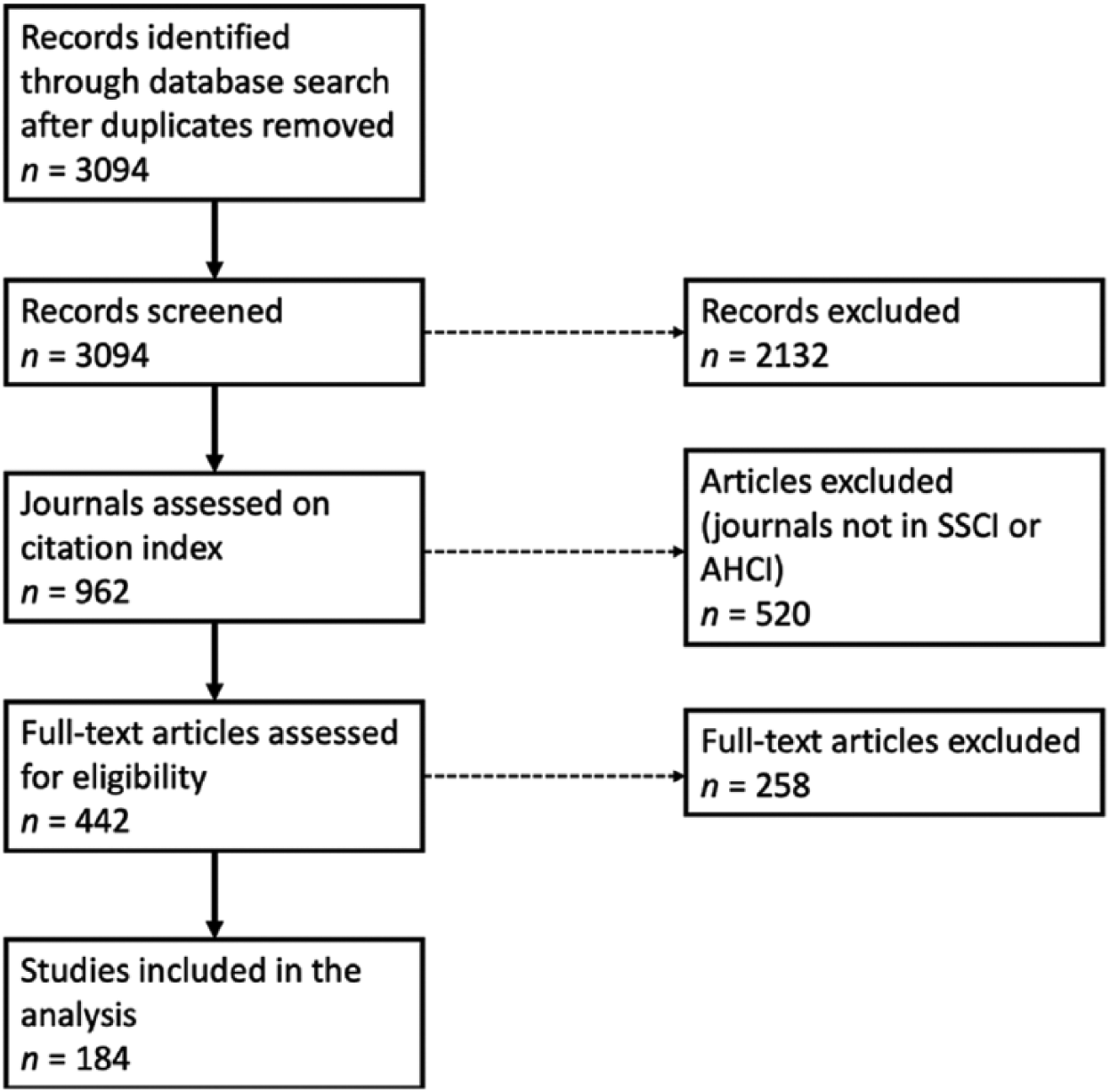
Flow diagram of the literature search, screening, and inclusion.
Inclusion Criteria
Studies were included if the following criteria were met:
Age of the participants between 6 and 12 years. Studies with multiple groups of participants of different ages, or with longitudinal samples (for instance, a first measurement in kindergarten and a second measurement in the fifth grade) were included only if at least half the participants or measurements fell in the 6- to 12-year age range, or if the mean age was between 6.0 and 12.11 years.
Creativity should be a central topic of the study, as apparent by creativity (or related concepts or terms such as “creative processes,” “creative self-efficacy,” or divergent thinking) being mentioned in the abstract and the theoretical framework. Constructs that are related but that are not explicitly linked to creativity in the article, such as problem solving, are excluded since an important aim of the review was to assess the operationalization of the concept “creativity.”
The study should contain a (quantitative or qualitative) measure of student or child creativity. This means that studies without empirical data (reviews, theoretical papers) were excluded, but also that studies that for instance only focus on teachers’ own creativity were excluded. After applying these inclusion criteria, 184 articles were included for further analysis.
Coding Procedure
The 184 included articles were first coded on the micro–macro and static–dynamic dimensions of the taxonomy. Of all studies that were classified as “dynamic,” we then selected studies in which an intervention (such as a lesson program or extracurricular activities) was implemented aimed at increasing children’s creativity. These studies were then also coded on the causality dimension, which can be seen as a “subdimension” of the static–dynamic dimension. An overview of all analyzed articles, including the codes on the dimensions for each article, can be found in the appendix (available in the online version of the journal).
All articles were coded by the first author. Additionally, a portion of the data set was also coded by a second coder to check the coding scheme for reliability (the second coder for the first two dimensions was the second author of this article, the second coder for the causality subdimension was a senior researcher with a PhD in developmental psychology, specialized in intervention research). After two training rounds in which the coders discussed instances of agreement or disagreement, the coders each coded a portion of the data set independently. Thirty-three articles were double coded on the first two dimensions and 25 articles were double coded on the causality subdimension. After establishing the interrater agreement, the remaining differences in the assigned codes were agreed upon through discussion. The interobserver agreement was 97% for the micro–macro dimension, 89% for the static–dynamic dimension, and 96% for the causality subdimension.
Micro–Macro
The main question for distinguishing between different operationalizations of creativity on this dimension is whether creativity is measured within the task (on the level of microgenetic expressions, behaviors, or strategies for executing the creative task) or whether creativity is aggregated over tasks (on the levels of test scores, products, or personality traits). Instruments that are used to assess creativity on a micro-level are, for instance, observations of participants during the execution of a creative task, think aloud protocols, or interviews focusing on strategy use for one specific task. On the macro-level, creativity can be measured by creativity tests, (expert) assessments of creative products, or personality questionnaires. If the study combines measures on different levels, this is coded as “micro and macro.”
Static–Dynamic
On this dimension, the focus is on whether some form of change in creativity is analyzed (which can be change on any timescale, from moment-to-moment to change over years). If creativity is measured on a group level, at one point in time (for instance, comparisons between boys and girls, or the correlation between IQ and creativity test scores), we coded the design as static; if change over multiple time points is considered (for instance, change within sequences of interaction during a creative task, or change in creativity over years), then the study was labeled as dynamic.
Unidirectional versus Process Causality
The main question for this dimension was: Does the study only focus on the question if creativity changes as a consequence of the intervention (unidirectional causality) or does the study also focus on how creativity changes within the intervention over time (process causality)? This implies that studies that have a “conventional” design in which pre and post measures of creativity are compared (ideally but not necessarily in contrast to a control group without intervention) are labeled as having a unidirectional causality framework. Studies that also zoom in on how change occurs within the intervention (possibly in addition to the conventional design), for instance, by analyzing processes of teacher–student or peer interaction, or individual problem solving and engagement over time during the course of the lesson program, are labeled as having a process causality framework.
Results
Results on the First Two Dimensions
First, we analyzed the ways in which creativity is defined and measured in the recent literature by describing the articles in terms of the first two dimensions of the taxonomy (micro–macro and static–dynamic). Table 1 provides an overview of the frequencies of the first two dimensions.
Frequencies of studies on the first two dimensions (micro–macro and static–dynamic)
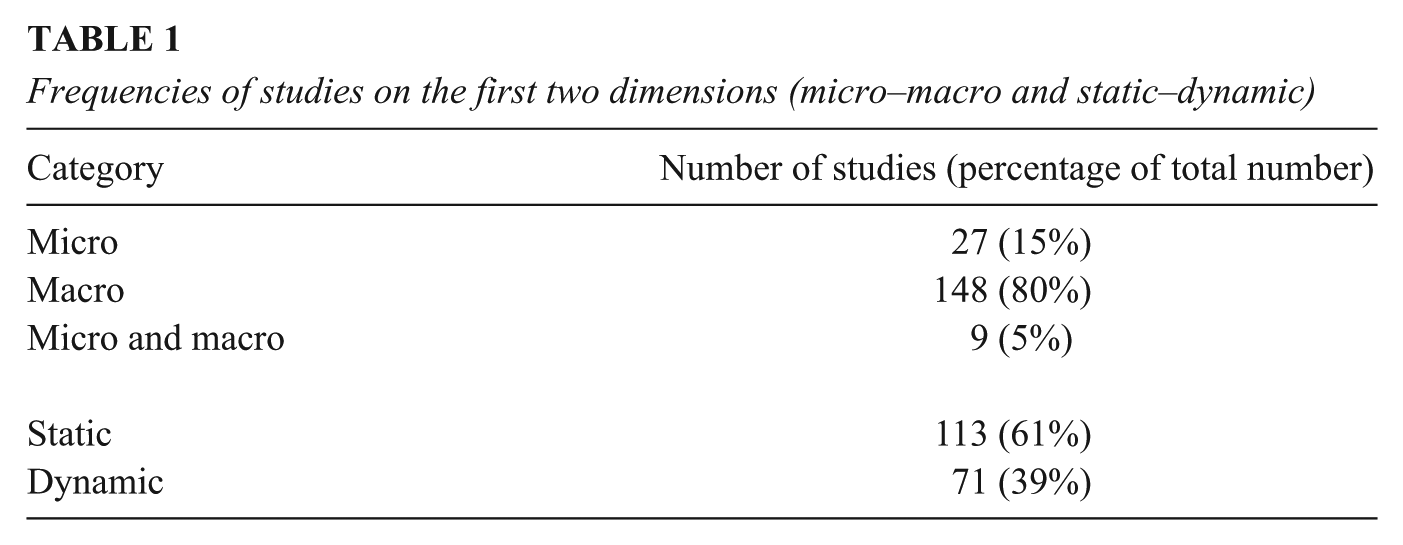
As can be seen in Table 1, the creativity literature is not spread evenly across the two dimensions. On the first dimension, the studies with macro measurements of creativity far outnumber studies with micro measures of creativity. A small number of studies combine macro and micro measures. For example, a particularly innovative approach is highlighted in the study of Gajda, Beghetto, and Karwowski (2017). They first established the overall association between students’ creativity scores (on the Test for Creative Thinking–Drawing Production) and academic achievement. While there was an overall positive association between creativity and academic achievement, there was also a large variety in the strength and direction of this association on the level of the classroom. In order to explain these large differences between classrooms, they zoomed in on naturally occurring teacher–student interactions on the micro-level in classrooms with either a positive, negative, or null association. By looking at the differences between the classrooms in the content and structure of these interactions, Gajda et al. (2017) uncovered mechanisms in the interplay between creativity in interactions, and learning, which accounted for the difference between the macro-level associations. Combining micro- and macro-level measures in this way sheds light on the way these levels of creativity and creative development in children are connected.
With regard to the second dimension, about two thirds of the studies can be classified as having a static design, whereas one third had a more dynamic design. Note, however, that all studies with more than one measurement point were classified as being “dynamic.” We will come back to this point when we discuss how the literature fits in the taxonomy.
In Table 2, all studies are placed in the taxonomy (all three dimensions). As we can see, the Macro–Static cluster is predominant in the recent literature on children’s creativity, with 58% of all studies falling in that category. Typical designs of studies in this cluster are, for instance, studies where scores on a test of creative thinking are related to gender differences (i.e., Lau & Cheung, 2010; Oral, Kaufman, & Agars, 2007), intelligence (Jaarsveld, Lachmann, Hamel, & Leeuwen, 2010; Markovits & Brunet, 2012), or behavioral problems (Brandau et al., 2007; Levy Tacher & Anderson Readdick, 2006) at a single point in time. The second most prevalent group of studies fits into the Macro–Dynamic cluster. These are studies that also employ aggregated macro-level data on creativity such as test scores, teacher, parent, or self-ratings of children’s creativity and the like, but look at trends over multiple time points. For instance, the study of Lin and Shih (2016) looked at the relation between the development of creative thinking and reasoning abilities in children over the course of several years. Of all articles with a macro–dynamic design (both implicit and explicit), however, most studies only compared two time points (usually a pre- and a posttest to assess the effects of an intervention). Since development is more often than not a nonlinear process, studies that aim to look at children’s creative development should in principle contain more than two time points in order to accurately describe developmental trends.
Frequencies of studies on all clusters of the taxonomy (all three dimensions)
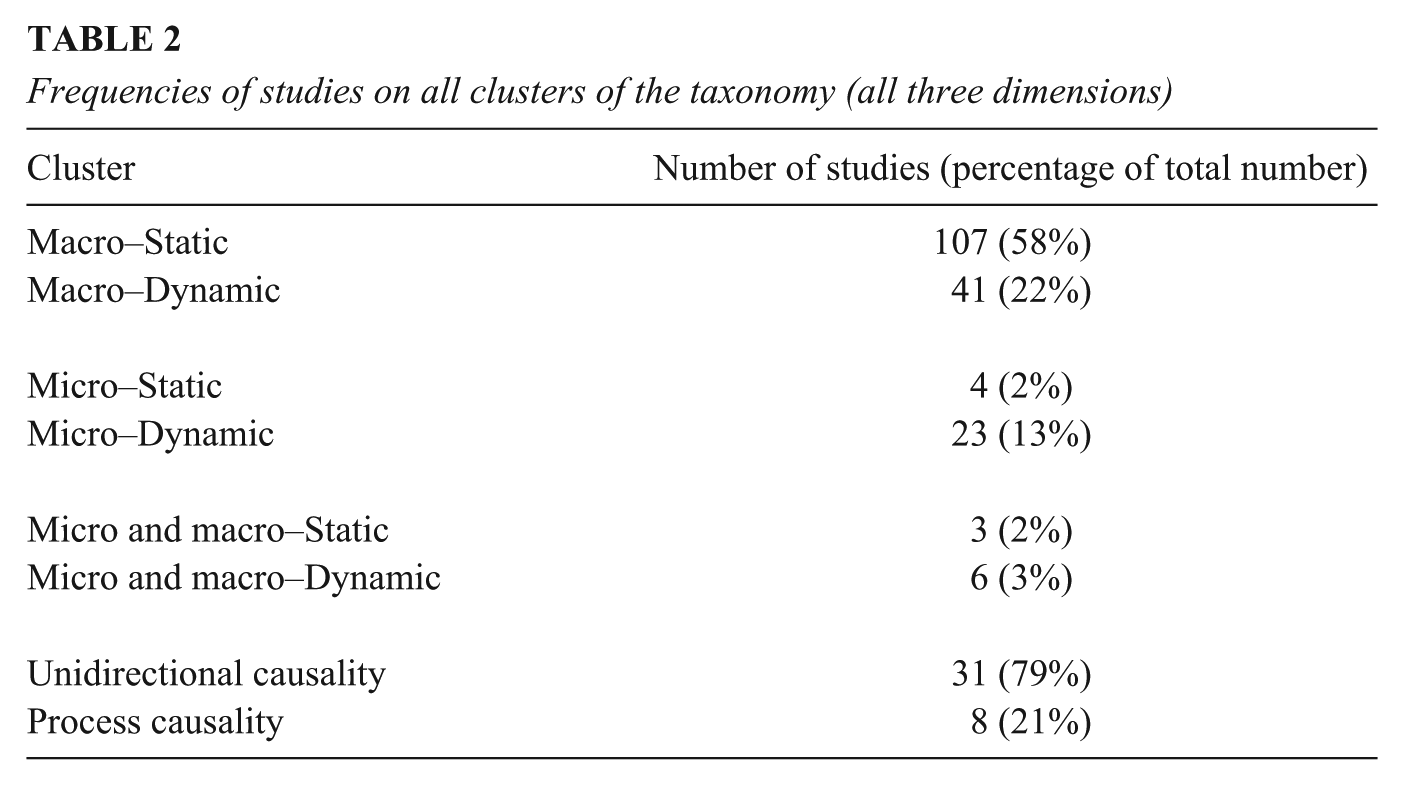
Compared with the macro clusters, far fewer studies fall in one of the micro clusters of the taxonomy. Only 13% of all studies can be classified as Micro–Dynamic. In these studies, creativity is assessed within a task or a lesson, from moment to moment. An example of this type of study is the work of Vass, Littleton, Miell, and Jones (2008), who analyzed the discourse of children working together on a creative writing task. This study can be classified as dynamic because children’s consecutive turns were analyzed; in other words, how they respond to each other over time. Similarly, the study of Burnard and Younker (2008) looks at collaborative processes during a musical composition task. The interactions between peers were analyzed from the perspective of the Engeström’s activity theory, which bears resemblance with the real-time level of our theoretical model. Burnard and Younker describe how creative processes in peer collaboration, and in interaction with the task and specific “tools” emerge from moment to moment.
The least prevalent cluster is the Micro–Static one. In this cluster, the data are collected on the level of microgenetic actions, behaviors, or strategies. However, in contrast to the Micro–Dynamic cluster, the data are analyzed without taking time into account. For instance, student behaviors are counted but not analyzed in sequences. Instead, only frequencies per session are recorded. An example is the study of Muhonen (2016). She interviewed students’ experiences with song-crafting in lessons. From these interviews, several themes emerged which referred to micro-level actions (for instance, how the students experimented with the material), but these themes were not analyzed in relation to time.
Results on the Third (Causality) Dimension
The third dimension (a subdimension of the static–dynamic dimension) contains two categories: unidirectional causality and process causality. Of the 184 articles included in this review, 39 could be classified as intervention studies. We classified studies in which an attempt is made to foster children’s creativity by means of an intervention (for instance, through a specialized lesson program or participation in after-school art projects) as intervention studies. Naturalistic observations of regular classroom activities, or during lesson programs not specifically aimed at enhancing creativity, were not included in this subselection.
Out of the 39 intervention studies, 79% (31 studies) had a framework of unidirectional causality. The design of these studies is usually a conventional pre- and posttest design, where possible gains on standardized creativity tests are compared with a control group where the intervention was not implemented. For instance, Cheng, Wang, Liu, and Chen (2010) looked at fourth graders’ poetic creativity (n = 64). In the experimental condition, the teacher gave the children 30 minutes of instruction on how to form associations in poems, whereas the students in the control condition received no specific association instruction. The assessments of the students’ poems by external judges were used as an outcome measure. The authors found that association instruction had positive effects on number association, picture association and free association. Another example is the study of Lee, Bain, and McCallum (2007) who investigated whether the effects of explicit instructions on fluency, flexibility, and originality (either by a teacher or via a worksheet) improved primary school students’ (n = 15) scores on the Torrance Test of Creative Thinking and assessment of real-life problem solving. Compared with the control group, the experimental group showed a significant increase in creativity scores.
The remaining 8 studies (21% of the total number of intervention studies) could be classified as having a process causality framework. The intervention study of Griffiths and Woolf (2009) departed from the traditional pre- or posttest design with an intervention and a control group. They studied an intervention in the form of a partnership between professional artists, primary school teachers, and students. Instead of looking whether the students showed significant gains on an outcome measure, they focused on how the program could be embedded in the schools and formed a model where artists, teachers, and students move through different phases, ranging from beginner to independent, with the students’ and the teacher’s agency in the creative process increasing and the artist’s role diminishing over time.
Conclusion and Discussion
In the past decades, the literature on children’s creative development has flourished. However, the lack of an overall consensus about the concept of creativity and how it can best be measured puts the field at risk of losing a coherent view and direction for the future. In this article, we strived for both a theoretical and empirical integration of the field of research on children’s creativity. First, we integrated the main theories of creativity into one coherent, complex dynamic systems model of creativity. In our theoretical model, the core of creative development consists of the real-time transactions between the child and the child’s social (teacher, peers, etc.) and material environment (the task). Over time, new ideas or variations emerge into creative (sub)products or processes and contribute to creativity as a personal trait, embedded in the child’s proximate environment as well as the broader culture. In line with the main sociocultural theories of creativity, we thus see creativity as a process over time, with emergence and constraint being central mechanisms connecting the different levels at which creativity occurs. These fundamental principles of a complex dynamic system’s perspective have been successfully applied to many different domains of human functioning and development. A complex dynamic system’s model of creativity can thus serve as a foundation for an integration of the current literature on creativity and at the same time can also provide more focus for future research.
Consequently, our goal of empirical integration was achieved by creating a taxonomy based on the theoretical model and systematically analyzing the literature on children’s creativity published in the past decade. We started our article by asking what creativity is. Different views on the nature of creativity have consequences for the operationalization of creativity. That is to say, the ontology of creativity cannot be seen separately from the epistemology of creativity. In our systematic review, we found the empirical literature to be concentrated on the macro–static side of the taxonomy. This type of research provides us with valuable information on how creativity on the aggregated level, such as measured by standardized tests and overall assessments, relates to other stable individual or environmental traits, such as the type of school children attend or their overall level of motivation. We can also conclude, however, that the basis of our theoretical model, the creative processes in the here-and-now, is often overlooked in the mainstream empirical literature on children’s creativity.
This strong focus on creativity on more aggregated levels is problematic for three reasons. First, there is the problem of ergodicity (Molenaar & Campbell, 2009). Ergodicity is the extent to which findings on an aggregated or group level can be generalized to individuals (or the other way around, but the first is most common in psychological research). Generalizing findings from group comparisons or correlations is only possible if two assumptions are met: (a) each subject in the population has to obey the same statistical model (assumption of homogeneity) and (b) if the statistical properties, such as factor loadings are the same at all points in time (assumption of stationarity). Most human populations, however, do not meet these criteria. Applied to our findings, this means that we cannot generalize most of the findings on creativity to individuals. For instance, consider the finding that intrinsic motivation correlates with creativity: children who score higher on general measures of school-related intrinsic motivation also tend to score higher on overall creativity (as a personality trait; Oral et al., 2007). The rationale behind this finding is that intrinsic motivation is more conductive for creativity than extrinsic motivation. However, based on this general finding, we have no idea how intrinsic motivation and creativity might intertwine within children, over time.
The second, related problem, is what Sawyer (1999) calls methodological individualism. When we look at creativity in real time, it often emerges from collaborations between individuals, such as peers, or from teacher–student interactions. Methodological individualism refers to the assumption that conclusions about group-level processes, such as creativity, can be derived from data on creativity as an individual trait. As we have seen in the recent empirical literature, creativity as a disposition is most often ascribed to an internal latent variable in individuals that can be “captured” using reliable tests for creative thinking. A complex dynamic systems approach, however, provides an alternative in the form of processes resulting from person–environment interactions, with creativity being an enacted, socially embedded property. The difference between these two views is a difference in basic ontology, and consequently a difference in epistemological choices, resulting in the choice of different methods.
The third problem relates to the practical or societal consequences of adopting one approach of creativity over the other. This affects how creativity is viewed in society. The literature on creativity is heavily steered toward methods aimed at capturing creativity as a latent trait (rather than studying it as socially embedded, enacted, and constructed). At the more extreme side of misconceptions about creativity, this includes the popularization of creativity “residing” in the right hemisphere of the brain. More subtle, but at least as influential, is the popularization of research which constitutes the majority of this systematic review, for instance, articles about gender differences in creativity or the relation between creativity and various personality constructs (e.g., Baer & Kaufman, 2008; Sung & Choi, 2009). In addition, Plucker et al. (2004) conclude that most creativity research focuses on eminent or genius creative individuals (“Big-C” creativity). Regardless of its conclusions, this type of research confirms the misconception of creativity being a personal characteristic of some people, and not of others.
As suggested earlier, the issue of whether psychological attributes can best be seen as latent traits or as socially constructed, embedded, and enacted properties of interactive systems has a rich history in other areas such as in the field of intelligence (Grigorenko & Sternberg, 1998), self-esteem (de Ruiter et al., 2017; Delignières, Fortes, & Ninot, 2004), and psychological disorders (Bringmann et al., 2013; Isvoranu, Boyette, Guloksuz, & Borsboom, 2017). The impact of these debates reaches far beyond robust discussions between academic researchers in scientific journals, but have huge societal impact as well, and therefore are analyzed critically by science theorists and sociologists. For instance, the way in which psychological disorders such as attention-deficit hyperactivity disorder and depression are studied scientifically and the large impact this has on health care policies, drug prescription, and education, has been and still is a source of debate (e.g., Batstra & Frances, 2011; Dehue, 2009). To our knowledge, despite the extensive research on creativity, it has not or hardly been a topic in the sociology or theory of science. We hope that, next to offering suggestions for future research in the domain of creativity itself, this article can also become a first step in analyzing the study of creativity as a scientific–sociological phenomenon. One important topic, relating especially to education, would be the way creativity is framed in educational policy. Broadly speaking, creativity has a “desirable” side because of how it is framed within 21st-century skills, and as such, can be linked to various forms of societal and economic prosperity. On the other hand, the concept of creativity also entails nonconformity, deviance, and as such has been associated with (mental) instability (Akinola & Mendes, 2008; Kyaga et al., 2013). How these different aspects are linked to power issues inside and outside of education is an important step in furthering academic thinking about creativity.
Our systematic review also included an overview of intervention studies regarding children’s creativity. Specifically, we examined the framework of causality that is used in the design of the studies: unidirectional or process causality. We found that almost all studies take the approach of unidirectional causality, which means that they established whether the intervention had an effect on creativity (usually by comparing a pre- and posttest; preferably also comparing the gains on creativity scores to the gains in the control group). Very rarely do studies also include research questions on how changes in creativity take place over time. This is remarkable, since there is theoretical consensus on the notion of creativity as a process over time. The intervention as such remains a “black box” (see Koopmans, 2014); we know that, on average, children seem to benefit from interventions aimed at creative thinking or creative expression, but we know virtually nothing about how and why creativity changes in the intervention group, and which children seem to benefit more or less from the interventions. It is important to note that in a complex dynamic systems framework, which is the basis of our theoretical framework, causality entails more than just process causality (Byrne & Uprichard, 2012). Process causality basically states that we should examine chains of cause and effect over time. Causality in a complex systems framework adds to that assumption that the units of analysis should be systems rather than separate variables (Byrne & Uprichard, 2012). We would assert therefore that adding measures of change during an intervention (even if only on the level of separate variables) would be a promising first step toward more sophisticated intervention research in the domain of children’s creativity.
Future Research
The present systematic review provides answers concerning how creativity is defined and measured in the recent empirical literature, and how this relate to our theoretical model. Because of the broad scope of the review and the large number of articles included, not all articles can be discussed in depth, which is a limitation that comes naturally with the answering of a more fundamental question. This systematic review can, and in our opinion should, be a first starting point for looking more in depth at different themes within creativity research. The theoretical model can serve as a framework for answering specific questions. Future systematic reviews can look, for instance, at the bidirectional influences between creativity and motivation (which is a deeply socially embedded concept as well) or the role of behavioral disorders (such as attention-deficit hyperactivity disorder or autism spectrum disorder–related behavior) in children’s creativity. Another relevant direction is the interplay between implicit, or unconscious, and explicit or conscious processes in creativity. Although self-organization implies that creativity is a consciously steered process, there is empirical evidence that both unconscious and conscious evaluative processes play a key role in creativity.
Another possible limitation could be seen in the use of limited keywords and exclusivity in references to “divergent thinking” and “creativity.” Of course, there are many other constructs that are to some extent related to creativity, such as problem solving, arts education, and musical composition. It might well be that we have missed articles that dealt with these types of constructs without mentioning the word creativity or creative process. However, this choice was made consciously and not only to limit the already large number of articles that we included in the review. More fundamentally, our article deals with questions around the ontology and epistemology of the creativity construct, and therefore only authors that participate in the dialogue around creativity (and thus use the word prominently in their research) were considered.
In this article, we have shown that there exists a gap between the general theoretical consensus that creativity can be defined as a process of emergence over time, and the recent empirical work in which children’s creativity is mainly conceptualized as a static, stable individual trait. In our view, three important steps need to be taken in the future to ensure that the literature optimally adds to our understanding of creativity in children. First, a more even distribution of studies over all dimensions is needed. That means that more research should focus on micro-levels of creative development and thus study creativity as an embedded, embodied, and enacted process, in interaction between the child and his or her close environment. Second, attention should be paid to the mechanisms connecting the micro and macro levels of the taxonomy, and thereby the different layers in the theoretical model. How do creative products, or creativity as a general personal trait, emerge out of repeated moment-to-moment interactions between the child, the social environment, and the task? How do higher level variables (which should be seen as processes themselves), such as motivation, act as constraints or enablers on micro-level processes? As of now, little is known about these mechanisms in relation to children’s creativity. And third, our future research efforts should be directed toward designing more sophisticated intervention studies, in which attention is paid to effects as trajectories of complex systems over time (Byrne & Uprichard, 2012), and which can thus shed light on how interventions work and for whom (van Vondel, Steenbeek, van Dijk, & van Geert, 2016).
Supplemental Material
DS_10.3102_0034654318815707 – Supplemental material for Children’s Creativity: A Theoretical Framework and Systematic Review
Supplemental material, DS_10.3102_0034654318815707 for Children’s Creativity: A Theoretical Framework and Systematic Review by Elisa Kupers, Andreas Lehmann-Wermser, Gary McPherson and Paul van Geert in Review of Educational Research
Footnotes
Authors
ELISA KUPERS is assistant professor at the University of Groningen, Department of Special Educational Needs and Youth Care, Grote Rozenstraat 38, 9712 TJ Groningen, the Netherlands; email:
ANDREAS LEHMANN-WERMSER is full professor at the Institute of Music Education, Hannover University of Music, Drama and Media, Emmichplatz 1, 30175 Hannover, Germany; email:
GARY MCPHERSON is Ormond Professor at the Faculty of VCA & MCM, University of Melbourne, Gate 12, Royal Parade, Parkville VIC 3010, Australia; email:
PAUL VAN GEERT is emeritus and honorary professor at the Department of Developmental Psychology, University of Groningen, Grote Kruisstraat 2/1 9712 TS Groningen, the Netherlands; email:
References
Supplementary Material
Please find the following supplemental material available below.
For Open Access articles published under a Creative Commons License, all supplemental material carries the same license as the article it is associated with.
For non-Open Access articles published, all supplemental material carries a non-exclusive license, and permission requests for re-use of supplemental material or any part of supplemental material shall be sent directly to the copyright owner as specified in the copyright notice associated with the article.
